Super Spiral Mega-Boom, Micron's Earnings Report Rekindles the Semiconductor Bull Run

Odaily星球日报Published on 2026-06-25Last updated on 2026-06-25

Abstract

On June 25, 2026, Micron Technology released its blockbuster Q3 FY2026 results, significantly exceeding market expectations and reigniting confidence in the semiconductor bull market. Revenue soared to $41.456 billion (vs. ~$35.4B expected), up 346% year-over-year, while GAAP net profit surged nearly 15 times to $28.243 billion. Guidance for Q4 was even more striking, with projected revenue of approximately $50 billion, far surpassing prior estimates. The report highlighted that the AI boom is now fueling growth across Micron's entire product stack, not just HBM. Cloud memory, core data center, SSD, mobile, and automotive businesses all saw revenue growth exceeding 250-600%, with margins hovering around 80%. While HBM4 is already in volume shipment and 2026 capacity is sold out, AI-driven demand is also tightening supply for traditional DRAM and NAND, sustaining a strong pricing cycle. A pivotal development is Micron's shift toward a "demand-first" model. The company disclosed 16 long-term strategic customer agreements (SCAs), most spanning 5 years to 2030, covering about 20% of DRAM and one-third of NAND shipments. These are take-or-pay contracts, with 14 agreements already securing roughly $100 billion in guaranteed future revenue and $22 billion in customer performance assurances. To fulfill this locked-in demand, Micron plans substantial capacity expansion, with Q4 capital expenditure projected at ~$10 billion. This investment, backed by concrete long-term orders rathe...

Original | Odaily Planet Daily (@OdailyChina)

Author | Azuma (@azuma_eth)

At midnight Beijing time on June 25th, the highly anticipated Micron Q3 FY2026 earnings report was officially released.

Prior to this quarter's report, Micron found itself in a somewhat awkward position. On one hand, everyone knew it would deliver an outstanding report. On the other hand, everyone also knew that the market had already priced in such "outstanding" performance.

Over the past few weeks, various market participants have been speculating around the same question — for a memory giant already at the heart of the AI wave, just how strong do its results need to be to continue driving its stock price higher and inject further confidence into the already frenzied semiconductor bull market?

The answer is — more exaggerated than anyone expected!

The Market Was Aggressive Enough, But Still Conservative

The Q3 report released this morning shows that Micron's third-quarter revenue reached $41.456 billion (consensus estimates were around $35.4 billion), a staggering year-over-year increase of 346%; GAAP net profit was $28.243 billion, up nearly 15 times year-over-year; adjusted earnings per share were $25.11.
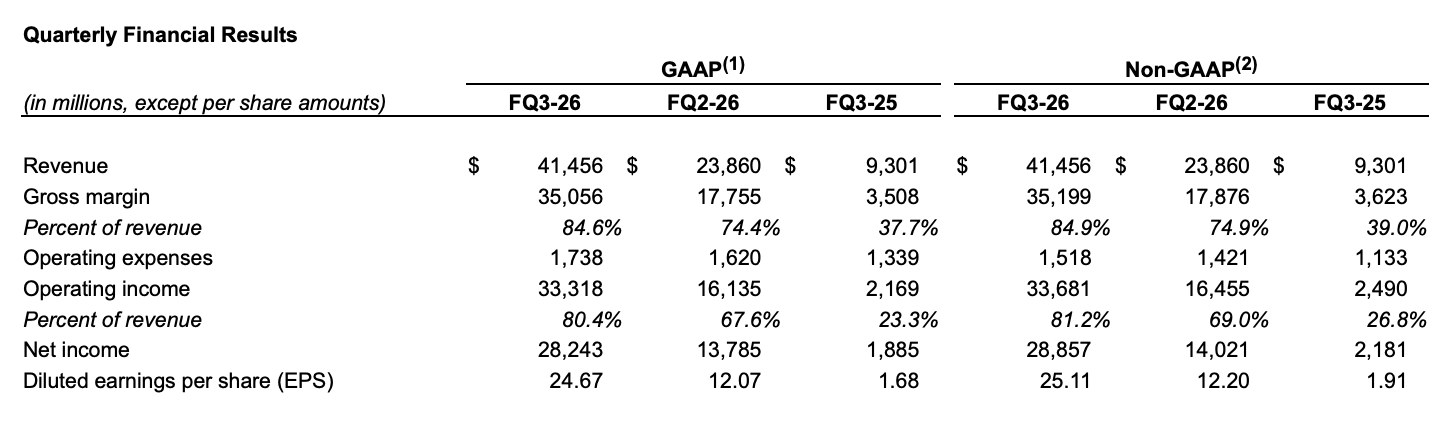
Even more exaggerated is the next quarter's guidance. Micron expects its Q4 revenue to reach $50 billion (plus or minus $1 billion), far exceeding the market's previous expectation of about $42.9 billion and even Goldman Sachs's aggressive forecast of $48.8 billion (widely seen as the most optimistic scenario); Q4 gross margin is expected to be about 86%, with EPS expected to reach around $31.
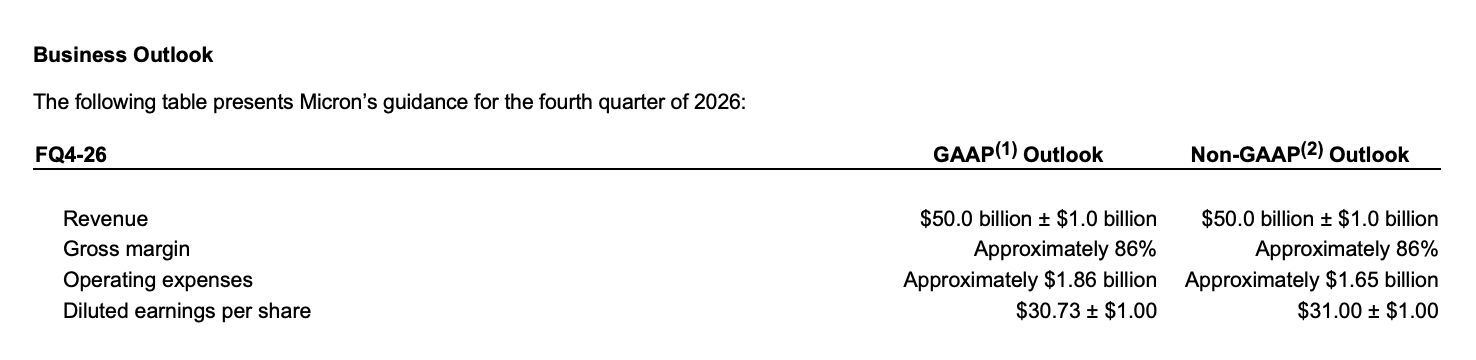
This is why many investors exclaimed the same sentiment immediately after the report's release: this is what you call a super, invincible, spiral, explosive, sky-rocketing earnings report!

From HBM to SSD, the Entire Memory Stack is Sprinting

If one were to identify a core driver for this round of growth, the answer remains, of course, AI. However, compared to the HBM that the market has repeatedly discussed over the past year, a more noteworthy point in this report is — AI's influence has begun to spread throughout the entire memory supply chain.

From a business structure perspective, almost all of Micron's core businesses are growing simultaneously, including:

  • Cloud memory business revenue reached $13.77 billion, up over 300% year-over-year;
  • Core data center business revenue reached $11.52 billion, up over 600% year-over-year;
  • Data center SSD revenue exceeded $5 billion;
  • Mobile and client business grew over 250% year-over-year;
  • Automotive and embedded business also achieved over 300% growth;
  • Gross margins across business lines generally remained around 80% or higher.

This signifies that the current AI wave is benefiting not just a single product, but the entire memory industry chain comprehensively.

On one hand, HBM remains the most direct beneficiary. Micron stated that HBM4 has begun volume shipments to core customers, with samples already delivered to multiple end customers; HBM4E is progressing as planned and is expected to enter mass production in 2027. Simultaneously, the company reiterated that its 2026 HBM capacity is completely sold out.

On the other hand, the continued expansion of AI training and inference demand is also driving concurrent growth in high-end DRAM, enterprise SSD, and NAND product demand. As more advanced capacity is prioritized for HBM, supply in the traditional DRAM and NAND markets tightens further, propelling the entire memory market into its strongest pricing cycle in recent years.

This is also why Micron remains extremely optimistic about the industry's outlook. Management expects the tight supply-demand situation in the DRAM and NAND markets to persist beyond 2027. In other words, in Micron's view, the industry is not nearing a cycle peak, but rather resembles the early stages of the AI infrastructure construction cycle.

Long-Term Agreements Locked In as Far Out as 2030

If we merely interpret this earnings report as a victory for HBM, we might still be underestimating its true significance. Because compared to the $50 billion revenue guidance, perhaps the most noteworthy numbers in this report are another set — $100 billion.

On the earnings call, Micron disclosed that to date, the company has signed 16 long-term strategic customer agreements (SCAs) covering data center, consumer electronics, and automotive customers. Most of these agreements have terms of up to 5 years, with some automotive client agreements lasting 3 years, extending as far out as the end of 2030.

These agreements already cover approximately 20% of DRAM shipments and about one-third of NAND shipments. As more agreements are finalized, over half of future revenue is expected to fall under the long-term agreement framework.

It is important to emphasize that these agreements are not traditional supply contracts. Management confirmed that the agreements utilize a strongly binding Take-or-Pay model. Even if customers do not fully take delivery in the future, they are still obligated to fulfill the agreed purchase commitments. Some major agreements even incorporate price ceiling and floor mechanisms, with the ceiling anchored to Q2 FY2026 market prices. Even at the agreement's price floor, the corresponding gross margin level remains significantly higher than Micron's historical cycle peaks.

Based on data disclosed by Micron management, 14 of these agreements currently correspond to guaranteed revenue of approximately $100 billion; concurrently, customers will also provide a total of about $22 billion in performance guarantees, with roughly $18 billion in cash form, which can be directly used to support future capacity construction and R&D investment.

For the memory industry, this is almost a historic change. For decades, the industry's operating logic has been "expand capacity first, then wait for demand to catch up"; now, Micron is gradually shifting to another model — lock in orders first, then expand capacity.

This is also what excites the capital market the most. Because it means Micron's current profitability is no longer based solely on expectations for a cyclical upturn, but is underpinned by long-term contracts.

Capacity Expansion, Expansion, and More Expansion, $10 Billion to be Spent in Q4

If long-term agreements answer "where is the demand coming from?", then capital expenditure answers another question — how does Micron plan to meet this demand?

The report shows that Micron expects Q4 capital expenditure to reach approximately $10 billion (higher than Wall Street's previous expectation of about $8.9 billion). Full-year FY2026 capital expenditure is projected to be around $27 billion, and quarterly capital expenditure in FY2027 will be higher than the Q4 FY2026 level. New investments will primarily be used for HBM, advanced DRAM, and advanced packaging capacity construction.

In the past, such capital expenditure figures might have raised market concerns. After all, for the memory industry, "large-scale capacity expansion" is hardly an unfamiliar phrase. Historically, whether it's Samsung, SK Hynix, or Micron itself, companies have ramped up investment at industry peaks, ultimately leading to oversupply, price collapses, and亲手 ending the previous bull market.

But this time, things seem to be changing. The reason is simple — this new capacity is not based on optimistic forecasts of future demand, but on long-term orders already signed.

On one side is $100 billion in guaranteed revenue, $22 billion in performance guarantees, and long-term agreements extending to 2030; on the other side is continuously expanding HBM, advanced DRAM, and advanced packaging capacity. Comparing these data points, the current capacity expansion appears more like executing already locked-in orders, rather than the traditional cycle-betting expansion based on demand forecasts.

Micron's Earnings Report Rekindles the Semiconductor Bull Market

Prior to the release of Micron's quarterly report, market sentiment surrounding the ongoing semiconductor bull run had shown signs of wavering.

Earlier this week, the South Korean semiconductor sector experienced a noticeable pullback, with leading companies like SK Hynix and Samsung Electronics collectively under pressure. Some investors began to worry whether the AI trade had become too crowded after over a year of frenzied gains.

And Micron's answer was quite direct — demand hasn't peaked; the market is still underestimating demand.

From the far-exceeding-expectations Q3 performance and the high $50 billion Q4 revenue guidance; from the sold-out HBM capacity to the long-term strategic agreements extending to 2030 — all convey the same signal: AI infrastructure construction is accelerating, not slowing down.

Following the report's release, Micron's stock surged 16% in after-hours trading, driving collective gains for other U.S. semiconductor companies like Intel, ASML, Marvell, and Qualcomm. Japanese and South Korean markets also opened higher and rose today, with the South Korean market experiencing another trading halt, and Samsung and Hynix both rebounding significantly. After the A-share market opened, the semiconductor industry chain also strengthened, led by memory and advanced packaging sectors.

In a sense, this is no longer just an earnings report belonging to Micron, but another confidence booster for the entire semiconductor industry. Because the market has reconfirmed one thing — the AI story is far from over, and memory is becoming an increasingly important protagonist in this story.


Trending Cryptos

Related Questions

QWhat were the key financial highlights of Micron's Q3 2026 earnings report?

AMicron's Q3 2026 revenue reached $41.456 billion, a 346% year-over-year increase, significantly exceeding the expected ~$35.4 billion. GAAP net profit was $28.243 billion, up nearly 1500% year-over-year. Adjusted earnings per share were $25.11. The company's Q4 guidance forecasts revenue of approximately $50 billion, far surpassing prior market expectations.

QWhat is driving the explosive growth across Micron's business segments, and which product is specifically mentioned as a direct beneficiary?

AThe explosive growth is primarily driven by the AI wave. While the impact has expanded across the entire memory stack, the High Bandwidth Memory (HBM) remains the most direct beneficiary. Micron confirmed that HBM4 is in volume production for core customers, HBM4E is on schedule, and all HBM capacity for 2026 is sold out.

QWhat significant change in business model does Micron's 16 Long-term Strategic Customer Agreements (SCAs) represent for the memory industry?

AThe 16 'take-or-pay' SCAs, some extending to 2030, represent a historic shift. Instead of the traditional industry model of 'expand capacity first, then wait for demand to catch up,' Micron is moving towards a model of 'lock in orders first, then expand capacity.' This provides guaranteed future revenue and reduces cycle volatility.

QHow is Micron's massive capital expenditure plan for Q4 2026, estimated at ~$10 billion, different from historical expansion cycles?

AThis massive capital expenditure is fundamentally different. It is not based on speculative future demand forecasts, but is primarily driven by the need to fulfill the firm, long-term 'take-or-pay' customer agreements already secured. This makes the expansion more akin to executing on locked-in orders rather than a traditional gamble on the cycle.

QHow did Micron's earnings report impact broader market sentiment towards the semiconductor sector?

AMicron's report, with its hugely exceeded expectations and strong long-term visibility, re-ignited confidence in the semiconductor bull market. It countered recent concerns about AI trade saturation by signaling that AI infrastructure build-out is accelerating. This led to a surge in Micron's stock and sparked rallies across U.S., South Korean, and A-share semiconductor stocks.

Related Reads

Annual Salary of Millions Competing for Electricians, Meta Rushes to Open Its Own Technical School

The AI boom is facing an unexpected bottleneck: a severe shortage of skilled construction workers and electricians. As tech giants like Meta, OpenAI, and Alphabet race to build massive data centers—such as OpenAI's $16 billion "Stargate" project—they are hitting a critical labor wall. The U.S. needs an estimated 130,000 more electricians, 240,000 construction workers, and 150,000 supervisors by 2030 for AI infrastructure alone, but tens of thousands of electrician jobs go unfilled each year. While AI companies offer high premiums, with electricians earning up to $280,000 annually, worker scarcity still causes massive losses—delays on a single project can cost $14.2 million per month. The complexity of building AI data centers, which require immense power (equivalent to powering hundreds of thousands of homes), sophisticated electrical systems, and advanced liquid cooling solutions, demands highly skilled technicians who are in short supply. To combat this, companies are investing heavily in training. Meta has committed $115 million to a free training school offering tuition, housing, and stipends, targeting 5,000 new workers. OpenAI is partnering with unions to secure skilled labor. These efforts are paying off, with a significant rise in Gen Z interest in trade schools over college. However, the power demands are staggering. AI data centers are driving a rapid surge in electricity consumption, projected to account for up to 12% of U.S. power use by 2028 and raising costs for consumers. Furthermore, the construction boom is project-based, leading to a potential future glut of trained workers once building peaks, which could depress wages industry-wide. The race for AI supremacy now depends as much on skilled hands as on advanced chips.

marsbit44m ago

Annual Salary of Millions Competing for Electricians, Meta Rushes to Open Its Own Technical School

marsbit44m ago

OpenAI No Longer Sells Its Most Expensive Model for Profit

OpenAI is shifting its business strategy away from promoting its most expensive, flagship models for every task. Recent price cuts—80% for GPT-5.6 Luna and 20% for Terra—signal a deeper change: the company now actively advises users that many tasks don't require the most powerful model. Instead, OpenAI recommends a tiered approach: use the high-end GPT-5.6 Sol for complex planning and analysis, then delegate execution to cheaper models like Luna. This mirrors moves by Anthropic, which recently launched Claude Opus 5 at half the price of its top model, Fable 5. Both companies are de-emphasizing flagship models as primary revenue drivers, using them instead for brand prestige and technological showcases. The industry is entering a "mass-market" phase, similar to automotive, where high-volume, cost-effective models handle daily operations and drive scale. OpenAI's price reductions are partly enabled by AI models themselves optimizing underlying code and infrastructure, creating a self-reinforcing cycle of efficiency gains and cost reduction. Competition is shifting from "who is smartest" to "who offers the best value." The goal is no longer selling individual models but fostering widespread API adoption and ecosystem lock-in. By making AI calls cheap and ubiquitous, companies like OpenAI aim to become the indispensable, utility-like infrastructure powering automated workflows—the "water and electricity" of software, quietly embedded everywhere.

marsbit44m ago

OpenAI No Longer Sells Its Most Expensive Model for Profit

marsbit44m ago

Will the Fed Definitely Raise Interest Rates in September? How Will Crypto and U.S. Stocks Withstand the Pressure?

The market's expectation for a September Fed rate hike surged dramatically in early August, jumping from under 50% to over 80% within a week. This shift followed a contentious July FOMC meeting, where a 9-3 vote to hold rates revealed growing dissent from hawkish members advocating for an immediate hike to combat persistent inflation. The primary catalyst for this repricing is rising oil prices, driven by renewed geopolitical tensions around the Strait of Hormuz, which threaten global supply. Energy costs directly influence inflation metrics, making the upcoming July CPI report (due August 12th) a critical data point. If it shows inflation reaccelerating, the probability of a September hike will solidify. For Bitcoin and crypto assets, this is typically bearish news. Bitcoin continues to behave as a high-beta, liquidity-sensitive risk asset. A rate hike raises the opportunity cost of holding non-yielding assets and could drive capital toward money markets, pressuring crypto prices in the short term. However, historical patterns suggest that if a hike is perceived as the end of a tightening cycle rather than the start, any negative price impact may be brief. U.S. stocks, particularly crypto-linked equities like Coinbase and growth-oriented tech stocks, are also vulnerable. Higher rates increase discount rates in valuation models, putting pressure on high-multiple companies. This coincides with a pivotal tech earnings season where investor focus has shifted from massive AI capital expenditure to tangible revenue and cash flow generation. Companies with negative cash flow and weak growth narratives could face heightened volatility if borrowing costs rise in September. In summary, a September Fed hike has evolved into a mainstream market scenario. Key factors to watch are oil prices, the July CPI report, and Fed communications, which will determine the final decision and its impact on volatile crypto and equity markets.

marsbit55m ago

Will the Fed Definitely Raise Interest Rates in September? How Will Crypto and U.S. Stocks Withstand the Pressure?

marsbit55m ago

Trading

Spot

Hot Articles

How to Buy MEGA

Welcome to HTX.com! We've made purchasing MegaETH (MEGA) simple and convenient. Follow our step-by-step guide to embark on your crypto journey.Step 1: Create Your HTX AccountUse your email or phone number to sign up for a free account on HTX. Experience a hassle-free registration journey and unlock all features.Get My AccountStep 2: Go to Buy Crypto and Choose Your Payment MethodCredit/Debit Card: Use your Visa or Mastercard to buy MegaETH (MEGA) instantly.Balance: Use funds from your HTX account balance to trade seamlessly.Third Parties: We've added popular payment methods such as Google Pay and Apple Pay to enhance convenience.P2P: Trade directly with other users on HTX.Over-the-Counter (OTC): We offer tailor-made services and competitive exchange rates for traders.Step 3: Store Your MegaETH (MEGA)After purchasing your MegaETH (MEGA), store it in your HTX account. Alternatively, you can send it elsewhere via blockchain transfer or use it to trade other cryptocurrencies.Step 4: Trade MegaETH (MEGA)Easily trade MegaETH (MEGA) on HTX's spot market. Simply access your account, select your trading pair, execute your trades, and monitor in real-time. We offer a user-friendly experience for both beginners and seasoned traders.

2.4k Total ViewsPublished 2026.04.30Updated 2026.06.02

How to Buy MEGA

Discussions

Welcome to the HTX Community. Here, you can stay informed about the latest platform developments and gain access to professional market insights. Users' opinions on the price of MEGA (MEGA) are presented below.

活动图片












