Lately, the war between humans and AI has shifted from brutal to bizarre.
However, even in the bizarre category, "Kid AI" stands in a league of its own, which I'd call the indescribable entity of the AI world.
Especially with summer vacation upon us, AI research camp advertisements are popping up everywhere. Yesterday, I saw an ad for an AI research camp on Xiaohongshu: "Children aged 7-13, make an AI movie in one day." I sent it to my friend who works on AI comics and shows. She took one look, cried for three days and nights in bed, and almost immediately wanted to abdicate, roll back to her hometown, and farm.
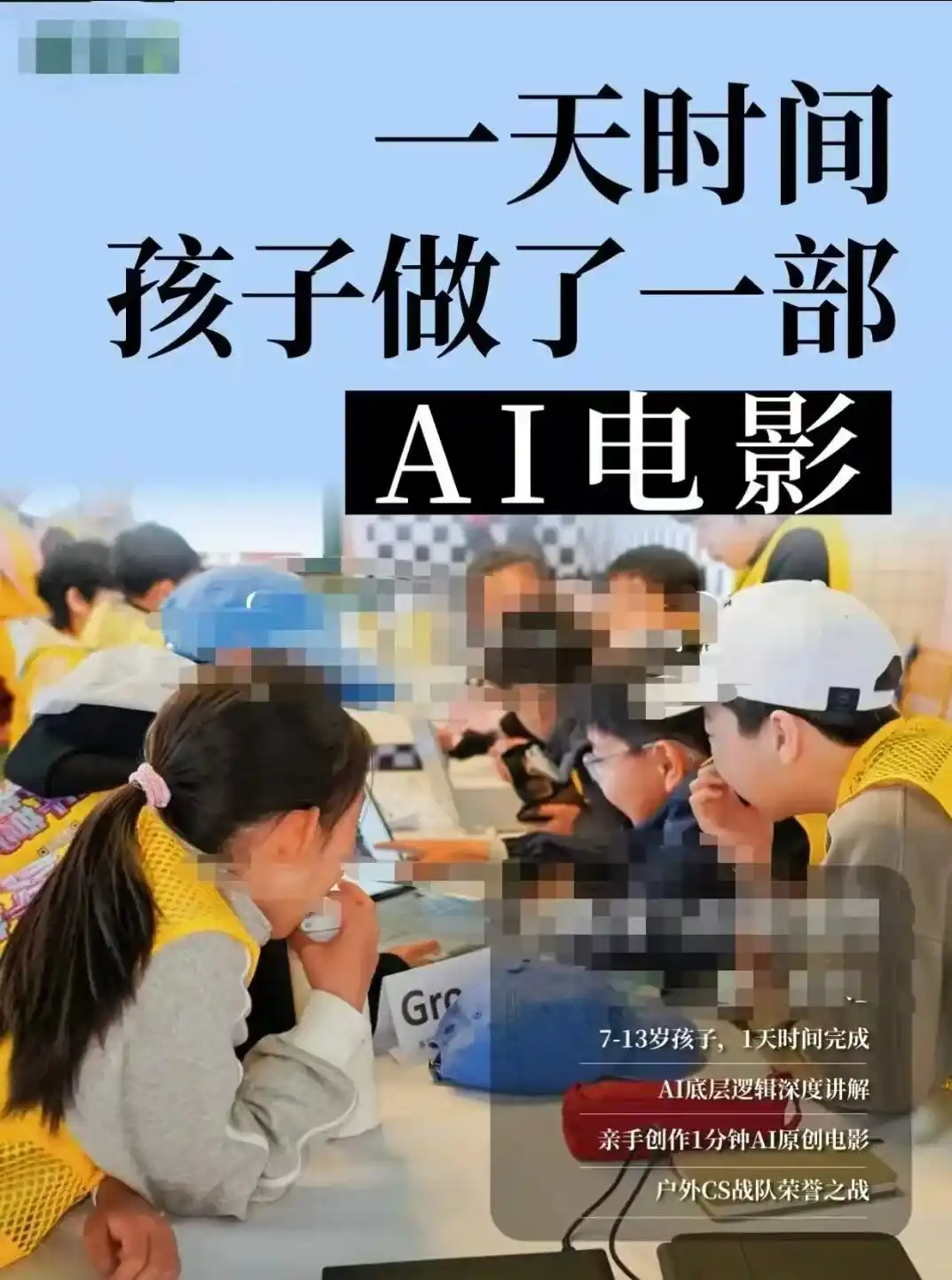
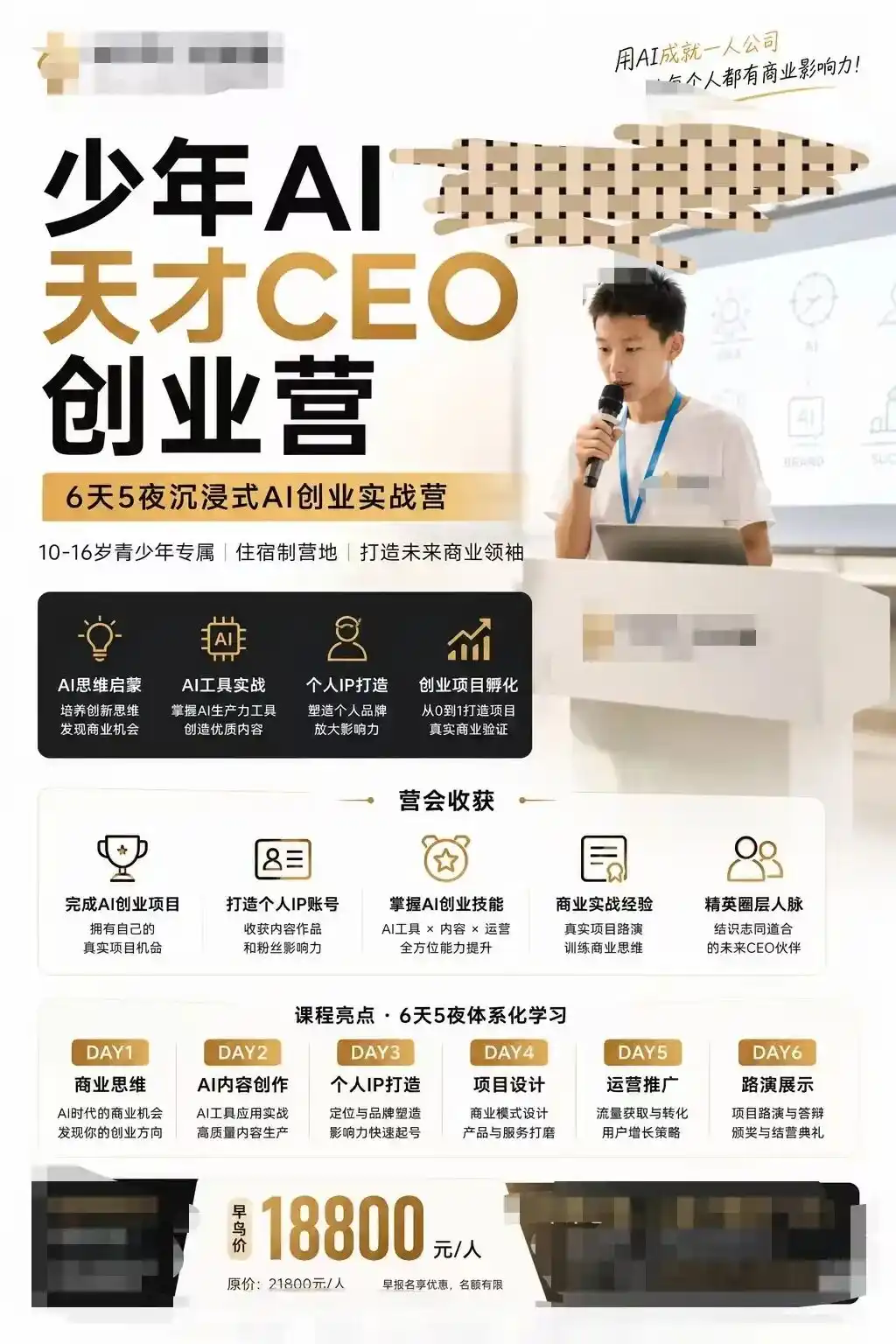
There are even more exaggerated claims: "A 10-year-old child starts an AI company in 6 days, incubating a startup project from 0 to 1." The small business owners diligently drafting their business proposals might slowly type out a "?" in front of their screens.
And the parents? They just look quietly at the posters, seemingly feeling something stir within:
"Three parts depend on effort, seven parts are destined by heaven. This might be my child's one and only chance in this life. It's only 18,800 yuan. Spend it, must spend it!"
From this perspective, AI is comparable to the celestial treasures and supreme spirit stones in cultivation novels. As soon as a young outer sect disciple gets hold of them, they can immediately challenge the ancestral elders of the sect, ascend to the peak of life, directly transform into a gifted and adorable child, and even bring their parents along for the ride, becoming generation-zero rich at a young age.
Surely many will say, isn't this just premium marketing talk from AI research institutes to empty everyone's wallets? Well, the BeWei AI Lobster Competition held in Beijing's Zhongguancun this past March was practically a resounding slap in the face to those doubters:
Jiang Muran, a 14-year-old middle school student in eighth grade, won the championship with his AI entrepreneurship assembly line project, ClawFounder, and joyfully received the title of "Zhongguancun Lobster King." Along with the title, he also received 10 billion tokens and a 200,000 yuan prize.
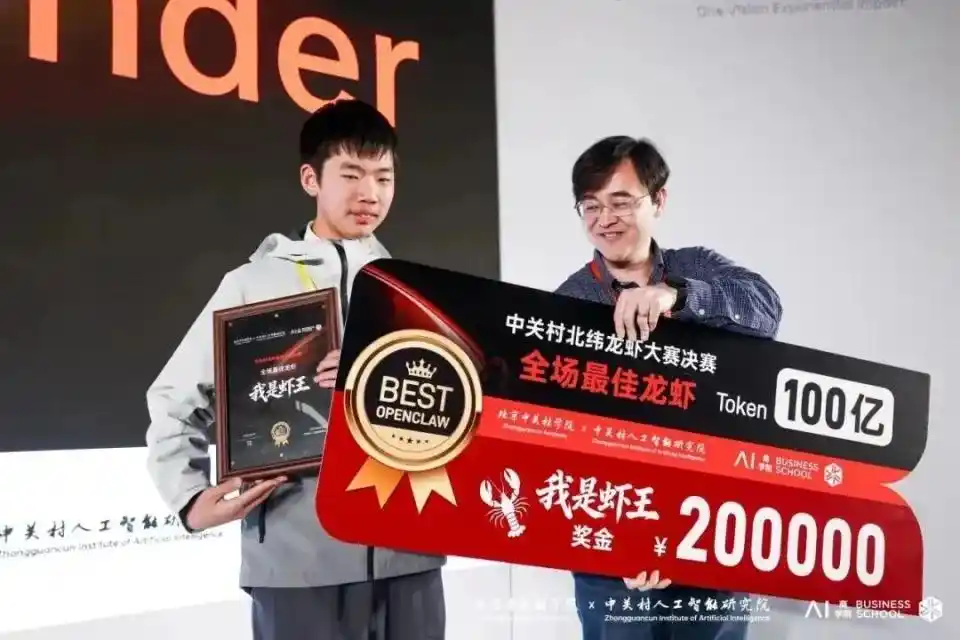
A new 'someone else's child' has been born, how can one afford to stand still? (just kidding)
01
Has Your Child Started a Business with AI?
Research camps happen every year, but this summer there are an extraordinary number, especially AI research camps. If you don't include these two letters, you'd almost be embarrassed to advertise.
In the research classrooms, little kids sit solemnly in front of computers in meeting rooms, having some nebulous conversations with AI. At first glance, I thought I'd traveled into a novel world—specifically, Liu Cixin's "The Supernova Era."
This book is about all people on Earth over the age of 13 being forced offline due to some alien force majeure, leaving only a bunch of children diligently going to work every day, striving to rebuild Earth's civilization.
In this context, it feels both fitting and dystopian.
All the adults are gone, so the kids need to shoulder the banner of entrepreneurship?

If you look closely at these popular AI research camps this year, you'll find they're quite different from previous ones.
Actually, as early as the GPT explosion in 2022, many training institutions promptly launched AI learning camps and other activities for children. But back then, the focus was still on visiting labs, experiencing new equipment, listening to lectures by renowned experts, with simple titles like "cultivating AI thinking." We can think of it as a derivative of the classic programming boot camps of the past, mainly fostering children's curiosity.
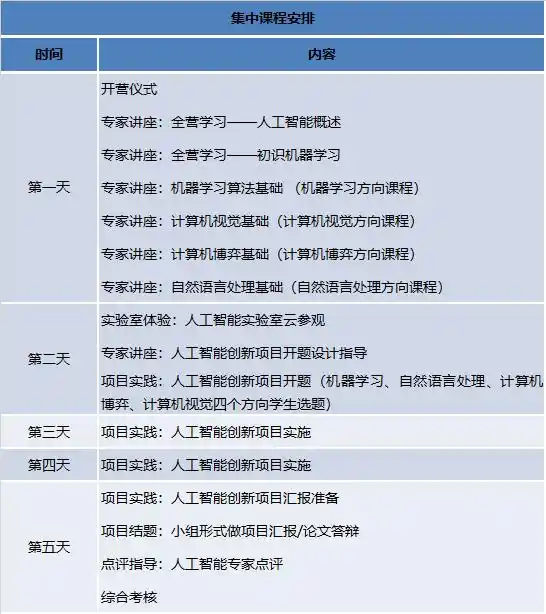
By this year, the style of AI research has completely changed, emphasizing just two words—hands-on, hands-on, still hands-on!
Either it's偏向 business-oriented, with a child becoming a company CEO in 6 days, creating an Agent product in 10 days, and even taking the stage for a roadshow. Let me just ask, does the kid even know what the word "roadshow" means? And "explaining the business model canvas"? In the end, the child learns nothing substantial but picks up a mouthful of internet jargon.
A perfectly good AI research camp gets turned into pre-job training for a big tech company. What a mess.
Or it focuses on using software. The teacher opens the Doubao interface and directly teaches the kids how to generate copy, videos, and make a few stiff-looking images to post on Douyin. The kid spends 1 minute posting and 2 hours playing on their phone. This round gives the kid a legitimate excuse to sneak and play on their parent's phone.
After doing too much of this kind of hands-on work, kids even start talking with a Doubao flavor. Sometimes, I have to check the kid's temperature to be sure this is really the carbon-based life form I gave birth to back then (just kidding).
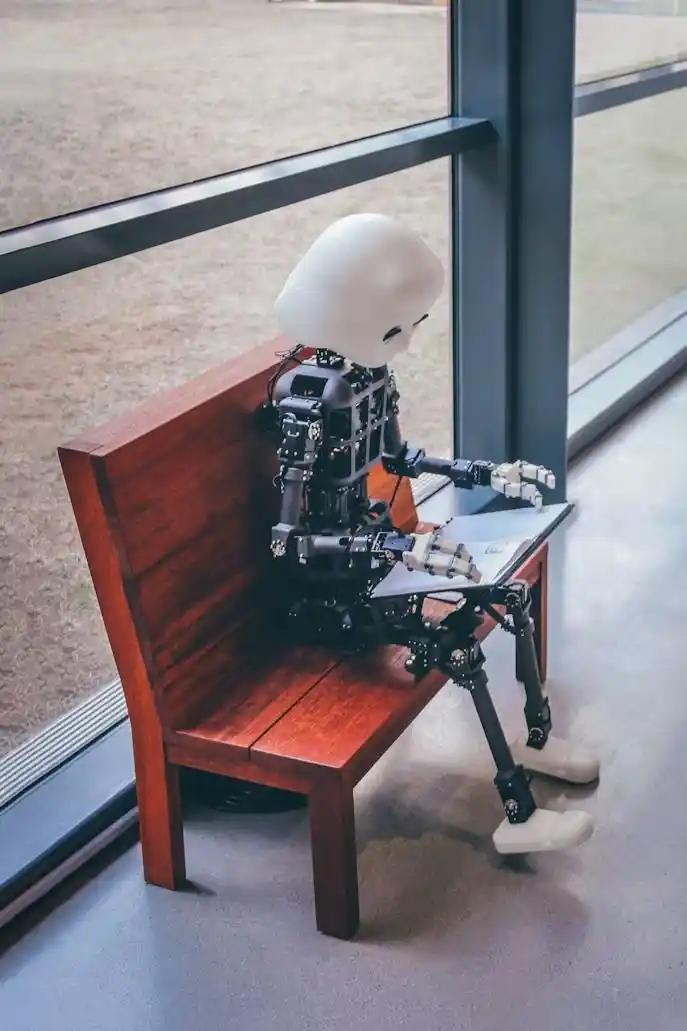
There are even more bizarre cases. Parents bring their child home after finishing an AI class and are amazed to find the child's grades have indeed improved significantly, homework is done lightning fast, with A's on every page. Months later, the parents finally catch them red-handed:
Darned AI, how dare you teach my kid to copy homework?
This is the legendary act of pulling the rug from under someone. To avoid the child working hard through university only to have their job snatched by AI, might as well downgrade the source from undergraduate to vocational college from the start. No happiness means no pain, right?
Parents anxiously confront the AI research teacher. Over there, the teacher is also aggrieved: Didn't you insist we teach the kids to apply AI? What can I do if the kid learns to copy homework on their own? Dare you say you've never used AI to copy documents at work? Hasn't the kid just learned workplace skills ten years early?
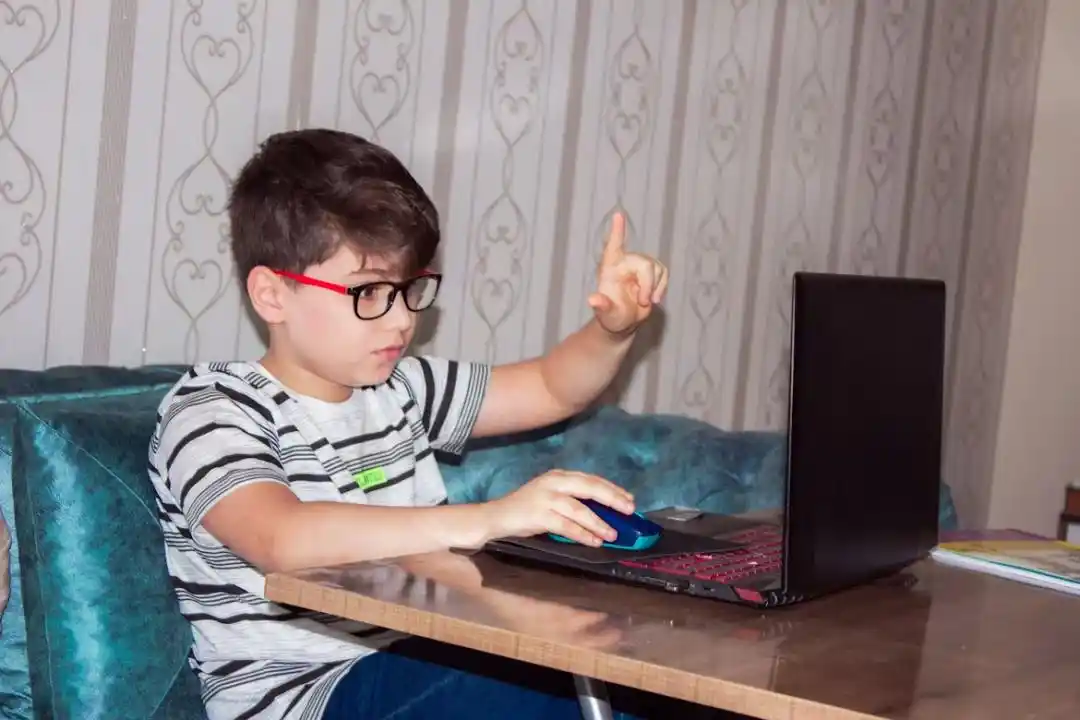
It's only then that parents realize that terms like "AI native" and "cultivating workplace thinking" are all fluff. Without a solid foundation, everything else is a castle in the air. That's the real substance.
Our generation went through basic education step by step, diligently laying down a foundation that may not be excellent, but is at least stable.
Now, these kids haven't even finished their compulsory education, yet they're being hastily fed ideas like "AI is the future" and "use AI tools skillfully." How could their mindset not change? If I were them, I'd also think, "Then what's the point of studying? Better drop out quickly, dive into AI entrepreneurship, and make a few Agents to cash in on the hype. Sounds great!"
Only those who have been battered by society know how naive this view is.
As for simpler functions like text-to-text or text-to-image, kids fit the saying "as long as you learn slowly enough, you won't have to learn at all" even better than we do. A 12-year-old learning to use Doubao to make a PPT now, and the time when they actually need AI to handle work tasks upon entering the job market—that's not just a gap of ten years and ten versions. Even if you want them to start working at 14, learning it at 13 and a half wouldn't be too late at all.

No wonder Ke Jie, who personally witnessed the beginning of humanity's defeat by AI, said bluntly in a live stream: "Having kids learn AI, isn't that just an IQ tax?"
But beyond directly criticizing parents for falling for an IQ tax scam, we're more curious about what made these intelligent parents fall into this trap.
As is well known, a mouse steps on a trap because there's cheese on it. These parents, if not prodigies, are at least outstanding individuals. Why would they willingly jump into the mysterious trap of AI research camps? What is the real lure in the trap?
The answer might lie with this generation of parents themselves.
02
What's It Like Competing with AI for Jobs?
This generation of parents once settled down and built careers during the rapid expansion of the internet. Now, they are experiencing ups and downs at the forefront of the AI wave.
Foreign companies are more straightforward about AI-related layoffs. According to the latest job cut report released by Challenger, Gray & Christmas, in April 2026, major companies announced layoffs of 83,387 people, of which 21,490 were due to AI, accounting for nearly a quarter.

Domestic companies in China are more subtle in this regard, but everyone knows how many among those holding layoff agreements were replaced by AI or are about to be transformed into 'skills.'
A couple of months ago, the Hangzhou Intermediate People's Court shared a case that was hard to stomach: Mr. Zhou, an AI quality inspection supervisor at a Hangzhou fintech company, was demoted and transferred by his company with the reason "AI can do your job." After review, the Hangzhou court ultimately ruled that the company's actions were purely an excuse for illegal layoffs; all talk of insufficient work capability was nonsense.
What "organizational restructuring"? Might as well fool yourself.
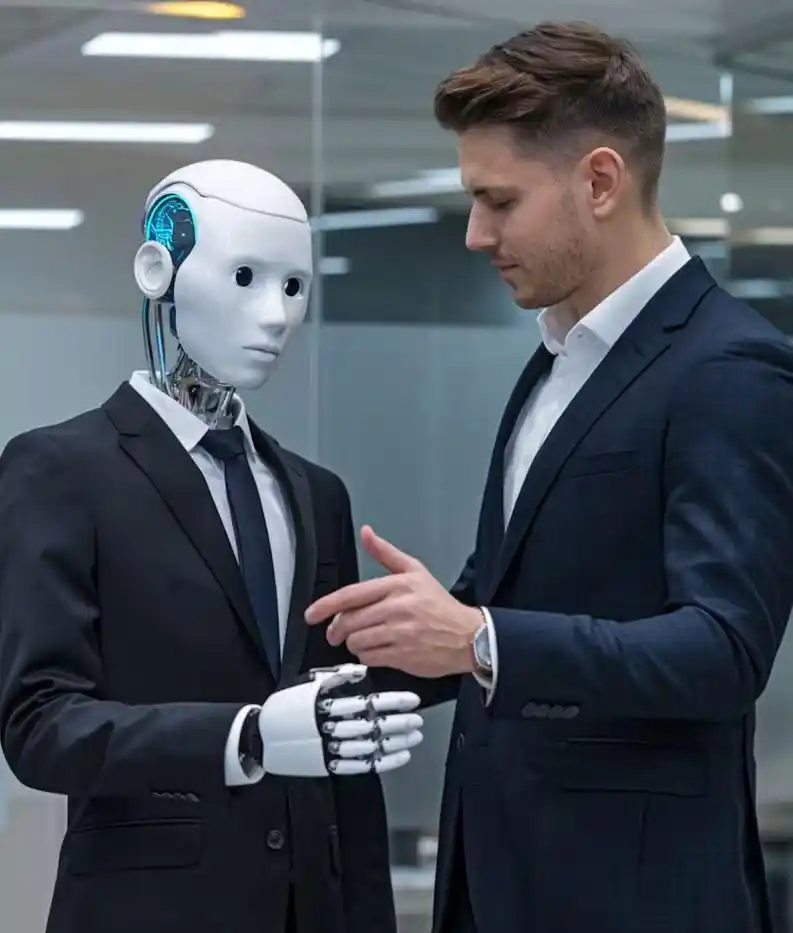
For more ordinary office workers, if AI were just steadily replacing one person after another, that might be simpler. But the reality is, AI can do a bit of this and a bit of that, can mess up at any time, leaving actual employees to clean up after it. As long as AI does something reasonably well, everyone faces the anxiety and pressure of comparison.
AI, rather than doing a certain amount of work, is more like that catfish in the company tank, creating an "atmosphere of anxiety."
Everyone is desperately learning new agents, racking their brains to fabricate token usage statistics, trying to increase the proportion of AI use in their work, fearing to give leaders the impression that they aren't embracing AI. People only dare to vent under layers of anonymity, angrily calling the small group of programmers obsessed with AI large models "code traitors."
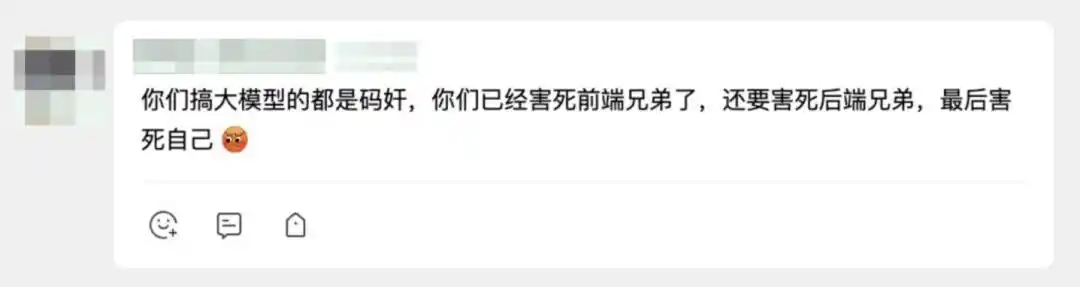
When all of an employee's work decisions are based not on efficiency but on fear, it's hard to say how much progress the company's business can make.
And this fear is transmitted from parents to children through the family. Learning with application and demonstration as the priority—this is typical workplace thinking. Let's look back at the previously mentioned AI research camps. That urge to not patiently learn foundational knowledge but to immediately show off what you've learned—isn't it exactly the same?
The kids back then were pushed to sing and dance in front of relatives. Now, kids compete to see who can develop and send an AI Agent to the family group chat first. The pain points of East Asian families still have the same core, just wrapped in a cyberpunk shell.

These parents lie in bed at night, scrolling through Douyin, only to see a bunch of ten-year-old kids flexing their muscles with AI. Chinese culture has long idolized "heroes emerge from the young." Even traveling gets the adage "budget travel, luxury travel, neither beats youthful travel." Everything feels bittersweet when you're older. Even the god of Reader's Digest, Warren Buffett—what people remember is him earning his first bucket of gold delivering newspapers at 13, not him buying his flagship company, Berkshire Hathaway, at 42.
At this point, compared to diligently striving themselves, choosing to believe that "7 years old is the golden age for AI entrepreneurship" and then frantically pushing their kids—doesn't that start to feel less strange?
03
AI's Children, The Era's Children
For ordinary children and ordinary parents, AI research camps are a common scam in an anxious era. But what about for the truly gifted AI child prodigies?
The story is equally harsh.
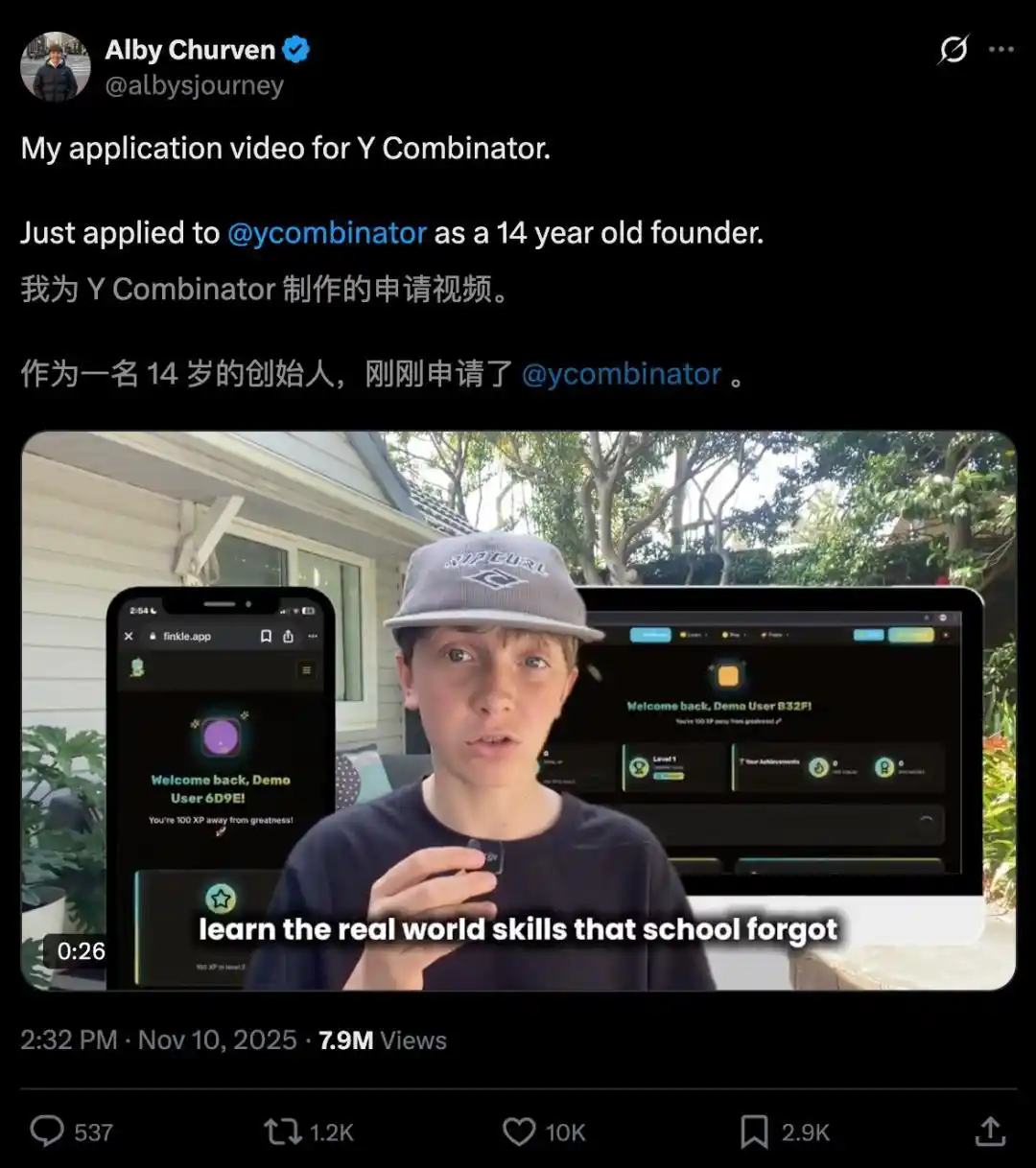
Australian prodigy Alby Churven founded a front-end programming company, Clovr, at the age of 14. He also created Finkel, a gamified learning platform for teenagers, hoping to help more kids understand AI.
He experienced a moment of blazing glory. Countless AI big shots vied to take photos with him, invited him to events and speeches, making him think he had already entered the high-end AI circle. But after talking around, the result was absurd: people wanting to borrow his influence were everywhere; people willing to invest in him? Not a single one.
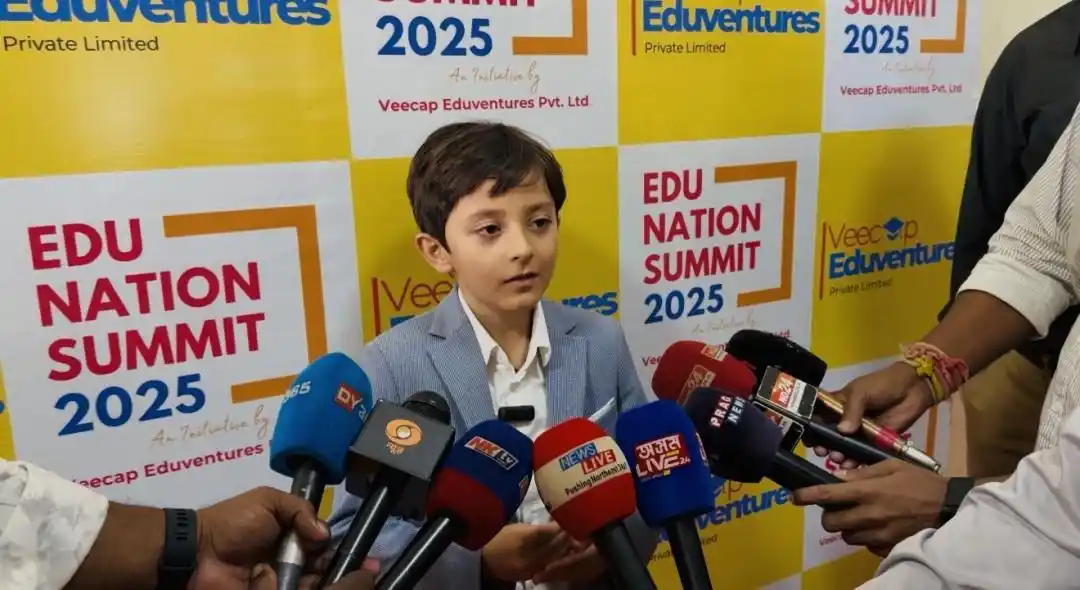
As for American prodigy Bob Chopra from Miami, who successfully started a business at 9 and has his own tech education platform, IvySchool.ai, those willing to believe he truly has talent are also few and far between.
Rather than a genius entrepreneur, everyone tends to think he's just the face of this children's education website. Frankly, another child model.
In contrast, Carina Letong Hong, also called a prodigy and amassing hundreds of millions of dollars in a short time, seems much more normal.
She was at least born in 2000, has a systematic and complete educational background, and can list more than four school locations on her Xiaohongshu profile. Her founded company, Axiom, is also positioned in mathematical AI, aiming to solve practical math problems. This seems far more reliable than the "children's education" track that other prodigies flock to.

Ultimately, seasoned investors understand better than passersby what these so-called "prodigies" are all about.
You can be a prodigy, but not so prodigious it becomes hard to swallow.
You can be excellent, but no matter how excellent, it just adds a 2.5x speed boost to life, not skipping countless crucial stages.
After all, our world isn't a cultivation novel from Qidian, nor do we come with a system like a protagonist from Yangshizi. If you truly believe your child is outstanding, then let them immerse themselves in the torrent of learning and secure an admission letter from a top university. That shines brighter than any entrepreneurial title.
This article is from the WeChat public account "Cool Play Lab," author: Cool Play Lab