InfoFi Narrative Collapses, Kaito, Cookie, and Others Shut Down Related Products

marsbitPublished on 2026-01-15Last updated on 2026-01-15

Abstract

The InfoFi narrative, which gained significant traction in the crypto industry, experienced a sudden collapse following an announcement by X's product lead, Nikita Bier, regarding changes to the platform’s API policy. The new policy prohibits applications that reward users for posting on X, citing concerns over AI-generated spam and low-quality replies. This decision effectively undermines the core functionality of many InfoFi projects that rely on X’s API to access user data and distribute tokenized rewards. Key projects, Kaito and Cookie, quickly responded to the policy shift. Kaito announced it would pivot toward Kaito Studio, a more selective, brand-driven platform that moves beyond the crypto space. Its founder, Yu Hu, emphasized a broader focus beyond cryptocurrency. Similarly, Cookie decided to shut down its Snaps platform but is developing Cookie Pro, a real-time crypto market intelligence tool, while exploring potential future adaptations in line with X’s guidelines. The abrupt policy change highlights the vulnerability of InfoFi models that depend heavily on-platform engagement metrics. While some projects, such as those focused on monetizing narratives rather than direct posting rewards, may remain unaffected, the incident marks a significant shift for the attention economy within crypto. The evolution of InfoFi may continue in new forms, but its current iteration has been severely disrupted.

Author: Gu Yu, ChainCatcher

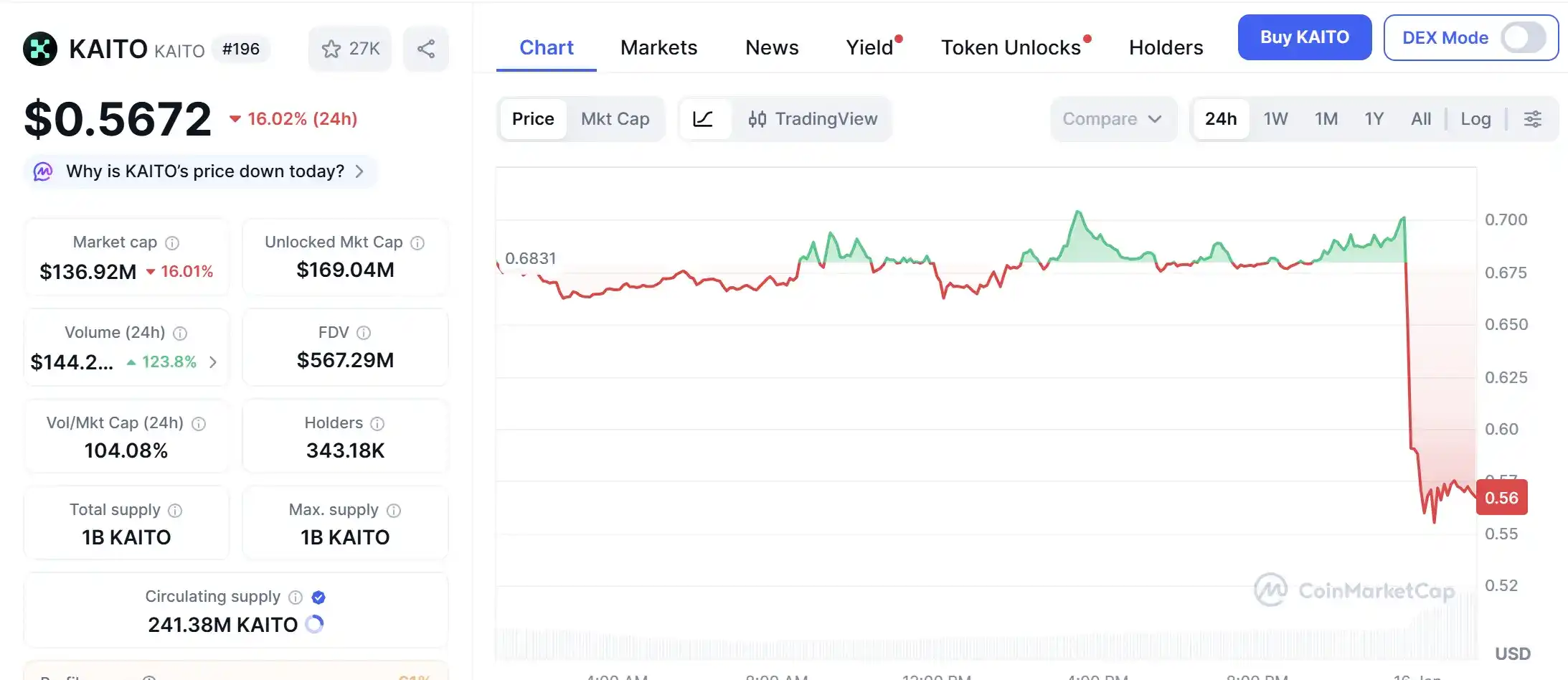
At 1:16 AM Beijing time on January 16, the crypto industry was once again as the highly popular InfoFi narrative suddenly collapsed. Kaito, Cookie, and others successively announced the shutdown of InfoFi-related products and attempted to pivot, with their token prices plummeting by nearly 20% at one point.
And this was all triggered by a tweet from X Product Lead Nikita Bier. Nikita Bier stated that the team is revising its developer API policy and will no longer allow any applications that reward users for posting on the X platform (e.g., "infofi"). This has led to the platform being flooded with a large amount of AI spam and reply spam.

"We have revoked the API access for these applications, so your X experience should start to improve soon (once the bots realize they are no longer being paid)." Nikita Bier said.

Since most InfoFi projects rely on the X product API to obtain user tweet data and determine reward schemes, once the API is disabled, the vast majority of content for such products will stop updating, losing their foundation.

An hour after the news was released, projects like Kaito and Cookie quickly issued response statements on their official Twitter accounts, showing that they had anticipated and prepared for this situation. Let's first see how they specifically responded.

Kaito: To Focus More on Areas Beyond Crypto

Kaito stated that in response to the large number of spam tweets, the project tried stricter eligibility reviews, higher leaderboard thresholds, social + on-chain screening mechanisms, and different incentive mechanisms. However, due to platform-wide X algorithm changes and the launch of other InfoFi projects with varying thresholds, the problem of low-quality and spam information remains widespread across the cryptocurrency field.

After discussions with the X team, both parties agreed that a completely permissionless distribution system is no longer feasible and does not meet the needs of high-quality brands, serious content creators, or X as a platform.

Next, Kaito will focus on launching Kaito Studio, which will be closer to a traditional tiered marketing platform where brands can selectively collaborate with creators based on established criteria and clear project scopes.

Kaito founder Yu Hu said that the past few months have been busy with the development of Kaito Studio, hence the low profile on social media and announcements, with little mention of project construction and strategic adjustments. Additionally, he personally met with some large brands outside the cryptocurrency field to learn from the successful experiences of traditional industry.

"We should no longer build and create for cryptocurrency, but for the broader world." Yu Hu believes that 2026 will be the year Kaito transcends CT as its main platform and cryptocurrency as its primary vertical.

Cookie: To Launch Real-Time Crypto Market Wallet Tool

Cookie posted that deciding to shut down the Snaps platform and all active creator campaigns was a difficult and sudden decision, but it was necessary to maintain the integrity of the Cookie data layer and products.

After discussions with the X team regarding its API and X usage policies, Cookie decided to immediately shut down Snaps and all ongoing activities.

However, the project still holds hope for the future of the Snaps product. "Currently, we are actively negotiating with X to determine if Snaps can continue to operate in a new form." Cookie believes, "We have always firmly believed that we fully comply with all of X's rules and policies. We will await confirmation and guidance from X on whether creator activities (such as Snaps) can operate in any form in the future."

At the same time, Cookie also proposed future product iteration plans, "For the past six months, we have been developing Cookie Pro—a real-time market intelligence tool for the cryptocurrency field, planned for official launch in the first quarter."

Has InfoFi Fallen?

It is undeniable that InfoFi has brought much vitality and change to the industry in recent years. It combines information and finance, creating a mechanism that evaluates user contributions based on the attention generated by their content (e.g., views, comments, and shares) and links it to token rewards.

In essence, InfoFi transforms attention from an abstract concept into quantifiable and tradable data. User participation shifts from simple content consumption to productive activity, and projects can more targetedly provide rewards to their content contributors.

However, when attention becomes the standard for rewards, the purpose of creating content now shifts from providing information or encouraging meaningful engagement to merely seeking rewards. And generative AI makes content creation easier, leading to the rapid spread of bulk content lacking real information or insight.

Several key members of the X team have mentioned the decline in Twitter content quality brought by InfoFi, so projects like Kaito have tried to optimize their algorithmic solutions, but never expected X to directly block this path from its foundation.

It is worth noting, however, that not all InfoFi projects incentivize users to post for rewards. For example, projects like xHunt and Ethos that rely on the X API primarily use the API to obtain tweet data for scoring and other operations. The impact of this X API policy adjustment on these projects is not yet known and requires further observation.

Additionally, some types of InfoFi projects mainly focus on the monetization of industry hotspot narratives, such as Noise and Narrative, and are expected to be largely unaffected.

Now that the InfoFi narrative has quickly collapsed, the attention economy and creator economy remain key focuses of the entire internet industry. In the future, InfoFi may reappear in front of the public in new forms and concepts.


Trending Cryptos

Related Questions

QWhat major event led to the collapse of the InfoFi narrative and the shutdown of products like Kaito and Cookie?

AThe collapse was triggered by X's product lead Nikita Bier announcing a revision to the developer API policy, which no longer allows applications that reward users for posting on X (such as 'infofi') due to the proliferation of AI-generated spam and low-quality replies.

QHow did Kaito respond to X's API policy change, and what is their new strategic direction?

AKaito responded by shifting focus to Kaito Studio, a more traditional graded marketing platform where brands can selectively collaborate with creators based on set criteria. They aim to expand beyond the cryptocurrency领域 and target broader industries.

QWhat product did Cookie announce it was developing after shutting down its Snaps platform?

ACookie announced it is developing 'Cookie Pro,' a real-time market intelligence tool for the cryptocurrency space, planned for launch in the first quarter.

QWhy did X decide to restrict API access for InfoFi applications according to the article?

AX restricted API access because InfoFi applications incentivized users to post content primarily for rewards, leading to an influx of low-quality, AI-generated spam that degraded the overall user experience on the platform.

QAre all types of InfoFi projects affected equally by X's API policy change, as per the article?

ANo, not all InfoFi projects are equally affected. Projects like xHunt and Ethos that use X API for data scoring may be impacted, while others like Noise and Narrative, which focus on monetizing industry narratives, are expected to remain largely unaffected.

Related Reads

Now the Greatest Regret Is to My Family: Crypto Experts Took a Stumble in the Stock Market

Summary: This article examines the significant losses recently suffered by cryptocurrency traders and influencers who ventured into the stock market, specifically by heavily investing in AI-related and semiconductor storage stocks. The narrative centers on the dramatic reversal in the Korean and US equity markets in late July, with stocks like SK Hynix and related leveraged ETFs experiencing historic plunges, erasing massive gains. The analysis highlights several key factors behind the "flip." Traders, accustomed to crypto's high volatility and frustrated by a stagnant market, chased the apparent momentum in AI-themed equities. Many made fatal mistakes: applying high-leverage strategies common in crypto (e.g., 2x ETFs, on-chain perpetual contracts) to stocks, and failing to understand the distinct rules of different stock markets (like Korean pre-market trading). This led to widespread liquidations, especially when a thin Korean pre-market trade triggered a cascading flash crash on a decentralized exchange. Post-crash reflections from prominent figures reveal deep regret and self-criticism. They acknowledge misjudging their expertise, overestimating their edge against sophisticated institutional players, and the dangers of leverage. The article concludes that while such setbacks are part of trading, surviving long-term requires recognizing one's limitations and the inherent risks of cross-market strategies.

marsbit20m ago

Now the Greatest Regret Is to My Family: Crypto Experts Took a Stumble in the Stock Market

marsbit20m ago

US Senate Makes Important Amendments to "Conflict of Interest" Section of Cryptocurrency Bill

The U.S. Senate has taken a key step regarding the CLARITY Act, which could shape the future of the U.S. crypto market. On July 29, Senators Tom Tillis and Ruben Gallego finalized amendments to the bill's "conflict of interest" rules, one of its most contentious aspects. The bipartisan bill aims to tighten restrictions on high-level federal officials' ties to digital assets. The new text, crafted as an alternative to a White House-endorsed ethics code, is expected to impose stricter rules limiting officials' ability to issue or directly participate in digital asset projects. However, with Congress entering an August recess and the revised text not yet reviewed by much of the Senate, the bill's timeline is uncertain. Senate Majority Leader John Thune indicated a procedural vote could occur between July 29 and August 1 but expressed doubt the full bill could pass before the break. The House-approved CLARITY Act, passed in July 2025, has been under Senate negotiation for over a year. Key goals of the CLARITY Act include clarifying jurisdictional boundaries between the SEC and CFTC, setting rules for digital commodity spot markets, and addressing topics like stablecoin yields, DeFi, and illicit financing. The stablecoin yield provisions could significantly impact U.S.-based DeFi protocols, exchanges, and issuers, affecting their global competitiveness. The outcome is being closely watched by both the U.S. and global digital asset markets.

cryptonews.ru1h ago

US Senate Makes Important Amendments to "Conflict of Interest" Section of Cryptocurrency Bill

cryptonews.ru1h ago

Pavel Durov Designated as a Terrorist in Russia. What Does This Mean for Telegram Users?

Pavel Durov, the founder of Telegram, has been added to Russia's list of terrorists and extremists by Rosfinmonitoring, as published on July 30. The entry includes his name and date of birth. The designation follows an announcement by the Russian Federal Security Service (FSB) on July 29, which charged Durov with aiding terrorist activity. The FSB alleges that a Telegram dating bot named "DaiVinchik" was used to recruit 46 individuals for attacks on police and arson, orchestrated by Ukrainian special services. The FSB also accuses Telegram's administration of failing to remove channels and bots used by Ukrainian intelligence and extremist groups. Durov is reportedly subject to an international arrest warrant. Inclusion on the Rosfinmonitoring list leads to significant restrictions: the freezing of Durov's bank accounts and assets, severe limitations on financial transactions, and a ban on election participation, media interaction, and event organization. Transfers to his accounts may be considered terrorism financing. For ordinary Russian Telegram users, purchasing Telegram Premium is not classified as financing terrorism, according to an IT expert. General use of the messenger—messaging, managing channels—does not automatically make a user a participant in extremist activity. There has been no official decision to ban Telegram itself. It is noted that French authorities are also investigating Durov over allegations of inadequate measures against criminal activity on the platform and insufficient cooperation with law enforcement. Durov denies all charges.

cryptonews.ru1h ago

Pavel Durov Designated as a Terrorist in Russia. What Does This Mean for Telegram Users?

cryptonews.ru1h ago

Trading

Spot

Hot Articles

How to Buy COOKIE

Welcome to HTX.com! We've made purchasing Cookie DAO (COOKIE) simple and convenient. Follow our step-by-step guide to embark on your crypto journey.Step 1: Create Your HTX AccountUse your email or phone number to sign up for a free account on HTX. Experience a hassle-free registration journey and unlock all features.Get My AccountStep 2: Go to Buy Crypto and Choose Your Payment MethodCredit/Debit Card: Use your Visa or Mastercard to buy Cookie DAO (COOKIE) instantly.Balance: Use funds from your HTX account balance to trade seamlessly.Third Parties: We've added popular payment methods such as Google Pay and Apple Pay to enhance convenience.P2P: Trade directly with other users on HTX.Over-the-Counter (OTC): We offer tailor-made services and competitive exchange rates for traders.Step 3: Store Your Cookie DAO (COOKIE)After purchasing your Cookie DAO (COOKIE), store it in your HTX account. Alternatively, you can send it elsewhere via blockchain transfer or use it to trade other cryptocurrencies.Step 4: Trade Cookie DAO (COOKIE)Easily trade Cookie DAO (COOKIE) on HTX's spot market. Simply access your account, select your trading pair, execute your trades, and monitor in real-time. We offer a user-friendly experience for both beginners and seasoned traders.

3.9k Total ViewsPublished 2025.07.23Updated 2026.06.02

How to Buy COOKIE

Discussions

Welcome to the HTX Community. Here, you can stay informed about the latest platform developments and gain access to professional market insights. Users' opinions on the price of COOKIE (COOKIE) are presented below.

活动图片