Fitch Ratings flags risk for US banks with high crypto exposure

cointelegraphPublished on 2025-12-09Last updated on 2025-12-09

Abstract

Fitch Ratings warns that US banks with significant cryptocurrency exposure may face negative reassessments of their business models and risk profiles. While crypto integration can offer benefits like improved efficiency and new revenue streams, it also introduces reputational, liquidity, operational, and compliance risks. The agency notes that banks must adequately manage challenges such as crypto volatility, pseudonymity of owners, and security of digital assets. A downgrade from Fitch could lead to lower investor confidence and higher borrowing costs for these banks. The report also highlights systemic risks from the growing stablecoin market, which could impact the broader system and even the Treasury market if adoption expands sufficiently. Major banks like JPMorgan and Bank of America are mentioned as being involved in the sector.

International credit rating agency Fitch Ratings has warned that it may reassess US banks with “significant” cryptocurrency exposure negatively.

In a report posted on Sunday, Fitch Ratings argued that while crypto integrations can boost fees, yields and efficiency, they also pose “reputational, liquidity, operational and compliance” risks for banks.

“Stablecoin issuance, deposit tokenization and blockchain technology use give banks opportunities to improve customer service. They also let banks leverage blockchain speed and efficiency in areas such as payments and smart contracts,” Fitch said, adding:

“However, we may negatively re-assess the business models or risk profiles of U.S. banks with concentrated digital asset exposures.”

Fitch stated that while regulatory advancements in the US are paving the way for a safer cryptocurrency industry, banks still face several challenges when dealing with cryptocurrencies.

“However, banks would need to adequately address challenges around the volatility of cryptocurrency values, the pseudonymity of digital asset owners, and the protection of digital assets from loss or theft to adequately realize the earnings and franchise benefits,” said Fitch.
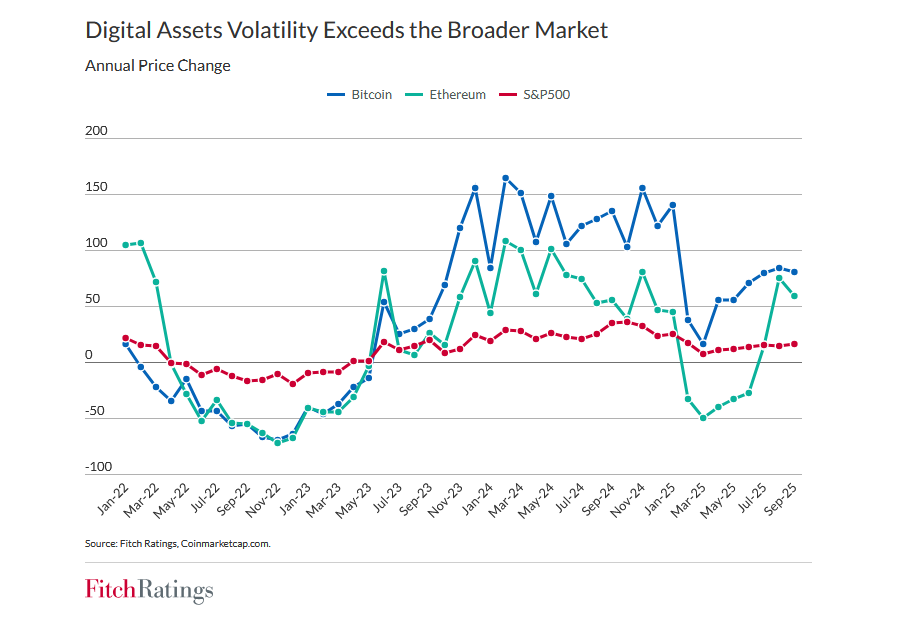
Bitcoin and Ether volatility vs S&P 500. Source: Fitch Ratings

Fitch Ratings is one of the “Big Three” credit rating agencies in the US alongside Moody’s and S&P Global Ratings.

The ratings from these firms — which can be controversial — carry significant weight in the financial world and impact how businesses are perceived or invested in from an economic viability perspective.

As such, Fitch’s downgrading the ratings of a bank with significant crypto exposure could result in lower investor confidence, higher borrowing costs and challenges to growth.

The report highlighted that several major banks, including JPMorgan Chase, Bank of America, Citigroup, and Wells Fargo, are involved in the crypto sector.

Fitch highlights systemic stablecoin risks

Fitch argued that another risk could come from the explosive growth of the stablecoin market, especially if it becomes large enough to influence other areas and institutions.

“Financial system risks could also increase if adoption of stablecoins expands, particularly if it reaches a level sufficient to influence the Treasury market.”

Related: Crypto, TradFi sentiment improves: Will Bitcoin traders clear shorts above $93K?

Moody’s also recently highlighted potential systemic risks of stablecoins in a report from late September, arguing that widespread adoption of stablecoins in the US could ultimately threaten the legitimacy of US dollar.

“High penetration of USD-linked stablecoins in particular can weaken monetary transmission, especially where pricing and settlement increasingly occur outside the domestic currency,” Moody’s said.

“This creates cryptoization pressures analogous to unofficial dollarization, but with greater opacity and less regulatory visibility,” it added.

Magazine: When privacy and AML laws conflict: Crypto projects’ impossible choice

Related Reads

Institutions Are Taking Over the Crypto Market: Is This the End of Decentralization, or the Prelude to a New Cycle?

The cryptocurrency market is undergoing a structural shift in 2025, with institutional investors now accounting for approximately 95% of capital inflows, while retail participation has declined to 5–6%. According to Aishwary Gupta of Polygon Labs, this transition is driven by maturing infrastructure rather than market sentiment. Major asset managers like BlackRock, Apollo, and Hamilton Lane are allocating portions of their portfolios to digital assets via ETFs and on-chain tokenized products, leveraging public blockchains that meet traditional finance compliance standards. Key drivers include yield generation through tokenized treasuries and institutional staking, followed by efficiency gains from faster settlements, shared liquidity, and programmable assets. While retail investors retreated due to losses from meme coin cycles, Gupta believes they will return as more regulated and transparent products emerge. He argues that institutional involvement does not undermine decentralization; instead, it enhances legitimacy and fosters a hybrid financial ecosystem where DeFi, NFTs, and traditional assets coexist on public chains. Although increased compliance may limit some experimentation, it promotes more sustainable innovation. Looking ahead, institutional liquidity is expected to reduce market volatility and accelerate the growth of real-world asset tokenization and cross-chain interoperability infrastructure. This evolution signals crypto’s transition from a speculative asset to a core component of the global financial system.

比推3분 전

Institutions Are Taking Over the Crypto Market: Is This the End of Decentralization, or the Prelude to a New Cycle?

比推3분 전

World's Richest Man, 'Silicon Valley Iron Man' Musk, to Take SpaceX Public in 2026!

Elon Musk, the world's richest person and CEO of SpaceX, plans to take the company public in 2026 with a target valuation of approximately $1.5 trillion. The IPO is expected to raise "significantly more than $30 billion," potentially making it the largest in history, surpassing Saudi Aramco's 2019 offering. A key driver of this ambitious valuation is a new narrative: **space-based AI computing**. Musk introduced the concept of "space AI compute" at a recent investor conference, arguing that within five years, running AI training and inference in space could become the lowest-cost solution. The core advantages include near-uninterrupted solar power and the vacuum of space acting as an ultimate heat sink. Additionally, with its reusable Starship rockets, SpaceX aims to drastically reduce launch costs to as low as $200–300 per kilogram. This vision, however, faces significant technical hurdles. Challenges include managing extreme heat radiation in direct sunlight, protecting hardware from cosmic radiation, and the economic risks associated with potential launch failures. Competitors are also entering the arena, including Jeff Bezos’ Blue Origin, which is developing its own orbital data centers, and Sam Altman’s OpenAI, which is reportedly considering acquiring a rocket company. Despite the challenges, Wall Street has responded positively. Firms like Ark Invest are now valuing SpaceX as a high-growth AI infrastructure company rather than a traditional aerospace firm, projecting that its space-based compute business could generate $80–120 billion in high-margin revenue by 2030. The success of this new "space dream" hinges on the continued development of Starship, overcoming technical barriers, and navigating future regulatory landscapes.

marsbit17분 전

World's Richest Man, 'Silicon Valley Iron Man' Musk, to Take SpaceX Public in 2026!

marsbit17분 전

Trading

Spot
Futures
活动图片