Crypto activity in Brazil rises 43% with average investment surpassing $1,000: Report

cointelegraphPublished on 2025-12-21Last updated on 2025-12-21

Abstract

Cryptocurrency activity in Brazil surged by 43% in 2025, with the average investment per user exceeding $1,000 (around 5,700 BRL), according to a Mercado Bitcoin report. The market is shifting from speculation to structured investing, with 18% of users diversifying across multiple assets. Bitcoin remained the most-traded asset, followed by USDT, ETH, and SOL. Stablecoins saw triple the previous year’s transactions as investors sought lower volatility. Lower-risk digital fixed-income products grew 108%, with $325 million distributed to investors. Younger investors (under 24) increased by 56%, and participation expanded beyond major cities. Itaú Asset Management recommended a 1–3% Bitcoin allocation due to geopolitical and monetary risks.

Crypto activity in Brazil expanded sharply in 2025, with total transaction volume climbing 43% year over year as average investment per user crossed the $1,000 mark, according to a new report from crypto platform Mercado Bitcoin.

The report, titled “Raio-X do Investidor em Ativos Digitais 2025,” claimed that the Brazilian crypto market is no longer driven purely by speculation but increasingly shaped by structured investing and portfolio planning. The data was based on activity across Mercado Bitcoin’s platform, the largest digital asset exchange in Latin America.

Per the report, the average amount invested per person reached roughly 5,700 Brazilian reais, equivalent to more than $1,000. At the same time, 18% of investors allocated funds across more than one crypto asset, indicating a gradual shift toward diversification rather than single-asset bets.

Bitcoin (BTC) remained the most traded asset, followed by the US dollar-pegged stablecoin USDt (USDT), Ether (ETH) and Solana (SOL), the report showed. Stablecoins also stood out as a key on-ramp for new and existing investors, accounting for roughly three times more transactions than in the prior year, as users sought lower volatility amid uncertain macro conditions.
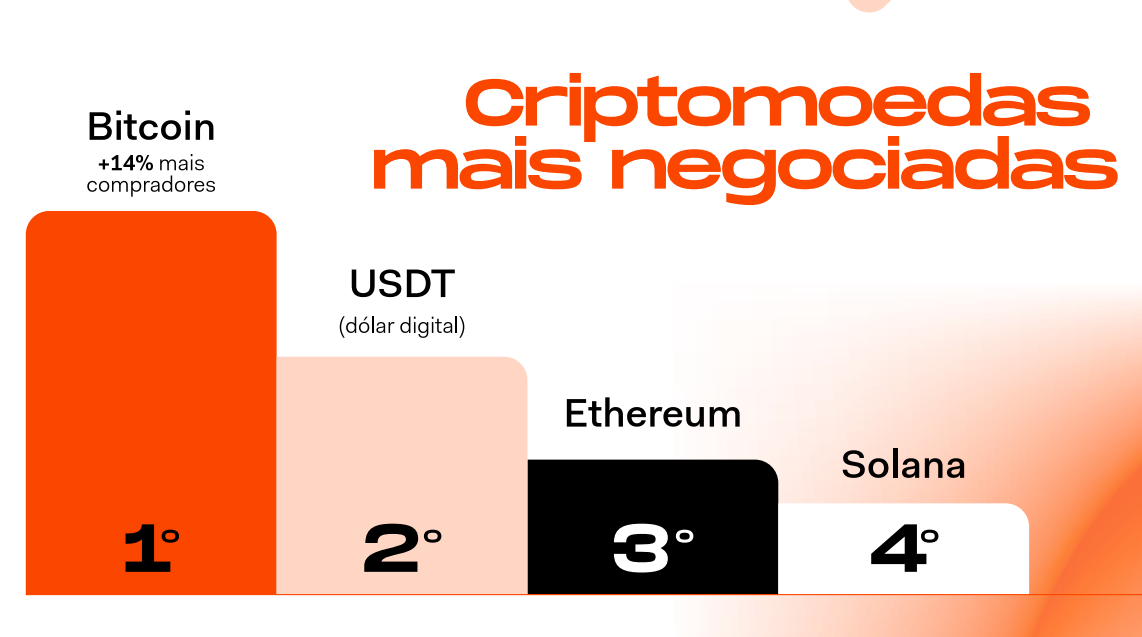
Bitcoin remains most-traded asset in Brazil. Source: Mercado Bitcoin

Related: Brazilian stock exchange to launch tokenization platform and stablecoin

Brazil’s low-risk crypto products see 108% growth

The report revealed that lower-risk crypto products gained momentum in 2025. Digital fixed-income offerings, known locally as Renda Fixa Digital (RFD), recorded a 108% increase in investment volume, with Mercado Bitcoin distributing about $325 million to investors in 2025.

Demographics also shifted. Investors aged 24 and under posted a 56% increase year over year. However, Mercado Bitcoin noted that demand expanded across all age groups, including high-net-worth and institutional profiles.

Regionally, Brazil’s Southeast and South remained dominant by transaction volume, led by São Paulo and Rio de Janeiro, while states in the Central-West and Northeast gained visibility as crypto participation spread geographically.

Related: Solana enters Brazil’s main exchange as Valour expands regulated crypto access

Itaú Asset advises 1%–3% Bitcoin allocation

As Cointelegraph reported, Itaú Asset Management has recommended that investors allocate between 1% and 3% of their portfolios to Bitcoin, citing rising geopolitical risks, shifting monetary policy and ongoing currency volatility.

In a research note, strategist Renato Eid described Bitcoin as a distinct asset with its own return profile and a potential hedging role due to its global and decentralized nature, despite sharp price swings throughout 2025.

Magazine: 2026 is the year of pragmatic privacy in crypto — Canton, Zcash and more

Related Questions

QWhat was the percentage increase in crypto transaction volume in Brazil in 2025, according to the Mercado Bitcoin report?

ACrypto transaction volume in Brazil increased by 43% year over year in 2025.

QWhat was the average amount invested per person in Brazilian reais, and what was its approximate equivalent in US dollars?

AThe average amount invested per person was roughly 5,700 Brazilian reais, which is equivalent to more than $1,000.

QWhich four crypto assets were reported as the most traded in Brazil, listed in order?

AThe most traded assets were Bitcoin (BTC), followed by the stablecoin USDt (USDT), Ether (ETH), and Solana (SOL).

QWhat was the reported growth percentage for lower-risk crypto products like Digital Fixed-Income (RFD) in 2025?

ALower-risk crypto products, specifically Digital Fixed-Income offerings (RFD), recorded a 108% increase in investment volume.

QWhat Bitcoin allocation range did Itaú Asset Management recommend for investors' portfolios and what reasons did they cite?

AItaú Asset Management recommended an allocation of between 1% and 3% to Bitcoin, citing rising geopolitical risks, shifting monetary policy, and ongoing currency volatility.

Related Reads

$50 Million Funding Ignites Airdrop Anticipation, Variational Becomes New Focus of Perp DEX

Variational, a perpetual decentralized exchange (Perp DEX) on Arbitrum, has become a focal point in the crypto community after announcing a $50 million Series A funding round led by Dragonfly Capital, with participation from Bain Capital Crypto and Coinbase Ventures. This news caused a significant pre-listing price surge and increased predictions of a high fully diluted valuation (FDV) upon launch. A key feature of Variational is its zero-trading-fee model. It differentiates itself by aggregating multi-source liquidity, including traditional and crypto-native market makers, to address on-chain liquidity challenges. According to DefiLlama, it ranks fourth among Perp DEXs by open interest and is notable as the only top-five platform yet to issue a token. The primary way for users to engage is through its "Trade-to-Earn" Omni Points program. Points are awarded weekly based on trading activity, with bonuses for early users and a tiered reward system that incentivizes higher trading volumes. The program also includes a referral system offering USDC rewards and extra points. The design emphasizes organic trading over mere volume farming. While an exact Token Generation Event (TGE) date for the VAR token is not confirmed, official documentation states the points program will run at least until the end of Q3 2026. Community and prediction market sentiment generally expects the TGE to occur in Q3 or Q4 of this year.

Odaily星球日报9m ago

$50 Million Funding Ignites Airdrop Anticipation, Variational Becomes New Focus of Perp DEX

Odaily星球日报9m ago

Morning Brief | Deloitte Acquires Crypto Infrastructure Firm Blocknative; Stablecoin Firm Checker Raises $8M; a16z Likely Becomes Largest External Holder of HYPE

ChainCatcher Daily Update - May 21st Major headlines include Deloitte's acquisition of crypto infrastructure firm Blocknative, signaling further traditional finance adoption. In funding news, stablecoin infrastructure company Checker secured $8 million, while decentralized derivatives platform Variational raised $50 million in a Series A round led by Dragonfly Capital. Significant corporate moves saw Tether acquire SoftBank's entire stake in Twenty One Capital (XXI), and Mastercard pivot its strategy by investing in BVNK for stablecoin payments after abandoning Zerohash. VC giant Andreessen Horowitz (a16z) is reported to be a major external holder of HYPE, with positions exceeding $356 million. On the institutional front, MicroStrategy's CEO noted that 13 of its top 15 institutional shareholders increased their $MSTR holdings in Q1 2026, with aggregate positions growing 27%. Meanwhile, the parent company of the NYSE, ICE, announced plans to launch a futures market for AI computing power ("hashrate"). The report also features a "Meme Hot List" ranking trending tokens on Ethereum, Solana, and Base networks, and highlights several key articles. These include an analysis of renowned investor Duan Yongping's first crypto investment in Circle, concerns over talent drain and institutional selling pressure at the Ethereum Foundation, the growing business of crypto asset recovery, and an examination of the trillion-dollar potential and remaining hurdles for the tokenized asset market.

链捕手38m ago

Morning Brief | Deloitte Acquires Crypto Infrastructure Firm Blocknative; Stablecoin Firm Checker Raises $8M; a16z Likely Becomes Largest External Holder of HYPE

链捕手38m ago

147 Trillion vs 70 Billion: The Rise of On-Chain 'Risk Managers' and the Potential Dawn of a New Era in DeFi Asset Management

"147 Trillion vs 70 Billion: The Rise of On-Chain 'Risk Managers' and the Potential Dawn of a New Era in DeFi Asset Management" Key Points: The role of professional asset managers is emerging in DeFi, ending the era where protocols and governance dictated everything. While early DeFi protocols like Aave and Compound bundled risk management within their code, innovations like Morpho have separated infrastructure from risk judgment. This allows specialized "Risk Managers" to operate independent lending vaults, acting as on-chain asset managers. The market, though early with ~$7B in assets under management (AUM), is rapidly consolidating around top performers like SteakhouseFi (RWA focus), SentoraHQ (AI-driven models), and Gauntlet (crisis management). This modular structure mirrors TradFi's division of labor: distributors (e.g., exchanges) source capital, Risk Managers design strategies and set standards, and underlying protocols handle custody and execution. For traditional asset managers, this familiar structure presents clear entry paths: 1) **Distribution**: Partnering with Risk Managers as a backend service. 2) **Supply**: Bringing real-world assets (RWA) on-chain as collateral. 3) **Operation**: Becoming a Risk Manager themselves (e.g., Bitwise). The core competency required is shifting from coding to traditional risk underwriting and financial expertise—areas where established institutions hold a natural advantage. While the current DeFi market (~$80B) is minuscule compared to global asset management (~$147T), it represents a significant growth runway. The teams that build the trusted standards and rails for risk-managed capital now are poised to define the market's future as institutional capital seeks secure on-ramps.

marsbit46m ago

147 Trillion vs 70 Billion: The Rise of On-Chain 'Risk Managers' and the Potential Dawn of a New Era in DeFi Asset Management

marsbit46m ago

Trading

Spot
Futures
活动图片