Arcus Chooses Stepfather Robinhood Chain, Leaving Biological Father dYdX Awkwardly Making Up for It

marsbitPublished on 2026-07-03Last updated on 2026-07-03

Abstract

Robinhood launched its public mainnet, Robinhood Chain, a Layer 2 network built on Arbitrum. This move attracted major protocols like Uniswap and Chainlink. However, a new decentralized exchange, Arcus, developed by the dYdX team, became a focal point by choosing to launch on Robinhood Chain instead of the dYdX Chain. Arcus offers zero-fee, 24/7 trading of tokenized stocks and perpetual contracts. This decision sparked community concerns about dYdX Chain's future, dYdX's focus, and the value of the DYDX token, leading to a sharp price drop. dYdX founder Antonio Juliano clarified that dYdX Chain will continue operating but acknowledged Arcus as a separate, independent product. He mentioned future Arcus tokens might be partly allocated to the dYdX community. The dYdX Foundation reaffirmed that DYDX remains the governance token for dYdX Chain, with no current plans for token migration. The core question remains how dYdX Chain and DYDX token holders will benefit from Arcus's potential growth, creating uncertainty for existing stakeholders.

Author | Asher(@Asher_ 0210)
Yesterday morning, Robinhood announced the official public mainnet launch of its proprietary Layer 2 network, Robinhood Chain. Built on the Arbitrum tech stack, the chain is positioned as institution-grade, permissionless, AI-native, and specifically designed for real-world assets (RWA).

In other words, Robinhood isn't aiming to add just another chain to the crypto space; it wants to consolidate stocks, RWA, lending, trading, and on-chain financial products within its own infrastructure.

As the big platform steps in, key ecosystem players are quickly aligning themselves.

Leading protocols such as Uniswap, 1inch, Lighter, Morpho, Chainlink, BitGo, Ethena, and EtherFi have successively announced integration with Robinhood Chain, covering core crypto sectors like trading, liquidity, lending, oracles, custody, and cross-chain.
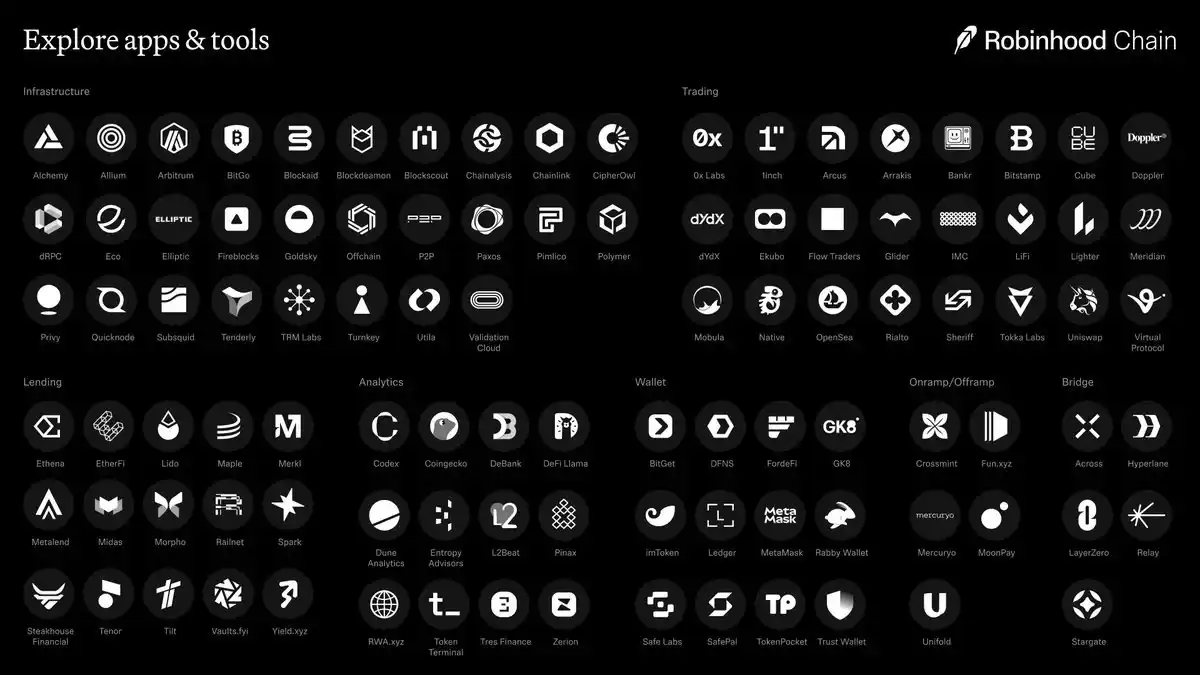
Overview of Robinhood Chain Ecosystem Projects

Amidst this grand ecosystem integration, Arcus, a new DEX launched by the dYdX team, has ironically become the focal point of community discussion.

Community users raised questions: Is dYdX Labs shifting its focus to Arcus? Will the original dYdX Chain be sidelined? Can the DYDX token continue to capture protocol value in the future? How will Arcus be associated with the dYdX ecosystem?

Affected by the related controversy, DYDX fell over 12% in the past 24 hours, with its current market cap temporarily at $108 million.
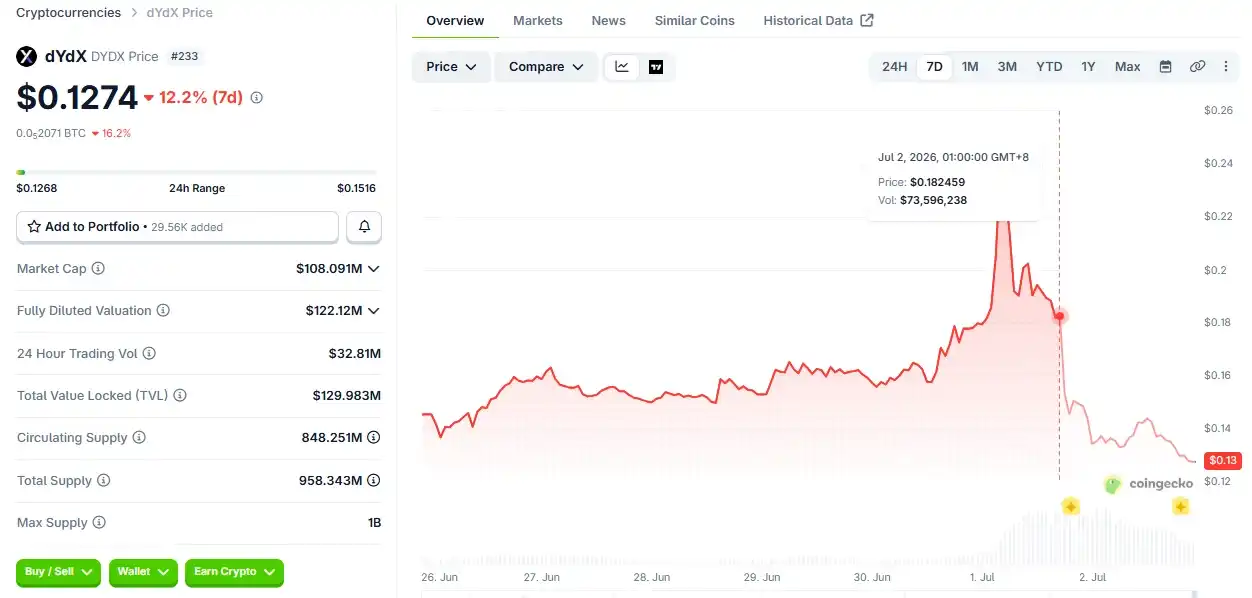
DYDX Token Price Chart (Last 7 Days)

What is Arcus? 7x24 Zero-Fee Trading of Tokenized Stocks

Arcus: A decentralized exchange developed by the dYdX team, now open for early waitlist

Arcus is a decentralized exchange developed by the dYdX team, now live on Robinhood Chain, offering 7x24 zero-fee trading for 95 tokenized stocks and perpetual contracts. Arcus supports tokenized trading of stocks, commodities, indices, and crypto assets. All tokenized stocks are issued by and redeemable on Robinhood Chain, can be self-custodied, and integrated into the DeFi ecosystem.
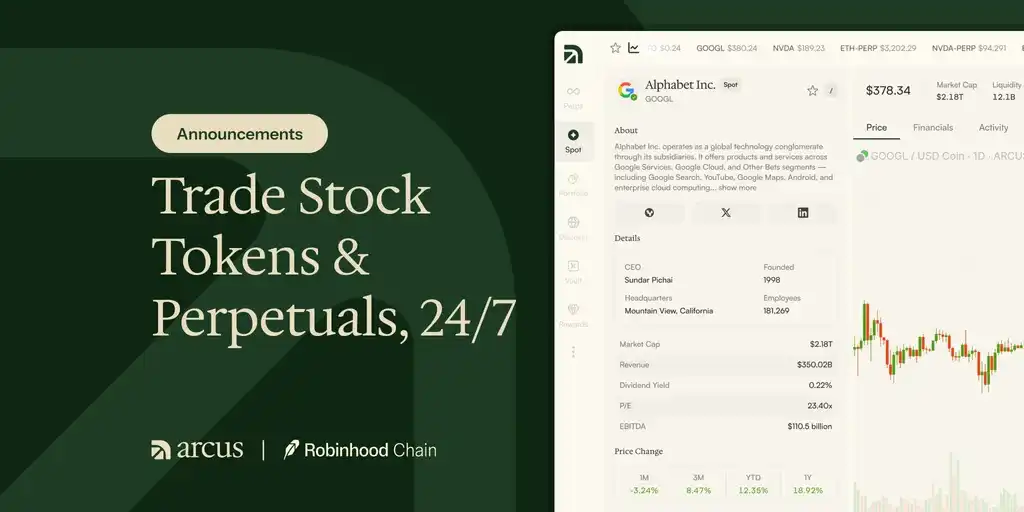
Arcus x Robinhood: 24/7 Trading of Stocks and Perpetuals

Currently, Arcus has opened its early waitlist (Link: https://waitlist.arcus.xyz/). Users can complete the interaction by connecting their personal X account and wallet.
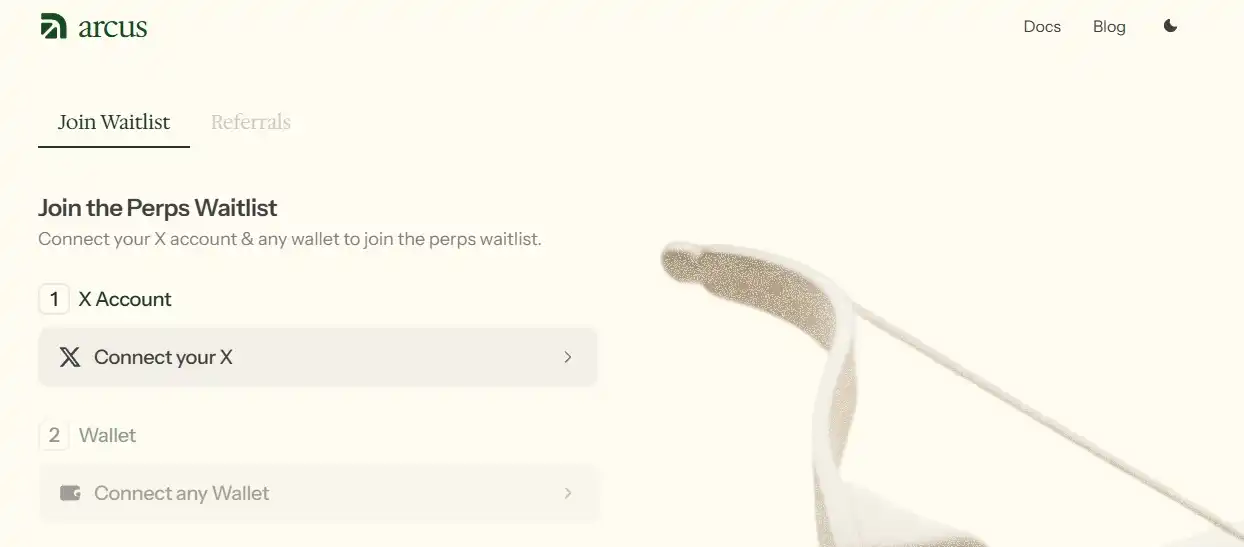
Arcus Has Opened Early Waitlist

Additionally, Arcus plans to support tokenized stocks and crypto assets as collateral for perpetual contracts in the future and offer pre-IPO trading for popular private companies like OpenAI.

Future Arcus tokens will be allocated to the dYdX community

At first glance, Arcus, the DEX developed by the dYdX team, is capitalizing on this year's crypto narrative—tokenized stocks. However, the issue is that Arcus is not deployed on dYdX Chain; instead, it has chosen to operate on Robinhood Chain and is being developed as an independent product with independent infrastructure. This suggests that dYdX Labs is telling a new growth story, but one that doesn't place dYdX Chain and the DYDX token at its core.

More subtly, dYdX founder Antonio Juliano stated in the latest dYdX documentation that "a portion of future Arcus tokens will be allocated to the dYdX community." While this statement aims to reassure the old community, it also directly amplifies the expectation of an Arcus token launch, making many users pay more attention to new potential airdrop opportunities.
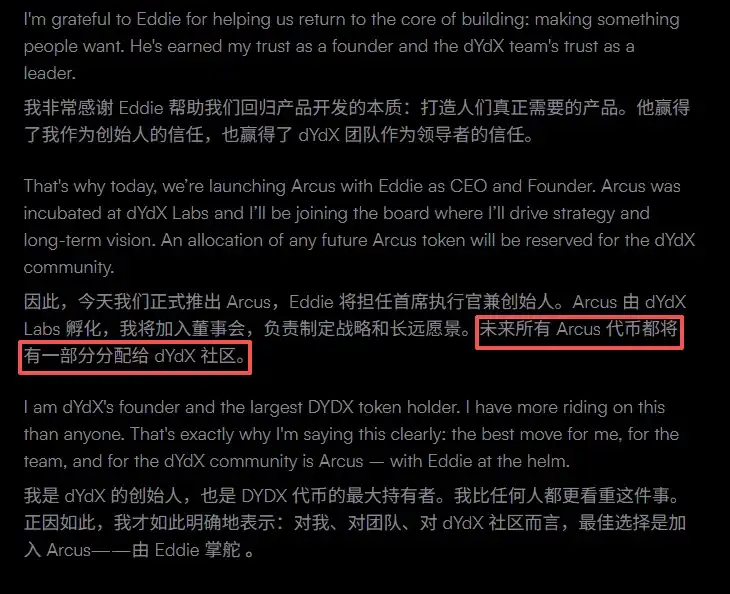
Arcus Tokens to be Allocated to dYdX Community

Considering that dYdX conducted one of the largest airdrops in the industry, once Arcus initiates trading incentives, point campaigns, or early user programs, it could attract a portion of traders and liquidity to shift towards the new platform in advance. For dYdX Chain, this means trading volume and activity, already under pressure, might face further diversion.

dYdX Founder Responds: Arcus is a New Product, dYdX Chain Won't Be Halted

Facing community questions, dYdX founder Antonio Juliano explained that dYdX Chain has gone very deep on decentralization, featuring open-source architecture, community governance, over 200 markets, and more than 50 validators running order books.

However, he also admitted that this path came with trade-offs in performance and user experience. As on-chain derivatives competition intensifies, the market is rewarding faster, simpler, and more liquidity-concentrated trading platforms. Arcus was born in this context.

Furthermore, Antonio stated that Eddie Zhang will serve as CEO and Founder of Arcus, while he himself will join the board, responsible for strategy and long-term vision. In other words, Arcus is not a new feature on dYdX Chain but a new trading platform separately advanced by dYdX Labs.

Addressing the old community, Antonio said dYdX v4 will continue to be supported, and user funds and positions will remain accessible on dYdX Chain; if Arcus issues tokens in the future, a portion will be reserved for the dYdX community, prioritizing users who have previously participated in dYdX trading, staking, validation, and community building.

Subsequently, the dYdX Foundation further emphasized that Arcus is an independent product built on independent infrastructure, and dYdX Chain will not be affected. DYDX remains the governance and staking token for dYdX Chain; its mechanisms, supply, and operational characteristics are unchanged, and there are currently no plans for token swaps or migration.

But the market's concern isn't just about "whether dYdX Chain will still work."

The real question is: If Arcus generates significant trading volume and revenue in the future, can dYdX Chain share in that growth? If Arcus issues a new token, how much equity will DYDX holders receive? And how will dYdX Labs allocate resources between Arcus and dYdX Chain going forward?

Until clear answers are provided to these value-accrual questions, Arcus represents a new story for dYdX Labs but, for DYDX holders, is more like a pending problem to solve.

Trending Cryptos

Related Questions

QWhat is the main reason behind the community's concern regarding dYdX after the launch of Arcus on Robinhood Chain?

AThe community is concerned that dYdX Labs may be shifting its focus and resources to the new project Arcus, potentially marginalizing the original dYdX Chain. This raises questions about whether the DYDX token will continue to capture protocol value and how future growth and value from Arcus will be shared with the existing dYdX ecosystem and its token holders.

QWhat are the key features and offerings of the new DEX, Arcus, developed by the dYdX team?

AArcus is a decentralized exchange offering 7x24 hour, zero-fee trading of tokenized stocks and perpetual contracts. It currently supports 95 tokenized stocks, issued and redeemable on Robinhood Chain, and plans to support using these assets as collateral for perpetuals and offer pre-IPO trading for private companies like OpenAI.

QAccording to dYdX founder Antonio Juliano, how are Arcus and dYdX Chain positioned in relation to each other?

AAntonio Juliano clarified that Arcus is a new, independent product built on separate infrastructure (Robinhood Chain), not a feature on dYdX Chain. It is being developed to address market demands for speed and user experience. He stated that dYdX v4 and dYdX Chain will continue to be supported and maintained as a separate platform.

QHow did Antonio Juliano and the dYdX Foundation attempt to address the concerns of the existing dYdX community?

AThey attempted to reassure the community by stating that dYdX Chain operations will continue unaffected, user funds are safe, and DYDX token's role for governance and staking remains unchanged. Furthermore, they announced that a portion of any future Arcus token would be allocated to the dYdX community, prioritizing past participants in trading, staking, validation, and community activities.

QWhat was the immediate market reaction to the news and controversy surrounding Arcus and dYdX?

AThe DYDX token price dropped by over 12% in 24 hours following the news and community debates. This reflects market uncertainty and concern about potential value diversion from the dYdX ecosystem to the new Arcus project.

Related Reads

After Three Consecutive Quarters of Decline, Can the Crypto Market Find a Window for Stabilization in Q3?

The cryptocurrency market has just concluded its worst-performing quarter since 2022, with total capitalization dropping 12.6% to $2.1 trillion. All core metrics indicate capital is leaving the sector, not just rotating within it. Bitcoin fell 14.2% and Ethereum dropped 25.4% in Q2, breaking their previous correlation with US tech stocks. A key driver is the reversal in US spot Bitcoin ETF flows, which saw a net outflow of approximately $4.67 billion in Q2, including a record monthly outflow near $4.5 billion in June. While recent data suggests long-term holders are accumulating again, sustained ETF outflows mean continued selling pressure. Market focus is now singularly on the Federal Reserve. The upcoming July FOMC meeting is seen as the most critical event for Q3. A dovish signal could support Bitcoin reclaiming a $68,000-$84,000 range, while a hawkish stance might establish a new trading band around $50,000-$56,000. Additionally, regulatory uncertainty persists, with the progress of the crucial *CLARITY Act* stalling in the Senate, reducing its perceived 2026 passage probability to 40-45%. Despite the broad downturn, a few sectors showed growth. Prediction markets saw nominal volume surge 48.7% year-over-year to $113.8 billion, and tokenized collectibles transaction volume rose 143% quarterly to $1.4 billion. The Real-World Asset (RWA) tokenization sector also continued steady growth, now representing ~$28.1 billion in on-chain value. The market's foundation for an extreme crash appears limited, with Bitcoin price hovering near its 200-week moving average. However, the trading paradigm has shifted from narrative-driven speculation to decisions based on price action, policy developments, and interest rate expectations, making a broad sentiment-driven rally unlikely in the near term.

marsbitYesterday 08:36

After Three Consecutive Quarters of Decline, Can the Crypto Market Find a Window for Stabilization in Q3?

marsbitYesterday 08:36

BIT Trading Moment: BTC Still Suppressed by Weekly 200 EMA, Rejection May Restart Decline; Storage and Semiconductors that Surged Last Night Begin Falling in Evening Trading

**Crypto & Stock Market Wrap: Bitcoin Tests Resistance, Stocks Retreat After AI Surge** Bitcoin consolidates around $66,000, facing key resistance near $68,000—an area seen as a major psychological and technical hurdle where previous rallies have failed. Analysts note the cryptocurrency is caught between its 200-week moving average (~$63,333) and 200-week EMA (~$68,328). A clear break above $68k is needed to signal a stronger bullish trend, while a rejection could lead to a retest of $63k support. Market sentiment remains cautious, with low futures open interest pointing to a low-liquidity rebound rather than a full bull market. Bitcoin spot ETFs saw another $203 million inflow. US stock futures pointed lower after a strong Tuesday session led by a massive rebound in semiconductors and memory stocks. The rally was fueled by renewed optimism about AI-driven hardware demand, with Micron, SanDisk, and SK Hynix surging. However, those gains reversed in pre-market trading. Super Micro Computer (SMCI) soared over 20% after hours on strong guidance and a record backlog. Other standouts included Rocket Lab and nuclear energy plays Oklo and X-Energy. Rising oil prices (Brent above $91) and climbing Treasury yields (10-year near 4.64%), however, are reigniting inflation concerns and acting as a headwind for equities. In Asia, markets were mixed. South Korea's KOSPI pared early gains to close slightly higher as semiconductor stocks like SK Hynix gave back initial surges. Japan's Nikkei edged lower as the yen hit a fresh 38-year low against the dollar, raising fears of potential market intervention. Key events to watch include the Samsung Galaxy launch, AMD's AI event, and a slew of major tech earnings from Alphabet, Tesla, and IBM after the close on Wednesday, followed by the ECB meeting and Intel's earnings on Thursday.

marsbitYesterday 08:28

BIT Trading Moment: BTC Still Suppressed by Weekly 200 EMA, Rejection May Restart Decline; Storage and Semiconductors that Surged Last Night Begin Falling in Evening Trading

marsbitYesterday 08:28

Former CFTC Chairman, Circle President Tarbert: Preaching Long-Termism While Cashing Out $30 Million Himself

Former CFTC Chairman and Circle President Heath Tarbert has consistently advocated for a long-term vision in public, urging patience from investors as Circle’s stock price has fallen significantly from its peak. However, it has been revealed that since Circle’s IPO, Tarbert has continuously sold his CRCL shares through pre-arranged trading plans, cashing out approximately $30 million, without making any public market purchases. This contrast between his public messaging and personal actions has drawn criticism. Tarbert joined Circle in July 2023 as Chief Legal Officer, leveraging his regulatory experience to help guide the company through its IPO and expansion. Despite promoting stablecoins as long-term infrastructure, he established a 10b5-1 trading plan just before Circle went public, leading to substantial stock sales over the following year. In March 2026, he initiated another plan to sell more shares. His career trajectory highlights a pattern of moving between high-level regulatory roles and influential positions in the financial sector. After resigning as CFTC Chairman in early 2021, he joined Citadel Securities as Chief Legal Officer just 27 days later, during a period of intense regulatory scrutiny for the firm. He later joined Circle, aiding its efforts to navigate regulatory challenges for its public listing. While Tarbert's expertise in policy and compliance is valuable to companies like Circle, his actions—advocating long-term confidence while personally divesting—raise questions about the alignment between his public statements and his private financial decisions, leaving investors who followed his advice to bear the market risks.

marsbitYesterday 08:06

Former CFTC Chairman, Circle President Tarbert: Preaching Long-Termism While Cashing Out $30 Million Himself

marsbitYesterday 08:06

Gate Research Institute: The 'Wall Street-ization' Wave of Crypto Financial Products – Competition or Integration?

The article titled "Gate Research Institute: Are Crypto Financial Products Sparking a 'Wall Street' Wave—Competition or Convergence?" explores the evolving relationship between the crypto ecosystem and traditional finance (TradFi). The piece begins by reflecting on Bitcoin's original 2009 vision of decentralization, disintermediation, and moving away from banks. It then contrasts this with the 2024 landscape, where key crypto assets like Bitcoin are increasingly held through Wall Street products like ETFs issued by giants like BlackRock. The article questions whether this signifies that TradFi is systematically taking over the rights to issue, price, custody, and distribute crypto financial assets. The core argument is that this is not a zero-sum takeover but rather a bidirectional convergence where each side addresses the other's weaknesses. Crypto offers 24/7 global markets, programmable settlement, and open access but lacks compliant channels, institutional-grade custody, deep fiat liquidity, and mainstream distribution. TradFi possesses these but is constrained by legacy systems, limited operating hours, and slow settlement. Two primary convergence paths are highlighted: * **Path A (CEX to TradFi):** Exemplified by Gate, which has progressed from offering tokenized stocks and CFDs to providing direct, real stock trading (US, Hong Kong, South Korea) within its platform, using USDT. * **Path B (TradFi to Crypto):** Exemplified by Robinhood, which has integrated crypto trading, acquired exchanges like Bitstamp, and is moving traditional assets like stocks onto the blockchain via tokenization and its own Layer 2. Both paths are ultimately competing to become the next-generation, unified financial account—a "super account" where users can seamlessly trade cryptocurrencies, stocks, ETFs, RWA (Real World Assets), and tokenized treasury products in one interface. The growth of RWA and tokenized treasuries (e.g., BlackRock's BUIDL) is presented as the asset-layer fusion, providing stable, yield-bearing assets on-chain and acting as a bridge between the two worlds. In conclusion, the "Wall Street-ization" of crypto is framed as a mutual transformation. Decentralized ideals persist in the protocol layer, while at the application layer, a more efficient, global, and accessible unified capital market is emerging from this convergence. The future competition lies not between crypto exchanges and stockbrokers, but between platforms vying to offer the most comprehensive asset coverage, liquidity, and user experience within a single account.

marsbitYesterday 08:01

Gate Research Institute: The 'Wall Street-ization' Wave of Crypto Financial Products – Competition or Integration?

marsbitYesterday 08:01

Trading

Spot

Hot Articles

How to Buy DYDX

Welcome to HTX.com! We've made purchasing dYdX (DYDX) simple and convenient. Follow our step-by-step guide to embark on your crypto journey.Step 1: Create Your HTX AccountUse your email or phone number to sign up for a free account on HTX. Experience a hassle-free registration journey and unlock all features.Get My AccountStep 2: Go to Buy Crypto and Choose Your Payment MethodCredit/Debit Card: Use your Visa or Mastercard to buy dYdX (DYDX) instantly.Balance: Use funds from your HTX account balance to trade seamlessly.Third Parties: We've added popular payment methods such as Google Pay and Apple Pay to enhance convenience.P2P: Trade directly with other users on HTX.Over-the-Counter (OTC): We offer tailor-made services and competitive exchange rates for traders.Step 3: Store Your dYdX (DYDX)After purchasing your dYdX (DYDX), store it in your HTX account. Alternatively, you can send it elsewhere via blockchain transfer or use it to trade other cryptocurrencies.Step 4: Trade dYdX (DYDX)Easily trade dYdX (DYDX) on HTX's spot market. Simply access your account, select your trading pair, execute your trades, and monitor in real-time. We offer a user-friendly experience for both beginners and seasoned traders.

2.9k Total ViewsPublished 2024.03.29Updated 2026.06.02

How to Buy DYDX

Discussions

Welcome to the HTX Community. Here, you can stay informed about the latest platform developments and gain access to professional market insights. Users' opinions on the price of DYDX (DYDX) are presented below.

活动图片