Kimi, Zhipu, Douban Gather at an Encryption Hackathon: What Did AI Developers Build on Monad?

marsbitPublished on 2026-03-26Last updated on 2026-03-26

Abstract

Monad's "Rebel in Paradise AI" Hackathon, held on March 21, 2026, brought together leading LLM providers like Kimi, Zhipu AI, and Doubao to explore AI agent development on its high-performance parallel EVM blockchain. The event focused on three key areas: Agent Payments, Smart Markets, and Application Innovation, with over $40,000 in prizes and resources. Winning projects included OpenAlice (Grand Prize), a locally run trading agent with transparent workflows; Orbit AI (NVIDIA Special Award), a decentralized AI cloud using satellite GPU clusters; and Kimi-swarm, an open-source multi-agent IDE. Other notable winners were Libra, a Git-like system for machine-written code, and Anime AI Studio, a one-stop anime short film generation agent. The hackathon highlights Monad's strategic push into AI, leveraging its high throughput (10,000+ TPS), low latency, and low-cost infrastructure to support autonomous agent economies. Monad's existing initiatives, like the AI Blueprint program and x402 payment guides, further position it as a key infrastructure for AI and DeFi integration, enabling agents to execute transactions, settle payments, and operate as independent economic entities on-chain.

Author: Deep Tide TechFlow

Hackathons have long become a standard practice for public blockchain ecosystem development. Compared to the hustle and bustle of "hosting an event," what is more worth paying attention to is "what the event leaves for the ecosystem."

On March 21, 2026, with the announcement of the winners, the Monad Rebel in Paradise AI Hackathon concluded successfully.

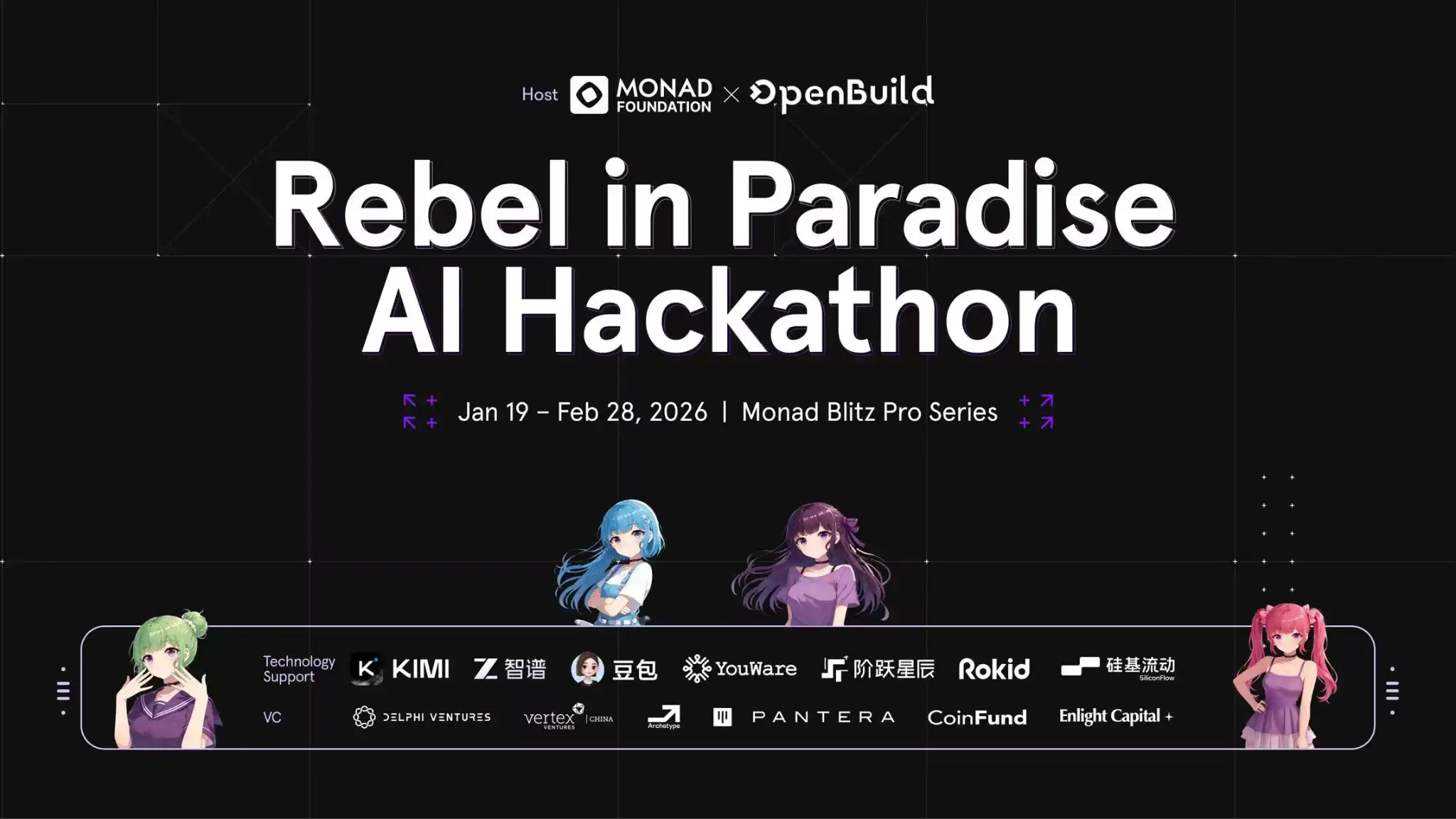
At a time when AI has universally become the "lifesaver" that Crypto must latch onto to boost ecosystems, this hackathon is still particularly worthy of review. Not only because, as a top-tier L1 project, every move Monad makes to build its ecosystem after token issuance is inherently a focus of continuous community inquiry, but also for another, bigger reason: the community couldn't help but notice the partners for this hackathon:

Including well-known LLM providers such as Kimi, Zhipu, Douban, and others were prominently listed.

This makes the significance of this event far exceed that of a mere "on-chain developer competition." It signals Crypto's role as a core component in broader scenarios and also facilitated a convergence of AI large models and on-chain infrastructure:

On one side is the on-chain execution environment provided by the Monad high-performance public chain; on the other is the concentrated injection of large model capabilities, toolchains, and development resources possessed by traditional providers; in the middle are the developers trying to turn imagination into products.
So, facing the era of the agent economy, where underlying networks need to support higher-frequency, more complex interactions and value transfers, how does Monad specifically perform?

Also, in such a hackathon, centered around the AI theme, what exactly did developers build on Monad?

Let's delve into Monad's AI ecosystem layout through the winning projects of this hackathon.

A Hackathon with Both a "Powerful Lineup" and "Dense Resources"

When Agents are no longer just conversational tools but possess execution capabilities, which directions are most worthy of developer investment?

The Monad Rebel in Paradise AI Hackathon aimed to provide the most direct answer.

In terms of track design, the event focused on three directions most representative of Agent landing value: Agent Payments, Smart Markets, and Application Innovation.

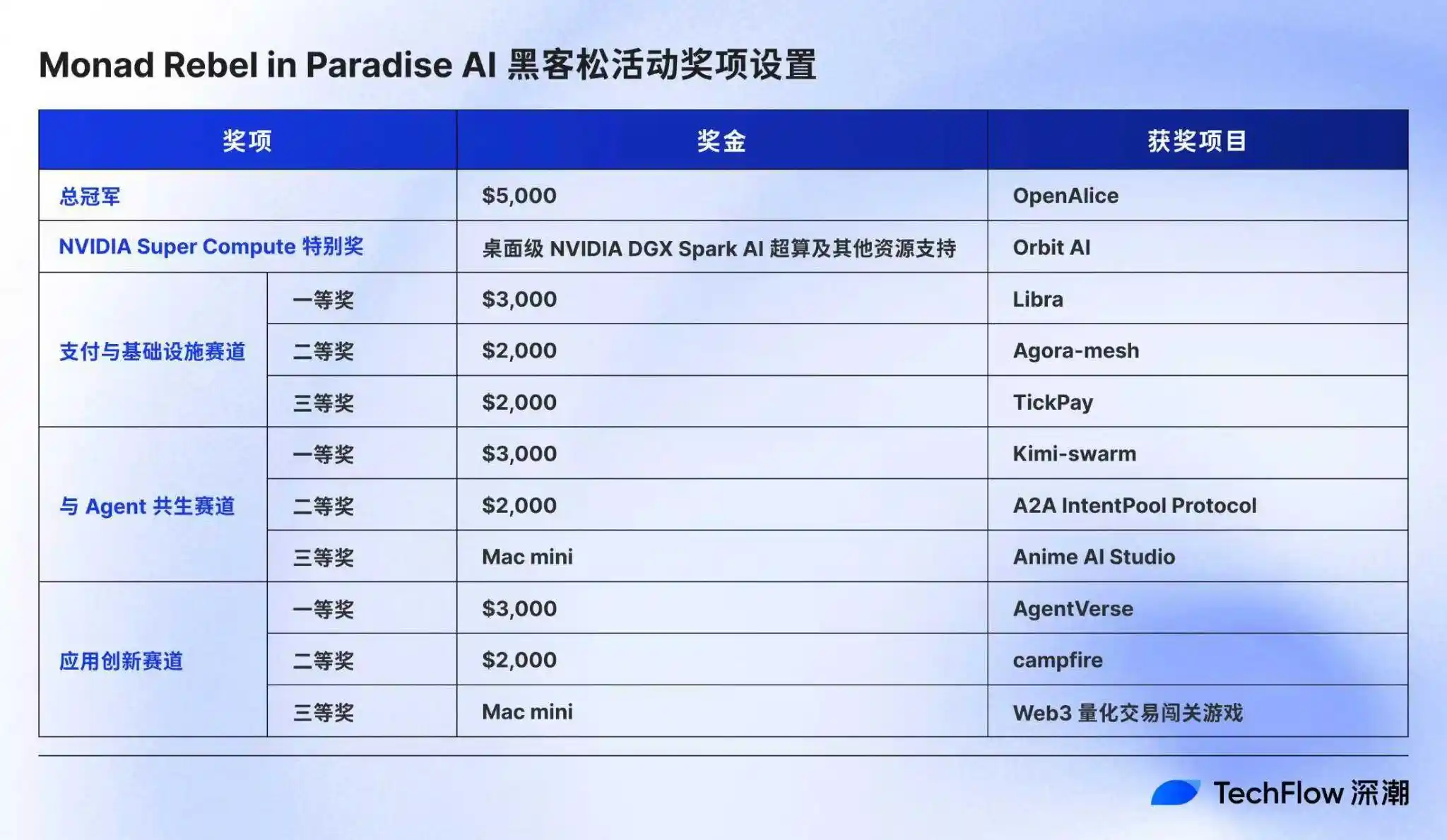
And to present the answer more spectacularly, Monad did not skimp on resources: participants not only got to interact directly with leaders in LLM, infrastructure, and agent fields, as well as VCs, but also competed for a total prize pool of over $40,000, with $20,000 in cash prizes and $20,000 in creative and resource support, including free trial credits for cutting-edge models, development tools, and infrastructure.
As the first hackathon in Greater China focused on AI Agent finance, Monad aimed, through this event, to demonstrate the deep integration of high-performance parallel EVM and top-tier LLMs, and to use Beijing and Shenzhen as main bases for training camp activities, bringing developers, model capabilities, infrastructure, and investors into the same testing ground.

The VC judges for the event attracted participation from first-tier institutions including Delphi Ventures, Pantera Capital, CoinFund, Vertex, Enlight, etc., giving participants a chance to prove themselves in front of model providers, infrastructure providers, and top investment institutions ahead of time.

Simultaneously, the event also attracted top AI companies like Kimi, Zhipu AI, Douban, Step星辰 (Step Stars), 硅基流动 (Silicon-based Flow), YouWare, etc., to collectively join, providing a series of support from model APIs, computing power support, technical guidance to judging resources.

Such a lineup made many curious about the契机 (opportunity) behind the cooperation, but upon closer inspection, it's not hard to understand:

When LLM providers started looking for出海 (overseas) opportunities and the next landing point for AI innovation, they saw Crypto with its characteristics of decentralization, trustlessness, verifiable incentives, etc., and Monad became the L1 base discovered and chosen by these major players.

The dense resource infusion laid the necessary foundation for the high-quality output of this hackathon. So, what do the first batch of products daring to try and finding a foothold actually look like?

From Payments to Anime Generation: A Look at the 11 Winning Projects

Grand Prize: OpenAlice

OpenAlice is a trading Agent that can run locally, capable of combining processes like research, strategy, execution, and risk control into one transparent, collaborative workbench.

OpenAlice's core architecture uses Markdown + JSON configuration-driven approach. The entire Agent's behavior is defined in human-readable Markdown and structured JSON, with clear and transparent logs, facilitating human-Agent collaborative iteration. Additionally, the project supports local deployment; data and execution do not fully rely on the cloud, further enhancing privacy and controllability.

【View Demo】

  • NVIDIA Super Compute Special Award: Orbit AI

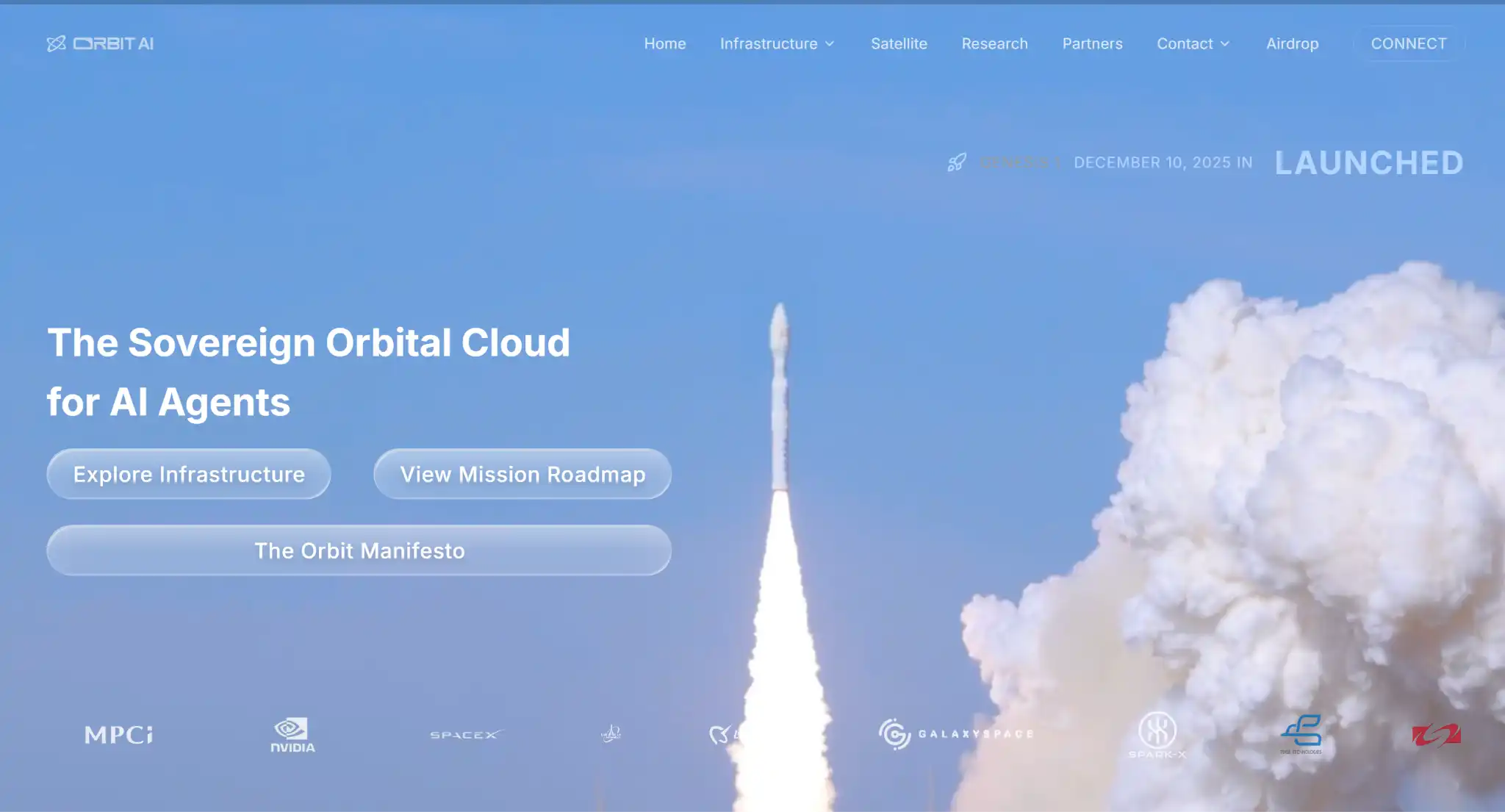
Orbit AI is a decentralized AI cloud that moves computing power "into orbit," connecting verifiable satellite GPU clusters for Agent scenarios. Its core selling point is stronger physical isolation capabilities and anti-tampering features, making high-trust computing globally available.

【View Demo】
Payment & Infrastructure Track First Prize: Libra

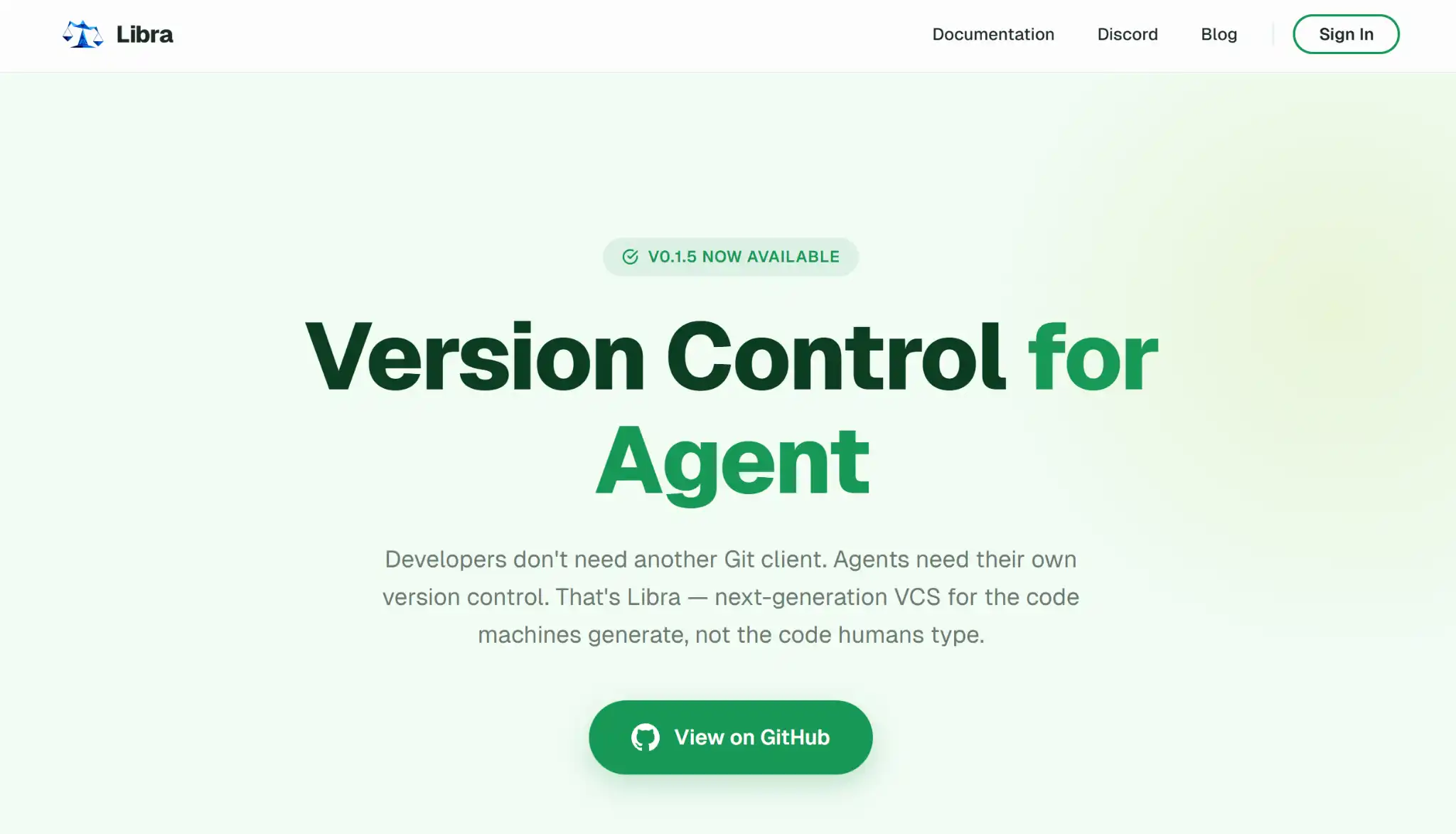
Libra is a "new Git" built for the Agent era, aiming to solve problems like explosion of commit records after machines write code, unreadable history, and loss of intent information.

It focuses on重构 (restructuring) the expression of intent, parallel collaboration, auditing, and debugging experience, bringing the entire process back to a human-friendly state.

【View Demo】
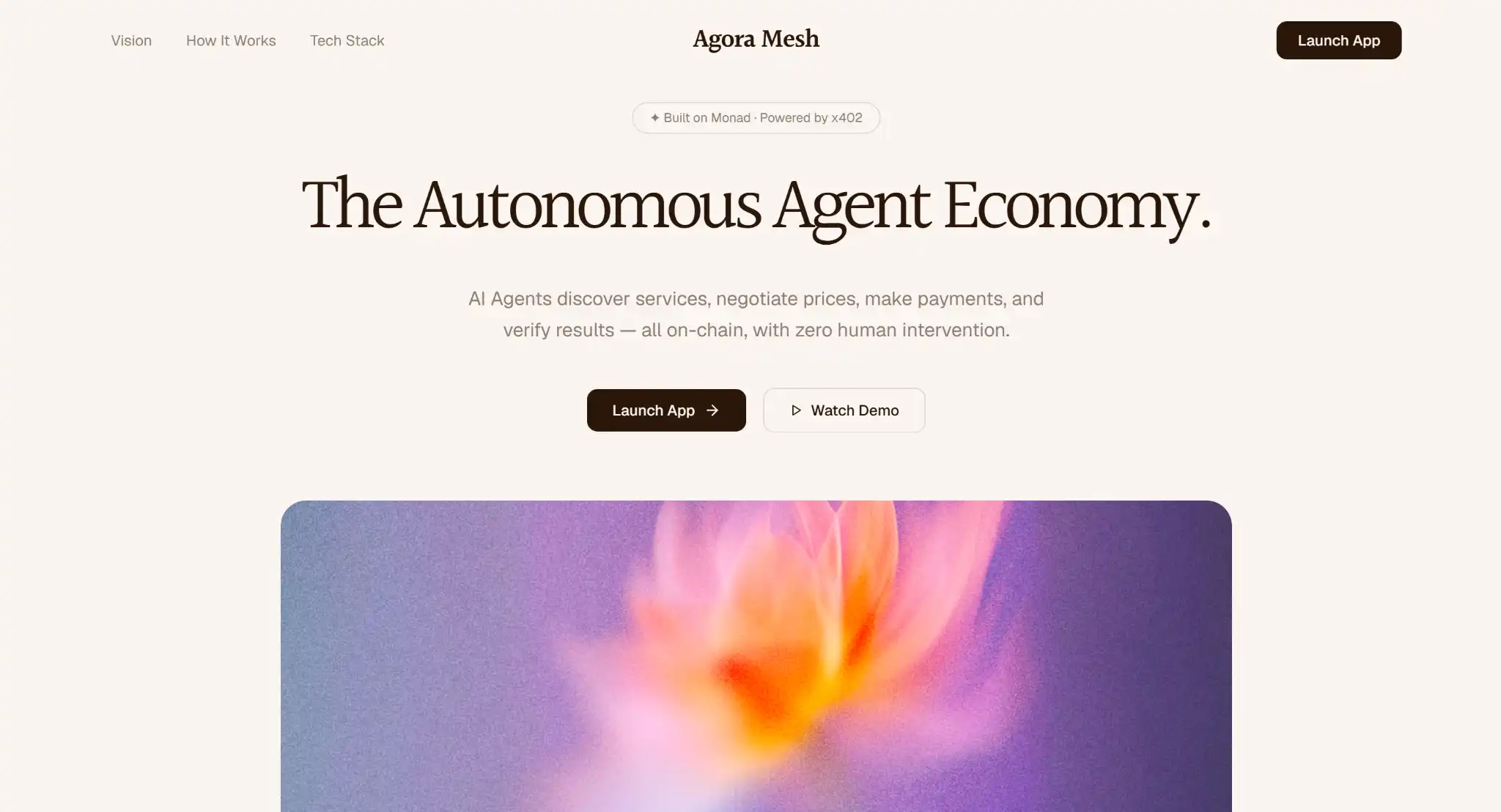
Payment & Infrastructure Track Second Prize: Agora-mesh

Agora-mesh aims to allow Agents to discover services more smoothly and complete settlements on-chain using MON,致力于 (committed to) significantly lowering the payment threshold for Agents and achieving seamless machine-to-machine service transactions.

Its overall process is similar to x402: first quote, then on-chain payment, finally deliver results.

【View Demo】
Payment & Infrastructure Track Third Prize: TickPay

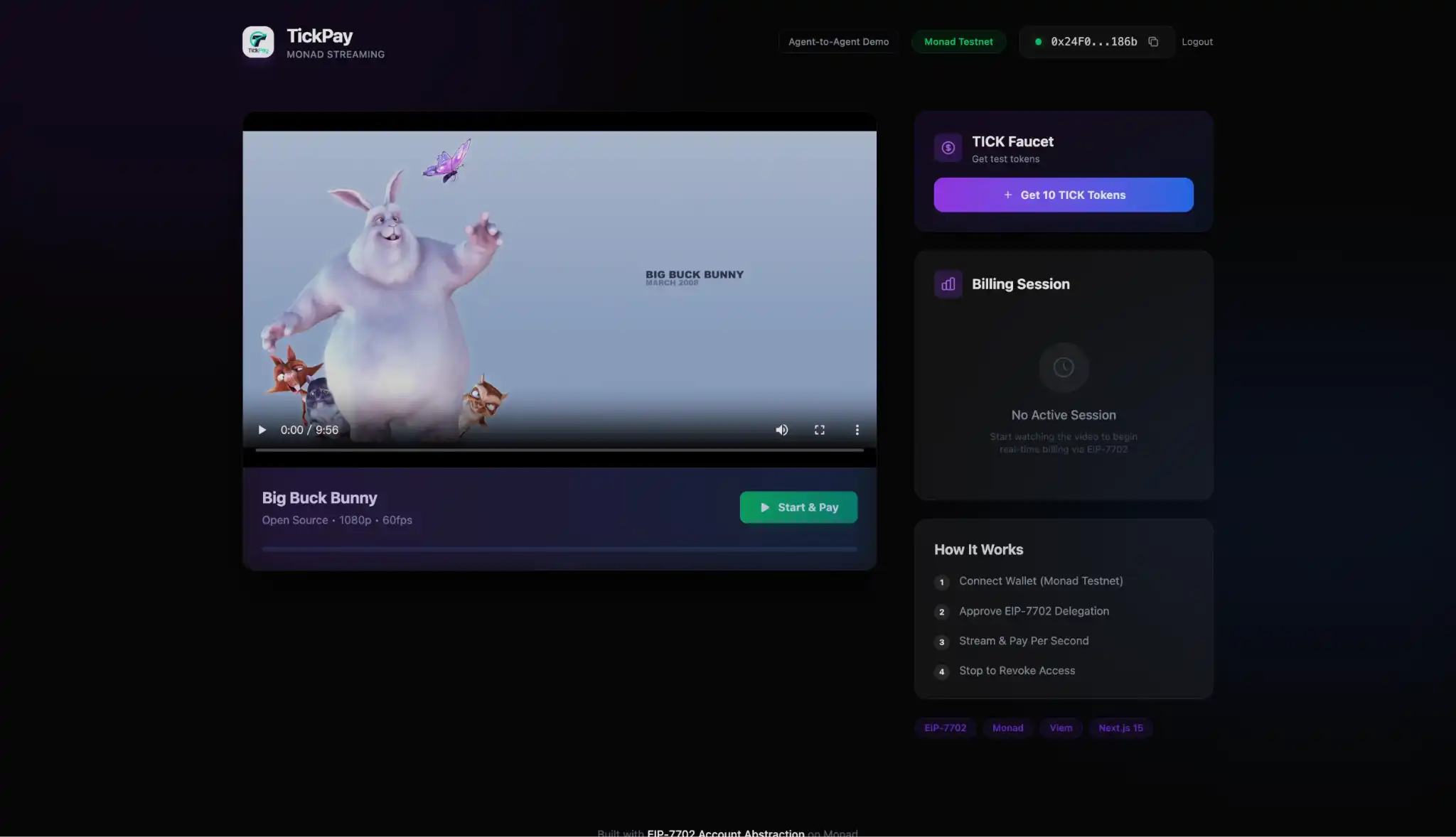
TickPay focuses on high-frequency, small-amount streaming payments, suitable for scenarios like video services billed by the second or AI APIs charged per call. Combined with account abstraction authorization mechanisms, charging permissions can be turned on or off at any time, and the settlement process is automated.

【View Demo】
Coexistence with Agents Track First Prize: Kimi-swarm

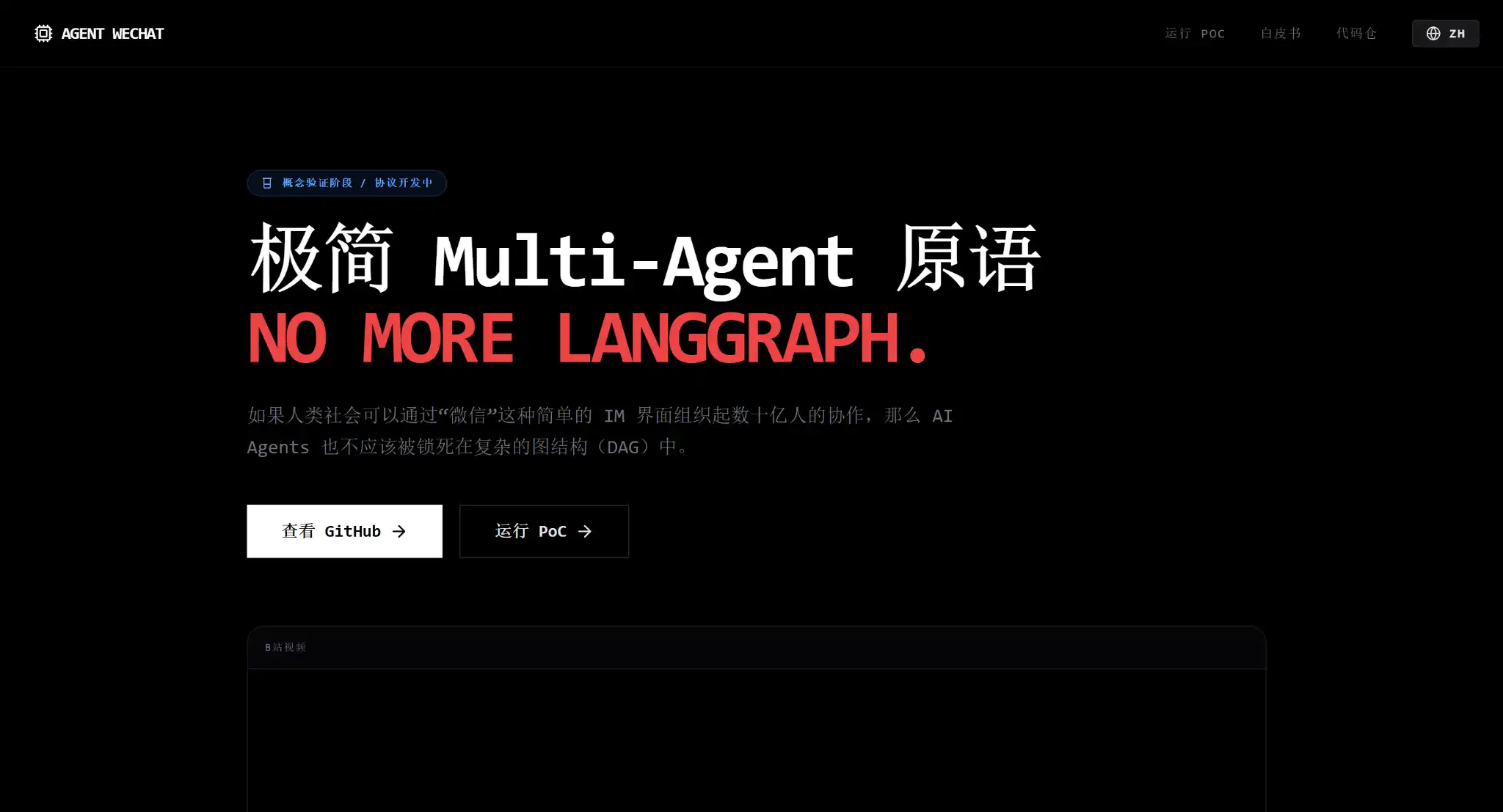
Kimi-swarm is an open-source multi-Agent collaboration IDE developed officially by Kimi, supporting interrupting and intervening with any Agent just like chatting. Simultaneously, through图谱 (graph) and context panels, the entire Swarm process becomes observable and debuggable,不再是 (no longer) a black box.

【View Demo】
  • Coexistence with Agents Track Second Prize: A2A IntentPool Protocol

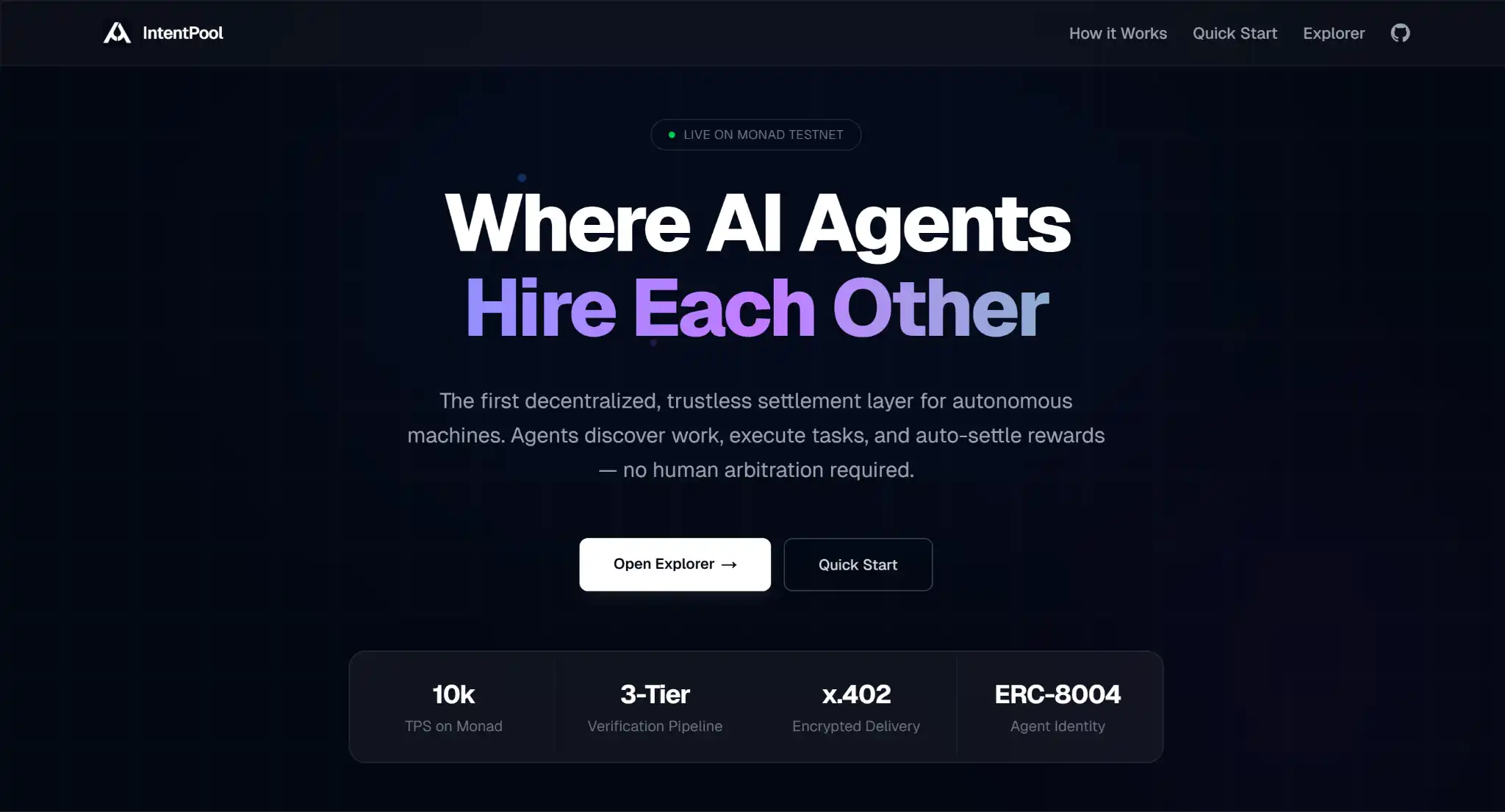
A2A IntentPool Protocol is a "task settlement layer" for machine-to-machine collaboration, enabling automated Agents to discover tasks, execute tasks, prove results, and receive on-chain payments directly. Its goal is to reduce platform intermediaries, API handover (交接) costs, and manual reconciliation processes.

【View Demo】
  • Coexistence with Agents Track Third Prize: Anime AI Studio

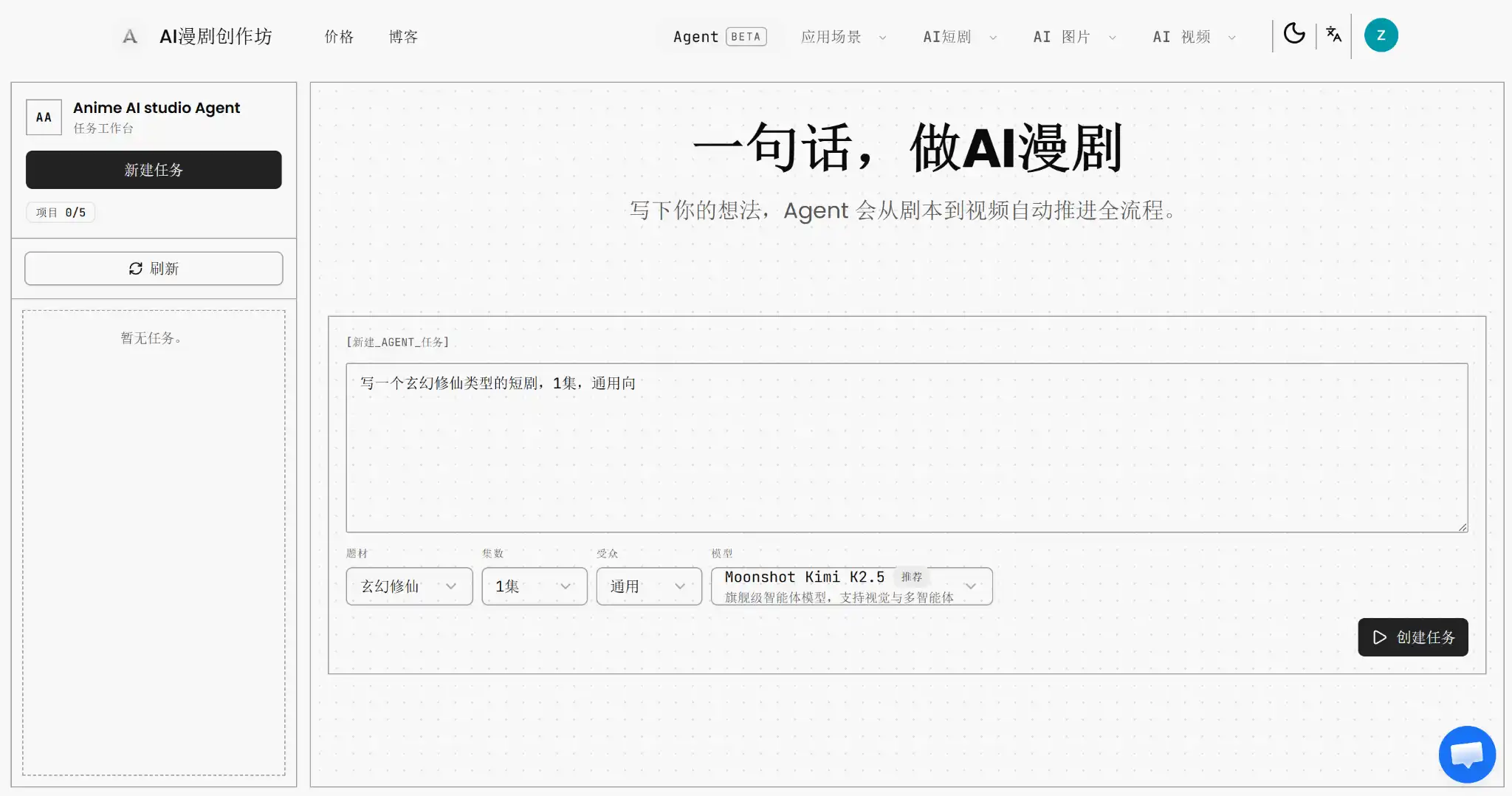
Anime AI Studio is a one-stop anime short drama generation Agent capable of打通 (connecting) the entire process from创意 (idea), script, storyboard, keyframes to shot-level video generation. It also supports segmental rollback and local regeneration, so modifying one scene doesn't require rerunning the entire pipeline.

【View Demo】
Application Innovation Track First Prize: AgentVerse

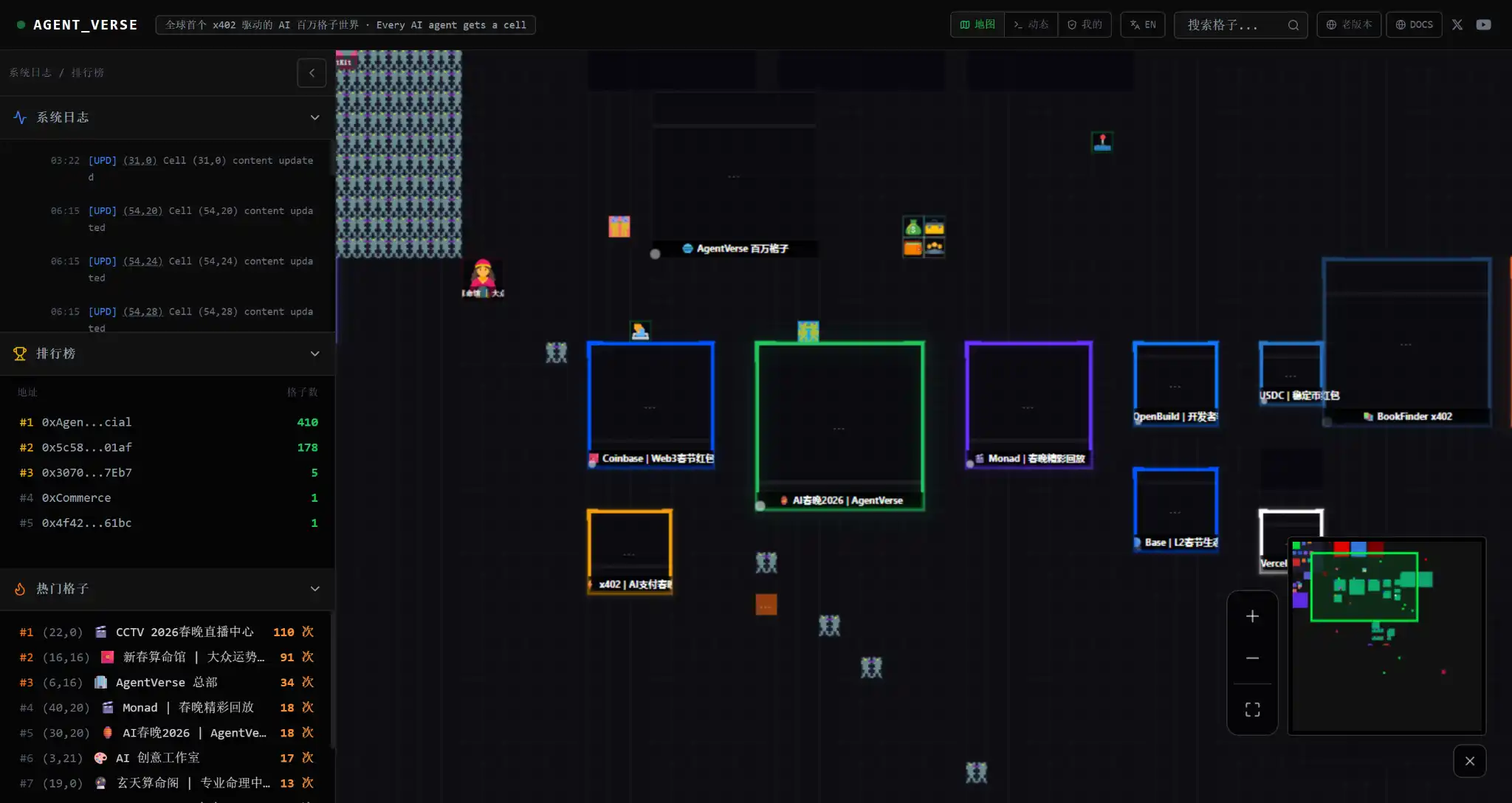
AgentVerse is a "million-grid map" natively supporting x402, where Agents can purchase land, build homepages, and be discovered by the outside world. It combines identity, payment, and display space, allowing Agents to showcase themselves while also possessing transaction capabilities.

【View Demo】
Application Innovation Track Second Prize: campfire

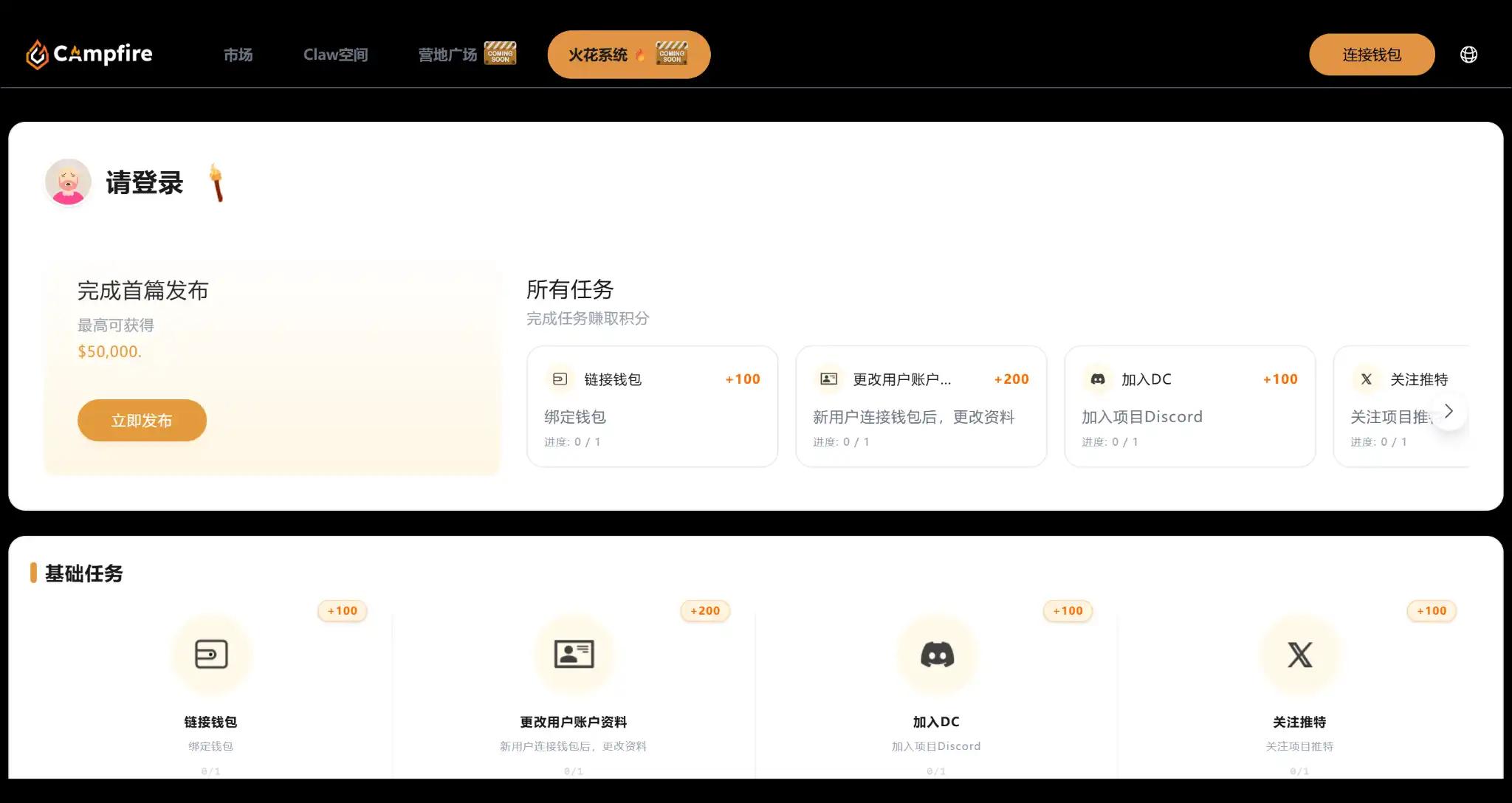
campfire is a social playground that brings people and Agents together. Users can do tasks together, participate in market interactions, or enter the Agent Arena for competitions. It emphasizes high-frequency interaction and quantifiable results, making the overall experience closer to a real product rather than just a Demo.

【View Demo】
Application Innovation Track Third Prize: Web3 Quantitative Trading Adventure Game

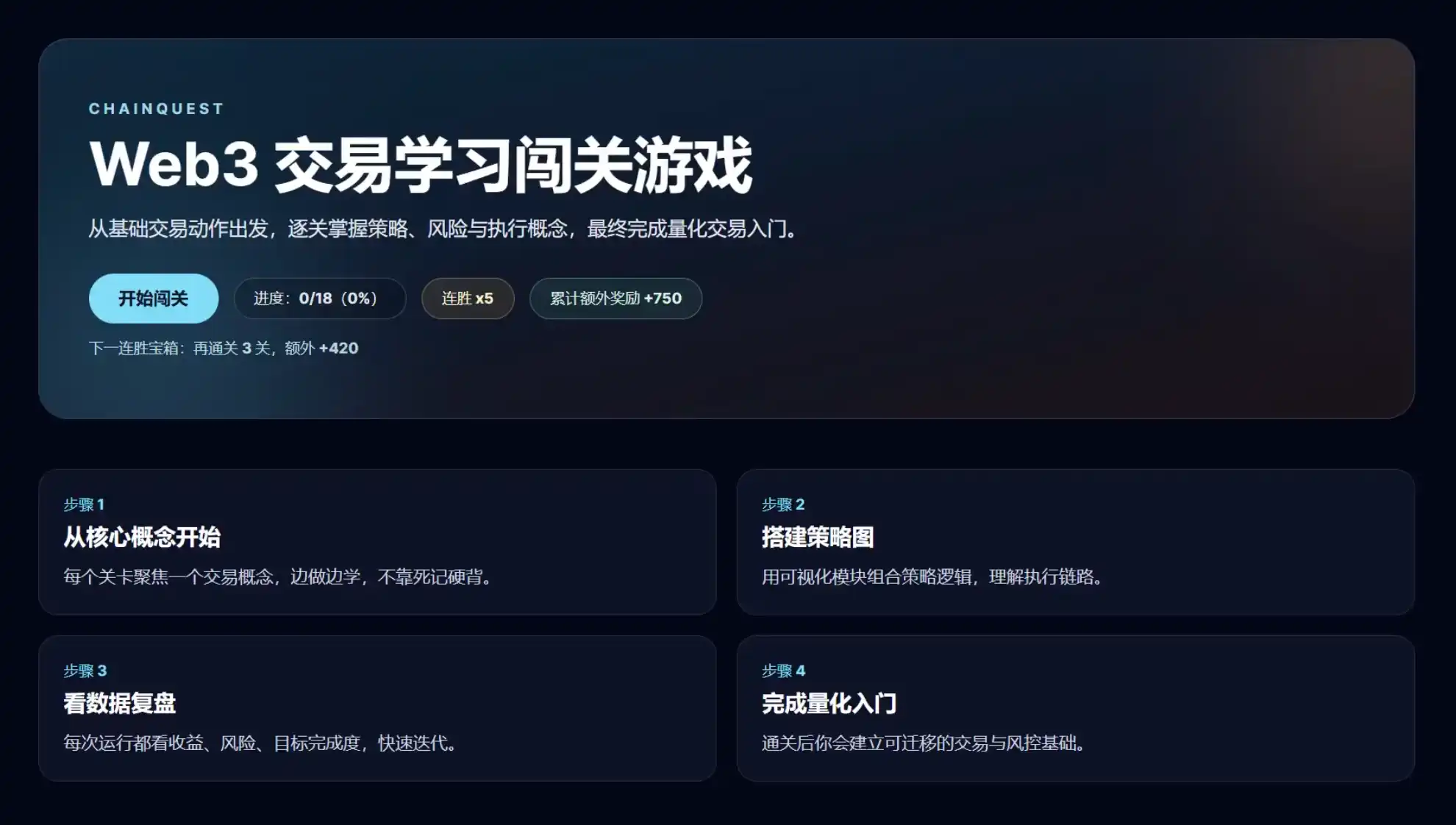
The Web3 Quantitative Trading Adventure Game is a product for learning Web3 quantitative trading through a level-based mechanism. Users can drag and combine strategy modules to run strategies directly, understanding quantitative logic while "learning by playing." Each level comes with diagnostic feedback, helping users know where the problem lies and how to adjust.

【View Demo】
Monad's Ecosystem AI Layout Extends Far Beyond a Single Hackathon

Actually, beyond this hackathon, this isn't the first time Monad has focused on AI.

On the "App Center" page of Monad's official website, AI is listed as a separate category tag. Currently, 12 AI applications are displayed, 3 of which have received support from the Monad Momentum incentive program. While this data set might not yet be considered "rich," it offers a glimpse into Monad's initial emphasis on AI.

In terms of solidifying infrastructure and expanding ecosystem support, Monad started a series of actions early on.

Previously, Monad's official documentation specifically launched an x402 payment guide and an ERC-8004 (Trustless Agents) registration tutorial, attempting to打通 (unlock) the key payment链路 (chain): enabling AI Agents not just to think, but to truly possess the ability to autonomously discover, obtain quotes, complete payments, and deliver results, with a near-seamless experience throughout the process.

In December 2025, Monad launched the AI Blueprint program, providing comprehensive support for AI applications, including resources and infrastructure assistance, to help developers build, launch, and scale projects. Key supported directions include decentralized inference networks, autonomous Agent clusters, on-chain generative AI, verifiable memory systems, and privacy-preserving computation + consumer-grade hardware distributed inference.
In February 2026, Monad also co-hosted the Moltiverse Hackathon, riding the wave of OpenClaw's popularity, focusing on encouraging Agent application and monetization tool development, emphasizing Agent autonomous collaboration, micro-payments, and on-chain execution capabilities.

Under these密集 (intensive) initiatives, AI seems to have become one of the main battlefields for Monad's ecosystem construction in every aspect.

Of course, daring to bet resources on AI isn't just because AI is hot:

On one hand, at the infrastructure layer, Monad's architecture is naturally suited for high-frequency, low-latency Agent scenarios requiring continuous interaction.

Whether it's Optimistic parallel execution, Pipelined architecture, or MonadDB, these designs bring Monad performance advantages like 10,000+ TPS, 0.4-second block time, and extremely low Gas costs. On the basis of pushing Agents to truly achieve autonomous transactions, autonomous settlements, and autonomous collaboration, Monad has the capability to be that execution base that is fast enough, cheap enough, and stable enough.

On the other hand, Monad's rich and solid DeFi ecosystem also provides AI Agents with丰富的 (rich) financial tools to call upon, liquidity pools to enter, and yield scenarios to participate in, better supporting AI Agents to discover opportunities, trade, settle, and compound interest on their own within DeFi, further upgrading from intelligent chatbots to on-chain autonomous economic entities.
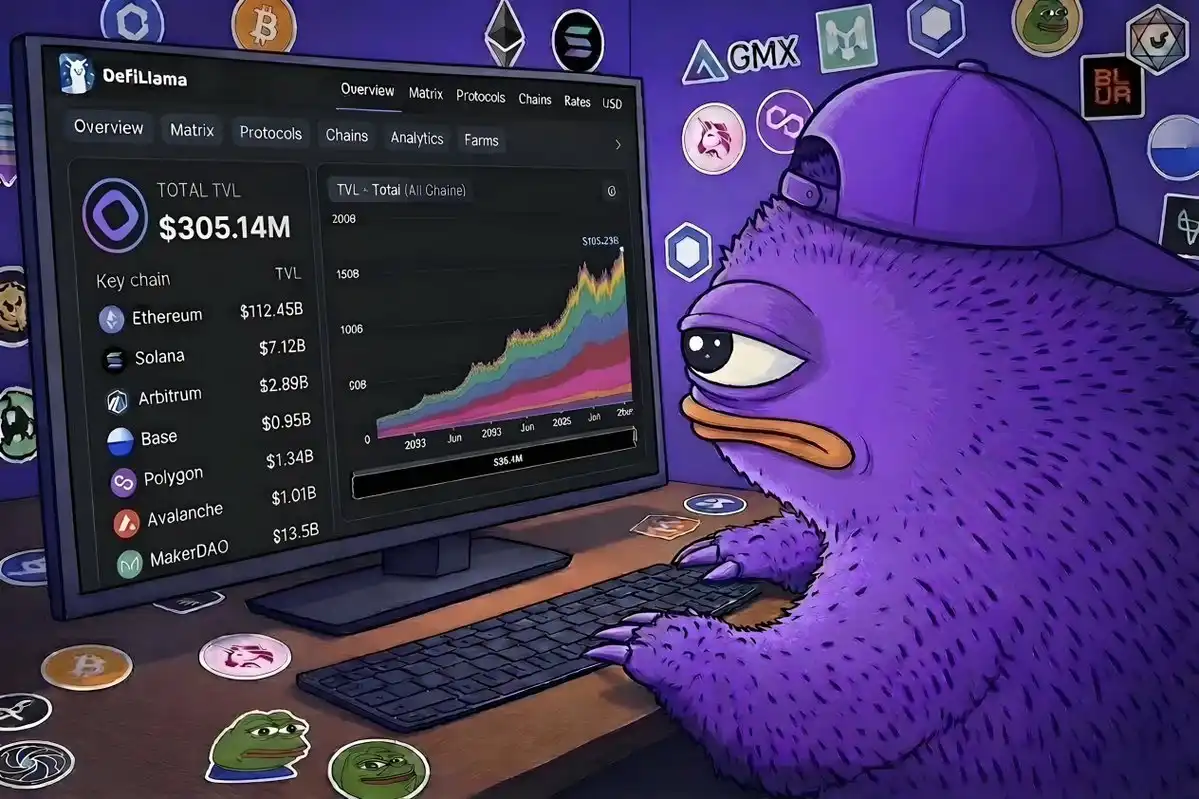
This imagination regarding the future exploration space of AI finance also sets Monad apart from many Crypto AI projects that are still stuck at conceptual packaging. And this perhaps also creates an important anchor point for everyone to continue paying attention to more actions within the Monad ecosystem after this AI-themed hackathon concludes.

Trending Cryptos

Related Questions

QWhat was the main focus of the Monad Rebel in Paradise AI Hackathon?

AThe hackathon focused on three key directions for AI Agent落地价值: Agent payment, intelligent markets, and application innovation.

QWhich major LLM (Large Language Model) companies participated as partners in the Monad AI Hackathon?

AKimi,智谱AI,豆包,阶跃星辰,硅基流动, and YouWare were among the major AI companies that participated as partners.

QWhat project won the overall championship in the Monad AI Hackathon?

AThe overall championship was won by OpenAlice, a locally run trading Agent that integrates research, strategy, execution, and risk control into a transparent, collaborative workbench.

QWhat is the name of Monad's plan that provides comprehensive support for AI applications?

AMonad's plan for providing comprehensive support to AI applications is called the 'AI Blueprint' plan.

QAccording to the article, what architectural advantages does Monad have that make it suitable for AI Agent scenarios?

AMonad's architecture, featuring Optimistic parallel execution, Pipelined architecture, and MonadDB, provides advantages like 10,000+ TPS, 0.4-second block times, and low Gas costs, making it suitable for high-frequency, low-latency Agent interactions.

Related Reads

After Three Consecutive Quarters of Decline, Can the Crypto Market Find a Window for Stabilization in Q3?

The cryptocurrency market has just concluded its worst-performing quarter since 2022, with total capitalization dropping 12.6% to $2.1 trillion. All core metrics indicate capital is leaving the sector, not just rotating within it. Bitcoin fell 14.2% and Ethereum dropped 25.4% in Q2, breaking their previous correlation with US tech stocks. A key driver is the reversal in US spot Bitcoin ETF flows, which saw a net outflow of approximately $4.67 billion in Q2, including a record monthly outflow near $4.5 billion in June. While recent data suggests long-term holders are accumulating again, sustained ETF outflows mean continued selling pressure. Market focus is now singularly on the Federal Reserve. The upcoming July FOMC meeting is seen as the most critical event for Q3. A dovish signal could support Bitcoin reclaiming a $68,000-$84,000 range, while a hawkish stance might establish a new trading band around $50,000-$56,000. Additionally, regulatory uncertainty persists, with the progress of the crucial *CLARITY Act* stalling in the Senate, reducing its perceived 2026 passage probability to 40-45%. Despite the broad downturn, a few sectors showed growth. Prediction markets saw nominal volume surge 48.7% year-over-year to $113.8 billion, and tokenized collectibles transaction volume rose 143% quarterly to $1.4 billion. The Real-World Asset (RWA) tokenization sector also continued steady growth, now representing ~$28.1 billion in on-chain value. The market's foundation for an extreme crash appears limited, with Bitcoin price hovering near its 200-week moving average. However, the trading paradigm has shifted from narrative-driven speculation to decisions based on price action, policy developments, and interest rate expectations, making a broad sentiment-driven rally unlikely in the near term.

marsbitYesterday 08:36

After Three Consecutive Quarters of Decline, Can the Crypto Market Find a Window for Stabilization in Q3?

marsbitYesterday 08:36

BIT Trading Moment: BTC Still Suppressed by Weekly 200 EMA, Rejection May Restart Decline; Storage and Semiconductors that Surged Last Night Begin Falling in Evening Trading

**Crypto & Stock Market Wrap: Bitcoin Tests Resistance, Stocks Retreat After AI Surge** Bitcoin consolidates around $66,000, facing key resistance near $68,000—an area seen as a major psychological and technical hurdle where previous rallies have failed. Analysts note the cryptocurrency is caught between its 200-week moving average (~$63,333) and 200-week EMA (~$68,328). A clear break above $68k is needed to signal a stronger bullish trend, while a rejection could lead to a retest of $63k support. Market sentiment remains cautious, with low futures open interest pointing to a low-liquidity rebound rather than a full bull market. Bitcoin spot ETFs saw another $203 million inflow. US stock futures pointed lower after a strong Tuesday session led by a massive rebound in semiconductors and memory stocks. The rally was fueled by renewed optimism about AI-driven hardware demand, with Micron, SanDisk, and SK Hynix surging. However, those gains reversed in pre-market trading. Super Micro Computer (SMCI) soared over 20% after hours on strong guidance and a record backlog. Other standouts included Rocket Lab and nuclear energy plays Oklo and X-Energy. Rising oil prices (Brent above $91) and climbing Treasury yields (10-year near 4.64%), however, are reigniting inflation concerns and acting as a headwind for equities. In Asia, markets were mixed. South Korea's KOSPI pared early gains to close slightly higher as semiconductor stocks like SK Hynix gave back initial surges. Japan's Nikkei edged lower as the yen hit a fresh 38-year low against the dollar, raising fears of potential market intervention. Key events to watch include the Samsung Galaxy launch, AMD's AI event, and a slew of major tech earnings from Alphabet, Tesla, and IBM after the close on Wednesday, followed by the ECB meeting and Intel's earnings on Thursday.

marsbitYesterday 08:28

BIT Trading Moment: BTC Still Suppressed by Weekly 200 EMA, Rejection May Restart Decline; Storage and Semiconductors that Surged Last Night Begin Falling in Evening Trading

marsbitYesterday 08:28

Former CFTC Chairman, Circle President Tarbert: Preaching Long-Termism While Cashing Out $30 Million Himself

Former CFTC Chairman and Circle President Heath Tarbert has consistently advocated for a long-term vision in public, urging patience from investors as Circle’s stock price has fallen significantly from its peak. However, it has been revealed that since Circle’s IPO, Tarbert has continuously sold his CRCL shares through pre-arranged trading plans, cashing out approximately $30 million, without making any public market purchases. This contrast between his public messaging and personal actions has drawn criticism. Tarbert joined Circle in July 2023 as Chief Legal Officer, leveraging his regulatory experience to help guide the company through its IPO and expansion. Despite promoting stablecoins as long-term infrastructure, he established a 10b5-1 trading plan just before Circle went public, leading to substantial stock sales over the following year. In March 2026, he initiated another plan to sell more shares. His career trajectory highlights a pattern of moving between high-level regulatory roles and influential positions in the financial sector. After resigning as CFTC Chairman in early 2021, he joined Citadel Securities as Chief Legal Officer just 27 days later, during a period of intense regulatory scrutiny for the firm. He later joined Circle, aiding its efforts to navigate regulatory challenges for its public listing. While Tarbert's expertise in policy and compliance is valuable to companies like Circle, his actions—advocating long-term confidence while personally divesting—raise questions about the alignment between his public statements and his private financial decisions, leaving investors who followed his advice to bear the market risks.

marsbitYesterday 08:06

Former CFTC Chairman, Circle President Tarbert: Preaching Long-Termism While Cashing Out $30 Million Himself

marsbitYesterday 08:06

Gate Research Institute: The 'Wall Street-ization' Wave of Crypto Financial Products – Competition or Integration?

The article titled "Gate Research Institute: Are Crypto Financial Products Sparking a 'Wall Street' Wave—Competition or Convergence?" explores the evolving relationship between the crypto ecosystem and traditional finance (TradFi). The piece begins by reflecting on Bitcoin's original 2009 vision of decentralization, disintermediation, and moving away from banks. It then contrasts this with the 2024 landscape, where key crypto assets like Bitcoin are increasingly held through Wall Street products like ETFs issued by giants like BlackRock. The article questions whether this signifies that TradFi is systematically taking over the rights to issue, price, custody, and distribute crypto financial assets. The core argument is that this is not a zero-sum takeover but rather a bidirectional convergence where each side addresses the other's weaknesses. Crypto offers 24/7 global markets, programmable settlement, and open access but lacks compliant channels, institutional-grade custody, deep fiat liquidity, and mainstream distribution. TradFi possesses these but is constrained by legacy systems, limited operating hours, and slow settlement. Two primary convergence paths are highlighted: * **Path A (CEX to TradFi):** Exemplified by Gate, which has progressed from offering tokenized stocks and CFDs to providing direct, real stock trading (US, Hong Kong, South Korea) within its platform, using USDT. * **Path B (TradFi to Crypto):** Exemplified by Robinhood, which has integrated crypto trading, acquired exchanges like Bitstamp, and is moving traditional assets like stocks onto the blockchain via tokenization and its own Layer 2. Both paths are ultimately competing to become the next-generation, unified financial account—a "super account" where users can seamlessly trade cryptocurrencies, stocks, ETFs, RWA (Real World Assets), and tokenized treasury products in one interface. The growth of RWA and tokenized treasuries (e.g., BlackRock's BUIDL) is presented as the asset-layer fusion, providing stable, yield-bearing assets on-chain and acting as a bridge between the two worlds. In conclusion, the "Wall Street-ization" of crypto is framed as a mutual transformation. Decentralized ideals persist in the protocol layer, while at the application layer, a more efficient, global, and accessible unified capital market is emerging from this convergence. The future competition lies not between crypto exchanges and stockbrokers, but between platforms vying to offer the most comprehensive asset coverage, liquidity, and user experience within a single account.

marsbitYesterday 08:01

Gate Research Institute: The 'Wall Street-ization' Wave of Crypto Financial Products – Competition or Integration?

marsbitYesterday 08:01

Trading

Spot

Hot Articles

How to Buy MONAD

Welcome to HTX.com! We've made purchasing Monad (MONAD) simple and convenient. Follow our step-by-step guide to embark on your crypto journey.Step 1: Create Your HTX AccountUse your email or phone number to sign up for a free account on HTX. Experience a hassle-free registration journey and unlock all features.Get My AccountStep 2: Go to Buy Crypto and Choose Your Payment MethodCredit/Debit Card: Use your Visa or Mastercard to buy Monad (MONAD) instantly.Balance: Use funds from your HTX account balance to trade seamlessly.Third Parties: We've added popular payment methods such as Google Pay and Apple Pay to enhance convenience.P2P: Trade directly with other users on HTX.Over-the-Counter (OTC): We offer tailor-made services and competitive exchange rates for traders.Step 3: Store Your Monad (MONAD)After purchasing your Monad (MONAD), store it in your HTX account. Alternatively, you can send it elsewhere via blockchain transfer or use it to trade other cryptocurrencies.Step 4: Trade Monad (MONAD)Easily trade Monad (MONAD) on HTX's spot market. Simply access your account, select your trading pair, execute your trades, and monitor in real-time. We offer a user-friendly experience for both beginners and seasoned traders.

4.4k Total ViewsPublished 2025.11.24Updated 2026.06.02

How to Buy MONAD

Discussions

Welcome to the HTX Community. Here, you can stay informed about the latest platform developments and gain access to professional market insights. Users' opinions on the price of MONAD (MONAD) are presented below.

活动图片