Prediction Markets = Market Manipulation? The Failure of Collective Wisdom and the Battle for Settlement Rights

marsbitPublished on 2025-12-23Last updated on 2025-12-23

Abstract

This article examines the controversial nature of prediction markets, particularly Polymarket, through three case studies, arguing that they are vulnerable to manipulation, groupthink, and battles over settlement authority, rather than being pure expressions of collective wisdom. Case 1: "Who will HBO identify as Satoshi?" Despite leaked evidence and media reports confirming the documentary would identify Peter Todd, the price for "Len Sassaman" remained high due to the community's emotional preference for a more narratively satisfying outcome. This demonstrates how narrative and emotion can cause market prices to deviate from factual evidence. Case 2: "How many gifts will Santa deliver?" Traders discovered a hardcoded number in the NORAD website's source code and drove the price of that outcome above 90%. However, this turned the market into a bet on whether the developers would change the number before the deadline, highlighting how centralized control of information sources creates exploitable opportunities. Case 3: "Israel strikes Gaza" contract. In the final hours, a coordinated effort using unverified screenshots and sell orders crashed the price of "No" to 1-2%, creating a false narrative of an attack. The contract was controversially settled as "Yes," showcasing how narrative, capital, and control over the settlement process can be weaponized to manipulate outcomes. The analysis concludes that prediction markets are not neutral but are instead arenas where media n...

Prediction markets, the current hot topic. But when you dive deep, every time you press Yes/No, the gears of fate begin to turn.

This article attempts to analyze controversial topics on prediction markets (primarily Polymarket), exploring their manipulability within binary博弈 (game theory of binary outcomes).

Case Selection

Who will HBO identify as Satoshi?

How many gifts will Santa deliver in 2025

Israel strikes Gaza by...?

And attempts to discuss potential market intervention methods from perspectives like psychology/group effects/house game theory/mass communication.

"Who is Satoshi" Bet: The Market Refuses to Believe the Truth

Around the release of HBO's "Money Electric: The Bitcoin Mystery," a contract on Polymarket became a classic example of "narrative diverging from fact": "Who will HBO identify as Satoshi?" (October 2024).
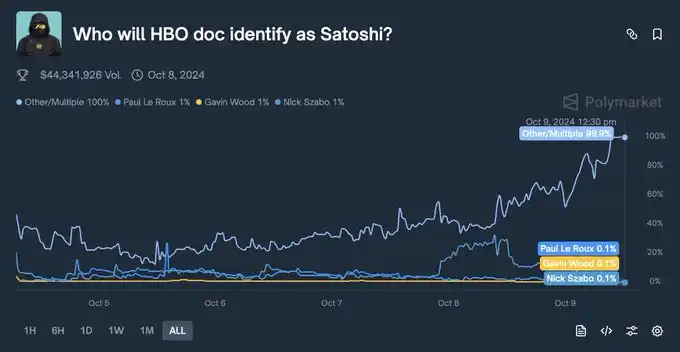
On the surface, this was a collective guessing game about the crypto world's ultimate unsolved case, with participants trying to bet on who the documentary would name as Bitcoin's creator: Len Sassaman, Hal Finney, Adam Back, or Peter Todd, who never appeared on any long conspiracy theory list.​

The vast majority of cryptocurrency community members, KOLs, and media firmly believed HBO would reveal the late cryptographer Len Sassaman. Because Len's life story fit the characteristics of Satoshi, and his tragic, legendary image aligned with HBO's narrative aesthetic.

And Len Sassaman's probability (Yes) soared to 68% - 70%.

The key lies in the timeline.

Some journalists and insiders who were invited to early media screenings began leaking clips on Twitter and dark web forums. The leaked clips and screenshots clearly showed director Cullen Hoback questioning another developer, Peter Todd, and attempting to portray him as Satoshi.

Peter Todd himself even posted on Twitter mocking the director, indirectly confirming he was a main subject of the documentary. At the same time, preview articles and headlines from multiple media outlets already used phrases like "doc identifies Peter Todd as Satoshi".​

Despite this, the most fascinating part emerged. Even with screenshots out, the price for Len Sassaman on Polymarket didn't crash, still holding at a high of 40%-50%!

Because the community refused to believe. People brainwashed each other in the comments: "This is just an HBO red herring," "Peter Todd is just a supporting character, the final big twist will definitely be Len."

At this point, opportunity arose. The odds for Peter Todd / Other options were extremely attractive (at one point only 10%-20%).

This was like "picking gold bars from the bargain bin."

——When and only when fact contradicts desire, Alpha is greatest.

People wanted it to be Len Sassaman so badly (because he is deceased, wouldn't dump Bitcoin, and has a poignant story). This emotional preference blinded rational judgment. In prediction markets, never bet on what you "hope" will happen, only bet on facts.

And the rules themselves stated: "who will HBO identify as Satoshi", not "who really is Satoshi".

Media narrative + emotional resonance. Just give the market a compelling enough story, and the price will willingly deviate from fact.

"Santa Code Gate": When Hardcoding Becomes an Option

The second incident seemed more lighthearted: the NORAD Santa Tracker project. Every Christmas, NORAD displays the "number of gifts Santa delivers" on a dedicated website. In 2025, this fun project became a guessing subject on Polymarket: "How many gifts will Santa deliver in 2025?"

Then, someone opened the browser console.

Technical traders found a hardcoded value precise to the single digit: 8,246,713,529 in the front-end JS/JSON files of noradsanta.org. This number was logically similar to the "gift count" from previous years, yet significantly lower than the reasonable range projected based on historical growth rates (8.4–8.5B), more like a temporary script filled in by a programmer rushing to meet a deadline.
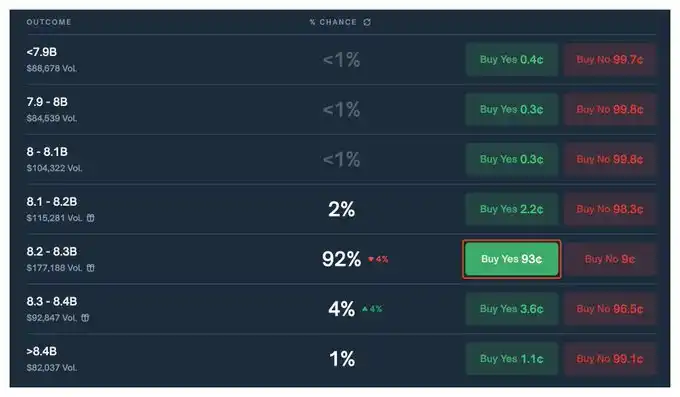
In the market's eyes, this hardcode was quickly interpreted as the "ultimate answer":

  • The corresponding "8.2–8.3B" range contract price surged from around 60% to over 90%;
  • Substantial funds saw this as cashing in on an "information advantage," treating the remaining few percentage points as arbitrage for the taking.

But the真正微妙的地方在于: once the leak was widely used by traders, the hardcode itself became a triggerable variable.

The NORAD website is centrally maintained; the developers have full authority to override the pre-written value at the last moment; when "lazy developer" and "hardcode fraud" become part of the social舆论 (public opinion), the maintainers even have an incentive to change the value in real-time to prove they are not a slapdash organization.

This means that for those who bought large positions in the "8.2–8.3B=Yes" at 0.93, what they were truly betting against was not how many gifts Santa "delivered," but whether a developer would change that string of numbers in the final commit before going live.

Structurally, this market allows multiple "intervention methods" to exert significant leverage on the price.

The NORAD website is centrally maintained; the developers have full authority to override the pre-written value at the last moment. When "lazy developer" and "hardcode fraud" become part of the social narrative, the maintainers even have an incentive to change the value in real-time to prove they are not a slapdash organization.

This means that for those who bought large positions in the "8.2–8.3B=Yes" at 0.93, what they were truly betting against was not how many gifts Santa "delivered," but whether a developer would change that string of numbers in the final commit before going live.

Here, the prediction market is no longer "predicting an objective random variable," but provides a derivative field for a small group controlling the system's switches to "bet on how their actions will be interpreted by the outside world." The person writing the front-end code naturally possesses the dual power of "spoiler +随时篡改 (tampering at any time)."

Technical players deploying code crawlers early can establish positions before most people are even aware the hardcode exists; media or influencers can indirectly influence whether the maintainers adjust their strategy by amplifying the narrative of the "hardcode scandal."

Here, the prediction market is no longer about predicting an objective random variable, but provides a derivative field for a small group controlling the system's switches to bet on how their actions will be interpreted by the outside world.

"Gaza Strike" Contract: The Scripted Kill in the Pre-Dawn Market

The third incident had the most real-world impact. Thanks to @ec_unoxx's summary, the trader is @poliedge100, Teacher Little Alligator.

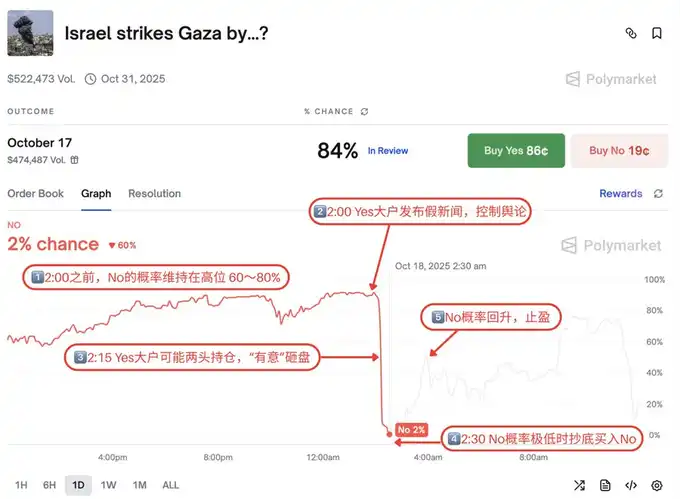
A contract centered on "whether Israel would strike Gaza before a specific deadline"上演了一场 (staged) an extremely "scripted" price washout in the tail-end phase临近到期 (approaching expiration).

Initially, the market widely believed the probability of a large-scale strike before the deadline was limited, with the "No" price staying in the high range of 60%–80% for a long time. As time passed, "nothing happening" itself seemed to continuously reinforce the validity of "No".

Then came the familiar rhythm: pre-dawn hours +舆论攻势 (public opinion offensive) + panic selling.

  • In the platform's comments section, the "Yes" side began密集张贴 (intensively posting) unverified screenshots, local media links, even old news, creating a narrative atmosphere of "the strike has already happened, just the major media is slow to react."
  • Simultaneously, large sell orders appeared on the order book, actively breaking through (smashing through) the support for "No", pushing the price down to the "junk zone" of 1%–2%.

For holders极度依赖情绪 (extremely reliant on emotion) for information, this series of actions was enough to create an "endgame illusion":

"Since someone is selling off to escape, and the comments are all saying it happened, it must be that I missed the news."

While this panic was being manufactured, a small group of people坚持做事实核查 (persisting in fact-checking) came to a completely different conclusion from another direction:

  • Before the preset deadline, there was no sufficiently clear, consistently recognized by authoritative media, and符合合约规则定义的 (meeting the contract rule definition) evidence of an "airstrike";
  • From a textual rule perspective, "No" still had a high probability of being the final legitimate settlement result.
Thus, an asymmetric lottery ticket appeared again structurally:

  • The market price treated "No" as a 1% minor probability;
  • Textual evidence and rule interpretation suggested a现实概率 (realistic probability) far higher than 1%.

What truly sparked controversy was the scene after settlement:

  • After the tail-end session, someone proposed settling as "Yes", entering a limited dispute period;
  • Due to procedural reasons or insufficient resources from participating parties, this settlement direction was ultimately not successfully overturned;
  • The contract was最终锁定 (finally locked) as "Yes", and many who insisted on a textual rule interpretation could only argue afterwards "whether this conformed to the original rule design," but couldn't change the flow of funds.

This accident exposed the "greenhouse effect" of prediction markets极为赤裸 (extremely赤裸裸, nakedly):

  • Public opinion can cause price collapses in a short time;
  • Capital can create the false appearance of "smart money retreating" through self-directed selling;
  • Ultimate settlement power often lies in the hands of a very few parties with resources and organizational capacity.

This is no longer "deviation of collective wisdom," but a manipulation space formed by the amalgamation of narrative, capital, and rule interpretation power.

To summarize, in the three cases above, prediction markets present another picture:

  • For news initiators and media

Every prediction market can be seen as a real-time thermometer for narrative influence.

Documentary directors, PR teams, topic creators can all adjust their output rhythm by observing the order book: which candidates to continue hyping, which plots need more drama.

In some extreme cases, content creators can even "reverse" utilize the order book, writing market preferences back into the script.

  • For project parties / platforms

The ambiguity of rules, the choice of settlement sources, the design of dispute mechanisms, all directly affect "who profits from tail-end events."

Ambiguous oracles, broad discretionary power, equate to reserving a "gray space" that can be used by organized forces.

In this space, prediction markets are no longer passive "result registries," but active tools for liquidity momentum building.

  • For participants (retail investors / KOLs / communities)

Comment sections, social media, and various secondary interpretations constitute a整套 (complete set) of psychological leverage that can be exploited.

By集中发布 (centrally publishing) "seemingly authoritative" screenshots, links, out-of-context news headlines, actors can push prices from rational ranges into panic or frenzy zones in a short time.

In this structure, those with stronger discourse power (KOLs, big Vs, research accounts) naturally possess the ability to manipulate narratives.

  • For hackers and "system players"

Monitoring front-end code, data source updates, news APIs, even oracle mechanisms本身就可以成为 (can themselves become) systematic strategies.

Capturing hardcodes, configuration errors, rule edge cases in advance, and then building positions before the market reacts, is a form of high-leverage "structured alpha."

More aggressive players will directly research: how to legally or "edge" influence settlement information sources, making the world "appear" consistent with their position direction for a short time.

Finally, quoting @LeotheHorseman Teacher Horse Man's x pinned tweet:

The truthfulness of information feels irrelevant now (in both epistemological and practical senses), what people are willing to pay for is reality. Perhaps the most important proposition of the current era is how the pricing of information and the information of pricing interact with each other.


Trending Cryptos

Related Questions

QWhat is the main argument presented in the article about prediction markets like Polymarket?

AThe article argues that prediction markets are often susceptible to manipulation through narrative control, emotional bias, and the exploitation of rule ambiguities, rather than purely reflecting collective wisdom or objective reality.

QIn the HBO 'Who is Satoshi' market, why did the price for Len Sassaman remain high despite evidence pointing to Peter Todd?

AThe price remained high because the crypto community had a strong emotional preference for Len Sassaman (a deceased cryptographer with a tragic and compelling story) and collectively refused to believe the leaked evidence, dismissing it as an HBO 'red herring' or narrative misdirection.

QHow did the discovery of hardcoded data in the NORAD Santa tracker website create a unique risk for traders?

AIt created a risk because the market began betting on a fixed number, but the website's developers, who are centralized maintainers, had the power to change that number at the last minute, especially if public pressure about the lazy hardcoding made them want to prove they weren't incompetent.

QWhat three elements does the article identify as combining to form a 'manipulation space' in the Israel-Gaza contract case?

AThe three elements are narrative (spreading unverified information/rumors), capital (large sell orders to manipulate the market price), and the power to interpret rules (control over the final settlement decision).

QAccording to the article, what new role do prediction markets play for news creators and media organizations?

AThey act as a real-time thermometer for narrative influence, allowing directors, PR teams, and content creators to gauge public sentiment and potentially adjust their output or even 'write the narrative back into the script' based on market preferences.

Related Reads

After Three Consecutive Quarters of Decline, Can the Crypto Market Find a Window for Stabilization in Q3?

The cryptocurrency market has just concluded its worst-performing quarter since 2022, with total capitalization dropping 12.6% to $2.1 trillion. All core metrics indicate capital is leaving the sector, not just rotating within it. Bitcoin fell 14.2% and Ethereum dropped 25.4% in Q2, breaking their previous correlation with US tech stocks. A key driver is the reversal in US spot Bitcoin ETF flows, which saw a net outflow of approximately $4.67 billion in Q2, including a record monthly outflow near $4.5 billion in June. While recent data suggests long-term holders are accumulating again, sustained ETF outflows mean continued selling pressure. Market focus is now singularly on the Federal Reserve. The upcoming July FOMC meeting is seen as the most critical event for Q3. A dovish signal could support Bitcoin reclaiming a $68,000-$84,000 range, while a hawkish stance might establish a new trading band around $50,000-$56,000. Additionally, regulatory uncertainty persists, with the progress of the crucial *CLARITY Act* stalling in the Senate, reducing its perceived 2026 passage probability to 40-45%. Despite the broad downturn, a few sectors showed growth. Prediction markets saw nominal volume surge 48.7% year-over-year to $113.8 billion, and tokenized collectibles transaction volume rose 143% quarterly to $1.4 billion. The Real-World Asset (RWA) tokenization sector also continued steady growth, now representing ~$28.1 billion in on-chain value. The market's foundation for an extreme crash appears limited, with Bitcoin price hovering near its 200-week moving average. However, the trading paradigm has shifted from narrative-driven speculation to decisions based on price action, policy developments, and interest rate expectations, making a broad sentiment-driven rally unlikely in the near term.

marsbitYesterday 08:36

After Three Consecutive Quarters of Decline, Can the Crypto Market Find a Window for Stabilization in Q3?

marsbitYesterday 08:36

BIT Trading Moment: BTC Still Suppressed by Weekly 200 EMA, Rejection May Restart Decline; Storage and Semiconductors that Surged Last Night Begin Falling in Evening Trading

**Crypto & Stock Market Wrap: Bitcoin Tests Resistance, Stocks Retreat After AI Surge** Bitcoin consolidates around $66,000, facing key resistance near $68,000—an area seen as a major psychological and technical hurdle where previous rallies have failed. Analysts note the cryptocurrency is caught between its 200-week moving average (~$63,333) and 200-week EMA (~$68,328). A clear break above $68k is needed to signal a stronger bullish trend, while a rejection could lead to a retest of $63k support. Market sentiment remains cautious, with low futures open interest pointing to a low-liquidity rebound rather than a full bull market. Bitcoin spot ETFs saw another $203 million inflow. US stock futures pointed lower after a strong Tuesday session led by a massive rebound in semiconductors and memory stocks. The rally was fueled by renewed optimism about AI-driven hardware demand, with Micron, SanDisk, and SK Hynix surging. However, those gains reversed in pre-market trading. Super Micro Computer (SMCI) soared over 20% after hours on strong guidance and a record backlog. Other standouts included Rocket Lab and nuclear energy plays Oklo and X-Energy. Rising oil prices (Brent above $91) and climbing Treasury yields (10-year near 4.64%), however, are reigniting inflation concerns and acting as a headwind for equities. In Asia, markets were mixed. South Korea's KOSPI pared early gains to close slightly higher as semiconductor stocks like SK Hynix gave back initial surges. Japan's Nikkei edged lower as the yen hit a fresh 38-year low against the dollar, raising fears of potential market intervention. Key events to watch include the Samsung Galaxy launch, AMD's AI event, and a slew of major tech earnings from Alphabet, Tesla, and IBM after the close on Wednesday, followed by the ECB meeting and Intel's earnings on Thursday.

marsbitYesterday 08:28

BIT Trading Moment: BTC Still Suppressed by Weekly 200 EMA, Rejection May Restart Decline; Storage and Semiconductors that Surged Last Night Begin Falling in Evening Trading

marsbitYesterday 08:28

Former CFTC Chairman, Circle President Tarbert: Preaching Long-Termism While Cashing Out $30 Million Himself

Former CFTC Chairman and Circle President Heath Tarbert has consistently advocated for a long-term vision in public, urging patience from investors as Circle’s stock price has fallen significantly from its peak. However, it has been revealed that since Circle’s IPO, Tarbert has continuously sold his CRCL shares through pre-arranged trading plans, cashing out approximately $30 million, without making any public market purchases. This contrast between his public messaging and personal actions has drawn criticism. Tarbert joined Circle in July 2023 as Chief Legal Officer, leveraging his regulatory experience to help guide the company through its IPO and expansion. Despite promoting stablecoins as long-term infrastructure, he established a 10b5-1 trading plan just before Circle went public, leading to substantial stock sales over the following year. In March 2026, he initiated another plan to sell more shares. His career trajectory highlights a pattern of moving between high-level regulatory roles and influential positions in the financial sector. After resigning as CFTC Chairman in early 2021, he joined Citadel Securities as Chief Legal Officer just 27 days later, during a period of intense regulatory scrutiny for the firm. He later joined Circle, aiding its efforts to navigate regulatory challenges for its public listing. While Tarbert's expertise in policy and compliance is valuable to companies like Circle, his actions—advocating long-term confidence while personally divesting—raise questions about the alignment between his public statements and his private financial decisions, leaving investors who followed his advice to bear the market risks.

marsbitYesterday 08:06

Former CFTC Chairman, Circle President Tarbert: Preaching Long-Termism While Cashing Out $30 Million Himself

marsbitYesterday 08:06

Gate Research Institute: The 'Wall Street-ization' Wave of Crypto Financial Products – Competition or Integration?

The article titled "Gate Research Institute: Are Crypto Financial Products Sparking a 'Wall Street' Wave—Competition or Convergence?" explores the evolving relationship between the crypto ecosystem and traditional finance (TradFi). The piece begins by reflecting on Bitcoin's original 2009 vision of decentralization, disintermediation, and moving away from banks. It then contrasts this with the 2024 landscape, where key crypto assets like Bitcoin are increasingly held through Wall Street products like ETFs issued by giants like BlackRock. The article questions whether this signifies that TradFi is systematically taking over the rights to issue, price, custody, and distribute crypto financial assets. The core argument is that this is not a zero-sum takeover but rather a bidirectional convergence where each side addresses the other's weaknesses. Crypto offers 24/7 global markets, programmable settlement, and open access but lacks compliant channels, institutional-grade custody, deep fiat liquidity, and mainstream distribution. TradFi possesses these but is constrained by legacy systems, limited operating hours, and slow settlement. Two primary convergence paths are highlighted: * **Path A (CEX to TradFi):** Exemplified by Gate, which has progressed from offering tokenized stocks and CFDs to providing direct, real stock trading (US, Hong Kong, South Korea) within its platform, using USDT. * **Path B (TradFi to Crypto):** Exemplified by Robinhood, which has integrated crypto trading, acquired exchanges like Bitstamp, and is moving traditional assets like stocks onto the blockchain via tokenization and its own Layer 2. Both paths are ultimately competing to become the next-generation, unified financial account—a "super account" where users can seamlessly trade cryptocurrencies, stocks, ETFs, RWA (Real World Assets), and tokenized treasury products in one interface. The growth of RWA and tokenized treasuries (e.g., BlackRock's BUIDL) is presented as the asset-layer fusion, providing stable, yield-bearing assets on-chain and acting as a bridge between the two worlds. In conclusion, the "Wall Street-ization" of crypto is framed as a mutual transformation. Decentralized ideals persist in the protocol layer, while at the application layer, a more efficient, global, and accessible unified capital market is emerging from this convergence. The future competition lies not between crypto exchanges and stockbrokers, but between platforms vying to offer the most comprehensive asset coverage, liquidity, and user experience within a single account.

marsbitYesterday 08:01

Gate Research Institute: The 'Wall Street-ization' Wave of Crypto Financial Products – Competition or Integration?

marsbitYesterday 08:01

Trading

Spot

Hot Articles

Discussions

Welcome to the HTX Community. Here, you can stay informed about the latest platform developments and gain access to professional market insights. Users' opinions on the price of HOT (HOT) are presented below.

活动图片