
Valuation Surpasses 200 Billion, Kimi Reportedly Raises 13.6 Billion More, Speeds Up Hong Kong IPO

marsbitPublished on 2026-06-08Last updated on 2026-06-08

Abstract

Beijing-based AI unicoth MoonDark (Kimi) is reportedly in talks for a new funding round aiming to raise up to $20 billion (approximately RMB 136 billion), targeting a post-money valuation of $300 billion (approximately RMB 2.035 trillion). If successful, this would mark its third round in six months and a six-fold increase from its $43 billion valuation in December last year. Last month, the company completed a $20 billion funding round led by Meituan Longzhu, reaching a valuation exceeding $200 billion. According to reports, MoonDark has raised over RMB 376 billion across six rounds, making it the most funded large language model startup in China. Founded in 2023 by CEO Yang Zhilin, the company's core product is the Kimi AI Assistant. In April, it launched and open-sourced its flagship model, Kimi K2.6, which has demonstrated performance comparable to top models like GPT-5.4 in certain benchmarks. Recently, it began beta testing for Kimi Work, a local AI agent for knowledge workers. Commercially, the company's Annual Recurring Revenue (ARR) reportedly surpassed $2 billion in April. Regarding its IPO plans, Bloomberg reported in March that MoonDark is preparing for a listing in Hong Kong, though the process remains in early stages. The funding and IPO pace for leading Chinese AI firms has accelerated notably in 2026, mirroring global trends where companies like OpenAI and Anthropic are also setting new fundraising and valuation records. Securing substantial capital is bec...

Zhixi News, June 8 — According to reports, the Beijing-based AI large model unicorn Moon's Dark Side (Kimi) is currently negotiating a new round of financing, aiming for a maximum scale of 20 billion USD (approximately 136 billion RMB) and a target valuation of 300 billion USD (approximately 2,035 billion RMB).

If this round is completed as targeted, Moon's Dark Side's valuation would increase by about 6 times compared to its 4.3 billion USD (approximately 298 billion RMB) valuation in December last year. This would also be the third round of financing initiated by Moon's Dark Side in nearly six months.

Just last month, Moon's Dark Side completed a financing round of approximately 20 billion USD (approximately 136 billion RMB), with a post-money valuation exceeding 200 billion USD (approximately 1,356 billion RMB). This round was led by Meituan Dragon Ball, with participation from Tsinghua Capital, China Mobile, CPE (CITIC Private Equity), among others.

According to previous reports by Huafeng Capital, Moon's Dark Side has completed 6 rounds of financing, with a total funding amount exceeding 37.6 billion RMB, making it the domestic large model startup with the highest cumulative financing.
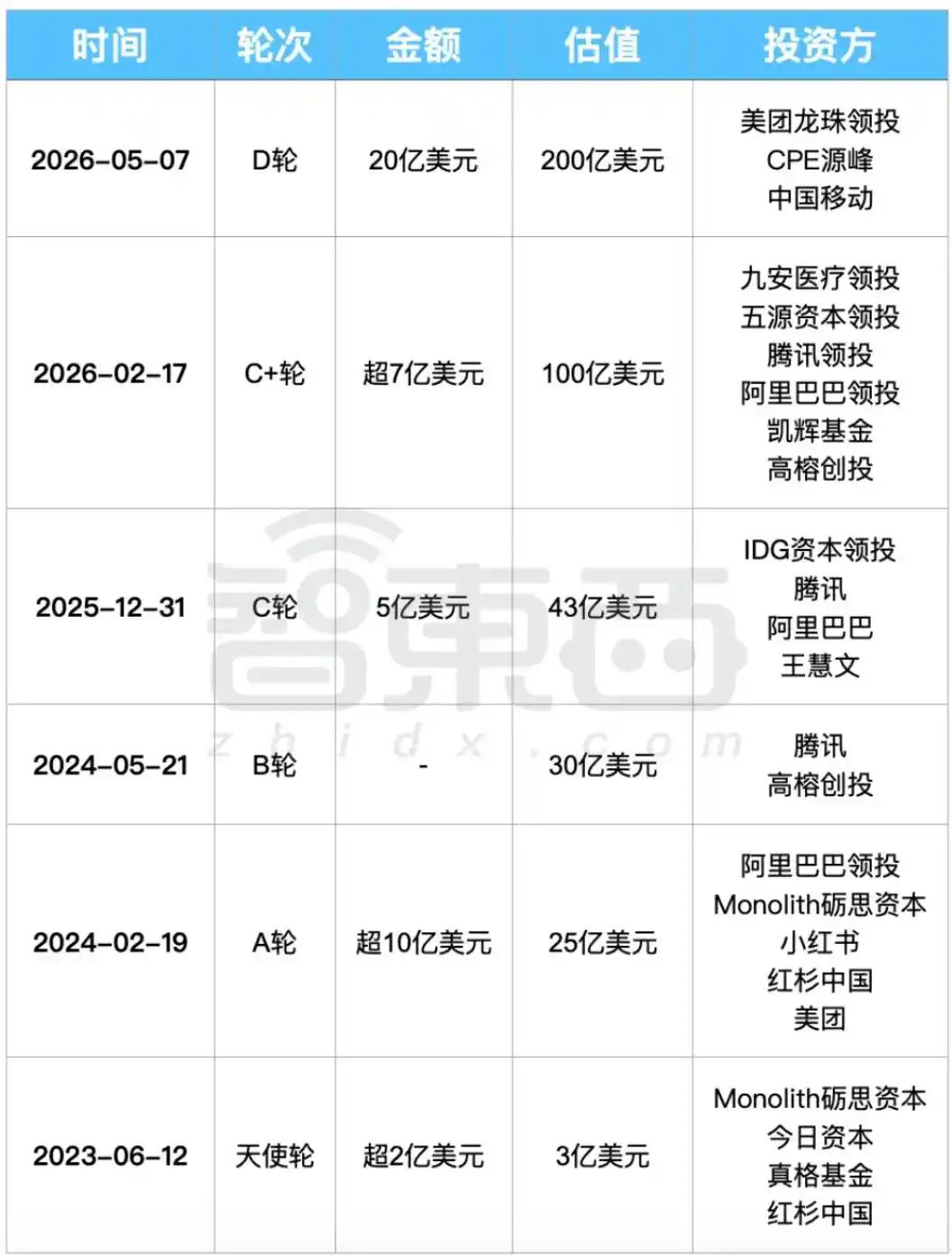
▲ Moon's Dark Side's past financing situation (Chart by Zhixi News, data source: Qichacha)

Moon's Dark Side was founded in 2023 in Beijing. Its founder and CEO, Yang Zhilin, earned his bachelor's degree from the Department of Computer Science at Tsinghua University and his Ph.D. from Carnegie Mellon University (CMU). He previously worked at Google Brain and Meta AI.

The core product of Moon's Dark Side is the Kimi Intelligent Assistant. On April 20, Moon's Dark Side released and open-sourced its flagship model Kimi K2.6. In multiple global authoritative benchmark tests, K2.6's performance in certain dimensions matched or even surpassed top closed-source models such as GPT-5.4, Claude Opus 4.6, and Gemini 3.1 Pro.

As of today, on the OpenRouter Benchmarks list, Kimi K2.6 ranks 9th on the Artificial Analysis Intelligence Index list with a score of 53.9, placing it after MiniMax-M3 and before Xiaomi MiMo-V2.5-Pro.
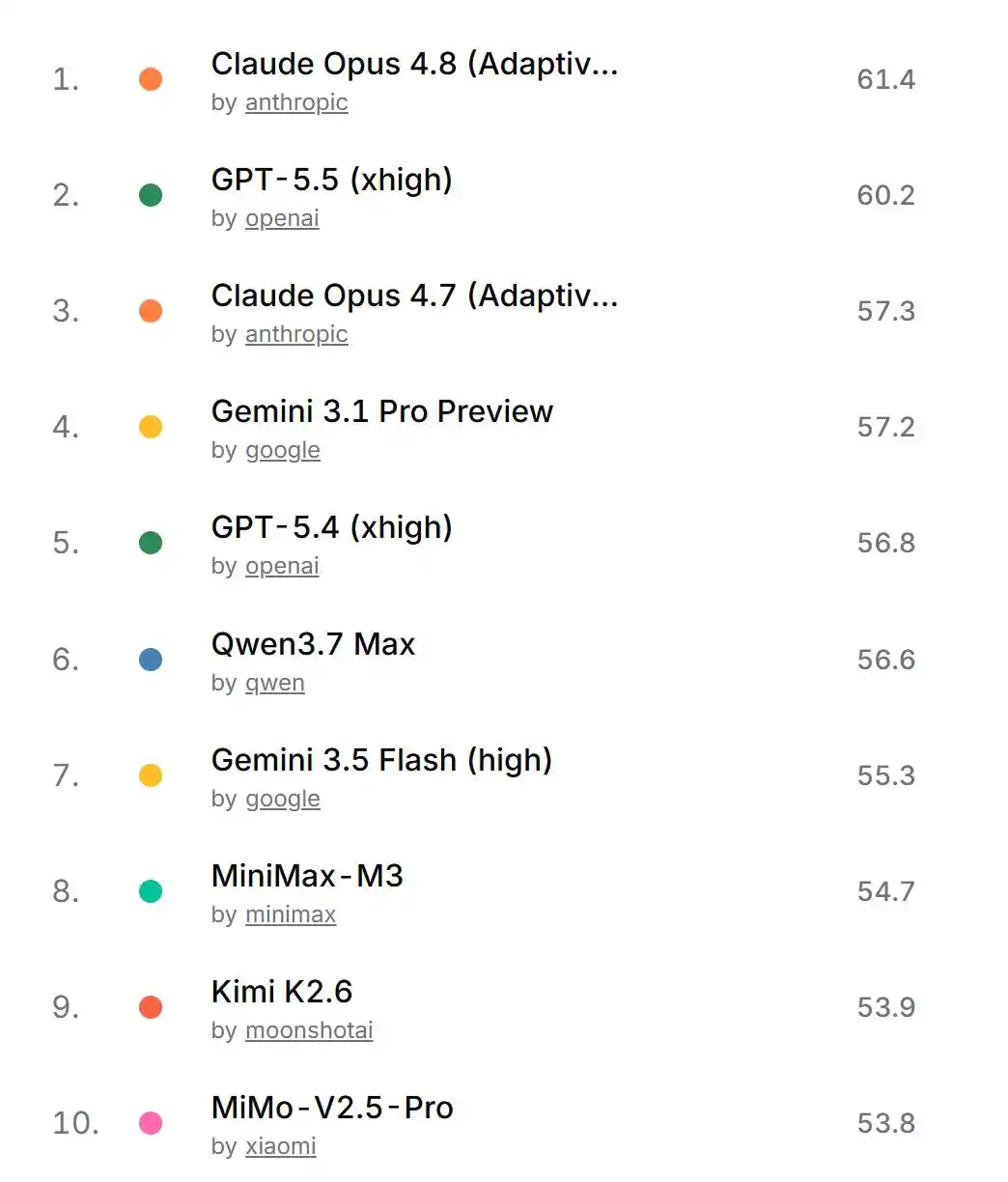
▲ Kimi K2.6 ranks 9th on the Artificial Analysis Intelligence Index list (Source: OpenRouter)

On the product side, on June 3, Moon's Dark Side began the beta testing of Kimi Work Beta, positioned as a local universal Agent for knowledge workers. Users can describe task goals in natural language, and Kimi Work can decompose tasks, call tools, use browsers, create and organize files locally on the computer, and deliver work products such as documents, spreadsheets, and PPTs.

Regarding commercialization, Moon's Dark Side has begun to generate a certain scale of revenue. According to previous disclosures by Huafeng Capital, Moon's Dark Side's Annual Recurring Revenue (ARR) in April had already exceeded 200 million USD (approximately 1.36 billion RMB), with accelerated growth in paid subscriptions and API revenue.

In terms of IPO progress, on March 26, Bloomberg reported that Moon's Dark Side is recently preparing for a Hong Kong IPO. Sources familiar with the matter stated that Moon's Dark Side is in the early stages, with the aim of stimulating investor interest in AI. Another source revealed that related preparations are still ongoing, and an IPO launch may not ultimately proceed.

Overall, since entering 2026, the capitalization process of leading domestic large model companies has significantly accelerated. On one hand, companies like Moon's Dark Side and Stepwise Stars have densely completed large-scale financing rounds, and DeepSeek was also reported last week to be about to complete its first external financing since its founding. On the other hand, companies like Zhipu and MiniMax have already taken the lead in opening the door to the Hong Kong stock market and are continuing to advance related work for A-share listings.

Looking globally, leading overseas AI companies like OpenAI and Anthropic are also preparing for IPOs, continuously setting new records for financing and valuation. In March this year, OpenAI completed a financing round of 122 billion USD (approximately 8,272 billion RMB), achieving a post-money valuation of 852 billion USD (approximately 57.8 trillion RMB). On June 1, Anthropic announced the completion of a 65 billion USD (approximately 4,407 billion RMB) Series H financing round, with a post-money valuation reaching 965 billion USD (approximately 65.3 trillion RMB), and secretly filed its IPO prospectus the following day.

Against this backdrop, the financing and IPO pace of domestic large model companies has noticeably quickened. Capital, computing power, and commercialization capabilities are becoming key variables alongside model competition. For large model companies still in a high-investment cycle, large-scale financing and IPOs are not only ways to replenish ammunition but will also become important chips in the next phase of competing for top positions.

This article is from the WeChat public account "Zhixi News" (ID: zhidxcom), author: Yang Jingli

Trending Cryptos

Related Questions

QWhat is the rumored size of Moonshot AI's (Kimi) new funding round and its target valuation?

AMoonshot AI is reportedly in talks for a new funding round aiming to raise up to $20 billion, with a target valuation of $300 billion.

QHow many funding rounds has Moonshot AI completed, and what is its total cumulative funding amount?

AAccording to the article, Moonshot AI has completed 6 funding rounds, with a total cumulative funding exceeding 37.6 billion RMB.

QWhat is the name of Moonshot AI's core product and its recently launched flagship model?

AMoonshot AI's core product is the Kimi Intelligent Assistant. It recently released and open-sourced its flagship model, Kimi K2.6.

QWhat significant beta testing did Moonshot AI begin in early June 2026?

AOn June 3rd, Moonshot AI began the beta test of 'Kimi Work,' a local universal Agent designed for knowledge workers to perform complex tasks on their computers.

QWhat is the reported Annual Recurring Revenue (ARR) for Moonshot AI as of April, and what is its potential IPO plan?

AAs of April, Moonshot AI's Annual Recurring Revenue (ARR) reportedly exceeded $200 million. The company is reportedly preparing for a potential IPO in Hong Kong.

Related Reads

The Verdict in Choi Tae-won's Divorce Case: Revealing the Inheritance Undercurrent Behind SK Hynix's Trillion-Won Empire

SK Group Chairman Chey Tae-won's high-profile divorce case, involving a record 1.38 trillion won settlement, has drawn attention to the succession plans for Korea's second-largest conglomerate, especially its crown jewel, SK hynix. Unlike traditional chaebol scripts centered on the eldest son, Chey's three children from his marriage to former President Roh Tae-woo's daughter, Roh Soh-yeong, are carving distinct, non-traditional paths. Eldest daughter Chey Yun-jung (b. 1989) is seen as the most evident successor. With a scientific and consulting background, she holds executive roles at SK bioscience and SK Inc.'s growth support department, focusing on future strategy and biopharma. Her marriage is to an AI infrastructure entrepreneur, not a traditional business alliance. Second daughter Chey Min-jung (b. 1991) took a unique route, voluntarily serving as a South Korean naval officer, including an anti-piracy deployment. She later worked on policy and strategy for SK hynix in Washington D.C. before co-founding an AI-driven healthcare startup. She married a former U.S. Marine Corps officer, connecting her to U.S. defense and policy circles—networks crucial for a global semiconductor giant. The only son, Chey In-geun (b. 1995), who studied physics like his father, worked briefly at SK E&S before joining McKinsey. Despite fitting the traditional "heir" profile as the eldest son, he remains silent and holds no public position or shares in SK, suggesting the old succession playbook is obsolete. As SK hynix's valuation soars, becoming a geopolitical asset in the AI era, the heirs' legitimacy is no longer automatic. They must prove themselves in fields like AI biotech, global policy, and strategic consulting. Their marriages also reflect new elite networks in tech and defense, not old political alliances. Their inheritance is the complex challenge of navigating a globalized, tech-driven world, not just a corporate throne.

marsbitYesterday 09:06

The Verdict in Choi Tae-won's Divorce Case: Revealing the Inheritance Undercurrent Behind SK Hynix's Trillion-Won Empire

marsbitYesterday 09:06

From OpenSea to OpenRouter: Is Alex Atallah Repeating His 'Exit at the Peak' Playbook?

From OpenSea to OpenRouter: Is Alex Atallah Repeating His "Exit at the Peak" Playbook? According to the Wall Street Journal, payments giant Stripe is in talks to acquire the AI model aggregation platform OpenRouter in a potential deal valuing the company near $100 billion. This would mark founder Alex Atallah's second creation of a company reaching a $100 billion valuation, following his co-founding of NFT marketplace OpenSea. OpenRouter, founded just over three years ago, has grown rapidly by acting as a unified gateway for developers to access over 400 AI models. It currently has about 10 million users and processes over 200 trillion tokens monthly. While the platform's annualized revenue is around $50 million, its valuation has skyrocketed from $1.3 billion in March 2026. The potential acquisition by Stripe, a company OpenRouter's founder once likened it to, represents a major expansion into AI infrastructure for the payments leader. This move echoes Atallah's previous timing with OpenSea, where he departed before the NFT market's significant downturn. For OpenRouter, selling now may be strategic. Despite its scale, its business model—charging a 5-5.5% fee on AI inference calls—faces pressure from competition, open-source models, and potential price wars among model providers, limiting its profitability narrative for an IPO. A key asset for potential acquirers like Stripe is OpenRouter's vast repository of real-world AI usage data, which offers unique insights into model performance and developer preferences that are difficult to replicate. Whether this potential deal signifies a new valuation benchmark for AI infrastructure or another market peak signal remains to be seen.

链捕手Yesterday 08:42

From OpenSea to OpenRouter: Is Alex Atallah Repeating His 'Exit at the Peak' Playbook?

链捕手Yesterday 08:42

Trading

Spot

Hot Articles

Sign up to HTX

Sign up to HTX

1.4k Total ViewsPublished 2023.06.19Updated 2024.01.10

Sign up to HTX

How to Buy UP

Welcome to HTX.com! We've made purchasing Superform (UP) simple and convenient. Follow our step-by-step guide to embark on your crypto journey.Step 1: Create Your HTX AccountUse your email or phone number to sign up for a free account on HTX. Experience a hassle-free registration journey and unlock all features.Get My AccountStep 2: Go to Buy Crypto and Choose Your Payment MethodCredit/Debit Card: Use your Visa or Mastercard to buy Superform (UP) instantly.Balance: Use funds from your HTX account balance to trade seamlessly.Third Parties: We've added popular payment methods such as Google Pay and Apple Pay to enhance convenience.P2P: Trade directly with other users on HTX.Over-the-Counter (OTC): We offer tailor-made services and competitive exchange rates for traders.Step 3: Store Your Superform (UP)After purchasing your Superform (UP), store it in your HTX account. Alternatively, you can send it elsewhere via blockchain transfer or use it to trade other cryptocurrencies.Step 4: Trade Superform (UP)Easily trade Superform (UP) on HTX's spot market. Simply access your account, select your trading pair, execute your trades, and monitor in real-time. We offer a user-friendly experience for both beginners and seasoned traders.

5.2k Total ViewsPublished 2026.02.10Updated 2026.06.02

How to Buy UP

Discussions

Welcome to the HTX Community. Here, you can stay informed about the latest platform developments and gain access to professional market insights. Users' opinions on the price of UP (UP) are presented below.

活动图片