Circle's Second Growth Curve: After the $222 Million ARC Financing, CRCL or ARC?

链捕手Dipublikasikan tanggal 2026-05-14Terakhir diperbarui pada 2026-05-14

Abstrak

Circle, the issuer of USDC, announced that its new public blockchain Arc completed a $222 million private sale for its native token ARC, with the network's fully diluted valuation reaching $3 billion. The funding round was led by a16z crypto, with participation from major institutions including BlackRock, Apollo, and ICE. The article explains Circle's rationale for building its own L1 blockchain, Arc. Existing chains like Ethereum and Solana are seen as lacking native support for large-scale institutional needs, such as regulatory compliance, predictable transaction costs, and asset issuance/redemption workflows. Arc is designed to fill this gap as a foundational layer for the on-chain economy, moving beyond Circle's reliance on USDC reserve interest for revenue. It details the dual-token model of Arc: USDC serves as the stable gas token for predictable transactions, while ARC is the network's native asset used for staking in the planned transition to Proof-of-Stake, governance, and aligning long-term incentives among participants. ARC's total supply is 10 billion, with 60% allocated to ecosystem development, 25% to Circle, and 15% to a long-term reserve. All protocol fees are converted to ARC, with portions burned and distributed to stakers. The piece contrasts the value proposition of Circle's public stock (CRCL) and the ARC token. CRCL captures the company's core cash flows from USDC interest and other business lines. ARC captures the growth potential of the Arc network...

Author: Zhou, ChainCatcher

On May 11th, while releasing its Q1 2026 financial report, Circle announced that the ARC native token of its public blockchain Arc had completed a $222 million presale, with a fully diluted valuation of $3 billion for the network.

The round was led by a16z crypto with a $75 million investment, followed by top-tier institutions including BlackRock, Apollo, ICE (parent company of NYSE), SBI Group, SC Ventures, and ARK Invest.

CRCL's stock price surged nearly 16% that day, with its market cap rebounding above $30 billion.
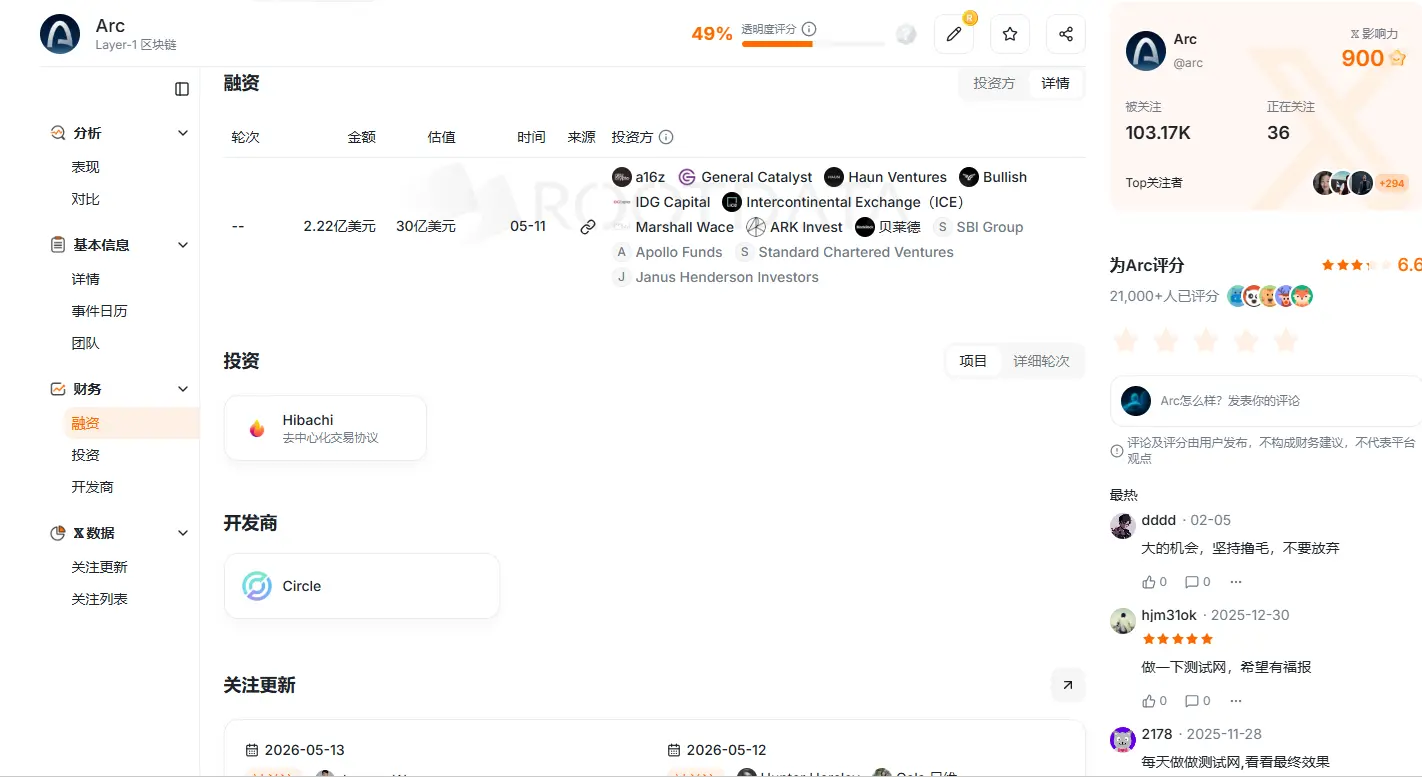
Image source: RootData

This development raises a core market question: Circle is already a public company; if investors are optimistic about its future, why not simply hold CRCL stock? Why issue the ARC token as well? Both are capturing the value of the Arc network. What exactly does each represent?

1. Why Did Circle Build Arc Itself?

Why did Circle choose to invest massive resources into building its own public blockchain instead of continuing to issue and use USDC on Ethereum or Solana?

a16z Crypto explains that as global finance gradually moves on-chain, only a few public blockchains will be able to serve as the "foundational base for an on-chain economic system."

Stablecoin transaction volume approached $9 trillion last year, placing it in the same league as global payment networks like Visa and PayPal. Cross-border payments, B2B settlement, and forex trading are becoming core use cases for stablecoins, which have upgraded to become a core layer of global financial infrastructure.

However, existing blockchain infrastructure is still primarily geared towards crypto-native users and individual developers, lacking native support for large-scale institutional-level demands.

Industry insiders point out that institutions face several core pain points when conducting business on-chain, including: the need for fully closed-loop on-chain/off-chain validation for asset issuance and redemption; payments requiring deterministic finality; compliance capabilities needing to be embedded at the foundational layer; configurable privacy protection; and the need for predictable Gas costs using USDC, among others.

Ethereum, Solana, and other existing public blockchains struggle to natively meet these demands.

For Circle, the company has historically relied primarily on USDC reserve interest for profitability. In Q1, USDC circulation reached $77 billion, a 28% year-over-year increase. As its business scale continues to expand, relying solely on existing public chains can no longer fully meet the deeper needs of institutional clients.

Therefore, Circle's launch of Arc aims precisely to fill this gap. The underlying logic is that having a stablecoin circulate on someone else's chain does not mean owning the stablecoin financial ecosystem—which is why Circle decided to build its own L1.
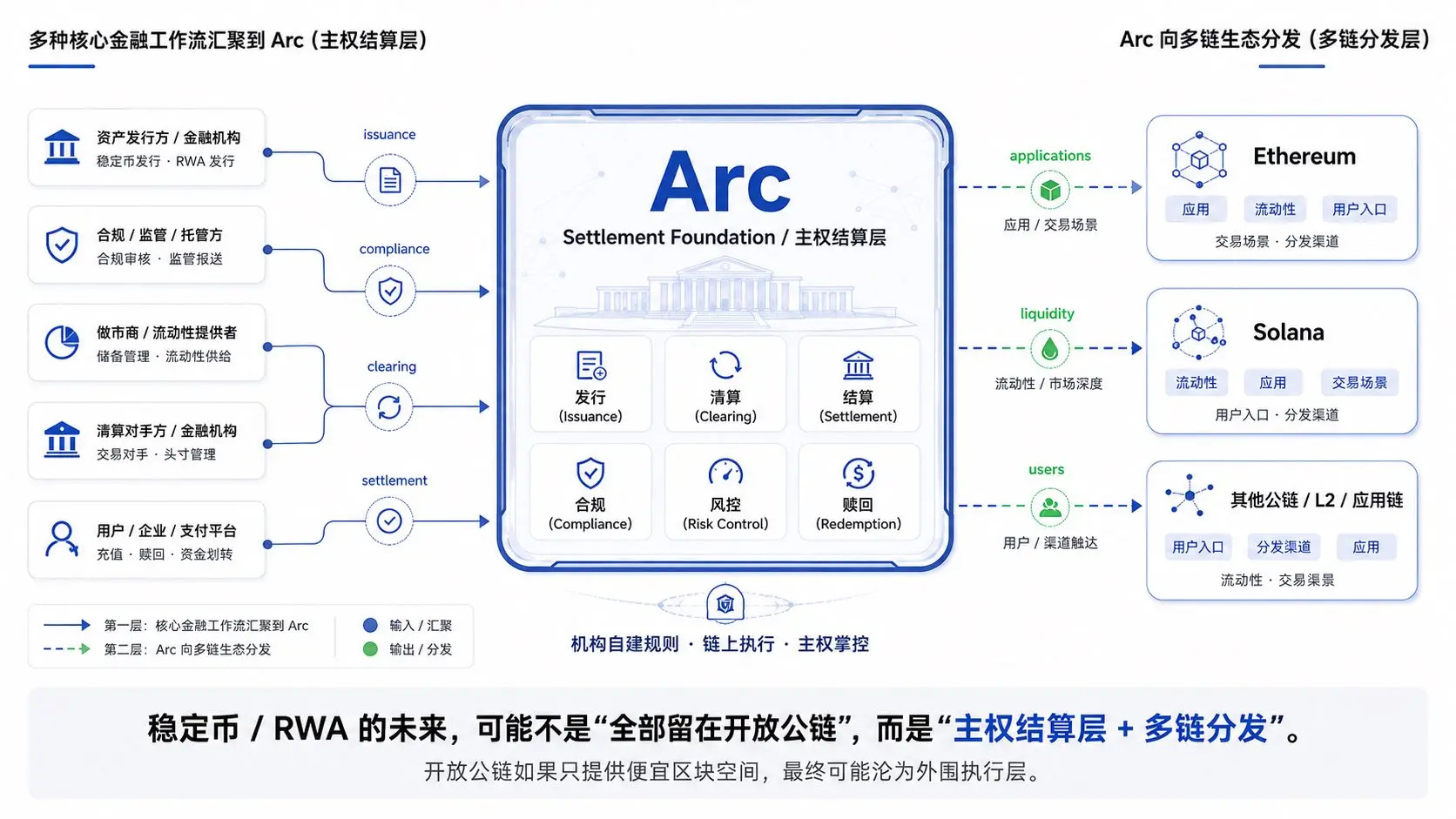
Image source: X user @vanisaxxm

2. USDC Solves the Transaction Problem, ARC Solves the Coordination Problem

Since USDC is already the Gas token for Arc, why is another ARC token needed?

USDC has effectively solved the stability issue at the transaction level. Institutions can pay fees directly priced in USD, with predictable costs that can be accounted for, avoiding the troubles caused by crypto asset price volatility for finance departments.

However, for a network to operate healthily in the long term, solving the transaction problem alone is not enough. It also needs to address coordination problems.

According to the official whitepaper, Arc will gradually transition from its current Proof-of-Authority to Proof-of-Stake. Validator nodes need to stake assets to secure the network, with the core principle of staking being to bind node behavior through economic incentives; malicious actions risk slashing. USDC's value is pegged at $1, making it unable to truly bind node interests to the network's success or failure. Only the native ARC token can provide such dynamic economic incentives.
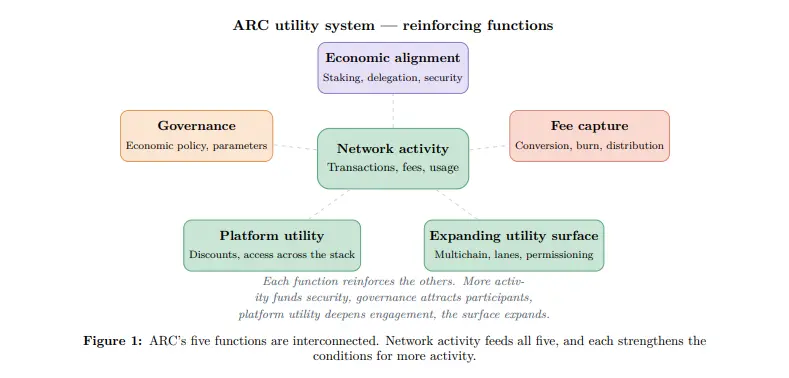
Governance also requires interest alignment. Key decisions such as fee rates, inflation parameters, and burn ratios require participants to adopt a long-term perspective. If voting were based solely on USDC, holders could easily lack sustained motivation, potentially voting and then exiting. ARC holders' asset value is directly tied to network performance, giving them stronger motivation to make choices beneficial for the network's long-term development.

The whitepaper also clarifies that ARC's governance authority has phased boundaries. Economic parameters are determined by token holder votes, but important matters like protocol upgrades, security incident handling, and validator qualification reviews initially remain under Circle's control, with gradual decentralization planned as governance matures.

In simple terms, USDC is the lifeblood of the Arc network, responsible for efficient daily flow; ARC is the equity of the network, responsible for aligning the long-term interests of all parties. This dual-token design also partially transforms the cost of ecosystem development from Circle's fixed cash expenditures into incentive arrangements tied to the network's success or failure.

3. CRCL and ARC: Which Pieces of the Pie Do They Capture?

Thus, Circle now holds both the publicly listed equity CRCL and the network's native token ARC, both capturing the value of the same Arc network. So, which pieces of the pie do they respectively capture?

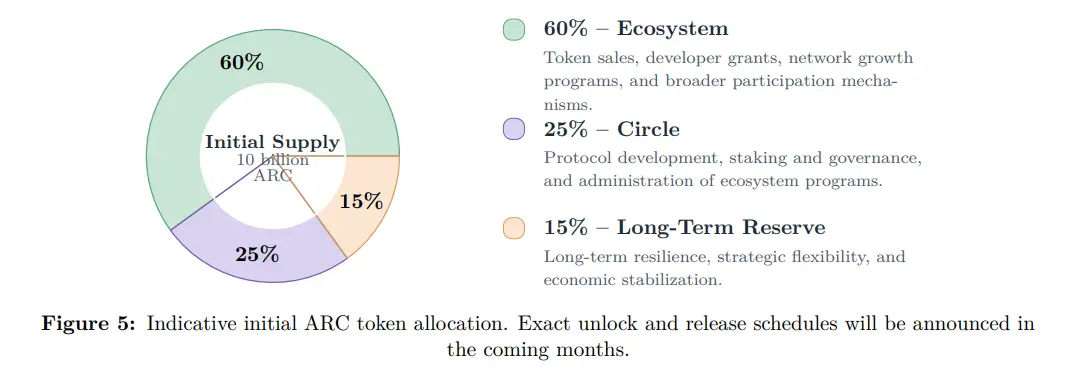
According to the whitepaper, the total supply of ARC is 10 billion tokens, with a clear allocation: 60% for the ecosystem, including developer incentives, network growth programs, and user participation rewards; 25% allocated to Circle for operating validator nodes, staking, and governance; 15% as a long-term reserve for network stability and strategic flexibility.
Regarding the fee mechanism, all protocol fees on Arc, regardless of the asset used for payment, will be fully converted to ARC at the protocol layer, with a portion permanently burned and a portion distributed to stakers and validators. The more active the network, the stronger the value capture by ARC.

CRCL shareholders primarily benefit through Circle as a company. The company continues to enjoy the core revenue from USDC reserve interest, along with gains from the growth of other businesses like the payment network CPN. Simultaneously, Circle's 25% ARC holdings allow it to indirectly share in network-level rewards.

Crypto analyst BTCdayu proposes a three-dimensional valuation framework for CRCL: The first dimension is reserve interest income, the most stable current cash flow and the valuation floor. The second dimension is payment network revenue, which, as CPN scales, could approach a Visa-like network fee model. The third dimension is the network option value brought by Arc, reflecting market expectations for Circle's transformation from a stablecoin issuer to a financial infrastructure platform.

Simply put, CRCL captures the company's overall stable cash flow and existing business growth, while ARC captures the growth elasticity at the network level, including Gas fee conversion, ecosystem expansion, and long-term network effects.

This forms a clear dual-track structure. The more successful the Arc network, the greater the USDC usage and business synergies, benefiting Circle at the corporate level. Concurrently, the rising value of the ARC token increases the value of Circle's 25% share, ultimately benefiting CRCL shareholders.

However, the two are legally completely separate. As mentioned officially, ARC does not represent equity in Circle and does not grant any claim to Circle's revenue, profits, assets, or CRCL shares. This means ARC holders lack the fiduciary duty protections afforded to public company shareholders; their returns depend entirely on the network's actual adoption and the tokenomics design.

4. How Can Ordinary Users Participate?

Having understood the value distribution between CRCL and ARC, a practical question arises: Who exactly is the ARC token being sold to? And how can ordinary users participate at low cost?

The first category of buyers is strategic institutional investors. They entered via the $222 million presale at a unit price of $0.3, with lock-up periods ranging from 1 to 4 years. These institutions not only provide capital but are also potential users and builders of Arc. For example, BlackRock is already testing tokenized asset settlement on the testnet; ICE, as the parent of NYSE, and SBI Group, as Japan's largest financial group, are strategically positioning themselves for future business on Arc.

The second category is ecosystem builders and long-term holders. Developers and liquidity providers receive ARC incentives for their contributions; the 60% ecosystem allocation is for this purpose. They prioritize the network's long-term growth, akin to early employees holding company equity.

The third category is retail speculators and participants. They focus on early narrative opportunities and ecosystem incentives, anticipating price volatility post-mainnet launch.

For ordinary users without presale access, Arc offers several low-cost participation paths.

The Arc Testnet launched in October 2025 and has processed over 244 million test transactions to date. The mainnet is expected to launch in the summer of 2026. Users can claim free test tokens to perform operations like Swaps, bridging, and contract deployment to familiarize themselves with network interaction.

The Arc House community is the primary entry point for ordinary users. Users can accumulate points by registering, staying active, posting, reading content, and participating in Q&A. Having an answer accepted yields extra points.

Advanced methods include content contribution, video sharing, event organization, and even hosting offline Meetups. Additionally, users with teams or products can apply for Circle Developer Grants.

It should be noted that Arc House points merely represent community contribution recognition; they hold no monetary value, nor do they guarantee any specific rights allocation. Specific rules are subject to the latest official announcements.

Conclusion

Currently, competition in the institutional on-chain sector is fierce, and Arc is not alone. Canton Network, under Digital Asset, is reportedly completing a new funding round at a valuation of around $2 billion, led by a16z crypto; Plasma positions itself as a stablecoin-native settlement layer with a relatively more attractive valuation; Visa included Arc, Canton, Plasma, Base, Tempo, and others as stablecoin settlement test points in April. This indicates the sector is still in a phase of parallel development with multiple competitors.

Against this backdrop, Arc's $3 billion presale FDV (Fully Diluted Valuation) sits at a relatively high level. Retail investors considering secondary market participation need to thoroughly evaluate the project's narrative potential and the competitive landscape within the sector.

From a long-term perspective, holding ARC, which carries an annual inflation of 2% to 3%, requires the network to generate sufficient real transaction fees to offset the inflation pressure for value appreciation. CRCL, in contrast, relies on USDC reserve interest and payment network revenue, supported by relatively clear cash flows. They represent different risk-return structures.

Short-term, market sentiment often follows its own logic. Around the mainnet launch, concentrated narrative hype could bring periodic opportunities. During such times, the value of Circle's 25% ARC holdings would also appreciate, benefiting CRCL shareholders.

On the regulatory front, the passage of the GENIUS Act has solidified Circle's moat, while the CLARITY Act's new draft version has been made public and is advancing in Congress, potentially providing clearer regulatory certainty for the digital asset ecosystem—a significant positive for Circle.

Overall, Arc is currently one of Circle's key strategic initiatives. As the whitepaper states, "A global economic operating system cannot be coordinated by a single entity; it transforms participants who use Arc into participants who sustain Arc." Whether this vision ultimately materializes still depends on the network's ability to attract sufficient real institutional transactions and economic activity after the mainnet launch.

Until all data lands, all narratives remain just narratives.

Kripto yang Sedang Tren

Pertanyaan Terkait

QWhat is the purpose of Circle launching its own Layer 1 blockchain, Arc, instead of continuing to operate on established chains like Ethereum or Solana?

ACircle launched Arc to address the core needs of institutional clients, such as asset issuance/redemption with on/off-chain settlement, deterministic finality for payments, embedded compliance, configurable privacy, and predictable Gas costs paid in USDC. These needs are not natively met by existing public chains. Arc is designed to be an economic infrastructure base capable of hosting a global financial system on-chain, allowing Circle to capture more value from the stablecoin ecosystem it facilitates.

QWhy does the Arc network need a native ARC token when it already uses USDC for transaction fees?

AUSDC is used as a stable gas token for predictable transaction costs. The ARC token is needed to solve network coordination problems. It provides economic incentives for staking in the planned Proof-of-Stake security model, aligns long-term interests for governance decisions, and binds participants to the network's success. While USDC handles the flow of value, ARC acts as the network's 'equity', facilitating security and decentralized governance.

QHow do the CRCL stock and ARC token capture value differently from the Arc network and Circle's business?

ACRCL stock captures the value of Circle the company, primarily through stable revenue streams like USDC reserve interest and its payment network (CPN). It also benefits indirectly from Circle's 25% holding of ARC tokens. The ARC token directly captures the value of the Arc network itself, including gas fees converted to ARC (partly burned, partly distributed), ecosystem growth, and long-term network effects. CRCL offers stable cash flows, while ARC offers growth elasticity tied to network adoption.

QWhat are the main ways for ordinary users to participate in the Arc ecosystem early, such as for potential airdrops or rewards?

AOrdinary users can participate through several low-cost methods: 1) Using the Arc Testnet to perform transactions and interact with dApps. 2) Joining the Arc House community to earn contribution points through activities like registration, posting, reading content, and answering questions. 3) More advanced participation includes content creation, video sharing, event organization, and applying for Circle Developer Grants. Note that Arc House points are for community recognition and do not guarantee specific token rewards.

QWhat are some of the competitive challenges and considerations for Arc mentioned in the article?

AThe institutional on-chain sector is highly competitive. Key competitors include Canton Network (backed by Digital Asset), Plasma (positioned for stablecoin-native settlement), and others like Base and Tempo. Visa is testing multiple networks including Arc. The article notes that Arc's $3 billion fully diluted valuation (FDV) from its presale is relatively high. For long-term value, the ARC token needs to generate sufficient real transaction fees to offset its 2-3% annual inflation. Success depends on attracting substantial real institutional activity post-mainnet launch.

Bacaan Terkait

Setelah Tiga Kuartal Berturut-Turut Turun, Bisakah Pasar Kripto Menyambut Jendela Stabilitas di Kuartal Ketiga?

Pasar kripto mengalami kuartal terburuk sejak 2022, dengan kapitalisasi pasar turun 12.6% menjadi $2.1 triliun, didorong oleh keluarnya modal dan penurunan volume perdagangan. Bitcoin dan Ethereum masing-masing jatuh 14.2% dan 25.4% di kuartal kedua. Aliran keluar bersih dari ETF Bitcoin AS mencapai $4.67 miliar, menandakan tekanan jual yang berkelanjutan. Faktor utama meliputi terputusnya hubungan dengan saham AS, kebijakan moneter Federal Reserve yang ketat, dan pelepasan aset oleh perusahaan seperti Strategy. Proses legislasi UU CLARITY yang akan memberikan kejelasan regulasi terhambat, meningkatkan premi risiko di sektor ini. Namun, ada tanda-tanda potensi stabilisasi. Aliran keluar ETF yang besar secara historis sering terjadi di akhir fase penurunan, dan para pemegang Bitcoin jangka panjang mulai menambah kepemilikan lagi. Sementara sebagian besar sektor menyusut, pasar prediksi dan aset koleksi yang ditokenisasi mencatat pertumbuhan signifikan. Pandangan untuk kuartal ketiga sangat bergantung pada pertemuan Fed akhir Juli. Sinyal kebijakan yang lunak dapat mendukung pemulihan Bitcoin, sementara sikap yang hawkish dapat memicu konsolidasi lebih lanjut. Meskipun tantangan regulasi tetap ada, indikator teknis seperti harga Bitcoin yang mendekati rata-rata bergerak 200-mingguannya menunjukkan dasar jangka panjang belum rusak. Logika pasar telah bergeser dari mengandalkan narasi ke faktor fundamental seperti kebijakan dan ekspektasi suku bunga.

marsbitKemarin 08:40

Setelah Tiga Kuartal Berturut-Turut Turun, Bisakah Pasar Kripto Menyambut Jendela Stabilitas di Kuartal Ketiga?

marsbitKemarin 08:40

The SpaceX Trade, Terbuka: SPCXON Mulai Diperdagangkan di WEEX

SpaceX meluncurkan IPO terbesar dalam sejarah pada Juni 2026, namun akses bagi banyak pedagang terhambat oleh batasan regional dan prosedur broker. WEEX kini menghadirkan SPCXON/USDT di pasar spotnya, sebuah instrumen tokenisasi yang memungkinkan paparan terhadap pergerakan harga SpaceX melalui akun kripto yang diselesaikan dengan USDT, tanpa memerlukan broker AS atau pembiayaan bank. SPCXON adalah produk tokenisasi yang mencerminkan ekonomi kepemilikan SpaceX bagi pedagang yang memenuhi syarat di luar AS, dengan dividen diinvestasikan kembali. Aset ini diperdagangkan di WEEX sebagai pasangan spot dengan USDT, tersedia selama jam pasar, memberikan akses mudah bagi trader kripto. Kasus investasi untuk SpaceX didasarkan pada pertumbuhan pendapatan Starlink dan pencapaian Starship, meskipun valuasinya yang tinggi (sekitar 90-110 kali pendapatan) telah memperhitungkan eksekusi sempurna selama bertahun-tahun. Faktor seperti jumlah saham publik yang terbatas dan masa buka kunci (unlock) insider pertama menjadi pertimbangan penting. Penting untuk diingat bahwa SPCXON memberikan paparan, bukan kepemilikan langsung atas saham atau hak suara. Harganya dapat diperdagangkan pada premium atau diskon terhadap nilai aset bersih. WEEX menawarkan akses ke berbagai aset TradFi yang ditokenisasi seperti ini dalam satu akun terpadu, bersama dengan pasar futures dan kampanye perdagangan dengan pool hadiah.

TheNewsCryptoKemarin 08:33

The SpaceX Trade, Terbuka: SPCXON Mulai Diperdagangkan di WEEX

TheNewsCryptoKemarin 08:33

Momen Perdagangan BIT: BTC Masih Tertekan oleh EMA 200 Mingguan, Setelah Ditolak Mungkin Kembali Turun, Saham Penyimpanan dan Semikonduktor yang Melonjak Malam Kemudian Mulai Anjlok di Pasar Malam

**PASAR KRIPTO & SAHAM: BTC Hadapi Resistensi, Saham Semikonduktor Turun di Perdagangan Malam** Pasar kripto melanjutkan pemulihan, dengan harga Bitcoin bertahan di sekitar $66,000 setelah rebound lebih dari 15% dari titik terendah Juli. Namun, BTC menghadapi **tembok resistensi kuat di dekat $68,000**, yang bertepatan dengan biaya rata-rata investor selama lima bulan terakhir dan titik gagalnya rebound pertengahan Juni. Secara teknis, perhatian tertuju pada **200 EMA mingguan (~$68,328) sebagai level kunci**. Jika BTC ditolak di level ini, potensi penurunan menuju support $63,000 terbuka. Analis menyoroti volume rendah dan penurunan open interest futures di CME, menandakan rebound ini lebih dipicu likuiditas rendah musim panas daripada awal bull run penuh. Di pasar saham AS, **indeks futures utama turang** setelah sesi kemarin yang kuat. Sektor semikonduktor dan penyimpanan (storage), yang melonjak pada hari Selasa (contoh: Micron +12%), **mengalami koreksi di perdagangan malam (night trading)**. ETF semikonduktor turun 2,22% dan saham Micron turun 2,29%. Meski begitu, ada sorotan positif seperti **Super Micro Computer (SMCI)** yang naik lebih dari 15% setelah melaporkan pandangan pendapatan yang kuat dan pesanan baru yang sangat besar, mengonfirmasi permintaan server AI tetap solid. Kekhawatiran makro muncul dari **kenaikan harga minyak mentah (di atas $91)** akibat ketegangan geopolitik dan **lonjakan imbal hasil (yield) obligasi pemerintah AS**, dengan imbal hasil 10-tahun mencapai sekitar 4,64%. Faktor-faktor ini dapat menambah tekanan inflasi dan membatasi ruang gerak pasar saham. Saham terkait kripto seperti Coinbase dan Robinhood naik kuat didorong oleh perkembangan regulasi yang lebih jelas di AS. Di Asia, **Korea Selatan** dan **Jepang** menunjukkan kinerja beragam. Indeks KOSPI Korea naik didukung pemulihan saham semikonduktor, sementara pasar Jepang melemah dengan **Yen terus melemah ke level terendah sejak 1986**, meningkatkan kekhawatiran akan intervensi bank sentral. **Yang Perlu Diperhatikan Selanjutnya:** * **22 Juli:** Acara AI AMD, rilis laporan keuangan dari Google (Alphabet), Tesla, IBM. * **23 Juli:** Keputusan suku bunga Bank Sentral Eropa (ECB), data klaim pengangguran AS, laporan keuangan Intel. * Perkembangan lebih lanjut dari **harga minyak, imbal hasil obligasi, dan dinamika Yen Jepang** akan menjadi penentu sentimen pasar risiko secara keseluruhan.

marsbitKemarin 08:32

Momen Perdagangan BIT: BTC Masih Tertekan oleh EMA 200 Mingguan, Setelah Ditolak Mungkin Kembali Turun, Saham Penyimpanan dan Semikonduktor yang Melonjak Malam Kemudian Mulai Anjlok di Pasar Malam

marsbitKemarin 08:32

Mantan Ketua CFTC dan Presiden Circle, Tarbert: Satu Pihak Menasihati Anda untuk Berpikir Jangka Panjang, di Sisi Lain Menguangkan $30 Juta Sendiri

Penulis: Zen, PANews Heath Tarbert, mantan Ketua CFTC dan Presiden Circle, baru-baru ini menyerukan kepada investor untuk mengadopsi pandangan jangka panjang terhadap saham Circle, meskipun harganya telah turun 70% dari puncaknya. Namun, ia sendiri secara konsisten menjual saham CRCL sejak perusahaan go public, menguangkan sekitar $30 juta tanpa pernah membeli saham tambahan di pasar terbuka. Tarbert, yang bergabung dengan Circle pada Juli 2023 dan menjadi Presiden pada awal 2025, dikenal sebagai pendukung kuat narasi "jangka panjang" perusahaan. Namun, sehari sebelum IPO Circle, ia menetapkan rencana perdagangan 10b5-1 untuk menjual hingga 353.290 saham dalam setahun. Dalam 13 bulan setelah IPO, ia menjual lebih dari 360.000 saham, termasuk penjualan tunggal senilai $11,5 juta pada Maret 2026. Ia bahkan menetapkan rencana 10b5-1 kedua untuk menjual hingga 160.000 saham lagi pada akhir tahun 2026. Langkah Tarbert ini menuai kecaman karena dianggap tidak konsisten dengan pesan "jangka panjang" yang ia sampaikan kepada publik. Perjalanan kariernya sering dikaitkan dengan "revolving door" antara regulator dan dunia keuangan. Setelah mengundurkan diri sebagai Ketua CFTC pada Maret 2021, ia bergabung dengan Citadel Securities hanya 27 hari kemudian sebagai Kepala Penasihat Hukum, tepat saat perusahaan itu menghadapi pengawasan ketat terkait peristiwa GameStop. Di Citadel, ia juga mendukung undang-undang yang memperluas wewenang CFTC atas pasar crypto, sementara Citadel diketahui berencana berekspansi ke aset kripto. Tarbert kemudian pindah ke Circle pada 2023, membantu perusahaan mengatasi tantangan regulasi dan akhirnya go public melalui IPO langsung. Meskipun sangat berharga bagi perusahaan, tindakannya menjual saham dalam jumlah besar sambil mendorong investor untuk bertahan menimbulkan pertanyaan tentang komitmennya yang sebenarnya terhadap masa depan jangka panjang Circle.

marsbitKemarin 08:09

Mantan Ketua CFTC dan Presiden Circle, Tarbert: Satu Pihak Menasihati Anda untuk Berpikir Jangka Panjang, di Sisi Lain Menguangkan $30 Juta Sendiri

marsbitKemarin 08:09

Gate Research Institute: Produk Keuangan Kripto Menggulirkan Gelombang "Wall Street-ization", Kompetisi atau Integrasi?

**Ringkasan: Gelombang "Wall Street-ization" Produk Keuangan Kripto: Kompetisi atau Integrasi?** Artikel ini membahas fenomena konvergensi antara keuangan tradisional (TradFi) dan keuangan kripto (Crypto). Meskipun Bitcoin awalnya dirancang sebagai sistem peer-to-peer yang terdesentralisasi dan bebas dari perantara seperti bank, pasar kripto kini semakin diintegrasikan ke dalam infrastruktur keuangan tradisional. **Tren "Wall Street-ization":** Dimulai dengan disetujuinya ETF spot Bitcoin pada 2024, aset kripto kini dikemas menjadi produk seperti ETF (oleh BlackRock, Fidelity, dll.), futures, dan sekuritisasi aset riil (RWA) seperti obligasi pemerintah yang ditokenisasi. Ini memberikan akses yang mudah dan teregulasi bagi investor institusional, tetapi juga berarti kekuasaan atas penerbitan, penentuan harga, kustodian, dan distribusi aset kripto semakin bergeser ke lembaga keuangan besar. **Dua Jalur Konvergensi (1+1>2):** Artikel ini menyoroti dua arah integrasi: 1. **Dari CEX ke TradFi:** Dilambangkan oleh **Gate.io**, yang berkembang dari bursa kripto menjadi platform multi-aset. Gate kini menawarkan perdagangan saham nyata (AS, Hong Kong, Korea) menggunakan USDT, menyediakan akses tanpa batas waktu ke pasar tradisional. 2. **Dari TradFi ke Crypto:** Dilambangkan oleh **Robinhood**, platform broker tradisional yang memperluas layanannya ke aset kripto (termasuk melalui akuisisi Bitstamp) dan mengembangkan produk seperti token saham di blockchain. **Tujuan Bersama: Akun Keuangan "Super" Terpadu:** Kedua jalur ini bertujuan menciptakan **akun keuangan generasi berikutnya yang terpadu**. Pengguna di masa depan mungkin dapat memperdagangkan Bitcoin, saham Apple, ETF, emas, dan obligasi pemerintah yang ditokenisasi dalam satu antarmuka yang sama, menggunakan stablecoin sebagai lapisan dana. **RWA dan Obligasi Pemerintah di On-Chain sebagai Lapisan Tengah:** Tokenisasi aset dunia nyata, terutama obligasi pemerintah AS, menyediakan aset berpenghasilan rendah risiko di ekosistem on-chain. Pasar ini tumbuh pesat (naik 40% pada paruh pertama 2026) meskipun pasar kripto turun, menunjukkan permintaan nyata. **Kesimpulan:** "Wall Street-ization" bukanlah pengambilalihan sepihak, melainkan **transformasi timbal balik**. TradFi dan Crypto saling melengkapi: Crypto mendapatkan akses ke likuiditas, kepatuhan, dan jaringan distribusi yang luas, sementara TradFi mengadopsi efisiensi, kecepatan, dan pasar 24/7 dari Crypto. Hasil akhirnya adalah pembentukan **pasar modal terpadu yang lebih efisien dan global**, di mana batas antara aset tradisional dan kripto semakin kabur.

marsbitKemarin 08:07

Gate Research Institute: Produk Keuangan Kripto Menggulirkan Gelombang "Wall Street-ization", Kompetisi atau Integrasi?

marsbitKemarin 08:07

Trading

Spot

Artikel Populer

Cara Membeli ARC

Selamat datang di HTX.com! Kami telah membuat pembelian AI Rig Complex (ARC) menjadi mudah dan nyaman. Ikuti panduan langkah demi langkah kami untuk memulai perjalanan kripto Anda.Langkah 1: Buat Akun HTX AndaGunakan alamat email atau nomor ponsel Anda untuk mendaftar akun gratis di HTX. Rasakan perjalanan pendaftaran yang mudah dan buka semua fitur.Dapatkan Akun SayaLangkah 2: Buka Beli Kripto, lalu Pilih Metode Pembayaran AndaKartu Kredit/Debit: Gunakan Visa atau Mastercard Anda untuk membeli AI Rig Complex (ARC) secara instan.Saldo: Gunakan dana dari saldo akun HTX Anda untuk melakukan trading dengan lancar.Pihak Ketiga: Kami telah menambahkan metode pembayaran populer seperti Google Pay dan Apple Pay untuk meningkatkan kenyamanan.P2P: Lakukan trading langsung dengan pengguna lain di HTX.Over-the-Counter (OTC): Kami menawarkan layanan yang dibuat khusus dan kurs yang kompetitif bagi para trader.Langkah 3: Simpan AI Rig Complex (ARC) AndaSetelah melakukan pembelian, simpan AI Rig Complex (ARC) di akun HTX Anda. Selain itu, Anda dapat mengirimkannya ke tempat lain melalui transfer blockchain atau menggunakannya untuk memperdagangkan mata uang kripto lainnya.Langkah 4: Lakukan trading AI Rig Complex (ARC)Lakukan trading AI Rig Complex (ARC) dengan mudah di pasar spot HTX. Cukup akses akun Anda, pilih pasangan perdagangan, jalankan trading, lalu pantau secara real-time. Kami menawarkan pengalaman yang ramah pengguna baik untuk pemula maupun trader berpengalaman.

455 Total TayanganDipublikasikan pada 2025.01.09Diperbarui pada 2026.06.02

Cara Membeli ARC

Diskusi

Selamat datang di Komunitas HTX. Di sini, Anda bisa terus mendapatkan informasi terbaru tentang perkembangan platform terkini dan mendapatkan akses ke wawasan pasar profesional. Pendapat pengguna mengenai harga ARC (ARC) disajikan di bawah ini.

活动图片