XRP Is No Longer Dormant: Flare Data Reveals Over 120 Billion Baht Locked in DeFi

bitcoinistPubblicato 2025-12-31Pubblicato ultima volta 2025-12-31

Introduzione

The article highlights a significant shift in the perception of XRP, moving away from being seen as a passive asset. Data from the Flare Network reveals that over 80% of FXRP (a 1:1 representation of XRP) is now locked in DeFi protocols, representing over $125.8 million in value. This indicates a substantial increase in user activity, deeper liquidity, and renewed positive momentum for both XRP and the XRP Ledger (XRPL). Key metrics show nearly 67.8 million FXRP tokens are utilized in DeFi, with over 5,800 active users. Transaction activity is robust, exceeding 1.2 million DeFi transactions, including over 1.12 million FXRP swaps. This engagement is described as being driven by long-term conviction rather than short-term yield chasing, as capital remains locked and user numbers grow steadily even in a weak market. The article argues that XRP's historical lack of DeFi adoption was due to a lack of infrastructure, not demand. Flare's FAssets system is unlocking this previously inaccessible utility by allowing XRP to interact with EVM-compatible DeFi applications without requiring trusted custodians. Additionally, the piece introduces "Bitcoin Hyper" as a new Layer-2 solution designed to bring Bitcoin into practical DeFi use. It aims to solve Bitcoin's limitations in speed and fees by leveraging the Solana Virtual Machine, positioning itself as a crucial bridge between Bitcoin and the growing DeFi ecosystem.

Data indicates that XRP is shedding its image as a dormant asset, with the majority of FXRP being locked in DeFi. This is a sign of increasing user activity, deeper liquidity, and a return of positive momentum for XRP and the XRP Ledger via the Flare network.

Data from the Flare Network supports the hypothesis of a stronger upward trend for XRP and XRPL.

Momentum around XRP and the XRP Ledger (XRPL) is strengthening, as on-chain data reinforces the case for continued DeFi adoption. Blockchain infrastructure provider Flare Network shared insights on social media platform X on December 29th, arguing that XRP holders are actively engaging in DeFi, citing detailed FXRP metrics that point to increased usage, higher user activity, and deeper liquidity tied to XRPL-linked assets.

XRP holders are often perceived as a passive group and not DeFi users, but FXRP data tells a different story, and it remains a compelling cryptocurrency investment.

Over 80% of FXRP is locked in DeFi, representing over $124 million in real utility deployed on Flare. More interestingly, this growth occurred during a weak market. The number of users is still increasing, capital remains locked, and adoption is growing steadily, not driven by a chase for short-term returns. Ultimately, the issue was never about demand, but about infrastructure. Flare is unlocking XRP's DeFi, the team added.
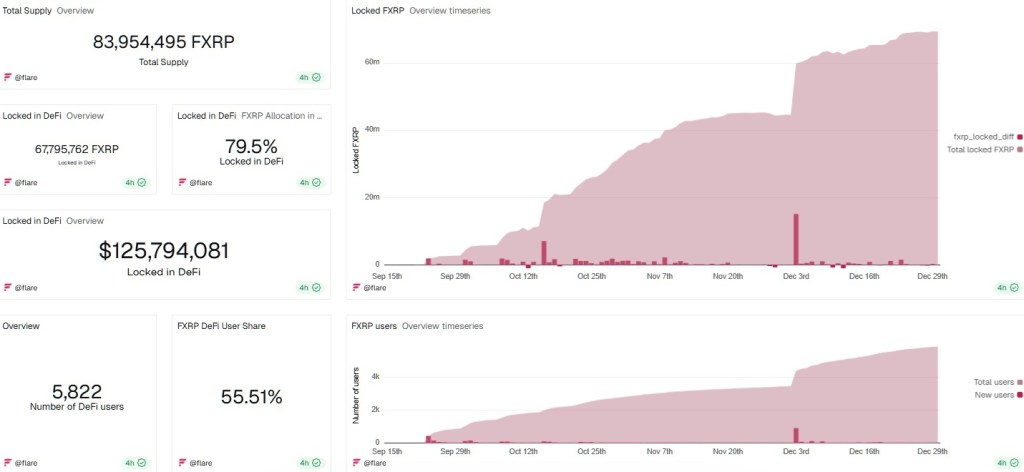
According to Flare's data as of December 30th, roughly 80% of the total FXRP supply is locked in decentralized finance, representing approximately $125.8 million in utility deployed in protocols on Flare. In a weak market environment, the network dashboard shows the total FXRP supply is about 83.95 million tokens, with nearly 67.8 million FXRP tokens tied up in DeFi applications.

User participation continues to expand, with over 5,800 DeFi users, and FXRP users account for more than 55.5% of all FXRP holders. Transaction activity also remains strong, exceeding 1.2 million DeFi transactions, including over 1.12 million FXRP swaps, alongside tens of thousands of liquidity additions and withdrawals. Flare's message frames this behavior as conviction-driven engagement, not opportunistic yield chasing, emphasizing that capital remains consistently locked while the number of users shows a steady upward trend.

Additional data further supports a positive outlook for XRP and the XRP Ledger by showing that the infrastructure has unlocked previously inaccessible utility. FXRP serves as a 1:1 representation of XRP minted through Flare's FAssets system, enabling interaction with EVM-compatible DeFi applications without the need for a custodian, while remaining economically linked to the liquidity of the XRP Ledger.

Beyond core DeFi, related products like stXRP are also gaining traction, with over $4.17 million locked in Sparkdex, over $1 million in Enosys, and additional allocations in Kinetic and other platforms. Within the Kinetic protocol alone, FXRP liquidity exceeds 37.4 million tokens, the total FXRP supply is valued at over $72 million, and lending activity is approaching $2.7 million. These figures reflect growing interoperability and capital efficiency directly tied to XRP. The data clearly reiterates that XRP's historical DeFi limitations stemmed from a lack of infrastructure, not a lack of demand. As the Flare Network expands smart contract capabilities and DeFi access, XRP and the XRP Ledger are increasingly positioned as a scalable liquidity layer capable of supporting the sustainable growth of decentralized finance.

Bitcoin Hyper: A New Shortcut for Bitcoin to a Functional DeFi World

Bitcoin Hyper is designed to unlock Bitcoin's traditional limitations regarding speed and fees. With its Layer 2 structure harnessing the power of the Solana Virtual Machine, Bitcoin can support fast, low-cost transactions and genuinely expand into dApps and DeFi, not just as a concept on paper. The HYPER token acts as the heart of the system, facilitating transactions, staking, and network governance, helping to transform Bitcoin's role from merely a store of value to a ready-to-use financial infrastructure in the decentralized world.
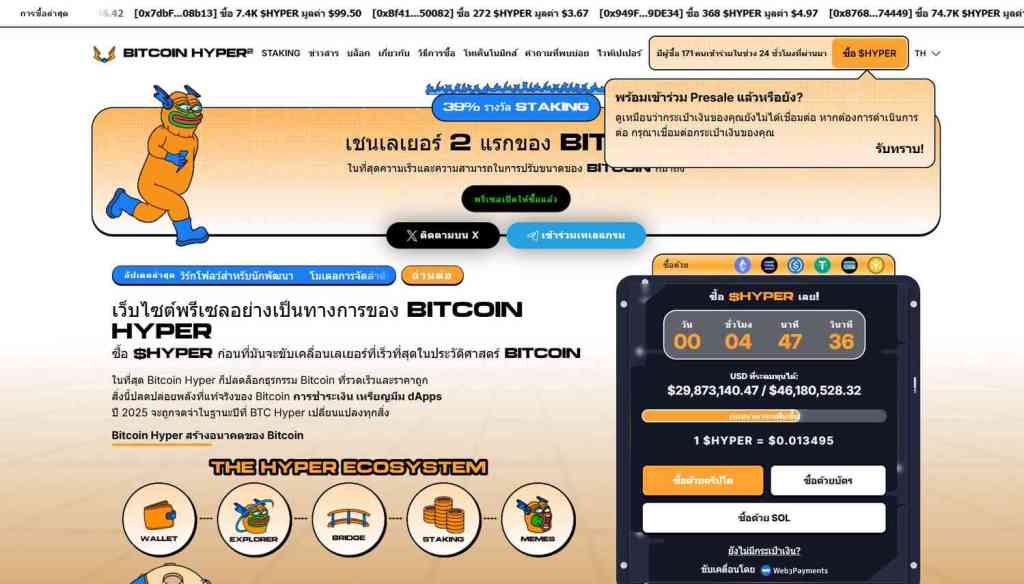
Looking at the DeFi trend where real capital is flowing in, as seen with XRP on Flare, it's clear the problem is not user demand, but the unprepared infrastructure. Bitcoin Hyper is stepping in to fill that gap, paving the way for Bitcoin's liquidity to enter DeFi more efficiently. For investors looking for projects that play into the real demand of the market, not just temporary trends, Bitcoin Hyper is one option to watch, as it is positioning itself as a crucial bridge between Bitcoin and the continuously growing world of DeFi.

Go to Bitcoin Hyper

Domande pertinenti

QWhat percentage of FXRP is currently locked in DeFi according to the Flare Network data?

AApproximately 80% of the total FXRP supply is locked in decentralized finance (DeFi).

QWhat is the estimated total value of FXRP that is being utilized in protocols on Flare?

AThe estimated total value of FXRP being utilized is over $124 million USD.

QHow does FXRP function on the Flare Network in relation to the native XRP asset?

AFXRP is a 1:1 representation of XRP minted through Flare's FAssets system, allowing it to interact with EVM-compatible DeFi applications without requiring a custodian, while remaining economically linked to the liquidity of the XRP Ledger.

QWhat key limitation of XRP in the DeFi space does the Flare Network claim to be solving?

AFlare Network is solving the historical limitation of XRP in DeFi, which was a lack of infrastructure (like smart contract capabilities), not a lack of user demand.

QBesides the main DeFi protocols, what other FXRP-related product is mentioned as gaining popularity, and what is its locked value on Sparkdex?

AThe product stXRP is mentioned as gaining popularity, with a locked value of over $4.17 million USD on Sparkdex.

Letture associate

The AI Agent Era Accelerates Its Arrival: Questflow Defines a New Paradigm of Financial Intelligence with On-Chain AI Brokerage

The AI Agent era is accelerating, with the CB Insights AI 100 list highlighting global investment confidence. The focus has shifted from whether AI works to its speed of deployment and ability to manage complex workflows, with autonomous AI Agents driving this transformation. At the forefront is Questflow, a Singapore-based startup redefining financial intelligence through its on-chain AI brokerage. Unlike tools that merely provide data dashboards, Questflow deploys AI Agents that proactively scan markets, form judgments, and execute trades via a conversational interface—operating 24/7 without requiring manual confirmation for each decision. This embodies the new AI paradigm of agents capable of executing multi-step workflows autonomously. Questflow's mission is to democratize institutional-grade trading intelligence. Historically reserved for the ultra-wealthy, this capability is now accessible starting from just $1 through Questflow's "AI Clone + Copy Trade" model. The platform charges only a 1% execution fee, aligning its incentives directly with users and eliminating traditional management or performance fees. The timing is opportune, aligning with key trends identified by CB Insights: the scalable deployment of AI Agents, accelerated AI adoption in financial services, and the maturation of on-chain infrastructure. With robust liquidity on platforms like Hyperliquid and Polymarket, alongside advancements in AI reasoning and non-custodial wallet security, Questflow is positioned to merge the roles of broker, fund, and exchange into a single, accessible platform for millions.

链捕手6 min fa

The AI Agent Era Accelerates Its Arrival: Questflow Defines a New Paradigm of Financial Intelligence with On-Chain AI Brokerage

链捕手6 min fa

Why Pricing Social Interactions is Doomed to Fail?

Titled "Why Putting a Price on Social Interaction Is Doomed to Fail," this article critiques attempts to monetize social networks directly through SocialFi models, arguing their inevitable failure stems from a fundamental misunderstanding of media dynamics. Using Marshall McLuhan's theory of "hot" and "cold" media, the author posits that social networks are inherently "cold" media. Their value isn't contained in individual posts but is co-created through user participation, interpretation, and fragmented, ongoing interaction (e.g., replies, shares). This ambiguity and need for user involvement are core to their function. The article asserts that SocialFi projects like Friend.tech failed because introducing real-time, tradable financial pricing (a definitive "hot" signal) into this "cold" environment doesn't add a layer—it replaces the medium's essence. The unambiguous price signal overshadows and nullifies the nuanced, participatory social signal. Users become traders, not participants, and when speculative profits vanish, the underlying social ecosystem—never genuinely cultivated—collapses entirely. This principle extends beyond crypto. The author argues platforms like Twitter have gradually "heated up" through metrics (likes, retweets counts, algorithmically defined value), shifting users from participants to performers and eroding organic engagement. The solution isn't to abandon capital but to manage its entry point. Successful models like Substack, Patreon, or Bandcamp allow capital to "condense" at specific, isolated nodes (e.g., subscriptions, one-time payments) without permeating and "heating" every social interaction. They preserve the core "cold," participatory medium while enabling monetization at designated boundaries. The NFT boom and bust serves as a stark parallel: the ancient "cold" medium of collecting (valued for story, community, gradual accumulation) was rapidly destroyed by platforms that introduced real-time floor prices, rarity scores, and trading dashboards, transforming collectors into speculators and vaporizing cultural value when prices fell. The core lesson: "Liquidity equals heat." Injecting high liquidity and definitive pricing into a "cold" participatory medium doesn't optimize it; it fundamentally alters and destroys its value-creating mechanism. The future lies not in pricing every social gesture but in finding precise, non-invasive points for capital to condense without overheating the entire ecosystem.

marsbit14 min fa

Why Pricing Social Interactions is Doomed to Fail?

marsbit14 min fa

Jensen Huang's CMU Speech: In the AI Era, Don't Just Watch, Build

Jensen Huang, CEO of NVIDIA and a first-generation immigrant, delivered the commencement address to Carnegie Mellon University's class of 2026. He shared his personal journey from a humble background to founding NVIDIA, emphasizing resilience, learning from failure, and the responsibility that comes with leadership. Huang framed the present moment as the dawn of the AI revolution, a shift he believes is more profound than previous computing waves. He described AI as fundamentally resetting computing—moving from human-written software to machines that understand, reason, and use tools. This will create a new industry for generating intelligence and transform every sector. While acknowledging AI's potential to automate tasks and displace some jobs, Huang distinguished between the *tasks* of a job and its core *purpose*. He argued AI will augment human capability, not replace humans. The real risk, he stated, is not AI itself, but people being left behind by those who effectively use AI. He presented AI as a generational opportunity for massive infrastructure investment—in chip factories, data centers, energy grids, and advanced manufacturing—that could re-industrialize nations like the U.S. and bridge the digital divide by making computing and intelligent tools accessible to all. Huang called for a balanced approach: advancing AI safely and responsibly, establishing prudent policies, ensuring broad access, and encouraging universal participation. He urged the graduates not to fear the future but to engage with optimism and ambition, reminding them of CMU's motto, "My heart is in the work." His core message was clear: this is their moment to actively build and shape the AI-powered future, not merely observe it.

marsbit1 h fa

Jensen Huang's CMU Speech: In the AI Era, Don't Just Watch, Build

marsbit1 h fa

Trading

Spot
Futures

Articoli Popolari

Cosa è XRP 2.0

XRP 2.0: Una Nuova Frontiera nel Paesaggio delle Criptovalute Introduzione a XRP 2.0 Nel mondo in continua evoluzione delle criptovalute, nuovi progetti emergono continuamente, cercando attenzione e adozione. Una tale iniziativa promettente è XRP 2.0, un nuovo progetto di criptovaluta progettato per sfruttare avanzate tecnologie blockchain e metodologie di crittografia robuste. Anche se il nome richiama alla mente l'XRP di Ripple, è fondamentale notare che XRP 2.0 opera in modo indipendente, concentrandosi sul miglioramento della sicurezza delle transazioni, della privacy e della scalabilità. Mentre il panorama finanziario digitale abbraccia sempre di più soluzioni decentralizzate, XRP 2.0 mira a contribuire in modo significativo al web3 e all'espansione generale dei progetti crypto. Cos'è XRP 2.0? Alla sua base, XRP 2.0 è un progetto di criptovaluta che mira a creare un ecosistema di valuta digitale sicuro e decentralizzato. La sua tecnologia fondamentale integra principi di blockchain sofisticati con tecniche di crittografia all'avanguardia. L'obiettivo principale di XRP 2.0 è quello di affermarsi come una piattaforma affidabile ed efficiente in grado di consentire un'esecuzione rapida delle transazioni, dando priorità a migliori protezioni della privacy per i suoi utenti. Il progetto è promosso come una soluzione a molte limitazioni affrontate dalle criptovalute esistenti, proponendo un sistema in grado di gestire un volume maggiore di transazioni con migliorata velocità e privacy. Questa versatilità pone XRP 2.0 come un significativo competitor in un mercato affollato di varie valute digitali. Chi è il Creatore di XRP 2.0? L'identità del creatore dietro XRP 2.0 è stata segnalata come 'Wilbur'. Tuttavia, i dettagli completi riguardanti Wilbur o l'entità associata rimangono sfuggenti. L'anonimato di molti creatori di criptovalute non è un fenomeno raro nel settore, spesso progettato per mantenere un certo grado di privacy e sicurezza. Chi sono gli Investitori di XRP 2.0? Al momento, informazioni specifiche relative alle fondazioni o organizzazioni di investimento a supporto di XRP 2.0 non sono disponibili pubblicamente. Nel settore delle criptovalute, il supporto di investitori rinomati può influenzare significativamente la credibilità e il successo di un progetto, tuttavia la trasparenza riguardo ai sostenitori finanziari di XRP 2.0 non è stata stabilita. Come Funziona XRP 2.0? XRP 2.0 si distingue per l'impiego di una combinazione di tecnologia blockchain e algoritmi di crittografia avanzati che garantiscono transazioni sicure e decentralizzate. La sua struttura innovativa include caratteristiche uniche progettate per promuovere il coinvolgimento degli utenti e ampliare le funzionalità oltre le transazioni convenzionali delle criptovalute. Tra queste caratteristiche, XRP 2.0 incorpora capacità alimentate da intelligenza artificiale, come funzionalità di testo in immagini e testo in voce. Queste aggiunte sono progettate per migliorare l'esperienza interattiva per gli utenti, promuovendo una maggiore applicabilità in vari settori. Unendo progressi tecnologici con design incentrati sugli utenti, XRP 2.0 mira a catturare l'attenzione di una vasta gamma di individui e aziende che cercano di integrare soluzioni di criptovaluta nei loro framework operativi. Cronologia di XRP 2.0 Comprendere XRP 2.0 richiede di esaminare i traguardi che hanno definito il suo percorso fino ad ora: 23 luglio 2023: XRP 2.0 viene introdotto come un nuovo progetto di criptovaluta, mirante a rivoluzionare le capacità di transazione sicura e decentralizzata nel dominio blockchain. 8 settembre 2023: Si verifica il lancio di un altro progetto, XRP20, marcando l'emergere di un token ERC-20 sulla blockchain di Ethereum che resta non correlato a XRP 2.0. 13 novembre 2023: Il ledger XRP subisce un significativo aggiornamento con il rilascio della versione 2.0.0 del software server rippled. È essenziale notare che questo sviluppo è scollegato dal progetto di criptovaluta XRP 2.0. Punti Chiave su XRP 2.0 Per distillare l'essenza di XRP 2.0, emergono diversi fattori critici: Caratteristiche Uniche: L'inclusione di funzionalità come il testo in immagini e testo in voce alimentato da intelligenza artificiale diversifica ulteriormente le potenziali applicazioni di XRP 2.0. Tecnologia Blockchain: Il framework utilizza meccanismi blockchain avanzati e protocolli di crittografia, garantendo un ambiente sicuro e decentralizzato per le transazioni. Scalabilità e Privacy: XRP 2.0 dà priorità a migliori protezioni della privacy nei processi di transazione e alla scalabilità necessaria per accogliere una base di utenti in crescita. Nessuna Affiliazione con Ripple: È importante notare che, nonostante il suo nome, XRP 2.0 non ha alcuna fedeltà o collaborazione con l'XRP di Ripple, distinguendo il proprio framework operativo e obiettivi all'interno dell'ecosistema delle criptovalute. Conclusione XRP 2.0 rappresenta un'ambiziosa venture nell'ambito delle criptovalute, mirante a offrire una combinazione di sicurezza, privacy ed efficienza nelle transazioni digitali. Integrando tecnologie sofisticate e caratteristiche user-friendly, il progetto si propone di ampliare gli orizzonti di ciò che le criptovalute possono realizzare nell'economia digitale odierna. Sebbene l'anonimato del suo creatore e la mancanza di investitori dichiarati possano sollevare domande per alcuni, il focus di XRP 2.0 su funzionalità avanzate e decentralizzazione ne amplifica l'appeal in un mercato crypto sempre più affollato. Man mano che il panorama delle criptovalute continua a evolversi, XRP 2.0 potrebbe emergere come un attore decisivo nell'espansione di soluzioni blockchain sicure e scalabili.

166 Totale visualizzazioniPubblicato il 2024.04.05Aggiornato il 2024.12.03

Cosa è XRP 2.0

Come comprare XRP

Benvenuto in HTX.com! Abbiamo reso l'acquisto di XRP (XRP) semplice e conveniente. Segui la nostra guida passo passo per intraprendere il tuo viaggio nel mondo delle criptovalute.Step 1: Crea il tuo Account HTXUsa la tua email o numero di telefono per registrarti il tuo account gratuito su HTX. Vivi un'esperienza facile e sblocca tutte le funzionalità,Crea il mio accountStep 2: Vai in Acquista crypto e seleziona il tuo metodo di pagamentoCarta di credito/debito: utilizza la tua Visa o Mastercard per acquistare immediatamente XRPXRP.Bilancio: Usa i fondi dal bilancio del tuo account HTX per fare trading senza problemi.Terze parti: abbiamo aggiunto metodi di pagamento molto utilizzati come Google Pay e Apple Pay per maggiore comodità.P2P: Fai trading direttamente con altri utenti HTX.Over-the-Counter (OTC): Offriamo servizi su misura e tassi di cambio competitivi per i trader.Step 3: Conserva XRP (XRP)Dopo aver acquistato XRP (XRP), conserva nel tuo account HTX. In alternativa, puoi inviare tramite trasferimento blockchain o scambiare per altre criptovalute.Step 4: Scambia XRP (XRP)Scambia facilmente XRP (XRP) nel mercato spot di HTX. Accedi al tuo account, seleziona la tua coppia di trading, esegui le tue operazioni e monitora in tempo reale. Offriamo un'esperienza user-friendly sia per chi ha appena iniziato che per i trader più esperti.

1.4k Totale visualizzazioniPubblicato il 2024.12.10Aggiornato il 2025.03.21

Come comprare XRP

Discussioni

Benvenuto nella Community HTX. Qui puoi rimanere informato sugli ultimi sviluppi della piattaforma e accedere ad approfondimenti esperti sul mercato. Le opinioni degli utenti sul prezzo di XRP XRP sono presentate come di seguito.

活动图片