XRP Is Coming To Solana Via Hex Trust And LayerZero Bridge

bitcoinistPubblicato 2025-12-12Pubblicato ultima volta 2025-12-12

Introduzione

XRP is being bridged to the Solana blockchain as a wrapped token (wXRP) through a collaboration between Hex Trust and LayerZero. This wrapped asset will be fully backed 1:1 by native XRP held in custody, ensuring redeemability back to the XRP Ledger. Built on LayerZero's OFT standard, wXRP is designed for cross-chain utility and aims to launch with over $100 million in initial liquidity. The integration will enable XRP holders to use the token within Solana's DeFi ecosystem—including DEXs and lending markets—while maintaining exposure to the original asset. The minting and redemption process is tailored for authorized, KYC/AML-compliant institutions, targeting market makers and larger balance sheets rather than retail users.

Solana is making a straight-for-the-liquidity play: bring XRP on-chain in a way that looks familiar to DeFi users, but legible to institutions. In a series of posts on X early Friday, Solana said XRP is “coming to Solana,” with Hex Trust and LayerZero set to bridge and issue a wrapped version of the token—wXRP—designed to be “DeFi-ready” on Solana while staying redeemable 1:1 for native XRP on the XRP Ledger.

XRP Heads To Solana As Wrapped Token

That “redeemable 1:1” line is doing a lot of work. According to Hex Trust, wXRP will be issued only when an equivalent amount of XRP is deposited into custody, and it will be burned when redeemed—classic wrapped-asset mechanics, but with a compliance wrapper aimed squarely at bigger balance sheets. The firm said it will act as issuer and custodian for the underlying XRP, describing wXRP as a 1:1-backed representation of native XRP built to support cross-chain utility and DeFi activity.

“XRP has stood the test of time and cemented itself as one of crypto’s preeminent and most liquid currencies. XRP’s long standing utility meets Solana’s high-performance execution. With significant day one liquidity, traders, holders, and institutions can use XRP within leading Solana DEXes, lending markets, and liquidity protocols, while maintaining exposure to the underlying asset and 24/7 XRPL redemption rights,” the Solana Foundation stated in a thread via X on December 12.

The other headline claim: liquidity, immediately. Hex Trust said wXRP is expected to launch with over $100 million in total value locked, framing it as “day one” depth that should help with pricing and market health once the token starts circulating across venues.

LayerZero’s role is the plumbing. Hex Trust said wXRP will be issued on LayerZero’s Omnichain Fungible Token (OFT) standard, positioning it to move across multiple networks rather than live as a one-off wrapper on a single chain. Solana is first, with Hex Trust also naming Optimism, Ethereum, and HyperEVM among initial targets, plus additional chains later.

Why now? Solana’s pitch is basically: XRP is old-school liquid, Solana is high-throughput, and the combination should unlock new use cases without forcing holders to exit the asset. The practical version of that is straightforward—wXRP becomes usable inside Solana’s DEXs, lending markets, and liquidity protocols while keeping a standing redemption path back to XRPL.

The subtle version is about who’s allowed through the door: Hex Trust says minting and redemption is designed for “authorized merchants” in a KYC/AML-compliant environment, which is the kind of sentence that tends to show up when the target user is a market maker, not a meme trader.

And yes, the messaging is trying to thread the custody needle. Solana Foundation product marketing lead Vibhu Norby described the bridge as “self-custodial from end to end” while emphasizing 1:1 redemption back to the ledger—language meant to reassure crypto-native users that this isn’t “paper XRP,” even if the underlying asset is sitting with a regulated custodian.

Via X, Norby commented on the story behind the partnership: “In November, I unexpectedly became enemy #1 of the XRP Army. Through the resulting public learning process, I had a chance to meet many OG devs, core community members, memelords, and the team at Ripple itself, and I came to an understanding of the uniqueness of XRP as an asset, and its community.”

More color is expected on Day 3 of Solana Breakpoint, where RippleX’s Luke Judges is listed on the agenda for a short “Product Keynote: Hextrust” session moderated by Norby. If this rollout goes the way Solana is implying, that slot is less ceremonial than it sounds.

At press time, XRP traded at $2.0284.
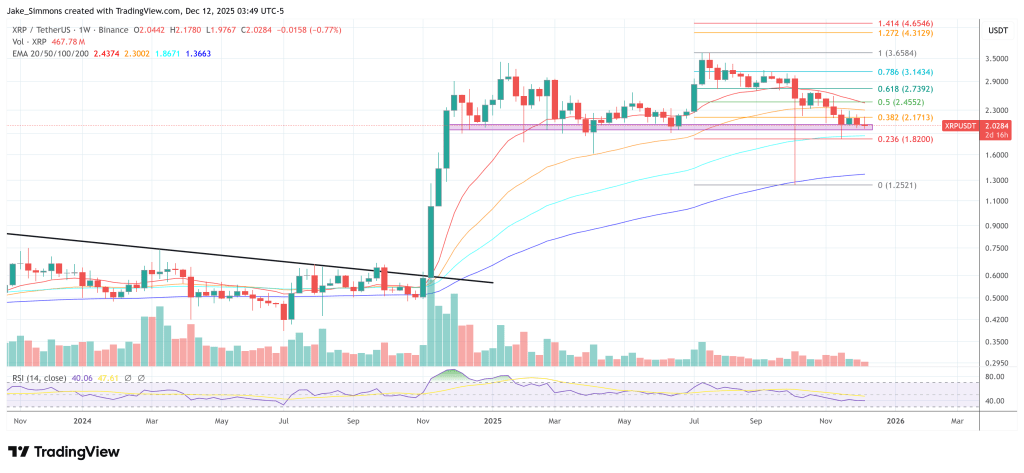
XRP hovers above key support, 1-week chart | Source: XRPUSDT on TradingView.com

Crypto di tendenza

Letture associate

Chipsea Turns from A-share to H-share: Riding the Price Surge Trend, or Gambling on the Cycle?

Xintianxia Technology, a Chinese flash memory chipmaker, is making its second attempt to list on the Hong Kong Stock Exchange after withdrawing its application for a mainland China IPO in late 2023. This move coincides with an upcycle in the memory chip sector. Ranked fifth among global fabless code-type flash memory suppliers in 2025, Xintianxia specializes in NOR Flash and SLC NAND chips. However, it holds a small 1.3% global market share in this niche segment. The company is highly dependent on a concentrated group of suppliers, with its top five accounting for over 80% of procurement in Q1 2026. After posting losses in 2023 and 2024, the company's fortunes reversed sharply in Q1 2026. Revenue grew 77.4% year-over-year to RMB 224 million, with net profit reaching RMB 75.89 million. This dramatic turnaround was primarily driven by strategic inventory stockpiling and significant price increases for its core products, leading to a gross margin surge to 55.63%. However, this aggressive strategy carries major risks. Inventory days have risen significantly, and the company's operating cash flow turned negative in Q1 2026 due to high stockpiling costs. The memory industry's cyclical nature means the current price boom may not last. If a downturn arrives, Xintianxia's high-cost inventory could become a financial burden, a scenario that previously derailed its A-share listing ambitions. Further complicating its IPO journey are corporate governance concerns. The company paid substantial dividends during loss-making years, and several major shareholders, including state-backed funds and the founder, cashed out significant stakes shortly before the Hong Kong listing application. Chinese regulators have requested details on past equity transfers, questioning pricing fairness. In essence, Xintianxia's Hong Kong listing bid is a high-stakes gamble on the sustainability of the current chip price cycle. Its future hinges not just on favorable market conditions but on its ability to withstand the inevitable downturn and prove its long-term operational resilience.

marsbit9 min fa

Chipsea Turns from A-share to H-share: Riding the Price Surge Trend, or Gambling on the Cycle?

marsbit9 min fa

BlackRock Launches Stablecoin Reserve Fund BRSRV: Bringing Short-Term US Treasuries to Solana, Ethereum, and Tempo

BlackRock Launches Tokenized Stablecoin Reserve Fund BRSRV, Expands to Solana and Tempo Global asset management giant BlackRock has introduced BRSRV (BlackRock Daily Reinvestment Stablecoin Reserve Vehicle), a tokenized money market fund specifically designed for stablecoin reserves. Concurrently, the firm is issuing tokenized, on-chain shares of its existing BSTBL (BlackRock Select Treasury-Based Liquidity Fund). A key development is the expansion of supported blockchains beyond Ethereum to include Solana and Stripe-affiliated chain Tempo for recording share ownership. The transfer agent Securitize will manage the process through approved, whitelisted wallets requiring verified identity, with a minimum initial investment of $3 million. The fund will invest solely in cash, short-term U.S. Treasuries, and overnight repurchase agreements backed by U.S. government securities, explicitly avoiding any crypto assets. BlackRock states the structure aims to qualify as a compliant reserve asset under the U.S. GENIUS Act for payment stablecoins. This launch builds upon BlackRock's broader tokenization strategy, notably following its BUIDL fund introduced in March 2024, which now holds over $26 billion in assets. The move places BlackRock alongside other major institutions like Morgan Stanley and Fidelity in offering products tailored for the stablecoin reserve market, signaling a deepening institutional push into tokenized real-world assets (RWA) and on-chain finance infrastructure.

marsbit10 min fa

BlackRock Launches Stablecoin Reserve Fund BRSRV: Bringing Short-Term US Treasuries to Solana, Ethereum, and Tempo

marsbit10 min fa

Wall Street Morning Report: AI + Cloud Computing Takes Over the Market Again, Amazon Knocks on the Door of $3 Trillion

Wall Street's August began with a strong rally, driven by easing Middle East tensions as President Trump signaled progress on U.S.-Iran talks, prompting a sharp drop in oil prices. Major indices hit record or near-record highs, with the Dow Jones Industrial Average up 1.32%, the Nasdaq Composite surging 2.13%, and the S&P 500 rising 1.48%. The energy sector was the sole decliner. The AI and cloud computing narrative dominated the tech rally. The "Magnificent Seven" index jumped 3.6%. Amazon's market cap surpassed $3 trillion for the first time following robust AWS results, while Nvidia regained a $5 trillion valuation. Meta, Google, and Microsoft also posted significant gains. Other AI-related stocks like Palantir, CoreWeave, and various semiconductor and infrastructure companies saw strong advances. In other markets, gold held above $4,000, supported by central bank buying. Treasury yields fell as oil prices dropped. The U.S. dollar remained stable despite strong manufacturing data. Japan's substantial currency intervention raised concerns, but U.S. officials reassured markets about the mechanism used. Key events ahead include major industry conferences (Ai4 2026, FMS Summit) and earnings reports from companies like SpaceX, AMD, and Pfizer. The White House is also set to host a meeting with leading AI firms to discuss regulatory frameworks.

marsbit1 h fa

Wall Street Morning Report: AI + Cloud Computing Takes Over the Market Again, Amazon Knocks on the Door of $3 Trillion

marsbit1 h fa

The July Tech Stock Pullback: Which Funds Are Paying the Price for Buying High?

In July, China's technology stocks experienced a sharp correction, causing significant pain for actively managed mutual funds that aggressively increased their holdings in the sector during the second quarter. The sell-off saw major indices like the ChiNext and STAR 50 fall over 25% and 28% for the month, respectively. Funds that piled into tech at its June peak faced steep losses. Notably, several veteran "value investor" fund managers, known for long-term holdings in consumer staples, made dramatic shifts. Star managers like Zhang Kun (E Fund Blue Chip Selected) and Liu Yanchun (Invesco Great Wall Dingyi) drastically reduced positions in liquor stocks like Kweichow Moutai, switching instead to semiconductor and AI hardware companies like SMIC and Ingenic International. Data shows active equity funds' allocation to the electronics sector reached a historical high of 42.64% by end-Q2. Around 67 funds saw their TMT (Technology, Media, Telecom) weighting surge from an average of 6.75% to 54.99%. The consequences were severe in July: these high-TMT funds fell an average of over 20%, with 12 plunging more than 40%. Examples include Jinhua High-Quality Growth and Guoshou Anbao Wenhui, which fell 26.34% and nearly 40% respectively after raising TMT weights above 70%. The article also highlights issues of "style drift," where funds with names like "high-dividend" held high-P/E tech stocks instead, confusing investors. Newly launched funds suffered even more. For instance, Guotai Haitong New Energy RuiXuan Hybrid, launched in mid-June, saw its net asset value plummet to 0.5509 yuan by July 30, a loss of nearly 45%. Analysts note the extreme sector concentration mirrored past bubbles (e.g., 2021 new energy). The intense, crowded trade itself became a major risk. While tech stocks rebounded sharply on July 31, the funds that chased the high face a longer-term market test.

marsbit1 h fa

The July Tech Stock Pullback: Which Funds Are Paying the Price for Buying High?

marsbit1 h fa

Trading

Spot

Articoli Popolari

Cosa è XRP 2.0

XRP 2.0: Una Nuova Frontiera nel Paesaggio delle Criptovalute Introduzione a XRP 2.0 Nel mondo in continua evoluzione delle criptovalute, nuovi progetti emergono continuamente, cercando attenzione e adozione. Una tale iniziativa promettente è XRP 2.0, un nuovo progetto di criptovaluta progettato per sfruttare avanzate tecnologie blockchain e metodologie di crittografia robuste. Anche se il nome richiama alla mente l'XRP di Ripple, è fondamentale notare che XRP 2.0 opera in modo indipendente, concentrandosi sul miglioramento della sicurezza delle transazioni, della privacy e della scalabilità. Mentre il panorama finanziario digitale abbraccia sempre di più soluzioni decentralizzate, XRP 2.0 mira a contribuire in modo significativo al web3 e all'espansione generale dei progetti crypto. Cos'è XRP 2.0? Alla sua base, XRP 2.0 è un progetto di criptovaluta che mira a creare un ecosistema di valuta digitale sicuro e decentralizzato. La sua tecnologia fondamentale integra principi di blockchain sofisticati con tecniche di crittografia all'avanguardia. L'obiettivo principale di XRP 2.0 è quello di affermarsi come una piattaforma affidabile ed efficiente in grado di consentire un'esecuzione rapida delle transazioni, dando priorità a migliori protezioni della privacy per i suoi utenti. Il progetto è promosso come una soluzione a molte limitazioni affrontate dalle criptovalute esistenti, proponendo un sistema in grado di gestire un volume maggiore di transazioni con migliorata velocità e privacy. Questa versatilità pone XRP 2.0 come un significativo competitor in un mercato affollato di varie valute digitali. Chi è il Creatore di XRP 2.0? L'identità del creatore dietro XRP 2.0 è stata segnalata come 'Wilbur'. Tuttavia, i dettagli completi riguardanti Wilbur o l'entità associata rimangono sfuggenti. L'anonimato di molti creatori di criptovalute non è un fenomeno raro nel settore, spesso progettato per mantenere un certo grado di privacy e sicurezza. Chi sono gli Investitori di XRP 2.0? Al momento, informazioni specifiche relative alle fondazioni o organizzazioni di investimento a supporto di XRP 2.0 non sono disponibili pubblicamente. Nel settore delle criptovalute, il supporto di investitori rinomati può influenzare significativamente la credibilità e il successo di un progetto, tuttavia la trasparenza riguardo ai sostenitori finanziari di XRP 2.0 non è stata stabilita. Come Funziona XRP 2.0? XRP 2.0 si distingue per l'impiego di una combinazione di tecnologia blockchain e algoritmi di crittografia avanzati che garantiscono transazioni sicure e decentralizzate. La sua struttura innovativa include caratteristiche uniche progettate per promuovere il coinvolgimento degli utenti e ampliare le funzionalità oltre le transazioni convenzionali delle criptovalute. Tra queste caratteristiche, XRP 2.0 incorpora capacità alimentate da intelligenza artificiale, come funzionalità di testo in immagini e testo in voce. Queste aggiunte sono progettate per migliorare l'esperienza interattiva per gli utenti, promuovendo una maggiore applicabilità in vari settori. Unendo progressi tecnologici con design incentrati sugli utenti, XRP 2.0 mira a catturare l'attenzione di una vasta gamma di individui e aziende che cercano di integrare soluzioni di criptovaluta nei loro framework operativi. Cronologia di XRP 2.0 Comprendere XRP 2.0 richiede di esaminare i traguardi che hanno definito il suo percorso fino ad ora: 23 luglio 2023: XRP 2.0 viene introdotto come un nuovo progetto di criptovaluta, mirante a rivoluzionare le capacità di transazione sicura e decentralizzata nel dominio blockchain. 8 settembre 2023: Si verifica il lancio di un altro progetto, XRP20, marcando l'emergere di un token ERC-20 sulla blockchain di Ethereum che resta non correlato a XRP 2.0. 13 novembre 2023: Il ledger XRP subisce un significativo aggiornamento con il rilascio della versione 2.0.0 del software server rippled. È essenziale notare che questo sviluppo è scollegato dal progetto di criptovaluta XRP 2.0. Punti Chiave su XRP 2.0 Per distillare l'essenza di XRP 2.0, emergono diversi fattori critici: Caratteristiche Uniche: L'inclusione di funzionalità come il testo in immagini e testo in voce alimentato da intelligenza artificiale diversifica ulteriormente le potenziali applicazioni di XRP 2.0. Tecnologia Blockchain: Il framework utilizza meccanismi blockchain avanzati e protocolli di crittografia, garantendo un ambiente sicuro e decentralizzato per le transazioni. Scalabilità e Privacy: XRP 2.0 dà priorità a migliori protezioni della privacy nei processi di transazione e alla scalabilità necessaria per accogliere una base di utenti in crescita. Nessuna Affiliazione con Ripple: È importante notare che, nonostante il suo nome, XRP 2.0 non ha alcuna fedeltà o collaborazione con l'XRP di Ripple, distinguendo il proprio framework operativo e obiettivi all'interno dell'ecosistema delle criptovalute. Conclusione XRP 2.0 rappresenta un'ambiziosa venture nell'ambito delle criptovalute, mirante a offrire una combinazione di sicurezza, privacy ed efficienza nelle transazioni digitali. Integrando tecnologie sofisticate e caratteristiche user-friendly, il progetto si propone di ampliare gli orizzonti di ciò che le criptovalute possono realizzare nell'economia digitale odierna. Sebbene l'anonimato del suo creatore e la mancanza di investitori dichiarati possano sollevare domande per alcuni, il focus di XRP 2.0 su funzionalità avanzate e decentralizzazione ne amplifica l'appeal in un mercato crypto sempre più affollato. Man mano che il panorama delle criptovalute continua a evolversi, XRP 2.0 potrebbe emergere come un attore decisivo nell'espansione di soluzioni blockchain sicure e scalabili.

250 Totale visualizzazioniPubblicato il 2024.04.05Aggiornato il 2024.12.03

Cosa è XRP 2.0

Come comprare XRP

Benvenuto in HTX.com! Abbiamo reso l'acquisto di XRP (XRP) semplice e conveniente. Segui la nostra guida passo passo per intraprendere il tuo viaggio nel mondo delle criptovalute.Step 1: Crea il tuo Account HTXUsa la tua email o numero di telefono per registrarti il tuo account gratuito su HTX. Vivi un'esperienza facile e sblocca tutte le funzionalità,Crea il mio accountStep 2: Vai in Acquista crypto e seleziona il tuo metodo di pagamentoCarta di credito/debito: utilizza la tua Visa o Mastercard per acquistare immediatamente XRPXRP.Bilancio: Usa i fondi dal bilancio del tuo account HTX per fare trading senza problemi.Terze parti: abbiamo aggiunto metodi di pagamento molto utilizzati come Google Pay e Apple Pay per maggiore comodità.P2P: Fai trading direttamente con altri utenti HTX.Over-the-Counter (OTC): Offriamo servizi su misura e tassi di cambio competitivi per i trader.Step 3: Conserva XRP (XRP)Dopo aver acquistato XRP (XRP), conserva nel tuo account HTX. In alternativa, puoi inviare tramite trasferimento blockchain o scambiare per altre criptovalute.Step 4: Scambia XRP (XRP)Scambia facilmente XRP (XRP) nel mercato spot di HTX. Accedi al tuo account, seleziona la tua coppia di trading, esegui le tue operazioni e monitora in tempo reale. Offriamo un'esperienza user-friendly sia per chi ha appena iniziato che per i trader più esperti.

1.7k Totale visualizzazioniPubblicato il 2024.12.10Aggiornato il 2026.06.02

Come comprare XRP

Discussioni

Benvenuto nella Community HTX. Qui puoi rimanere informato sugli ultimi sviluppi della piattaforma e accedere ad approfondimenti esperti sul mercato. Le opinioni degli utenti sul prezzo di XRP XRP sono presentate come di seguito.

活动图片