XRP Dev Predicts Market Cap To Hit $300 Billion Soon, What Would The Price Be?

bitcoinistPubblicato 2026-02-17Pubblicato ultima volta 2026-02-17

Introduzione

A pseudonymous XRP Ledger developer and analyst known as Bird has projected that XRP's market capitalization will soon surge to $300 billion. This would represent a significant increase of over 239% from its current valuation of approximately $88.38 billion. Based on XRP's circulating supply of 60.91 billion tokens, this market cap would translate to a price of around $5 per token—a 271% increase from its current trading price of $1.47. Bird's technical analysis, shared on X, includes a TradingView chart indicating a potential breakout after a prolonged period of selling pressure. The chart uses Fibonacci extension levels, with the 1.618 level aligning with the $300 billion target. While this is a highly optimistic forecast, some members of the crypto community have expressed that even this projection is too low, believing XRP could eventually reach a multi-trillion dollar valuation. The prediction reflects growing optimism despite recent market downturns.

A new technical projection is circulating in the crypto market after pseudonymous analyst and XRP Ledger (XRPL) developer Bird forecast a sharp rise in the cryptocurrency’s market capitalization. The analyst predicts that the altcoin could soon reach a valuation of $300 billion, accompanied by a significant price increase from current levels.

XRP Market Cap Forecasted To Surge To $300 Billion

In a post on X, Bird boldly declared that a “$300 billion XRP market cap is coming very soon.” The assertive forecast clearly shows his strong confidence in the token’s near-term growth potential, suggesting a major increase from current levels and reflecting growing optimism around the token despite recent price swings and a broader market downtrend.

Bird’s forecasts were accompanied by a detailed TradingView chart illustrating a potential breakout scenario for XRP’s market capitalization. At the time of the analysis, its valuation stood at $88.38 billion. Technical levels on the chart highlight a prolonged downturn stretching from early 2025 into early 2026. Additionally, a descending white trendline can be seen connecting multiple lower lows, indicating sustained selling pressure over several months.
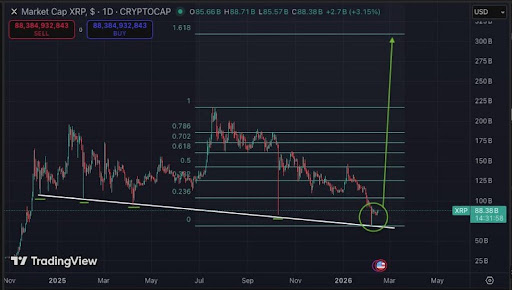
Source: Chart from Bird on X

The most recent price action shows the market cap revisiting a long-term support zone between $100 billion and $80 billion, an area circled on the chart to emphasize its significance. Fibonacci retracement and extension levels are plotted from a price swing high to a major now, marking key levels at 0.236, 0.382, 0.5, 0.618, 0.702, 0.786, 1, and 1.618.

The 1 level aligns near the $225 billion region, while the 1.618 extension points above toward Bird’s projected $300 billion market cap. The chart illustrates a large upward green arrow extending from $88.38 billion valuation at the time of the analysis toward $300 billion, representing an increase of more than $211 billion. This suggests that Bird expects its valuation to skyrocket by more than 239%.

Price At A $300 Billion Market Cap

Analysts calculate XRP’s price by dividing its market capitalization by its circulating supply. Based on its current circulating supply of approximately 60.91 billion tokens and a projected market cap of $300 billion, this would imply a price increase to approximately $5 per token. At the time of writing, the cryptocurrency is trading near $1.47, meaning a surge to this level would represent a rally of approximately 271%.

Although $5.45 is a big jump from present lows, many in the crypto community have expressed dissatisfaction with the bullish projection. Some say it’s too low, voicing out frustration and criticizing XRP’s slow price growth over the past decade.

Others believe the altcoin is still undervalued at a $300 billion market cap, with some members projecting that the cryptocurrency’s valuation could eventually reach trillions of dollars.

XRP trading at $1.47 on the 1D chart | Source: XRPUSDT on Tradingview.com

Domande pertinenti

QWhat is the projected market cap for XRP as predicted by the developer Bird?

ABird predicts that XRP's market cap will reach $300 billion very soon.

QHow much would the price of XRP be if it reaches a $300 billion market cap?

ABased on the current circulating supply of approximately 60.91 billion tokens, the price would be around $5 per token.

QWhat is the current market cap of XRP as mentioned in the analysis?

AAt the time of the analysis, XRP's market cap was $88.38 billion.

QWhat percentage increase does the $300 billion market cap represent from the current valuation?

AA $300 billion market cap would represent an increase of more than 239% from the $88.38 billion valuation at the time of the analysis.

QHow are some members of the crypto community reacting to the $300 billion market cap projection?

ASome community members expressed dissatisfaction, believing the projection is too low, and think XRP is still undervalued, with some projecting it could eventually reach a valuation in the trillions of dollars.

Letture associate

Uncovering the Truth About Agent Commerce, Payments, and Infrastructure

Decoding Agent Commerce, Payments, and Infrastructure: The Reality Over the past year, I've been building infrastructure for the Agent economy, engaging with major players like Stripe, Visa, Coinbase, Google, and dozens of startups. A clear conclusion emerges: true, large-scale demand does not yet exist. Startups face structural challenges. Data points illustrate this gap. Stripe's Agent commerce platform has over 1,000 merchants but only single-digit transacting agents. Visa's Agent payment token requires 9-month KYC and a $250M revenue threshold, accessible only to giants like Amazon. On-chain analysis reveals actual daily Agent transaction volume is around $17k, half of which are test transactions. The article analyzes four potential markets: **1. Agent-to-Merchant (A2M):** Current AI shopping UX is often inferior to traditional e-commerce for visual, comparison-heavy purchases (clothing, electronics). Chat interfaces are a step back. Real merchant interest is defensive "Agent Engine Optimization," fearing future obsolescence, not current demand. Potential exists in high-frequency, low-decision purchases (e.g., food delivery) or simplifying terrible UX (complex checkouts, non-native shoppers), but these require massive consumer distribution channels dominated by giants like DoorDash and Amazon. **2. Agent-to-API (A2A):** Developers already have subscriptions and billing for core APIs (compute, data). The argument for micro-payments via crypto for sub-dollar API calls is addressed by pre-paid balances today. The deeper issue is supplier resistance; major SaaS firms rely on enterprise contracts, not fractional cent pricing. Opportunity lies in the long tail of niche services, but this is a smaller market catering to developers, a historically low-paying group. **3. Agent-to-Agent (A2A):** This remains a theoretical long-term vision with near-zero current transaction volume. It involves unique challenges: discovery, trust, negotiation, dispute resolution. When it materializes, it will require a fundamentally new settlement infrastructure for high-speed, variable-value, multi-party transactions. It's a real long-term bet, but not the current market. **4. Agent-to-Finance (A2F):** This is the only category with existing, paying demand. Integrating AI into financial workflows (trading, portfolio management) is a natural evolution and enables new capabilities like autonomous rebalancing. However, competition favors incumbents with regulatory licenses, compliance infrastructure, and existing client relationships. **The Real Issue:** Why is infrastructure still being built? Incumbents can afford long-term bets, and payment companies see every problem as a nail for their payment hammer. However, payment is just one piece. The core challenge is *coordination*—orchestrating work between Agents and humans, verifying outcomes, and settling results. Payment is part of settlement, which is part of coordination. Companies that solve the coordination problem will subsume payments, not the other way around. Startups lack the infinite runway of giants and must find today's real market, which, after a year of exploration, lies outside these four categories—in an area with real, growing, and underserved activity.

marsbit42 min fa

Uncovering the Truth About Agent Commerce, Payments, and Infrastructure

marsbit42 min fa

Kalshi, MTS, and a16z's Ambition

The article "Kalshi, MTS, and a16z's Ambition" explores prediction markets as a focal point of excitement in 2025 for investors, crypto enthusiasts, and media. It traces their intellectual lineage from Friedrich Hayek's ideas on dispersed knowledge and market coordination to Robin Hanson's Logarithmic Market Scoring Rule (LMSR), which incentivizes truthful information sharing. The piece argues that a16z's significant investment in prediction market platform Kalshi (valued at $220B) transcends mere financial speculation. a16z frames prediction markets as a new form of "media" that provides "presence"—a way for individuals to actively engage with and influence world events through financial stakes, countering postmodern detachment. By wagering on outcomes, users become "super observers," and the market's aggregated probabilities gain authoritative power to define event truth and importance. The article uses media company MTS ("Monitoring The Situation") as a case study of a16z's "new media" strategy: rapidly producing high-intensity, multi-format content to "take over the timeline." However, prediction markets like Kalshi are presented as the ultimate piece in this media empire. Their real-money, crowd-sourced probabilities possess a unique "reality distortion field" and perceived objectivity, potentially swaying public opinion and granting a private company unprecedented interpretive power over reality. Ultimately, Kalshi's immense valuation is attributed not just to its exchange model, but to its role as a foundational component in a16z's envisioned new media landscape, where prediction markets define narrative and truth.

链捕手42 min fa

Kalshi, MTS, and a16z's Ambition

链捕手42 min fa

Trading

Spot
Futures
活动图片





