Wintermute: Sharp Decline in Crypto Volatility, Retail Capital Fleeing En Masse to US Stocks

marsbitPubblicato 2026-02-27Pubblicato ultima volta 2026-02-27

Introduzione

Wintermute, a crypto OTC trader, analyzes the ongoing shift in retail capital flows from the crypto market to U.S. equities. Historically, retail speculation drove crypto bull markets, but recent data shows a sharp reversal: retail investors are now pouring into stocks at record rates, while crypto and equities have transitioned from moving in sync to behaving like substitutes. Key data reveals a significant divergence starting late 2024. When retail activity in stocks surges, crypto liquidity suffers. This is partly due to compressed realized volatility in crypto—its core appeal for speculators—as markets mature, institutional tools like ETFs expand, and the asset class grows in size. Meanwhile, U.S. equities offer competitive volatility and perceived analytical edges through AI tools, making them more attractive. Additionally, seamless on-and-off ramps between crypto and stock trading apps enable easy capital rotation. Retail investors now treat crypto as just one option in a broader speculative toolkit, rather than the primary destination. This shift demands a new multi-asset investment framework for crypto participants, incorporating equity market signals to gauge retail risk appetite and timing.

Author:Wintermute

Compiled by: Deep Tide TechFlow

Deep Tide Guide:This article is written by a Wintermute OTC trader, providing an in-depth analysis of the root causes behind the current outflow of retail capital from the crypto market. Historically, crypto bull markets have often been driven by retail speculation, but the latest data indicates that retail investors are flooding into US stocks at a record pace, causing the crypto market and US stocks to shift from "rising and falling together" to a "seesaw" relationship. As crypto market volatility declines, the barriers to entry and exit lower, and AI grants retail investors an analytical edge in US stocks, cryptocurrency is no longer the preferred choice for retail speculation. Understanding this logic of capital rotation can help us readjust our multi-asset investment framework.

Full Text Below:

Retail activity has always driven the crypto market. Through speculation, reflexive buying-the-dip, and flexible capital rotation among various tokens, retail investors have defined every major cycle in crypto history. But the latest data suggests that the relationship between retail and the crypto market is changing.

For some time, we have been warning that the US stock market is capturing retail attention at the expense of altcoin liquidity. The latest data from J.P. Morgan's strategy desk, combined with our proprietary flow data, further indicates that US stocks and cryptocurrencies are becoming substitutable risk assets.

Correlation Reversal

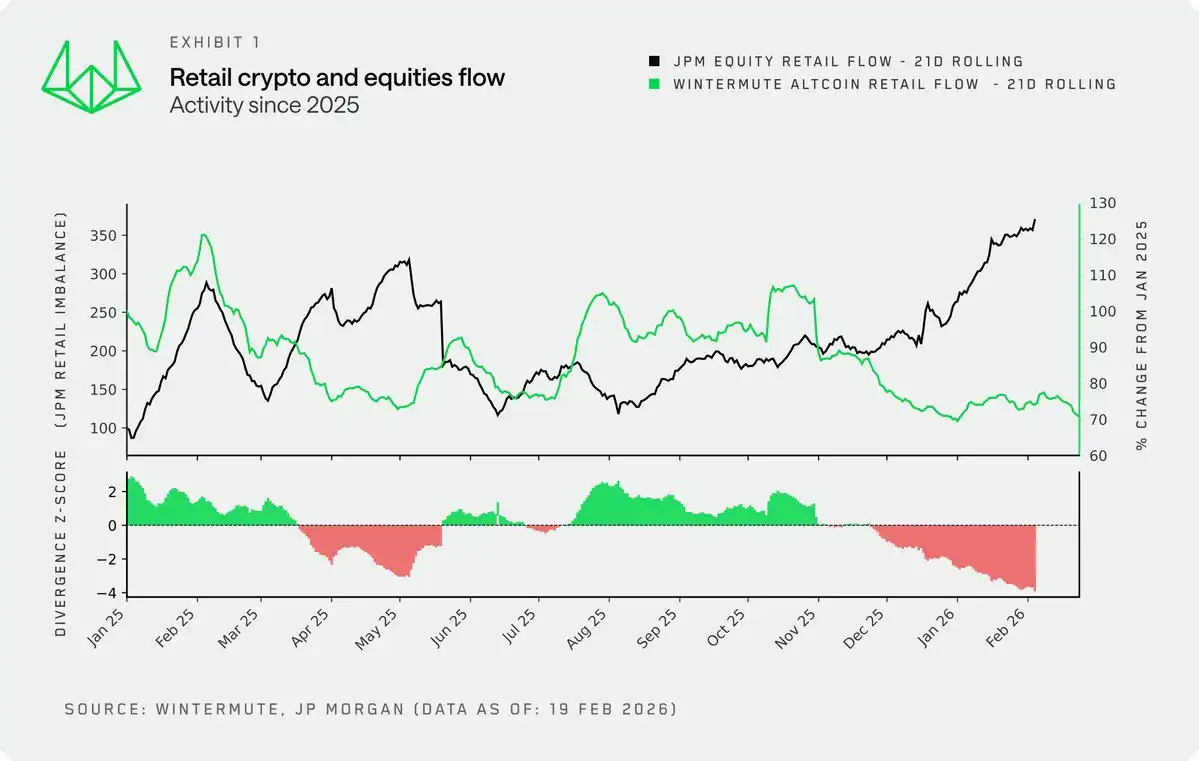
By overlaying Wintermute's proprietary crypto retail flow data with J.P. Morgan's data on retail inflows into US stocks, we gain a new perspective on the relationship between retail activity in US stocks and the crypto market.

Historically, the two have typically moved in sync. Until late 2024, rising risk appetite usually meant buying on both sides, as, to some extent, they were both outlets for excess capital (referencing M2 data) and risk appetite. However, since late 2024, this correlation has broken down. Today we are seeing the most severe divergence in recent history: retail is pouring into US stocks at a record pace while choosing to hold and wait in the crypto market.
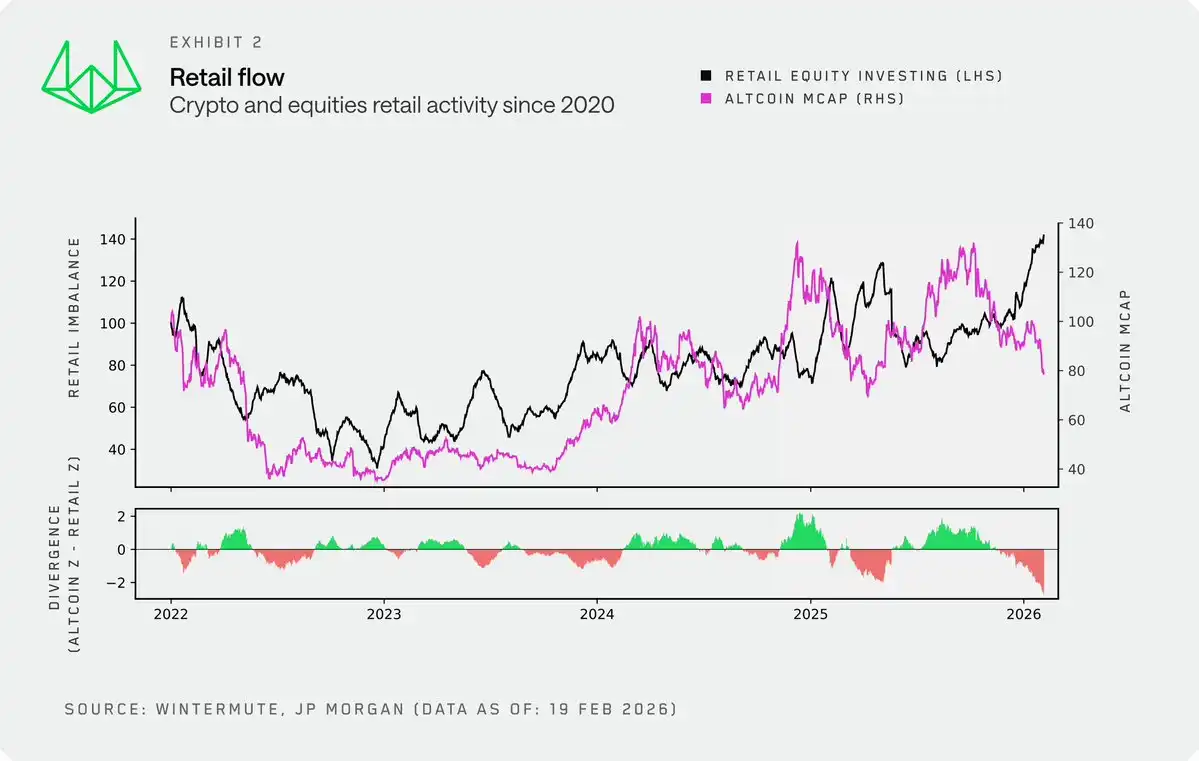
Looking at a longer time frame, we use the total market capitalization of altcoins as a long-term proxy for retail crypto activity. It aligns highly with our retail flow data and has a more objective, longer historical record. From 2022 to late 2024, cryptocurrencies and US stocks largely moved in tandem, with retail viewing both as part of a high-risk portfolio. But this decoupling in late 2024 is particularly pronounced, with retail trading behavior becoming more short-term driven, volatile, and lacking structure.
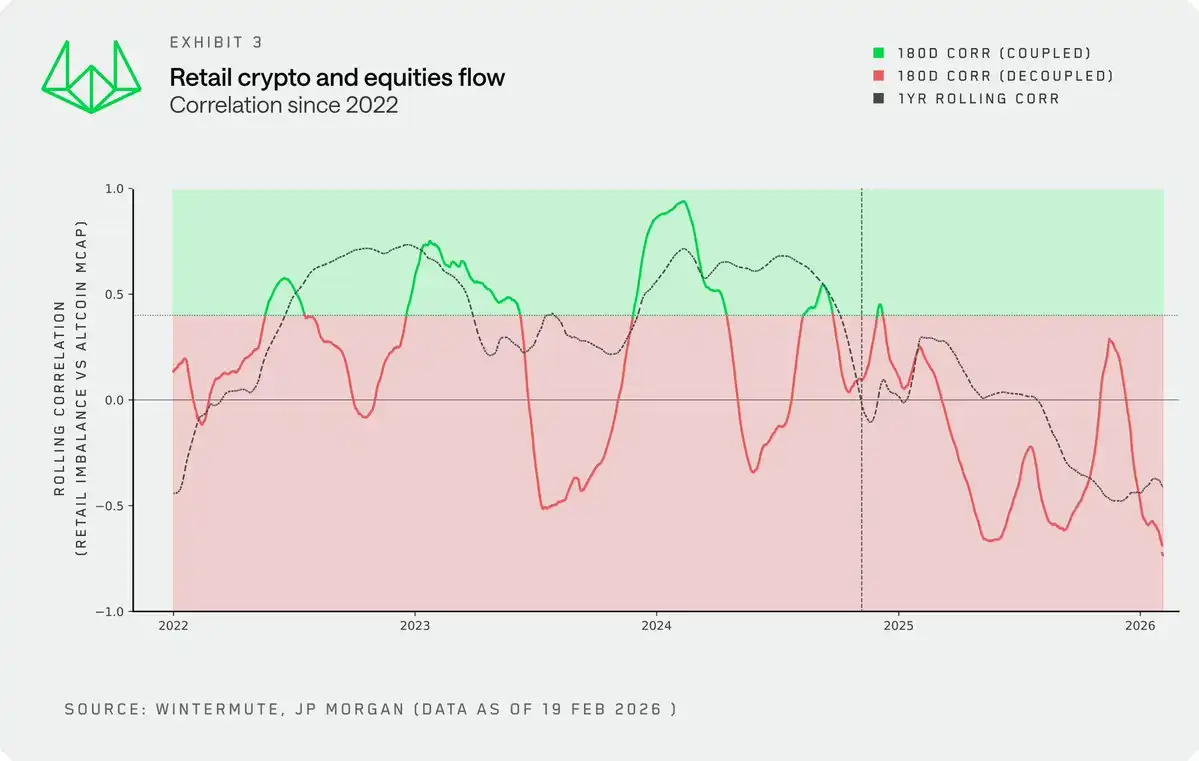
The rolling correlation between retail activity and altcoin market cap confirms this shift. The once volatile but generally positive relationship has now turned negative. Retail is now making an "either-or" capital allocation between these two, rather than buying both simultaneously.
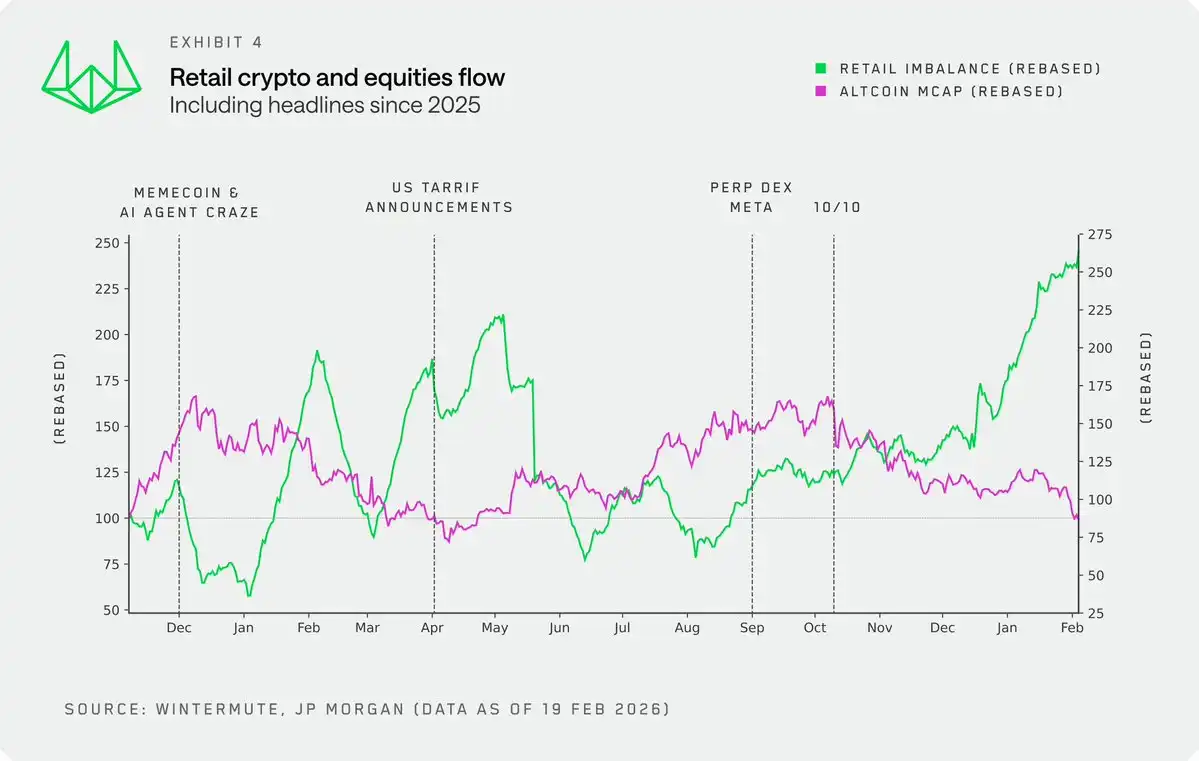
Focusing on 2025, this dynamic becomes clearer when combined with key catalyst events. Several points are very evident:

  • When US market activity stalled, Memecoins and AI agents had their moment, as retail shifted speculative demand to these areas.
  • Retail continued to aggressively buy the dip in US stocks, both during the tariff policy period announced in April 2025 and more recently.
  • After October 10th, capital almost completely shifted to US stocks, and this trend continues to this day.

Causality

One point must be clear: we do not believe the retail cohort in crypto is large enough to pull capital *from* US stocks. Quite the opposite, it is the soaring retail enthusiasm in the US stock market that is draining liquidity *from* the crypto market.

New data also confirms this. US retail activity has become a new variable, and crypto investors should closely monitor this indicator to find windows of opportunity when retail capital can provide sustained buying support for the crypto market.
Volatility is the Product Itself

While there are many reasons, one core reason why retail has been so active in and attracted to the crypto market is the asset's volatility characteristics. Volatility *is* the product itself. This was the core driving force that initially pulled retail into crypto.
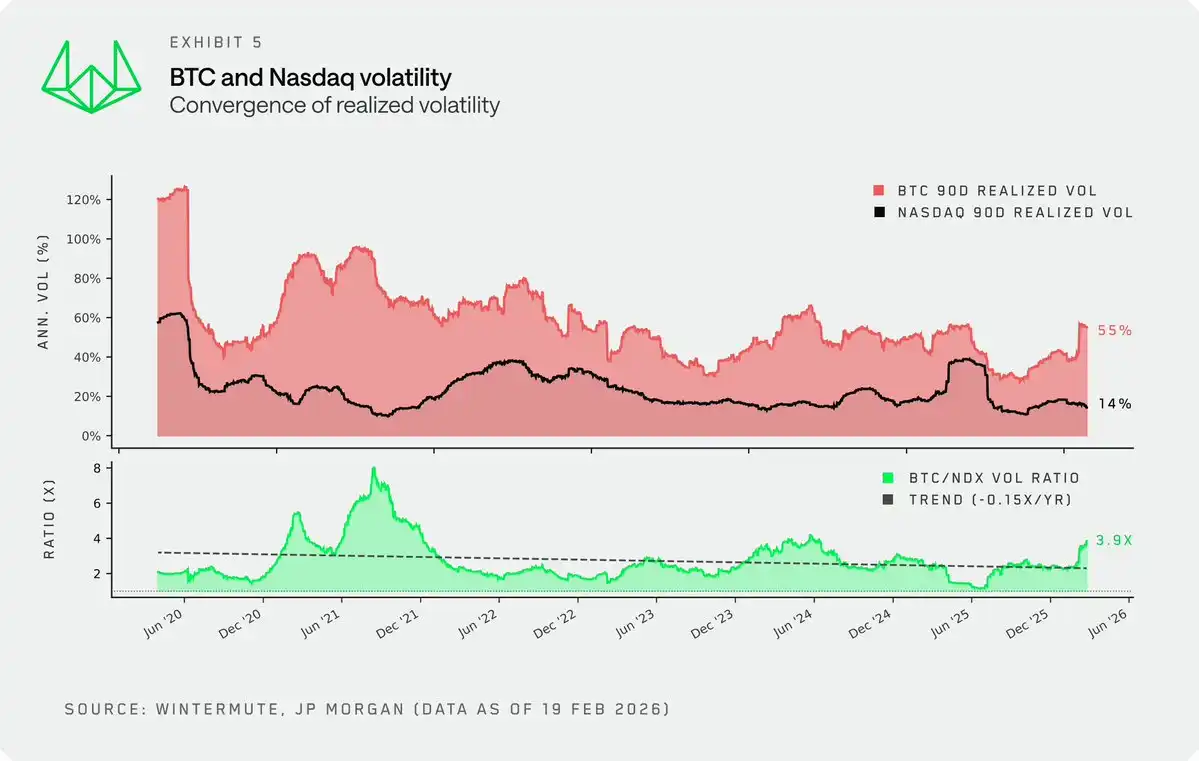
However, although crypto market volatility still far exceeds that of US stocks, its realized volatility has been undergoing structural compression, a trend that is difficult to reverse. The volatility ratio of BTC to the Nasdaq 100 Index (NDX) has been declining, compressed to below two times in the first half of 2025.

Some thoughts on key driving factors:

  • Market Maturation. Increasing participation from sophisticated investors, coupled with the emergence of new liquidity tools like ETFs and DATs, suppresses the typical, reflex-driven volatility spikes seen in earlier cycles.
  • Market Size. The total crypto market cap now stands at $2.3 trillion. Even with a 40% drawdown from the all-time high (ATH), the amount of capital required to move the market is far greater than it was five years ago.

As volatility compresses, the core selling point that attracted retail to cryptocurrency fades. The dramatic surges and crashes that defined the 21-22 bull cycle and attracted a whole cohort of retail investors are now a thing of the past. For volatility-seeking retail, US stocks are becoming increasingly attractive.

Technology-Driven Factors

Beyond the structural changes in the crypto market itself, technology-driven factors are also accelerating this capital rotation, a point not yet sufficiently discussed in the market.

  • Integration of Investment Channels. The integration of crypto trading into fintech and traditional brokerage platforms (or the integration of US stock trading into crypto-native platforms)确实降低了入场门槛,但其更深远的影响体现在「资金撤离」上. In previous cycles, complex deposit and withdrawal processes effectively locked capital inside the crypto ecosystem once it entered, fostering organic rotation among different tokens. Today, equally smooth on/off ramps mean capital can move freely and without friction between cryptocurrencies and US stocks.
  • The Edge. Retail seems increasingly drawn to US stocks, partly because they are gaining a new kind of advantage through AI. Large Language Models (LLMs) have significantly enhanced retail analytical capabilities, creating an illusion of a level playing field with institutions.

But this feeling is absent in crypto. While you can also analyze crypto projects based on data, the crypto space lacks a consensus valuation framework and clear token value capture mechanisms, coupled with an ever-expanding universe of investable assets, making it difficult for retail to find that sense of "having an edge" here.

Conclusion

Retail was once the most reliable source of reflexive demand in the crypto market, but now their risk appetite is increasingly being satisfied elsewhere. US stocks offer highly competitive volatility, provide retail with a growing analytical edge, and allow seamless switching between crypto and stocks through the same app on their phones. Cryptocurrency still has a place in retail portfolios, but it is now just one of many gambling tools, no longer the preferred vehicle for speculation.

This shift should also reshape how investors view the market. Some tried-and-true indicators have become ineffective. For crypto investors seeking success, merely looking for leading indicators of risk appetite and combining them with crypto-native frameworks is no longer sufficient. Investors increasingly need to view cryptocurrency through the lens of a multi-asset portfolio, as has long been standard practice in US equity and fixed income markets.


Domande pertinenti

QAccording to the article, what is the main reason for the shift of retail funds from crypto to US stocks?

AThe main reason is that US stocks are now offering competitive volatility, enhanced analytical advantages through AI tools, and seamless switching between crypto and stocks via the same apps, making them a more attractive speculative vehicle for retail investors.

QWhat key change in the correlation between crypto and US stock markets has been observed since late 2024?

ASince late 2024, the historically positive correlation between crypto and US stock markets has broken down, with retail funds now showing a negative correlation as they treat them as substitutable risk assets and allocate funds between them rather than buying both simultaneously.

QHow has the volatility of the crypto market changed structurally, and why is this significant?

AThe realized volatility of the crypto market has undergone structural compression, with the BTC vs. NDX volatility ratio falling below 2x in H1 2025. This is significant because volatility was a core product that drew retail investors to crypto, and its decline reduces crypto's appeal as a speculative asset.

QWhat technological factors are accelerating the capital rotation from crypto to US stocks?

AKey technological factors include the seamless integration of crypto and stock trading on fintech and brokerage platforms, which simplifies capital movement, and the perceived analytical edge retail investors gain in stocks through AI and large language models (LLMs), which is lacking in the crypto space due to its ambiguous valuation frameworks.

QHow should crypto investors adapt their perspective according to the article's conclusion?

ACrypto investors should adopt a multi-asset portfolio perspective, viewing cryptocurrency as just one of many gambling tools rather than the primary speculative vehicle, and increasingly monitor US retail activity as a key indicator for timing potential buying opportunities in crypto.

Letture associate

Coinbase Vice President: The Wars Over Cryptocurrency Regulation Are Over

Coinbase's new Vice President, Ryan VanGrak, declared that regulatory wars in the cryptocurrency sector are over. Since taking office on July 9, 2026, he has shifted the company's approach from litigation and sanctions to focusing on growth and innovation. The industry can now concentrate on development rather than fighting for its right to exist. He highlighted that the Digital Asset Market Clarity Act (CLARITY Act), which aims to establish a clear federal regulatory framework dividing oversight between the SEC and CFTC, has gained significant momentum. This framework is intended to provide proper supervision, investor protection, and maintain U.S. leadership in digital assets. VanGrak's appointment marks a strategic shift from a "wartime" to a "peacetime" advisor, replacing former Chief Legal Officer Paul Grewal, who oversaw major litigation, including a dismissed 2023 SEC lawsuit. With his background at Citadel Securities and the SEC, VanGrak brings deep regulatory and institutional finance expertise as Coinbase expands beyond a simple exchange into a broader financial services provider, offering stocks, futures, prediction markets, and AI tools. For investors, bipartisan support for crypto legislation like the CLARITY Act represents a major shift from the enforcement-focused environment of 2023-2024. Lawmakers are now focused on *how* to regulate crypto, not *if* it should exist. However, risks remain, as the bill's passage is not yet guaranteed.

cryptonews.ru35 min fa

Coinbase Vice President: The Wars Over Cryptocurrency Regulation Are Over

cryptonews.ru35 min fa

Deep Dive into FWA: An Intriguing Experiment Turning NFTs into "On-Chain Gachapon"

A Deep Dive into FWA: The “On-Chain Gacha” Experiment for NFTs Fake World Assets (FWA), created by TokenWorks, introduces an innovative “NFT gacha machine” fully operating on-chain. Users can deposit eligible NFTs paired with ETH (called Backing) to create a Position, acting as a prize pool. Others can then pay a uniform Acquisition Price for a chance to win a random NFT from the pool. The core mechanism features a reverse probability system: Positions with lower Backing have a higher chance of being selected, serving as common prizes, while high-Backing Positions are rare “jackpots.” The acquisition price is calculated based on the harmonic mean of all Backings, keeping entry costs low. When a Position is won, the purchaser must choose: keep the NFT or accept the Standing Bid (85% of the Backing, claimable in ETH or $FWA tokens), returning the NFT to the original depositor. The protocol involves two main roles. Depositors provide liquidity (NFT + ETH), earning a share of fees from each draw, distributed equally per active Position, plus potential $FWA rewards. Purchasers pay to spin the gacha, receiving $FWA rewards for participation. A special “Crown” reward goes to the Position with the highest Backing. The $FWA token has a fixed supply and is initially obtainable only through protocol participation (depositing or purchasing), with external buying disabled early on to reduce sell pressure. Its value is supported by a built-in buy pressure: when purchasers opt for the $FWA settlement on a Standing Bid, the protocol uses the backing ETH to buy $FWA from the market. Revenue for the protocol comes from a 1% fee on each draw, a 1% settlement fee when an NFT is kept, and the 15% discount from Standing Bid settlements (currently allocated to the protocol). The design cleverly blends Uniswap-style liquidity provision, gacha mechanics, and tokenomics to create a novel, self-regulating marketplace for NFT liquidity and engagement.

marsbit49 min fa

Deep Dive into FWA: An Intriguing Experiment Turning NFTs into "On-Chain Gachapon"

marsbit49 min fa

10,000 Scientists Get 1 Year of Free Access: OpenAI Brings the Scientific Research Pipeline into ChatGPT

OpenAI has launched the "ChatGPT for Academic Researchers" program, offering free one-year access to its flagship models for 100,000 university researchers globally, with 10,000 spots available this summer. Selected institutions include prestigious centers like ENS Paris and the IAS at Princeton. The initiative provides an integrated research workspace within ChatGPT, bundling tools like ChatGPT, ChatGPT Work, and Codex, along with expanded Deep Research capabilities, higher usage limits, and specialized tools for life sciences. The suite connects to platforms like Zotero and GitHub, aiming to streamline the entire research workflow from literature review and coding to data analysis and manuscript drafting. OpenAI notes that about 1.3 million people already use ChatGPT weekly for advanced science and math. The program targets building long-term user dependency by embedding these tools into daily research habits. However, access comes with limitations: it does not include API credits or model weights, and eligibility is restricted to verified academic researchers from supported countries. This approach contrasts with Anthropic's "AI for Science" program, which offers API credits but not an integrated workspace. Both companies emphasize preventing misuse by withholding model weights, a point of contention for AI researchers seeking transparency. The core strategy remains clear: provide a powerful, integrated environment to foster user reliance ahead of the post-free period.

marsbit54 min fa

10,000 Scientists Get 1 Year of Free Access: OpenAI Brings the Scientific Research Pipeline into ChatGPT

marsbit54 min fa

What's Going On with Gigadevice? Major Shareholder Cashes Out 44 Billion, Then Announces 20 Billion Buyback

Gigadevice Innovation, a leading Chinese memory chip company, has executed a controversial financial maneuver. The company's controlling shareholder and chairman, Zhu Yiming, sold approximately 44 billion RMB worth of his shares between early May and mid-June 2026, capitalizing on a soaring stock price that peaked at 846.66 RMB on June 29th. Following a subsequent stock crash—plummeting to around 350 RMB in 22 trading days and erasing over 330 billion RMB in market value—Zhu announced a combined "market rescue" plan on July 29th. This plan includes his personal commitment to buy back at least 1 billion RMB in shares and a company proposal to repurchase 1 to 2 billion RMB worth of stock. This sequence of high-selling followed by a low-buying plan has confused and unsettled many of the company's 240,000 retail investors. The stock's dramatic decline was attributed to several factors: the successful IPO of its sister company, Changxin Technologies, which ended Gigadevice's status as a primary investment proxy for the domestic memory sector; a Morgan Stanley report warning of a potential peak in the memory chip cycle; and a severe loss of market confidence triggered by the chairman's massive sell-off. While the sell-off was procedurally compliant, its timing has been criticized. The company's fundamentals appear strong, with preliminary H1 2026 results showing revenue up 177% year-on-year to 11.5 billion RMB and net profit skyrocketing 1099% to 6.9 billion RMB, driven by a boom in memory chips and MCU demand. However, a significant portion (2.05 billion RMB) of this profit came from non-recurring gains like securities investment, and the memory industry is notoriously cyclical. Analysts highlight the company's role in the domestic substitution of niche DRAM and NOR Flash memory, with some maintaining bullish price targets. Yet, the recent events underscore key risks: its fabless model creates dependency on foundries like Changxin, and the chairman's actions have raised serious questions about management's alignment with minority shareholders. The promised buybacks cannot commence until December 13th due to a mandatory six-month cooling-off period following an insider sale, leaving the stock vulnerable in the interim.

marsbit54 min fa

What's Going On with Gigadevice? Major Shareholder Cashes Out 44 Billion, Then Announces 20 Billion Buyback

marsbit54 min fa

Trading

Spot
活动图片