Will the U.S. Bond Market Trigger the Next Storm in U.S. Stocks? The Coming Week is Crucial

marsbitPubblicato 2026-08-04Pubblicato ultima volta 2026-08-04

Introduzione

"Will US Treasuries Trigger the Next Storm in the US Stock Market? The Coming Week Is Crucial" summarizes rising concerns in financial markets. Long-term US Treasury yields have surged sharply, with the 30-year yield reaching its highest level since 2007 and the 10-year yield breaking its trading range. This move is largely driven by growing market skepticism about the Federal Reserve's commitment to controlling inflation, especially after a rare dissent within the Fed's policy committee. Market volatility is increasing, as evidenced by the ICE BofA MOVE Index hitting a May high and demand for protective puts on long-term Treasury ETFs spiking to crisis-era levels. Analysts warn that stress in the bond market could soon spill over into equities, pressuring stock prices. The coming week is seen as critical, with several potential catalysts: the US Treasury's upcoming financing plan details and the key July nonfarm payrolls report. Both events could significantly influence interest rate expectations and potentially intensify market turbulence. The article concludes by noting the US Treasury market's foundational role in global finance, suggesting its ongoing instability could have widespread repercussions beyond bonds alone.

Original Author: Xu Chao

Original Source: Wall Street News

The U.S. Treasury market is sending increasingly strong signals of stress to other asset classes, with stocks being the first to feel the impact.

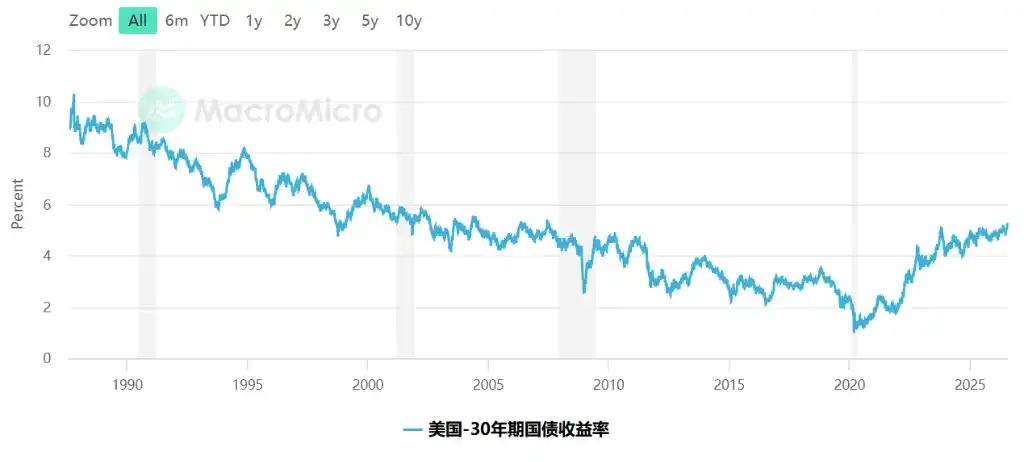
Long-term U.S. Treasury yields surged sharply last week, with the 30-year yield hitting its highest level since 2007, and the 10-year yield breaking out of the trading range it had maintained since late 2023.

Meanwhile, the ICE BofA MOVE Index, which measures expected volatility in the Treasury market, rose to its highest level since May, while demand for put options betting on falling bond prices surged. Data from the Chicago Board Options Exchange shows that the one-month put skew for options linked to the iShares 20+ Year Treasury Bond ETF soared to its highest level since the 2008 financial crisis.
In the coming week, the release of details from the U.S. Treasury's financing plans and the July non-farm payroll report could further intensify the volatility in the bond market.

Bob Elliott of Unlimited Funds recently wrote in a commentary: "It's difficult to gauge how much longer other asset markets, like equities, can withstand current interest rate levels without being dragged down." Gennadiy Goldberg, head of U.S. rates strategy at TD Securities, also warned that uncertainty surrounding the Federal Reserve's policy guidance, combined with geopolitical and other market noise, has created a precarious environment.

Fed Credibility Questioned, Long-Term Yields Break Out

The core driver of this recent surge in U.S. Treasury yields stems from market doubts about the Federal Reserve's policy credibility.

Since Federal Reserve Chair Kevin Warsh took the helm, he has adopted a tough stance on fighting inflation, yet the inflation rate has remained above the Fed's 2% target for five consecutive years. Investors are beginning to question whether the Fed truly has the will to raise interest rates again.

Last Wednesday, a rare divergence emerged within the Fed's rate-setting committee—three regional Fed presidents voted in favor of a rate hike, opposing the majority's position. As Warsh concluded his press conference last week, long-term yields jumped suddenly while short-term yields fell, sharply narrowing the spread between them. Analysis by Dow Jones Market Data shows this was the most significant compression of the yield curve on a 'Fed decision day' since 2023.

TD Securities' Goldberg stated: "The market is questioning just how determined the Fed is on controlling inflation." He also noted that while the base case remains no rate hikes this year or next, the probability of a hike has "increased significantly."

Bond Market Volatility Rises, Hedging Demand Expands Sharply

The unusual movement in yields quickly spread to the derivatives market, causing a sharp rise in hedging demand.

The ICE BofA MOVE Index reached its highest level since May, indicating traders are actively hedging against the risk of further rate increases.

At the same time, the ratio of trading volume in put options to call options linked to the iShares 20+ Year Treasury Bond ETF (TLT) has noticeably increased. Analysts at the Chicago Board Options Exchange pointed out that the one-month put skew for TLT options has surged to its highest level since the 2008 financial crisis.

Particularly noteworthy is that this rise in long-end yields has diverged from oil price movements—oil prices are falling, not rising in tandem with yields. This has further weakened the correlation between yields and oil prices, adding to market uncertainty.

Spillover Effects Emerge, Pressure on Stocks Rises

Turmoil in the U.S. Treasury market has historically been a precursor to stock market risks, and the current situation similarly has equity investors on edge.

Bob Elliott noted in his commentary that whenever Treasury yields reach or approach current levels, stress tends to begin spreading to other markets, with stocks being the first to be dragged down. Currently, the 30-year yield is at 5.239% and the 10-year yield is at 4.693%, both in historically high ranges.

Goldberg also admitted that geopolitical uncertainty stemming from the situation with Iran, ambiguity in the Fed's policy guidance, and a combination of other market noise are all contributing to the fragile environment. "All these uncertainties are intertwined," he said.

Multiple Event Windows Approach, A Critical Week of Testing Lies Ahead

The coming week will be a critical window to determine whether the stress in the Treasury market can spread further.

Later this week, the U.S. Treasury will release details of its latest government financing plans, and anything unexpected could trigger a new wave of volatility in the bond market. Several important economic data points will also be released throughout the week, culminating in Friday's July non-farm payroll report, which will significantly influence market expectations regarding the Fed's policy direction.

At the same time, last week, the U.S. Treasury and the Federal Reserve jointly conducted a historic coordinated intervention with Japanese authorities to stabilize the persistently weakening yen. Analysts believe the U.S. side's participation in the intervention was partly motivated by a desire to prevent renewed volatility in the U.S. Treasury market.

The $30 trillion U.S. Treasury market is the cornerstone of the global financial system, serving both as the core collateral for short-term institutional liquidity and as the benchmark pricing anchor for trillions of dollars in global debt. If this "sleeping giant" continues to stir, its tremors will extend far beyond the bond market itself.


Domande pertinenti

QAccording to the article, what are the two key events in the upcoming week that could further intensify bond market volatility?

AThe two key events are: 1) The release of details of the U.S. Treasury's latest government financing plan, and 2) The release of the July non-farm payrolls report.

QWhat does the article suggest is the core driver behind the recent surge in long-term U.S. Treasury yields?

AThe core driver is the market's doubt about the credibility of the Federal Reserve's policy, specifically questioning how determined the Fed is in controlling inflation.

QWhat specific indicators mentioned in the article show a significant increase in demand for hedging against rising rates?

AThe indicators are: 1) The ICE BofA MOVE Index reaching its highest level since May, indicating traders are actively hedging against further rate hikes. 2) The one-month put option skew for the iShares 20+ Year Treasury Bond ETF (TLT) surging to its highest level since the 2008 financial crisis.

QWhy is the potential turmoil in the U.S. Treasury market a concern for the stock market, as highlighted by the analysts cited?

AAnalysts like Bob Elliott warn that pressure often spills over into other markets, with stocks being the first to be dragged down, when Treasury yields reach or approach current high levels. The high yields increase pressure on equity valuations.

QWhat did the article imply about one of the motivations behind the recent coordinated intervention to stabilize the Japanese yen involving U.S. authorities?

AThe article implied that part of the motivation for the U.S. to join the intervention was to prevent renewed volatility from erupting in the U.S. Treasury market.

Letture associate

Crypto Bull Is Back, Which Assets Bounced the Hardest?

The cryptocurrency market experienced a significant surge last week, with Bitcoin rallying over 26% to nearly $79,500, its strongest weekly gain since March 2023, fueling discussions of a renewed bull market. This rebound highlighted several key market dynamics. First, short-term directional shifts are increasingly tied to U.S. policy cycles. The rally was driven by two major catalysts: the U.S. Treasury's announcement to increase long-term bond buybacks, easing macro liquidity pressures, and former President Trump's push for clearer crypto legislation, boosting regulatory certainty and risk appetite. Second, Bitcoin spot ETFs solidified their role as a leading market indicator. In the week ending August 21, U.S. Bitcoin and Ethereum spot ETFs saw a combined net inflow of $2.6 billion, the highest since October 2025, signaling strong institutional re-entry. Third, the rally followed a clear capital rotation pattern: Bitcoin's breakout ignited broader gains, with Ethereum (up nearly 30%), major altcoins, and meme coins sequentially posting larger percentage increases. Analysis of the top performers among the top 50 altcoins by market cap revealed the week's biggest gainers: ENA (Ethena) led with a 100.75% surge, fueled by a Coinbase partnership. It was followed by PUMP (Pump.fun, up 88-99%), STX (Stacks, up 82-94%), TRUMP (Official Trump, up 79-91%), and ZEC (Zcash, up 75.15%), which uniquely reached a new all-time high. Meme coins like BOME on Solana also saw explosive gains, exemplifying the high-risk, high-reward sentiment. The rally illustrated a clear path: Bitcoin set the stage, major coins like Ethereum led the charge, and altcoins/meme coins delivered the most explosive returns, mapping the gradient of returning market enthusiasm.

marsbit11 min fa

Crypto Bull Is Back, Which Assets Bounced the Hardest?

marsbit11 min fa

Wuhan is About to Witness Its Largest IPO in History

Wuhan is poised for its largest-ever IPO as Yangtze Memory Technologies Co., Ltd. (YMTC) has officially applied for a listing on the Shanghai Stock Exchange's STAR Market, seeking to raise 33 billion yuan. The domestic leader in 3D NAND flash memory chips completed its IPO辅导 (tutoring) process in a record three months, with market expectations valuing the company at 300 billion yuan or higher. YMTC's roots trace back to 2006 with the founding of Wuhan Xinxin. After surviving the global financial crisis and periods of operational difficulty, the company was formally established in 2016 through a joint investment involving Tsinghua Unigroup, the National Integrated Circuit Industry Investment Fund (the "Big Fund"), and local Hubei government funds. With a distinct "national team" background, its major shareholders include provincial and municipal state-owned assets committees and the Big Fund. Based in Wuhan's Optics Valley (East Lake High-tech Development Zone), YMTC's potential listing highlights the region's rise as a tech hub. Optics Valley is already home to 72 listed companies and has ambitious plans to exceed 100 by 2030. The zone recently established four industry-focused母基金 (mother funds) totaling 18 billion yuan to further boost sectors like integrated circuits and optoelectronics. YMTC's IPO would complete the "Optics Valley Seven Stars," a group of leading local optoelectronic and communication giants.

marsbit11 min fa

Wuhan is About to Witness Its Largest IPO in History

marsbit11 min fa

Banks and Regulators Join Pilot Project to Test Quantum-Resistant Crypto Transfers

Banks and financial regulators from Europe, the Middle East, and Asia have joined a pilot project to test quantum-resistant crypto infrastructure for digital asset wallets and on-chain transactions. The initiative, announced by the Responsible Fintech Institute and infrastructure provider Safeheron, will use NEAR's quantum-resistant testnet. It will employ the ML-DSA-65 post-quantum digital signature standard, recently finalized by the U.S. National Institute of Standards and Technology (NIST). Participating regulators include the Abu Dhabi Global Market, Bhutan's Gelphu Financial Services Authority, and Malta's Financial Services Authority. Financial institutions involved are Bison Bank and DK Bank. In the pilot, banks will test wallet creation and transactions in a unified application environment, while regulators will initially observe and later contribute to governance mechanisms. The organizers plan to publish a technical paper detailing the research, protocol design, and test results, eventually open-sourcing the core technology. This effort comes as financial authorities prepare for the advent of quantum computers, which threaten current public-key cryptography. For instance, the Hong Kong Monetary Authority aims for the territory's banking sector to be fully prepared for quantum-related security risks by 2030. The Bank for International Settlements (BIS) also recommended in a 2025 document that financial institutions begin a coordinated, phased transition to post-quantum systems.

cryptonews.ru13 min fa

Banks and Regulators Join Pilot Project to Test Quantum-Resistant Crypto Transfers

cryptonews.ru13 min fa

Trading

Spot
活动图片