Wuhan is About to Witness Its Largest IPO in History

marsbitPubblicato 2026-08-24Pubblicato ultima volta 2026-08-24

Introduzione

Wuhan is poised for its largest-ever IPO as Yangtze Memory Technologies Co., Ltd. (YMTC) has officially applied for a listing on the Shanghai Stock Exchange's STAR Market, seeking to raise 33 billion yuan. The domestic leader in 3D NAND flash memory chips completed its IPO辅导 (tutoring) process in a record three months, with market expectations valuing the company at 300 billion yuan or higher. YMTC's roots trace back to 2006 with the founding of Wuhan Xinxin. After surviving the global financial crisis and periods of operational difficulty, the company was formally established in 2016 through a joint investment involving Tsinghua Unigroup, the National Integrated Circuit Industry Investment Fund (the "Big Fund"), and local Hubei government funds. With a distinct "national team" background, its major shareholders include provincial and municipal state-owned assets committees and the Big Fund. Based in Wuhan's Optics Valley (East Lake High-tech Development Zone), YMTC's potential listing highlights the region's rise as a tech hub. Optics Valley is already home to 72 listed companies and has ambitious plans to exceed 100 by 2030. The zone recently established four industry-focused母基金 (mother funds) totaling 18 billion yuan to further boost sectors like integrated circuits and optoelectronics. YMTC's IPO would complete the "Optics Valley Seven Stars," a group of leading local optoelectronic and communication giants.

By Rongzhong Finance

Another super IPO is on the way.

Recently, the Shanghai Stock Exchange website showed that the IPO review status of Yangtze Memory Technologies Co., Ltd. on the STAR Market has changed to "Accepted." The company plans to raise 33 billion yuan, with CITIC Securities and China Securities as its sponsors.
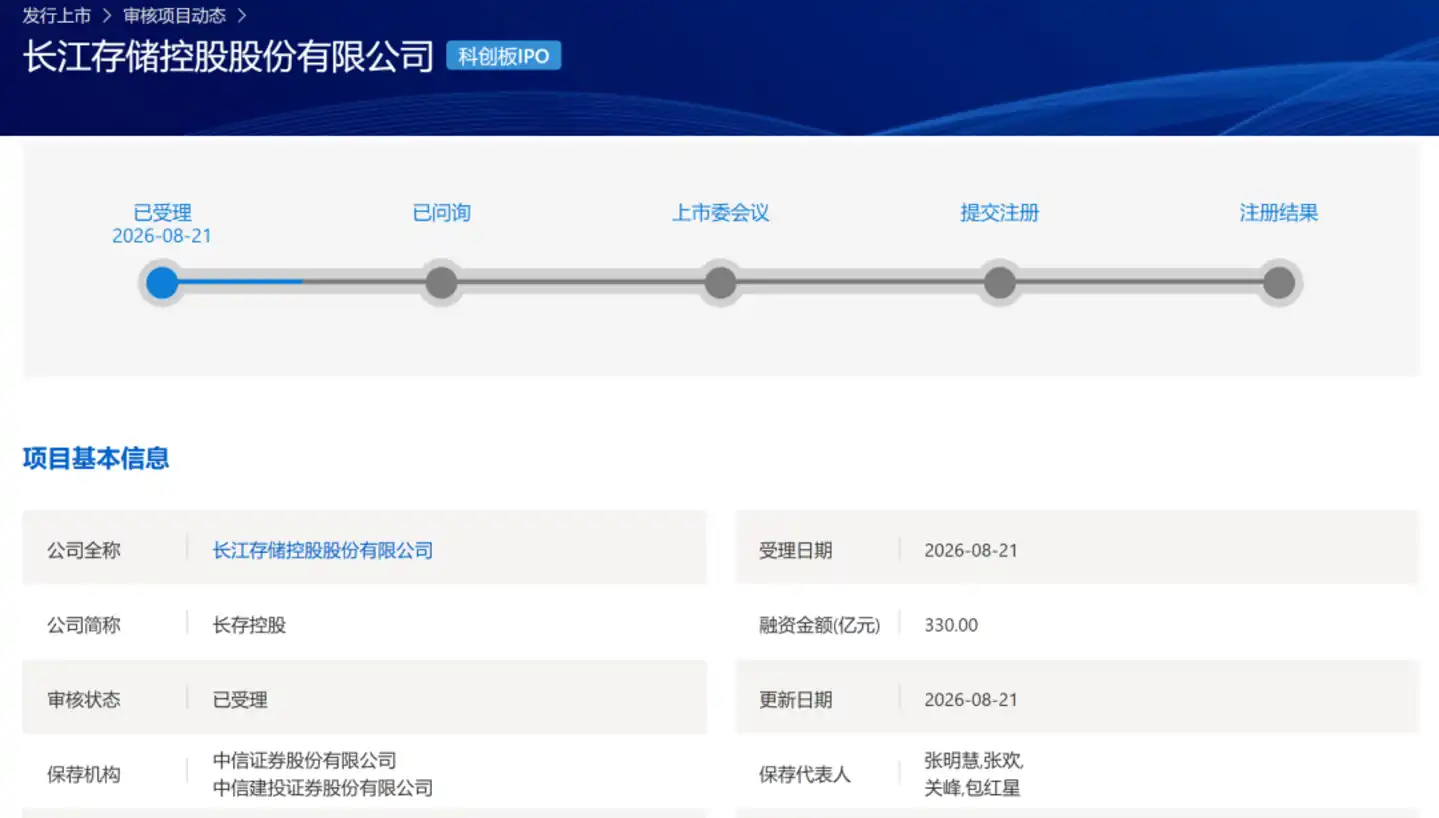
From completing the tutoring filing on May 19th to passing the tutoring acceptance on August 19th, Yangtze Memory took only three months, setting a record for the speed of IPO tutoring in the semiconductor industry. At the same time, this brings it closer to the title of "Wuhan's largest IPO in history." Previously, the Hurun Research Institute's "2025 Global Unicorn List" showed Yangtze Memory's valuation at 160 billion yuan. With the IPO process advancing, market expectations have been revised upwards to 300 billion yuan or even higher.

As we can see, this domestic-only 3D NAND flash memory IDM manufacturer is pushing Wuhan's Optics Valley into the spotlight of the capital market.

A Decade Sharpening the 'Memory Chip'

The story of Yangtze Memory is generally considered to have begun in 2016, but to understand where this hundred-billion behemoth unicorn came from, the clock needs to be turned back to 2000.

That year, the State Council issued the "No. 18 Document" on the integrated circuit industry, triggering the first wave of chip entrepreneurship in China. The landmark event was the return of "the father of Chinese chips," Zhang Rujing, to mainland China to found SMIC. Around the same time, Wuhan began planning to develop its integrated circuit industry.

The difficulty was considerable. Back then, Wuhan's traditional industry was dominated by steel. As a central city, it urgently needed to find an industrial engine for the next decade. Wuhan's leaders ambitiously looked toward this unfamiliar track. Zou Xuecheng, Director of the Research Center for Very Large Scale Integrated Circuits and Systems at Huazhong University of Science and Technology, later told the Yangtze River Daily, "If we don't do this, Hubei and Wuhan will have no name on the map of China's future semiconductor industry."

So, Wuhan spent two years fully preparing, contacting over a dozen well-known domestic and international chip manufacturers seeking cooperation. In 2006, an opportunity arose when SMIC executives were invited to inspect Wuhan. After repeated studies and expert evaluations, it was finally decided that the provincial, municipal, and East Lake High-tech Development Zone governments would jointly invest to establish XMC (Wuhan Xinxin Semiconductor Manufacturing Corp.), with the goal of building the first 12-inch integrated circuit production line in central China. Initially, it was fully managed by SMIC.

Looking back from a god's-eye perspective, this plan was not unanimously approved at the expert evaluation meeting at the time. The reason for opposition was simple: "An investment scale of tens of billions of yuan is too small, lacking economies of scale to be profitable, and the full-process management model is not conducive to subsequent independent development."

But amid such controversy, Phase I of XMC—the first 12-inch integrated circuit production line in central China—was established. According to statistics, provincial and municipal government investments at the time totaled 10.7 billion yuan, accounting for nearly one-tenth of Hubei Province's total state-owned economic investment that year. This production line, which started operations in 2008, coincidentally hit the global financial crisis. Affected by it, the semiconductor industry fell into a downturn, and XMC was severely hit upon its debut.

To survive, the company once shifted to manufacturing for the American flash memory manufacturer Spansion, relying on China's manufacturing cost advantages to secure orders. However, Spansion soon went bankrupt, plunging XMC back into dire straits. At that time, SMIC itself was struggling and unable to continue injecting capital. International giants like TSMC and Micron once eyed this production line, intending to take advantage of the situation.

As the saying goes, "No destruction, no construction." At the last critical moment, the Wuhan government chose to persist, deciding to develop XMC independently. In 2011, both parties established a joint venture; in 2013, SMIC officially withdrew. Wuhan East Lake High-tech Development Zone strongly invited Yang Shining, who had served as SMIC's COO and worked at Intel for over a decade, to become XMC's CEO. The company began to explore the market independently, and its 3D flash memory technology gradually caught up with international giants like SK Hynix, Micron, and Toshiba.

Thus, with the support of the new CEO and Wuhan's "national team," XMC secured orders from important clients like GigaDevice and gradually gained a foothold. In 2014, the National Integrated Circuit Industry Investment Fund launched a second round of large-scale investment in the domestic semiconductor industry. Wuhan decided to "gamble once more" in the memory track. After multiple efforts, in March 2016, the National Memory Base, with a total investment of approximately $24 billion, officially landed in Wuhan Optics Valley. Local media press releases described it as "the largest single high-tech industry investment project in our province since the founding of the People's Republic of China."

On July 26th of the same year, based on XMC, Yangtze Memory Technologies Co., Ltd. was established through joint investment by Tsinghua Unigroup, the National Integrated Circuit Industry Investment Fund, Hubei Guoxin Industry Investment Fund, and Hubei Provincial Science & Technology Investment Group.

Counting from the establishment of XMC in 2006 to the birth of Yangtze Memory in 2016, Wuhan's layout in the memory industry took a full decade.

Massive 'National Team' Background

Looking at the equity structure, Yangtze Memory currently has no controlling shareholder or actual controller.

Before the issuance, Hubei Changsheng is the largest shareholder, holding 26.54%; Xinfei Technology holds 25.35%; the National Integrated Circuit Industry Investment Fund Phase I and Phase II hold 11.97% and 11.38%, respectively; Optics Valley Industry Investment and Guoxin Fund hold 9.25% and 5.90%, respectively.

The prospectus states that the shareholding ratios of the four major shareholders holding more than 10% are relatively close, and none exceed 30%, meaning no single shareholder can significantly influence shareholder meeting resolutions. "During the reporting period, the main capital contributors behind the upward tracing of the company's major shareholders are the Hubei Provincial State-owned Assets Supervision and Administration Commission, Wuhan Municipal State-owned Assets Supervision and Administration Commission, East Lake High-tech Development Zone Management Committee, Big Fund Phase I, and Big Fund Phase II."

Reviewing Yangtze Memory's financing history, one can directly see its distinct "national team" colors.
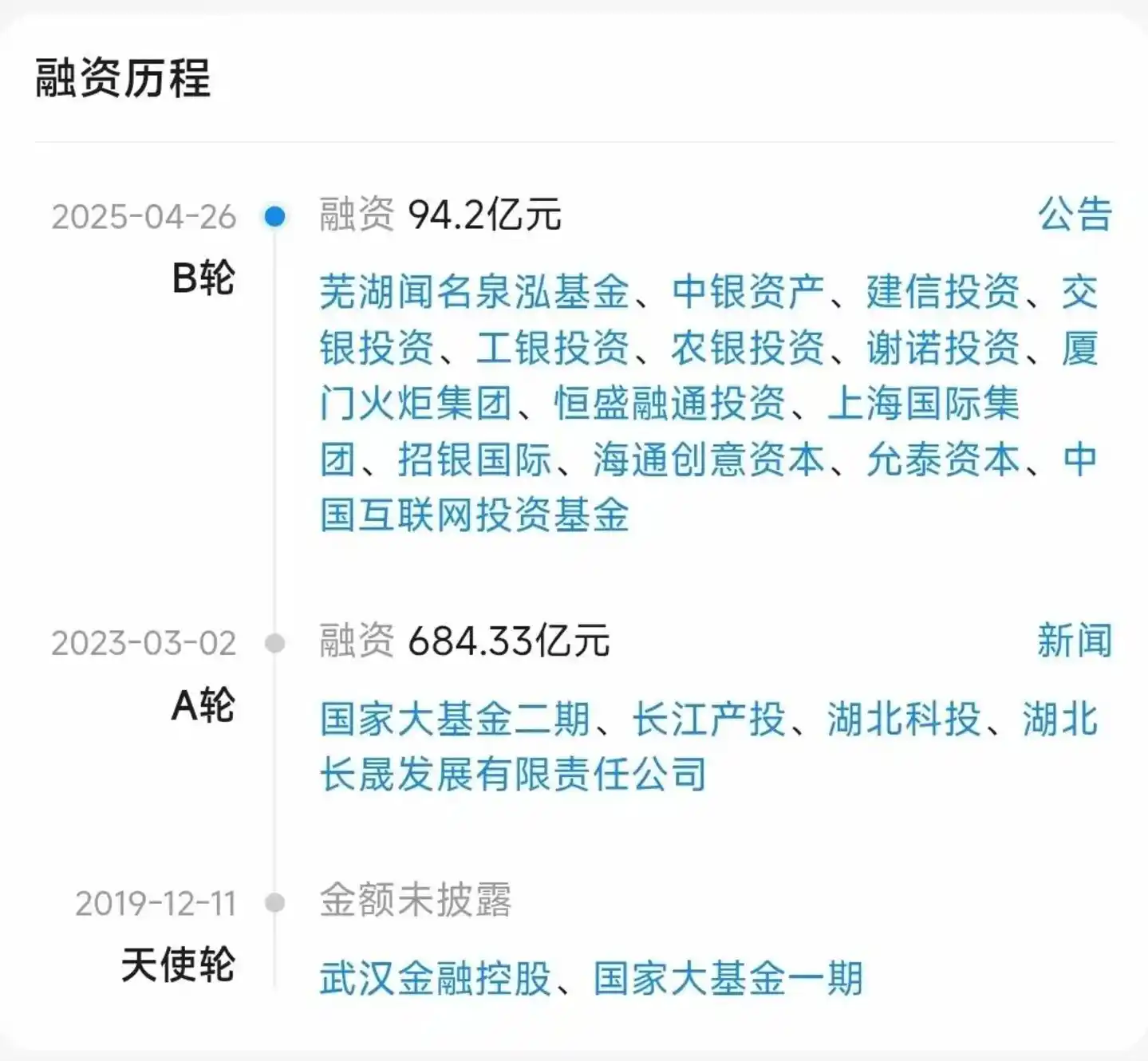
Qichacha data shows that in December 2019, the company completed its Angel round of financing, with Wuhan Financial Holdings and the National Big Fund Phase I investing. In March 2023, the company completed its Series A financing, raising 68.433 billion yuan, with the National Big Fund Phase II, Changjiang Industry Investment, Hubei Science & Technology Investment, and Hubei Changsheng entering successively. In April 2025, the company completed its Series B financing of 9.42 billion yuan. The investor lineup further expanded to include over ten institutions such as Wuhu Wenming Quanhong Fund, BOC Asset Management, CCB Investment, BoCom Investment, ICBC Investment, ABC Investment, Xienuo Investment, Xiamen Torch Group, Hengsheng Rongtong Investment, Shanghai International Group, CMBI, Haitong Creative Capital, Yuntai Capital, and China Internet Investment Fund.

The combined scale of these three rounds of financing far exceeds that of general market-oriented projects, also indirectly confirming the national-team nature of this company's capital structure. The aforementioned employee持股 platforms "Wuhan Zhixin Plan No. 1" to "No. 6" were implemented alongside the shareholding system reform around the Series B round, binding the core technical team to the company's long-term development.

Behind this continuously bolstered shareholder list is the direct financial support from the provincial, municipal, and East Lake High-tech Development Zone governments over a decade, on multiple occasions. Now, as the IPO enters the acceptance stage, this early investment spanning ten years is about to be priced by the capital market. According to estimates, the shares held by Wuhan's state-owned assets through various platforms alone, once Yangtze Memory successfully goes public, are expected to be worth hundreds of billions of yuan on paper, with paper gains being incalculable.

Optics Valley, More IPOs Are on the Way

Undoubtedly, if all goes smoothly, Wuhan will reap the city's largest IPO in history. For this enterprise, whose every step of growth bears the imprint of its locality, its location, "Optics Valley," is also pushed into the spotlight of the capital market.

As of June this year, Optics Valley has gathered 72 listed companies. The total market value of domestic and foreign listed companies has exceeded 1.8 trillion yuan, accounting for about one-third of Hubei Province's and over 60% of Wuhan's total.

Optics Valley authorities have stated more than once, "Listed companies are the main force of technological innovation, the strong engine of industrial development, and the spokesperson of urban vitality in Optics Valley." Centered on this positioning, Optics Valley has successively introduced special policies in recent years such as the "Action Plan for High-quality Development of Listed Companies," the "New 15 Articles for IPOs," and the "10 Articles for Venture Capital," established the Central China Service Base of the Beijing Stock Exchange, and launched the "IPO Seedling Loan" for technology-based SMEs, with single loans up to 50 million yuan supported by financing. The government sets up a risk compensation fund for financial institutions, with the proportion reaching up to 30%.

Currently, this report card is only a阶段性 achievement, as Optics Valley's latest goal has been updated—by 2030, the total number of listed enterprises in Optics Valley aims to exceed 100, and the number of companies with a market value of 100 billion yuan aims to double compared to the current number, reaching 8.

The liveliness of the secondary market cannot be sustained without the接力 of primary market investment; it is also a consensus that the source of活水 must first flow into early-stage projects. The latest move occurred at the World Optics Valley Science and Technology Financial Ecology Co-construction Conference held on June 27th.

At this conference, Optics Valley established four industrial-focused mother funds in one go, with a total scale of 18 billion yuan, targeting four major directions: optoelectronics information, life health, integrated circuits, and future industries. According to the plan, by 2030, these four mother funds will leverage a new fund cluster of no less than 100 billion yuan, driving total investment exceeding 300 billion yuan.

It is worth noting that tracks that sound distant, such as photonic integration, embodied intelligence, and quantum technology, have already been提前布局 by Optics Valley. Among them, Liuxin Optoelectronics' 8-inch wafer photonic integration chip technology is industry-leading; Yuwei Optics' full-spectrum industrial LiDAR and high-precision ranging products are already among the top domestic enterprises; Langyi Robot specializes in the "embodied cerebellum" for humanoid robots, and its products have become the first choice for many national robotics companies... The list goes on and on.

Moreover, new candidates are continuously being produced under this system. According to disclosures from Optics Valley, since 2026, there have been at least 40公开融资 events for tech companies in the region, covering seed rounds from the million-yuan level to industrial rounds in the billion-yuan level. In the past three years, Optics Valley's technology credit has累计 provided support exceeding 300 billion yuan to nearly 6,000 enterprises, with 426 registered funds in the region. These enterprises that have received financial support are the reserve army for the "Optics Valley sector."

Currently, the "Optics Valley Seven Stars," represented by seven optical communication giants including Yangtze Memory, Changfei Fiber, Huagong Tech, Accelink, FiberHome, Guide Infrared, and CITIC Mobile, are整链崛起 at an unprecedented speed and姿态. Among them, Yangtze Memory is the only unlisted company among the "Optics Valley Seven Stars." As its IPO process advances further, Optics Valley will also welcome the团圆时刻 of the "Seven Stars" in the capital market.


Crypto di tendenza

Domande pertinenti

QWhat is the current status of Yangtze Memory Technologies Co., Ltd.'s IPO application on the Shanghai Stock Exchange?

AThe IPO application of Yangtze Memory Technologies Co., Ltd. on the Shanghai Stock Exchange has been updated to 'accepted'.

QHow much capital does Yangtze Memory Technologies Co., Ltd. plan to raise through its IPO?

AYangtze Memory Technologies Co., Ltd. plans to raise 33 billion yuan through its IPO.

QWhat is Yangtze Memory's business focus and its significance in the domestic market?

AYangtze Memory is China's only 3D NAND flash memory IDM (Integrated Device Manufacturer).

QWhich are the major state-backed shareholders in Yangtze Memory Technologies Co., Ltd. prior to the IPO?

AMajor state-backed shareholders include Hubei Changsheng (26.54%), Xinfei Technology (25.35%), National Integrated Circuit Industry Investment Fund Phase I (11.97%) and Phase II (11.38%), Optics Valley Industry Investment (9.25%), and Guoxin Fund (5.90%).

QWhat is the future goal for the number of listed companies in Optics Valley by 2030?

AOptics Valley aims to have the total number of listed companies exceed 100 by 2030.

Letture associate

NVIDIA's AI Sweeps ARC-AGI-3, Chinese-Led Team Aces All 183 Levels in One Go

NVIDIA's general-purpose coding agent AVO has achieved a perfect 100.00 RHAE score on the ARC-AGI-3 benchmark. It solved all 183 levels across 25 game environments in just 6,624 steps. ARC-AGI-3 is a notoriously difficult test where agents are placed into unfamiliar games with no instructions, forcing them to deduce rules and goals through trial and observation. Top models like Claude Opus 5 typically score only around 30% when acting alone. AVO's breakthrough comes not from improving the underlying AI model (Claude Opus 5), but from adding an intelligent external framework or "harness" around it. This framework addresses three key failure modes: misunderstanding global rules, misapplying familiar mechanics, and failing to learn correctly from success. Two core mechanisms drive AVO's performance: 1. **Persistent Memory:** It stores past attempts, compiler outputs, and reasoning across tasks, preventing the model from resetting and re-exploring dead ends when its context window fills. 2. **Supervisor Agent:** A separate module monitors the main agent's progress, intervening to redirect strategy when it gets stuck or repeats unproductive actions. Notably, AVO processed the visual game environments using a pure 64x64 text grid representation, without any image tokens. Originally developed for GPU kernel optimization, AVO autonomously evolved CUDA code for 7 days, producing attention kernels that outperformed NVIDIA's own cuDNN and the leading open-source implementation, FlashAttention-4. The same core architecture was then successfully applied to ARC-AGI-3, demonstrating its generalizability for long-horizon, autonomous problem-solving. The project features a predominantly Chinese team, including Distinguished Engineer Bing Xu (co-author of the original GAN paper and creator of MXNet) and Tianqi Chen (creator of TVM and XGBoost). NVIDIA's strategy highlights that while AI models are crucial, the surrounding system—managing memory, tools, and feedback—is equally vital for creating capable, long-term autonomous agents. This approach aligns with NVIDIA's focus on providing the essential hardware and software infrastructure for the next generation of AI workloads.

marsbit15 min fa

NVIDIA's AI Sweeps ARC-AGI-3, Chinese-Led Team Aces All 183 Levels in One Go

marsbit15 min fa

Bitcoin Approaches $80,000 Milestone, HYPE Hits New All-Time High | Invited Analysis

The cryptocurrency market experienced a significant surge this week, with Bitcoin rising sharply by 26.72% to approach the key psychological level of $80,000, peaking at $79,515. Simultaneously, the token HYPE broke its all-time high, reaching $83.38. This rally has shifted market sentiment from widespread pessimism to active bullish positioning. The article provides a technical analysis of both assets. For Bitcoin, the analysis details a multi-week corrective structure since October 2025, with the current price testing the upper boundary of a wide consolidation range between $57,820 and $82,850. The primary scenario anticipates a rejection near this upper resistance, leading to a pullback within the range (Path Two), though paths for a breakout or a breakdown are also outlined. On the daily chart, Bitcoin is analyzed as being in the final stages (wave c) of a five-wave rally from the July low. For HYPE, the article recounts a successful bullish call initiated on February 23, which has yielded a maximum gain of 225.7% to date. With the price achieving a new all-time high, the analysis suggests the upward trend is intact, with the next target around $90. The weekly strategy for Bitcoin involves waiting for a potential pullback to key support zones ($73,500-$75,000 or $67,300-$69,100) for short-term long opportunities, while maintaining a neutral medium-term stance. For HYPE, the strategy advises existing long positions to trail stop-losses, while new entrants could consider buying on a successful retest of the $77 support level. The article concludes with standard risk management rules and a disclaimer that the content is for informational purposes only and not investment advice.

Odaily星球日报35 min fa

Bitcoin Approaches $80,000 Milestone, HYPE Hits New All-Time High | Invited Analysis

Odaily星球日报35 min fa

Trading

Spot

Articoli Popolari

Cosa è $S$

Comprendere SPERO: Una Panoramica Completa Introduzione a SPERO Mentre il panorama dell'innovazione continua a evolversi, l'emergere delle tecnologie web3 e dei progetti di criptovaluta gioca un ruolo fondamentale nel plasmare il futuro digitale. Un progetto che ha attirato l'attenzione in questo campo dinamico è SPERO, denotato come SPERO,$$s$. Questo articolo mira a raccogliere e presentare informazioni dettagliate su SPERO, per aiutare gli appassionati e gli investitori a comprendere le sue basi, obiettivi e innovazioni nei domini web3 e crypto. Che cos'è SPERO,$$s$? SPERO,$$s$ è un progetto unico all'interno dello spazio crypto che cerca di sfruttare i principi della decentralizzazione e della tecnologia blockchain per creare un ecosistema che promuove l'impegno, l'utilità e l'inclusione finanziaria. Il progetto è progettato per facilitare interazioni peer-to-peer in modi nuovi, fornendo agli utenti soluzioni e servizi finanziari innovativi. Al suo interno, SPERO,$$s$ mira a responsabilizzare gli individui fornendo strumenti e piattaforme che migliorano l'esperienza dell'utente nello spazio delle criptovalute. Questo include la possibilità di metodi di transazione più flessibili, la promozione di iniziative guidate dalla comunità e la creazione di percorsi per opportunità finanziarie attraverso applicazioni decentralizzate (dApps). La visione sottostante di SPERO,$$s$ ruota attorno all'inclusività, cercando di colmare le lacune all'interno della finanza tradizionale mentre sfrutta i vantaggi della tecnologia blockchain. Chi è il Creatore di SPERO,$$s$? L'identità del creatore di SPERO,$$s$ rimane piuttosto oscura, poiché ci sono risorse pubblicamente disponibili limitate che forniscono informazioni dettagliate sul suo fondatore o fondatori. Questa mancanza di trasparenza può derivare dall'impegno del progetto per la decentralizzazione—un ethos che molti progetti web3 condividono, dando priorità ai contributi collettivi rispetto al riconoscimento individuale. Centrando le discussioni attorno alla comunità e ai suoi obiettivi collettivi, SPERO,$$s$ incarna l'essenza dell'empowerment senza mettere in evidenza individui specifici. Pertanto, comprendere l'etica e la missione di SPERO rimane più importante che identificare un creatore singolo. Chi sono gli Investitori di SPERO,$$s$? SPERO,$$s$ è supportato da una varietà di investitori che vanno dai capitalisti di rischio agli investitori angelici dedicati a promuovere l'innovazione nel settore crypto. Il focus di questi investitori generalmente si allinea con la missione di SPERO—dando priorità a progetti che promettono avanzamenti tecnologici sociali, inclusività finanziaria e governance decentralizzata. Queste fondazioni di investitori sono tipicamente interessate a progetti che non solo offrono prodotti innovativi, ma contribuiscono anche positivamente alla comunità blockchain e ai suoi ecosistemi. Il supporto di questi investitori rafforza SPERO,$$s$ come un concorrente degno di nota nel dominio in rapida evoluzione dei progetti crypto. Come Funziona SPERO,$$s$? SPERO,$$s$ impiega un framework multifunzionale che lo distingue dai progetti di criptovaluta convenzionali. Ecco alcune delle caratteristiche chiave che sottolineano la sua unicità e innovazione: Governance Decentralizzata: SPERO,$$s$ integra modelli di governance decentralizzati, responsabilizzando gli utenti a partecipare attivamente ai processi decisionali riguardanti il futuro del progetto. Questo approccio favorisce un senso di proprietà e responsabilità tra i membri della comunità. Utilità del Token: SPERO,$$s$ utilizza il proprio token di criptovaluta, progettato per servire varie funzioni all'interno dell'ecosistema. Questi token abilitano transazioni, premi e la facilitazione dei servizi offerti sulla piattaforma, migliorando l'impegno e l'utilità complessivi. Architettura Stratificata: L'architettura tecnica di SPERO,$$s$ supporta la modularità e la scalabilità, consentendo un'integrazione fluida di funzionalità e applicazioni aggiuntive man mano che il progetto evolve. Questa adattabilità è fondamentale per mantenere la rilevanza nel panorama crypto in continua evoluzione. Coinvolgimento della Comunità: Il progetto enfatizza iniziative guidate dalla comunità, impiegando meccanismi che incentivano la collaborazione e il feedback. Nutrendo una comunità forte, SPERO,$$s$ può affrontare meglio le esigenze degli utenti e adattarsi alle tendenze di mercato. Focus sull'Inclusione: Offrendo basse commissioni di transazione e interfacce user-friendly, SPERO,$$s$ mira ad attrarre una base utenti diversificata, inclusi individui che potrebbero non aver precedentemente interagito nello spazio crypto. Questo impegno per l'inclusione si allinea con la sua missione generale di empowerment attraverso l'accessibilità. Cronologia di SPERO,$$s$ Comprendere la storia di un progetto fornisce preziose intuizioni sulla sua traiettoria di sviluppo e sui traguardi. Di seguito è riportata una cronologia suggerita che mappa eventi significativi nell'evoluzione di SPERO,$$s$: Fase di Concettualizzazione e Ideazione: Le idee iniziali che formano la base di SPERO,$$s$ sono state concepite, allineandosi strettamente con i principi di decentralizzazione e focus sulla comunità all'interno dell'industria blockchain. Lancio del Whitepaper del Progetto: Dopo la fase concettuale, è stato rilasciato un whitepaper completo che dettaglia la visione, gli obiettivi e l'infrastruttura tecnologica di SPERO,$$s$ per suscitare interesse e feedback dalla comunità. Costruzione della Comunità e Prime Interazioni: Sono stati effettuati sforzi attivi di outreach per costruire una comunità di early adopters e potenziali investitori, facilitando discussioni attorno agli obiettivi del progetto e ottenendo supporto. Evento di Generazione del Token: SPERO,$$s$ ha condotto un evento di generazione del token (TGE) per distribuire i propri token nativi ai primi sostenitori e stabilire una liquidità iniziale all'interno dell'ecosistema. Lancio della Prima dApp: La prima applicazione decentralizzata (dApp) associata a SPERO,$$s$ è stata attivata, consentendo agli utenti di interagire con le funzionalità principali della piattaforma. Sviluppo Continuo e Partnership: Aggiornamenti e miglioramenti continui alle offerte del progetto, inclusi partnership strategiche con altri attori nello spazio blockchain, hanno plasmato SPERO,$$s$ in un concorrente competitivo e in evoluzione nel mercato crypto. Conclusione SPERO,$$s$ rappresenta una testimonianza del potenziale del web3 e delle criptovalute di rivoluzionare i sistemi finanziari e responsabilizzare gli individui. Con un impegno per la governance decentralizzata, il coinvolgimento della comunità e funzionalità progettate in modo innovativo, apre la strada verso un panorama finanziario più inclusivo. Come per qualsiasi investimento nello spazio crypto in rapida evoluzione, si incoraggiano potenziali investitori e utenti a ricercare approfonditamente e a impegnarsi in modo riflessivo con gli sviluppi in corso all'interno di SPERO,$$s$. Il progetto mostra lo spirito innovativo dell'industria crypto, invitando a ulteriori esplorazioni delle sue innumerevoli possibilità. Mentre il percorso di SPERO,$$s$ è ancora in fase di sviluppo, i suoi principi fondamentali potrebbero effettivamente influenzare il futuro di come interagiamo con la tecnologia, la finanza e tra di noi in ecosistemi digitali interconnessi.

450 Totale visualizzazioniPubblicato il 2024.12.17Aggiornato il 2024.12.17

Cosa è $S$

Cosa è AGENT S

Agent S: Il Futuro dell'Interazione Autonoma in Web3 Introduzione Nel panorama in continua evoluzione di Web3 e criptovalute, le innovazioni stanno costantemente ridefinendo il modo in cui gli individui interagiscono con le piattaforme digitali. Uno di questi progetti pionieristici, Agent S, promette di rivoluzionare l'interazione uomo-computer attraverso il suo framework agentico aperto. Aprendo la strada a interazioni autonome, Agent S mira a semplificare compiti complessi, offrendo applicazioni trasformative nell'intelligenza artificiale (AI). Questa esplorazione dettagliata approfondirà le complessità del progetto, le sue caratteristiche uniche e le implicazioni per il dominio delle criptovalute. Cos'è Agent S? Agent S si presenta come un innovativo framework agentico aperto, progettato specificamente per affrontare tre sfide fondamentali nell'automazione dei compiti informatici: Acquisizione di Conoscenze Specifiche del Dominio: Il framework apprende in modo intelligente da varie fonti di conoscenza esterne ed esperienze interne. Questo approccio duale gli consente di costruire un ricco repository di conoscenze specifiche del dominio, migliorando le sue prestazioni nell'esecuzione dei compiti. Pianificazione su Lungo Orizzonte di Compiti: Agent S impiega una pianificazione gerarchica potenziata dall'esperienza, un approccio strategico che facilita la suddivisione e l'esecuzione efficiente di compiti complessi. Questa caratteristica migliora significativamente la sua capacità di gestire più sottocompiti in modo efficiente ed efficace. Gestione di Interfacce Dinamiche e Non Uniformi: Il progetto introduce l'Interfaccia Agente-Computer (ACI), una soluzione innovativa che migliora l'interazione tra agenti e utenti. Utilizzando Modelli Linguistici Multimodali di Grandi Dimensioni (MLLM), Agent S può navigare e manipolare senza sforzo diverse interfacce grafiche utente. Attraverso queste caratteristiche pionieristiche, Agent S fornisce un framework robusto che affronta le complessità coinvolte nell'automazione dell'interazione umana con le macchine, preparando il terreno per innumerevoli applicazioni nell'AI e oltre. Chi è il Creatore di Agent S? Sebbene il concetto di Agent S sia fondamentalmente innovativo, informazioni specifiche sul suo creatore rimangono elusive. Il creatore è attualmente sconosciuto, il che evidenzia sia la fase embrionale del progetto sia la scelta strategica di mantenere i membri fondatori sotto anonimato. Indipendentemente dall'anonimato, l'attenzione rimane sulle capacità e sul potenziale del framework. Chi sono gli Investitori di Agent S? Poiché Agent S è relativamente nuovo nell'ecosistema crittografico, informazioni dettagliate riguardanti i suoi investitori e sostenitori finanziari non sono documentate esplicitamente. La mancanza di approfondimenti pubblicamente disponibili sulle fondazioni di investimento o sulle organizzazioni che supportano il progetto solleva interrogativi sulla sua struttura di finanziamento e sulla roadmap di sviluppo. Comprendere il supporto è cruciale per valutare la sostenibilità del progetto e il suo potenziale impatto sul mercato. Come Funziona Agent S? Al centro di Agent S si trova una tecnologia all'avanguardia che gli consente di funzionare efficacemente in contesti diversi. Il suo modello operativo è costruito attorno a diverse caratteristiche chiave: Interazione Uomo-Computer Simile a Quella Umana: Il framework offre una pianificazione AI avanzata, cercando di rendere le interazioni con i computer più intuitive. Mimando il comportamento umano nell'esecuzione dei compiti, promette di elevare le esperienze degli utenti. Memoria Narrativa: Utilizzata per sfruttare esperienze di alto livello, Agent S utilizza la memoria narrativa per tenere traccia delle storie dei compiti, migliorando così i suoi processi decisionali. Memoria Episodica: Questa caratteristica fornisce agli utenti una guida passo-passo, consentendo al framework di offrire supporto contestuale mentre i compiti si sviluppano. Supporto per OpenACI: Con la capacità di funzionare localmente, Agent S consente agli utenti di mantenere il controllo sulle proprie interazioni e flussi di lavoro, allineandosi con l'etica decentralizzata di Web3. Facile Integrazione con API Esterne: La sua versatilità e compatibilità con varie piattaforme AI garantiscono che Agent S possa adattarsi senza problemi agli ecosistemi tecnologici esistenti, rendendolo una scelta attraente per sviluppatori e organizzazioni. Queste funzionalità contribuiscono collettivamente alla posizione unica di Agent S all'interno dello spazio crittografico, poiché automatizza compiti complessi e multi-fase con un intervento umano minimo. Man mano che il progetto evolve, le sue potenziali applicazioni in Web3 potrebbero ridefinire il modo in cui si svolgono le interazioni digitali. Cronologia di Agent S Lo sviluppo e le tappe di Agent S possono essere riassunti in una cronologia che evidenzia i suoi eventi significativi: 27 Settembre 2024: Il concetto di Agent S è stato lanciato in un documento di ricerca completo intitolato “Un Framework Agentico Aperto che Usa i Computer Come un Umano”, mostrando le basi per il progetto. 10 Ottobre 2024: Il documento di ricerca è stato reso pubblicamente disponibile su arXiv, offrendo un'esplorazione approfondita del framework e della sua valutazione delle prestazioni basata sul benchmark OSWorld. 12 Ottobre 2024: È stata rilasciata una presentazione video, fornendo un'idea visiva delle capacità e delle caratteristiche di Agent S, coinvolgendo ulteriormente potenziali utenti e investitori. Questi indicatori nella cronologia non solo illustrano i progressi di Agent S, ma indicano anche il suo impegno per la trasparenza e il coinvolgimento della comunità. Punti Chiave su Agent S Man mano che il framework Agent S continua a evolversi, diversi attributi chiave si distinguono, sottolineando la sua natura innovativa e il potenziale: Framework Innovativo: Progettato per fornire un uso intuitivo dei computer simile all'interazione umana, Agent S porta un approccio nuovo all'automazione dei compiti. Interazione Autonoma: La capacità di interagire autonomamente con i computer attraverso GUI segna un passo avanti verso soluzioni informatiche più intelligenti ed efficienti. Automazione di Compiti Complessi: Con la sua metodologia robusta, può automatizzare compiti complessi e multi-fase, rendendo i processi più veloci e meno soggetti a errori. Miglioramento Continuo: I meccanismi di apprendimento consentono ad Agent S di migliorare dalle esperienze passate, migliorando continuamente le sue prestazioni e la sua efficacia. Versatilità: La sua adattabilità attraverso diversi ambienti operativi come OSWorld e WindowsAgentArena garantisce che possa servire un'ampia gamma di applicazioni. Man mano che Agent S si posiziona nel panorama di Web3 e delle criptovalute, il suo potenziale per migliorare le capacità di interazione e automatizzare i processi segna un significativo avanzamento nelle tecnologie AI. Attraverso il suo framework innovativo, Agent S esemplifica il futuro delle interazioni digitali, promettendo un'esperienza più fluida ed efficiente per gli utenti in vari settori. Conclusione Agent S rappresenta un audace passo avanti nell'unione tra AI e Web3, con la capacità di ridefinire il modo in cui interagiamo con la tecnologia. Sebbene sia ancora nelle sue fasi iniziali, le possibilità per la sua applicazione sono vaste e coinvolgenti. Attraverso il suo framework completo che affronta sfide critiche, Agent S mira a portare le interazioni autonome al centro dell'esperienza digitale. Man mano che ci addentriamo nei regni delle criptovalute e della decentralizzazione, progetti come Agent S giocheranno senza dubbio un ruolo cruciale nel plasmare il futuro della tecnologia e della collaborazione uomo-computer.

875 Totale visualizzazioniPubblicato il 2025.01.14Aggiornato il 2025.01.14

Cosa è AGENT S

Come comprare S

Benvenuto in HTX.com! Abbiamo reso l'acquisto di Sonic (S) semplice e conveniente. Segui la nostra guida passo passo per intraprendere il tuo viaggio nel mondo delle criptovalute.Step 1: Crea il tuo Account HTXUsa la tua email o numero di telefono per registrarti il tuo account gratuito su HTX. Vivi un'esperienza facile e sblocca tutte le funzionalità,Crea il mio accountStep 2: Vai in Acquista crypto e seleziona il tuo metodo di pagamentoCarta di credito/debito: utilizza la tua Visa o Mastercard per acquistare immediatamente SonicS.Bilancio: Usa i fondi dal bilancio del tuo account HTX per fare trading senza problemi.Terze parti: abbiamo aggiunto metodi di pagamento molto utilizzati come Google Pay e Apple Pay per maggiore comodità.P2P: Fai trading direttamente con altri utenti HTX.Over-the-Counter (OTC): Offriamo servizi su misura e tassi di cambio competitivi per i trader.Step 3: Conserva Sonic (S)Dopo aver acquistato Sonic (S), conserva nel tuo account HTX. In alternativa, puoi inviare tramite trasferimento blockchain o scambiare per altre criptovalute.Step 4: Scambia Sonic (S)Scambia facilmente Sonic (S) nel mercato spot di HTX. Accedi al tuo account, seleziona la tua coppia di trading, esegui le tue operazioni e monitora in tempo reale. Offriamo un'esperienza user-friendly sia per chi ha appena iniziato che per i trader più esperti.

1.7k Totale visualizzazioniPubblicato il 2025.01.15Aggiornato il 2026.06.02

Come comprare S

Discussioni

Benvenuto nella Community HTX. Qui puoi rimanere informato sugli ultimi sviluppi della piattaforma e accedere ad approfondimenti esperti sul mercato. Le opinioni degli utenti sul prezzo di S S sono presentate come di seguito.

活动图片