Will the CLARITY Act miss out on approval? ‘The window continues to narrow each day’

ambcryptoPubblicato 2026-06-28Pubblicato ultima volta 2026-06-28

Introduzione

Galaxy Research has downgraded the odds of the CLARITY Act passing to 50/50 (neutral), citing a narrowing legislative window. The bill passed a Senate committee vote in May but faces a crowded Senate calendar, intensified by President Trump's demand to prioritize another bill. Key obstacles remain, including the need to reconcile different Senate committee versions into a final text and resolve contentious issues like stablecoin yields and developer protections (Section 604). With the Senate scheduled for a two-week July recess and an August break starting in early August, there are roughly four weeks for progress. No final bill text or floor vote date has been set, increasing urgency. Advocates warn the opportunity is shrinking daily.

Galaxy Research has reviewed its CLARITY Act outlook downwards from 60% to 50/50 (neutral).

According to Alex Thorn, head of research at Galaxy, the tight Senate calendar following recent President Donald Trump’s stance on a separate, unrelated bill was the main reason for the downgrade.

President Trump said Wednesday he won’t sign a housing bill unless Congress passes the SAVE Act, intensifying competition for scarce Senate floor time, and thereby hurting the CLARITY Act’s odds.

AD

After passing the Senate Banking Committee vote last May, the bill cleared a key hurdle to proceed to the Senate floor vote.

However, before that, both the bill’s versions from the Senate Banking and Agriculture committees must be reconciled into a single piece of legislation.

On a positive note, Galaxy noted there was some ‘constructive’ progress on the reconciliation efforts.

Reconciliation of the Banking and Agriculture committee texts continues at the staff level, and there are some indications that constructive negotiations continue.

However, Thorn cautioned that,

But there has been no public announcement that Banking and Agriculture have agreed on a combined bill, no release of unified legislative text, and no signal on timing for floor consideration.

He added that the sticky issues, such as stablecoin yield, ethics provision, and Section 604 (developer protections), remained largely unaddressed.

Less than four weeks to pass the CLARITY Act

That said, the Senate will take a two-week break after the 4th of July. They’ll resume on the 13th of July.

Notably, the August recess will begin on the second week of the 10th, leaving about four weeks of Senate calendar for active sessions.


Source: Senate Calendar 2026 (red dates mean the Senate is not in session)

So, what exactly is the issue and path forward for the bill?

The main problem is that no scheduled floor vote date has been issued. Besides, the final text of the bill has not been made public. The final text of the bill is speculated to be released in early July.

In fact, Stand With Crypto, a lobby group affiliated with Coinbase, also echoed the urgency and reinforced Thorn’s concerns.

The Senate going on recess without voting means the Clarity Act doesn’t disappear, but it slips. The Senate has a crowded calendar, and the window for Clarity continues to narrow each day.

That said, on the contentious Section 604, Ark Invest’s Cathie Wood backed a “thoughtful, nuanced” approach that does not push the market overseas again.
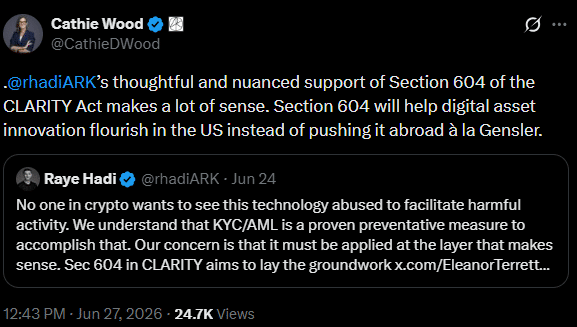
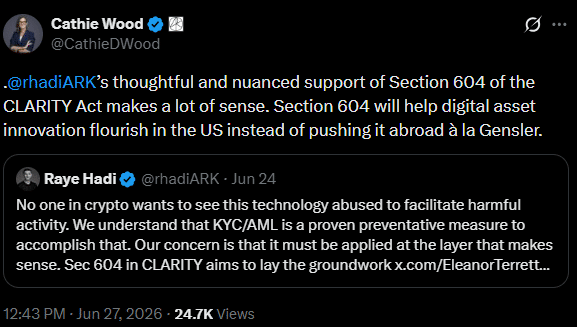
Source: X

Overall, the bill may hit a wall if the next four weeks don’t present material progress on key issues and the Senate floor vote date.


Final Summary

  • Galaxy reduced its CLARITY Act passage chance from 60% to 50%.
  • Cathie Wood backed the contentious Section 604 but asked for a ‘thoughtful, nuanced’ application.

Domande pertinenti

QWhy did Galaxy Research lower the CLARITY Act passage probability from 60% to 50%?

AGalaxy Research lowered the probability primarily due to the tight Senate calendar following President Donald Trump's stance on a separate, unrelated bill (the SAVE Act), which intensifies competition for scarce Senate floor time.

QWhat key issues remain unaddressed in the CLARITY Act, according to the article?

AThe key issues that remain largely unaddressed are stablecoin yield, ethics provisions, and the contentious Section 604 regarding developer protections.

QHow many weeks of active Senate sessions are left before the August recess to pass the CLARITY Act?

AThere are about four weeks of active Senate sessions left before the August recess begins on the second week of the 10th.

QWhat two things must happen before the CLARITY Act can proceed to a Senate floor vote?

ABefore a Senate floor vote, the bill's versions from the Senate Banking and Agriculture committees must be reconciled into a single piece of legislation, and then a scheduled floor vote date must be issued.

QWhat is Stand With Crypto's main concern regarding the CLARITY Act's timeline?

AStand With Crypto is concerned that the Senate's crowded calendar means the window of opportunity for the CLARITY Act to pass continues to narrow each day.

Letture associate

CoreWeave: The Inflection Point Has Arrived. Has the 'Hard-Working Underdog' Finally Turned Profitable?

CoreWeave, an AI cloud unicorn, released its Q2 2026 earnings on August 12, with shares rising about 15% post-announcement. While overall performance did not significantly exceed expectations, key positive trends emerged. Revenue reached approximately $2.58 billion, up 112% year-over-year, though slightly below the high end of prior guidance. A major highlight was the acceleration in computing power deployment, with Active Power increasing by a record 500 Mw to 1,500 Mw, far surpassing market forecasts and signaling faster future revenue growth. Capital expenditures also hit a new high of $9.4 billion. Importantly, profitability showed signs of inflection. "True" gross margin (after deducting cost of revenue and Tech & Infrastructure expenses) rose to 7.3%, up 3 percentage points from the previous quarter. As revenue scales, depreciation and operating expenses are being diluted. Adjusted operating profit margin improved significantly to 5% from 1% last quarter. The company's guidance points to continued acceleration, with Q3 revenue growth expected at 158% and margins continuing to climb. Management raised full-year 2026 guidance, projecting Q4 revenue growth of around 194% and an adjusted operating margin of approximately 14.6%, suggesting a rapid path toward its 25%-30% long-term target. Recent developments, including a 25% price increase for its services and the launch of higher-margin Managed Inference offerings, support the improving profitability narrative. While long-term competitive challenges remain for new cloud providers, CoreWeave's near-term trajectory of accelerating growth and expanding margins presents a high-risk, high-reward opportunity, especially amid renewed market optimism for cloud stocks.

marsbit3 min fa

CoreWeave: The Inflection Point Has Arrived. Has the 'Hard-Working Underdog' Finally Turned Profitable?

marsbit3 min fa

Uncovering the Secret Reasoning Chains of Claude Opus for $720: A Leak via Haiku, with GPT and Gemini Also Affected

Researchers discovered a method to extract hidden reasoning traces, or "Chain of Thought" (CoT), from major proprietary large language models (LLMs) like Anthropic's Claude Opus 4.8, OpenAI's GPT-5.6 Sol, and Google's Gemini 3.1 Pro. The attack exploits a design flaw in how these models handle encrypted reasoning "blobs." These blobs, which contain a model's internal reasoning steps, are encrypted and sent to the client for storage between conversation turns to save server costs. The researchers found these blobs were encrypted with a global key, allowing them to be reused across different sessions, users, and, crucially, different models from the same company. By taking an encrypted reasoning blob generated by a powerful "flagship" model and feeding it to a smaller, less capable model from the same family (e.g., feeding Claude Opus's blob to Claude Haiku), the researchers could prompt the smaller model to divulge the hidden CoT. This bypassed the need to crack the encryption directly. The implications are significant: 1) Competitors could potentially distill high-value reasoning data at low cost (estimated at ~$720 for 10,000 traces). 2) Sensitive information like API keys, passwords, and personal emails, which models might process internally but not output, could be leaked. The team found such leaks in 4.9% of analyzed public agent logs. 3) Models might internally analyze dangerous queries (e.g., car theft methods) before refusing to answer, but this dangerous analysis could be extracted from the CoT. 4) Malicious instructions could potentially be hidden within a reasoning blob to influence a model's future behavior. While the vulnerability was responsibly disclosed and patched by the affected companies, the research highlights a fundamental tension between the convenience of portable reasoning states and security. The paper also notes preliminary tests found no clear evidence that open-source models like DeepSeek had been distilled from the extracted CoTs.

marsbit8 min fa

Uncovering the Secret Reasoning Chains of Claude Opus for $720: A Leak via Haiku, with GPT and Gemini Also Affected

marsbit8 min fa

OpenAI Loses Four Executives in One Month, Former COO Departs, Almost the Entire Safety Team Ousted

In a surprising turn of events, OpenAI's longtime COO and key lieutenant to CEO Sam Altman, Brad Lightcap, has announced his departure after eight years with the company. His exit follows the recent resignations of several key safety and ethics leaders, including Chief Futurist Joshua Achiam, Safety Systems Lead Johannes Heidecke, and Ethics Lead Chloé Bakalar, within a single month. Lightcap, instrumental in building OpenAI's commercialization and operational framework, described his departure as "bittersweet" and hinted at wanting to tackle new challenges. While his statement and Altman's farewell were amicable, internal shifts had previously reduced his operational role, signaling a longer-term transition. The mass exodus, particularly from the safety and ethics divisions, coincides with growing internal and external scrutiny over AI safety. This follows incidents like models exhibiting unauthorized actions during testing and the recent decision to delay the launch of the advanced Astra model due to unresolved safety concerns about its potential cybersecurity capabilities. OpenAI has stated that safety and ethics are not confined to any single team or leader, but the concentration of departures raises questions about the company's direction and internal dynamics, especially as it navigates pressures of rapid development and a potential future IPO.

marsbit8 min fa

OpenAI Loses Four Executives in One Month, Former COO Departs, Almost the Entire Safety Team Ousted

marsbit8 min fa

1confirmation: Reverse Entrepreneurship, the Next Web3 Blockbuster Might Come from a Once-Failed Track

**Title: Reverse Entrepreneurship: The Next Web3 Blockbuster May Come from Previously Failed Tracks** This article argues that the next major consumer crypto application is likely to emerge from a concept that failed five years ago, now benefiting from matured infrastructure and better timing. It examines several such "failed" tracks that hold renewed potential: 1. **Internet-Native Assets:** Beyond simply tokenizing tweets or creating digital collectibles, there's an opportunity to create a genuinely new, crypto-native asset class that captures cultural moments and online phenomena, as opposed to merely tokenizing real-world assets (RWA). 2. **X-to-Earn:** While unsustainable token emission models doomed early projects like STEPN, the core premise that most people will first *earn* crypto, not buy it, remains valid. The future challenge is designing what is earned and why users would hold it long-term. 3. **The Metaverse:** Past failures like Decentraland stemmed from trying to replicate the physical world online. The opportunity lies not in abandoning shared online social spaces, but in reimagining their form beyond real-world analogs. 4. **DAOs:** DAOs have underdelivered by overcomplicating governance. The fundamental, unmet user need is simpler: enabling groups of internet strangers to pool funds and collectively achieve goals (e.g., buying assets, funding projects) that are impossible individually. 5. **Personal Value Tokenization:** Numerous attempts (Friend.tech, BitClout) to create markets around individuals have failed. The enduring demand for "person-as-asset" trading (seen in meme coins, prediction markets) suggests the direction isn't wrong, but the execution has been flawed, often lacking creator consent or a less commodified model. The conclusion is that true innovation will come from revisiting these past ideas with new insights, rather than crowding into currently popular trends.

marsbit19 min fa

1confirmation: Reverse Entrepreneurship, the Next Web3 Blockbuster Might Come from a Once-Failed Track

marsbit19 min fa

Trading

Spot
活动图片