Why Is Everything Rising Except the Crypto Market?

marsbitPubblicato 2026-01-21Pubblicato ultima volta 2026-01-21

Introduzione

The article explores the paradoxical divergence between cryptocurrency markets and other asset classes like gold, silver, and equities, which have seen significant gains while Bitcoin has stagnated. Despite institutional adoption, including Bitcoin ETFs, government reserves, and major financial players entering the space, Bitcoin's price has underperformed due to its role as a leading indicator for risk assets, global liquidity constraints from Fed QT and Bank of Japan rate hikes, and heightened geopolitical tensions under the Trump administration. In contrast, gold's surge is driven by central bank accumulation amid declining faith in dollar hegemony, while equity rallies in the US and China are policy-driven, focusing on AI and national security sectors. Historically, Bitcoin has rebounded strongly after periods of extreme undervaluation relative to gold, suggesting potential for recovery. However, chasing overheated markets like small-cap stocks or AI equities now carries risks of a bubble. Bitcoin's current weakness may signal broader market vulnerabilities ahead, making it a critical time for long-term investors to stay disciplined.

"As long as you don't invest in Crypto, you can make money in everything else."

Recently, the crypto market and other global markets seem to be worlds apart.

In 2025, gold rose over 60%, silver surged 210.9%, and the U.S. Russell 2000 index increased by 12.8%. Bitcoin, however, ended the year in the red after a brief new high.

Entering 2026, the divergence is intensifying. On January 20, gold and silver hit new highs again, the U.S. Russell 2000 index outperformed the S&P 500 for 11 consecutive days, and China's STAR 50 index gained over 15% in a single month. Bitcoin, on the other hand, fell for five consecutive days on January 20, dropping from $98,000 to $91,000 without looking back.
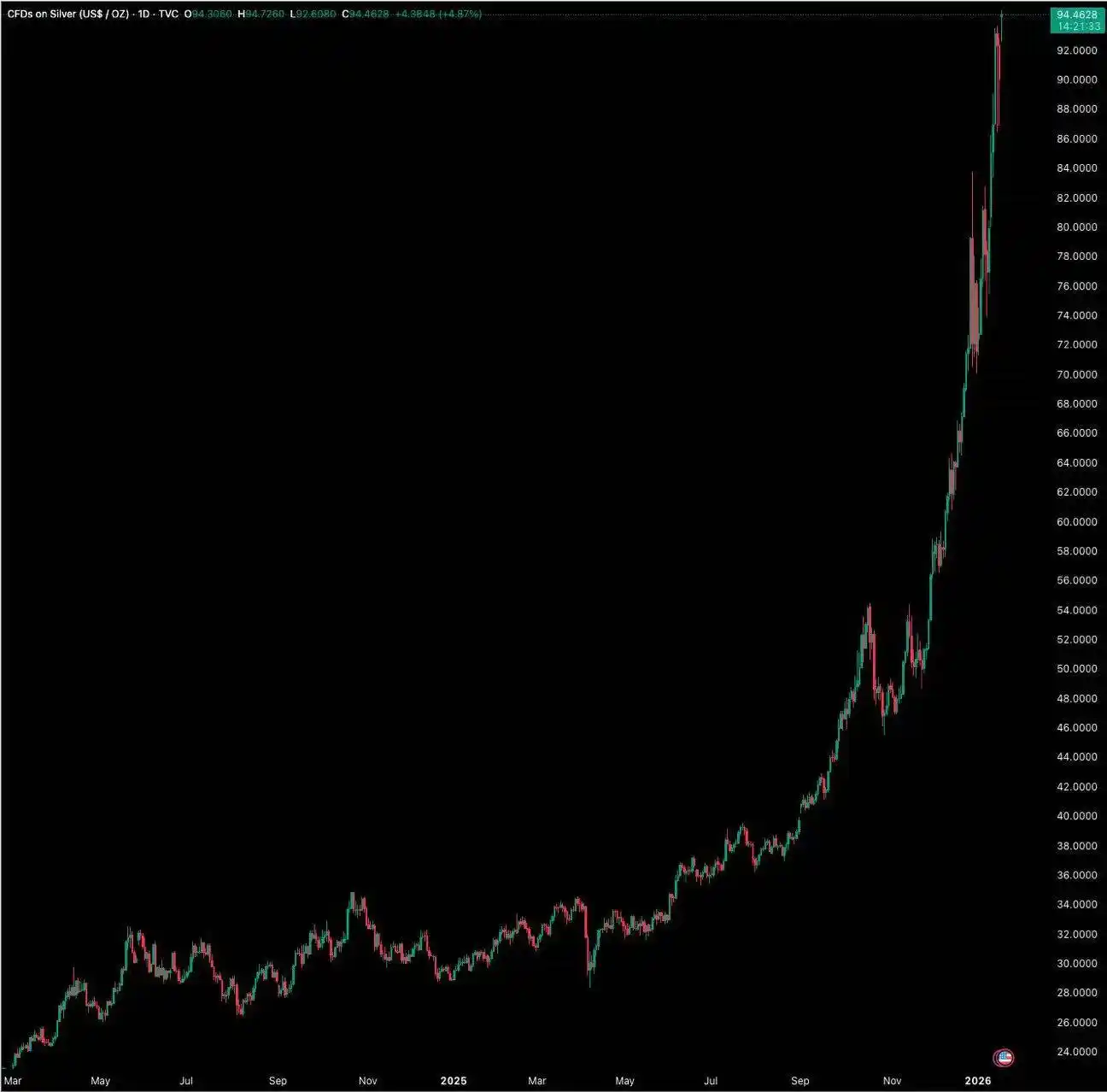
Funds seem to have decisively left the crypto market after 10/11. BTC has been oscillating below the $100,000 mark for over three months, and the market has entered a period of "the lowest volatility in history."

Disappointment is spreading among crypto investors. When asked about investors who left Crypto and made money in other markets, they even shared the "ABC" secret—"Anything But Crypto"—meaning as long as you don't invest in Crypto, you can make money anywhere else.

The "Mass Adoption" everyone anticipated in the last cycle has indeed arrived, but not in the form of decentralized application普及 everyone hoped for. Instead, it's a complete "assetization" led by Wall Street.

This round has seen the U.S. establishment and Wall Street embrace Crypto with unprecedented enthusiasm. The SEC approved Bitcoin spot ETFs from BlackRock, Fidelity, and others; BlackRock and JPMorgan have allocated assets to Ethereum; the U.S. government passed legislation to establish a national strategic Bitcoin reserve; pension funds in several states have invested in Bitcoin; the SEC chairman publicly stated that U.S. stocks would be on-chain within two years; and even the New York Stock Exchange (NYSE) announced plans to launch its own cryptocurrency trading platform.

So the question arises: Why, after gaining so much political and capital backing, is Bitcoin's price performance so disappointing when precious metals and stock markets are hitting new highs?

When crypto investors have become accustomed to checking pre-market U.S. stock prices to gauge crypto market movements, why is Bitcoin not rising along with them?

Why Is Bitcoin So Weak?


Leading Indicator

Bitcoin is a "leading indicator" for global risk assets, as Real Vision founder Raoul Pal has repeatedly mentioned in his articles. Because Bitcoin's price is purely driven by global liquidity and is not directly affected by national earnings reports or interest rates, its fluctuations often lead those of mainstream risk assets like the Nasdaq index.
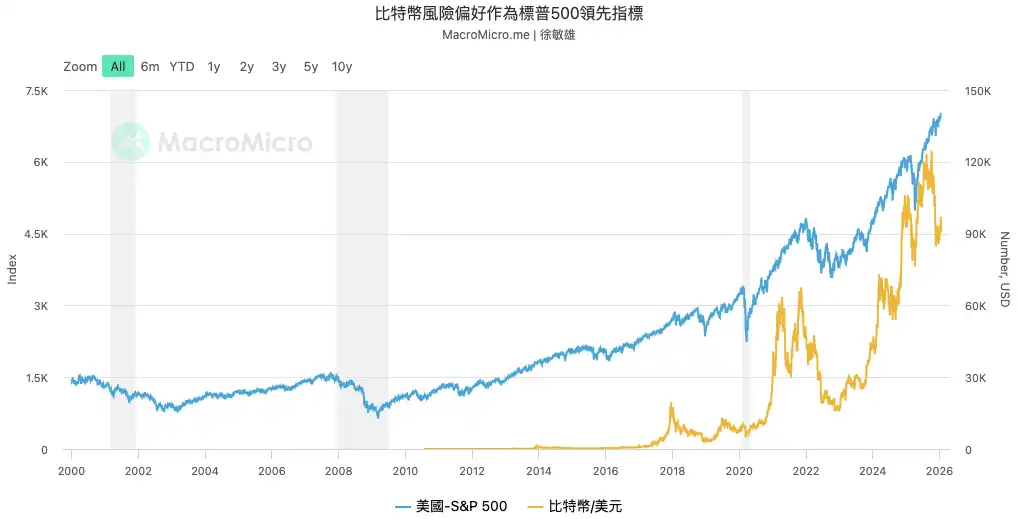
According to MacroMicro data, Bitcoin's price turning points have repeatedly领先 the S&P 500 index in recent years. Therefore, once Bitcoin, as a leading indicator, stalls in its upward momentum and fails to make new highs, it serves as a strong warning signal that the upward momentum of other assets may also be nearing exhaustion.


Liquidity Tightening


Secondly, Bitcoin's price, to this day, remains highly correlated with global net dollar liquidity. Although the Fed cut interest rates in 2024 and 2025, the quantitative tightening (QT) that began in 2022 is still continuously draining liquidity from the market.
Bitcoin hitting new highs in 2025 was more due to new funds brought by ETF approvals, but this did not change the fundamental landscape of tight global macro liquidity. Bitcoin's sideways movement is a direct reaction to this macro reality. In an environment short on money, it's difficult for it to start a super bull market.


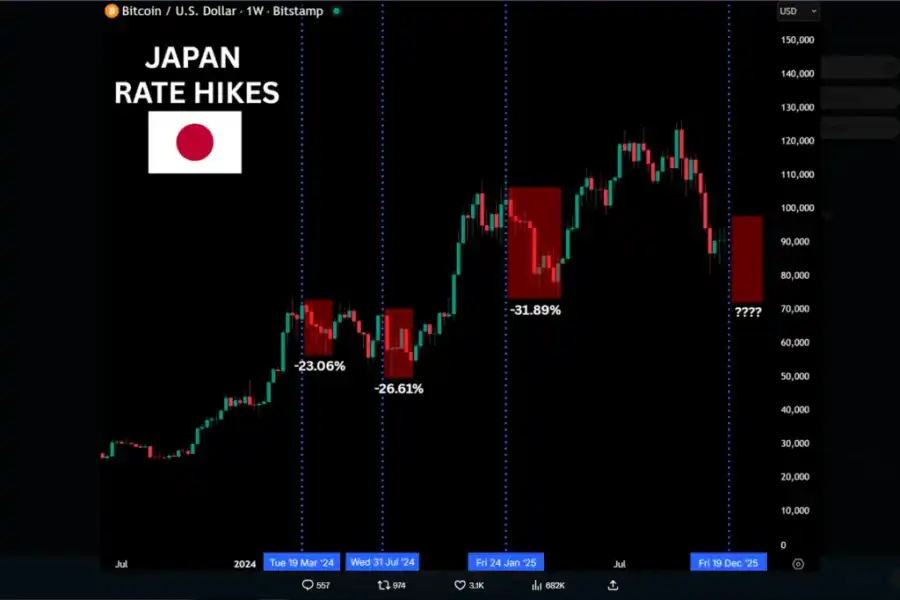
The world's second-largest source of liquidity—the yen—is also tightening. The Bank of Japan raised its short-term policy rate to 0.75% in December 2025, the highest level in nearly 30 years. This directly impacts a crucial source of funding for global risk assets over the past decades: the yen carry trade. Historical data shows that since 2024, all three rate hikes by the Bank of Japan were accompanied by Bitcoin price drops of over 20%. Synchronized tightening by the Fed and the Bank of Japan has made the global liquidity environment even worse.

Geopolitical Conflict

Finally, potential geopolitical "black swans" are keeping market nerves on edge, and Trump's series of domestic and international actions in early 2026 have pushed this uncertainty to new heights.

Internationally, the actions of the Trump administration are full of unpredictability. From military intervention in Venezuela and capturing its president (unprecedented in modern international relations) to war with Iran again being on the brink; from attempting to forcibly purchase Greenland to issuing new tariff threats against the EU. This series of aggressive unilateral actions is comprehensively intensifying major power矛盾.

Domestically in the U.S., his measures have sparked deep public concern about a constitutional crisis. He not only proposed renaming the "Department of Defense" to the "Department of War" but has also ordered active-duty troops to prepare for potential domestic deployment.
These actions, combined with his past暗示 of regretting not using military force and unwillingness to accept midterm election losses, have made public担忧 increasingly clear: Would he refuse to accept a midterm election loss and use force to stay in power? This speculation and high pressure are already intensifying internal U.S. conflicts, with protests currently showing signs of expanding.
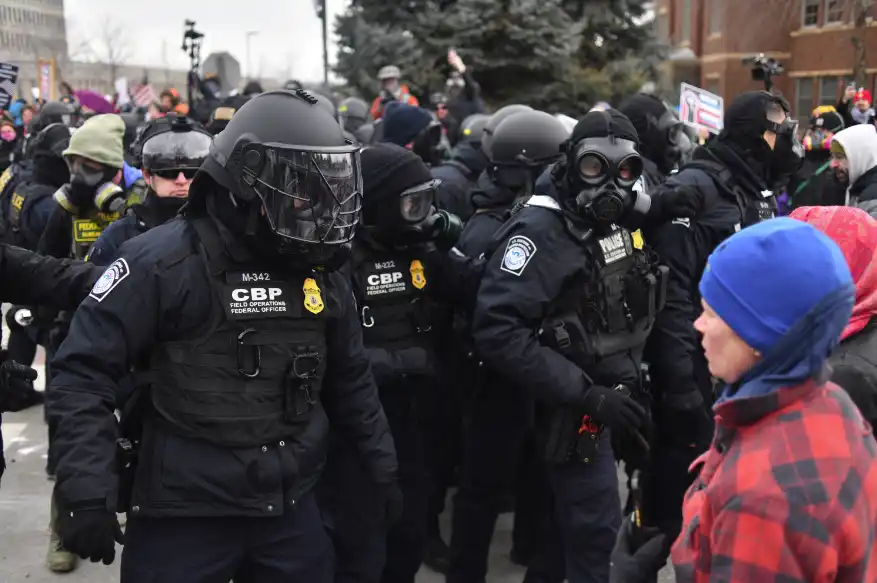
The normalization of such conflicts is dragging the world into a "gray zone" between localized war and a new Cold War. Traditional full-scale hot war had relatively clear paths, market expectations, and was even accompanied by stimulus "bailouts."

The destructive power of these localized conflicts lies in their extreme uncertainty, full of "unknown unknowns." For risk capital markets that highly rely on stable expectations, this uncertainty is fatal, as it significantly increases market risk premiums. When large capitals cannot predict the future, the most rational choice is to increase cash holdings and wait on the sidelines, rather than allocating funds to high-risk, high-volatility assets.

Why Aren't Other Assets Falling?

In stark contrast to the crypto market's stagnation, since 2025, markets like precious metals, U.S. stocks, and A-shares have taken turns rising. However, the rise in these markets is not due to a普遍 improvement in macro and liquidity fundamentals, but rather structural rallies driven by sovereign will and industrial policy against the backdrop of great power competition.

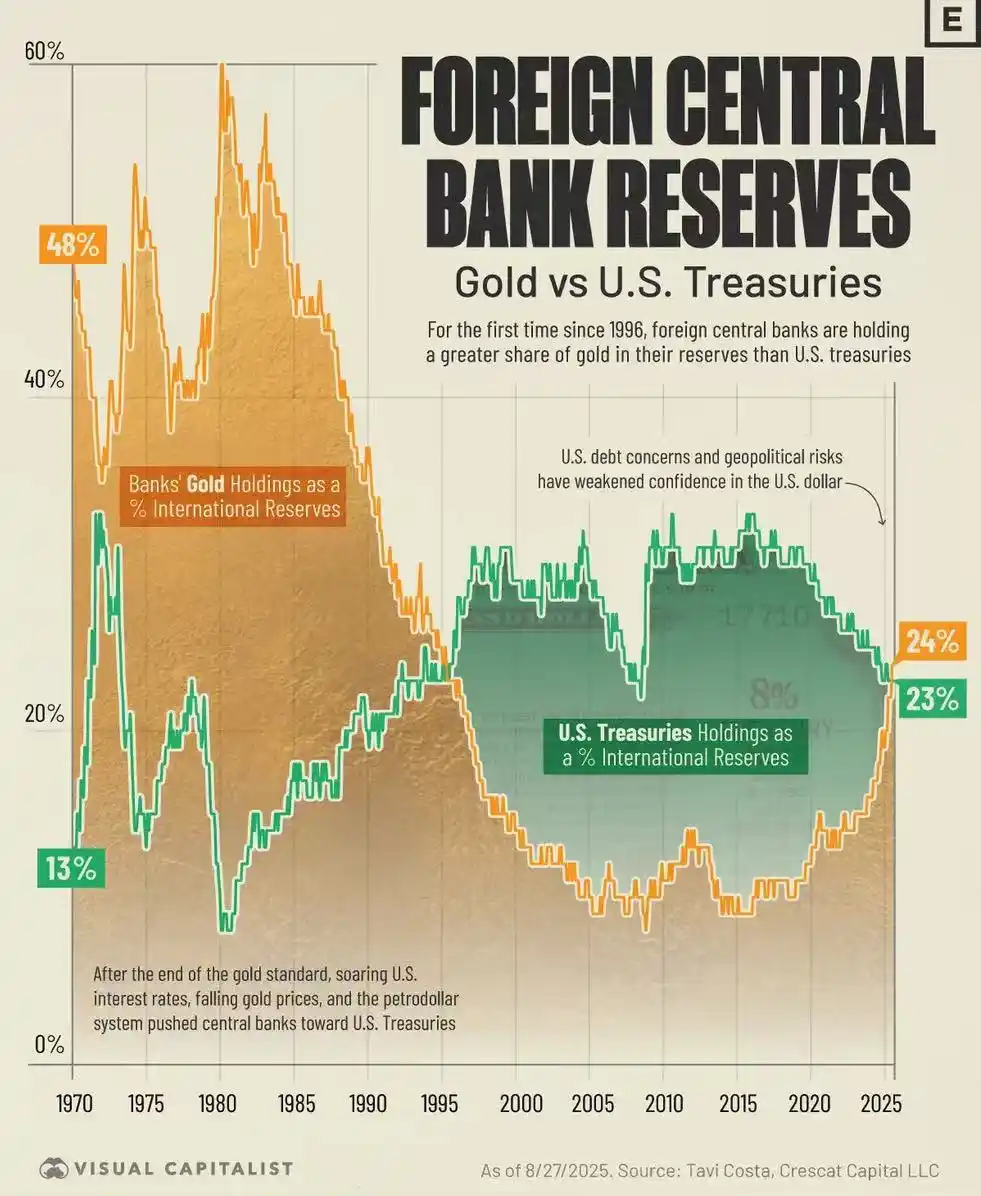
Gold's rise is a reaction by sovereign states to the existing international order, rooted in the credibility cracks of the dollar system. The 2008 global financial tsunami and the 2022 freezing of Russia's foreign exchange reserves彻底 shattered the "risk-free" myth of the U.S. dollar and Treasury bonds as the world's ultimate reserve assets. In this context, global central banks have become "price-insensitive buyers." They buy gold not for short-term profits, but to find an ultimate store of value that does not rely on any single sovereign credit.


Data from the World Gold Council shows that in 2022 and 2023, global central banks' net gold purchases exceeded 1,000 tons for two consecutive years, setting historical records. The main driver of this gold rally is official power, not market speculation.

The stock market's rise, on the other hand, is a reflection of national industrial policies. Whether it's the U.S. "AI Nationalization" strategy or China's "Industrial Self-Reliance" policy, state power is deeply介入 and directing capital flows.


Take the U.S., for example. Through the CHIPS and Science Act, the AI industry has been elevated to a national security战略 priority. Funds are明显 flowing out of large tech stocks and into more growth-oriented small and mid-cap stocks that align with policy directions.


In China's A-share market, funds are also highly concentrated in areas closely related to national security and industrial upgrading, such as "信创" (IT application innovation) and "国防军工" (national defense and military industry). This type of government-driven rally has a pricing logic that naturally存在 a hard-to-bridge gap with Bitcoin, which relies on purely market-driven liquidity.

Will History Repeat Itself?

Historically, it's not the first time Bitcoin's performance has diverged from other assets. And each time, the divergence ended with a strong rebound in Bitcoin.

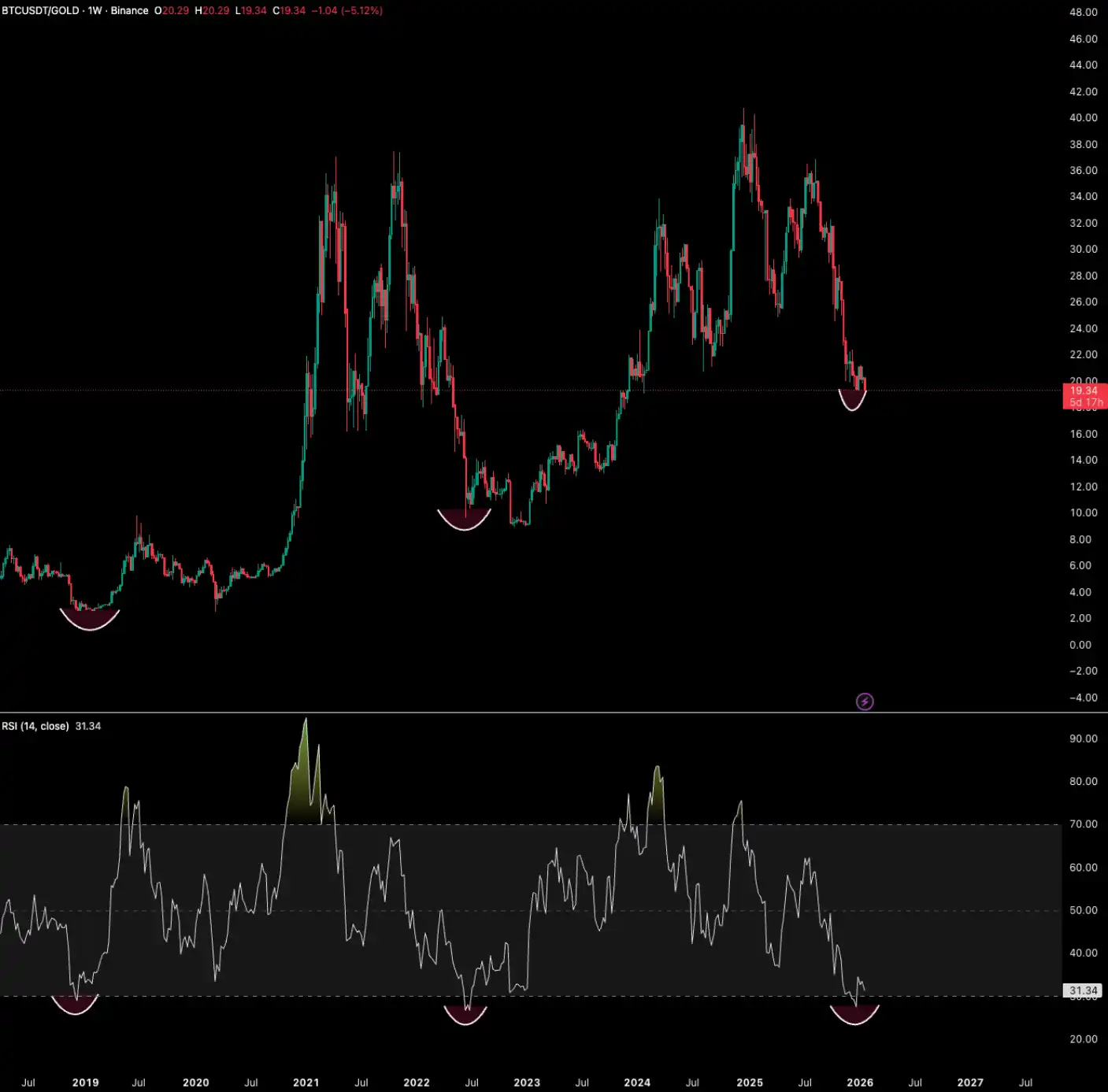
Historically, there have been four instances where Bitcoin's RSI (Relative Strength Index) against gold fell below 30, indicating extreme oversold conditions: in 2015, 2018, 2022, and 2025. Each time, when Bitcoin was极度 undervalued relative to gold, it预示 a subsequent significant rebound.

In 2015, at the end of the bear market, Bitcoin's RSI against gold fell below 30, subsequently launching the 2016-2017 super bull market.

In 2018, during the bear market, Bitcoin fell over 40%, while gold rose nearly 6%. After the RSI fell below 30, Bitcoin反弹 over 770% from its 2020 low.

In 2022, during the bear market, Bitcoin fell nearly 60%. After the RSI fell below 30, Bitcoin recovered strongly in 2024 and early 2025, outperforming gold again.

From late 2025 to now, we are witnessing this historic oversold signal for the fourth time. Gold surged 64% in 2025, and Bitcoin's RSI against gold has once again fallen into oversold territory.

Is It Still Time to Chase Other Rising Assets?


Amid the "ABC" noise,轻易 selling crypto assets to chase other currently booming markets might be a dangerous decision.


When U.S. small-cap stocks start leading gains, it has historically often been the final狂欢 before liquidity dries up at the end of a bull market. The Russell 2000 index has risen over 45% from its 2025 low, but most of its components have relatively poor profitability and are very sensitive to interest rate changes. Once the Fed's monetary policy falls short of expectations, the fragility of these companies will be immediately exposed.

Secondly, the AI sector's狂热 is showing typical bubble characteristics. Whether it's Deutsche Bank's survey or warnings from Bridgewater founder Ray Dalio, the AI bubble is listed as the biggest market risk for 2026. Valuations of star companies like Nvidia and Palantir have reached historical highs, and whether their profit growth can support such high valuations is being questioned more and more. A deeper risk is that AI's enormous energy consumption could trigger a new round of inflationary pressure, forcing central banks to tighten monetary policy and burst the asset bubble.

According to Bank of America's fund manager survey in January, global investor optimism hit a new high since July 2021, and global growth expectations soared. Cash holdings fell to a record low of 3.2%, and protection measures against market corrections are at their lowest level since January 2018.

On one side are疯狂 rising sovereign assets and普遍 optimistic investor sentiment; on the other are escalating geopolitical conflicts.

Against this backdrop, Bitcoin's "stagnation" is not simply "underperforming." It is more like a sobering signal, an early warning of greater risks ahead, and also an accumulation of strength for a grander narrative shift.

For true long-termists, this is precisely the moment to test convictions, resist temptation, and prepare for the coming crises and opportunities.


Domande pertinenti

QWhy has Bitcoin's price performance been disappointing despite strong political and capital backing from Wall Street and the US government?

ABitcoin's weak performance is attributed to its role as a leading indicator for global risk assets, signaling potential exhaustion in other markets. Additionally, global liquidity remains tight due to ongoing quantitative tightening by the Fed and Bank of Japan's interest rate hikes. Geopolitical tensions, including unpredictable US foreign and domestic actions under Trump, have increased uncertainty, driving capital away from high-risk assets like Bitcoin.

QWhat is driving the surge in gold and silver prices while Bitcoin stagnates?

AGold and silver are rising due to sovereign demand as central banks seek non-sovereign value storage amid cracks in the US dollar's credibility. This is driven by strategic moves to diversify reserves post-2008 financial crisis and the 2022 freezing of Russian assets, making central banks 'price-insensitive buyers' rather than speculative market forces.

QHow does Bitcoin historically behave when its Relative Strength Index (RSI) against gold falls below 30?

AHistorically, when Bitcoin's RSI against gold falls below 30 (as seen in 2015, 2018, 2022, and 2025), it signals extreme oversold conditions and precedes significant rebounds. For example, after the 2018 oversold signal, Bitcoin surged over 770% from its 2020 low.

QWhy are stock markets like US small-caps and Chinese tech sectors performing well despite macro uncertainties?

AStock market gains are driven by state-led industrial policies rather than broad macro improvements. In the US, the 'AI Nationalization' strategy and CHIPS Act funnel capital into small-caps and AI sectors. In China, funds concentrate on national security and tech independence themes like 'xinchuang' and defense, creating structurally driven rallies detached from pure liquidity-dependent assets like Bitcoin.

QWhat risks are associated with chasing the current rally in assets like AI stocks and small-caps?

AChasing rallies in AI stocks and small-caps carries risks of a late-cycle bubble. Small-caps (e.g., Russell 2000 up 45% since 2025 lows) are rate-sensitive and vulnerable if Fed policy tightens. AI stocks face valuation concerns (e.g., Nvidia, Palantir) and potential inflation from energy consumption, which could trigger monetary tightening and a market crash. Investor optimism is at highs with cash levels at record lows, leaving markets exposed to corrections.

Letture associate

After Three Consecutive Quarters of Decline, Can the Crypto Market Find a Window for Stabilization in Q3?

The cryptocurrency market has just concluded its worst-performing quarter since 2022, with total capitalization dropping 12.6% to $2.1 trillion. All core metrics indicate capital is leaving the sector, not just rotating within it. Bitcoin fell 14.2% and Ethereum dropped 25.4% in Q2, breaking their previous correlation with US tech stocks. A key driver is the reversal in US spot Bitcoin ETF flows, which saw a net outflow of approximately $4.67 billion in Q2, including a record monthly outflow near $4.5 billion in June. While recent data suggests long-term holders are accumulating again, sustained ETF outflows mean continued selling pressure. Market focus is now singularly on the Federal Reserve. The upcoming July FOMC meeting is seen as the most critical event for Q3. A dovish signal could support Bitcoin reclaiming a $68,000-$84,000 range, while a hawkish stance might establish a new trading band around $50,000-$56,000. Additionally, regulatory uncertainty persists, with the progress of the crucial *CLARITY Act* stalling in the Senate, reducing its perceived 2026 passage probability to 40-45%. Despite the broad downturn, a few sectors showed growth. Prediction markets saw nominal volume surge 48.7% year-over-year to $113.8 billion, and tokenized collectibles transaction volume rose 143% quarterly to $1.4 billion. The Real-World Asset (RWA) tokenization sector also continued steady growth, now representing ~$28.1 billion in on-chain value. The market's foundation for an extreme crash appears limited, with Bitcoin price hovering near its 200-week moving average. However, the trading paradigm has shifted from narrative-driven speculation to decisions based on price action, policy developments, and interest rate expectations, making a broad sentiment-driven rally unlikely in the near term.

marsbit3 h fa

After Three Consecutive Quarters of Decline, Can the Crypto Market Find a Window for Stabilization in Q3?

marsbit3 h fa

BIT Trading Moment: BTC Still Suppressed by Weekly 200 EMA, Rejection May Restart Decline; Storage and Semiconductors that Surged Last Night Begin Falling in Evening Trading

**Crypto & Stock Market Wrap: Bitcoin Tests Resistance, Stocks Retreat After AI Surge** Bitcoin consolidates around $66,000, facing key resistance near $68,000—an area seen as a major psychological and technical hurdle where previous rallies have failed. Analysts note the cryptocurrency is caught between its 200-week moving average (~$63,333) and 200-week EMA (~$68,328). A clear break above $68k is needed to signal a stronger bullish trend, while a rejection could lead to a retest of $63k support. Market sentiment remains cautious, with low futures open interest pointing to a low-liquidity rebound rather than a full bull market. Bitcoin spot ETFs saw another $203 million inflow. US stock futures pointed lower after a strong Tuesday session led by a massive rebound in semiconductors and memory stocks. The rally was fueled by renewed optimism about AI-driven hardware demand, with Micron, SanDisk, and SK Hynix surging. However, those gains reversed in pre-market trading. Super Micro Computer (SMCI) soared over 20% after hours on strong guidance and a record backlog. Other standouts included Rocket Lab and nuclear energy plays Oklo and X-Energy. Rising oil prices (Brent above $91) and climbing Treasury yields (10-year near 4.64%), however, are reigniting inflation concerns and acting as a headwind for equities. In Asia, markets were mixed. South Korea's KOSPI pared early gains to close slightly higher as semiconductor stocks like SK Hynix gave back initial surges. Japan's Nikkei edged lower as the yen hit a fresh 38-year low against the dollar, raising fears of potential market intervention. Key events to watch include the Samsung Galaxy launch, AMD's AI event, and a slew of major tech earnings from Alphabet, Tesla, and IBM after the close on Wednesday, followed by the ECB meeting and Intel's earnings on Thursday.

marsbit3 h fa

BIT Trading Moment: BTC Still Suppressed by Weekly 200 EMA, Rejection May Restart Decline; Storage and Semiconductors that Surged Last Night Begin Falling in Evening Trading

marsbit3 h fa

Former CFTC Chairman, Circle President Tarbert: Preaching Long-Termism While Cashing Out $30 Million Himself

Former CFTC Chairman and Circle President Heath Tarbert has consistently advocated for a long-term vision in public, urging patience from investors as Circle’s stock price has fallen significantly from its peak. However, it has been revealed that since Circle’s IPO, Tarbert has continuously sold his CRCL shares through pre-arranged trading plans, cashing out approximately $30 million, without making any public market purchases. This contrast between his public messaging and personal actions has drawn criticism. Tarbert joined Circle in July 2023 as Chief Legal Officer, leveraging his regulatory experience to help guide the company through its IPO and expansion. Despite promoting stablecoins as long-term infrastructure, he established a 10b5-1 trading plan just before Circle went public, leading to substantial stock sales over the following year. In March 2026, he initiated another plan to sell more shares. His career trajectory highlights a pattern of moving between high-level regulatory roles and influential positions in the financial sector. After resigning as CFTC Chairman in early 2021, he joined Citadel Securities as Chief Legal Officer just 27 days later, during a period of intense regulatory scrutiny for the firm. He later joined Circle, aiding its efforts to navigate regulatory challenges for its public listing. While Tarbert's expertise in policy and compliance is valuable to companies like Circle, his actions—advocating long-term confidence while personally divesting—raise questions about the alignment between his public statements and his private financial decisions, leaving investors who followed his advice to bear the market risks.

marsbit4 h fa

Former CFTC Chairman, Circle President Tarbert: Preaching Long-Termism While Cashing Out $30 Million Himself

marsbit4 h fa

Gate Research Institute: The 'Wall Street-ization' Wave of Crypto Financial Products – Competition or Integration?

The article titled "Gate Research Institute: Are Crypto Financial Products Sparking a 'Wall Street' Wave—Competition or Convergence?" explores the evolving relationship between the crypto ecosystem and traditional finance (TradFi). The piece begins by reflecting on Bitcoin's original 2009 vision of decentralization, disintermediation, and moving away from banks. It then contrasts this with the 2024 landscape, where key crypto assets like Bitcoin are increasingly held through Wall Street products like ETFs issued by giants like BlackRock. The article questions whether this signifies that TradFi is systematically taking over the rights to issue, price, custody, and distribute crypto financial assets. The core argument is that this is not a zero-sum takeover but rather a bidirectional convergence where each side addresses the other's weaknesses. Crypto offers 24/7 global markets, programmable settlement, and open access but lacks compliant channels, institutional-grade custody, deep fiat liquidity, and mainstream distribution. TradFi possesses these but is constrained by legacy systems, limited operating hours, and slow settlement. Two primary convergence paths are highlighted: * **Path A (CEX to TradFi):** Exemplified by Gate, which has progressed from offering tokenized stocks and CFDs to providing direct, real stock trading (US, Hong Kong, South Korea) within its platform, using USDT. * **Path B (TradFi to Crypto):** Exemplified by Robinhood, which has integrated crypto trading, acquired exchanges like Bitstamp, and is moving traditional assets like stocks onto the blockchain via tokenization and its own Layer 2. Both paths are ultimately competing to become the next-generation, unified financial account—a "super account" where users can seamlessly trade cryptocurrencies, stocks, ETFs, RWA (Real World Assets), and tokenized treasury products in one interface. The growth of RWA and tokenized treasuries (e.g., BlackRock's BUIDL) is presented as the asset-layer fusion, providing stable, yield-bearing assets on-chain and acting as a bridge between the two worlds. In conclusion, the "Wall Street-ization" of crypto is framed as a mutual transformation. Decentralized ideals persist in the protocol layer, while at the application layer, a more efficient, global, and accessible unified capital market is emerging from this convergence. The future competition lies not between crypto exchanges and stockbrokers, but between platforms vying to offer the most comprehensive asset coverage, liquidity, and user experience within a single account.

marsbit4 h fa

Gate Research Institute: The 'Wall Street-ization' Wave of Crypto Financial Products – Competition or Integration?

marsbit4 h fa

Trading

Spot
活动图片




