Why Do Gold Farming Studios Sustain World of Warcraft but 'Kill' All Web3 Games?

marsbitPubblicato 2026-01-30Pubblicato ultima volta 2026-01-30

Introduzione

The article explores why gold farming studios, which thrived in games like World of Warcraft (WoW), have negatively impacted Web3 games. In WoW, gold farming did not destroy the game because in-game currency was not the ultimate value—prestige, achievements, and top-tier gear were untradeable and bound to player effort. Blizzard also managed the issue by incorporating gold buying into official systems, adding time-based constraints, and emphasizing social and cooperative elements that gold couldn’t bypass. Roblox, another successful game, avoids gold farming issues by focusing on creativity—monetizing through map creation and community engagement rather than repetitive tasks—and maintaining a closed economic system with limited cash-out options. In contrast, Web3 games often fail because they inherently link play and earn, allowing repeatable actions and free asset withdrawal. This design attracts capital and bots rather than genuine players, making it impossible to balance fun, profit, and scalability. The author argues that not everything should be financialized; some values, like memory and experience, are meant to be lived, not traded.

Written by: Lao Bai

A while ago, I tweeted about my son frantically recharging Robux in Roblox to steal other people's items, marveling at how this game is even more powerful than Genshin Impact's gacha system or Pop Mart's blind boxes—a true god of spending, which resonated with many folks. That post also had the highest traffic recently.

The next day, it suddenly occurred to me—why are there seemingly no "gold farming studios" in Roblox, despite it being such a cash-heavy game? Or even if there are, why do they have almost no impact on the game's lifecycle? Coincidentally, @j0hnwang also dug up his previous article on Roblox, mentioning this very point. I had bookmarked it before and went back to read it again.
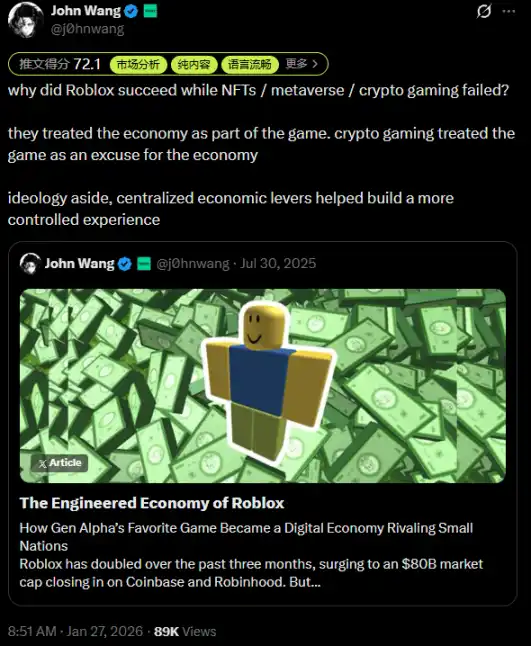
John's view is that Roblox treats the economic system as part of the game, while crypto games treat the game as a facade for the economic system. He believes that centralized economic mechanisms help build a more controllable gaming experience.

This makes sense. The lack of fun in Web3 games has been a common criticism, but the current generation of Web3 games has significantly improved in playability, and their economic mechanisms are also very centrally regulated. Yet, the outcome remains unchanged. There must be other reasons.

Then I thought about World of Warcraft and Kaito. On the day X blocked Kaito's API, I made the following comment.

Once Behavior Can Be Scaled, It Will Be Industrialized

From the "Chinese Farmers" in the Web2 era of World of Warcraft, to the scripts and gold farming studios in Web3's X2Earn, and now the inevitable "AI批量起号,多人矩阵嘴撸" (AI mass account creation, multi-account matrix farming) brought by嘴撸 (a term for farming).

So,嘴撸 wasn't ruined by clever retail players or KOLs; it was ruined by the property of "replicability." This isn't just a problem with the Kaito project; it's essentially the ultimate fate of all incentive systems.

So, what is the secret behind World of Warcraft and Roblox? Why can't studios kill them? Why did players complain about inflation and Chinese Farmers when they first appeared on the US servers, but eventually accept it as a fixed part of the game's ecosystem?

There must be something that Web3 games lack, and it's not just centralized economic mechanisms.

First, Let's Talk About World of Warcraft
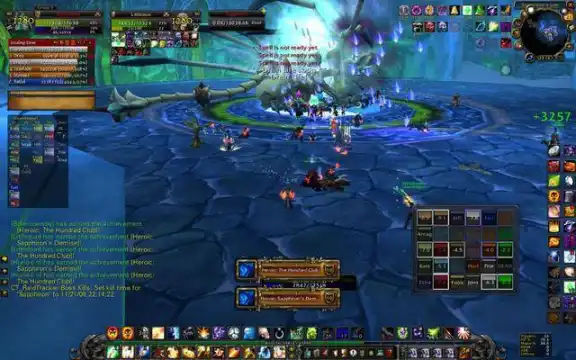
1. Gold Is Not the "Endgame Value"

Those who have deeply played WOW should know this: in the game, gold has little to do with your status or identity. Your achievements, rankings, reputation, etc.—none of these can be directly bought with gold. When a top-tier item drops in a dungeon, you either roll for it or bid with DKP (Dragon Kill Points) based on contribution. The player who loots it also binds it immediately, so it can't be sold for cash.

So, gold can at most save you some time, but it can't turn you into a core player. Many domestic web games back then were the complete opposite—big spenders could dominate everything with RMB, similar to the current style of Web3 games.

Essentially, in World of Warcraft, all "meaningful things"—top equipment, achievements, titles, dungeon contribution, etc.—cannot be directly purchased with gold. So, although gold farming can be scaled, leading to the industrialization of the first Chinese Farmers, it始终无法主导游戏的核心体验 (could never dominate the core experience of the game). In other words, this "industrialization" was confined to the "peripheral layer" of the game.

2. The Official Approach: "Absorption, Not Confrontation"

After the emergence of gold farming studios, Blizzard made a series of moves that, in hindsight, were very clever:

  • First, official control—allowing you to buy gold with real money, but the price is regulated by the system, and there's no free financial exit, turning the underground black market into official currency exchange;
  • Second, adding various barriers—such as daily and weekly quests, various cooldown locks... No matter how many accounts or high levels you have, you still have to wait patiently, diluting the advantage of industrialization;
  • Third, adding more "meaningful things" that cannot be bought with gold, like guilds, raids, social reputation... This led to the later emergence of gold runs and GKP (Gold Kill Points), but various dungeon first kills were always achieved by top guilds, never by gold runs. So, gold farming in World of Warcraft always remained a "second-class citizen."

As for Roblox, the Logic Is Slightly Different
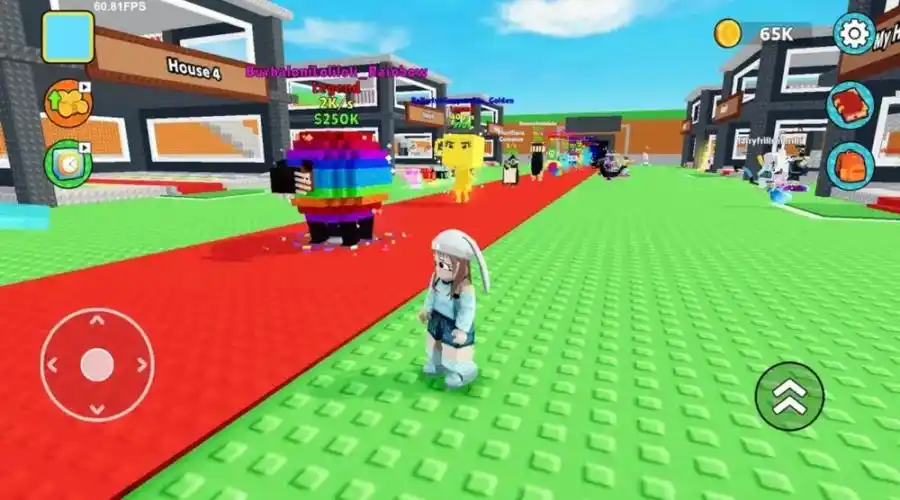
1. Encouraging Creativity Over Repetitive Labor

If you read the article I referenced in my previous post about Roblox, you'll know that the most profitable activities in Roblox are not repetitive tasks like farming resources, which offer little profit.

The real money is in creating maps, designing gameplay, and operating communities.

These are difficult for studios to scale and replicate. No matter how many resources you farm, you can't farm a gameplay that appeals to kids (though with AI now, this might also become "mass-producible").

2. Closed-Loop Internal Economic System, Restricted Asset Exchange

This is somewhat similar to John's idea. It's quick to buy Robux with a credit card, but converting Robux back to cash isn't as smooth—there are barriers, delays, and exchange rate losses, so arbitrage and搬砖 (a term for grinding/farming for profit) tactics don't work well here.

Moreover, most of the money in Roblox flows to platform fees, the top creators mentioned above, and in-game consumption, forming a closed-loop economic system with little overflow.

Of course, whether it's World of Warcraft or Roblox, being fun and having a large player base are the most important foundations, which is undeniable.

So, What Is the Real Reason Behind the Collective Demise of Web3 Games?

Thinking back, aside from the fun factor, perhaps the initial design intention of链游 (chain games/Web3 games) destined today's outcome.

Almost all链游 allow for "repeatable behavior" + "freely withdrawable assets."

In an era where Web2 gaming systems are already mature, this inevitably turns the final players of链游 into capital + scripts, not humans.

In other words, as long as Play and Earn are linked, this will always be the result.

Whether it's Play 2 Earn, the later improved Move 2 Earn, or Play & Earn, they are all different in name but not in essence.

This is somewhat like an impossible triangle for games. Among being fun, allowing speculators to make money, and enabling studios to scale, you can achieve at most two.
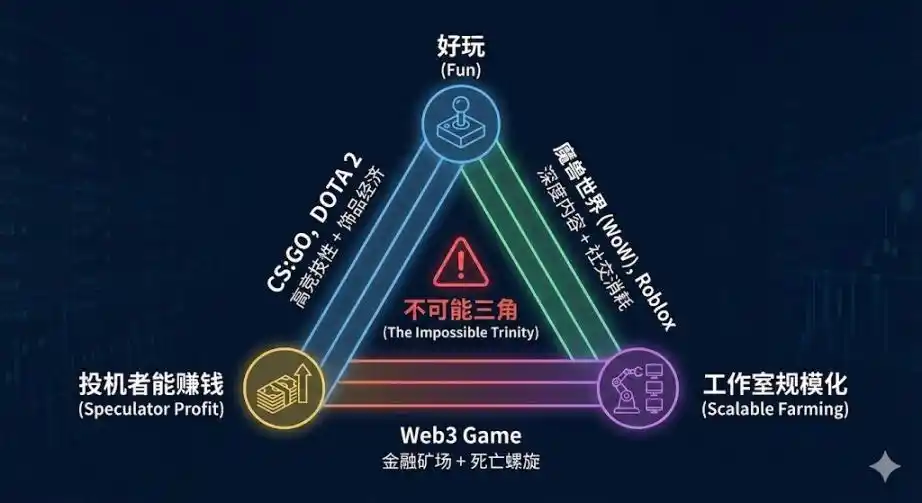
From this perspective, the problem with Web3 games isn't team quality or funding scale; it's that, at the most fundamental genetic level, they cannot be "fun."

Would Putting World of Warcraft on-Chain Work? Would It Be Meaningful?

I remember during the peak of链游 hype, we often fantasized about a scenario: what if World of Warcraft went on-chain?

Not the entire game, but putting WOW's economic system on-chain, including gold, items, mounts, etc., making them freely tradable, freely withdrawable, and financializable.

Now, thinking back, we were very naive. Doing this would注定会被系统毁掉 (destined to be destroyed by the system).

The underlying axioms of World of Warcraft's success:

  • Meaning cannot be traded—The most valuable things, top equipment, achievements, titles... are almost all bound, untradeable, non-transferable. These things signify what you have done, not what you own;
  • Progress does not equal wealth—Your time investment, operational skills, and team collaboration are your foundation. Gold can at most make you more comfortable; it cannot allow you to跨越阶级 (transcend classes);
  • Players are not asset owners but role-players—This equipment was obtained by me through effort / exchanged with DKP, this Boss was a world first kill by our guild, this character is my心血 (labor of love) trained over 10 years... Once this becomes "something I bought, an investment," this character emotionally bound to you downgrades into a skin for an asset account.

If we must talk about going on-chain, the things in World of Warcraft truly worth putting on-chain are these—for example, proof of a Boss's first kill, guild history, timestamps of your achievements, records of witnessing world events... What goes on-chain is not assets and value, but memories and traces.

The greatness of World of Warcraft lies precisely in the fact that its most important things can never be sold.

From this perspective, "链游必须死" (Chain games must die).

And it's not just链游. We once treated blockchain as a hammer, seeing everything as a nail to be struck. Little did we know that too many things in this world根本不需要被「金融化」 (simply do not need to be "financialized"). Their reason for existence is to be experienced, remembered, and told.


Domande pertinenti

QWhy did gold farming studios not destroy World of Warcraft (WoW) like they did with Web3 games?

AIn WoW, gold is not the ultimate value; meaningful elements like top-tier equipment, achievements, and reputation cannot be directly bought with gold. The official response involved absorbing and regulating the economy rather than outright对抗, implementing systems like official currency exchange, time-gated content, and non-tradable prestigious items. This kept gold farming activity on the periphery without dominating the core game experience.

QHow does Roblox prevent gold farming studios from harming its ecosystem?

ARoblox encourages creative activities like map design and community management, which are hard to scale industrially, rather than repetitive resource grinding. Its economy is a closed loop with friction and delays for cashing out Robux, making arbitrage difficult. The platform's focus on creativity and internal consumption, combined with financial barriers to withdrawal, limits the impact of farming.

QWhat is the fundamental reason Web3 games fail according to the article?

AWeb3 games inherently link play and earn, allowing repeatable actions and freely withdrawable assets. This design inevitably attracts capital and bots rather than genuine players, making it impossible for the games to be truly fun. The 'impossible triangle' suggests that a game cannot simultaneously achieve being fun, allowing speculators to profit, and enabling studio scalability—Web3 games prioritize the latter two at the expense of enjoyment.

QWhat would happen if World of Warcraft's economy were fully put on-chain?

AFully on-chaining WoW's economy would destroy it because the game's success relies on non-tradable elements like bound items, achievements, and player identity rooted in effort and memory, not financial ownership. On-chaining would reduce characters to asset accounts, stripping away the emotional attachment and meaning that comes from earned progress and shared experiences.

QWhat does the article suggest is worth putting on-chain from games like WoW?

AThe article suggests that instead of assets and value, meaningful elements like proof of first kills, guild history, achievement timestamps, and records of world events should be put on-chain. These represent memories and traces of player experiences, which align with the emotional and narrative value of the game, rather than promoting financialization.

Letture associate

Has Hook Summer Really Arrived? sato, Lo0p, FLOOD Ignite the New Narrative of Uniswap v4

"Hook Summer" Arrives? Sato, Lo0p, FLOOD Ignite Uniswap v4 Narrative Amidst a slight market recovery, attention within the Ethereum ecosystem has shifted to Meme coins built on Uniswap v4's Hook protocol. Following ASTEROID, tokens like sato, sat1, Lo0p, and FLOOD have become market focal points, with market caps ranging from millions to tens of millions, bringing concentrated liquidity to a narrative-dry market. Uniswap v4 Hooks are "plugin smart contracts" that allow developers to inject custom logic at key points in a liquidity pool's lifecycle (initialization, adding/removing liquidity, swaps, etc.), making the AMM programmable. Recent representative projects include: * **sato**: Market cap peaked over $38M; uses a v4 curve mechanism for minting/burning, locking ETH as reserve. * **sat1**: Market cap briefly exceeded $10M, positioning as an "optimized sato," but later declined significantly. * **Lo0p**: Market cap neared $6.6M; a "lending AMM protocol" allowing users to borrow ETH against deposited LO0P tokens without immediate selling pressure. * **FLOOD**: Market cap approached $6M; channels trading reserves into Aave v3 to generate yield, which is retained in the pool. The emergence of these Hook-based tokens could drive long-term growth for the Uniswap ecosystem by attracting users and liquidity to v4 pools. Combined with Uniswap's activated fee switch (partially used to burn UNI), the long-term outlook for UNI appears positive. However, short-term UNI price appreciation is not directly guaranteed. Factors include the sustainability and lifecycle of these new tokens, their price volatility, overall market conditions, and regulatory pressures. Currently, Uniswap v4's TVL ($595M) lags behind v3 and v2, indicating Hook adoption still requires time to mature. In summary, the Hook ecosystem serves as "long-term nourishment" for UNI, but acts more as a "catalyst" than a direct "booster" in the short term. Note: These are early-stage experimental tokens and may carry unknown risks.

marsbit23 min fa

Has Hook Summer Really Arrived? sato, Lo0p, FLOOD Ignite the New Narrative of Uniswap v4

marsbit23 min fa

Has Hook Summer Truly Arrived? sato, Lo0p, FLOOD Ignite the New Uniswap v4 Narrative

With the broader market showing signs of recovery, a new wave of interest has emerged around Ethereum-based meme coins. Following ASTEROID, tokens like sato, sat1, Lo0p, and FLOOD, built upon the Uniswap v4 Hook protocol, are capturing market attention. Their market capitalizations range from millions to tens of millions of dollars, injecting much-needed focused liquidity into a market lacking narratives. This article explores whether this trend signifies an incoming "Hook Summer" and its potential impact on UNI's price. Hooks are essentially plug-in smart contracts for Uniswap v4 liquidity pools, allowing developers to inject custom logic at key points in a pool's lifecycle (like initialization, adding/removing liquidity, swaps). This transforms the AMM into programmable building blocks. Key highlighted projects include: * **sato**: Peaked over $38M market cap. It utilizes a v4 curve for minting/burning; buying locks ETH as reserve to mint new tokens, while selling redeems ETH from the reserve and burns tokens. * **sat1**: Market cap briefly exceeded $10M, promoted as an "optimized sato," but later declined significantly. * **Lo0p**: Reached nearly $6.6M. It's a lending AMM protocol where buying LO0P tokens locks them as collateral, allowing users to borrow ETH from the pool reserve at 40% LTV, aiming to improve capital efficiency for idle ETH in LPs. * **FLOOD**: Peaked near $6M. Its mechanism directs asset reserves from buys into Aave v3 to generate yield, with fees and interest retained in the pool to potentially influence the token's price long-term. In the long term, the development of the Hook ecosystem can attract users and liquidity to Uniswap v4, benefiting UNI's fundamentals—especially combined with the recent activation of the protocol fee switch, where a portion of fees is used to burn UNI. However, in the short term, these Hook-based tokens are unlikely to directly drive significant UNI price appreciation. Their impact is moderated by factors like token sustainability, price volatility, and broader market and regulatory conditions. Currently, Uniswap v4's TVL ($595M) still trails behind v2 and v3, indicating adoption and growth will take time. The article concludes that while the Hook ecosystem provides long-term "nourishment" for UNI, its short-term role is more of a "catalyst" than a "booster." Readers are cautioned that these are early-stage experimental tokens and may carry unknown risks.

Odaily星球日报35 min fa

Has Hook Summer Truly Arrived? sato, Lo0p, FLOOD Ignite the New Uniswap v4 Narrative

Odaily星球日报35 min fa

Interview with Michael Saylor: I Did Say I Would Sell Bitcoin, But Never a Net Sale

Interview with Michael Saylor: I Said We'd Sell Bitcoin, But Never Be a Net Seller In a recent podcast, MicroStrategy Executive Chairman Michael Saylor clarified the company's stance on potentially selling Bitcoin. Following MicroStrategy's earnings call statement about being prepared to sell BTC to fund dividends for its STRC (Strategic) credit product, Saylor emphasized the distinction between selling and being a "net seller." Saylor explained the core business model: MicroStrategy sells credit instruments like STRC and uses the proceeds to buy Bitcoin, which is viewed as "digital capital" expected to appreciate around 30-40% annually. A portion of these capital gains can then be used to pay the dividends on the credit products. He stressed that even if the company sells some Bitcoin for dividends, it simultaneously buys much more with new credit issuance. For example, after raising $3.2 billion from STRC sales in April, the dividend obligation was only $80-90 million, making the company a net buyer. The clarification aims to counter market narratives questioning the value of Bitcoin on MicroStrategy's balance sheet if it were never sold, and to dismiss claims of a "Ponzi scheme." Saylor reiterated his personal philosophy for investors: "Don't be a net seller of bitcoin" and ensure your Bitcoin holdings increase each year. Saylor also discussed Bitcoin's role as the foundation for "digital credit," noting that STRC has become the largest and most liquid preferred stock issue in the U.S., offering high risk-adjusted returns (Sharpe ratio). He highlighted Bitcoin's deep liquidity, stating that even large purchases by MicroStrategy do not move the market significantly, which is driven by macro factors, geopolitical tensions, and capital flows from ETFs and credit products. Finally, Saylor reflected on his early inspiration from sci-fi books, which motivated his path to MIT, and maintained his fundamental thesis on Bitcoin remains unchanged: it is superior digital capital enabling superior digital credit.

链捕手39 min fa

Interview with Michael Saylor: I Did Say I Would Sell Bitcoin, But Never a Net Sale

链捕手39 min fa

Trading

Spot
Futures
活动图片