Author: YU GU, ChainCatcher
In the traditional business world, brand equity is a company's lifeline. Frequently changing a name is almost equivalent to actively destroying the moat.
NVIDIA doesn't change its name every few years, Apple wouldn't abandon the Apple brand due to a business pivot, and Nike wouldn't tear down its brand because of a market downturn.
But in the cryptocurrency world, the rules are often the opposite. According to statistics from RootData, over 16% of crypto projects have changed their names, and many well-known, top-tier projects also exhibit this phenomenon extensively.
Just yesterday, the on-chain IP ecosystem Story Protocol announced a name change to DATA, with IP tokens migrating 1:1 to new DATA tokens. In the past few months, Xion changed its name to Verona, Matrixport changed to BIT, and the TON token symbol changed to GRAM. Earlier, a group of well-known projects including Klaytn, EOS, Fantom, MakerDAO, Elrond, and Matic Network also changed their names.
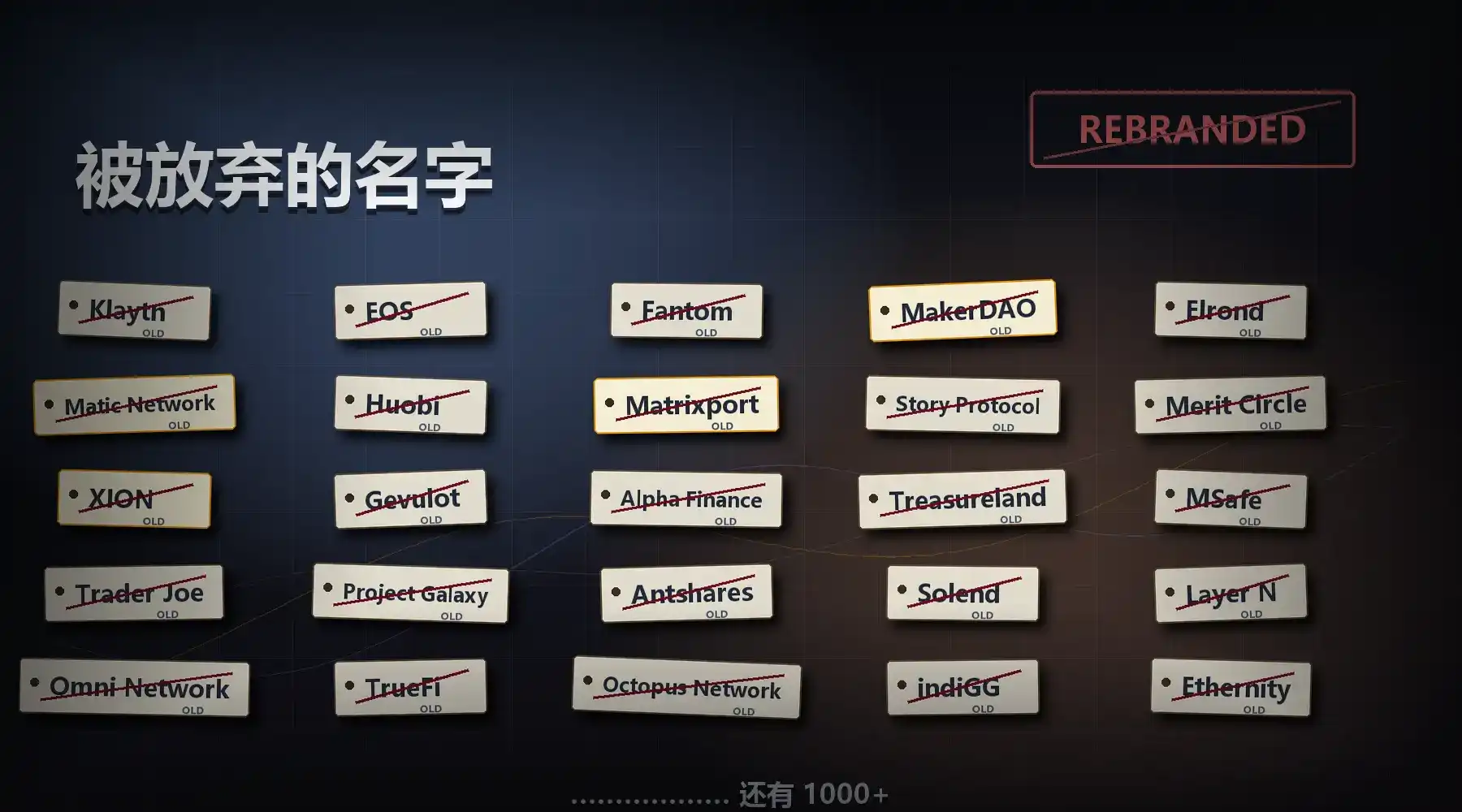
More extreme projects have even changed their names more than once. For example, MAITRIX had former names including CENTRAL, X Network, XLD Finance; BitSafe was formerly dlcBTC, DLC.Link; TaleX was formerly Read2N, Metale Protocol; KGeN was formerly indiGG, Kratos Gaming Network. The names change more and more, but most projects don't gain new life with a new name; instead, they gradually fade into obscurity.
This leads to a question rarely seriously discussed in the crypto industry: Why do crypto projects always like to change their names?
The answer might not be complicated: because in the crypto industry, brand is not the most important asset; attention, narrative, token price, and liquidity are.
I. Crypto Brand Loyalty Is Too Low
Traditional brands fear name changes because user loyalty stems from long-term consumption experience. A user who has bought iPhones for years, drank Starbucks for years, or worn Nike for years doesn't form their brand perception in a day, nor will it easily change due to a marketing campaign.
But the user structure of crypto projects is completely different.
Most early users are not consumers in the traditional sense but investors, airdrop hunters, liquidity providers, node participants, and narrative traders. They use a product not necessarily because it's good, but because there might be an airdrop, potential profits, or upside potential.
This means that crypto brand loyalty is inherently weak.
In traditional industries, users ask, "Is this brand trustworthy?"; in the crypto industry, users more often ask, "Can this coin still go up?". As long as the price remains depressed for a long time, the narrative fails, and the ecosystem stagnates, an old name can become a liability.
A name associated with a crash, being trapped, hacks, team controversies, or roadmap failures struggles to reignite market imagination. It carries not brand equity, but chart scars and community resentment.
This is the fundamental reason crypto projects dare to change names frequently: in many cases, the old name has no moat, only historical baggage.
II. Renaming as a Marketing Strategy
Not all name changes should be simply viewed as "changing skins." Some projects rename because the original name can no longer encompass the new strategic scope. As market hot concepts change, if a name includes outdated concepts like "Social" or "DAO," or the meaning no longer fits, a name change is an inevitable choice.
For example, the decentralized social protocol OpenSocial changed its name to Eden after pivoting to AI; the decentralized e-signature platform EthSign removed "Eth" from its name after business expansion; the Ethereum sidechain Matic Network changed its name to Polygon (meaning polygon) after building multiple scaling solutions.
When a project's business boundaries change fundamentally, the original brand may limit external perception. Renaming at this point is a necessary strategic realignment.
Of course, there are also many projects actively "riding the hype," gaining more attention by incorporating hot concepts into their names. During the last metaverse frenzy, Elrond changed its name to MultiversX, directly adding "Multiverse" elements, clearly hoping to capitalize on the metaverse and multi-dimensional digital world narrative.
Similarly, as AI, RWA, and Perp became industry hotspots, many projects quickly aligned with new concepts through name changes. For instance, Vanilla Finance changed to Superp, Function X changed to Pundi AI, reshaping their own narratives.
After all, in the crypto industry, narrative itself is part of asset pricing. A name closer to a new narrative is more easily noticed by exchanges, KOLs, retail investors, and market-making funds.
For many projects, the core reason for a name change is that the old brand has already fallen into a trust trough.
In crypto industry history, hacks, contract vulnerabilities, cross-chain bridge thefts, and team scandals can quickly destroy a project's brand credibility. Once users associate a name with "hacked," "collapsed," "rug pull," or "poor compensation," continuing to use the old name means constantly carrying negative public sentiment.
Thus, renaming becomes the most direct PR tool for project teams, often euphemistically called "brand repositioning."
Anyswap changed its name to Multichain after being hacked; Alpha Finance changed to Stella after a $37 million hack—both have a similar color. Superficially, they are adjusting product lines and strategic positioning; but from market perception, the name change also serves, to some extent, the function of "cutting off old memories."
III. The Gray Space of Renaming and Token Swap
If it were just a name change, the impact would be limited. What's truly worth vigilance is that many crypto projects often accompany a name change with a token swap.
A token swap means old tokens need to be migrated to new tokens; exchanges issue announcements, deposits and withdrawals are suspended, old trading pairs are delisted, and new trading pairs are listed. For the project team, this is a rare second chance at an "initial listing."
Many projects also conduct token splits. For example, 1:100, 1:1000, splitting a higher-priced token into more units, making the price per token appear cheaper. Projects like SKY and BEAM have adopted similar approaches. A stock split itself doesn't change company value, but a lower unit price often attracts more retail attention.
More crucially, after a name change and token swap, exchange historical K-line charts are often reset.
For many old tokens, the historical baggage is extremely heavy. Years of trapped holders, downtrends, negative news, and resistance levels are all condensed in the old K-lines. After the new token launches, it ostensibly has a brand new chart—no historical high suppression, no long-term decline shadows, and less direct memory of trapped holders.
This is extremely advantageous for project teams and market makers. When old tokens migrate to new ones, many exchanges suspend deposits and withdrawals. At this point, the actual circulating supply in the secondary market may become very light. On the few platforms where trading is open, market-making funds may need relatively little capital to pump the new token's price, creating the market illusion of a "post-upgrade surge."
Subsequently, the project team, early participants, or market-making funds may take the opportunity to sell off as liquidity is restored and users chase the rally.
This is the most dangerous aspect of renaming and token swaps: superficially, it's a brand upgrade; in essence, it may be a liquidity reset.
Furthermore, many projects redesign tokenomics during the swap process. Ordinary users see a 1:1 migration, thinking their rights aren't harmed. But the project team may simultaneously add new allocations for validator rewards, ecosystem funds, team incentives, node subsidies, and strategic reserves, thereby creating a large number of new tokens out of thin air.
FRONT changing to Self Chain and TVK changing to Vanar Chain are classic cases. They both massively increased token supply under the guise of node rewards and ecosystem building, diluting the value held by users.
IV. The Real Issue Isn't Renaming, But Evading History
Crypto projects can certainly change their names; that's not a serious problem in itself.
Changes in technical roadmap, expansion of product boundaries, shifts in market hotspots, and mitigation of legal risks can all lead to reasonable brand repositioning. Cases like Matic changing to Polygon show that a good name can indeed help a project embrace a larger strategic space.
But in more cases, crypto projects rename not to build brand equity, but to escape it.
To escape the old K-line, escape trapped holders, escape hacks, escape failed narratives, escape user doubts, escape a story that can no longer be told convincingly.
This is the biggest difference between the crypto industry and the traditional business world: traditional companies fear losing brand memory, while many crypto projects fear users remembering too much.
Therefore, when a project announces a name change, the market shouldn't only ask what its new name is, but should question three things:
What real capabilities or strategies has it actually added? Has its tokenomics changed? What old history does it most want users to forget?
If behind the name change lies real products, real revenue, real users, and a clearer strategy, then it might be the start of a new phase. But if the name change is merely accompanied by a token swap, hype-chasing, increased supply, and K-line resetting, then it's likely just a repackaged version of the old game.