Why Crypto Cards Are Doomed to Fail?

marsbitPubblicato 2025-12-12Pubblicato ultima volta 2025-12-12

Introduzione

Crypto cards are a temporary solution designed to bridge traditional payment systems with the cryptocurrency world, but they are ultimately doomed to fail. They rely on centralized banking infrastructure, depend on compliance with traditional financial regulations, and lack the privacy and decentralization that are core to crypto values. These cards function as an abstraction layer, adding extra fees and complexity while still being controlled by entities like Visa or Mastercard. They do not replace traditional payment systems but instead reinforce them. Most crypto cards operate like liquidity bridges, converting crypto to fiat for spending, which incurs taxable events and additional costs. They also fail to provide true financial inclusivity, as users from restricted countries cannot access them, contradicting crypto’s ethos of equality. While companies continue developing crypto cards to lock users into their ecosystems (e.g., MetaMask using Linea), these efforts are largely superficial, relying on third-party services like Rain for infrastructure. The only model that aligns with crypto principles is EtherFi, which allows users to spend against crypto collateral without selling assets, avoiding taxable events and embodying a true DeFi-TradFi hybrid. Ultimately, crypto cards are a flawed transitional product, not a long-term innovation.

Editor's Note: Crypto cards were once seen as a bridge connecting the traditional payment system with the crypto world, but as the industry develops, the limitations of this model have become increasingly apparent: centralization, reliance on compliance, lack of privacy, additional fees, and even a departure from the core spirit of cryptocurrency.

This article provides an in-depth analysis of the nature of crypto cards, pointing out that they are merely transitional solutions, not true innovations in decentralized payments. At the same time, the article presents EtherFi as one of the few models that aligns with crypto values, demonstrating the potential for DeFi and TradFi integration.

Below is the original text:

My overall view is that crypto cards are only a temporary solution to address two problems we all know well: first, bringing cryptocurrency to the masses; second, ensuring that cryptocurrency can be accepted as a payment method globally.

Crypto cards are still cards after all. If someone truly identifies with the core values of cryptocurrency but believes that the future will be dominated by cards, then you might need to rethink your vision.

All Crypto Card Companies Will Eventually Fail


In the long run, crypto cards will likely die out, but traditional cards will not. Crypto cards just add a layer of abstraction; they are not pure cryptocurrency use cases. The card issuer is still a bank. Yes, they may have different logos, different designs, different user experiences, but as I said before, this is just abstraction. Abstraction makes things more convenient for users, but the underlying process hasn't changed.

Different public chains and Rollups have been obsessed with comparing their TPS and infrastructure to Visa and Mastercard. This goal has existed for years: either "replace" or, more aggressively, "disrupt" Visa, Mastercard, AmEx, and other payment processors.

But this goal cannot be achieved through crypto cards—they are not replacements; instead, they bring more value to Visa and Mastercard.

These institutions are still the critical "gatekeepers." They have the power to set rules, define compliance standards, and even ban your card, company, or even bank if necessary.

Why would an industry that has always pursued "permissionless" and "decentralized" ideals now hand everything over to payment processors?

Your card is Visa, not Ethereum. Your card is a traditional bank, not MetaMask. You are spending fiat, not cryptocurrency.

Your favorite crypto card companies have done almost nothing except put their logo on the card. They are just riding the narrative and will disappear in a few years, and those digital cards issued until 2030 won't actually function by then.

I'll explain later how easy it is to make a crypto card now—in the future, you might even make one yourself!

The Same Problems + More Fees

The best analogy I can think of is "Application-Specific Sequencing." Yes, it's cool that applications can process transactions themselves and profit from it, but it's only temporary: infrastructure costs are falling, communication is maturing, and the economic issues exist at a higher level, not a lower one. (If you're interested, check out @mvyletel_jr's great talk on ASS.)

The same goes for crypto cards. Yes, you can top up with cryptocurrency, and the card will convert it to fiat for payment, but the problems of centralization and permissioned access remain.

It does help in the short term: merchants don't need to adopt new payment methods, and crypto spending is almost "invisible."

But this is just a transitional step toward what most crypto believers truly want:
Demand: Pay directly with stablecoins, Solana, Ethereum, Zcash
No need: The indirect path of USDT → Crypto Card → Bank → Fiat

Adding a layer of abstraction adds a layer of fees: spread fees, withdrawal fees, transfer fees, and sometimes even custody earnings. These fees may seem insignificant, but they compound: a penny saved is a penny earned.

Using a Crypto Card Doesn't Mean You Are "Unbanked" or "Debanked"

Another misconception I've observed is that people think using a crypto card means they are unbanked or debanked. Of course, this isn't true. Under the label of a crypto card, there is still a bank, and the bank must report some of your information to the local government. Not all data, but at least some key data.

If you are an EU citizen or resident, the government will know your bank account earnings, large suspicious transactions, certain investment income, account balances, etc. If the underlying bank is in the US, they know even more.

From a crypto perspective, this has both pros and cons. The pro is transparency and verifiability, but the same rules apply when you use a standard debit or credit card from your local bank. The con is that it is not anonymous or pseudonymous: the bank still sees your name, not an EVM or SVM address, and you still need to do KYC.

Limitations Still Exist

You might say that crypto cards are great because they are really easy to set up: download the app, complete KYC, wait 1–2 minutes for verification, top up with cryptocurrency, and then you're ready to use it. Yes, this is indeed a killer feature, extremely convenient, but not everyone can use it.

Russia, Ukraine, Syria, Iraq, Iran, Myanmar, Lebanon, Afghanistan, and half of Africa—citizens of these countries cannot use cryptocurrency for daily spending without residency in another country.

But hey, it's only 10–20 countries that don't qualify, what about the other 150+ countries? The issue is not whether the majority can use it, but the core value of crypto: a decentralized network with equal nodes, financial equality, and equal rights for all. This does not exist in crypto cards because they are not "crypto" at all.

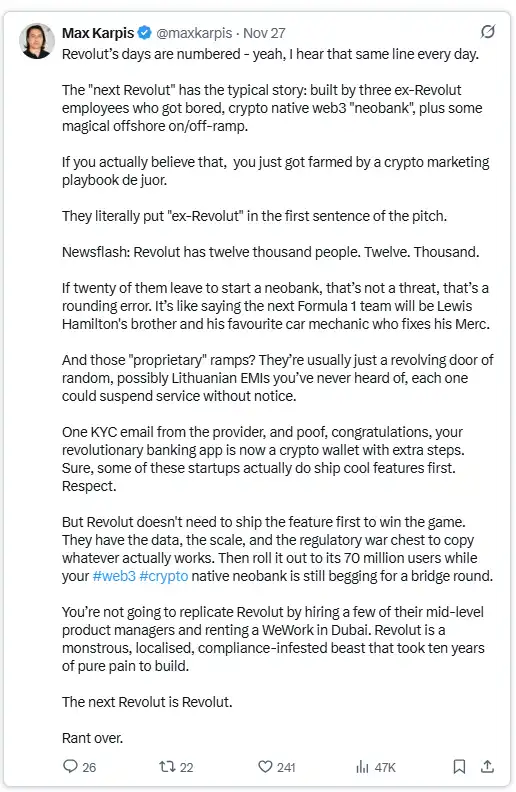
Max Karpis perfectly explains here why "neo-banks" are doomed to fail from the start.
For reference, a real scenario where I used cryptocurrency for payment was when booking a flight on Trip.com. They recently added an option to pay with stablecoins, directly from your wallet, and of course, it's available to anyone in the world.
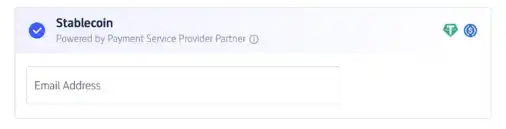
This is the real cryptocurrency use case and a true crypto payment. I believe the final form will be like this: wallets will be specifically optimized for the user experience of payments and spending, or (less likely) wallets will evolve into crypto cards, if crypto payments are somehow widely adopted.

Crypto Cards Function Similarly to Liquidity Bridges (Rain)

I have an interesting observation: self-custody crypto cards operate very similarly to cross-chain bridges.

This only applies to self-custody cards: cards issued by centralized exchanges (CEX) are not self-custody, so exchanges like Coinbase have no obligation to make users think the funds are under their control.

A legitimate use case for CEX cards is that they can serve as proof of funds for government, visa applications, or similar scenarios. When you use a crypto card tied to your CEX balance, you are still within the same ecosystem.

Self-custody crypto cards are different: they operate like liquidity bridges, where you lock funds (cryptocurrency) on chain A (crypto balance), and then unlock funds (fiat) on chain B (the real world).

This "bridge" in the crypto card space is like the shovel during the California Gold Rush: it is the key secure channel connecting crypto-native users and businesses that want to issue their own cards.

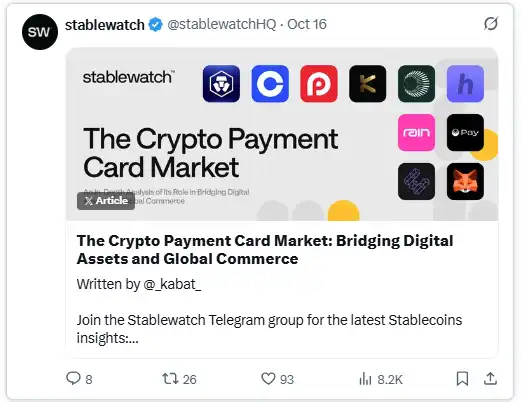
@stablewatchHQ's analysis of this bridge is spot-on, considering it essentially a Card-as-a-Service (CaaS) model. This is the most overlooked aspect by everyone discussing crypto cards. These CaaS platforms provide the infrastructure for businesses to launch their own branded cards.
Rain: How Crypto Cards Are Born

About half of your favorite crypto cards are probably powered by @raincards, and you may never have heard of it. Rain is one of the most fundamental protocols in the neo-banking system because it handles almost all the core components behind crypto cards. All that's left for the remaining companies to do is slap their logo on it (sounds harsh, but it's close to the truth).
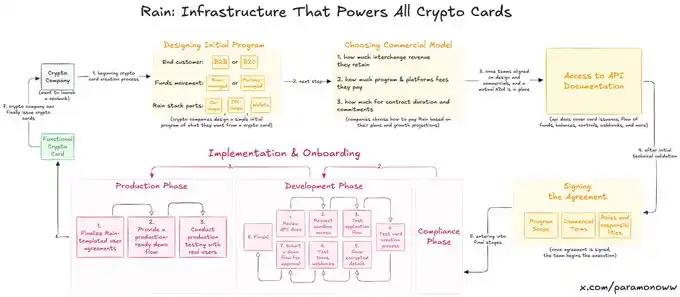
Rain enables companies to quickly launch their own crypto cards, and frankly, Rain's execution capabilities could even allow it to exist long-term outside the crypto space. So, stop fantasizing that teams need to raise tens of millions of dollars to issue a crypto card—they don't need that capital; they just need Rain.

The reason I emphasize Rain so much is that people generally overestimate the effort required to issue a crypto card. Maybe I'll write a separate article about Rain in the future because it is truly a severely underestimated technology.

Crypto Cards Have No Privacy or Anonymity

The lack of privacy or anonymity in crypto cards is not a problem with the cards themselves, but rather an issue deliberately ignored by those promoting them, hiding behind so-called "crypto values."


Privacy is not a widely used feature in the crypto space; pseudoprivacy (pseudonymity) does exist because we see addresses, not names. However, if you are ZachXBT, Wintermute's Igor Igamberdiev, Paradigm's Storm, or someone else with strong on-chain analysis capabilities, you can significantly narrow down the real identity corresponding to an address.

Of course, crypto cards don't even have the pseudonymity of traditional cryptocurrencies because you must complete KYC to activate a crypto card (actually, you're not activating a crypto card; you're opening a bank account).

If you are in the EU, the company providing the crypto card will still send some of your data to the government for tax purposes or other reasons the government needs to know. Now, you've given regulators a new opportunity to track you: linking your crypto address to your real identity.

Personal Data: The Currency of the Future

Cash still exists (the only form of anonymity, except the seller seeing you) and will exist for a long time. But eventually, everything will be digitized. The current digital system does not offer any benefits to consumers in terms of privacy: the more you spend, the higher the fees you pay, and in exchange, they know more about you. What a "great deal"!


Privacy is a luxury, and in the crypto card space, it will remain so. An interesting idea is that if we achieve truly good privacy, even to the point where businesses and institutions are willing to pay for it (not like Facebook, but with our consent), it could become the currency of the future, or even the only currency in a jobless, AI-driven world.

If Everything Is Doomed to Fail, Why Are Tempo, Arc Plasma, Stable Still Being Built?

The answer is simple—to lock users into the ecosystem.

Most non-custodial cards choose L2s (e.g., MetaMask uses @LineaBuild) or independent L1s (e.g., Plasma Card uses @Plasma). Due to high costs and finality issues, Ethereum or Bitcoin are generally not suitable for such operations. Some cards use Solana, but this is still a minority.

Of course, companies choose different blockchains not only for infrastructure but also for economic benefits.

MetaMask uses Linea not because Linea is the fastest or most secure, but because both Linea and MetaMask belong to the ConsenSys ecosystem.

I specifically use MetaMask as an example because it uses Linea. Everyone knows that almost no one uses Linea; it is far behind Base or Arbitrum in the L2 competition.

But ConsenSys made a smart decision to put Linea underneath their card because it locks users into the ecosystem. Users get accustomed to a good user experience through something they use daily. Linea naturally attracts liquidity, trading volume, and other metrics, rather than relying on liquidity mining campaigns or begging users to bridge.

This strategy is similar to what Apple did when it launched the iPhone in 2007, keeping users on iOS until they become so habituated they can't switch to another ecosystem. Never underestimate the power of habit.

EtherFi Is the Only Viable Crypto Card

After all this thinking, I've concluded that: @ether_fi is probably the only crypto card that truly aligns with the crypto spirit (this research is not sponsored by EtherFi, and even if it were, I wouldn't mind).

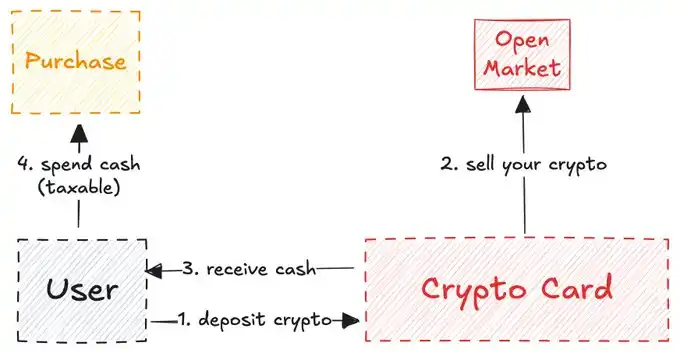
In most crypto cards, the cryptocurrency you top up is sold, and then your balance is replenished with cash (similar to the liquidity bridge I described earlier).

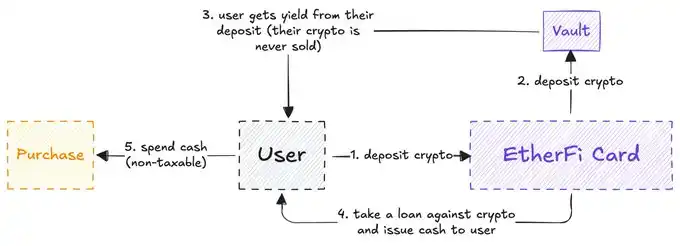
EtherFi is different: the system never sells your cryptocurrency; instead, it gives you a cash loan and uses your crypto assets to earn yield.

EtherFi's model is similar to Aave. Most DeFi users dream of seamlessly taking out cash loans collateralized by their crypto assets, and this capability has emerged. You might ask: "Isn't this the same? I can top up with crypto and spend with a crypto card like a normal debit card; is this extra step necessary?"
The problem is that selling your cryptocurrency is a taxable event, sometimes even more taxable than daily spending. And in most cards, every operation you do might be taxed, leading to you paying more taxes (again, using a crypto card does not mean being debanked).

EtherFi solves this problem to some extent because you are not actually selling cryptocurrency; you are just using it as collateral for a loan.

For this reason alone (plus no foreign exchange fees on USD, cashback, and other benefits), EtherFi becomes the best example of the convergence of DeFi and TradFi.

Most cards try to pretend they are crypto products but are actually just liquidity bridges, while EtherFi is truly for crypto users, not just for bringing cryptocurrency to the masses: it allows crypto users to spend locally until the masses realize how cool this model is. Among all crypto cards, EtherFi might be the only one that can survive long-term.

I think crypto cards are an experimental field, but unfortunately, most teams you see are just riding the narrative without giving due recognition to the underlying systems and developers.

Let's see where progress and innovation take us. Currently, we are seeing the globalization of crypto cards (horizontal growth), but there is a lack of vertical growth, which is precisely what this payment technology needs in its early stages.


Domande pertinenti

QWhy does the author believe that crypto cards are ultimately doomed to fail?

AThe author argues that crypto cards are merely a temporary solution that adds a layer of abstraction without addressing the core values of cryptocurrency, such as decentralization and permissionless access. They rely on traditional banking systems and payment processors like Visa and Mastercard, which centralize control, impose fees, and require KYC, contradicting crypto's foundational principles.

QWhat is the fundamental issue with the privacy and anonymity of crypto cards?

ACrypto cards lack privacy and anonymity because they require KYC (Know Your Customer) verification, linking users' real identities to their transactions. Unlike pseudonymous crypto transactions using addresses, crypto cards expose personal data to banks and governments, eliminating any form of financial privacy.

QHow does the author describe the operational model of most self-custody crypto cards?

AThe author compares self-custody crypto cards to liquidity bridges: users lock funds in cryptocurrency on one chain (e.g., a blockchain), and the card unlocks fiat currency in the real world for spending. This model involves intermediaries and fees, similar to a cross-chain bridge, rather than enabling direct crypto payments.

QWhat makes EtherFi's crypto card different from others according to the author?

AEtherFi's card differs by not selling users' cryptocurrency for fiat. Instead, it provides cash loans collateralized by crypto assets, allowing users to spend without triggering taxable events. This model aligns with DeFi principles, such as earning yield on locked assets, and avoids the pitfalls of traditional crypto cards that rely on selling crypto.

QWhy do companies build crypto cards despite their perceived limitations and inevitable failure?

ACompanies build crypto cards primarily to lock users into their ecosystems, leveraging habit and convenience to retain them. For example, MetaMask uses Linea to integrate users into ConsenSys' ecosystem. This strategy mimics Apple's approach with iOS, fostering user dependency rather than genuinely advancing crypto payment innovation.

Letture associate

Yao Shunyu's 88 Days

Yao Shunyu, a 27-year-old AI expert with a background from Princeton and OpenAI, joined Tencent in September 2025. Within 88 days, he led a major overhaul of Tencent’s AI strategy and organization, resulting in the release of Hunyuan Hy3 preview—a MoE model with 295B total parameters and 21B active parameters, supporting up to 256K context length. The launch came after Tencent leadership, including CEO Ma Huateng and President Martin Lau, openly criticized Hunyuan's earlier underperformance—citing slow development, over-reliance on superficial benchmark optimization, and poor generalization in real-world applications. Internal adoption was low, with key business units like WeChat and gaming seeking external AI solutions. Yao reshaped Tencent’s AI approach by integrating previously siloed teams, dissolving the ten-year-old Tencent AI Lab, and establishing new units focused on AI infrastructure and data. Hy3 preview was developed using co-design principles, closely aligned with product teams to ensure practical usability from the start. It has already been integrated into core products like Yuanbao, QQ, and enterprise tools. The release signals a shift from chasing rankings to building usable, scalable AI grounded in Tencent’s ecosystem. While external partnerships (like with DeepSeek and OpenClaw) helped retain users temporarily, the focus is now on making Hunyuan a reliable internal foundation. The real test lies in sustaining this new organizational momentum amid fierce competition from Alibaba, DeepSeek, and others.

marsbit30 min fa

Yao Shunyu's 88 Days

marsbit30 min fa

Trading

Spot
Futures

Articoli Popolari

Cosa è $S$

Comprendere SPERO: Una Panoramica Completa Introduzione a SPERO Mentre il panorama dell'innovazione continua a evolversi, l'emergere delle tecnologie web3 e dei progetti di criptovaluta gioca un ruolo fondamentale nel plasmare il futuro digitale. Un progetto che ha attirato l'attenzione in questo campo dinamico è SPERO, denotato come SPERO,$$s$. Questo articolo mira a raccogliere e presentare informazioni dettagliate su SPERO, per aiutare gli appassionati e gli investitori a comprendere le sue basi, obiettivi e innovazioni nei domini web3 e crypto. Che cos'è SPERO,$$s$? SPERO,$$s$ è un progetto unico all'interno dello spazio crypto che cerca di sfruttare i principi della decentralizzazione e della tecnologia blockchain per creare un ecosistema che promuove l'impegno, l'utilità e l'inclusione finanziaria. Il progetto è progettato per facilitare interazioni peer-to-peer in modi nuovi, fornendo agli utenti soluzioni e servizi finanziari innovativi. Al suo interno, SPERO,$$s$ mira a responsabilizzare gli individui fornendo strumenti e piattaforme che migliorano l'esperienza dell'utente nello spazio delle criptovalute. Questo include la possibilità di metodi di transazione più flessibili, la promozione di iniziative guidate dalla comunità e la creazione di percorsi per opportunità finanziarie attraverso applicazioni decentralizzate (dApps). La visione sottostante di SPERO,$$s$ ruota attorno all'inclusività, cercando di colmare le lacune all'interno della finanza tradizionale mentre sfrutta i vantaggi della tecnologia blockchain. Chi è il Creatore di SPERO,$$s$? L'identità del creatore di SPERO,$$s$ rimane piuttosto oscura, poiché ci sono risorse pubblicamente disponibili limitate che forniscono informazioni dettagliate sul suo fondatore o fondatori. Questa mancanza di trasparenza può derivare dall'impegno del progetto per la decentralizzazione—un ethos che molti progetti web3 condividono, dando priorità ai contributi collettivi rispetto al riconoscimento individuale. Centrando le discussioni attorno alla comunità e ai suoi obiettivi collettivi, SPERO,$$s$ incarna l'essenza dell'empowerment senza mettere in evidenza individui specifici. Pertanto, comprendere l'etica e la missione di SPERO rimane più importante che identificare un creatore singolo. Chi sono gli Investitori di SPERO,$$s$? SPERO,$$s$ è supportato da una varietà di investitori che vanno dai capitalisti di rischio agli investitori angelici dedicati a promuovere l'innovazione nel settore crypto. Il focus di questi investitori generalmente si allinea con la missione di SPERO—dando priorità a progetti che promettono avanzamenti tecnologici sociali, inclusività finanziaria e governance decentralizzata. Queste fondazioni di investitori sono tipicamente interessate a progetti che non solo offrono prodotti innovativi, ma contribuiscono anche positivamente alla comunità blockchain e ai suoi ecosistemi. Il supporto di questi investitori rafforza SPERO,$$s$ come un concorrente degno di nota nel dominio in rapida evoluzione dei progetti crypto. Come Funziona SPERO,$$s$? SPERO,$$s$ impiega un framework multifunzionale che lo distingue dai progetti di criptovaluta convenzionali. Ecco alcune delle caratteristiche chiave che sottolineano la sua unicità e innovazione: Governance Decentralizzata: SPERO,$$s$ integra modelli di governance decentralizzati, responsabilizzando gli utenti a partecipare attivamente ai processi decisionali riguardanti il futuro del progetto. Questo approccio favorisce un senso di proprietà e responsabilità tra i membri della comunità. Utilità del Token: SPERO,$$s$ utilizza il proprio token di criptovaluta, progettato per servire varie funzioni all'interno dell'ecosistema. Questi token abilitano transazioni, premi e la facilitazione dei servizi offerti sulla piattaforma, migliorando l'impegno e l'utilità complessivi. Architettura Stratificata: L'architettura tecnica di SPERO,$$s$ supporta la modularità e la scalabilità, consentendo un'integrazione fluida di funzionalità e applicazioni aggiuntive man mano che il progetto evolve. Questa adattabilità è fondamentale per mantenere la rilevanza nel panorama crypto in continua evoluzione. Coinvolgimento della Comunità: Il progetto enfatizza iniziative guidate dalla comunità, impiegando meccanismi che incentivano la collaborazione e il feedback. Nutrendo una comunità forte, SPERO,$$s$ può affrontare meglio le esigenze degli utenti e adattarsi alle tendenze di mercato. Focus sull'Inclusione: Offrendo basse commissioni di transazione e interfacce user-friendly, SPERO,$$s$ mira ad attrarre una base utenti diversificata, inclusi individui che potrebbero non aver precedentemente interagito nello spazio crypto. Questo impegno per l'inclusione si allinea con la sua missione generale di empowerment attraverso l'accessibilità. Cronologia di SPERO,$$s$ Comprendere la storia di un progetto fornisce preziose intuizioni sulla sua traiettoria di sviluppo e sui traguardi. Di seguito è riportata una cronologia suggerita che mappa eventi significativi nell'evoluzione di SPERO,$$s$: Fase di Concettualizzazione e Ideazione: Le idee iniziali che formano la base di SPERO,$$s$ sono state concepite, allineandosi strettamente con i principi di decentralizzazione e focus sulla comunità all'interno dell'industria blockchain. Lancio del Whitepaper del Progetto: Dopo la fase concettuale, è stato rilasciato un whitepaper completo che dettaglia la visione, gli obiettivi e l'infrastruttura tecnologica di SPERO,$$s$ per suscitare interesse e feedback dalla comunità. Costruzione della Comunità e Prime Interazioni: Sono stati effettuati sforzi attivi di outreach per costruire una comunità di early adopters e potenziali investitori, facilitando discussioni attorno agli obiettivi del progetto e ottenendo supporto. Evento di Generazione del Token: SPERO,$$s$ ha condotto un evento di generazione del token (TGE) per distribuire i propri token nativi ai primi sostenitori e stabilire una liquidità iniziale all'interno dell'ecosistema. Lancio della Prima dApp: La prima applicazione decentralizzata (dApp) associata a SPERO,$$s$ è stata attivata, consentendo agli utenti di interagire con le funzionalità principali della piattaforma. Sviluppo Continuo e Partnership: Aggiornamenti e miglioramenti continui alle offerte del progetto, inclusi partnership strategiche con altri attori nello spazio blockchain, hanno plasmato SPERO,$$s$ in un concorrente competitivo e in evoluzione nel mercato crypto. Conclusione SPERO,$$s$ rappresenta una testimonianza del potenziale del web3 e delle criptovalute di rivoluzionare i sistemi finanziari e responsabilizzare gli individui. Con un impegno per la governance decentralizzata, il coinvolgimento della comunità e funzionalità progettate in modo innovativo, apre la strada verso un panorama finanziario più inclusivo. Come per qualsiasi investimento nello spazio crypto in rapida evoluzione, si incoraggiano potenziali investitori e utenti a ricercare approfonditamente e a impegnarsi in modo riflessivo con gli sviluppi in corso all'interno di SPERO,$$s$. Il progetto mostra lo spirito innovativo dell'industria crypto, invitando a ulteriori esplorazioni delle sue innumerevoli possibilità. Mentre il percorso di SPERO,$$s$ è ancora in fase di sviluppo, i suoi principi fondamentali potrebbero effettivamente influenzare il futuro di come interagiamo con la tecnologia, la finanza e tra di noi in ecosistemi digitali interconnessi.

75 Totale visualizzazioniPubblicato il 2024.12.17Aggiornato il 2024.12.17

Cosa è $S$

Cosa è AGENT S

Agent S: Il Futuro dell'Interazione Autonoma in Web3 Introduzione Nel panorama in continua evoluzione di Web3 e criptovalute, le innovazioni stanno costantemente ridefinendo il modo in cui gli individui interagiscono con le piattaforme digitali. Uno di questi progetti pionieristici, Agent S, promette di rivoluzionare l'interazione uomo-computer attraverso il suo framework agentico aperto. Aprendo la strada a interazioni autonome, Agent S mira a semplificare compiti complessi, offrendo applicazioni trasformative nell'intelligenza artificiale (AI). Questa esplorazione dettagliata approfondirà le complessità del progetto, le sue caratteristiche uniche e le implicazioni per il dominio delle criptovalute. Cos'è Agent S? Agent S si presenta come un innovativo framework agentico aperto, progettato specificamente per affrontare tre sfide fondamentali nell'automazione dei compiti informatici: Acquisizione di Conoscenze Specifiche del Dominio: Il framework apprende in modo intelligente da varie fonti di conoscenza esterne ed esperienze interne. Questo approccio duale gli consente di costruire un ricco repository di conoscenze specifiche del dominio, migliorando le sue prestazioni nell'esecuzione dei compiti. Pianificazione su Lungo Orizzonte di Compiti: Agent S impiega una pianificazione gerarchica potenziata dall'esperienza, un approccio strategico che facilita la suddivisione e l'esecuzione efficiente di compiti complessi. Questa caratteristica migliora significativamente la sua capacità di gestire più sottocompiti in modo efficiente ed efficace. Gestione di Interfacce Dinamiche e Non Uniformi: Il progetto introduce l'Interfaccia Agente-Computer (ACI), una soluzione innovativa che migliora l'interazione tra agenti e utenti. Utilizzando Modelli Linguistici Multimodali di Grandi Dimensioni (MLLM), Agent S può navigare e manipolare senza sforzo diverse interfacce grafiche utente. Attraverso queste caratteristiche pionieristiche, Agent S fornisce un framework robusto che affronta le complessità coinvolte nell'automazione dell'interazione umana con le macchine, preparando il terreno per innumerevoli applicazioni nell'AI e oltre. Chi è il Creatore di Agent S? Sebbene il concetto di Agent S sia fondamentalmente innovativo, informazioni specifiche sul suo creatore rimangono elusive. Il creatore è attualmente sconosciuto, il che evidenzia sia la fase embrionale del progetto sia la scelta strategica di mantenere i membri fondatori sotto anonimato. Indipendentemente dall'anonimato, l'attenzione rimane sulle capacità e sul potenziale del framework. Chi sono gli Investitori di Agent S? Poiché Agent S è relativamente nuovo nell'ecosistema crittografico, informazioni dettagliate riguardanti i suoi investitori e sostenitori finanziari non sono documentate esplicitamente. La mancanza di approfondimenti pubblicamente disponibili sulle fondazioni di investimento o sulle organizzazioni che supportano il progetto solleva interrogativi sulla sua struttura di finanziamento e sulla roadmap di sviluppo. Comprendere il supporto è cruciale per valutare la sostenibilità del progetto e il suo potenziale impatto sul mercato. Come Funziona Agent S? Al centro di Agent S si trova una tecnologia all'avanguardia che gli consente di funzionare efficacemente in contesti diversi. Il suo modello operativo è costruito attorno a diverse caratteristiche chiave: Interazione Uomo-Computer Simile a Quella Umana: Il framework offre una pianificazione AI avanzata, cercando di rendere le interazioni con i computer più intuitive. Mimando il comportamento umano nell'esecuzione dei compiti, promette di elevare le esperienze degli utenti. Memoria Narrativa: Utilizzata per sfruttare esperienze di alto livello, Agent S utilizza la memoria narrativa per tenere traccia delle storie dei compiti, migliorando così i suoi processi decisionali. Memoria Episodica: Questa caratteristica fornisce agli utenti una guida passo-passo, consentendo al framework di offrire supporto contestuale mentre i compiti si sviluppano. Supporto per OpenACI: Con la capacità di funzionare localmente, Agent S consente agli utenti di mantenere il controllo sulle proprie interazioni e flussi di lavoro, allineandosi con l'etica decentralizzata di Web3. Facile Integrazione con API Esterne: La sua versatilità e compatibilità con varie piattaforme AI garantiscono che Agent S possa adattarsi senza problemi agli ecosistemi tecnologici esistenti, rendendolo una scelta attraente per sviluppatori e organizzazioni. Queste funzionalità contribuiscono collettivamente alla posizione unica di Agent S all'interno dello spazio crittografico, poiché automatizza compiti complessi e multi-fase con un intervento umano minimo. Man mano che il progetto evolve, le sue potenziali applicazioni in Web3 potrebbero ridefinire il modo in cui si svolgono le interazioni digitali. Cronologia di Agent S Lo sviluppo e le tappe di Agent S possono essere riassunti in una cronologia che evidenzia i suoi eventi significativi: 27 Settembre 2024: Il concetto di Agent S è stato lanciato in un documento di ricerca completo intitolato “Un Framework Agentico Aperto che Usa i Computer Come un Umano”, mostrando le basi per il progetto. 10 Ottobre 2024: Il documento di ricerca è stato reso pubblicamente disponibile su arXiv, offrendo un'esplorazione approfondita del framework e della sua valutazione delle prestazioni basata sul benchmark OSWorld. 12 Ottobre 2024: È stata rilasciata una presentazione video, fornendo un'idea visiva delle capacità e delle caratteristiche di Agent S, coinvolgendo ulteriormente potenziali utenti e investitori. Questi indicatori nella cronologia non solo illustrano i progressi di Agent S, ma indicano anche il suo impegno per la trasparenza e il coinvolgimento della comunità. Punti Chiave su Agent S Man mano che il framework Agent S continua a evolversi, diversi attributi chiave si distinguono, sottolineando la sua natura innovativa e il potenziale: Framework Innovativo: Progettato per fornire un uso intuitivo dei computer simile all'interazione umana, Agent S porta un approccio nuovo all'automazione dei compiti. Interazione Autonoma: La capacità di interagire autonomamente con i computer attraverso GUI segna un passo avanti verso soluzioni informatiche più intelligenti ed efficienti. Automazione di Compiti Complessi: Con la sua metodologia robusta, può automatizzare compiti complessi e multi-fase, rendendo i processi più veloci e meno soggetti a errori. Miglioramento Continuo: I meccanismi di apprendimento consentono ad Agent S di migliorare dalle esperienze passate, migliorando continuamente le sue prestazioni e la sua efficacia. Versatilità: La sua adattabilità attraverso diversi ambienti operativi come OSWorld e WindowsAgentArena garantisce che possa servire un'ampia gamma di applicazioni. Man mano che Agent S si posiziona nel panorama di Web3 e delle criptovalute, il suo potenziale per migliorare le capacità di interazione e automatizzare i processi segna un significativo avanzamento nelle tecnologie AI. Attraverso il suo framework innovativo, Agent S esemplifica il futuro delle interazioni digitali, promettendo un'esperienza più fluida ed efficiente per gli utenti in vari settori. Conclusione Agent S rappresenta un audace passo avanti nell'unione tra AI e Web3, con la capacità di ridefinire il modo in cui interagiamo con la tecnologia. Sebbene sia ancora nelle sue fasi iniziali, le possibilità per la sua applicazione sono vaste e coinvolgenti. Attraverso il suo framework completo che affronta sfide critiche, Agent S mira a portare le interazioni autonome al centro dell'esperienza digitale. Man mano che ci addentriamo nei regni delle criptovalute e della decentralizzazione, progetti come Agent S giocheranno senza dubbio un ruolo cruciale nel plasmare il futuro della tecnologia e della collaborazione uomo-computer.

411 Totale visualizzazioniPubblicato il 2025.01.14Aggiornato il 2025.01.14

Cosa è AGENT S

Come comprare S

Benvenuto in HTX.com! Abbiamo reso l'acquisto di Sonic (S) semplice e conveniente. Segui la nostra guida passo passo per intraprendere il tuo viaggio nel mondo delle criptovalute.Step 1: Crea il tuo Account HTXUsa la tua email o numero di telefono per registrarti il tuo account gratuito su HTX. Vivi un'esperienza facile e sblocca tutte le funzionalità,Crea il mio accountStep 2: Vai in Acquista crypto e seleziona il tuo metodo di pagamentoCarta di credito/debito: utilizza la tua Visa o Mastercard per acquistare immediatamente SonicS.Bilancio: Usa i fondi dal bilancio del tuo account HTX per fare trading senza problemi.Terze parti: abbiamo aggiunto metodi di pagamento molto utilizzati come Google Pay e Apple Pay per maggiore comodità.P2P: Fai trading direttamente con altri utenti HTX.Over-the-Counter (OTC): Offriamo servizi su misura e tassi di cambio competitivi per i trader.Step 3: Conserva Sonic (S)Dopo aver acquistato Sonic (S), conserva nel tuo account HTX. In alternativa, puoi inviare tramite trasferimento blockchain o scambiare per altre criptovalute.Step 4: Scambia Sonic (S)Scambia facilmente Sonic (S) nel mercato spot di HTX. Accedi al tuo account, seleziona la tua coppia di trading, esegui le tue operazioni e monitora in tempo reale. Offriamo un'esperienza user-friendly sia per chi ha appena iniziato che per i trader più esperti.

831 Totale visualizzazioniPubblicato il 2025.01.15Aggiornato il 2025.03.21

Come comprare S

Discussioni

Benvenuto nella Community HTX. Qui puoi rimanere informato sugli ultimi sviluppi della piattaforma e accedere ad approfondimenti esperti sul mercato. Le opinioni degli utenti sul prezzo di S S sono presentate come di seguito.

活动图片













