Whoever Defines Token Holds the Minting Power in the AI Era

比推Pubblicato 2026-03-23Pubblicato ultima volta 2026-03-23

Introduzione

The article discusses the intense debate in China over the Chinese translation of "Token," a fundamental unit in AI and computing. Previously an obscure technical term, Token has become economically significant as it is now used in cloud service billing, AI model revenue metrics, and national AI industry statistics. With China's daily Token consumption soaring, the naming contest has attracted various stakeholders. Proposals include "智元" (intelligence unit), promoted by an AI media company for brand alignment; "模元" (model unit), emphasizing model ownership; and "符元" (symbol unit), a technically accurate but less popular term. The academic translation "词元" (word unit), established in 2021, is now overlooked due to Token's newfound economic value. The author argues that naming Token is not merely a linguistic issue but a struggle for narrative control and economic influence, akin to minting currency in the AI era. The piece highlights that whoever defines Token shapes the industry's future direction and financial flows.

Author: Kuli, Shenchao TechFlow

Original Title: Token Doesn't Need a Chinese Name, But the Business Behind It Does


Recently, you may have noticed something: people have started discussing what Token should be called.

Professor Yang Bin from Tsinghua University published an article titled "It's Already Urgent to Determine the Chinese Translation for Token"; on Zhihu, related translation questions have garnered 250,000 views, with comment sections buzzing with ideas.

Over the past two to three years, the domestic AI circle has been using the term Token directly without any issue. Why the sudden need for a Chinese name?

The immediate reason might be that, after this year's Spring Festival, the general public learned for the first time that Tokens cost money.

OpenClaw turned AI from chatting to working, with tasks burning through hundreds of thousands of Tokens, and bills skyrocketing; various cloud providers have also announced price increases, with Token as the billing unit.

At the same time, Token has begun appearing in places it never did before.

At the GTC conference, NVIDIA CEO Jensen Huang mentioned that in Silicon Valley, people are already asking in interviews, "How many Tokens does this job offer?" He suggested incorporating Tokens into engineers' compensation;

OpenAI founder Sam Altman took it even further, suggesting that Tokens will replace universal basic income, with everyone receiving computing power instead of money.

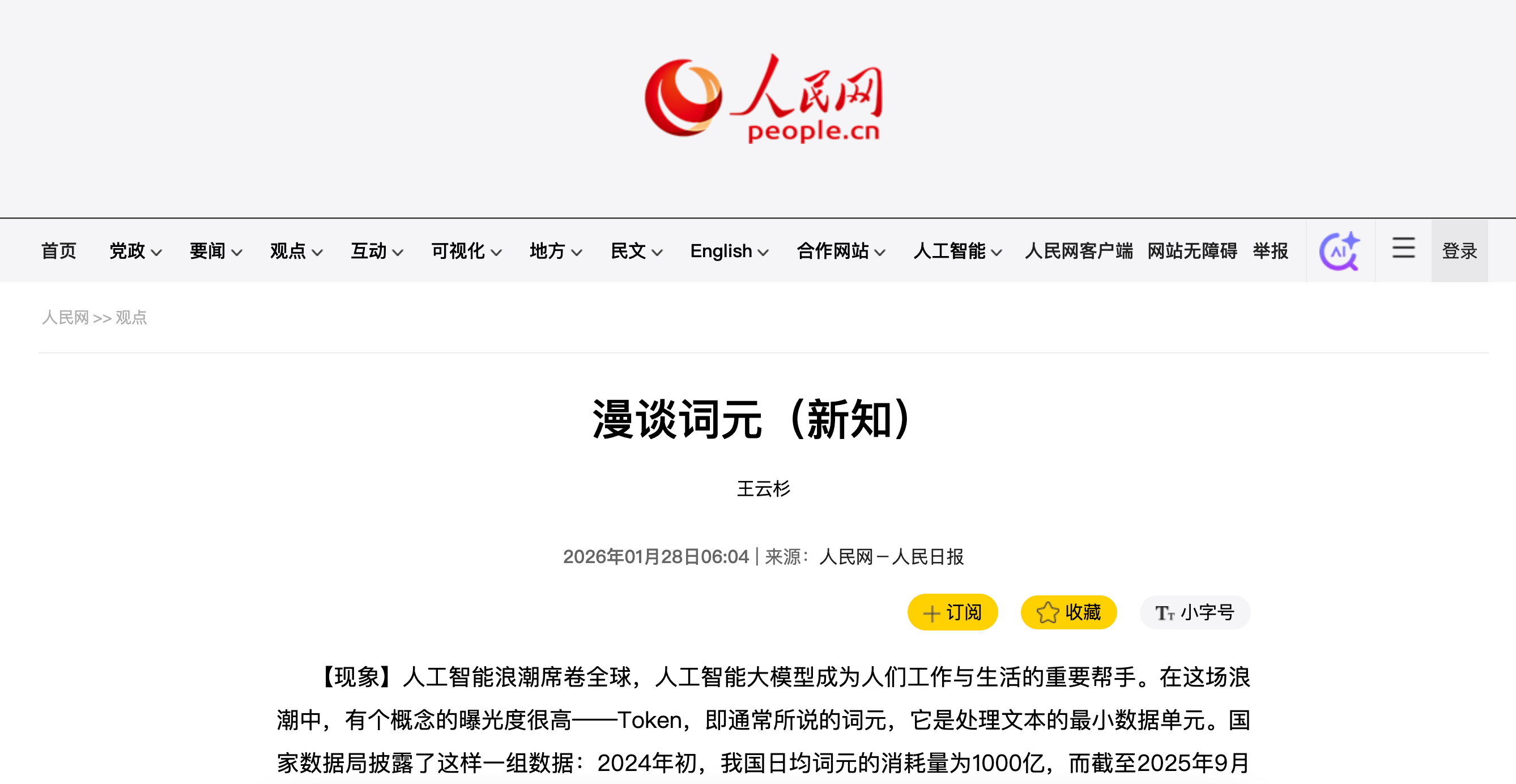
Data from the National Data Bureau shows that China's daily Token consumption surged from 100 billion in early 2024 to over 40 trillion by September 2025, reaching 180 trillion this February. At the beginning of the year, the People's Daily published an article titled "A Casual Talk on Ciyuan (词元)" to explain the term to readers.
Once a technical term enters cloud service bills, compensation packages, and official statistics, it can no longer remain in English.

The question is, what to call it?

If this were merely a translation issue, there would already be an answer. In 2021, the domestic academic community settled on a name for Token: 词元 (Ciyuan).

But no one paid attention because, back then, Token was just an internal term within technical circles.

Now, it's different.

The word Token itself is a universal container. People in the crypto world call it 代币 (daibi, token), those in security call it 令牌 (lingpai, token), and those in AI call it 词元 (ciyuan, lexeme). The same English word, depending on which direction the Chinese translation leans, determines whose territory it belongs to.

Thus, a battle over naming Token has begun.

Business Needs Discourse Power

How a word is translated is usually a matter for linguists. But this time, almost no linguists are involved in the naming.

The most prominent name currently is "智元" (Zhiyuan).

It's being pushed most vigorously by an AI media outlet called "新智元" (Xin Zhiyuan). If Token's Chinese name becomes "智元", this company's brand name would coincide with the industry's fundamental term, meaning every article discussing Token would provide free advertising for them.

Their own promotional article ends candidly: "We suggest translating Token as the industry's new consensus: 智元 (Zhiyuan), leaving the '新' (Xin, new) for us."

According to the same article, Baichuan Intelligent founder Wang Xiaochuan commented: "Calling it 智元 is quite good."

As a maker of large models, it's certainly good for him if Token is called 智元. Each operation of the model would then produce not just a billing unit, but a "basic unit of intelligence."

Selling Token is selling traffic; selling 智元 is selling intelligence—a completely different valuation story.

Professor Yang Bin from Tsinghua University proposed "模元" (Moyuan), with "模" (mo) corresponding to model. Whoever owns the large model holds the production rights to "模元". Leaning the term towards models directs pricing power to the model companies.

Some advocate for "符元" (Fuyuan), returning to the most fundamental definition in computer science—Token is simply a symbol processing unit, unrelated to intelligence or models.

Technically the purest, but the proposer is an independent technical writer without corporate backing or capital push, rendering this proposal almost inaudible in the discussion.

Which direction the name leans, the industry narrative moves in that direction, and money flows accordingly.

A distant example: the day Facebook renamed itself Meta, "metaverse" transformed from a sci-fi concept into a valuation story for a company. A recent example: China consumes 180 trillion Tokens daily, ranking first globally, but what to call this term, how to define it, and who defines it remain undecided...

The world's largest consumer of Tokens hasn't even decided what to call what it consumes.

However, this term actually already had a Chinese name.

In 2021, Professor Qiu Xipeng from Fudan University's School of Computer Science translated Token as "词元" (Ciyuan). The academic community accepted it and wrote it into textbooks. No one discussed it then because Token wasn't valuable at the time.

Now, Token is valuable.

It's the billing unit for cloud services, the revenue source for large model companies, and a core metric for measuring the scale of the AI industry at the national level. So the media arrived, the big shots arrived, the professors arrived, each bringing their preferred name and the rationale behind it.

Translation was never the issue. The issue is when this term started becoming valuable.
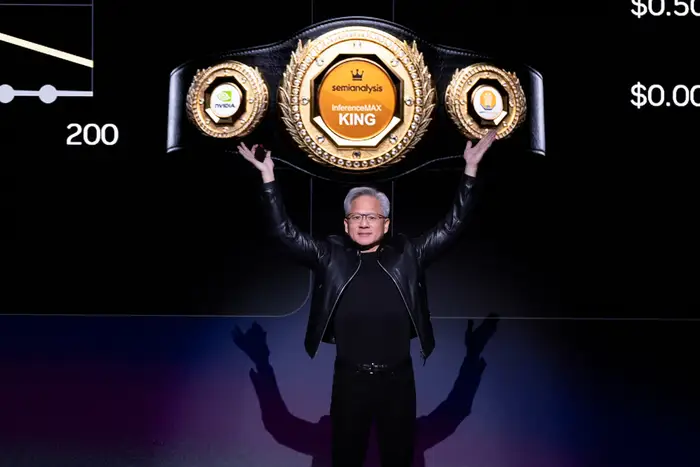
Jensen Huang didn't participate in the Chinese naming discussion at GTC. He did something simpler: held up a championship belt inscribed with "Token King" and declared that data centers are Token factories.

Whoever produces Tokens defines Tokens. He doesn't care about the name.

Token, Land Grabbing, and Minting

Therefore, the part truly worth serious thought isn't which translation is better.

After the term "calorie" was established, the entire food industry's pricing, labeling, and regulatory systems were built around it. After the definition of "流量" (liuliang, data traffic) was established in China's telecom industry, operators billed, competed, and designed packages based on it—the entire business model revolved around these two words for over a decade.

Token is now on the same path.

It's already the billing unit for cloud services, the revenue metric for large model companies, and a core indicator for measuring the AI industry at the national level. The VC circle is even discussing whether investment funds can be disbursed directly in Tokens.

Once a word becomes a measure of money, naming it is no longer translation—it's minting currency.

Call it "智元" (Zhiyuan), and the minting power goes to the AI narrative; whoever tells the story of intelligence benefits. Call it "模元" (Moyuan), and the minting power goes to the model companies; whoever has large models prints money. Call it "符元" (Fuyuan), and the minting power returns to the technology itself, but technology doesn't speak for itself.

The academic community's 2021 term "词元" (Ciyuan) was ignored not because the translation was poor, but because this "currency" wasn't valuable then.

Now it's valuable, and everyone wants to carve their name on it.


Twitter:https://twitter.com/BitpushNewsCN

Bitpush TG Discussion Group:https://t.me/BitPushCommunity

Bitpush TG Subscription: https://t.me/bitpush

Original link:https://www.bitpush.news/articles/7622494

Domande pertinenti

QWhy has there been a recent push to give Token a Chinese name, according to the article?

ABecause Token has become a unit of billing for cloud services, part of compensation packages, and a core metric for national AI industry statistics, making it necessary to have a standardized Chinese term as it enters everyday economic and official use.

QWhat are some of the proposed Chinese translations for 'Token' mentioned in the article, and who supports them?

A'智元' (Zhi Yuan) is promoted by the AI media '新智元' and supported by Wang Xiaochuan of Baichuan AI; '模元' (Mo Yuan) was proposed by Professor Yang Bin of Tsinghua University; '符元' (Fu Yuan) was suggested by an independent technical writer but has little traction.

QHow does the article compare the naming of 'Token' to historical examples like 'calories' or '流量' (data流量)?

AThe article compares it to how 'calories' defined the food industry's pricing and labeling system, and how '流量' (data流量) became the central unit for telecom billing and business models, indicating that naming Token is like establishing a new monetary standard for the AI economy.

QWhat does the article suggest is the real significance behind the debate over Token's Chinese name?

AThe debate is not about translation accuracy but about 'minting currency'—whoever defines the term gains narrative control and economic influence, shaping where money flows in the AI industry, whether toward AI intelligence stories, model companies, or pure technology.

QWhat was the academic translation for Token proposed in 2021, and why did it gain little attention at the time?

AIn 2021, Professor Qiu Xipeng of Fudan University translated Token as '词元' (Ci Yuan), which was accepted in academia and textbooks. It gained little attention because Token was not yet valuable as an economic unit at that time.

Letture associate

The AI Agent Era Accelerates Its Arrival: Questflow Defines a New Paradigm of Financial Intelligence with On-Chain AI Brokerage

The AI Agent era is accelerating, with the CB Insights AI 100 list highlighting global investment confidence. The focus has shifted from whether AI works to its speed of deployment and ability to manage complex workflows, with autonomous AI Agents driving this transformation. At the forefront is Questflow, a Singapore-based startup redefining financial intelligence through its on-chain AI brokerage. Unlike tools that merely provide data dashboards, Questflow deploys AI Agents that proactively scan markets, form judgments, and execute trades via a conversational interface—operating 24/7 without requiring manual confirmation for each decision. This embodies the new AI paradigm of agents capable of executing multi-step workflows autonomously. Questflow's mission is to democratize institutional-grade trading intelligence. Historically reserved for the ultra-wealthy, this capability is now accessible starting from just $1 through Questflow's "AI Clone + Copy Trade" model. The platform charges only a 1% execution fee, aligning its incentives directly with users and eliminating traditional management or performance fees. The timing is opportune, aligning with key trends identified by CB Insights: the scalable deployment of AI Agents, accelerated AI adoption in financial services, and the maturation of on-chain infrastructure. With robust liquidity on platforms like Hyperliquid and Polymarket, alongside advancements in AI reasoning and non-custodial wallet security, Questflow is positioned to merge the roles of broker, fund, and exchange into a single, accessible platform for millions.

链捕手4 min fa

The AI Agent Era Accelerates Its Arrival: Questflow Defines a New Paradigm of Financial Intelligence with On-Chain AI Brokerage

链捕手4 min fa

Why Pricing Social Interactions is Doomed to Fail?

Titled "Why Putting a Price on Social Interaction Is Doomed to Fail," this article critiques attempts to monetize social networks directly through SocialFi models, arguing their inevitable failure stems from a fundamental misunderstanding of media dynamics. Using Marshall McLuhan's theory of "hot" and "cold" media, the author posits that social networks are inherently "cold" media. Their value isn't contained in individual posts but is co-created through user participation, interpretation, and fragmented, ongoing interaction (e.g., replies, shares). This ambiguity and need for user involvement are core to their function. The article asserts that SocialFi projects like Friend.tech failed because introducing real-time, tradable financial pricing (a definitive "hot" signal) into this "cold" environment doesn't add a layer—it replaces the medium's essence. The unambiguous price signal overshadows and nullifies the nuanced, participatory social signal. Users become traders, not participants, and when speculative profits vanish, the underlying social ecosystem—never genuinely cultivated—collapses entirely. This principle extends beyond crypto. The author argues platforms like Twitter have gradually "heated up" through metrics (likes, retweets counts, algorithmically defined value), shifting users from participants to performers and eroding organic engagement. The solution isn't to abandon capital but to manage its entry point. Successful models like Substack, Patreon, or Bandcamp allow capital to "condense" at specific, isolated nodes (e.g., subscriptions, one-time payments) without permeating and "heating" every social interaction. They preserve the core "cold," participatory medium while enabling monetization at designated boundaries. The NFT boom and bust serves as a stark parallel: the ancient "cold" medium of collecting (valued for story, community, gradual accumulation) was rapidly destroyed by platforms that introduced real-time floor prices, rarity scores, and trading dashboards, transforming collectors into speculators and vaporizing cultural value when prices fell. The core lesson: "Liquidity equals heat." Injecting high liquidity and definitive pricing into a "cold" participatory medium doesn't optimize it; it fundamentally alters and destroys its value-creating mechanism. The future lies not in pricing every social gesture but in finding precise, non-invasive points for capital to condense without overheating the entire ecosystem.

marsbit12 min fa

Why Pricing Social Interactions is Doomed to Fail?

marsbit12 min fa

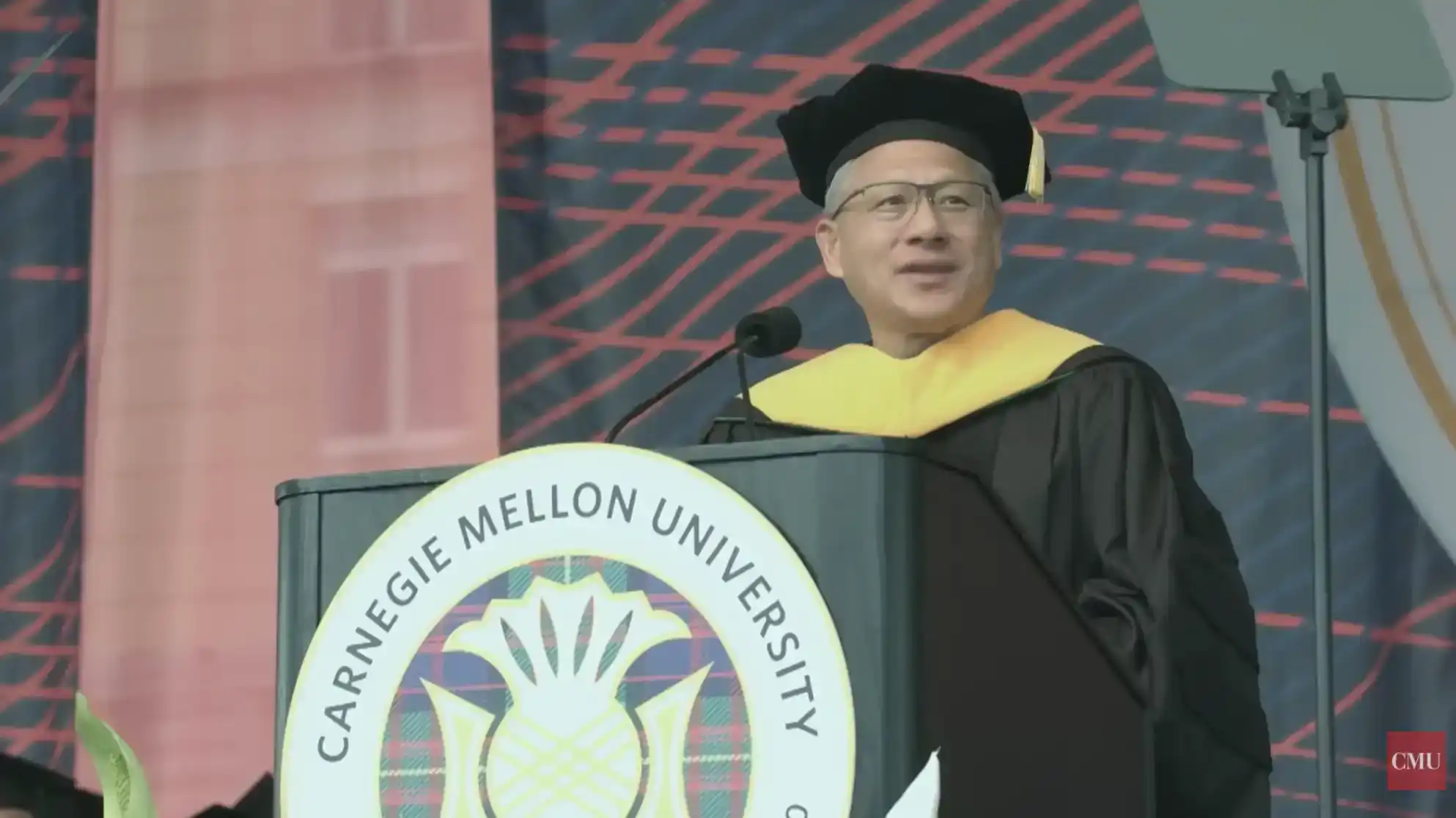
Jensen Huang's CMU Speech: In the AI Era, Don't Just Watch, Build

Jensen Huang, CEO of NVIDIA and a first-generation immigrant, delivered the commencement address to Carnegie Mellon University's class of 2026. He shared his personal journey from a humble background to founding NVIDIA, emphasizing resilience, learning from failure, and the responsibility that comes with leadership. Huang framed the present moment as the dawn of the AI revolution, a shift he believes is more profound than previous computing waves. He described AI as fundamentally resetting computing—moving from human-written software to machines that understand, reason, and use tools. This will create a new industry for generating intelligence and transform every sector. While acknowledging AI's potential to automate tasks and displace some jobs, Huang distinguished between the *tasks* of a job and its core *purpose*. He argued AI will augment human capability, not replace humans. The real risk, he stated, is not AI itself, but people being left behind by those who effectively use AI. He presented AI as a generational opportunity for massive infrastructure investment—in chip factories, data centers, energy grids, and advanced manufacturing—that could re-industrialize nations like the U.S. and bridge the digital divide by making computing and intelligent tools accessible to all. Huang called for a balanced approach: advancing AI safely and responsibly, establishing prudent policies, ensuring broad access, and encouraging universal participation. He urged the graduates not to fear the future but to engage with optimism and ambition, reminding them of CMU's motto, "My heart is in the work." His core message was clear: this is their moment to actively build and shape the AI-powered future, not merely observe it.

marsbit1 h fa

Jensen Huang's CMU Speech: In the AI Era, Don't Just Watch, Build

marsbit1 h fa

Trading

Spot
Futures

Articoli Popolari

Come comprare ERA

Benvenuto in HTX.com! Abbiamo reso l'acquisto di Caldera (ERA) semplice e conveniente. Segui la nostra guida passo passo per intraprendere il tuo viaggio nel mondo delle criptovalute.Step 1: Crea il tuo Account HTXUsa la tua email o numero di telefono per registrarti il tuo account gratuito su HTX. Vivi un'esperienza facile e sblocca tutte le funzionalità,Crea il mio accountStep 2: Vai in Acquista crypto e seleziona il tuo metodo di pagamentoCarta di credito/debito: utilizza la tua Visa o Mastercard per acquistare immediatamente CalderaERA.Bilancio: Usa i fondi dal bilancio del tuo account HTX per fare trading senza problemi.Terze parti: abbiamo aggiunto metodi di pagamento molto utilizzati come Google Pay e Apple Pay per maggiore comodità.P2P: Fai trading direttamente con altri utenti HTX.Over-the-Counter (OTC): Offriamo servizi su misura e tassi di cambio competitivi per i trader.Step 3: Conserva Caldera (ERA)Dopo aver acquistato Caldera (ERA), conserva nel tuo account HTX. In alternativa, puoi inviare tramite trasferimento blockchain o scambiare per altre criptovalute.Step 4: Scambia Caldera (ERA)Scambia facilmente Caldera (ERA) nel mercato spot di HTX. Accedi al tuo account, seleziona la tua coppia di trading, esegui le tue operazioni e monitora in tempo reale. Offriamo un'esperienza user-friendly sia per chi ha appena iniziato che per i trader più esperti.

330 Totale visualizzazioniPubblicato il 2025.07.17Aggiornato il 2025.07.17

Come comprare ERA

Discussioni

Benvenuto nella Community HTX. Qui puoi rimanere informato sugli ultimi sviluppi della piattaforma e accedere ad approfondimenti esperti sul mercato. Le opinioni degli utenti sul prezzo di ERA ERA sono presentate come di seguito.

活动图片