Who Is Shaping Ethereum's Future: The Takeover by Token-Holding Companies Could Be the Best Thing for ETH in Years

marsbitPubblicato 2026-07-17Pubblicato ultima volta 2026-07-17

Introduzione

**Title: Who is Building Ethereum's Future? Corporate ETH Holders Take Over Funding, Possibly the Best Thing for ETH in Years.** **Summary:** The Ethereum Foundation is scaling back due to fiscal concerns, but publicly traded companies holding large amounts of ETH, like Bitmine and SharpLink, are stepping in to fund protocol development. These firms collectively hold nearly 5% of ETH's circulating supply and are using their staking yields to pay for R&D. Unlike MicroStrategy, which merely accumulates Bitcoin, these ETH treasury companies are reinvesting profits directly into the protocol's development—potentially allowing all ETH holders to benefit from this free "spillover." Key drivers for this shift include these companies' stalled business model. Their "flywheel" of issuing stock to buy more ETH broke as their stock prices fell below the net value of their crypto holdings (mNAV < 1). With their ETH holdings also deeply underwater, simply waiting for price appreciation failed. By funding Ethereum's roadmap—through new non-profits like ETH Labs and Ethereum Institutional—they aim to increase the utility and value of the underlying asset that dominates their balance sheets. This creates a new alignment of interests: these companies are highly incentivized to see Ethereum succeed and are less likely to sell en masse. However, risks remain. The exact funding amounts are undisclosed, and these treasury firms themselves are vulnerable if ETH prices fall further, which could h...

Authors: Edgy, Yayya

Compiled by: TechFlow

TechFlow Guide: The Ethereum Foundation is contracting due to treasury issues, but token-holding companies like Bitmine and SharpLink are taking over development funding. These companies hold nearly 5% of circulating ETH and are now using staking yields to pay for protocol R&D. Unlike MicroStrategy, which just hoards Bitcoin, ETH-holding companies are returning yields to protocol development—potentially allowing all ETH holders to enjoy a free ride.

Key Takeaways

  • 80% of JTX platform fees go to the DAO; all proceeds received by the DAO will be used for open market buybacks and JTO burns, at least until Q4 2027, after which token holders will vote on whether to continue.
  • The real difference between Jito and Venice is the 'plumbing': where the revenue lands, who can shut off the burn mechanism, whether governance can replace the executor, and if the project has genuinely redirected company revenue to the token in the past.
  • When DAT companies' mNAV dropped below 1 and their holdings were underwater, the old flywheel of issuing stock to buy coins stalled. Companies like Bitmine and SharpLink then began directly funding protocol R&D; this improves incentive alignment but also exposes development funding to token price and company fragility.

The Crypto World Has Come Full Circle Back to TradFi

Crypto traders spent years urging everyone to escape the traditional financial system.

Hyperliquid's HIP-3 markets—stocks, commodities, and indices—reached $3 billion in volume over the last 7 days; the platform's native crypto perpetuals volume was $3.1 billion, almost equal.

We fled TradFi, only to trade TradFi with 20x leverage, lol.

In This Issue:

  • Jito's latest proposal, and why JTO holders should be pleased.
  • The new direction of ETH development funding: Are treasury companies taking over funding actually a good thing?
  • Network-wide updates: Polymarket launches combo bets, Plasma One releases Android version, Jito's JTX goes live, and more.

JIP-38: Making Jito a 'Token-Centric' Network

"We have equity, but we will direct value to the token."

When Venice said this two weeks ago, it was slammed by Crypto Twitter (CT); when Jito said the same thing this week, CT cheered.

Here are the real differences between the two projects. (We discussed Venice on July 2nd, so we won't repeat the background.)

What Happened?

On July 13th, Jito DAO released JIP-38, officially defining Jito as a "token-centric network": all major project revenue flows to the DAO and is governed by the token; the token has hard economic rights over how this revenue is used.

The specific commitment: 100% of the revenue share JTX brings to the DAO will be used to buy and burn JTO on the open market. JTX is Jito's new self-custody trading app for professional traders, opened to waitlist users the day after the proposal. This arrangement will run for at least a year and continue until Q4 2027.

What JTO Holders Get:

  • 80% of JTX platform fees go to the DAO; the remaining 20% is retained but can only be reinvested into the platform generating that revenue.
  • 100% of the DAO's share is used to buy and burn JTO. The result is a reduced supply, not money sitting in a treasury for accounting games.
  • Execution is handled by a "Revenue Splitter": it collects fees and performs the buybacks, with fee, buy, and burn records for each epoch disclosed on-chain.
  • In Q4 2027, token holders will vote again on the entire arrangement, using at least a year of real data.

Sounds familiar, right? This is almost exactly Erik Voorhees's defense for Venice. Venice sold $65 million in equity and promised increased burns; Jito raised $50 million from a16z last October, reportedly with "well over $100 million" in cash on hand. Both are companies with an equity layer, also claiming to direct revenue to the token.

Why do I view them differently? Three reasons.

1. Revenue Lands in Different Pockets

Venice's revenue belongs to the Venice team. Apart from a small automatic burn—about $166k in April—other burn amounts are decided monthly by the board, which owes fiduciary duty to shareholders, not token holders.

Jito's fees go on-chain to the DAO treasury. JIP-38 explicitly states the token has "hard economic rights" over fund deployment. When money enters an address governed by token holders, burning is no longer a project's goodwill; it's institutionalized.

2. Token Holders Can Replace the Treasury Executor

I checked who exactly controls Jito's buyback machine. The honest answer: it's still managed by people for now.

The Revenue Splitter is actively managed by a Dev Council, a small committee authorized by the DAO; the proposal only promises gradual automation and decentralization in the future, with no concrete plan yet.

But the "leash" is real. The council's mandate is bound by JIP-36's revocable authority structure: a single governance vote, plus a 12-hour timelock, can revoke its permissions.

If Venice's board reduces burns to zero, VVV holders can only tweet complaints; if Jito's council misbehaves, JTO holders can remove them within 12 hours.

3. Money Has Already Flowed From Company to Token Twice

Before August 2025, Jito's 6% Block Engine fees were split 50/50 between Jito Labs and the DAO, each getting 3%. JIP-24 then directed the full 6% "permanently" to the DAO, with Labs actively giving up its revenue source.

JIP-38 extends the same model to JTX from day one of the new product's launch. Venice's Series A added an equity claim on top of token holders; Jito's equity layer is continuously reducing its own claim.

This history makes Jito more credible. If Venice wants similar credibility, it should also set up automatic buybacks for recurring revenue from subscription services.

But Questions Remain

JTX just opened to 1,000 users, so its cash flow rounds to roughly zero. For now, it's just a signal about "where future value will flow," not existing value. The proposal also doesn't specify who ultimately gets the 20% development share; clearly, it will likely go to Jito Labs, responsible for developing JTX.

One year isn't long. Forum members have already requested extending the deadline to five years. Labs, the Foundation, and its investors also hold substantial JTO, so part of "token holders decide" actually means "insiders decide."

To be fair, revenue from existing products like JitoSOL and BAM already flows to the DAO, which is a strong positive signal.

Why This Isn't Just About Jito?

Because most crypto projects have both an equity layer and a token layer. Everyone says "value will accrue to the token," but you can't just trust it.

Don't grade the pitch, grade the plumbing. Just ask three questions:

  1. Where does the revenue legally end up: a company account, or an address governed by the token?
  2. Who can turn off the burn mechanism? Can token holders replace this person?
  3. Has money ever actually flowed from the company's pocket to the token before?

Venice fails the first two, and CT noticed. Jito passes all three but gets an asterisk on "human-controlled."

Sponsored Content | stBTC: Bitcoin Now Has Liquid Staking Too
Liquid staking is one of the most validated sectors in crypto. Lido alone has over $17 billion TVL; for years, ETH holders could earn staking yields without giving up liquidity.

Bitcoin holders have lacked a counterpart because Bitcoin previously had no reliable, native staking mechanism that could be wrapped.

Now that's changing. Stacks is about to launch Bitcoin Staking, and StackingDAO's stBTC is a liquid token built on top: BTC can earn staking yields while remaining freely movable within the Stacks ecosystem.

The expected base yield at launch is about 2.6%. That's not huge, but it's better than Bitcoin's native 0% yield since 2009.

This also isn't a new team risking your BTC. StackingDAO has operated STX stacking infrastructure for over two years, managing peak staked capital over $150 million, serving more than 40,000 stakers, with zero security incidents.

stBTC isn't live yet; it will launch shortly before Stacks releases Bitcoin Staking, meaning very soon.

ETH Has a New 'Management Team'

The Ethereum Foundation is stepping back due to treasury sustainability concerns.

Meanwhile, new players are stepping up. Treasury companies are beginning to fund Ethereum's next phase, and this could be the best thing to happen to ETH in years.

What Happened?

First, the timeline:

  • June 22: ETH Labs is founded. It's a nonprofit R&D institute formed by five former Ethereum Foundation researchers; they worked on finality, scaling, and protocol economics.
  • June 23: The Ethereum Foundation lays off 20%, cuts its 2026 budget by 40%, and restructures into five work clusters.
  • July 1: Ethereum Institutional is founded as a nonprofit "front door" for banks and asset managers into Ethereum; its focus also includes ecosystem marketing and ETH asset marketing. Yes, direct marketing of the asset.
  • July 14: EthSystems is founded. It's a for-profit company building confidential transaction systems for banks, operated by the original team from the Foundation's "Institutional Privacy Working Group."

Three entities in a month, and each press release has the same three names behind it: Bitmine (NYSE:BMNR), SharpLink (Nasdaq:SBET), and Joe Lubin.

Who Are These Funders?

Bitmine is Tom Lee's Digital Asset Treasury (DAT) company, holding 5.77 million ETH, about 4.8% of the total circulating supply. That means roughly one in every 21 ETH in the world is on this company's balance sheet, and its public goal is to hold 5% of the total supply.

SharpLink holds about 876,000 ETH, the second-largest corporate holder. The company's Chairman, Joe Lubin, also founded Consensys (MetaMask, Linea) and is an Ethereum co-founder.

The question isn't whether these companies matter, but why they suddenly started writing checks for protocol research.

Why Are DATs Becoming Ethereum's Venture Arm?

Frankly: because their old playbook isn't enough anymore.

The lifeblood of treasury companies is one number—mNAV, the multiple of the stock price relative to the net value of its crypto assets. When the market cap is higher than the value of its ETH holdings, the company can issue more stock, buy more ETH, increasing the assets per share. This was the flywheel Bitmine used to build its massive position.

Now the flywheel is frozen. The entire ETH treasury sector's mNAV is below 1, meaning the market values these companies at less than their holdings themselves. Issuing below NAV dilutes and hurts existing shareholders, so no new stock, no new ETH, no flywheel.

And the existing holdings are deeply underwater. Bitmine's average cost basis is around $3,883; the ETH price mentioned in the article is less than half that. SharpLink's average cost is around $3,609, with unrealized losses exceeding $1 billion during the last dip.

Waiting for the Ethereum Foundation to pump ETH back up didn't work, so these companies are taking matters into their own hands.

This isn't blind donations; they're building a system that can re-inflate the value of their own balance sheets.

The Bull Case: Finally Someone Pays for the Roadmap

From this perspective, ETH holders get to enjoy the spillover benefits of all this investment for free.

The Foundation is proactively contracting. Vitalik described the cuts as an intentional shift toward an "endowment model": the Foundation's annual spending ratio will drop from ~15% to 5% by 2030 to survive any winter. Noble, but it leaves a funding gap just as Wall Street is preparing to enter.

Treasury companies fill this gap with self-replenishing money. Projected annual staking yields of $284 million for Bitmine equate to an R&D budget that replenishes automatically without selling a single token. Tom Lee's argument: corporate stakers will provide guaranteed funding for Ethereum's future development.

If it works, the flywheel spins the right way: institutional roadmap delivery, banks bringing real cash flow, ETH demand gets repriced, and developers get multi-year funding.

MicroStrategy holds Bitcoin but funds zero Bitcoin development; ETH treasury companies are reinvesting staking yields into the protocol. This is a clear net positive for ETH.

The Bear Case

But the other side must be seen too.

No specific amounts are disclosed anywhere. As of writing, we don't know how much money is actually earmarked for ETH development. Maybe the market overestimates these funds' impact; actual contributions could be very limited.

DAT companies themselves are fragile. Pantera warns of a possible "brutal shakeout" for crypto treasury companies in 2026. If ETH keeps falling, the dollar value of staking yields shrinks, mNAV compresses further, and these companies stop funding ETH.

My takeaway: The Ethereum Foundation stepping back doesn't mean Ethereum development dies; it's a handover.

The new funders hold more ETH than almost anyone else on Earth. They can't dump without hurting themselves. It's not perfect governance, but it creates real incentive alignment.

DeFi Catalysts

Polymarket: Brings "parlays" to prediction markets with Combos: users can combine multiple sports outcomes into a single all-or-nothing position, priced by market makers via RFQ auctions.

Aave: Launches Stable Vaults, converting floating lending rates into fixed-rate stablecoin yields any business can embed; Aave's mobile savings feature already uses it.

Plasma One: Its new banking app is live on Android. Download before July 18 for six months free Core tier access.

Ethena: Minting users can now mint and redeem USDe with USDC for free. Expected instant liquidity should reduce value leakage in secondary markets.

Jito: Trading platform JTX is open to some waitlist users, offering Solana meme coins, tokenized stocks, and major asset spot markets.

Lido: wstETH launches on Robinhood Chain, bringing Ethereum staking yields to a new ecosystem.

Maple: syrupUSDG's launch on Robinhood Chain pushes assets under management past $200 million; Steakhouse has approved it as collateral for Robinhood Earn vaults.

Jupiter: New product Gacha brings graded Pokemon and One Piece collectible cards on-chain; draw value can be multiples of the payment, with top prizes up to $100k.

Tempo: Receive Policies let accounts reject unwanted tokens and restrict senders; rules are enforced at the protocol layer, not the application layer.

RHEA Finance: Launches Perp Confidential Deposit on July 15, allowing users to keep trading with existing accounts and Hyperliquid liquidity while hiding deposit information.

Jito JIP-38: Commits to using 100% of the DAO's share of JTX revenue for programmatic buybacks and JTO burns until at least Q4 2027; the DAO's share is 80% of platform fees.

Hyperliquid: HIP-3 markets' share of platform perpetual volume rose from ~2% in January to nearly 50%; on-chain stock perps are approaching crypto asset trading volume.

Securitize: While listing on the NYSE, tokenized $295 million of its own SECZ stock, becoming the first U.S. public company to do so at listing.

Galaxy: Launches Galaxy Onchain Financing Rate (GOFR), providing DeFi credit to institutions via a single, continuously rebalancing rate, without managing wallets or private keys; minimum loan $1 million, with native BTC as collateral.

Airdrop Alpha

Lighter: Airdrops $11 million worth of LIT to Robinhood Chain traders. Perpetuals trading earns points convertible to LIT, with a 2x multiplier via Robinhood Wallet.

Kamino: Launches a $300k rewards campaign around three-month USDG deposits, with partners Steakhouse and Global Dollar Network.

GRVT: Airdrop registration closes July 17, TGE scheduled for July 21. Users can claim at TGE or delay for up to a 4x multiplier; choice is irrevocable.

Jupiter: Stakers can claim 50 million JUP from Q2 Active Staking Rewards. Eligibility is a quarterly average stake of 50 JUP; claim window closes October 8.

Industry News

Transatlantic Taskforce: U.S. Treasury and UK Treasury release a joint ten-point roadmap to advance tokenized asset and cross-border stablecoin rule coordination.

Swift: Announces its blockchain ledger is ready for initial use; 17 banks from six continents are preparing for pilot transactions with tokenized deposits.

Kaito: Kaito Pro launches stock data, tracking sentiment, price, investment theses, and more for over 3,000 global stocks in one interface.

SBI Holdings: Partners with Solana Foundation to build Japan's first on-chain financial market, including JPY stablecoin JPYSC, tokenized RWAs from corporate bonds to real estate, and cross-border settlement infrastructure.

Bonzo Lend: Hedera's largest lending protocol attacked due to Supra oracle verifier vulnerability, losing ~$9.05 million; protocol paused, TVL down 77%.

Circle: Receives final OCC approval to establish First National Digital Currency Bank, N.A.; USDC custody and future reserve management will fall under direct federal supervision.

Meme
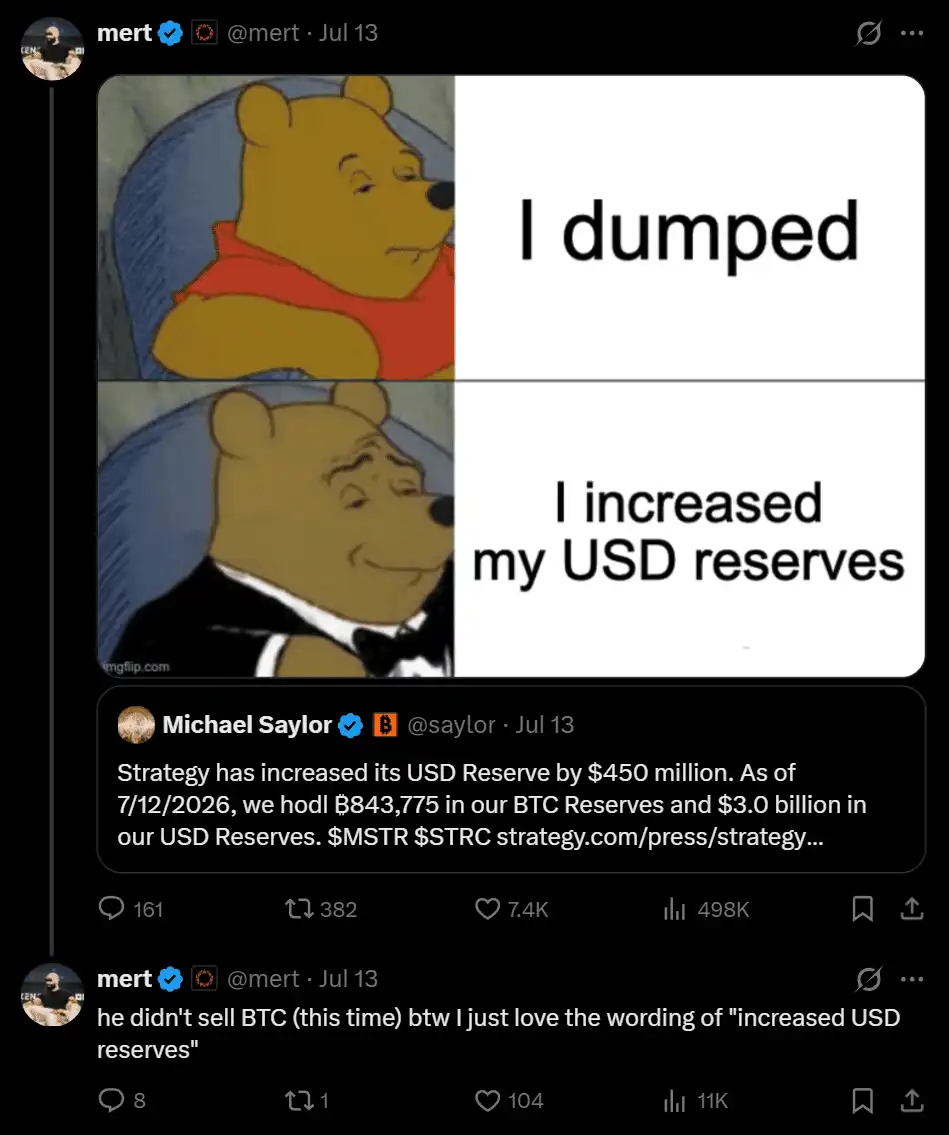
Text in image: Top – "I sold"; Bottom – "I increased my USD reserves."

Until next time,

Edgy

Crypto di tendenza

Domande pertinenti

QAccording to the article, why are crypto treasury companies like Bitmine and SharpLink starting to fund Ethereum protocol development?

ABecause their traditional flywheel of issuing stock to buy more ETH has stalled. Their stock's market value has fallen below the value of their ETH holdings (mNAV

QWhat is the key difference between Jito's JIP-38 proposal and Venice's approach regarding value accrual to their tokens?

AThe key differences are in the 'pipeline': 1. Jito's platform fees go directly to the DAO treasury (a token-governed address), while Venice's revenue goes to the company. 2. JTO holders can vote to revoke the committee managing the buyback, whereas VVV holders cannot change Venice's board decisions. 3. Jito has a history of redirecting company revenue (from its block engine) to the DAO, proving its commitment.

QWhat is the bullish argument presented for ETH treasury companies funding protocol development?

AIt allows all ETH holders to 'free ride.' As Ethereum Foundation scales back spending, these companies fill the funding gap. Their massive ETH staking yields (e.g., Bitmine's ~$284M annually) create a self-replenishing R&D budget without selling ETH. If successful, this could lead to protocol progress, institutional adoption, increased ETH demand, and stable funding for developers, creating a positive flywheel.

QWhat are the potential risks or bearish arguments against relying on DAT companies for Ethereum development funding?

A1. The specific funding amounts are undisclosed and could be limited. 2. The DAT companies themselves are fragile; if ETH price falls further, their staking yields shrink in USD terms and their mNAV worsens, which could lead them to stop funding development. 3. The entire crypto treasury sector faces a potential 'brutal shakeout,' making this funding source unreliable.

QWhat major change is the Ethereum Foundation undergoing, and what new entities have emerged to take a role in Ethereum's development?

AThe Ethereum Foundation is undergoing a significant contraction, laying off 20% of staff, cutting its 2026 budget by 40%, and restructuring into five clusters, aiming for a slower 'endowment model.' New entities that have emerged include ETH Labs (a non-profit R&D institute), Ethereum Institutional (a non-profit on-ramp for institutions), and EthSystems (a for-profit company building confidential transaction systems), all backed by companies like Bitmine and SharpLink.

Letture associate

Opening Claude's Brain Is Useless; The True Key to the AI Black Box Lies in Ontology Engineering

"Dissecting Claude's Brain Is Futile: The Real Key to the AI Black Box Lies in Ontology Engineering" This article critiques the limitations of Anthropic's "J-Space" research, which attempts to explain AI models by observing their internal neural activation patterns, akin to fMRI brain scans. While this "internalist" approach offers unprecedented visibility into model states, it fundamentally conflates observability with true explainability. The core issue is that understanding a model's output requires more than tracing neural activity; it necessitates examining the meaning of the information it processes—its relationship to the world, semantic norms, and human cognitive frameworks. The author proposes a paradigm shift: moving from a neuroscience-inspired focus on the model itself to an "information ontology" approach centered on the knowledge the model handles. Drawing from Kant's philosophical categories, the argument posits that true explainability lies in structuring and understanding information within a formal conceptual framework, not in peering into the "black box." The practical application of this theory is ontology engineering. Ontologies provide a structured, computable framework for knowledge, serving as a semantic anchor for model outputs. The article details a bidirectional synergy: Large Language Models (LLMs) can automate and scale ontology construction, while ontologies, in turn, enhance AI explainability. They act as a verification framework, allowing model reasoning to be traced back to defined concepts, properties, and relationships. This transforms explainability from the impossible task of making neural networks transparent into the achievable engineering goal of making their outputs and impacts understandable, traceable, and accountable. The future of AI explainability, therefore, lies not in explaining the model's internal mechanics but in explaining and governing the knowledge structures and real-world effects of its outputs.

marsbit1 h fa

Opening Claude's Brain Is Useless; The True Key to the AI Black Box Lies in Ontology Engineering

marsbit1 h fa

Trading

Spot

Articoli Popolari

Cosa è ETH 3.0

ETH3.0 e $eth 3.0: Un'Analisi Approfondita del Futuro di Ethereum Introduzione Nel panorama in rapida evoluzione delle criptovalute e della tecnologia blockchain, ETH3.0, spesso indicato come $eth 3.0, è emerso come un argomento di considerevole interesse e speculazione. Il termine comprende due concetti principali che warrantono chiarimenti: Ethereum 3.0: Questo rappresenta un potenziale futuro aggiornamento volto ad aumentare le capacità dell'attuale blockchain di Ethereum, concentrandosi principalmente sul miglioramento della scalabilità e delle prestazioni. ETH3.0 Meme Token: Questo progetto di criptovaluta distinto cerca di sfruttare la blockchain di Ethereum per creare un ecosistema incentrato sui meme, promuovendo il coinvolgimento all'interno della comunità delle criptovalute. Comprendere questi aspetti di ETH3.0 è essenziale non solo per gli appassionati di criptovalute, ma anche per coloro che osservano tendenze tecnologiche più ampie nello spazio digitale. Che cos'è ETH3.0? Ethereum 3.0 Ethereum 3.0 è pubblicizzato come un aggiornamento proposto per la rete Ethereum già stabilita, che è stata la spina dorsale di molte applicazioni decentralizzate (dApps) e contratti smart sin dalla sua nascita. I miglioramenti previsti si concentrano principalmente sulla scalabilità, integrando tecnologie avanzate come lo sharding e le prove a conoscenza zero (zk-proofs). Queste innovazioni tecnologiche mirano a facilitare un numero senza precedenti di transazioni al secondo (TPS), potenzialmente raggiungendo milioni, affrontando così una delle limitazioni più significative della tecnologia blockchain attuale. Il miglioramento non è meramente tecnico, ma anche strategico; è volto a preparare la rete Ethereum per un'adozione e un'utilità diffuse in un futuro contrassegnato da un aumento della domanda di soluzioni decentralizzate. ETH3.0 Meme Token Al contrario di Ethereum 3.0, l'ETH3.0 Meme Token si avventura in un dominio più leggero e giocoso, combinando la cultura dei meme di internet con la dinamica delle criptovalute. Questo progetto consente agli utenti di acquistare, vendere e scambiare meme sulla blockchain di Ethereum, fornendo una piattaforma che promuove il coinvolgimento della comunità attraverso la creatività e interessi condivisi. L'ETH3.0 Meme Token mira a dimostrare come la tecnologia blockchain possa intersecarsi con la cultura digitale, creando casi d'uso che siano sia divertenti che finanziariamente praticabili. Chi è il Creatore di ETH3.0? Ethereum 3.0 L'iniziativa verso Ethereum 3.0 è principalmente propulsa da un consorzio di sviluppatori e ricercatori all'interno della comunità di Ethereum, tra cui Justin Drake. Conosciuto per le sue intuizioni e contributi all'evoluzione di Ethereum, Drake è stato una figura di spicco nelle discussioni riguardanti la transizione di Ethereum verso un nuovo livello di consenso, chiamato “Beam Chain.” Questo approccio collaborativo allo sviluppo significa che Ethereum 3.0 non è il prodotto di un creatore singolo, ma piuttosto una manifestazione di ingegno collettivo focalizzato sul progresso della tecnologia blockchain. ETH3.0 Meme Token I dettagli riguardanti il creatore dell'ETH3.0 Meme Token sono attualmente non rintracciabili. La natura dei token meme conduce spesso a una struttura più decentralizzata e guidata dalla comunità, il che potrebbe spiegare la mancanza di attribuzione specifica. Questo si allinea con l'etica della comunità crypto più ampia, dove l'innovazione spesso nasce da sforzi collaborativi piuttosto che individuali. Chi sono gli Investitori di ETH3.0? Ethereum 3.0 Il supporto per Ethereum 3.0 proviene principalmente dalla Ethereum Foundation insieme a una comunità entusiasta di sviluppatori e investitori. Questa associazione fondamentale fornisce un considerevole grado di legittimità e migliora le prospettive di implementazione di successo poiché sfrutta la fiducia e la credibilità costruite nel corso degli anni di operazioni della rete. Nel clima in rapida evoluzione delle criptovalute, il supporto della comunità gioca un ruolo cruciale nello sviluppo e nell'adozione, posizionando Ethereum 3.0 come un serio contenditore per i futuri progressi della blockchain. ETH3.0 Meme Token Sebbene le fonti attualmente disponibili non forniscano informazioni esplicite riguardo ai fondamenti o alle organizzazioni di investimento che sostengono l'ETH3.0 Meme Token, ciò è indicativo del modello di finanziamento tipico per i token meme, che spesso si basa sul supporto di base e sul coinvolgimento della comunità. Gli investitori in tali progetti sono tipicamente individui motivati dal potenziale per innovazioni guidate dalla comunità e dallo spirito di cooperazione trovato all'interno della comunità crypto. Come Funziona ETH3.0? Ethereum 3.0 Le caratteristiche distintive dell'Ethereum 3.0 risiedono nella sua proposta di implementazione della tecnologia di sharding e zk-proof. Lo sharding è un metodo di partizionamento della blockchain in pezzi più piccoli e gestibili o “shard,” che possono elaborare transazioni in modo concorrente piuttosto che sequenziale. Questa decentralizzazione dell'elaborazione aiuta a prevenire la congestione e garantisce che la rete rimanga reattiva anche sotto un carico pesante. La tecnologia delle prove a conoscenza zero (zk-proof) contribuisce con un ulteriore livello di sofisticazione consentendo la validazione delle transazioni senza rivelare i dati sottostanti coinvolti. Questo aspetto non solo migliora la privacy, ma aumenta anche l'efficienza complessiva della rete. Si parla anche di incorporare una macchina virtuale Ethereum a conoscenza zero (zkEVM) in questo aggiornamento, amplificando ulteriormente le capacità e l'utilità della rete. ETH3.0 Meme Token L'ETH3.0 Meme Token si distingue capitalizzando sulla popolarità della cultura dei meme. Stabilisce un mercato per gli utenti che desiderano partecipare al trading di meme, non solo per divertimento, ma anche per potenziale guadagno economico. Integrando funzioni come lo staking, la fornitura di liquidità e meccanismi di governance, il progetto promuove un ambiente che incentiva l'interazione e la partecipazione della comunità. Offrendo una miscela unica di intrattenimento e opportunità economica, l'ETH3.0 Meme Token mira ad attrarre un pubblico variegato, che va dagli appassionati di crypto ai semplici intenditori di meme. Timeline di ETH3.0 Ethereum 3.0 11 Novembre 2024: Justin Drake accenna al prossimo aggiornamento ETH 3.0, incentrato sui miglioramenti della scalabilità. Questo annuncio segna l'inizio delle discussioni formali riguardo l'architettura futura di Ethereum. 12 Novembre 2024: La proposta attesa per Ethereum 3.0 dovrebbe essere svelata a Devcon a Bangkok, preparando il terreno per un feedback più ampio della comunità e potenziali passi successivi nello sviluppo. ETH3.0 Meme Token 21 Marzo 2024: L'ETH3.0 Meme Token viene ufficialmente elencato su CoinMarketCap, segnando il suo ingresso nel dominio pubblico delle criptovalute e aumentando la visibilità per il suo ecosistema basato sui meme. Punti Chiave In conclusione, Ethereum 3.0 rappresenta una significativa evoluzione all'interno della rete Ethereum, concentrandosi sul superamento delle limitazioni riguardanti scalabilità e prestazioni attraverso tecnologie avanzate. I suoi aggiornamenti proposti riflettono un approccio proattivo alle future esigenze e usabilità. D'altra parte, l'ETH3.0 Meme Token incarna l'essenza della cultura guidata dalla comunità nello spazio delle criptovalute, sfruttando la cultura dei meme per creare piattaforme coinvolgenti che incoraggiano la creatività e la partecipazione degli utenti. Comprendere gli scopi e le funzionalità distinte di ETH3.0 e $eth 3.0 è fondamentale per chiunque sia interessato ai continui sviluppi nello spazio crypto. Con entrambe le iniziative che tracciano percorsi unici, esse sottolineano collettivamente la natura dinamica e multifacetica dell'innovazione blockchain.

212 Totale visualizzazioniPubblicato il 2024.04.04Aggiornato il 2024.12.03

Cosa è ETH 3.0

Cosa è ETHEREUM

HarryPotterTrumpHomerSimpson777Inu: Panoramica di un Progetto Crypto Web3 Introduzione Nel mondo in rapida evoluzione delle criptovalute e della finanza decentralizzata, progetti innovativi emergono frequentemente, catturando l'interesse della comunità degli investitori e degli appassionati di crypto. Uno di questi progetti è HarryPotterTrumpHomerSimpson777Inu, una criptovaluta che si trova all'incrocio tra cultura popolare e tecnologia blockchain. Questo token guidato dalla comunità mescola personaggi e figure politiche ben noti, con l'obiettivo di creare una piattaforma coinvolgente e promuovere un'adozione diffusa. Che cos'è HarryPotterTrumpHomerSimpson777Inu? HarryPotterTrumpHomerSimpson777Inu è un token costruito sulla blockchain di Ethereum, progettato per essere accessibile e divertente per un pubblico diversificato. L'unicità di questo progetto deriva dal suo approccio tematico, che intreccia elementi di fantasia, politica e intrattenimento. Sfruttando il fascino nostalgico di personaggi amati, il progetto cerca di creare un'esperienza di criptovaluta coinvolgente, incoraggiando il coinvolgimento e la partecipazione della comunità. L'obiettivo principale di HarryPotterTrumpHomerSimpson777Inu è stabilire un token che risuoni con gli utenti a livello personale, promuovendo sia il divertimento che il coinvolgimento nell'ambito crypto. Questo branding distintivo mira ad attrarre individui che in precedenza potrebbero non essersi interessati alle criptovalute, facilitando un nuovo punto di ingresso per utenti potenziali. Creatore di HarryPotterTrumpHomerSimpson777Inu L'identità del creatore dietro HarryPotterTrumpHomerSimpson777Inu rimane sconosciuta. Questa non è una pratica rara nel dominio delle criptovalute, dove l'anonimato è spesso preferito dai fondatori come mezzo di protezione della privacy e promozione di un ethos decentralizzato. Questa oscurità non diminuisce il valore del progetto; al contrario, riflette una tendenza più ampia all'interno del settore, dove molti progetti di successo sono emersi da origini anonime. Investitori di HarryPotterTrumpHomerSimpson777Inu Le informazioni pubbliche riguardo agli investitori di HarryPotterTrumpHomerSimpson777Inu sono limitate. La natura del progetto, incentrata sul coinvolgimento della comunità, suggerisce una dipendenza da investimenti di piccole dimensioni da parte di singoli appassionati piuttosto che da sostegni sostanziali da fondazioni di investimento consolidate o corporation. Questo livello di trasparenza nel finanziamento è tipico di molti progetti di criptovaluta guidati dalla comunità, dove il supporto spesso proviene da movimenti di base piuttosto che da investitori istituzionali. Come Funziona HarryPotterTrumpHomerSimpson777Inu? Operando sulla blockchain di Ethereum, HarryPotterTrumpHomerSimpson777Inu sfrutta la sua solida infrastruttura per facilitare transazioni e promuovere interazioni tra gli utenti all'interno della comunità. Ciò che distingue questo progetto è il suo posizionamento tematico: canalizzando il carisma di personaggi iconici provenienti da diversi ambiti culturali, crea un'identità di marca distintiva. Questo approccio non solo attrae gli utenti, ma coltiva anche una comunità fedele attorno al token. Le meccaniche operative del progetto si concentrano sul coinvolgimento della comunità. Adotta un modello decentralizzato che incoraggia la partecipazione, consentendo agli utenti di interagire attraverso vari canali mentre promuovono lo scambio di idee e esperienze. Inoltre, il progetto abbraccia i principi del Web3, privilegiando la sovranità degli utenti e la decentralizzazione, che sono i pilastri del futuro di Internet. Timeline di HarryPotterTrumpHomerSimpson777Inu La storia di HarryPotterTrumpHomerSimpson777Inu è segnata da diversi eventi decisivi: 12 agosto 2023: L'inizio di HarryPotterTrumpHomerSimpson777Inu, segnando il suo ingresso nell'ecosistema delle criptovalute. Fase di Sviluppo: Un periodo focalizzato sulla costruzione di una strategia completa per stimolare la crescita guidata dalla comunità e il coinvolgimento degli utenti. Listing sugli Scambi: Sebbene i dettagli specifici di listing non siano stati divulgati, il progetto è stato reso accessibile su vari scambi di criptovalute, migliorando la sua visibilità nel mercato. Coinvolgimento della Comunità: Sforzi continui per coinvolgere attivamente la comunità, stabilendo canali di dialogo e promuovendo la partecipazione attraverso varie attività, tra cui concorsi, discussioni e votazioni comunitarie. Aspetti Chiave di HarryPotterTrumpHomerSimpson777Inu Focus sulla Comunità Un tratto distintivo di HarryPotterTrumpHomerSimpson777Inu è la sua forte enfasi sul coinvolgimento della comunità. Il progetto incoraggia attivamente gli utenti a partecipare a discussioni, condividere idee e contribuire all'evoluzione del progetto. Questa interazione coltiva un senso di appartenenza e di ownership tra i membri della comunità, essenziale per la sostenibilità a lungo termine del token. Utilizzo della Blockchain di Ethereum La scelta di costruire sulla blockchain di Ethereum consente a HarryPotterTrumpHomerSimpson777Inu di sfruttare le sue caratteristiche di sicurezza ben consolidate e architettura decentralizzata. Questa base garantisce affidabilità per le transazioni e fornisce un framework affidabile su cui sviluppare varie funzionalità. Approccio Tematico Unico Fusione di elementi della cultura pop nella sua identità, HarryPotterTrumpHomerSimpson777Inu crea una narrazione coinvolgente che lo differenzia da altre criptovalute. L'amalgama di personaggi e temi genera riconoscimento e intrigo immediati, rendendo il token relazionabile a un'ampia gamma di utenti potenziali. Anonimato nello Sviluppo Il creatore anonimo del progetto rimane una caratteristica ricorrente in molte iniziative di criptovaluta. Questo aspetto evidenzia un ethos di decentralizzazione, introducendo anche un livello di mistero che potrebbe affascinare un segmento della comunità crypto, attirando l'attenzione sul progetto e invitando l'impegno da parte di utenti che supportano l'idea di un'iniziativa decentralizzata e gestita dalla comunità. Conclusione HarryPotterTrumpHomerSimpson777Inu si presenta come un'aggiunta distintiva al panorama delle criptovalute, combinando il fascino della cultura popolare con le meccaniche innovative della tecnologia blockchain. Sebbene i dettagli riguardanti il creatore e gli investitori specifici rimangano non divulgati, il focus del progetto sulla comunità e il suo approccio tematico lo contraddistinguono come un potenziale attore influente nel contesto del Web3 e delle criptovalute. Man mano che l'ecosistema delle criptovalute continua ad espandersi, iniziative come HarryPotterTrumpHomerSimpson777Inu ci ricordano le molteplici modalità in cui la blockchain può connettere le comunità globali attraverso narrazioni e valori condivisi.

1.0k Totale visualizzazioniPubblicato il 2024.04.06Aggiornato il 2024.12.03

Cosa è ETHEREUM

Come comprare ETH

Benvenuto in HTX.com! Abbiamo reso l'acquisto di Ethereum (ETH) semplice e conveniente. Segui la nostra guida passo passo per intraprendere il tuo viaggio nel mondo delle criptovalute.Step 1: Crea il tuo Account HTXUsa la tua email o numero di telefono per registrarti il tuo account gratuito su HTX. Vivi un'esperienza facile e sblocca tutte le funzionalità,Crea il mio accountStep 2: Vai in Acquista crypto e seleziona il tuo metodo di pagamentoCarta di credito/debito: utilizza la tua Visa o Mastercard per acquistare immediatamente EthereumETH.Bilancio: Usa i fondi dal bilancio del tuo account HTX per fare trading senza problemi.Terze parti: abbiamo aggiunto metodi di pagamento molto utilizzati come Google Pay e Apple Pay per maggiore comodità.P2P: Fai trading direttamente con altri utenti HTX.Over-the-Counter (OTC): Offriamo servizi su misura e tassi di cambio competitivi per i trader.Step 3: Conserva Ethereum (ETH)Dopo aver acquistato Ethereum (ETH), conserva nel tuo account HTX. In alternativa, puoi inviare tramite trasferimento blockchain o scambiare per altre criptovalute.Step 4: Scambia Ethereum (ETH)Scambia facilmente Ethereum (ETH) nel mercato spot di HTX. Accedi al tuo account, seleziona la tua coppia di trading, esegui le tue operazioni e monitora in tempo reale. Offriamo un'esperienza user-friendly sia per chi ha appena iniziato che per i trader più esperti.

3.0k Totale visualizzazioniPubblicato il 2024.12.10Aggiornato il 2026.06.02

Come comprare ETH

Discussioni

Benvenuto nella Community HTX. Qui puoi rimanere informato sugli ultimi sviluppi della piattaforma e accedere ad approfondimenti esperti sul mercato. Le opinioni degli utenti sul prezzo di ETH ETH sono presentate come di seguito.

活动图片