Burning $160,000, Frenziedly Coding 1 Million Lines: Bun's Creator Rewrites the Foundation with Claude

marsbitPubblicato 2026-07-17Pubblicato ultima volta 2026-07-17

Introduzione

**The Bun creator used Claude to rewrite its core in Rust in under two weeks for $165,000.** Jarred Sumner, the creator of the Bun JavaScript runtime, leveraged Claude Code to migrate the project's entire codebase from Zig to Rust—generating 1 million lines of code in less than two weeks. This cost approximately $165,000 in API tokens, a fraction of the estimated $3 million and 4 years a manual rewrite might have required. The new Rust-based version passed all existing tests and was quietly released in June. Inspired by this, Instagram co-founder Mike Krieger also used Claude to migrate a Python library to 165,000 lines of TypeScript over a weekend, slashing build times dramatically. Anthropic, the creator of Claude, formalized the process into a six-step framework for large-scale AI-assisted migrations. The core principle is to "fix the loop, not the code": the system uses existing code as specification, automated tests as judges, and iterates through generation, review, and repair cycles without constant human intervention. This approach makes large-scale migrations, once a daunting and costly task, a feasible and cost-effective automated process.

A project that once required 4 years was forcefully compressed into two weeks by Claude Code!

Costs were slashed from $3 million to just over a hundred thousand.

Recently, Anthropic publicly unveiled the full process of large-scale code migration using Claude Code for the first time. Their six-step framework has left the entire internet in awe.

The protagonist of the story is Jarred Sumner, the creator of Bun.

He once spent a year writing Bun, a JavaScript runtime that outperforms Node.js.

Now, in less than two weeks, he frenziedly wrote one million lines of code, migrating the entire project from Zig to Rust.

Bun's Creator Has AI Rewrite a Million Lines of Code

Back then, Jarred Sumner's logic for betting on Zig was pure: achieve performance comparable to C language through extreme simplicity.

This was almost a tool tailor-made for solo founders.

In his own words, "Before LLMs existed, I built Bun in a small apartment in Oakland in one year."

However, the dark side of extreme simplicity is the countless hidden pitfalls laid down early on.

Now, Bun's CLI monthly downloads have robustly surpassed the 10 million mark, and it has even become a heavy dependency at the core of Claude Code.

With the ecosystem's frenetic growth, the "technical debt" accrued over the years has come due, demanding repayment with interest.
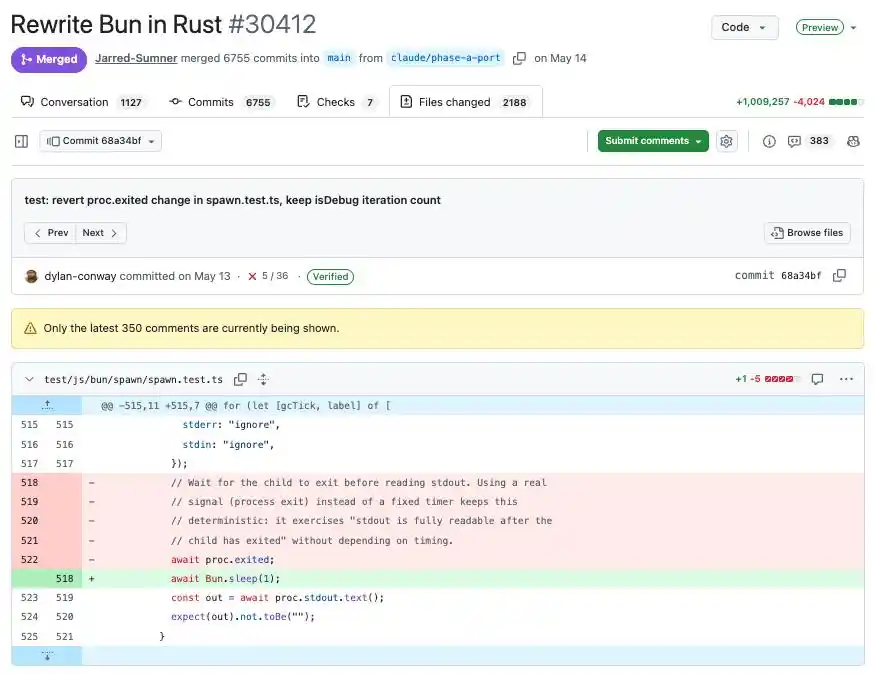
So he did something he never dared to think of before: using Claude Code to migrate the entire Bun codebase from Zig to the more memory-safe Rust.

In less than two weeks, it produced one million lines of code.

Before merging, all existing Bun test cases passed 100% in CI. After merging, 19 regressions surfaced, but they have all been fixed now. The Rust version quietly went live with Claude Code in June.

This migration consumed 5.9 billion input tokens and 690 million output tokens. Calculated at API pricing, it cost approximately $165,000.

It sounds expensive, but compared to the old budget of 4 years and $3 million, this amount is practically pocket change.

A Python Library Transformed into 165,000 Lines of TypeScript

Jarred Sumner is far from the only one using CC as an efficiency engine.

Mike Krieger, Head of Anthropic Labs and co-founder of Instagram, has an even more representative story.

Over a weekend, he migrated an entire Python codebase to 165,000 lines of TypeScript. The core part consumed about 27 million tokens.

Hundreds of agents, 8 checkpoints, 3 rounds of adversarial reviews, and finally, a consistency check that compared the output of every single command with the original Python version line-by-line. Any behavioral deviation was treated as a bug to be fixed.

He even had Claude design a set of end-to-end tests that ran for four consecutive nights, specifically targeting unforeseen corner-case issues.

Why was migration absolutely necessary?

His team's internal tools needed to be packaged as a single binary for delivery to users.

Using the Python toolchain, compilation took 8 minutes per platform, and the entire build matrix required a half-hour wait for each release.

After the migration, the same compilation takes only 2 seconds. The binary launches 6 times faster, and they also managed to retire an entire deployment pipeline.

Don't Fix the Code: The Six-Step Core Framework

So, what is the soul of this approach?

Anthropic summarizes it in one sentence: Don't fix the code; fix the loop that produces the code.
Large-scale migrations are particularly well-suited for AI, for simple reasons—

The work is inherently parallelizable; thousands of files can be processed simultaneously.

The old code itself serves as the best specification.

The test suite is a ready-made judge.

If compilation or testing fails, the next task automatically surfaces.

The model can relentlessly iterate against this "objective truth" for days, with no human arbitration needed in between.

Thus, Anthropic proposes a reusable six-step framework: First, set up the judge (tests), write the rulebook, draw the dependency graph, and list the gap inventory.

Then, conduct a small-scale "shakedown" to stress-test the rules, catching critical issues before scaling to thousands of files.

Next, perform the full translation, running a multi-agent cycle of "implementation—review—fix"; finally, compile, run, and compare behavior line-by-line.
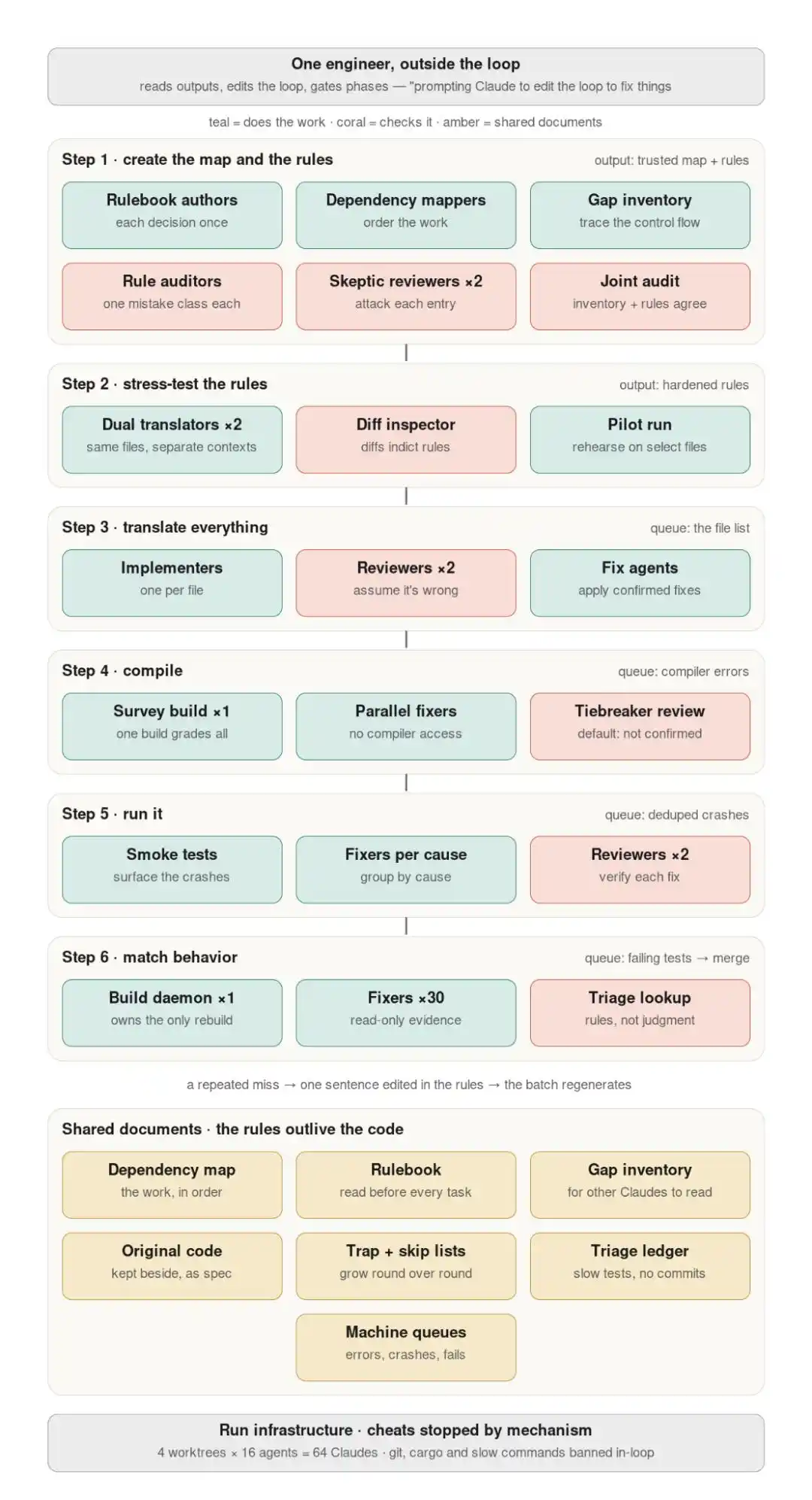
Throughout the entire process, rules are never manually patched:

Every time a reviewer catches an error, they add a sentence to the rulebook and regenerate the affected batch of files.

Anthropic's final suggestion: Pick a codebase you've been tolerating for too long, and go ask Claude what its migration process would look like.

Four years ago, this statement was a joke. Today, it's a check that can actually be cashed.

In the past, migration was a chasm developers dared not cross; now, it's just a progress bar waiting to be cleared.

This article is from the WeChat public account "New Zhi Yuan," author: ASI Revelation

Crypto di tendenza

Domande pertinenti

QWho is the main developer behind the migration of Bun from Zig to Rust using Claude Code, and what is notable about his previous work?

AThe main developer is Jarred Sumner, known as the 'father of Bun'. He is notable for previously writing the Bun JavaScript runtime, which is faster than Node.js, in just one year from a small apartment in Oakland before the era of large language models (LLMs).

QWhat was the estimated cost and time saved by using Claude Code to migrate Bun from Zig to Rust, compared to the traditional method?

AThe migration using Claude Code cost approximately $165,000 and was completed in less than two weeks. In contrast, the traditional method was estimated to take 4 years and cost $3 million, making the AI-assisted approach drastically cheaper and faster.

QWhat are the six key steps in Anthropic's framework for large-scale code migration using AI?

AThe six-step framework involves: 1) Setting up the 'referee' (test suites), 2) Writing the rulebook (specifications), 3) Mapping dependencies, 4) Listing gaps, 5) Running a small-scale pilot to test rules, and 6) Conducting full translation with a multi-agent 'implement-review-fix' loop, followed by compilation, execution, and behavioral verification.

QBesides the Bun migration, what is another example of a successful code migration using Claude Code mentioned in the article?

AAnother example is by Mike Krieger, co-founder of Instagram, who migrated a Python codebase to 16.5万 lines of TypeScript over a weekend. This migration reduced compilation time from 8 minutes per platform to 2 seconds, sped up binary startup by 6 times, and eliminated an entire deployment pipeline.

QWhat is the core philosophy behind Anthropic's approach to AI-assisted code migration, as summarized in the article?

AThe core philosophy is: 'Don't fix the code; fix the loop that produces the code.' Instead of manually patching individual issues, the process focuses on improving the automated generation and review cycle, using existing code as the specification and test suites as the objective referee to guide the AI.

Letture associate

CLARITY Act Delays Have Become a Compliance Crisis, Not Just a Political Stalemate

The article discusses the ongoing delay in the US Senate regarding the CLARITY Act, a bill intended to clarify the regulatory status of digital assets as either securities under the SEC or commodities under the CFTC. A year after the House passed it, this inaction is creating a concrete governance, risk, and compliance crisis for businesses, moving beyond mere political gridlock. While related bills for stablecoins and CBDC prohibitions have become law, the comprehensive CLARITY Act remains stalled. The delay creates profound uncertainty for companies on fundamental rules for exchanges, custodians, and all market participants. Without clear congressional action, regulatory classification depends on shifting enforcement actions and presidential administrations, making stable compliance impossible. The Senate's window for action is narrowing, with key votes needed before the August recess. Several major issues are blocking passage, including ethical concerns over crypto holdings by officials, law enforcement opposition to certain provisions, perceived loopholes for stablecoin rewards, and regulatory agency vacancies at the SEC and CFTC. Bipartisan support is fragile. Further delay risks postponing the legislation until 2030, perpetuating a costly "regulation by enforcement" environment. In contrast, passage would provide a durable regulatory framework. Regardless of the outcome, compliance leaders are urged to immediately map their digital asset exposures, prepare governance materials for both scenarios, and stress-test their arrangements. The article concludes that while the Senate's action is uncertain, corporate preparedness is not.

Foresight News3 min fa

CLARITY Act Delays Have Become a Compliance Crisis, Not Just a Political Stalemate

Foresight News3 min fa

The 'Big Short' Burry: Now is an Excellent Time to Bottom-Fish in Hong Kong Stocks

The article discusses growing optimism towards Hong Kong stocks, led by prominent investor Michael Burry of "The Big Short" fame. Burry recently stated it is an "excellent time" to find cheap stocks in the Hong Kong market. His bullish view is based on the prediction that as the global AI chip stock frenzy cools, capital will flow out of markets like South Korea and Japan and seek undervalued opportunities, positioning Hong Kong as a potential beneficiary. Supporting this view, Goldman Sachs' Asia equity capital markets head, Wang Yajun, argues the Hong Kong market has already entered the AI era, but major indices have not yet reflected this reality. He points to active AI-related IPOs and transactions as evidence of underlying market vitality, contrasting with the weak performance of key indices like the Hang Seng. Data highlights Hong Kong's underperformance: the Hang Seng Index is down about 7% year-to-date, while markets in South Korea and Japan and semiconductor ETFs have seen significant gains. This disparity is seen by Burry and others as creating a valuation gap and a potential buying opportunity. The article notes Burry has acted on his view by increasing holdings in Chinese e-commerce firm JD.com. Morgan Stanley has also recently advocated buying Hong Kong stocks, citing positive corporate earnings expectations. However, challenges remain, including persistent concerns over Chinese consumer spending and e-commerce profitability, which continue to weigh on the market. The divergence between weak index performance and strong activity in specific sectors like AI presents both opportunity and complexity for investors looking to capitalize on Hong Kong's potential turnaround.

marsbit32 min fa

The 'Big Short' Burry: Now is an Excellent Time to Bottom-Fish in Hong Kong Stocks

marsbit32 min fa

The Big Short's Burry: Now is the Perfect Time to Bottom-Fish in Hong Kong Stocks

Michael Burry, the investor famous for predicting the 2008 financial crisis, recently stated on X that now is an "excellent time" to look for cheap stocks in the Hong Kong market. His bullish view is based on the expectation that the global AI chip stock frenzy will cool, leading funds to flow out of Korea, Japan, and semiconductor ETFs and into undervalued areas like Hong Kong. He has already acted by increasing his stake in JD.com. Hong Kong stocks have significantly underperformed global peers this year, with the Hang Seng Index down about 7% and the Hang Seng Tech Index falling over 15%. This contrasts sharply with major gains in Korean, Japanese, and semiconductor markets. Burry sees this disparity as creating a bargain-hunting opportunity. Adding another perspective, Goldman Sachs' Asia equity capital markets head, Wang Yajun, argues that while the Hong Kong market has already entered the AI era with active related IPOs and trading, its major indices have not yet reflected this reality due to structural lag. He expects record equity fundraising this year, driven by more AI company listings. Morgan Stanley has also recently advocated buying Hong Kong stocks, citing optimistic corporate earnings prospects. However, challenges remain, including concerns over China's consumer recovery and e-commerce profitability. The key for investors is navigating the overall index pressure while identifying specific structural opportunities highlighted by these bullish narratives.

链捕手37 min fa

The Big Short's Burry: Now is the Perfect Time to Bottom-Fish in Hong Kong Stocks

链捕手37 min fa

Xi Jinping Attends Opening Ceremony of World Artificial Intelligence Conference 2026 and High-Level Meeting on Global AI Governance, Delivers Keynote Speech

On July 17, 2026, Chinese President Xi Jinping delivered a keynote speech titled "Working Together to Build a Fair and Equitable Global Governance System on Artificial Intelligence" at the opening ceremony of the 2026 World Artificial Intelligence Conference and High-level Conference on Global AI Governance in Shanghai. President Xi pointed out that the rapid development of AI, alongside the accelerated global changes, presents both significant opportunities and governance challenges. He raised critical questions for humanity regarding human-machine coexistence, safety, ethics, and bridging divides. China advocates for a people-oriented, benevolent approach to AI, making it a force for common prosperity and security, and jointly building a fair and reasonable global AI governance system. Xi Jinping put forward a four-point proposal: 1. **Uphold Openness for Win-Win Cooperation and Drive Innovation:** Seize the historic opportunity by encouraging open-source collaboration and sharing to foster AI innovation, industry growth, and application, empowering all sectors. 2. **Enhance Risk Awareness and Ensure Security and Controllability:** Attach great importance to AI's inherent and derivative risks. Build systems for laws, technical monitoring, risk warning, and emergency response to safeguard security, prevent misuse, and ensure human control. Oppose the practice of politicizing national security in AI. 3. **Encourage Inclusiveness and Promote Cultural Exchange:** Shape AI's values with humanity's common values. Use AI to enhance understanding and tolerance between civilizations, fostering a garden of diverse cultures. 4. **Advocate Solidarity and Improve Global Governance:** Practice true multilateralism, leverage the UN's role, and strengthen coordination on AI development strategies, governance rules, and technical standards to form a widely accepted global governance framework. Assist Global South countries in capacity building to bridge the digital divide and avoid new historical inequities. Xi highlighted that as a responsible major country, China, in its 15th Five-Year Plan period, is committed to being a provider of international public goods in AI, contributing Chinese solutions. China has promoted an "AI Plus" initiative, with its core intelligent economy exceeding RMB 10 trillion. To support global AI development, China will provide 5,000 AI training opportunities for developing countries, establish international AI application cooperation centers with regional organizations, and deploy its "Mazu" meteorological AI warning system in 30 countries. The establishment of the World Artificial Intelligence Cooperation Organization in Shanghai marks a significant milestone. Leaders from Kazakhstan, Cambodia, Thailand, and the UN Secretary-General delivered speeches, commending China's contributions to global AI governance and echoing President Xi's proposals. They agreed that AI's opportunities and challenges are borderless, requiring cooperative, inclusive, and equitable international efforts to ensure a secure, prosperous future that leaves no country behind. The conference issued a Chair's Statement. President Xi and his wife hosted a welcome banquet for international dignitaries on July 16. Senior Chinese officials attended the events.

链捕手40 min fa

Xi Jinping Attends Opening Ceremony of World Artificial Intelligence Conference 2026 and High-Level Meeting on Global AI Governance, Delivers Keynote Speech

链捕手40 min fa

Trading

Spot

Articoli Popolari

Cosa è $S$

Comprendere SPERO: Una Panoramica Completa Introduzione a SPERO Mentre il panorama dell'innovazione continua a evolversi, l'emergere delle tecnologie web3 e dei progetti di criptovaluta gioca un ruolo fondamentale nel plasmare il futuro digitale. Un progetto che ha attirato l'attenzione in questo campo dinamico è SPERO, denotato come SPERO,$$s$. Questo articolo mira a raccogliere e presentare informazioni dettagliate su SPERO, per aiutare gli appassionati e gli investitori a comprendere le sue basi, obiettivi e innovazioni nei domini web3 e crypto. Che cos'è SPERO,$$s$? SPERO,$$s$ è un progetto unico all'interno dello spazio crypto che cerca di sfruttare i principi della decentralizzazione e della tecnologia blockchain per creare un ecosistema che promuove l'impegno, l'utilità e l'inclusione finanziaria. Il progetto è progettato per facilitare interazioni peer-to-peer in modi nuovi, fornendo agli utenti soluzioni e servizi finanziari innovativi. Al suo interno, SPERO,$$s$ mira a responsabilizzare gli individui fornendo strumenti e piattaforme che migliorano l'esperienza dell'utente nello spazio delle criptovalute. Questo include la possibilità di metodi di transazione più flessibili, la promozione di iniziative guidate dalla comunità e la creazione di percorsi per opportunità finanziarie attraverso applicazioni decentralizzate (dApps). La visione sottostante di SPERO,$$s$ ruota attorno all'inclusività, cercando di colmare le lacune all'interno della finanza tradizionale mentre sfrutta i vantaggi della tecnologia blockchain. Chi è il Creatore di SPERO,$$s$? L'identità del creatore di SPERO,$$s$ rimane piuttosto oscura, poiché ci sono risorse pubblicamente disponibili limitate che forniscono informazioni dettagliate sul suo fondatore o fondatori. Questa mancanza di trasparenza può derivare dall'impegno del progetto per la decentralizzazione—un ethos che molti progetti web3 condividono, dando priorità ai contributi collettivi rispetto al riconoscimento individuale. Centrando le discussioni attorno alla comunità e ai suoi obiettivi collettivi, SPERO,$$s$ incarna l'essenza dell'empowerment senza mettere in evidenza individui specifici. Pertanto, comprendere l'etica e la missione di SPERO rimane più importante che identificare un creatore singolo. Chi sono gli Investitori di SPERO,$$s$? SPERO,$$s$ è supportato da una varietà di investitori che vanno dai capitalisti di rischio agli investitori angelici dedicati a promuovere l'innovazione nel settore crypto. Il focus di questi investitori generalmente si allinea con la missione di SPERO—dando priorità a progetti che promettono avanzamenti tecnologici sociali, inclusività finanziaria e governance decentralizzata. Queste fondazioni di investitori sono tipicamente interessate a progetti che non solo offrono prodotti innovativi, ma contribuiscono anche positivamente alla comunità blockchain e ai suoi ecosistemi. Il supporto di questi investitori rafforza SPERO,$$s$ come un concorrente degno di nota nel dominio in rapida evoluzione dei progetti crypto. Come Funziona SPERO,$$s$? SPERO,$$s$ impiega un framework multifunzionale che lo distingue dai progetti di criptovaluta convenzionali. Ecco alcune delle caratteristiche chiave che sottolineano la sua unicità e innovazione: Governance Decentralizzata: SPERO,$$s$ integra modelli di governance decentralizzati, responsabilizzando gli utenti a partecipare attivamente ai processi decisionali riguardanti il futuro del progetto. Questo approccio favorisce un senso di proprietà e responsabilità tra i membri della comunità. Utilità del Token: SPERO,$$s$ utilizza il proprio token di criptovaluta, progettato per servire varie funzioni all'interno dell'ecosistema. Questi token abilitano transazioni, premi e la facilitazione dei servizi offerti sulla piattaforma, migliorando l'impegno e l'utilità complessivi. Architettura Stratificata: L'architettura tecnica di SPERO,$$s$ supporta la modularità e la scalabilità, consentendo un'integrazione fluida di funzionalità e applicazioni aggiuntive man mano che il progetto evolve. Questa adattabilità è fondamentale per mantenere la rilevanza nel panorama crypto in continua evoluzione. Coinvolgimento della Comunità: Il progetto enfatizza iniziative guidate dalla comunità, impiegando meccanismi che incentivano la collaborazione e il feedback. Nutrendo una comunità forte, SPERO,$$s$ può affrontare meglio le esigenze degli utenti e adattarsi alle tendenze di mercato. Focus sull'Inclusione: Offrendo basse commissioni di transazione e interfacce user-friendly, SPERO,$$s$ mira ad attrarre una base utenti diversificata, inclusi individui che potrebbero non aver precedentemente interagito nello spazio crypto. Questo impegno per l'inclusione si allinea con la sua missione generale di empowerment attraverso l'accessibilità. Cronologia di SPERO,$$s$ Comprendere la storia di un progetto fornisce preziose intuizioni sulla sua traiettoria di sviluppo e sui traguardi. Di seguito è riportata una cronologia suggerita che mappa eventi significativi nell'evoluzione di SPERO,$$s$: Fase di Concettualizzazione e Ideazione: Le idee iniziali che formano la base di SPERO,$$s$ sono state concepite, allineandosi strettamente con i principi di decentralizzazione e focus sulla comunità all'interno dell'industria blockchain. Lancio del Whitepaper del Progetto: Dopo la fase concettuale, è stato rilasciato un whitepaper completo che dettaglia la visione, gli obiettivi e l'infrastruttura tecnologica di SPERO,$$s$ per suscitare interesse e feedback dalla comunità. Costruzione della Comunità e Prime Interazioni: Sono stati effettuati sforzi attivi di outreach per costruire una comunità di early adopters e potenziali investitori, facilitando discussioni attorno agli obiettivi del progetto e ottenendo supporto. Evento di Generazione del Token: SPERO,$$s$ ha condotto un evento di generazione del token (TGE) per distribuire i propri token nativi ai primi sostenitori e stabilire una liquidità iniziale all'interno dell'ecosistema. Lancio della Prima dApp: La prima applicazione decentralizzata (dApp) associata a SPERO,$$s$ è stata attivata, consentendo agli utenti di interagire con le funzionalità principali della piattaforma. Sviluppo Continuo e Partnership: Aggiornamenti e miglioramenti continui alle offerte del progetto, inclusi partnership strategiche con altri attori nello spazio blockchain, hanno plasmato SPERO,$$s$ in un concorrente competitivo e in evoluzione nel mercato crypto. Conclusione SPERO,$$s$ rappresenta una testimonianza del potenziale del web3 e delle criptovalute di rivoluzionare i sistemi finanziari e responsabilizzare gli individui. Con un impegno per la governance decentralizzata, il coinvolgimento della comunità e funzionalità progettate in modo innovativo, apre la strada verso un panorama finanziario più inclusivo. Come per qualsiasi investimento nello spazio crypto in rapida evoluzione, si incoraggiano potenziali investitori e utenti a ricercare approfonditamente e a impegnarsi in modo riflessivo con gli sviluppi in corso all'interno di SPERO,$$s$. Il progetto mostra lo spirito innovativo dell'industria crypto, invitando a ulteriori esplorazioni delle sue innumerevoli possibilità. Mentre il percorso di SPERO,$$s$ è ancora in fase di sviluppo, i suoi principi fondamentali potrebbero effettivamente influenzare il futuro di come interagiamo con la tecnologia, la finanza e tra di noi in ecosistemi digitali interconnessi.

125 Totale visualizzazioniPubblicato il 2024.12.17Aggiornato il 2024.12.17

Cosa è $S$

Cosa è AGENT S

Agent S: Il Futuro dell'Interazione Autonoma in Web3 Introduzione Nel panorama in continua evoluzione di Web3 e criptovalute, le innovazioni stanno costantemente ridefinendo il modo in cui gli individui interagiscono con le piattaforme digitali. Uno di questi progetti pionieristici, Agent S, promette di rivoluzionare l'interazione uomo-computer attraverso il suo framework agentico aperto. Aprendo la strada a interazioni autonome, Agent S mira a semplificare compiti complessi, offrendo applicazioni trasformative nell'intelligenza artificiale (AI). Questa esplorazione dettagliata approfondirà le complessità del progetto, le sue caratteristiche uniche e le implicazioni per il dominio delle criptovalute. Cos'è Agent S? Agent S si presenta come un innovativo framework agentico aperto, progettato specificamente per affrontare tre sfide fondamentali nell'automazione dei compiti informatici: Acquisizione di Conoscenze Specifiche del Dominio: Il framework apprende in modo intelligente da varie fonti di conoscenza esterne ed esperienze interne. Questo approccio duale gli consente di costruire un ricco repository di conoscenze specifiche del dominio, migliorando le sue prestazioni nell'esecuzione dei compiti. Pianificazione su Lungo Orizzonte di Compiti: Agent S impiega una pianificazione gerarchica potenziata dall'esperienza, un approccio strategico che facilita la suddivisione e l'esecuzione efficiente di compiti complessi. Questa caratteristica migliora significativamente la sua capacità di gestire più sottocompiti in modo efficiente ed efficace. Gestione di Interfacce Dinamiche e Non Uniformi: Il progetto introduce l'Interfaccia Agente-Computer (ACI), una soluzione innovativa che migliora l'interazione tra agenti e utenti. Utilizzando Modelli Linguistici Multimodali di Grandi Dimensioni (MLLM), Agent S può navigare e manipolare senza sforzo diverse interfacce grafiche utente. Attraverso queste caratteristiche pionieristiche, Agent S fornisce un framework robusto che affronta le complessità coinvolte nell'automazione dell'interazione umana con le macchine, preparando il terreno per innumerevoli applicazioni nell'AI e oltre. Chi è il Creatore di Agent S? Sebbene il concetto di Agent S sia fondamentalmente innovativo, informazioni specifiche sul suo creatore rimangono elusive. Il creatore è attualmente sconosciuto, il che evidenzia sia la fase embrionale del progetto sia la scelta strategica di mantenere i membri fondatori sotto anonimato. Indipendentemente dall'anonimato, l'attenzione rimane sulle capacità e sul potenziale del framework. Chi sono gli Investitori di Agent S? Poiché Agent S è relativamente nuovo nell'ecosistema crittografico, informazioni dettagliate riguardanti i suoi investitori e sostenitori finanziari non sono documentate esplicitamente. La mancanza di approfondimenti pubblicamente disponibili sulle fondazioni di investimento o sulle organizzazioni che supportano il progetto solleva interrogativi sulla sua struttura di finanziamento e sulla roadmap di sviluppo. Comprendere il supporto è cruciale per valutare la sostenibilità del progetto e il suo potenziale impatto sul mercato. Come Funziona Agent S? Al centro di Agent S si trova una tecnologia all'avanguardia che gli consente di funzionare efficacemente in contesti diversi. Il suo modello operativo è costruito attorno a diverse caratteristiche chiave: Interazione Uomo-Computer Simile a Quella Umana: Il framework offre una pianificazione AI avanzata, cercando di rendere le interazioni con i computer più intuitive. Mimando il comportamento umano nell'esecuzione dei compiti, promette di elevare le esperienze degli utenti. Memoria Narrativa: Utilizzata per sfruttare esperienze di alto livello, Agent S utilizza la memoria narrativa per tenere traccia delle storie dei compiti, migliorando così i suoi processi decisionali. Memoria Episodica: Questa caratteristica fornisce agli utenti una guida passo-passo, consentendo al framework di offrire supporto contestuale mentre i compiti si sviluppano. Supporto per OpenACI: Con la capacità di funzionare localmente, Agent S consente agli utenti di mantenere il controllo sulle proprie interazioni e flussi di lavoro, allineandosi con l'etica decentralizzata di Web3. Facile Integrazione con API Esterne: La sua versatilità e compatibilità con varie piattaforme AI garantiscono che Agent S possa adattarsi senza problemi agli ecosistemi tecnologici esistenti, rendendolo una scelta attraente per sviluppatori e organizzazioni. Queste funzionalità contribuiscono collettivamente alla posizione unica di Agent S all'interno dello spazio crittografico, poiché automatizza compiti complessi e multi-fase con un intervento umano minimo. Man mano che il progetto evolve, le sue potenziali applicazioni in Web3 potrebbero ridefinire il modo in cui si svolgono le interazioni digitali. Cronologia di Agent S Lo sviluppo e le tappe di Agent S possono essere riassunti in una cronologia che evidenzia i suoi eventi significativi: 27 Settembre 2024: Il concetto di Agent S è stato lanciato in un documento di ricerca completo intitolato “Un Framework Agentico Aperto che Usa i Computer Come un Umano”, mostrando le basi per il progetto. 10 Ottobre 2024: Il documento di ricerca è stato reso pubblicamente disponibile su arXiv, offrendo un'esplorazione approfondita del framework e della sua valutazione delle prestazioni basata sul benchmark OSWorld. 12 Ottobre 2024: È stata rilasciata una presentazione video, fornendo un'idea visiva delle capacità e delle caratteristiche di Agent S, coinvolgendo ulteriormente potenziali utenti e investitori. Questi indicatori nella cronologia non solo illustrano i progressi di Agent S, ma indicano anche il suo impegno per la trasparenza e il coinvolgimento della comunità. Punti Chiave su Agent S Man mano che il framework Agent S continua a evolversi, diversi attributi chiave si distinguono, sottolineando la sua natura innovativa e il potenziale: Framework Innovativo: Progettato per fornire un uso intuitivo dei computer simile all'interazione umana, Agent S porta un approccio nuovo all'automazione dei compiti. Interazione Autonoma: La capacità di interagire autonomamente con i computer attraverso GUI segna un passo avanti verso soluzioni informatiche più intelligenti ed efficienti. Automazione di Compiti Complessi: Con la sua metodologia robusta, può automatizzare compiti complessi e multi-fase, rendendo i processi più veloci e meno soggetti a errori. Miglioramento Continuo: I meccanismi di apprendimento consentono ad Agent S di migliorare dalle esperienze passate, migliorando continuamente le sue prestazioni e la sua efficacia. Versatilità: La sua adattabilità attraverso diversi ambienti operativi come OSWorld e WindowsAgentArena garantisce che possa servire un'ampia gamma di applicazioni. Man mano che Agent S si posiziona nel panorama di Web3 e delle criptovalute, il suo potenziale per migliorare le capacità di interazione e automatizzare i processi segna un significativo avanzamento nelle tecnologie AI. Attraverso il suo framework innovativo, Agent S esemplifica il futuro delle interazioni digitali, promettendo un'esperienza più fluida ed efficiente per gli utenti in vari settori. Conclusione Agent S rappresenta un audace passo avanti nell'unione tra AI e Web3, con la capacità di ridefinire il modo in cui interagiamo con la tecnologia. Sebbene sia ancora nelle sue fasi iniziali, le possibilità per la sua applicazione sono vaste e coinvolgenti. Attraverso il suo framework completo che affronta sfide critiche, Agent S mira a portare le interazioni autonome al centro dell'esperienza digitale. Man mano che ci addentriamo nei regni delle criptovalute e della decentralizzazione, progetti come Agent S giocheranno senza dubbio un ruolo cruciale nel plasmare il futuro della tecnologia e della collaborazione uomo-computer.

578 Totale visualizzazioniPubblicato il 2025.01.14Aggiornato il 2025.01.14

Cosa è AGENT S

Come comprare S

Benvenuto in HTX.com! Abbiamo reso l'acquisto di Sonic (S) semplice e conveniente. Segui la nostra guida passo passo per intraprendere il tuo viaggio nel mondo delle criptovalute.Step 1: Crea il tuo Account HTXUsa la tua email o numero di telefono per registrarti il tuo account gratuito su HTX. Vivi un'esperienza facile e sblocca tutte le funzionalità,Crea il mio accountStep 2: Vai in Acquista crypto e seleziona il tuo metodo di pagamentoCarta di credito/debito: utilizza la tua Visa o Mastercard per acquistare immediatamente SonicS.Bilancio: Usa i fondi dal bilancio del tuo account HTX per fare trading senza problemi.Terze parti: abbiamo aggiunto metodi di pagamento molto utilizzati come Google Pay e Apple Pay per maggiore comodità.P2P: Fai trading direttamente con altri utenti HTX.Over-the-Counter (OTC): Offriamo servizi su misura e tassi di cambio competitivi per i trader.Step 3: Conserva Sonic (S)Dopo aver acquistato Sonic (S), conserva nel tuo account HTX. In alternativa, puoi inviare tramite trasferimento blockchain o scambiare per altre criptovalute.Step 4: Scambia Sonic (S)Scambia facilmente Sonic (S) nel mercato spot di HTX. Accedi al tuo account, seleziona la tua coppia di trading, esegui le tue operazioni e monitora in tempo reale. Offriamo un'esperienza user-friendly sia per chi ha appena iniziato che per i trader più esperti.

1.1k Totale visualizzazioniPubblicato il 2025.01.15Aggiornato il 2026.06.02

Come comprare S

Discussioni

Benvenuto nella Community HTX. Qui puoi rimanere informato sugli ultimi sviluppi della piattaforma e accedere ad approfondimenti esperti sul mercato. Le opinioni degli utenti sul prezzo di S S sono presentate come di seguito.

活动图片