White House Pushes for Fast Crypto Deal as Senate Window Narrows and $1B Liquidations Rock Markets

bitcoinistPubblicato 2026-01-22Pubblicato ultima volta 2026-01-22

Introduzione

The White House is urging U.S. lawmakers to quickly pass crypto market structure legislation as the Senate faces challenges in securing bipartisan support. Patrick Witt, a key advisor, warns that delays could lead to harsher future policies and that legislation is inevitable. The push comes amid political pressure from upcoming midterm elections, which could further complicate legislative efforts. Meanwhile, crypto markets experienced significant turmoil with over $1 billion in liquidations, primarily from long positions in Bitcoin and Ethereum, amid falling prices and tightening global liquidity.

The White House is urging U.S. lawmakers to move quickly on legislation to reform the crypto market structure as political timelines tighten and digital asset markets face renewed volatility.

With the Senate struggling to secure bipartisan support and more than $1 billion in recent crypto liquidations, officials say the window for passing a workable regulatory framework may be closing.

Patrick Witt, executive director of the President’s Council of Advisors for Digital Assets, has warned that expecting the crypto industry to operate without clear rules is unrealistic. He argues that some form of legislation is “inevitable” and that delays could leave the sector exposed to harsher policies in the future.
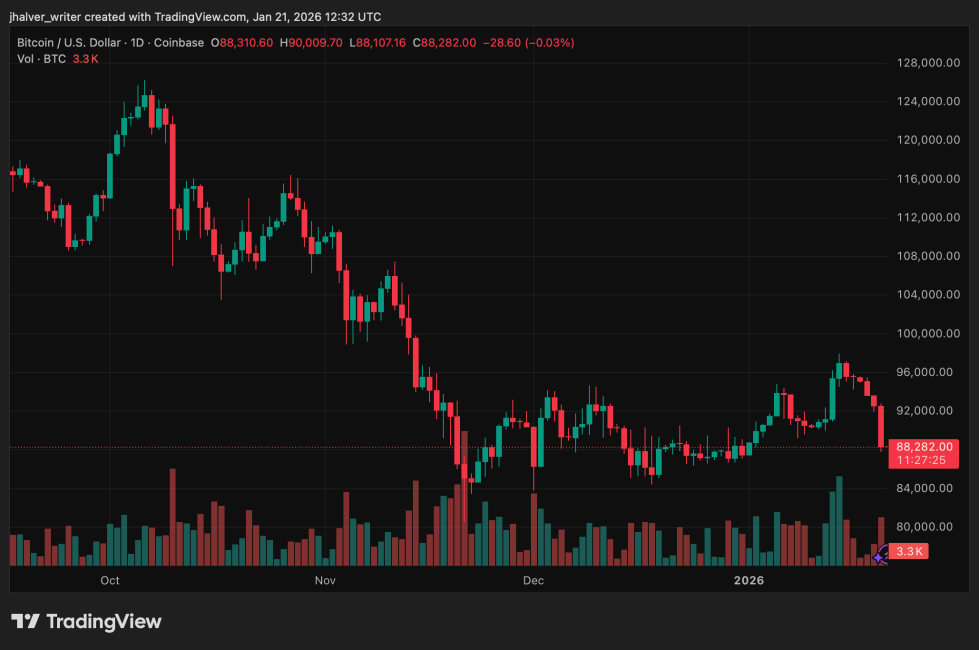
BTC's price trends to the downside on the daily chart. Source: BTCUSD on Tradingview

White House Presses for Action on Crypto Rules

The proposed Senate bill would define how the Securities and Exchange Commission (SEC) and the Commodity Futures Trading Commission (CFTC) oversee crypto markets, including stablecoins and decentralized finance protocols. However, disagreements over key provisions have slowed progress.

Both the Senate Banking and Agriculture Committees recently postponed markups as lawmakers worked to resolve disputes and gather enough support to advance the bill. Witt has been blunt in his message to the industry: accept compromise now or risk facing a less favorable outcome later.

He criticized Coinbase CEO Brian Armstrong for withdrawing support for the current version of the bill, after Armstrong said the company would “rather have no bill than a bad bill.”

Midterm Elections Add Pressure

The push for speed is also tied to the November U.S. midterm elections, which could reshape Congress. All House seats and 35 Senate seats are up for grabs, and polling and prediction markets suggest Democrats have a strong chance of flipping the House.

A divided Congress would likely slow or stall crypto legislation altogether. Witt has cautioned that the political alignment needed to pass a market structure bill may not be in place after the elections, making the coming months critical for any deal.

$1B Liquidations Highlight Market Stress

The policy debate comes as markets reel from a sharp deleveraging event. Today, more than 182,000 traders were liquidated in a single day, with total losses of over $1.08 billion. Most of the damage came from long positions in Bitcoin and Ethereum, as falling prices triggered cascading margin calls across major exchanges.

Bitcoin alone saw over $427 million in long liquidations, while Ethereum accounted for roughly $374 million. Technical indicators show many altcoins trading with RSI levels below 50, suggesting continued selling pressure.

Rising Japanese bond yields and renewed global risk-off sentiment have also tightened liquidity, prompting investors to shift away from volatile assets like crypto. Although Bitcoin later stabilized near $90,000, analysts say the recent rebound looks more like a pause after forced selling than a clear return to bullish momentum.

Cover image from ChatGPT, BTCUSD chart on Tradingview

Domande pertinenti

QWhy is the White House urging lawmakers to move quickly on crypto legislation?

AThe White House is pushing for speed due to tightening political timelines from the upcoming midterm elections and renewed market volatility, warning that the window for passing a workable regulatory framework may be closing.

QWhat is the main obstacle to passing the crypto market structure bill in the Senate?

AThe main obstacle is a lack of bipartisan support, with disagreements over key provisions causing postponed markups in committees as lawmakers work to resolve disputes.

QHow did Patrick Witt of the President’s Council respond to Coinbase CEO Brian Armstrong's stance on the bill?

APatrick Witt criticized Brian Armstrong for withdrawing support, after the Coinbase CEO said the company would 'rather have no bill than a bad bill.' Witt argued that accepting a compromise now is better than risking a less favorable outcome later.

QWhat event caused over $1 billion in crypto liquidations and which assets were most affected?

AA sharp deleveraging event caused over $1.08 billion in liquidations, with the majority of losses coming from long positions in Bitcoin ($427M) and Ethereum ($374M) as falling prices triggered margin calls.

QHow could the November midterm elections impact the future of crypto legislation?

AThe elections could reshape Congress, and if Democrats flip the House as predicted, it would likely result in a divided Congress that could slow or stall crypto legislation altogether, making the current political alignment critical for any deal.

Letture associate

a16z: AI's 'Amnesia', Can Continuous Learning Cure It?

The article "a16z: AI's 'Amnesia' – Can Continual Learning Cure It?" explores the limitations of current large language models (LLMs), which, like the protagonist in the film *Memento*, are trapped in a perpetual present—unable to form new memories after training. While methods like in-context learning (ICL), retrieval-augmented generation (RAG), and external scaffolding (e.g., chat history, prompts) provide temporary solutions, they fail to enable true internalization of new knowledge. The authors argue that compression—the core of learning during training—is halted at deployment, preventing models from generalizing, discovering novel solutions (e.g., mathematical proofs), or handling adversarial scenarios. The piece introduces *continual learning* as a critical research direction to address this, categorizing approaches into three paths: 1. **Context**: Scaling external memory via longer context windows, multi-agent systems, and smarter retrieval. 2. **Modules**: Using pluggable adapters or external memory layers for specialization without full retraining. 3. **Weights**: Enabling parameter updates through sparse training, test-time training, meta-learning, distillation, and reinforcement learning from feedback. Challenges include catastrophic forgetting, safety risks, and auditability, but overcoming these could unlock models that learn iteratively from experience. The conclusion emphasizes that while context-based methods are effective, true breakthroughs require models to compress new information into weights post-deployment, moving from mere retrieval to genuine learning.

marsbit2 h fa

a16z: AI's 'Amnesia', Can Continuous Learning Cure It?

marsbit2 h fa

Can a Hair Dryer Earn $34,000? Deciphering the Reflexivity Paradox in Prediction Markets

An individual manipulated a weather sensor at Paris Charles de Gaulle Airport with a portable heat source, causing a Polymarket weather market to settle at 22°C and earning $34,000. This incident highlights a fundamental issue in prediction markets: when a market aims to reflect reality, it also incentivizes participants to influence that reality. Prediction markets operate on two layers: platform rules (what outcome counts as a win) and data sources (what actually happened). While most focus on rules, the real vulnerability lies in the data source. If reality is recorded through a specific source, influencing that source directly affects market settlement. The article categorizes markets by their vulnerability: 1. **Single-point physical data sources** (e.g., weather stations): Easily manipulated through physical interference. 2. **Insider information markets** (e.g., MrBeast video details): Insiders like team members use non-public information to trade. Kalshi fined a剪辑师 $20,000 for insider trading. 3. **Actor-manipulated markets** (e.g., Andrew Tate’s tweet counts): The subject of the market can control the outcome. Evidence suggests Tate’sociated accounts coordinated to profit. 4. **Individual-action markets** (e.g., WNBA disruptions): A single person can execute an event to profit from their pre-placed bets. Kalshi and Polymarket handle these issues differently. Kalshi enforces strict KYC, publicly penalizes insider trading, and reports to regulators. Polymarket, with its anonymous wallet-based system, has historically been more permissive, arguing that insider information improves market accuracy. However, it cooperated with authorities in the "Van Dyke case," where a user traded on classified government information. The core paradox is reflexivity: prediction markets are designed to discover truth, but their financial incentives can distort reality. The more valuable a prediction becomes, the more likely participants are to influence the event itself. The market ceases to be a mirror of reality and instead shapes it.

marsbit3 h fa

Can a Hair Dryer Earn $34,000? Deciphering the Reflexivity Paradox in Prediction Markets

marsbit3 h fa

Trading

Spot
Futures

Articoli Popolari

Come comprare HOUSE

Benvenuto in HTX.com! Abbiamo reso l'acquisto di Housecoin (HOUSE) semplice e conveniente. Segui la nostra guida passo passo per intraprendere il tuo viaggio nel mondo delle criptovalute.Step 1: Crea il tuo Account HTXUsa la tua email o numero di telefono per registrarti il tuo account gratuito su HTX. Vivi un'esperienza facile e sblocca tutte le funzionalità,Crea il mio accountStep 2: Vai in Acquista crypto e seleziona il tuo metodo di pagamentoCarta di credito/debito: utilizza la tua Visa o Mastercard per acquistare immediatamente HousecoinHOUSE.Bilancio: Usa i fondi dal bilancio del tuo account HTX per fare trading senza problemi.Terze parti: abbiamo aggiunto metodi di pagamento molto utilizzati come Google Pay e Apple Pay per maggiore comodità.P2P: Fai trading direttamente con altri utenti HTX.Over-the-Counter (OTC): Offriamo servizi su misura e tassi di cambio competitivi per i trader.Step 3: Conserva Housecoin (HOUSE)Dopo aver acquistato Housecoin (HOUSE), conserva nel tuo account HTX. In alternativa, puoi inviare tramite trasferimento blockchain o scambiare per altre criptovalute.Step 4: Scambia Housecoin (HOUSE)Scambia facilmente Housecoin (HOUSE) nel mercato spot di HTX. Accedi al tuo account, seleziona la tua coppia di trading, esegui le tue operazioni e monitora in tempo reale. Offriamo un'esperienza user-friendly sia per chi ha appena iniziato che per i trader più esperti.

243 Totale visualizzazioniPubblicato il 2025.04.27Aggiornato il 2025.04.27

Come comprare HOUSE

Discussioni

Benvenuto nella Community HTX. Qui puoi rimanere informato sugli ultimi sviluppi della piattaforma e accedere ad approfondimenti esperti sul mercato. Le opinioni degli utenti sul prezzo di HOUSE HOUSE sono presentate come di seguito.

活动图片













