White House Clears Review Of Rule To Allow Crypto In $10 Trillion 401(k) Market

bitcoinistPubblicato 2026-03-27Pubblicato ultima volta 2026-03-27

Introduzione

The US Department of Labor's proposed rule to allow cryptocurrency investments in 401(k) retirement plans has cleared White House regulatory review. The rule, titled "Fiduciary Duties in Selecting Designated Investment Alternatives," would amend guidance under the Employee Retirement Income Security Act (ERISA), potentially enabling plan sponsors to include cryptocurrencies and private equity as investment options. This action rescinds a 2022 guidance that discouraged such investments due to perceived risks. The proposal, marked as "economically significant," follows a Trump executive order directing agencies to reduce barriers to alternative assets in retirement accounts. A public comment period is expected before a final rule is issued, opening access to the $10 trillion retirement market for crypto.

The Department of Labor’s (DOL) proposed rule to allow crypto investment options for 401(k) retirement plans has cleared the White House’s regulatory review, bringing digital assets closer to the US’s $10 trillion market.

White House Clears DOL’s Proposed 401(k) Rule

The White House’s Office of Information and Regulatory Affairs (OIRA) has concluded its review of a proposed rule submitted by the Department of Labor that could pave the way for crypto exposure in 401(k) retirement plans.

Notably, the Labor Department rescinded a 2022 guidance that discouraged fiduciaries from including crypto investments in 401(k) plans. The guidance followed a Biden-era executive order (EO) that required the government to assess the risks and benefits of digital assets.

As reported by Bitcoinist, it directed plan fiduciaries under the Employee Retirement Income Security Act (ERISA) to exercise extreme caution before incorporating crypto assets into their investment menus, asserting that the digital asset industry’s early stage could pose significant risks.

The DOL’s proposal, named “Fiduciary Duties in Selecting Designated Investment Alternatives,” could amend the fiduciary guidance for plans governed by the Employee Retirement Income Security Act (ERISA).
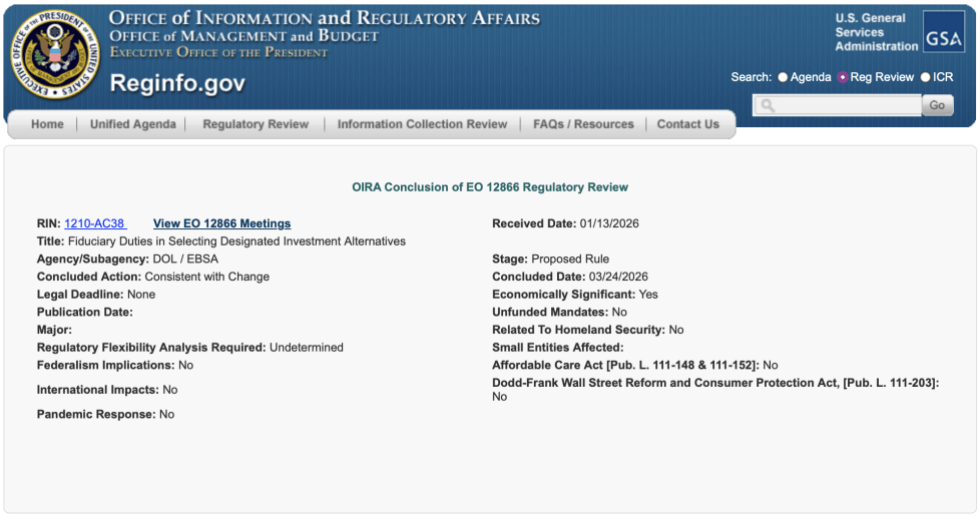
White House concludes regulatory review of DOL's proposed rule. Source: OIRA

This could potentially allow plan sponsors to include cryptocurrencies and private equity as designated investment alternatives. The federal agency marked the action as “consistent with change” and designed the proposal as an “economically significant” rule in its review, which concluded on March 24.

According to the OIRA website, the proposed rule carries no legal deadline for finalization. However, the DOL is expected to formally release the proposal in the coming weeks, allowing for a standard 60-day public comment period. Following this, revisions will be made, and a final rule will be issued.

US Push To Allow Crypto In Retirement Plants

The proposal follows an executive order signed by President Donald Trump last August seeking to allow more private equity, real estate, cryptocurrency, and other alternative assets in 401(k) retirement accounts.

The order directed the DOL, the Securities and Exchange Commission (SEC), the Treasury Secretary, and other federal agencies to reduce regulatory barriers that prohibited investments in alternative assets in their defined contribution retirement plans and explore ways to facilitate access to these assets.

In January, Bitwise’s CIO, Matt Hougan, discussed the possibility of 2026 being the year investors can own Bitcoin and other cryptocurrencies in 401(k) retirement plans, citing that the inclusion of digital assets is becoming more common in individual retirement accounts (IRAs).

The executive argued that providers are slow to adapt, but acknowledged that the Trump administration’s pro-crypto stance, which effectively removed the ban on crypto from 401(k)s, has opened the door to the multi-trillion-dollar market.

Recently, some US states have pushed to embed crypto into their public financial systems. In February, Indiana lawmakers advanced House Bill 1042 (HB 1042), also known as the Bitcoin Rights Bill, which requires several state-administered programs, including retirement plans for teachers, public employees, and legislators, to offer self-directed brokerage accounts with at least one digital asset investment option.

Multiple US lawmakers have backed the Trump Administration’s initiatives. In September, nine House members requested that the SEC Chairman, Paul Atkins, provide prompt assistance in implementing the president’s executive order and collaborate with the DOL to safeguard workers.

In addition, House of Representatives member Troy Downing introduced a bill to codify Trump’s directive and grant it the “force and effect of law.” This move aimed to facilitate investors’ access to Bitcoin and other alternative assets within their 401(k) retirement plans.
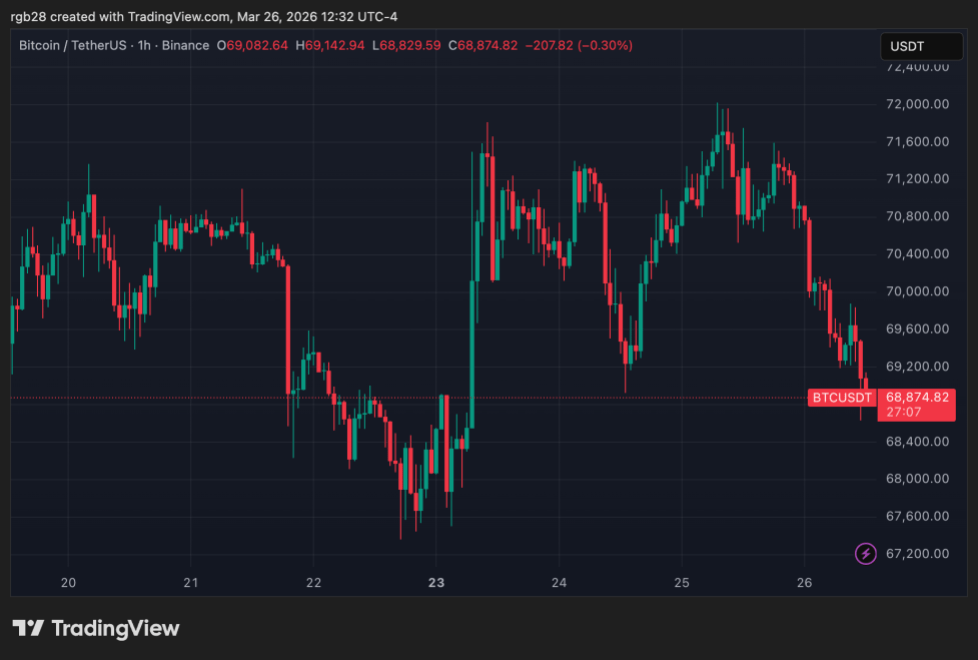
Bitcoin (BTC) trades at $68,874 in the one-week chart. Source: BTCUSDT on TradingView


Crypto di tendenza

Domande pertinenti

QWhat is the significance of the White House's Office of Information and Regulatory Affairs (OIRA) concluding its review of the DOL's proposed rule?

AIt signifies a major regulatory step forward, bringing digital assets closer to being allowed as investment options within the massive $10 trillion US 401(k) retirement market.

QWhich previous guidance did the Department of Labor rescind, and what was its stance on crypto in 401(k) plans?

AThe Labor Department rescinded its 2022 guidance, which had strongly discouraged plan fiduciaries from including cryptocurrency investments in 401(k) plans due to the significant risks posed by the early-stage digital asset industry.

QWhat specific types of alternative assets does the proposed rule aim to allow in 401(k) plans?

AThe proposed rule, named 'Fiduciary Duties in Selecting Designated Investment Alternatives,' could potentially allow plan sponsors to include cryptocurrencies and private equity as designated investment alternatives.

QWhich US President signed the executive order that initiated the push to allow alternative assets in retirement accounts, and what did it direct agencies to do?

APresident Donald Trump signed the executive order in August. It directed the DOL, SEC, Treasury, and other federal agencies to reduce regulatory barriers prohibiting investments in alternative assets and to explore ways to facilitate access to them in defined contribution retirement plans.

QBeyond federal action, how are some US states moving to integrate crypto into their financial systems, as mentioned in the article?

ASome states, like Indiana, are advancing legislation such as the 'Bitcoin Rights Bill' (HB 1042), which requires state-administered retirement plans for public employees and teachers to offer self-directed brokerage accounts with at least one digital asset investment option.

Letture associate

In Conversation with Ray Dalio: We Are Currently in an AI Bubble, with 1% of My Portfolio in Bitcoin

Ray Dalio, founder of Bridgewater Associates, warns in an interview that the current AI boom shows classic bubble characteristics, which could lead to significant economic downturns as seen in past cycles like 1929 or 2000. He explains that speculative enthusiasm, fueled by debt and overvaluation, often precedes a crash when rising rates or taxation force asset sales, causing widespread losses and recession. Dalio also outlines his "Big Cycle" theory, describing an approximate 80-year pattern where widening wealth gaps, massive government deficits, and shifting geopolitical power (like China's rise) create internal conflict and global instability. He emphasizes that we are in a late-cycle, transitional phase where traditional powers like the US and UK face decline. For personal wealth protection, Dalio advises diversification beyond cash into assets like stocks, bonds, real estate, and particularly gold, which he prefers over Bitcoin. While he holds about 1% of his portfolio in Bitcoin as a non-printable hard asset, he views gold as more secure from technological or governmental threats. Regarding AI's impact, Dalio believes it will disproportionately benefit capital owners, worsening inequality by replacing both physical and cognitive labor. He suggests that human intuition and emotional intelligence, combined with AI, will be key for future workers. On taxation, Dalio argues that wealth taxes are impractical and risk triggering asset sell-offs, reducing productive investment. He points to the UK as a cautionary example of debt, low productivity, and political strife. Geopolitically, Dalio foresees a more regionalized world, with the US showing weakness in prolonged conflicts like with Iran, akin to past imperial declines. The ideal outcome, he suggests, is coexisting powerful blocs (e.g., Americas, China-Asia Pacific) without major war.

marsbit3 h fa

In Conversation with Ray Dalio: We Are Currently in an AI Bubble, with 1% of My Portfolio in Bitcoin

marsbit3 h fa

Daily 7.2 Trillion KRW: Foreign Capital's Record Net Buying on Friday! Wall Street Says Headwinds for Korean Stock Fund Flows Have Subsided

South Korean stock market sees a dramatic shift in fund flows. On July 31, foreign investors made a record net purchase of approximately KRW 7.2 trillion in KOSPI stocks, marking a fundamental reversal from the persistent large-scale net outflows seen in previous months. This contributed to a significant narrowing of foreign net selling in July to KRW 9.8 trillion, down sharply from KRW 48.4 trillion in June and KRW 44.5 trillion in May. Simultaneously, domestic institutional pressure eased. South Korean pension funds and asset managers turned to a net buying position in July, purchasing KRW 1.0 trillion worth of KOSPI shares, contrasting with net sales in May and June. Market volatility is expected to be dampened by new financial regulations. Effective July 31, the Financial Services Commission tightened access for retail investors to single-stock leveraged ETFs by raising the minimum cash deposit requirement. Trading volumes for these products subsequently dropped to about 50% of their monthly average. Citigroup Research maintains its year-end KOSPI target of 10,000 points. The firm cites several supportive factors: the substantial easing of headwinds from capital outflows, a robust fundamental outlook for the semiconductor sector, historically low market valuations, strong economic fundamentals, and the potential for policy support from financial authorities if needed.

marsbit3 h fa

Daily 7.2 Trillion KRW: Foreign Capital's Record Net Buying on Friday! Wall Street Says Headwinds for Korean Stock Fund Flows Have Subsided

marsbit3 h fa

Thanks to Dice Rolls, Bitcoin Keys Are Stored Offline, But Not Everyone Will Do It

The article discusses using dice rolls to generate secure Bitcoin wallet seeds, providing entropy independent of potentially flawed hardware random number generators. It explains that each fair dice roll offers about 2.585 bits of entropy, with around 50 rolls needed for a standard 12-word seed phrase and 99+ recommended for higher security. This method gained attention after a vulnerability was revealed in some Coldcard hardware wallets, where a faulty firmware RNG (dating back to 2021) compromised generated keys. The analysis notes that while a dice-generated main seed was safe from this specific flaw, other Coldcard functions (like creating paper wallets, backup keys, or passwords) could still be vulnerable if they used the defective RNG. The piece argues that while dice-based entropy is technically robust, the manual process is error-prone, tedious, and unrealistic for most new users, who might make mistakes in recording or inputting rolls. It concludes that while manual entropy generation should remain an option for advanced users, the long-term goal is to develop reliable, user-friendly hardware and software that securely generates randomness without requiring specialized knowledge. Coldcard users are advised to check their firmware version and replace any secondary secrets (like paper wallet keys) created with vulnerable devices, while also considering multi-signature setups with devices from different manufacturers for added security.

cryptonews.ru9 h fa

Thanks to Dice Rolls, Bitcoin Keys Are Stored Offline, But Not Everyone Will Do It

cryptonews.ru9 h fa

Trading

Spot

Articoli Popolari

Come comprare HOUSE

Benvenuto in HTX.com! Abbiamo reso l'acquisto di Housecoin (HOUSE) semplice e conveniente. Segui la nostra guida passo passo per intraprendere il tuo viaggio nel mondo delle criptovalute.Step 1: Crea il tuo Account HTXUsa la tua email o numero di telefono per registrarti il tuo account gratuito su HTX. Vivi un'esperienza facile e sblocca tutte le funzionalità,Crea il mio accountStep 2: Vai in Acquista crypto e seleziona il tuo metodo di pagamentoCarta di credito/debito: utilizza la tua Visa o Mastercard per acquistare immediatamente HousecoinHOUSE.Bilancio: Usa i fondi dal bilancio del tuo account HTX per fare trading senza problemi.Terze parti: abbiamo aggiunto metodi di pagamento molto utilizzati come Google Pay e Apple Pay per maggiore comodità.P2P: Fai trading direttamente con altri utenti HTX.Over-the-Counter (OTC): Offriamo servizi su misura e tassi di cambio competitivi per i trader.Step 3: Conserva Housecoin (HOUSE)Dopo aver acquistato Housecoin (HOUSE), conserva nel tuo account HTX. In alternativa, puoi inviare tramite trasferimento blockchain o scambiare per altre criptovalute.Step 4: Scambia Housecoin (HOUSE)Scambia facilmente Housecoin (HOUSE) nel mercato spot di HTX. Accedi al tuo account, seleziona la tua coppia di trading, esegui le tue operazioni e monitora in tempo reale. Offriamo un'esperienza user-friendly sia per chi ha appena iniziato che per i trader più esperti.

354 Totale visualizzazioniPubblicato il 2025.04.27Aggiornato il 2026.06.02

Come comprare HOUSE

Discussioni

Benvenuto nella Community HTX. Qui puoi rimanere informato sugli ultimi sviluppi della piattaforma e accedere ad approfondimenti esperti sul mercato. Le opinioni degli utenti sul prezzo di HOUSE HOUSE sono presentate come di seguito.

活动图片












