When Bitcoin Miners Take to Space

marsbitPubblicato 2026-04-01Pubblicato ultima volta 2026-04-01

Introduzione

SpaceX is reportedly preparing for a historic IPO with a target of $1.75 trillion, while simultaneously advancing plans to deploy AI data centers in orbit, leveraging space’s vacuum for cooling and solar energy for power. This has sparked interest in whether Bitcoin mining—also energy-intensive and dependent on computing hardware—could also move to space. The core idea involves placing mining ASICs on the back of solar panels in orbit, using abundant solar energy to power mining operations. Heat dissipation in vacuum, a key challenge, is manageable through thermal radiation, and communication with mining pools is feasible with low latency via low Earth orbit satellites. However, the economics remain prohibitive. Launch costs, currently around $2,720 per kilogram via Falcon 9, make mining payloads financially unviable. Estimates suggest that with current technology, the payback period would exceed 100 years. SpaceX’s Starship may eventually reduce launch costs below $200/kg, making space mining more feasible. Companies like Starcloud—backed by NVIDIA and top VCs—are already testing orbit-based computing, including AI and planned Bitcoin mining experiments. Others, like SpaceChain and Cryptosat, focus on secure blockchain nodes and cryptographic services in space rather than mining. While orbital mining is not yet economically competitive with terrestrial operations, it represents a long-term vision for radically reducing energy costs and expanding the infrastructure of dec...

According to multiple media reports, Musk's space exploration company SpaceX will soon submit an IPO prospectus to the U.S. Securities and Exchange Commission (SEC), targeting a valuation of $1.75 trillion and an expected financing scale exceeding $75 billion. If successful, this would be the largest IPO in human history, far surpassing the record of $29.4 billion set by Saudi Aramco in 2019, and it will also be the most watched IPO this year.

Interestingly, in February 2026, SpaceX suddenly acquired xAI, another AI company under Musk, and incorporated the "Orbital Data Center" into its core strategy: utilizing the vacuum of space for heat dissipation and continuous solar power supply to send AI computing power into low Earth orbit. Musk believes that, in the long run, space-based AI is the only way to achieve scalable development.

At the same time, NVIDIA is also actively exploring this direction. It has invested in the orbital data center startup Starcloud, which successfully sent an NVIDIA H100 GPU into orbit in November 2025, completing the first-ever training and inference of an AI large language model in space.
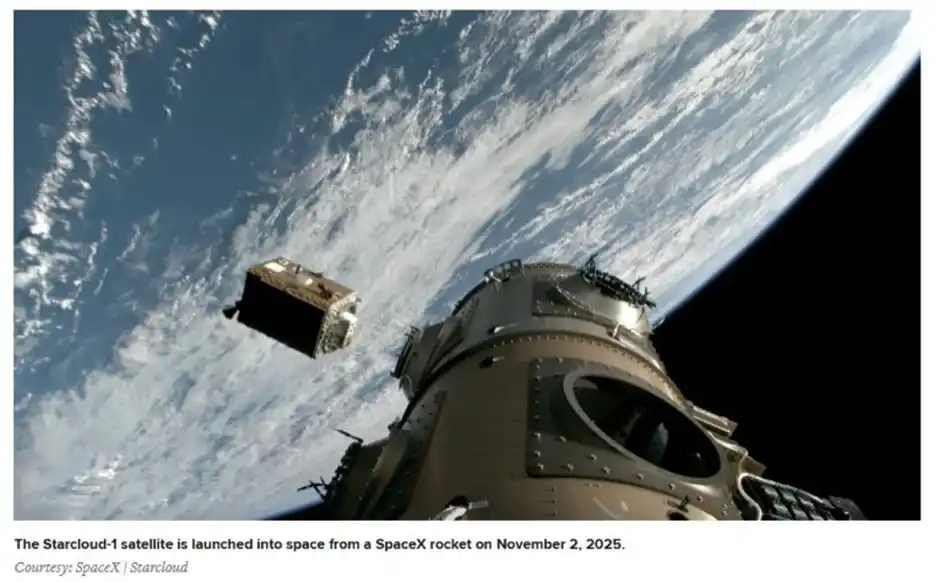
As SpaceX sends AI computing power into space, many are also beginning to wonder: since Bitcoin mining also relies on computing chips and can utilize solar power, could it also be moved to space? However, this issue is far more complex than most people imagine.

A Satellite, a Solar Panel, a Miner

Mining is a competitive mathematical calculation. Millions of miners worldwide operate simultaneously, competing to be the first to solve a specific hash value, with the successful one receiving the Bitcoin reward for the current block. This process is called Proof of Work, and its cost is a massive amount of electricity. The continuous power consumption of the global Bitcoin network is approximately 20 gigawatts, equivalent to the total industrial electricity consumption of a medium-sized country. Miners' profit margins are largely determined by electricity prices; once electricity prices rise, profit margins are compressed.

The endless sunlight in space directly addresses the core cost variable of Bitcoin mining: electricity.

In Earth's orbit, solar radiation intensity is about 1,380 watts per square meter, six times the average level on the ground, and is unaffected by clouds, day/night cycles, or seasons. In specific geosynchronous orbits, satellites can receive near-continuous sunlight and generate power persistently. Attaching a miner to the back of a solar panel and sending it into orbit to mine forever is the underlying logic of space mining.

Bitcoin core developer Peter Todd published a technical analysis in December 2024, pushing this idea from concept to an engineering blueprint. He proposed the concept of a "flat-panel miner": installing ASIC chips directly on the back of a solar panel, with the front facing the sun to generate power and the chips on the back consuming electricity to mine, with the entire structure radiating waste heat in both directions.
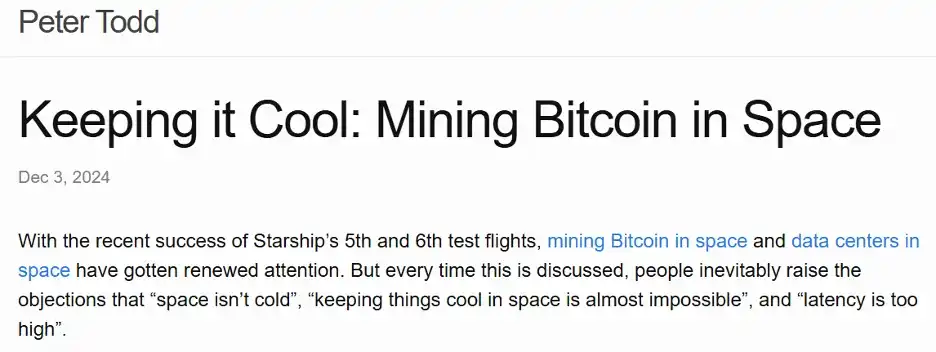
Space heat dissipation is a counterintuitive challenge. On Earth, chip heat can be carried away by air convection; but in the vacuum of space, with no air, heat can only be dissipated through radiation. Todd's calculations show that, without additional cooling devices, the thermal equilibrium temperature of this structure in orbit is about 59°C, well within the normal operating range of the chips. If the temperature is considered too high, simply tilting the entire panel slightly relative to the sun to reduce the illuminated area can further improve heat dissipation.

Communication is surprisingly simple as well. The communication between miners and mining pools essentially involves receiving new block headers and submitting computation results, generating about 10MB of data per day, less than the data consumed by streaming a single song. Communication latency in low Earth orbit (500 to 1,000 km above Earth) ranges from 4 to 30 milliseconds, resulting in a stale block rate (i.e., submitting outdated computation results) of less than 0.01%, on par with the vast majority of ground-based miners, with no substantial difference. In fact, Blockstream began using geosynchronous satellites to broadcast the entire Bitcoin blockchain globally as early as 2017, proving that the combination of satellites and blockchain has never been an unsolved problem.

So, if it's physically feasible and the engineering framework is viable, why isn't it widespread? The reason is the high cost of rocket transportation.

The Uneconomical Math

Using SpaceX's Falcon 9 rocket to send cargo to low Earth orbit currently costs about $2,720 per kilogram.

Peter Todd estimated that a complete 20-kilowatt space mining system, including solar panels, heat radiators, ASIC chip arrays, structural supports, and communication modules, weighs about 1,600 to 2,200 kilograms. At current prices, the launch cost alone would be as high as $4.3 million to $6 million.

How much computing power can this system contribute daily, and how many coins can it mine? Researcher Nick Moran provided the answer: daily revenue is about $92.7, equivalent to roughly $34,000 per year. The payback period exceeds 100 years.

Starcloud's CEO Philip Johnston calculated that launch costs must drop below $200 per kilogram for space mining to have basic commercial logic. This means the cost needs to decrease by another 13.

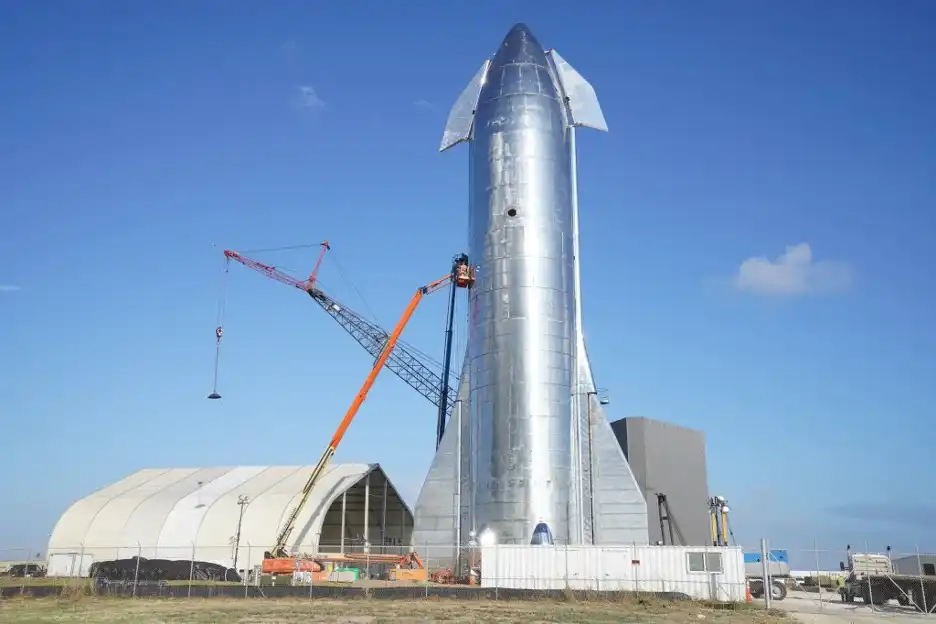
SpaceX's Starship is widely considered the key to achieving this leap. The fully reusable Starship could theoretically reduce the launch cost per kilogram to below $100 or even lower, which is one of the underlying assumptions for the viability of the orbital data center in SpaceX's current IPO vision. However, when this cost curve will materialize, and whether it will, remains an open variable.
Another challenge is the automatic adjustment of Bitcoin's network-wide mining difficulty. The Bitcoin protocol calculates the total network hash rate every two weeks and automatically adjusts the mining difficulty to maintain a block time of approximately 10 minutes. In other words, if a large number of space miners enter the market and the total network hash rate increases significantly, the mining difficulty will rise accordingly, synchronously compressing the profits of all miners, including those in orbit.

Some Are Always Busy Searching for Treasure

Despite this, a number of startups are actively pushing forward with this endeavor.

Starcloud, formerly Lumen Orbit, is currently the company closest to actual implementation and the most important case study in the entire field. Founded in 2024 and headquartered in Redmond, Washington, it is backed by NFX, Y Combinator, a16z's angel fund, Sequoia Capital's angel fund, and NVIDIA. Total funding is approximately $200 million. The company's CTO worked at Airbus Defense and Space for ten years, and the lead engineer previously worked on the Starlink project at SpaceX.

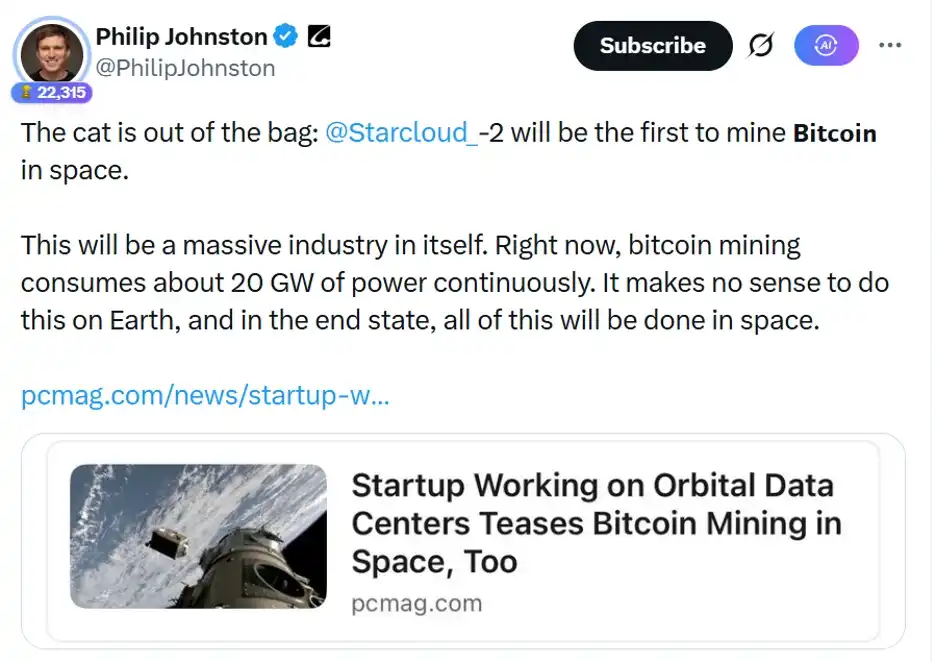
In November 2025, Starcloud successfully sent its first satellite, carrying an NVIDIA H100 GPU, into orbit, ran Google's Gemma language model in space, and sent the first-ever message generated by AI in orbit to Earth. In March 2026, Starcloud announced that its second satellite would carry both Bitcoin ASIC chips and NVIDIA's latest-generation Blackwell GPU, aiming to become the first organization to mine a Bitcoin in space. Additionally, the company has applied to the U.S. Federal Communications Commission (FCC) for a constellation plan deploying up to 88,000 satellites, with a long-term vision of building a total of 5 gigawatts of computing power infrastructure in orbit.
SpaceChain is an OG player in this field, co-founded by former Bitcoin core developer Jeff Garzik and Zheng Zhong. Since 2017, SpaceChain has launched at least seven blockchain payloads to satellites and the International Space Station. In June 2020, Garzik completed the first-ever Bitcoin transaction in space from an orbit 400 km above Earth, for an amount of 0.0099 BTC, using SpaceChain's multisignature wallet node installed on the space station. SpaceChain's core focus is on orbital secure nodes for blockchain transactions, not active mining: locking private keys in space where no hacker or government on Earth can physically access them.

Cryptosat, founded by two Stanford PhDs, currently operates three satellites in orbit, primarily providing tamper-resistant orbital cryptography services. In 2023, Cryptosat participated in the largest trusted setup ceremony in Ethereum's history (KZG Ceremony), generating partial random number parameters through orbital nodes, institutionally ensuring that these parameters could not be controlled by any single ground-based entity. It explores another possibility for space blockchain: not mining, but making the entire crypto-economic system more resistant to attack.

From Orbit to Market: What This Means for the Mining Industry

For currently operating Bitcoin mining companies, space mining does not pose an immediate competitive threat in the short term. However, the fact that numerous startups continue to attempt it indicates that the significant cost reduction potential it represents still holds great attraction and imaginative space for the industry. This also reflects, from a side perspective, the structural cost pressures facing the entire industry.

After the 2024 halving, the network-wide hash rate and difficulty continue to hit record highs, with energy costs accounting for 70% to 90% of total operating expenses. In this context, whoever can obtain clean electricity at the lowest cost and most stably has the deepest moat. Hydroelectric, wind, and associated natural gas resources in the United States, the Middle East, and Africa are becoming the core drivers of a new wave of mining mergers, acquisitions, and site selection.

The logic of space mining is an ultimate extrapolation of this trend: if cheap electricity on the ground will eventually narrow due to competitive demand, then go to where energy is most abundant—the cosmos.

Of course, if the Starcloud-2 satellite manages to mine the first Bitcoin in 2026, it would be equivalent to a grain of sand falling into the ocean compared to the global total hash rate of over 900 exahashes per second (EH/s). But symbolic significance itself has penetrating power. Just like that 0.0099 BTC space transaction in 2020, its value lies not in the amount but in proving that it can be done.

From SpaceX's IPO narrative to NVIDIA's orbital computing power布局, to Starcloud's ASIC satellite plan, an outline is emerging: the cosmos is becoming the competitive arena for the next generation of computing infrastructure. AI computing power led the way, and Bitcoin computing power is following closely behind.

On that day, the global digital network connecting every corner of the Earth, as described in Satoshi Nakamoto's whitepaper, could also break free from Earth and float in the universe, seeking new opportunities.


Domande pertinenti

QWhat is the core concept behind space-based Bitcoin mining as described in the article?

AThe core concept is to place Bitcoin mining hardware, specifically ASIC chips, on solar panels in Earth's orbit. This setup uses the abundant and constant solar energy in space for power, while the vacuum environment aids in radiating heat away from the mining equipment.

QWhat is the single biggest economic challenge preventing the widespread adoption of space-based Bitcoin mining?

AThe single biggest economic challenge is the extremely high cost of rocket launches to transport the mining equipment into orbit, currently around $2,720 per kilogram using a Falcon 9 rocket, making the payback period over 100 years.

QWhich company, backed by NVIDIA, is a key player in testing both AI and Bitcoin mining operations in space?

AStarcloud (formerly Lumen Orbit) is the company backed by NVIDIA. It successfully sent an NVIDIA H100 GPU into orbit in 2025 and announced plans for a second satellite to carry both Bitcoin ASIC chips and a Blackwell GPU.

QHow does the Bitcoin network's difficulty adjustment mechanism impact the potential profitability of space-based miners?

AThe Bitcoin protocol automatically adjusts the mining difficulty every two weeks based on the total network hashrate. If many space-based miners come online and significantly increase the total hashrate, the difficulty will rise, compressing profit margins for all miners, including those in space.

QBesides mining, what other two applications of blockchain technology in space are mentioned in the article?

AThe two other applications are: 1) Operating secure, tamper-proof orbital nodes for transactions and wallet storage (e.g., SpaceChain's multi-signature wallet on the ISS). 2) Providing trusted setup ceremonies and cryptographic services to enhance the security of crypto-economic systems (e.g., Cryptosat's role in Ethereum's KZG Ceremony).

Letture associate

Cook's Curtain Call and Ternus Takes the Helm: The Disruption and Reboot of Apple's 4 Trillion Dollar Empire

Tim Cook has officially announced he will step down as CEO of Apple in September, transitioning to executive chairman after a 15-year tenure during which he grew the company’s market value from around $350 billion to nearly $4 trillion. He will be succeeded by John Ternus, a 50-year-old hardware engineering veteran who has been groomed for the role through increasing public visibility and internal responsibility. Ternus’s appointment signals a strategic shift toward hardware and engineering leadership, with Johny Srouji—head of Apple Silicon—taking on an expanded role as Chief Hardware Officer. This consolidation aims to strengthen Apple’s core technological capabilities. However, Cook’s departure highlights a significant unresolved issue: Apple’s delayed and fragmented approach to artificial intelligence. Despite early efforts, such as hiring John Giannandrea from Google in 2018, Apple’s AI initiatives—particularly around Siri—have struggled with internal restructuring and reliance on external partnerships, including with Google. The transition comes at a critical moment as Apple faces paradigm shifts with the rise of artificial general intelligence (ASI). The company’s closed ecosystem of hardware, software, and services—once a major advantage—now presents challenges in adapting to an AI-centric world where intelligence may matter more than the device itself. Ternus must quickly articulate a clear AI strategy, possibly starting at WWDC, to reassure markets and redefine Apple’s role in a new technological era. His task is not only to maintain Apple’s operational excellence but also to reinvigorate its capacity to innovate and lead in the age of AI.

marsbit1 h fa

Cook's Curtain Call and Ternus Takes the Helm: The Disruption and Reboot of Apple's 4 Trillion Dollar Empire

marsbit1 h fa

Trading

Spot
Futures

Articoli Popolari

Cosa è BITCOIN

Comprendere HarryPotterObamaSonic10Inu (ERC-20) e la sua posizione nel mondo delle criptovalute Negli ultimi anni, il mercato delle criptovalute ha assistito a un aumento della popolarità delle meme coin, catturando l'interesse non solo dei trader, ma anche di coloro che cercano coinvolgimento comunitario e valore di intrattenimento. Tra questi token unici c'è HarryPotterObamaSonic10Inu (ERC-20), un progetto intrigante che mescola riferimenti culturali nel tessuto delle criptovalute. Questo articolo esplora gli aspetti chiave di HarryPotterObamaSonic10Inu, analizzando i suoi meccanismi, l'etica guidata dalla comunità e il suo coinvolgimento con il panorama crittografico più ampio. Che cos'è HarryPotterObamaSonic10Inu (ERC-20)? Come suggerisce il suo nome, HarryPotterObamaSonic10Inu è una meme coin costruita sulla blockchain di Ethereum, classificata secondo lo standard ERC-20. A differenza delle criptovalute tradizionali che possono enfatizzare l'utilità pratica o il potenziale investimento, questo token prospera grazie al valore di intrattenimento e alla forza della sua comunità. Il progetto mira a creare un ambiente in cui gli utenti coinvolti possono riunirsi, condividere idee e partecipare ad attività ispirate a diversi fenomeni culturali. Una caratteristica notevole di HarryPotterObamaSonic10Inu è la zero tassa sulle transazioni. Questo elemento allettante tende a incoraggiare il trading e il coinvolgimento della comunità, privo di costi aggiuntivi che possono scoraggiare i trader di piccole dimensioni. L'offerta totale della moneta è fissata a un miliardo di token, un numero che segna la sua intenzione di mantenere una circolazione sostanziale all'interno della comunità. Creatore di HarryPotterObamaSonic10Inu (ERC-20) Le origini di HarryPotterObamaSonic10Inu sono avvolte in un certo mistero; i dettagli sul creatore rimangono sconosciuti. Lo sviluppo di questo token non presenta un team identificabile o un piano esplicito, cosa non rara nel settore delle meme coin. Invece, il progetto è emerso organicamente, con il suo progresso fortemente dipendente dall'entusiasmo e dalla partecipazione della sua comunità. Investitori di HarryPotterObamaSonic10Inu (ERC-20) Per quanto riguarda investimenti esterni e finanziamenti, HarryPotterObamaSonic10Inu rimane ambiguo. Il token non elenca alcuna fondazione di investimento conosciuta o un sostegno organizzativo significativo. Invece, la linfa vitale del progetto è la sua comunità di base, che informa la sua crescita e sostenibilità attraverso azioni collettive e coinvolgimento nello spazio crittografico. Come funziona HarryPotterObamaSonic10Inu (ERC-20)? In quanto meme coin, HarryPotterObamaSonic10Inu opera principalmente al di fuori delle strutture tradizionali che governano spesso il valore degli asset. Ci sono diversi aspetti distintivi che definiscono il funzionamento del progetto: Transazioni senza tasse: Senza costi fiscali sulle transazioni, gli utenti possono comprare e vendere liberamente il token senza preoccuparsi di costi nascosti. Coinvolgimento della comunità: Il progetto prospera sull'interazione della comunità, sfruttando le piattaforme social per creare entusiasmo e facilitare il coinvolgimento. Discussioni, condivisione di contenuti e coinvolgimento sono elementi cruciali che aiutano ad espandere la sua portata e a favorire la lealtà tra i sostenitori. Nessuna utilità pratica: Va notato che HarryPotterObamaSonic10Inu non offre un'utilità concreta all'interno dell'ecosistema finanziario. Piuttosto, è classificato come un token principalmente per attività di intrattenimento e comunitarie. Riferimento culturale: Il token incorpora astutamente elementi della cultura pop per attirare interesse, collegandosi a appassionati di meme e seguaci delle criptovalute. HarryPotterObamaSonic10Inu esemplifica come le meme coin operino in modo diverso rispetto ai progetti di criptovalute più tradizionali, entrando nel mercato come costrutti sociali innovativi piuttosto che come asset utilitari. Cronologia di HarryPotterObamaSonic10Inu (ERC-20) La storia di HarryPotterObamaSonic10Inu è segnata da diversi traguardi notevoli: Creazione: Il token è emerso da un meme virale, catturando l'immaginazione di molti appassionati di criptovalute. Le date di creazione specifiche non sono disponibili, sottolineando la sua crescita organica. Inserimento negli scambi: HarryPotterObamaSonic10Inu ha fatto il suo ingresso in vari scambi, consentendo un accesso e un trading più facili da parte della comunità. Iniziative di coinvolgimento della comunità: Attività in corso volte a migliorare l'interazione della comunità, comprese gare, campagne sui social media e generazione di contenuti da parte di fan e sostenitori. Piani di espansione futura: La tabella di marcia del progetto include il lancio di una collezione NFT, merchandising e un sito di eCommerce relativo ai suoi temi culturali, coinvolgendo ulteriormente la comunità e cercando di aggiungere più dimensioni al suo ecosistema. Punti chiave su HarryPotterObamaSonic10Inu (ERC-20) Natura guidata dalla comunità: Il progetto dà priorità al contributo collettivo e alla creatività, garantendo che il coinvolgimento degli utenti sia al centro del suo sviluppo. Classificazione come meme coin: Rappresenta l'epitome delle criptovalute basate sull'intrattenimento, distinguendosi dai veicoli d'investimento tradizionali. Nessuna affiliazione diretta con Bitcoin: Nonostante la somiglianza nel nome del ticker, HarryPotterObamaSonic10Inu è distintivo e non ha alcuna relazione con Bitcoin o altre criptovalute consolidate. Focus sulla collaborazione: HarryPotterObamaSonic10Inu è progettato per creare uno spazio per la collaborazione e la condivisione di storie tra i suoi detentori, fornendo un canale per la creatività e il legame comunitario. Prospettive future: L'ambizione di espandersi oltre il suo presupposto iniziale verso NFT e merchandising delinea un percorso per il progetto per potenzialmente entrare in strade più mainstream all'interno della cultura digitale. Poiché le meme coin continuano a catturare l'immaginazione della comunità crittografica, HarryPotterObamaSonic10Inu (ERC-20) si distingue per i suoi legami culturali e il suo approccio centrato sulla comunità. Anche se potrebbe non adattarsi al modello tipico di un token orientato all'utilità, la sua essenza risiede nella gioia e nella camaraderia coltivate tra i suoi sostenitori, evidenziando la natura in evoluzione delle criptovalute in un'epoca sempre più digitale. Con la continuazione dello sviluppo del progetto, sarà importante osservare come le dinamiche della comunità influenzano la sua traiettoria nel panorama in continuo cambiamento della tecnologia blockchain.

1.1k Totale visualizzazioniPubblicato il 2024.04.01Aggiornato il 2024.12.03

Cosa è BITCOIN

Come comprare BTC

Benvenuto in HTX.com! Abbiamo reso l'acquisto di Bitcoin (BTC) semplice e conveniente. Segui la nostra guida passo passo per intraprendere il tuo viaggio nel mondo delle criptovalute.Step 1: Crea il tuo Account HTXUsa la tua email o numero di telefono per registrarti il tuo account gratuito su HTX. Vivi un'esperienza facile e sblocca tutte le funzionalità,Crea il mio accountStep 2: Vai in Acquista crypto e seleziona il tuo metodo di pagamentoCarta di credito/debito: utilizza la tua Visa o Mastercard per acquistare immediatamente BitcoinBTC.Bilancio: Usa i fondi dal bilancio del tuo account HTX per fare trading senza problemi.Terze parti: abbiamo aggiunto metodi di pagamento molto utilizzati come Google Pay e Apple Pay per maggiore comodità.P2P: Fai trading direttamente con altri utenti HTX.Over-the-Counter (OTC): Offriamo servizi su misura e tassi di cambio competitivi per i trader.Step 3: Conserva Bitcoin (BTC)Dopo aver acquistato Bitcoin (BTC), conserva nel tuo account HTX. In alternativa, puoi inviare tramite trasferimento blockchain o scambiare per altre criptovalute.Step 4: Scambia Bitcoin (BTC)Scambia facilmente Bitcoin (BTC) nel mercato spot di HTX. Accedi al tuo account, seleziona la tua coppia di trading, esegui le tue operazioni e monitora in tempo reale. Offriamo un'esperienza user-friendly sia per chi ha appena iniziato che per i trader più esperti.

3.5k Totale visualizzazioniPubblicato il 2024.12.12Aggiornato il 2025.03.21

Come comprare BTC

Cosa è $BITCOIN

ORO DIGITALE ($BITCOIN): Un'Analisi Completa Introduzione all'ORO DIGITALE ($BITCOIN) L'ORO DIGITALE ($BITCOIN) è un progetto basato su blockchain che opera sulla rete Solana, con l'obiettivo di combinare le caratteristiche dei metalli preziosi tradizionali con l'innovazione delle tecnologie decentralizzate. Sebbene condivida un nome con Bitcoin, spesso definito “oro digitale” a causa della sua percezione come riserva di valore, l'ORO DIGITALE è un token separato progettato per creare un ecosistema unico all'interno del panorama Web3. Il suo obiettivo è posizionarsi come un asset digitale alternativo valido, anche se i dettagli riguardanti le sue applicazioni e funzionalità sono ancora in fase di sviluppo. Cos'è l'ORO DIGITALE ($BITCOIN)? L'ORO DIGITALE ($BITCOIN) è un token di criptovaluta esplicitamente progettato per l'uso sulla blockchain di Solana. A differenza di Bitcoin, che fornisce un ruolo di stoccaggio di valore ampiamente riconosciuto, questo token sembra concentrarsi su applicazioni e caratteristiche più ampie. Aspetti notevoli includono: Infrastruttura Blockchain: Il token è costruito sulla blockchain di Solana, nota per la sua capacità di gestire transazioni ad alta velocità e a basso costo. Dinamiche di Offerta: L'ORO DIGITALE ha un'offerta massima fissata a 100 quadrilioni di token (100P $BITCOIN), sebbene i dettagli riguardanti la sua offerta circolante siano attualmente non divulgati. Utilità: Sebbene le funzionalità precise non siano esplicitamente delineate, ci sono indicazioni che il token potrebbe essere utilizzato per varie applicazioni, potenzialmente coinvolgendo applicazioni decentralizzate (dApp) o strategie di tokenizzazione degli asset. Chi è il Creatore dell'ORO DIGITALE ($BITCOIN)? Attualmente, l'identità dei creatori e del team di sviluppo dietro l'ORO DIGITALE ($BITCOIN) rimane sconosciuta. Questa situazione è tipica tra molti progetti innovativi nel settore blockchain, in particolare quelli allineati con la finanza decentralizzata e i fenomeni delle meme coin. Sebbene tale anonimato possa favorire una cultura guidata dalla comunità, intensifica le preoccupazioni riguardo alla governance e alla responsabilità. Chi sono gli Investitori dell'ORO DIGITALE ($BITCOIN)? Le informazioni disponibili indicano che l'ORO DIGITALE ($BITCOIN) non ha alcun sostenitore istituzionale noto o investimenti di venture capital prominenti. Il progetto sembra operare su un modello peer-to-peer incentrato sul supporto e sull'adozione della comunità piuttosto che su percorsi di finanziamento tradizionali. La sua attività e liquidità si trovano principalmente su exchange decentralizzati (DEX), come PumpSwap, piuttosto che su piattaforme di trading centralizzate consolidate, evidenziando ulteriormente il suo approccio di base. Come Funziona l'ORO DIGITALE ($BITCOIN) Le meccaniche operative dell'ORO DIGITALE ($BITCOIN) possono essere elaborate in base al suo design blockchain e alle caratteristiche della rete: Meccanismo di Consenso: Sfruttando il proof-of-history (PoH) unico di Solana combinato con un modello di proof-of-stake (PoS), il progetto garantisce una validazione efficiente delle transazioni contribuendo all'alta performance della rete. Tokenomics: Sebbene meccanismi deflazionistici specifici non siano stati dettagliati ampiamente, l'ampia offerta massima di token implica che potrebbe soddisfare microtransazioni o casi d'uso di nicchia che devono ancora essere definiti. Interoperabilità: Esiste il potenziale per l'integrazione con l'ecosistema più ampio di Solana, inclusi vari piattaforme di finanza decentralizzata (DeFi). Tuttavia, i dettagli riguardanti integrazioni specifiche rimangono non specificati. Cronologia degli Eventi Chiave Ecco una cronologia che evidenzia traguardi significativi riguardanti l'ORO DIGITALE ($BITCOIN): 2023: Il dispiegamento iniziale del token avviene sulla blockchain di Solana, contrassegnato dal suo indirizzo di contratto. 2024: L'ORO DIGITALE guadagna visibilità poiché diventa disponibile per il trading su exchange decentralizzati come PumpSwap, consentendo agli utenti di scambiarlo contro SOL. 2025: Il progetto assiste a un'attività di trading sporadica e a un potenziale interesse per impegni guidati dalla comunità, sebbene non siano state documentate partnership significative o avanzamenti tecnici fino ad ora. Analisi Critica Punti di Forza Scalabilità: L'infrastruttura sottostante di Solana supporta alti volumi di transazioni, il che potrebbe migliorare l'utilità di $BITCOIN in vari scenari di transazione. Accessibilità: Il potenziale basso prezzo di trading per token potrebbe attrarre investitori al dettaglio, facilitando una partecipazione più ampia grazie a opportunità di proprietà frazionata. Rischi Mancanza di Trasparenza: L'assenza di sostenitori, sviluppatori o di un processo di audit pubblicamente noti potrebbe generare scetticismo riguardo alla sostenibilità e all'affidabilità del progetto. Volatilità del Mercato: L'attività di trading è fortemente dipendente dal comportamento speculativo, il che può comportare una significativa volatilità dei prezzi e incertezze per gli investitori. Conclusione L'ORO DIGITALE ($BITCOIN) emerge come un progetto intrigante ma ambiguo all'interno dell'evolvente ecosistema di Solana. Sebbene tenti di sfruttare la narrativa dell'“oro digitale”, la sua partenza dal ruolo consolidato di Bitcoin come riserva di valore sottolinea la necessità di una chiara differenziazione della sua utilità e struttura di governance. L'accettazione e l'adozione future dipenderanno probabilmente dall'affrontare l'attuale opacità e dalla definizione più esplicita delle sue strategie operative ed economiche. Nota: Questo rapporto comprende informazioni sintetizzate disponibili a ottobre 2023, e potrebbero essersi verificati sviluppi oltre il periodo di ricerca.

99 Totale visualizzazioniPubblicato il 2025.05.13Aggiornato il 2025.05.13

Cosa è $BITCOIN

Discussioni

Benvenuto nella Community HTX. Qui puoi rimanere informato sugli ultimi sviluppi della piattaforma e accedere ad approfondimenti esperti sul mercato. Le opinioni degli utenti sul prezzo di BTC BTC sono presentate come di seguito.

活动图片