What The XRP Ledger Achieved In 2025 And What Must Improve In 2026

bitcoinistPubblicato 2025-12-31Pubblicato ultima volta 2025-12-31

Introduzione

The XRP Ledger (XRPL) made significant progress in 2025, particularly in the development of smart contracts, which reached an alpha test net stage, allowing developers to actively deploy and experiment. Interoperability advanced with the integration of Wormhole and Axelar, enabling bridged yield-bearing assets. Tokenization also saw strength with the launch of RLUSD and other stablecoins. However, DeFi activity declined after a strong start with meme coins, though baseline DEX activity remained higher than previous levels. The app layer improved but lacked a breakout application. For 2026, key improvements are needed. Builders emphasize the urgency of implementing batch transactions and sponsored fees to reduce user friction and enable mass onboarding. Enhancing DEX and AMM liquidity is critical, as is attracting more quality assets, especially real-world assets (RWAs) like yield-bearing stablecoins and tokenized stocks. There is a strong call for a serious incentive and grant program from the XRPL Foundation to fund developers, improve tools, and support consumer apps that can scale beyond the core community and attract millions of users.

The XRP Ledger (XRPL) closed 2025 with real progress on smart contracts, interoperability, and tokenization, but builders say 2026 needs to focus on removing user friction, improving DEX liquidity, and funding apps that can scale beyond the core community.

What The XRP Ledger Achieved In 2025

XRPL dUNL validator Vet said 2025 was “great” across several areas, led by smart contracts reaching an environment developers can actively test. “Smart Contracts, lots of development to get the alpha test net out — you can deploy and play around with it today,” Vet wrote. “A lot more community awareness.” The implication is straightforward: the work is no longer purely theoretical, and the ecosystem can start converting curiosity into actual deployments.

DeFi, however, did not maintain its earlier pace. Vet wrote that XRP DeFi “came strong out of 2024 with meme coins,” but “activity dried out over the year.” Even so, he argued the floor is higher than before: “DEX baseline activity is higher than before,” he wrote, describing 2026 as an opportunity to “build it out” into something more durable.

On interoperability, Vet highlighted a year of shipping. “Interoperability wise we got Wormhole going live, Axelar live + bridged yield bearing issued assets to the XRPL,” he wrote. He also pointed to a possible technical direction for the next phase: “ZKP looks like an enabler for trust minimized bridging,” suggesting zero-knowledge proofs could reduce reliance on trust-heavy bridge designs.

XRPL’s app layer improved, but without a breakout winner. “The existing projects and wallets on the XRPL doubled down a lot,” Vet wrote. “More polished, new features and integrations. No new app that took over the community though.” That matters because UX improvements help retention, but major growth typically follows a flagship product that creates its own gravity.

Tokenization was another bright spot, with Vet calling it “very strong with RLUSD,” alongside “smaller launches of other stables and tokenized funds.” Still, he flagged distribution as a bottleneck: “Distribution channels of those assets is still something we have to work on,” he wrote, tying it directly to the health of DeFi and applications. Issuance alone is not enough; assets need liquidity, integrations, and pathways into end-user products.

What Must Improve In 2026

Anodos Finance co-founder and CEO Panos Mekras used a post to lay out what he wants to see next year, arguing that XRPL has to prioritize both infrastructure and incentives.

“Seeing Batch transactions and sponsored fees/reserves live as soon as possible, which are crucial for removing friction and mass consumer onboarding,” Panos wrote. “More quality assets coming to XRPL, especially RWAs: yield-bearing stablecoins, tokenized stocks, commodities. A serious incentive and grant program finally happening, @XRPLF stepping up with real resources for builders, better dev tools, funding killer consumer apps and use cases that can bring millions to XRPL.”

Vet responded: “i agree with all 3 wishes.” Panos also called out DEX/AMM liquidity as “a serious issue,” framing it as a practical constraint on growth rather than an abstract metric.

At press time, XRP traded at $1.86.
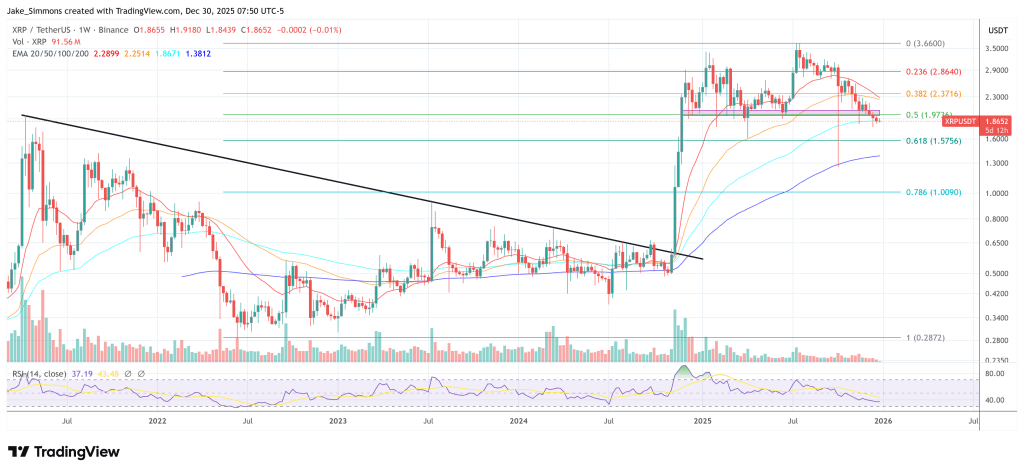
XRP remains below key support, 1-week chart | Source: XRPUSDT on TradingView.com

Crypto di tendenza

Domande pertinenti

QWhat were the key areas of progress for the XRP Ledger in 2025 according to the article?

AThe key areas of progress for the XRP Ledger in 2025 were smart contracts reaching an active testing environment, interoperability with solutions like Wormhole and Axelar going live, and significant advancements in tokenization, particularly with RLUSD.

QWhat did Vet identify as a major technical direction for the next phase of interoperability?

AVet identified Zero-Knowledge Proofs (ZKP) as a potential enabler for trust-minimized bridging, suggesting it could reduce reliance on trust-heavy bridge designs.

QAccording to Panos Mekras, what are two specific technical features crucial for removing user friction and enabling mass consumer onboarding in 2026?

AAccording to Panos Mekras, Batch transactions and sponsored fees/reserves are two specific technical features crucial for removing user friction and enabling mass consumer onboarding.

QWhat was cited as a 'serious issue' that is a practical constraint on the growth of the XRPL ecosystem?

ADEX/AMM liquidity was cited as a 'serious issue' and a practical constraint on the growth of the XRPL ecosystem.

QDespite the progress in tokenization, what specific challenge or bottleneck was highlighted?

AThe specific challenge highlighted was the distribution channels for these new assets, which was identified as a bottleneck that needs to be improved to support the health of DeFi and applications.

Letture associate

The Verdict in Choi Tae-won's Divorce Case: Revealing the Inheritance Undercurrent Behind SK Hynix's Trillion-Won Empire

SK Group Chairman Chey Tae-won's high-profile divorce case, involving a record 1.38 trillion won settlement, has drawn attention to the succession plans for Korea's second-largest conglomerate, especially its crown jewel, SK hynix. Unlike traditional chaebol scripts centered on the eldest son, Chey's three children from his marriage to former President Roh Tae-woo's daughter, Roh Soh-yeong, are carving distinct, non-traditional paths. Eldest daughter Chey Yun-jung (b. 1989) is seen as the most evident successor. With a scientific and consulting background, she holds executive roles at SK bioscience and SK Inc.'s growth support department, focusing on future strategy and biopharma. Her marriage is to an AI infrastructure entrepreneur, not a traditional business alliance. Second daughter Chey Min-jung (b. 1991) took a unique route, voluntarily serving as a South Korean naval officer, including an anti-piracy deployment. She later worked on policy and strategy for SK hynix in Washington D.C. before co-founding an AI-driven healthcare startup. She married a former U.S. Marine Corps officer, connecting her to U.S. defense and policy circles—networks crucial for a global semiconductor giant. The only son, Chey In-geun (b. 1995), who studied physics like his father, worked briefly at SK E&S before joining McKinsey. Despite fitting the traditional "heir" profile as the eldest son, he remains silent and holds no public position or shares in SK, suggesting the old succession playbook is obsolete. As SK hynix's valuation soars, becoming a geopolitical asset in the AI era, the heirs' legitimacy is no longer automatic. They must prove themselves in fields like AI biotech, global policy, and strategic consulting. Their marriages also reflect new elite networks in tech and defense, not old political alliances. Their inheritance is the complex challenge of navigating a globalized, tech-driven world, not just a corporate throne.

marsbit11 h fa

The Verdict in Choi Tae-won's Divorce Case: Revealing the Inheritance Undercurrent Behind SK Hynix's Trillion-Won Empire

marsbit11 h fa

From OpenSea to OpenRouter: Is Alex Atallah Repeating His 'Exit at the Peak' Playbook?

From OpenSea to OpenRouter: Is Alex Atallah Repeating His "Exit at the Peak" Playbook? According to the Wall Street Journal, payments giant Stripe is in talks to acquire the AI model aggregation platform OpenRouter in a potential deal valuing the company near $100 billion. This would mark founder Alex Atallah's second creation of a company reaching a $100 billion valuation, following his co-founding of NFT marketplace OpenSea. OpenRouter, founded just over three years ago, has grown rapidly by acting as a unified gateway for developers to access over 400 AI models. It currently has about 10 million users and processes over 200 trillion tokens monthly. While the platform's annualized revenue is around $50 million, its valuation has skyrocketed from $1.3 billion in March 2026. The potential acquisition by Stripe, a company OpenRouter's founder once likened it to, represents a major expansion into AI infrastructure for the payments leader. This move echoes Atallah's previous timing with OpenSea, where he departed before the NFT market's significant downturn. For OpenRouter, selling now may be strategic. Despite its scale, its business model—charging a 5-5.5% fee on AI inference calls—faces pressure from competition, open-source models, and potential price wars among model providers, limiting its profitability narrative for an IPO. A key asset for potential acquirers like Stripe is OpenRouter's vast repository of real-world AI usage data, which offers unique insights into model performance and developer preferences that are difficult to replicate. Whether this potential deal signifies a new valuation benchmark for AI infrastructure or another market peak signal remains to be seen.

链捕手11 h fa

From OpenSea to OpenRouter: Is Alex Atallah Repeating His 'Exit at the Peak' Playbook?

链捕手11 h fa

Trading

Spot

Articoli Popolari

Cosa è XRP 2.0

XRP 2.0: Una Nuova Frontiera nel Paesaggio delle Criptovalute Introduzione a XRP 2.0 Nel mondo in continua evoluzione delle criptovalute, nuovi progetti emergono continuamente, cercando attenzione e adozione. Una tale iniziativa promettente è XRP 2.0, un nuovo progetto di criptovaluta progettato per sfruttare avanzate tecnologie blockchain e metodologie di crittografia robuste. Anche se il nome richiama alla mente l'XRP di Ripple, è fondamentale notare che XRP 2.0 opera in modo indipendente, concentrandosi sul miglioramento della sicurezza delle transazioni, della privacy e della scalabilità. Mentre il panorama finanziario digitale abbraccia sempre di più soluzioni decentralizzate, XRP 2.0 mira a contribuire in modo significativo al web3 e all'espansione generale dei progetti crypto. Cos'è XRP 2.0? Alla sua base, XRP 2.0 è un progetto di criptovaluta che mira a creare un ecosistema di valuta digitale sicuro e decentralizzato. La sua tecnologia fondamentale integra principi di blockchain sofisticati con tecniche di crittografia all'avanguardia. L'obiettivo principale di XRP 2.0 è quello di affermarsi come una piattaforma affidabile ed efficiente in grado di consentire un'esecuzione rapida delle transazioni, dando priorità a migliori protezioni della privacy per i suoi utenti. Il progetto è promosso come una soluzione a molte limitazioni affrontate dalle criptovalute esistenti, proponendo un sistema in grado di gestire un volume maggiore di transazioni con migliorata velocità e privacy. Questa versatilità pone XRP 2.0 come un significativo competitor in un mercato affollato di varie valute digitali. Chi è il Creatore di XRP 2.0? L'identità del creatore dietro XRP 2.0 è stata segnalata come 'Wilbur'. Tuttavia, i dettagli completi riguardanti Wilbur o l'entità associata rimangono sfuggenti. L'anonimato di molti creatori di criptovalute non è un fenomeno raro nel settore, spesso progettato per mantenere un certo grado di privacy e sicurezza. Chi sono gli Investitori di XRP 2.0? Al momento, informazioni specifiche relative alle fondazioni o organizzazioni di investimento a supporto di XRP 2.0 non sono disponibili pubblicamente. Nel settore delle criptovalute, il supporto di investitori rinomati può influenzare significativamente la credibilità e il successo di un progetto, tuttavia la trasparenza riguardo ai sostenitori finanziari di XRP 2.0 non è stata stabilita. Come Funziona XRP 2.0? XRP 2.0 si distingue per l'impiego di una combinazione di tecnologia blockchain e algoritmi di crittografia avanzati che garantiscono transazioni sicure e decentralizzate. La sua struttura innovativa include caratteristiche uniche progettate per promuovere il coinvolgimento degli utenti e ampliare le funzionalità oltre le transazioni convenzionali delle criptovalute. Tra queste caratteristiche, XRP 2.0 incorpora capacità alimentate da intelligenza artificiale, come funzionalità di testo in immagini e testo in voce. Queste aggiunte sono progettate per migliorare l'esperienza interattiva per gli utenti, promuovendo una maggiore applicabilità in vari settori. Unendo progressi tecnologici con design incentrati sugli utenti, XRP 2.0 mira a catturare l'attenzione di una vasta gamma di individui e aziende che cercano di integrare soluzioni di criptovaluta nei loro framework operativi. Cronologia di XRP 2.0 Comprendere XRP 2.0 richiede di esaminare i traguardi che hanno definito il suo percorso fino ad ora: 23 luglio 2023: XRP 2.0 viene introdotto come un nuovo progetto di criptovaluta, mirante a rivoluzionare le capacità di transazione sicura e decentralizzata nel dominio blockchain. 8 settembre 2023: Si verifica il lancio di un altro progetto, XRP20, marcando l'emergere di un token ERC-20 sulla blockchain di Ethereum che resta non correlato a XRP 2.0. 13 novembre 2023: Il ledger XRP subisce un significativo aggiornamento con il rilascio della versione 2.0.0 del software server rippled. È essenziale notare che questo sviluppo è scollegato dal progetto di criptovaluta XRP 2.0. Punti Chiave su XRP 2.0 Per distillare l'essenza di XRP 2.0, emergono diversi fattori critici: Caratteristiche Uniche: L'inclusione di funzionalità come il testo in immagini e testo in voce alimentato da intelligenza artificiale diversifica ulteriormente le potenziali applicazioni di XRP 2.0. Tecnologia Blockchain: Il framework utilizza meccanismi blockchain avanzati e protocolli di crittografia, garantendo un ambiente sicuro e decentralizzato per le transazioni. Scalabilità e Privacy: XRP 2.0 dà priorità a migliori protezioni della privacy nei processi di transazione e alla scalabilità necessaria per accogliere una base di utenti in crescita. Nessuna Affiliazione con Ripple: È importante notare che, nonostante il suo nome, XRP 2.0 non ha alcuna fedeltà o collaborazione con l'XRP di Ripple, distinguendo il proprio framework operativo e obiettivi all'interno dell'ecosistema delle criptovalute. Conclusione XRP 2.0 rappresenta un'ambiziosa venture nell'ambito delle criptovalute, mirante a offrire una combinazione di sicurezza, privacy ed efficienza nelle transazioni digitali. Integrando tecnologie sofisticate e caratteristiche user-friendly, il progetto si propone di ampliare gli orizzonti di ciò che le criptovalute possono realizzare nell'economia digitale odierna. Sebbene l'anonimato del suo creatore e la mancanza di investitori dichiarati possano sollevare domande per alcuni, il focus di XRP 2.0 su funzionalità avanzate e decentralizzazione ne amplifica l'appeal in un mercato crypto sempre più affollato. Man mano che il panorama delle criptovalute continua a evolversi, XRP 2.0 potrebbe emergere come un attore decisivo nell'espansione di soluzioni blockchain sicure e scalabili.

208 Totale visualizzazioniPubblicato il 2024.04.05Aggiornato il 2024.12.03

Cosa è XRP 2.0

Come comprare XRP

Benvenuto in HTX.com! Abbiamo reso l'acquisto di XRP (XRP) semplice e conveniente. Segui la nostra guida passo passo per intraprendere il tuo viaggio nel mondo delle criptovalute.Step 1: Crea il tuo Account HTXUsa la tua email o numero di telefono per registrarti il tuo account gratuito su HTX. Vivi un'esperienza facile e sblocca tutte le funzionalità,Crea il mio accountStep 2: Vai in Acquista crypto e seleziona il tuo metodo di pagamentoCarta di credito/debito: utilizza la tua Visa o Mastercard per acquistare immediatamente XRPXRP.Bilancio: Usa i fondi dal bilancio del tuo account HTX per fare trading senza problemi.Terze parti: abbiamo aggiunto metodi di pagamento molto utilizzati come Google Pay e Apple Pay per maggiore comodità.P2P: Fai trading direttamente con altri utenti HTX.Over-the-Counter (OTC): Offriamo servizi su misura e tassi di cambio competitivi per i trader.Step 3: Conserva XRP (XRP)Dopo aver acquistato XRP (XRP), conserva nel tuo account HTX. In alternativa, puoi inviare tramite trasferimento blockchain o scambiare per altre criptovalute.Step 4: Scambia XRP (XRP)Scambia facilmente XRP (XRP) nel mercato spot di HTX. Accedi al tuo account, seleziona la tua coppia di trading, esegui le tue operazioni e monitora in tempo reale. Offriamo un'esperienza user-friendly sia per chi ha appena iniziato che per i trader più esperti.

1.6k Totale visualizzazioniPubblicato il 2024.12.10Aggiornato il 2026.06.02

Come comprare XRP

Discussioni

Benvenuto nella Community HTX. Qui puoi rimanere informato sugli ultimi sviluppi della piattaforma e accedere ad approfondimenti esperti sul mercato. Le opinioni degli utenti sul prezzo di XRP XRP sono presentate come di seguito.

活动图片














