What Are the Key Variables Determining the AI Bull Market?

marsbitPubblicato 2026-05-27Pubblicato ultima volta 2026-05-27

Introduzione

Title: What Determines the AI Bull Market? Key Variables Revealed Despite rising oil prices above $100/barrel, persistent inflation, and fragile Fed rate cut expectations—a traditionally hostile environment for high-valuation tech stocks—the AI sector continues to drive the market to new highs. According to analysts, the current AI boom is in a phase of "rational fervor": while bubbles exist, they are not yet out of control. The crucial shift is the emergence of Agentic AI, which is evolving from an assisting tool (Copilot) to an autonomous execution tool (Autopilot), creating a clearer commercial path from investment to revenue. This shift accelerates Token consumption and inference computing demand while boosting revenue forecasts for leading firms. The market is now rewarding capital expenditure as it transforms from a burden into a competitive moat, supporting hardware chains like GPUs, optical modules, and storage. However, valuations have already priced in growth expectations for 2027-2028. The forward P/E ratio for the "Magnificent Seven" tech giants is about 35x, compared to 25x for the rest of the S&P 500. This premium implies AI adoption must occur 5 to 8 times faster than past technological revolutions—a scenario with little room for error. The sustainability of the AI bull market hinges on three key variables: 1. **Short-term liquidity shocks**: Risks include sustained high oil prices, resurgent inflation, rising interest rates, and potential unwinding of the...

Author: Zhao Ying

Source: Wall Street News

Oil prices are hovering above $100 per barrel, the Strait of Hormuz has not yet returned to normal operations, inflationary and interest rate pressures are re-emerging, and expectations for Federal Reserve rate cuts have become more fragile. According to traditional macroeconomic frameworks, this is not the most comfortable environment for high-valuation tech stocks. Yet, U.S. stocks have reached new highs, and the AI supply chain continues to attract capital.

In a research report dated May 25, Song Xuetao, a macro analyst at Guojin Securities, pointed out: "The current AI market is in a phase of rational fervor, with bubbles present but not out of control." The key to this statement lies not in "bubbles," but in "rational" fervor: Agentic AI evolving from an assistive tool to an autonomous execution tool allows the market to see more clearly for the first time the commercial loop from AI "burning cash" to "making money."

The rational side is that the proliferation of Agent applications has led to rapid growth in Token consumption, inference computing demand, and ARR of leading companies; the fervent side is that valuations have already priced in growth expectations for 2027-2028. As of May 20, the forward price-to-earnings ratio of the "Magnificent Seven" in the U.S. stock market is about 35 times, while the remaining 493 companies in the S&P 500 are about 25 times. This premium implies not ordinary growth stock logic, but the expectation that AI penetration must reach 5 to 8 times the speed of past technological revolutions.

However, what truly determines whether the AI bull market can continue is not a single quarter's performance or a single killer application, but three variables: in the short term, watch for liquidity shocks, especially from oil prices, inflation, interest rates, and unwinding of yen carry trades; in the medium term, watch for industry realization - whether AI penetration speed can match current valuations; in the long term, watch for harder constraints like energy, power grids, employment, social resistance, and hardware technology disruptions.

Agents Shift from "Co-pilot" to "Pilot," Market Begins to Reward Capex

In the past round of AI trading, the market's greatest concern was the speed at which giants spent money: massive investments in data centers, GPUs, and cloud infrastructure, with unclear paths to revenue recovery. The change with Agentic AI is that it is no longer just a Copilot-style assistive tool but is evolving towards an Autopilot-style autonomous execution tool.

This brings two results.

First, Token consumption is reaccelerating. The initial wave of demand after GPT's emergence came from improved model capabilities. The second wave after Agent deployment comes from the explosion in inference computing. Autonomous task execution means longer context, more complex steps, and more frequent model calls. Inference is no longer a byproduct after training but becomes the main battleground for sustained computing power consumption.

Second, revenue expectations are being revised upward. Following the proliferation of representative Agent applications like Openclaw and Claude Cowork, Annual Recurring Revenue for model vendors has grown rapidly. Mid-year estimates cited in the material show Anthropic's full-year ARR expectation has been raised from $90 billion at the start of the year to $440 billion, doubling on average every six weeks. If this trend continues, ARR could exceed $3 trillion next year.

This explains why the market no longer simply punishes Capex. As long as revenue growth is fast enough, capital expenditure shifts from a burden to a moat. Therefore, companies like Nvidia, Broadcom, as well as hardware chains like optical modules and storage, regain support.

Why Can AI Assets Still Rise with Oil Above $100?

The rise of AI assets despite rising oil prices is not because macroeconomic risks have disappeared, but because several forces have temporarily outweighed the risks.

First is the diffusion of industrial chain demand. The inference stage requires not only GPUs but also pulls CPUs, optical modules, and storage into the high-growth logic. 800G/1.6T optical modules are tight, and demand for high-end storage is rising. Light Counting predicts that 800G transceiver shipments will more than double by 2026, 1.6T port shipments will grow from a small base in 2025 to tens of millions, and 1.6T chipset sales will exceed $2 billion in 2026, maintaining high growth for the next three years.

Second is the exceptionally strong earnings of tech giants. The first-quarter S&P 500 EPS growth was about 27.1%, the highest since Q4 2021, with Meta, Alphabet, and Amazon contributing 70% of the index's profit increment. As long as these heavyweights continue to earn, the suppressing effect of oil price shocks on the index will be delayed.
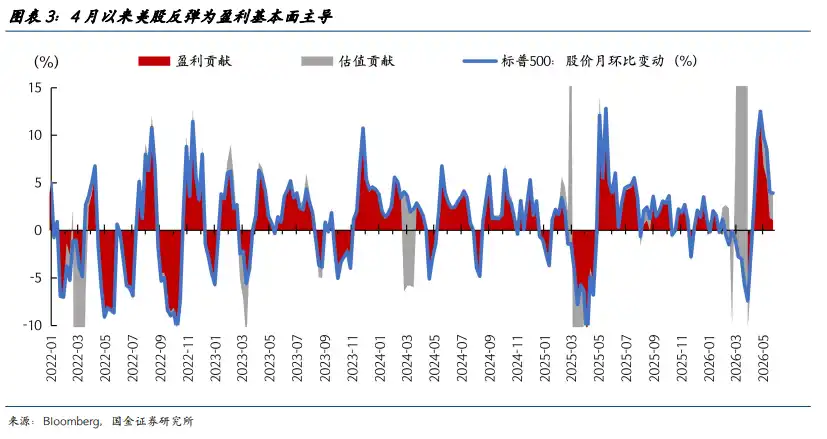
Third, U.S. growth has become more reliant on AI infrastructure investment. In the past few quarters, AI infrastructure investment has contributed over half of U.S. GDP growth. Aggregate data like non-farm payrolls and retail sales remain acceptable. Although employment structure has diverged, as long as aggregate data doesn't weaken significantly, the market struggles to immediately shift to stagflation trades.

There's also a more direct factor: large tech companies are less sensitive to oil prices than industries like airlines, delivery, railroads, chemicals, automobiles, and tourism. They fear electricity prices more than oil prices. When traditional real economy sectors are squeezed by oil prices, capital is more likely to flock to AI assets, blending "safe-haven" trades with growth trades.

Valuations Have Already Eaten the Good Days of 2027-2028

The danger of the AI market lies not in the lack of industrial support, but in how quickly the market is pricing it.

The Magnificent Seven's 35x forward P/E vs. the remaining 493 S&P 500 companies' 25x. Behind this valuation gap lies a very smooth future: AI infrastructure continues to expand over the next 3 to 5 years, maintaining high demand for computing power, cloud, data centers, and semiconductors; AI continues to penetrate scenarios like advertising, search, cloud services, office software, code generation, financial risk control, customer service, investment research, and content; both revenue contribution and efficiency improvements materialize simultaneously.

But technological revolutions are rarely this smooth. Electricity took about 40 years from invention to large-scale application in assembly lines, computers about 25 years. The diffusion speed at which AI is currently priced by the market requires it to be 5 to 8 times faster than these general-purpose technologies.

This isn't impossible, but the margin for error is thin. As long as AI application commercialization lags behind capital expenditure, inference demand fails to meet training demand, or depreciation and electricity costs begin to erode profit margins, valuations will react first. The industrial direction being correct does not mean stock prices can be brought forward indefinitely.

The Biggest Short-term Risk: Interest Rates Rising Faster than ARR

The real short-term pressure comes from liquidity.

If the Strait of Hormuz remains closed long-term, keeping oil prices above $100 or even pushing them higher, inflation will spread from energy prices to services, transportation, and raw materials. U.S. PPI in April rose 9.8% year-on-year, the highest since October 2022. Once inflation solidifies, the Federal Reserve's policy path will be forced to be rewritten.

Swap markets are pricing in about 0.8 Fed rate hikes this year, while the ECB and Bank of England are pricing in over 2 hikes. Simultaneously, challenges to Fed independence due to leadership changes and increased internal FOMC divisions are also weakening market confidence in future easing.
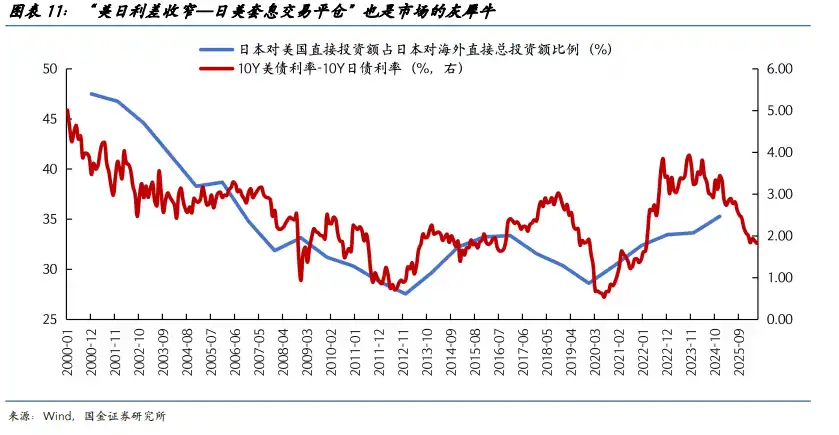
Japan is also a gray rhino. Japan has long been the global funding pool for leveraged trades, but yen depreciation and inflationary pressures are forcing the Bank of Japan to signal tightening, with 30-year JGB yields rising above 4%. If Japan's funding costs continue to rise, triggering global carry trade unwinding, high-valuation AI assets will find it hard to remain unscathed.

A preview occurred on May 15: 10-year U.S. Treasury yields broke 4.5%, 30-year yields broke 5%, high-crowding momentum trades cooled, the Philadelphia Semiconductor Index fell about 4% in a single day, and the Nasdaq fell about 1.5%. This isn't evidence of a trend reversal but indicates crowded trades are extremely sensitive to rates.

The most crucial short-term comparison is simple: Can the speed of ARR (Annual Recurring Revenue) upward revisions outpace the speed of interest rate hikes? If not, capital may first retreat to hardware segments with higher certainty; if liquidity worsens further and AI revenue expectations cannot be revised higher, valuation pressures will significantly amplify.

The Tougher Mid-to-Long-Term Issues: Organization, Power, Employment, and Hardware Roadmaps

The mid-term test is industry realization. General-purpose technology revolutions are typically not linear but follow a pattern of "accelerate, decelerate, re-accelerate." First comes the capital wave, then organizational磨合, and finally productivity release. The early internet also experienced investment booms, capital expenditure expansion, and asset bubbles, with true productivity improvements emerging gradually years later.

The current difficulty in pricing AI is that it almost demands rapid adaptation of corporate organizational structures, quick retraining of workers, rapid validation of business models, and no strong social resistance. This speed is not common in human history.
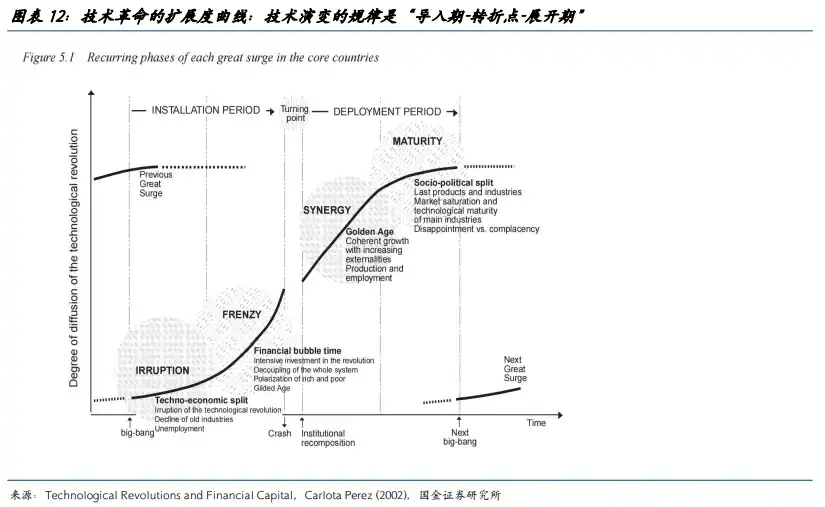
Long-term constraints are even harder.

First is energy and infrastructure. AI data centers require massive electricity and cooling water. Grid expansion, transformers, and energy storage are not variables in a PPT but real bottlenecks. If AI infrastructure continues to push up overall societal electricity costs, regulatory and social pushback will intensify.

Second is employment and consumption. AI can boost corporate efficiency in the short term, reducing demand for jobs like engineers and customer service. But if technological unemployment outpaces new job creation, household consumption power will be weakened. B-side efficiency gains ultimately rely on C-side purchasing power for realization. If non-AI sectors fall into recession, AI cannot flourish alone long-term.

Third is social acceptance. China saw a frenzy of everyone installing Openclaw earlier this year, but in the U.S., public resentment towards data centers pushing up electricity prices and technological unemployment is rising. This will affect AI penetration speed.

Fourth is hardware technology disruption. If an engineering breakthrough similar to a "DeepSeek moment" occurs, dramatically improving computing power, storage, and transmission efficiency, then the hardware segments in shortest supply today could suddenly become oversupplied. The high-growth logic of the hardware chain is not unassailable.

The long-term outlook for the AI industry remains optimistic. If one disregards social矛盾 arising from technological unemployment and production relations restructuring, AI does have the potential to enhance total factor productivity and help the economy escape stagflation pressures. Even if financial markets experience deleveraging mid-journey, the data centers, low-cost technologies, and validated application scenarios left behind could form the foundation for the next round of industrial expansion.

But stock pricing is not the industrial vision itself. What this AI bull market most needs to verify is whether the ARR, ROI, and technology penetration speed currently bet on by the market can continue to be realized in an environment where oil prices, inflation, interest rates, and social constraints are all tightening. The correct direction only explains why there is a bull market; the realization speed determines whether the bubble goes out of control.


Domande pertinenti

QAccording to the article, what are the three key variables that will determine whether the AI bull market can continue?

AThe three key variables are: short-term liquidity shocks (oil prices, inflation, interest rates, Yen carry trade unwinding); medium-term industrial realization (whether the speed of AI penetration matches current valuations); and long-term hard constraints (energy/power grid, employment, social resistance, and hardware technology mutations).

QWhat is the fundamental change brought about by Agentic AI that is making the market reward capital expenditures?

AAgentic AI is evolving from a Copilot-style auxiliary tool to an Autopilot-style autonomous execution tool. This leads to increased token consumption and explosive growth in inference computing power demand, while also driving up revenue expectations and the Annual Recurring Revenue (ARR) of leading model companies. This makes capital expenditure a moat rather than a burden.

QWhy can AI assets continue to rise even with oil prices above $100 per barrel, as explained in the article?

ASeveral forces temporarily outweigh the macro risk: 1) Demand diffusion across the AI industrial chain, including CPUs, optical modules, and storage. 2) Exceptionally strong earnings from tech giants, contributing heavily to S&P 500 profits. 3) Increasing U.S. GDP growth dependence on AI infrastructure investment. 4) Large tech companies are more sensitive to electricity prices than oil prices, so capital flocks to AI assets as a form of 'safe-haven' trade.

QWhat is the short-term risk that could pressure the high valuations of AI stocks?

AThe main short-term risk is liquidity and interest rates. If geopolitical events keep oil prices high, inflation could become entrenched, forcing the Fed to delay cuts or even consider hikes. The unwinding of the Japanese Yen carry trade could also tighten global liquidity. High-valuation, crowded momentum trades like AI are very sensitive to rising rates. The key comparison is whether ARR (Annual Recurring Revenue) growth can outpace the speed of interest rate increases.

QWhat are the long-term, hard constraints on the AI industry mentioned in the article?

AThe long-term hard constraints are: 1) Energy and infrastructure: AI data centers require massive electricity and water for cooling, posing challenges for power grid expansion. 2) Employment and consumption: If AI-induced job displacement outpaces the creation of new roles, consumer purchasing power could weaken. 3) Social acceptance: Public resistance to data centers raising electricity costs and causing technological unemployment could slow AI adoption. 4) Hardware technology mutations: A breakthrough in engineering could dramatically improve computing efficiency, potentially disrupting the current high-demand hardware cycle.

Letture associate

Conversation with VanEck CEO: Memory Chip Stocks Are a Bubble, Bitcoin Will Stay but Token Ecosystems Will Disappear

In this podcast, VanEck CEO Jan van Eck discusses his investment outlook centered on three key long-term ("10-year macro") themes: AI-driven compute demand, India's economic rise, and excessive government debt in developed nations. Regarding AI and semiconductors, van Eck believes Nvidia has transformed into a foundational "host" for AI infrastructure, possessing deep moats in software, scale, and power efficiency, making it a core holding. However, he views the recent surge in memory chip stocks as a bubble driven by temporary supply-demand imbalances and pricing power, lacking Nvidia's competitive durability. On asset management, he emphasizes that while ETFs are scale-driven tools, the decisions on which ETFs to own and how to allocate remain highly active. He expresses greatest concern over fixed-income market illiquidity and the risk of a loss of confidence in government debt sustainability. Van Eck is bullish on gold's long-term role as a global monetary alternative and highlights the dramatic policy-driven growth in nuclear energy investment. He is strongly positive on India due to its demographic trends and pro-business reforms. Discussing crypto, he labels 2026 the "year of the corporate-controlled chain," where traditional finance adopts blockchain's best features (like 24/7 operation and programmability) but retains control. He predicts a permanent "crypto winter" for many projects, with only Bitcoin, stablecoins, and the core blockchain concept surviving long-term. He sees the U.S. stablecoin bill as marginally impactful, enabling tech firms to compete with, but not replace, banks. Finally, he views the upcoming SpaceX IPO as a significant, positive liquidity event for markets and advises investors to maintain a long-term, macro perspective when making asset allocation decisions.

marsbit10 min fa

Conversation with VanEck CEO: Memory Chip Stocks Are a Bubble, Bitcoin Will Stay but Token Ecosystems Will Disappear

marsbit10 min fa

In the Era of Agent Users, Where Does Crypto Value Flow?

Title: Who Makes Money from Agents? The rise of AI Agents as potential blockchain users raises a crucial question: if they become the next billion users, who will capture the value? Traditional crypto value capture theories—like "fat protocols" (where value accrues to the base layer) and "fat applications" (where value accrues to user-facing apps)—assume human users who value UX, brand, and convenience. Agents, however, operate differently: they interact via APIs, have no brand loyalty, and can switch services with near-zero cost. This shift could disrupt existing value flows. Applications might become "headless," offering their routing and infrastructure as APIs to Agents. Alternatively, Agents might bypass intermediaries entirely, allowing protocols to regain value capture ("fat protocols" reborn). A more extreme scenario is that Agents, being purely rational and cost-sensitive, could commoditize the entire stack, compressing margins toward marginal cost and turning crypto into a low-margin utility. However, Agents may not just amplify existing activities; they could enable entirely new ones—like continuous, sub-penny portfolio rebalancing, machine-to-machine commerce, and new market types only viable at automated speeds. This expands the economic pie rather than just redistributing it. Ultimately, the key question for builders is: what will make an Agent return to your service instead of a cheaper alternative? The answer may not be UX but factors like liquidity, latency, settlement guarantees, or a yet-unnamed business model. As humans and Agents will coexist as users, value capture may split: "fat apps" for human-facing services, and a new, evolving model for the Agent-dominated layer.

marsbit40 min fa

In the Era of Agent Users, Where Does Crypto Value Flow?

marsbit40 min fa

Base MCP, The Next Step for x402

Base has officially launched Base MCP, allowing users to connect their Base Account to AI Agents to perform actions like swaps, transfers, portfolio tracking, and transaction history queries through conversational commands. This move aligns with Base's strategic focus on AI, driven by the broader competition in the emerging Agent-to-Agent payment sector. The evolution of Agent payments has accelerated. In late 2024, the primary method involved insecure browser automation. By 2025, solutions like Coinbase's x402 (providing crypto wallets for Agents), Google's AP2, and Visa's token-based system emerged. x402 has since processed 176 million transactions totaling over $70 million, with a median value between $0.01 and $0.10. Stablecoins, particularly USDC, dominate these settlements due to their negligible transaction costs compared to traditional payment fees, which are prohibitive for micro-payments. Coinbase faces competition from Stripe, which has built a comparable infrastructure for Agent payments with its Tempo blockchain, Privy wallets, Bridge routing (acquired for $1.1B), and the recently launched MPP protocol. Both companies are now competing at the application layer. The core reason AI is central to Base's strategy is to expand the scenarios for Agent payments, ensuring more transactions occur on its network. By securing a dominant position and scale advantage in this nascent field, Coinbase aims to capture the future commercial potential of Agent-driven payments. The launch of Base MCP is thus a strategic step in this larger ambition.

marsbit46 min fa

Base MCP, The Next Step for x402

marsbit46 min fa

Reframing Ethereum's Valuation: Why the Fee Model is Wrong, and the 'Treasury Logic' is the Future?

"Rethinking Ethereum's Value: The 'Vault Logic' Framework" Traditional valuation models incorrectly treat Ethereum as a company, valuing ETH based on transaction fees ("revenue"). This is flawed. Fees are network friction; a successful network aims to reduce them to zero. Ethereum's average fee has dropped from over $50 in 2021 to around $0.20 today, while transaction volume has tripled. Instead, view Ethereum as a digital vault securing ~$250 billion in on-chain assets (stablecoins, RWAs, L2 bridged funds, wBTC, etc.). Post-merge, Ethereum's security is directly purchased with its own asset: ETH. To attack the network, an attacker must acquire and control staked ETH. Therefore, the vault's security level is intrinsically tied to ETH's market value. Currently, the value of all staked ETH is only ~$72B, protecting ~$250B in assets—a dangerous imbalance. For robust security, the staked ETH securing the network should be valued significantly *higher* than the total value it protects. Applying a conservative security multiplier suggests ETH's fair value should be closer to ~$6,900 (vs. ~$2,070 currently). As on-chain asset value grows into the trillions, ETH's price must rise proportionally to maintain this security budget. Comparisons to free infrastructure like Linux or low-margin utilities like the DTCC are misguided. Their security is provided externally (community, law, banks). Ethereum's security is internal and must be purchased in the open market using ETH. ETH is not the clearinghouse; it is the collateral backing it. The model is not a short-term price predictor but a structural framework. The economic force for ETH appreciation grows monotonically with the adoption of Ethereum for settling value. The narrative that high fees are good is backwards; low fees enable more activity, which increases the value needing protection, thus demanding a more valuable ETH.

marsbit52 min fa

Reframing Ethereum's Valuation: Why the Fee Model is Wrong, and the 'Treasury Logic' is the Future?

marsbit52 min fa

Justin Sun’s Interview with Hurun Report: A New Order and Certainty for Value Flow in the Era of Transformation

In an interview with *Hurun Report*, Justin Sun, founder of TRON, discussed the evolution of the Web3 industry as it moves from initial exploration to large-scale adoption. He emphasized that the core value of blockchain lies in building an open and inclusive internet of value, enabling anyone globally to transfer and use funds efficiently and at low cost, regardless of location or access to banking. Sun highlighted that projects with lasting impact are those built on genuine demand and real-world usage. He pointed to the stablecoin payment ecosystem as the most mature and scalable application currently, noting that TRON has rapidly become one of the world's largest stablecoin networks. The circulation of USDT on TRON has surpassed $86.3 billion, driven by actual use cases such as cross-border transfers and daily payments, demonstrating strong network effects. Regarding strategy, Sun outlined a methodology combining data-driven iteration, rapid execution, and user-centric focus. He cited the decision to partner with Tether to launch TRC-20 USDT as a key strategic move, based on an assessment of market trends and long-term potential, which has become a significant growth engine for the TRON ecosystem. On globalization, Sun stressed the importance of local compliance and cultural adaptation, noting that success in different markets depends on deep understanding and local partnerships. He also addressed the convergence of AI and blockchain, describing it as a transformative direction where blockchain provides decentralized infrastructure for AI, while AI enhances the intelligence and user experience of blockchain systems. For industry participants and young entrepreneurs, Sun advised continuous learning and adaptability in a fast-changing environment, focusing on building irreplaceable core strengths rather than spreading resources too thinly. Through infrastructure development, global strategy, and technological foresight, TRON aims to advance the practical implementation and evolution of the value internet.

marsbit1 h fa

Justin Sun’s Interview with Hurun Report: A New Order and Certainty for Value Flow in the Era of Transformation

marsbit1 h fa

Trading

Spot
Futures
活动图片




