By Su Yang, Tencent Technology
Nvidia has once again delivered a stellar earnings report, with revenue, operating profit, and earnings per share all reaching new historic highs.
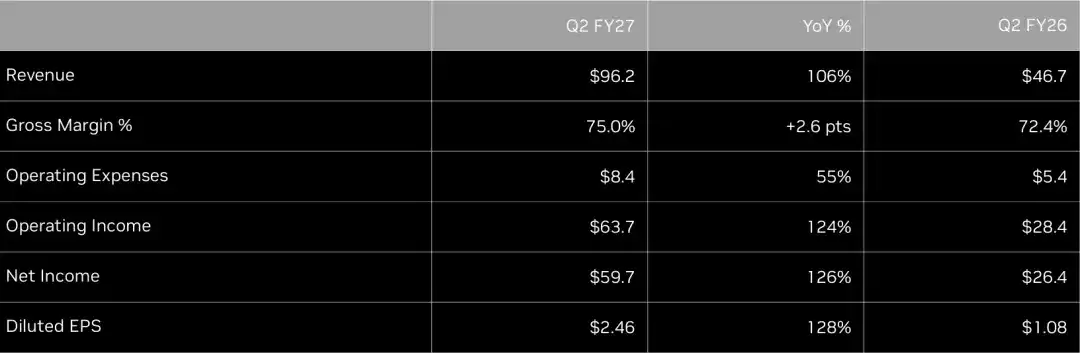
On August 26th US local time, Nvidia announced its fiscal 2027 second quarter results for the period ending July 26, 2026. The financial report shows that Nvidia's revenue for the quarter reached $96.221 billion, a 106% increase year-over-year and an 18% increase quarter-over-quarter; net profit reached $59.688 billion, a 126% increase year-over-year; diluted earnings per share were $2.46, a 128% increase year-over-year.
Compared to the previous quarter's revenue of $81.615 billion, Nvidia continues to break growth records. In the same period last year, the company's quarterly revenue was only $46.743 billion; it has almost doubled in just one year.
After the earnings report was released, Nvidia's after-hours stock price initially fell about 1.3%, then jumped over 4%, reflecting the divergence and shift in market focus: In the past, investors focused on whether Nvidia could continue to exceed expectations; now they are more concerned about how long the AI infrastructure construction boom can last, and whether the next-generation chips and new business models can sustain future growth.
In terms of profitability, Nvidia still maintains an exceptionally high level.
In the second quarter, the company's operating profit reached $63.734 billion, a 124% increase year-over-year; on a Non-GAAP basis, net profit was $53.954 billion, a 118% increase year-over-year. During the same period, the company's gross margin reached 75%, higher than 72.4% in the same period last year and slightly above 74.9% in the first quarter.
Nvidia founder and CEO Jensen Huang stated: "AI has reached a tipping point. It's doing useful work, its tokens are creating productivity and profitability. Now, computing is revenue."
Now, more AI labs and startups are expanding rapidly, the open-source model ecosystem, and new directions likephysical AIare beginning to develop, and the entire AI industry is entering a broader construction cycle.
At the same time, Nvidia continues to increase returns to shareholders. In the second quarter, the company returned approximately $26 billion to shareholders through share repurchases and cash dividends. As of the end of the quarter, the company still had approximately $99 billion remaining under its share repurchase authorization.
01 Data Center Revenue Soars, AI Cloud Customer Growth is Even Faster
The core driver of Nvidia's growth this round remains the data center business.
In the second quarter, Nvidia's data center revenue reached $89.023 billion, a 117% increase year-over-year and an 18% increase quarter-over-quarter, contributing nearly all of the company's revenue growth. As global enterprises and cloud service providers continue to invest in AI infrastructure construction, demand for Nvidia GPUs remains high.
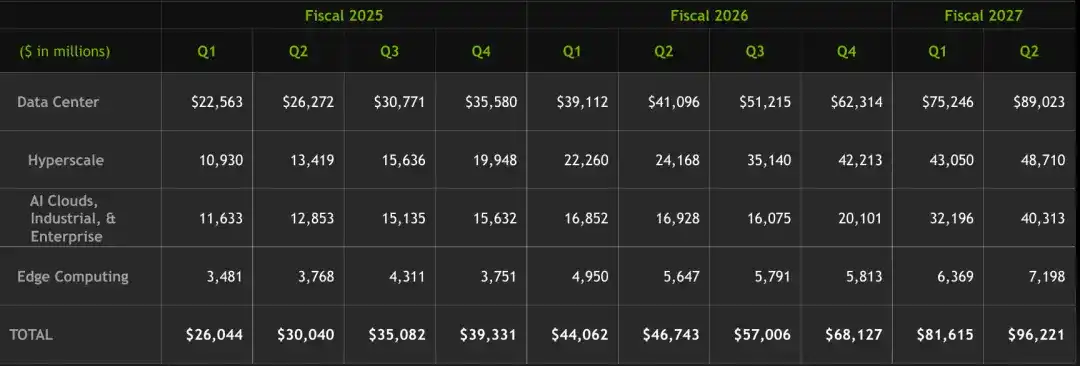
In the first quarter, Nvidia adjusted its disclosure method for the data center business, categorizing customers into Hyperscale and ACIE (AI Cloud, Industrial & Enterprise) two major categories.
Among them, hyperscale customer revenue reached $48.71 billion, a 102% increase year-over-year and a 13% increase quarter-over-quarter, primarily from large public cloud and internet companies.
At the same time, AI Cloud, Industrial & Enterprise (ACIE) customer revenue reached $40.313 billion, a 138% increase year-over-year and a 25% increase quarter-over-quarter. This business covers AI-native companies, enterprise customers, sovereign AI customers, and hyperscale computing demands using AI cloud services.
The new classification method shows that AI computing demand is spreading from a few cloud giants to enterprises, governments, and more industry scenarios. However, investors still focus on the profitability and long-term demand behind different customer types, not just the growth in order volume.
The Chinese mainland market remains an important variable in the earnings report.
Nvidia stated that in the second quarter, revenue from data centerHopperproducts shipped to the Chinese mainland accounted for less than 1% of data center revenue. Meanwhile, the company's outlook for the third quarter does not include any data center computing revenue from the Chinese mainland.
Aside from the data center business, the edge computing business revenue reached $7.198 billion in the second quarter, a 27% increase year-over-year and a 13% increase quarter-over-quarter. Growth was driven by Blackwell workstation sales, but growth in consumer PCs was partially offset by rising memory and system prices.
02 Blackwell Ultra Ramps Up, Vera Rubin Fully in Production
Nvidia is shifting its product roadmap from single GPU upgrades to a complete computing platform.
In the second quarter, Blackwell Ultra became a key factor driving data center business growth. Nvidia stated that the quarter's data center revenue growth primarily came from the large-scale deployment of Blackwell Ultra infrastructure. As cloud service providers and AI enterprises continue to build large-scale AI computing clusters, Blackwell is entering a broader phase of commercial deployment.
At the same time, Nvidia has begun preparing for the next product cycle. In the second quarter, the company announced that the Vera Rubin platform has entered full production, with related rack systems already running on partner cloud platforms like CoreWeave and Google Cloud.
The Rubin platform includes not only GPUs but also CPUs, networking, software, and system-level solutions. Among them, the Vera CPU is Nvidia's first CPU designed specifically for AI agents, and the product is planned to be adopted by leading global technology providers.
Additionally, Nvidia announced that the NVIDIA Groq 3 LPX for interactive AI inference is fully in production. Nvidia hopes to strengthen its competitiveness in real-time AI inference scenarios with products like Groq 3 LPX.
Besides hardware products, Nvidia is also strengthening its software ecosystem.
In the second quarter, the company launched the DSX platform, providing infrastructure builders with a complete solution for designing, building, and operating large-scale AI factories. This platform integrates computing, networking, software, and systems to help customers build larger-scale AI infrastructure.
In AI software, Nvidia continues to expand the NVIDIA Agent Toolkit and enhances development capabilities through PhysicsNeMo and CUDA-X libraries. The company stated it is collaborating with global software platform providers to launch new software, open-source models, and partner programs.
For Nvidia, product competition is no longer confined to individual chip performance but revolves around the complete ecosystem from chips, networking, software, to systems. However, the market is still focused on the transition speed from Blackwell to Rubin, and whether the new-generation platform can continue to drive customers to expand AI infrastructure investments.
03 AI Infrastructure Enters Financing Stage, Nvidia Takes on More Construction Role
As the scale of AI data centers expands, Nvidia is becoming more involved in infrastructure construction.
The second-quarter earnings report shows that as of July 26, 2026, Nvidia's future commitments amounted to $360 billion. This includes $279 billion in supply and capacity commitments, $29 billion in cloud service agreements, $23 billion in capital expenditures, and $25 billion in equity investments.
These commitments are primarily related to future AI infrastructure expansion. Of particular interest is Nvidia's involvement in theSB EnergyOhio PORTS-Pike project.
Nvidia stated that the company provided credit support for SB Energy's technology campus in Ohio. The initial phase of the project involves approximately 4.25GW of land, power, and plant construction to host Nvidia infrastructure for OpenAI. Nvidia's guarantee obligation amounts to up to $105 billion, which will take effect in stages after conditions such as the data center reaching a serviceable state are met.
At the same time, Nvidia is driving larger-scale capital investment in AI infrastructure. The company has announced strategic partnerships with institutions such asApollo, BlackRock, Blackstone, Brookfield, Goldman Sachs, and KKR, aiming to mobilize over $500 billion in third-party capital for AI infrastructure construction in the future.
Jensen Huang believes that AI infrastructure construction is entering a new phase, requiring massive capital investment in the future to support AI model training, inference, and the development of more applications.
However, as Nvidia participates in more infrastructure projects, the market has also begun to focus on the capital pressure this model brings.
As of the end of the second quarter, Nvidia had a total of $56.6 billion in cash, cash equivalents, and marketable debt securities. Meanwhile, the company issued $25 billion in senior unsecured notes in the second quarter for general corporate purposes. Nvidia stated that its current financial position remains robust, and future investments will focus on supporting supply chain, infrastructure, and long-term growth needs.
04 Q3 Revenue to Exceed $100 Billion, Competitive Pressure Begins to Show
For the next quarter, Nvidia expects continued growth.
The company expects fiscal 2027 third-quarter revenue to reach $108 billion, plus or minus 2%; it expects both GAAP and Non-GAAP gross margins to be 74%. Nvidia also emphasized that this guidance does not include any data center computing revenue from China.

Compared to the second quarter's $96.2 billion revenue, Nvidia expects the third quarter to maintain growth. However, market focus has shifted from single-quarter growth to the long-term competitive landscape.
Currently, competition in the AI chip market is intensifying. Nvidia emphasized in its earnings report that the company is maintaining its advantage through a complete computing platform, including processors, interconnect technologies, software, algorithms, systems, and services. The company hopes this entire ecosystem will meet AI training and inference needs.
But at the same time, competitors are accelerating their layouts. AMD continues to launch data center products, and Google is also developing its own TPU chips. Large tech companies are both important customers of Nvidia and investing resources to develop their own computing platforms.
Investors are particularly focused on the development of the AI inference market. As AI applications increase, computing demand is expanding from model training to inference services. Nvidia is strengthening inference capabilities through the Vera Rubin platform, Groq 3 LPX, and its software ecosystem, hoping to maintain its market leadership position.
However, future growth still needs to answer several questions: Can Blackwell Ultra and the Rubin platform continue to drive increased customer purchases? Can AI infrastructure investment maintain its current pace? And as customer self-developed chips increase, will Nvidia's share of the AI computing market be affected?
$96.2 billion in revenue is another milestone for Nvidia in the AI wave.
For Nvidia, the record-breaking financial data proves the success of the past cycle. The challenge of the next stage is how to maintain its core position as the AI industry enters a phase of larger-scale construction.