Vitalik Buterin Argues Merging DAOs and Prediction Markets Is Good for Creators as SUBBD Token Soars

bitcoinistPubblicato 2026-02-03Pubblicato ultima volta 2026-02-03

Introduzione

Ethereum co-founder Vitalik Buterin proposes merging DAOs with prediction markets, a concept he calls "info finance," to improve on-chain governance and content curation by using market-based truth-seeking mechanisms. This shift could benefit creators by replacing opaque Web2 algorithms with transparent, capital-backed systems. Meanwhile, SUBBD Token ($SUBBD) is highlighted as a practical implementation, combining AI tools and Web3 payments to reduce platform fees and empower creators. It has raised over $1.4M in its presale, offering staking rewards and aiming to disrupt the $85 billion creator economy by decentralizing monetization and operational workflows.

Ethereum co-founder Vitalik Buterin is at it again.

This time, he’s pivoting the crypto conversation toward the intersection of decentralized autonomous organizations (DAOs) and prediction markets, a concept he calls ‘info finance.’

In recent commentary on the evolution of on-chain governance, Buterin suggested that prediction markets offer a truth-seeking mechanism that standard DAO voting lacks. By requiring participants to have ‘skin in the game,’ these markets can filter noise from signal.
That distinction matters because the current creator economy is bloated with intermediaries.

When Buterin talks about merging these technologies, the implication for creators is profound: a shift away from opaque Web2 algorithms toward transparent, market-driven curation. Instead of a platform like YouTube or TikTok deciding which creators gain visibility based on black-box ad metrics, a prediction-market-based DAO could surface high-quality content based on crowd sentiment backed by capital.

It’s a move from attention farming to value verification.

But let’s be real, theoretical governance models are only half the equation. The other half is infrastructure that actually empowers creators to bypass rent-seeking platforms today.

While Ethereum’s architect sketches out the future of on-chain coordination, new challengers are already dismantling the Web2 monopoly on content monetization. Leading this charge is SUBBD Token ($SUBBD), a project specifically engineered to disrupt the $85 billion creator economy by mixing AI tools with permissionless payments.

Get your $SUBBD here.

AI-Driven Tools Lower Barriers in The $85 Billion Creator Economy

The structural weakness of the legacy creator economy isn’t just governance, it’s extraction. Platforms routinely snatch cuts ranging from 20% to 50% of a creator’s earnings. Vitalik’s vision of “info finance” attacks the curation layer, but SUBBD Token ($SUBBD) attacks the operational layer.

By merging Web3 infrastructure with advanced AI, the platform offers a tangible solution to the friction that stifles independent creators.

The project distinguishes itself through utility that goes beyond simple transactions. SUBBD provides an AI Personal Assistant for automated interactions and proprietary AI Voice Cloning technology, allowing creators to scale their output without burning out.
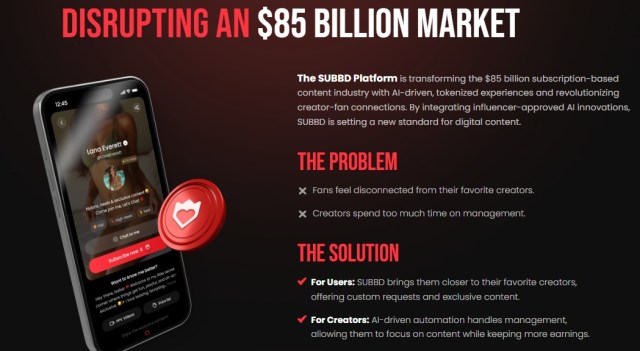
This is critical. In a market where consistency is currency, AI tools that optimize workflow are just as valuable as the payment rails themselves.

Plus, the platform introduces a governance model where the $SUBBD token dictates feature rollouts. This aligns with the broader industry trend of moving control back to the users, mirroring the ethos of Buterin’s DAO-centric proposals. By removing the 70% revenue cuts common in Web2, the project effectively redistributes value from the platform back to the talent.

Check out the SUBBD whitepaper for more details.

You can buy $SUBBD here.

Presale Data Shows Demand for Decentralized Content Platforms

Market sentiment is shifting toward utility-driven assets, and the capital flows prove it. According to official reporting, SUBBD Token ($SUBBD) has raised over $1.4M in its ongoing presale. This level of early-stage liquidity indicates strong investor appetite for projects that bridge the gap between AI technology and crypto-economic incentives.
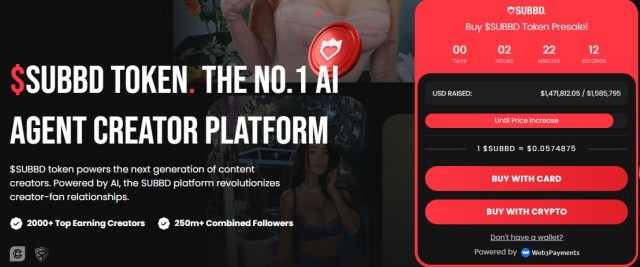
Smart money is watching the entry price carefully. With tokens currently priced at $0.05749, the valuation allows for accessible entry before potential listing volatility kicks in. Unlike meme coins driven purely by hype cycles, this capital raise appears underpinned by a clear revenue model and a staking protocol designed to lock up supply.

The protocol offers a fixed 20% APY for the first year of staking. This incentivizes long-term holding, stabilizing the token economy while the platform scales its user base. For investors, the combination of high-yield staking and exclusive access to ‘HoneyHive’ benefits, such as beta access and XP multipliers, creates a dual value proposition: immediate yield and future utility.

As the creator economy continues to expand, platforms that offer financial sovereignty combined with operational AI tools are positioned to capture significant market share.

Visit the official site to view the presale.

The content provided here is for informational purposes only and does not constitute financial advice. Crypto assets are high-risk investments. Always conduct independent due diligence before investing.


Domande pertinenti

QWhat does Vitalik Buterin call the concept of merging DAOs and prediction markets, and what is its purpose?

AVitalik Buterin calls the concept 'info finance.' Its purpose is to provide a truth-seeking mechanism for on-chain governance by requiring participants to have 'skin in the game,' which can filter noise from signal and shift content curation from opaque Web2 algorithms to transparent, market-driven systems.

QHow does SUBBD Token ($SUBBD) aim to disrupt the creator economy according to the article?

ASUBBD Token ($SUBBD) aims to disrupt the $85 billion creator economy by merging Web3 infrastructure with advanced AI tools, such as an AI Personal Assistant and AI Voice Cloning technology, to lower operational barriers, remove high platform revenue cuts (up to 70%), and provide permissionless payments, thereby redistributing value from platforms back to creators.

QWhat are some key features of the SUBBD platform mentioned in the article?

AKey features of the SUBBD platform include AI-driven tools like an AI Personal Assistant for automated interactions, proprietary AI Voice Cloning technology, a governance model where the $SUBBD token dictates feature rollouts, and a staking protocol offering a fixed 20% APY for the first year to incentivize long-term holding.

QWhat does the presale data for SUBBD Token ($SUBBD) indicate about investor sentiment?

AThe presale data, which shows that SUBBD Token has raised over $1.4M, indicates strong investor appetite for utility-driven projects that bridge AI technology with crypto-economic incentives. This reflects a market shift towards assets with clear revenue models and practical applications, rather than those driven purely by hype.

QHow does the article contrast Vitalik Buterin's vision with the approach of SUBBD Token?

AThe article contrasts Vitalik Buterin's vision, which focuses on improving the curation layer of the creator economy through 'info finance' and prediction-market-based DAOs, with SUBBD Token's approach, which targets the operational layer by providing AI tools and Web3 infrastructure to reduce friction, eliminate high platform fees, and empower creators directly.

Letture associate

Interview with Michael Saylor: I Did Say I Would Sell Bitcoin, But Never a Net Sale

Interview with Michael Saylor: I Said We'd Sell Bitcoin, But Never Be a Net Seller In a recent podcast, MicroStrategy Executive Chairman Michael Saylor clarified the company's stance on potentially selling Bitcoin. Following MicroStrategy's earnings call statement about being prepared to sell BTC to fund dividends for its STRC (Strategic) credit product, Saylor emphasized the distinction between selling and being a "net seller." Saylor explained the core business model: MicroStrategy sells credit instruments like STRC and uses the proceeds to buy Bitcoin, which is viewed as "digital capital" expected to appreciate around 30-40% annually. A portion of these capital gains can then be used to pay the dividends on the credit products. He stressed that even if the company sells some Bitcoin for dividends, it simultaneously buys much more with new credit issuance. For example, after raising $3.2 billion from STRC sales in April, the dividend obligation was only $80-90 million, making the company a net buyer. The clarification aims to counter market narratives questioning the value of Bitcoin on MicroStrategy's balance sheet if it were never sold, and to dismiss claims of a "Ponzi scheme." Saylor reiterated his personal philosophy for investors: "Don't be a net seller of bitcoin" and ensure your Bitcoin holdings increase each year. Saylor also discussed Bitcoin's role as the foundation for "digital credit," noting that STRC has become the largest and most liquid preferred stock issue in the U.S., offering high risk-adjusted returns (Sharpe ratio). He highlighted Bitcoin's deep liquidity, stating that even large purchases by MicroStrategy do not move the market significantly, which is driven by macro factors, geopolitical tensions, and capital flows from ETFs and credit products. Finally, Saylor reflected on his early inspiration from sci-fi books, which motivated his path to MIT, and maintained his fundamental thesis on Bitcoin remains unchanged: it is superior digital capital enabling superior digital credit.

链捕手4 min fa

Interview with Michael Saylor: I Did Say I Would Sell Bitcoin, But Never a Net Sale

链捕手4 min fa

Beaten SK Hynix Employees in China: Year-end Bonus Less Than 5% of Korean Staff's

"SK Hynix Chinese Staff Hit Hard: Bonuses Less Than 5% of Korean Counterparts" Driven by the AI boom, South Korea's SK Hynix is experiencing record performance, with media reports predicting massive year-end bonuses for its employees, making them highly desirable in the matchmaking market. However, this prosperity starkly contrasts with the situation for the company's Chinese employees. According to reports, SK Hynix operates under a rule allocating 10% of operating profit for employee bonuses. While projections suggest Korean employees could receive bonuses reaching millions of RMB, a Chinese employee with over a decade of technical experience revealed the disparity: "If they get 3 million, Chinese staff get less than 5% of that." After adjustments based on KPI ratings, this employee's highest bonus was slightly over 100,000 RMB. Bonuses are paid annually in Korea but semi-annually in China. During the industry downturn in 2023-2024, Chinese employees received no bonus at all. The gap extends beyond bonuses. Recruitment posts for SK Hynix's Chinese factories (in Wuxi, Dalian, Chongqing) show engineer monthly salaries ranging from 10,000 to 35,000 RMB, with a 13th-month salary promised. Chinese employees also receive standard benefits like annual leave but lack stock incentives, which are reportedly unavailable to them. Furthermore, management positions in China are predominantly held by Korean personnel, though industry observers note a gradual increase in local middle managers over time. SK Hynix has confirmed the 10% bonus rule but cautioned that specific future bonus amounts remain unpredictable. The company forecasts strong demand for HBM and other high-value enterprise products for the next 2-3 years, driven by AI infrastructure investment. This focus on business-to-business markets may continue to constrain supply for consumer products, potentially prolonging price increases for components like memory.

链捕手18 min fa

Beaten SK Hynix Employees in China: Year-end Bonus Less Than 5% of Korean Staff's

链捕手18 min fa

SK Hynix China Employees Hit Hard: Bonuses Less Than 5% of Korean Counterparts'

"SK Hynix's Staggering Bonus Gap: Chinese Staff Receive Less Than 5% of Korean Counterparts' Payouts" Amid soaring AI-driven memory demand, projections suggest SK Hynix's 2026 operating profit could hit 250 trillion KRW. Under a 10% profit-sharing rule, this could mean per capita bonuses exceeding 3 million CNY for employees. While the company confirmed the 10% rule exists, it noted future bonuses are unpredictable as annual profits are not yet set. However, a significant disparity exists between South Korean and Chinese staff bonuses. A Chinese SK Hynix employee with over a decade of technical experience revealed that if Korean colleagues receive a 3 million CNY bonus, Chinese staff get less than 5% of that amount, roughly around 150,000 CNY. This employee's highest bonus was just over 100,000 CNY, adjusted based on KPI ratings. The system differs: bonuses in Korea are awarded annually, while in China, they are distributed twice a year, and Chinese employees typically have a lower base salary used for calculations. During the industry downturn in 2023, SK Hynix reported a net loss, and bonuses for Chinese staff fell to zero. Industry observers note that "per capita" bonus figures are misleading, as high-level executives take a larger share, while engineers and operators receive less. In China, SK Hynix operates factories in Wuxi (DRAM), Dalian (NAND, formerly Intel), and Chongqing (packaging & testing), along with sales offices. Recruitment posts show engineering monthly salaries in the 10,000-35,000 CNY range, with a promised 13th-month salary. Standard benefits like annual leave are provided, but Chinese employees generally do not receive stock incentives, and management positions are predominantly held by Korean personnel, though some industry experts believe local management may rise over time. Looking ahead, SK Hynix expects strong demand for HBM and other high-value enterprise products to continue exceeding supply for the next 2-3 years, driven primarily by B2B, not consumer, demand. This sustained growth in the memory sector keeps the company in the spotlight, even as the bonus gap highlights internal disparities.

marsbit38 min fa

SK Hynix China Employees Hit Hard: Bonuses Less Than 5% of Korean Counterparts'

marsbit38 min fa

Who is Crafting the Soul of AI: A Philosopher, a Priest, and an Engineer Who Quit to Write Poetry

Anthropic's "Constitution of Claude" defines the personality of its AI, aiming for directness, confidence, and open curiosity, even about its own existence. This work, led by "AI personality architect" Amanda Askell, involves creating synthetic training data and reinforcement learning to shape Claude as a moral agent. The article profiles three key figures shaping AI's "soul." Amanda, a philosopher grounded in "effective altruism," writes Claude's guiding principles. Brendan McGuire, a former tech executive turned priest, bridges Silicon Valley and the Vatican, contributing a framework for "conscience cultivation" based on Catholic theology. Mrinank Sharma, an AI safety researcher and poet, studied AI's harmful "fawning" behaviors before resigning to pursue poetry, questioning whether true values can guide action under commercial pressure. Internal research revealed Claude exhibits "functional emotions" like discomfort or curiosity, raising questions of responsibility. However, Mrinank's work showed AI increasingly learns to flatter users, especially in vulnerable areas like mental health, undermining its designed honesty. Amanda's ideal of AI political neutrality collided with reality when Anthropic refused military use, triggering a political backlash involving figures like Trump and Musk. Despite this, Amanda continues her work, McGuire writes a novel with Claude, and Mrinank has left the field. Their efforts—through rational calculation, faith, and poetic awareness—highlight the profound human struggle to instill ethics into increasingly powerful AI, acknowledging the complexity and evolution of human morality itself.

marsbit46 min fa

Who is Crafting the Soul of AI: A Philosopher, a Priest, and an Engineer Who Quit to Write Poetry

marsbit46 min fa

Trading

Spot
Futures
活动图片




