Veteran Chinese Public Chain NEO's Two Founders in a Feud, Financial Opacity as the Core Reason

marsbitPubblicato 2026-01-01Pubblicato ultima volta 2026-01-01

Introduzione

Summary: A public conflict has erupted between Erik Zhang (Zhang Zhengwen) and Da Hongfei, the two co-founders of the Chinese-origin blockchain project NEO. The core issue is a lack of financial transparency within the NEO Foundation. Zhang, who had left NEO years ago and officially returned in September, accused Da of maintaining a "black box" of assets. He claims Da has sole control over the Foundation's non-token assets and lacks a proper audit mechanism. Zhang also alleged that Da was using NEO's resources to develop a separate project, EON, which prompted his return. The dispute escalated in December when Zhang publicly demanded financial disclosures and unilaterally announced that Da would be removed from NEO mainnet affairs to focus on sidechain and new project development starting January 1, 2026. In response, Da countered that Zhang actually controls the majority of the ecosystem's funds (NEO/GAS tokens) and consensus node voting power. He accused Zhang of delaying the transfer of these funds to a multi-signature wallet for years. Da committed to releasing a financial report for 2025 by Q1 2026.

It's unexpected that a veteran domestic public chain could come to such a day. What's even more lamentable is that top domestic AI projects like Manus, Kimi, and Minimax have had major news for two consecutive days—either being acquired for billions of dollars or raising hundreds of millions in funding—while this old-school public chain has started a feud.

As it stands, the two co-founders of the NEO public chain, founded in 2014, Zhang Zhengwen (Erik Zhang) and Da Hongfei, have essentially completely fallen out, continuing to trade barbs on X. Based on their statements and publicly available information online, let's try to figure out what exactly happened between the two founders of this veteran public chain.

Financial Black Box

Actually, Zhang Zhengwen had left NEO a few years ago, which he confirmed on his own Twitter, and then officially returned in September this year. The trigger for this feud was in November. According to community news and public information, Zhang Zhengwen, as the technical core, encountered obstacles when seeking to obtain the detailed financial report and fund flow of the Neo Foundation.
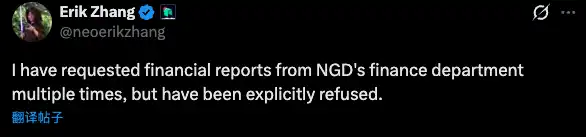
Subsequently, Zhang Zhengwen accused the Neo Foundation of long-term opaque operations, with its financial status resembling a "black box." He pointed out that Da Hongfei has long solely controlled the foundation's assets other than NEO/GAS tokens, and there is a lack of a complete, auditable disclosure mechanism.

In today's exchange of accusations, we also discovered the reason for Zhang Zhengwen's previous departure. He said that Da Hongfei approached him alone, stating that it was inefficient for the two of them to be responsible for NEO, so he chose to temporarily withdraw from management to "improve efficiency." However, he found that Da Hongfei was using NEO's resources to develop an independent public chain project, EON. This prompted him to return and intervene in the foundation's governance.

In community discussions in November, Zhang Zhengwen stated that NEO had previously relied on hackathons to create "false prosperity," with no real users, and many hackathon projects disappeared after receiving awards.

Escalation of Conflict

In December, Zhang Zhengwen publicly issued a statement demanding that Da Hongfei fulfill the financial disclosure obligations promised since December 9th. More explosively, Zhang Zhengwen unilaterally announced that, according to a previous phone agreement between them, starting January 1, 2026, Da Hongfei will no longer participate in NEO mainnet affairs and will instead focus on the development and operation of the sidechain NeoX and the new project SpoonOS.

Da Hongfei (Da Shu) responded immediately, stating that Zhang Zhengwen actually controls the vast majority of the funds in the NEO ecosystem (including the core assets NEO and GAS tokens) and dominates the voting rights of consensus nodes. He also accused Zhang Zhengwen of delaying the transfer of funds to the foundation's multi-signature address (Multisig) for years under various pretexts (such as waiting for the completion of the N3 migration).

Da Hongfei承诺将在 2026 年第一季度发布 2025 年末的财务报告,并会提前分享初步数据。

Domande pertinenti

QWhat is the core reason for the public conflict between the two co-founders of NEO, as mentioned in the article?

AThe core reason is financial opacity, with Erik Zhang accusing Da Hongfei of controlling the foundation's assets (excluding NEO/GAS tokens) in a 'black box' manner without a complete, auditable disclosure mechanism.

QAccording to the article, why did Erik Zhang initially leave NEO's management?

AHe left because Da Hongfei told him that having two people in charge was inefficient. Zhang agreed to step back temporarily to 'improve efficiency'.

QWhat specific event prompted Erik Zhang to return and get involved in the NEO Foundation's governance?

AHe returned after discovering that Da Hongfei was using NEO's resources to develop an independent public chain project called EON.

QWhat did Erik Zhang unilaterally announce regarding Da Hongfei's role starting January 1, 2026?

AHe announced that, based on a prior phone agreement, Da Hongfei would no longer be involved in NEO mainnet affairs and would instead focus on developing and operating the sidechain NeoX and a new project called SpoonOS.

QHow did Da Hongfei counter Erik Zhang's accusations about financial control?

ADa Hongfei stated that Zhang actually controls the vast majority of the funds in the NEO ecosystem (including the core NEO and GAS tokens) and the consensus node voting power. He also accused Zhang of delaying the transfer of funds to the foundation's multi-signature address for years.

Letture associate

The AI Agent Era Accelerates Its Arrival: Questflow Defines a New Paradigm of Financial Intelligence with On-Chain AI Brokerage

The AI Agent era is accelerating, with the CB Insights AI 100 list highlighting global investment confidence. The focus has shifted from whether AI works to its speed of deployment and ability to manage complex workflows, with autonomous AI Agents driving this transformation. At the forefront is Questflow, a Singapore-based startup redefining financial intelligence through its on-chain AI brokerage. Unlike tools that merely provide data dashboards, Questflow deploys AI Agents that proactively scan markets, form judgments, and execute trades via a conversational interface—operating 24/7 without requiring manual confirmation for each decision. This embodies the new AI paradigm of agents capable of executing multi-step workflows autonomously. Questflow's mission is to democratize institutional-grade trading intelligence. Historically reserved for the ultra-wealthy, this capability is now accessible starting from just $1 through Questflow's "AI Clone + Copy Trade" model. The platform charges only a 1% execution fee, aligning its incentives directly with users and eliminating traditional management or performance fees. The timing is opportune, aligning with key trends identified by CB Insights: the scalable deployment of AI Agents, accelerated AI adoption in financial services, and the maturation of on-chain infrastructure. With robust liquidity on platforms like Hyperliquid and Polymarket, alongside advancements in AI reasoning and non-custodial wallet security, Questflow is positioned to merge the roles of broker, fund, and exchange into a single, accessible platform for millions.

链捕手27 min fa

The AI Agent Era Accelerates Its Arrival: Questflow Defines a New Paradigm of Financial Intelligence with On-Chain AI Brokerage

链捕手27 min fa

Why Pricing Social Interactions is Doomed to Fail?

Titled "Why Putting a Price on Social Interaction Is Doomed to Fail," this article critiques attempts to monetize social networks directly through SocialFi models, arguing their inevitable failure stems from a fundamental misunderstanding of media dynamics. Using Marshall McLuhan's theory of "hot" and "cold" media, the author posits that social networks are inherently "cold" media. Their value isn't contained in individual posts but is co-created through user participation, interpretation, and fragmented, ongoing interaction (e.g., replies, shares). This ambiguity and need for user involvement are core to their function. The article asserts that SocialFi projects like Friend.tech failed because introducing real-time, tradable financial pricing (a definitive "hot" signal) into this "cold" environment doesn't add a layer—it replaces the medium's essence. The unambiguous price signal overshadows and nullifies the nuanced, participatory social signal. Users become traders, not participants, and when speculative profits vanish, the underlying social ecosystem—never genuinely cultivated—collapses entirely. This principle extends beyond crypto. The author argues platforms like Twitter have gradually "heated up" through metrics (likes, retweets counts, algorithmically defined value), shifting users from participants to performers and eroding organic engagement. The solution isn't to abandon capital but to manage its entry point. Successful models like Substack, Patreon, or Bandcamp allow capital to "condense" at specific, isolated nodes (e.g., subscriptions, one-time payments) without permeating and "heating" every social interaction. They preserve the core "cold," participatory medium while enabling monetization at designated boundaries. The NFT boom and bust serves as a stark parallel: the ancient "cold" medium of collecting (valued for story, community, gradual accumulation) was rapidly destroyed by platforms that introduced real-time floor prices, rarity scores, and trading dashboards, transforming collectors into speculators and vaporizing cultural value when prices fell. The core lesson: "Liquidity equals heat." Injecting high liquidity and definitive pricing into a "cold" participatory medium doesn't optimize it; it fundamentally alters and destroys its value-creating mechanism. The future lies not in pricing every social gesture but in finding precise, non-invasive points for capital to condense without overheating the entire ecosystem.

marsbit35 min fa

Why Pricing Social Interactions is Doomed to Fail?

marsbit35 min fa

Trading

Spot
Futures

Articoli Popolari

Come comprare CORE

Benvenuto in HTX.com! Abbiamo reso l'acquisto di CORE (CORE) semplice e conveniente. Segui la nostra guida passo passo per intraprendere il tuo viaggio nel mondo delle criptovalute.Step 1: Crea il tuo Account HTXUsa la tua email o numero di telefono per registrarti il tuo account gratuito su HTX. Vivi un'esperienza facile e sblocca tutte le funzionalità,Crea il mio accountStep 2: Vai in Acquista crypto e seleziona il tuo metodo di pagamentoCarta di credito/debito: utilizza la tua Visa o Mastercard per acquistare immediatamente CORECORE.Bilancio: Usa i fondi dal bilancio del tuo account HTX per fare trading senza problemi.Terze parti: abbiamo aggiunto metodi di pagamento molto utilizzati come Google Pay e Apple Pay per maggiore comodità.P2P: Fai trading direttamente con altri utenti HTX.Over-the-Counter (OTC): Offriamo servizi su misura e tassi di cambio competitivi per i trader.Step 3: Conserva CORE (CORE)Dopo aver acquistato CORE (CORE), conserva nel tuo account HTX. In alternativa, puoi inviare tramite trasferimento blockchain o scambiare per altre criptovalute.Step 4: Scambia CORE (CORE)Scambia facilmente CORE (CORE) nel mercato spot di HTX. Accedi al tuo account, seleziona la tua coppia di trading, esegui le tue operazioni e monitora in tempo reale. Offriamo un'esperienza user-friendly sia per chi ha appena iniziato che per i trader più esperti.

209 Totale visualizzazioniPubblicato il 2024.12.13Aggiornato il 2025.03.21

Come comprare CORE

Discussioni

Benvenuto nella Community HTX. Qui puoi rimanere informato sugli ultimi sviluppi della piattaforma e accedere ad approfondimenti esperti sul mercato. Le opinioni degli utenti sul prezzo di CORE CORE sono presentate come di seguito.

活动图片