VELVET stalls at $2—How deep could the current pullback go?

ambcryptoPubblicato 2026-07-02Pubblicato ultima volta 2026-07-02

Introduzione

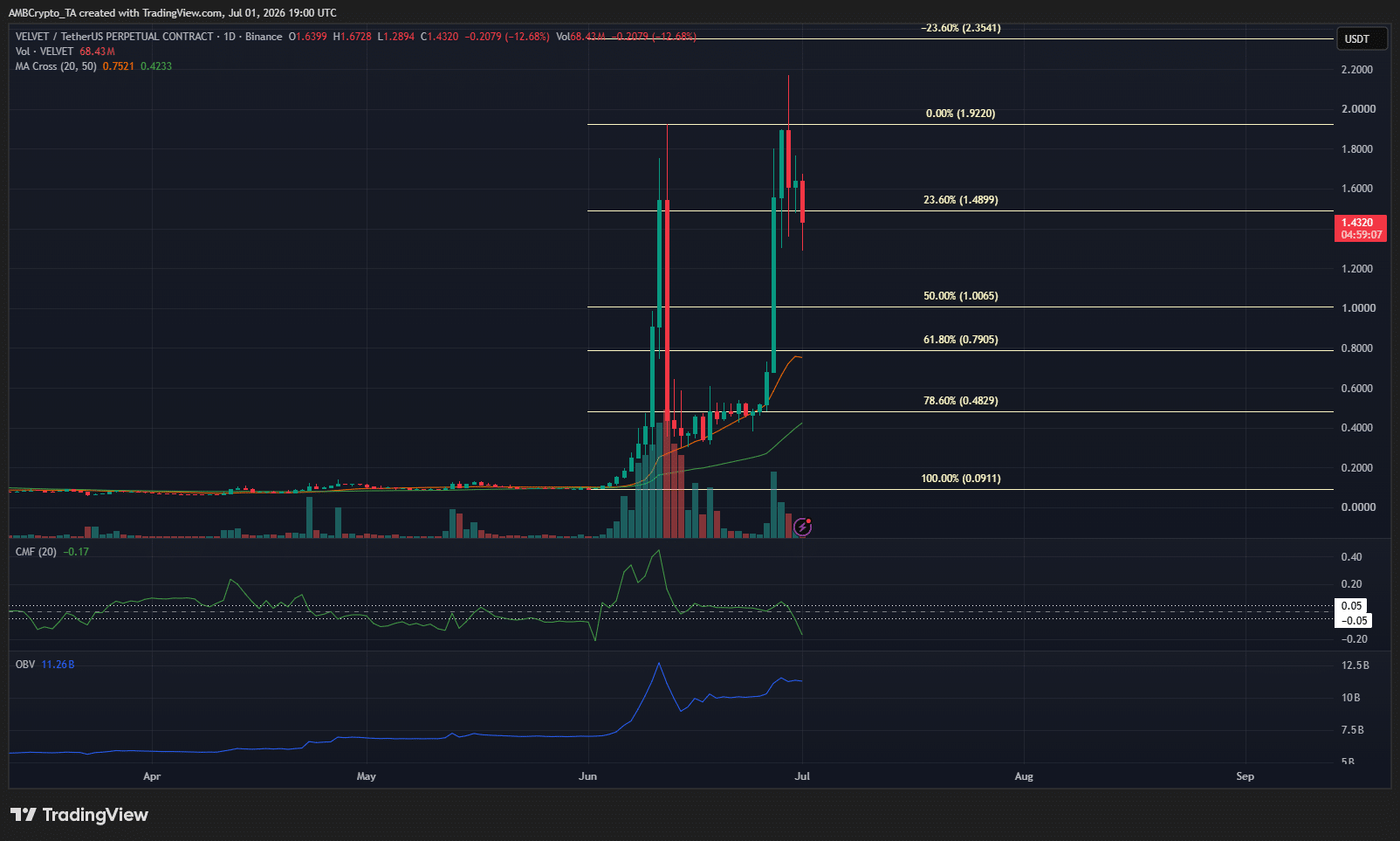
Velvet (VELVET) experienced a bullish push above the key $2.00 resistance on June 29, reaching a high of $2.17, fueled by partnership news with Aerodrome Finance. However, momentum has since slowed, with an 11.5% price correction in 24 hours and a 27.1% drop in trading volume. Technical analysis shows mixed signals. While the On-Balance Volume (OBV) indicates sustained buying pressure, the Chaikin Money Flow (CMF) has turned negative, signaling significant capital outflows and short-term distribution. The overall structure remains bearish on the 1-day chart, though the recent correction found support at the 20-day moving average. Market data suggests the current pullback represents controlled selling pressure rather than a full trend reversal. Key supports to watch are the $2.00 level and the 20-day moving average near $0.75. The risk-to-reward ratio for new long positions is currently unfavorable, but the steady spot Cumulative Volume Delta (CVD) and funding rate indicate underlying bullish strength. Traders may consider using a deeper pullback as a potential buying opportunity.

Velvet [VELVET] has continued its bullish trend. Powered by the Aerodrome Finance partnership news, the token price briefly pushed past the $2.0 round-number resistance on Monday, June 29.

Since then, its momentum has slowed down. The altcoin saw an 11.5% correction in the past 24 hours, and its daily trading volume has fallen by 27.1%, according to CoinMarketCap statistics.

Assessing if Velvet can reach its projected extension targets

AMBCrypto had reported on the bullish catalysts, technical indicators, and price structure, but also warned of increased volatility. The rally to $2.17 has subsided within the past 72 hours.
Source: VELVET on TradingView

The 1-day structure was bearish despite the deep correction from $1.922 to $0.302 in the second week of June. Interestingly, this retracement halted at the 20-day moving average dynamic support.

Since this correction, VELVET has rallied to the local $1.922 highs once again, climbing to $2.17 before pulling back in the past three days as discussed earlier.

The volume indicators gave mixed signals. The OBV was rising higher to show steady buying pressure, but the CMF sank below -0.05 in the past couple of days. Its current reading of -0.17 highlighted severe capital outflows from the VELVET market.

This incongruence between the volume indicators meant that there was short-term distributory pressure on the altcoin. Overall, the buying volume in recent weeks has been high, and the current wave of selling has not dented it.

Traders’ call to action- Use a pullback to buy

The risk-to-reward ratio was too low for traders to go long now. At the same time, there was no guarantee that VELVET had run its uptrend to the fullest and would now descend toward $0.48 and lower once again.
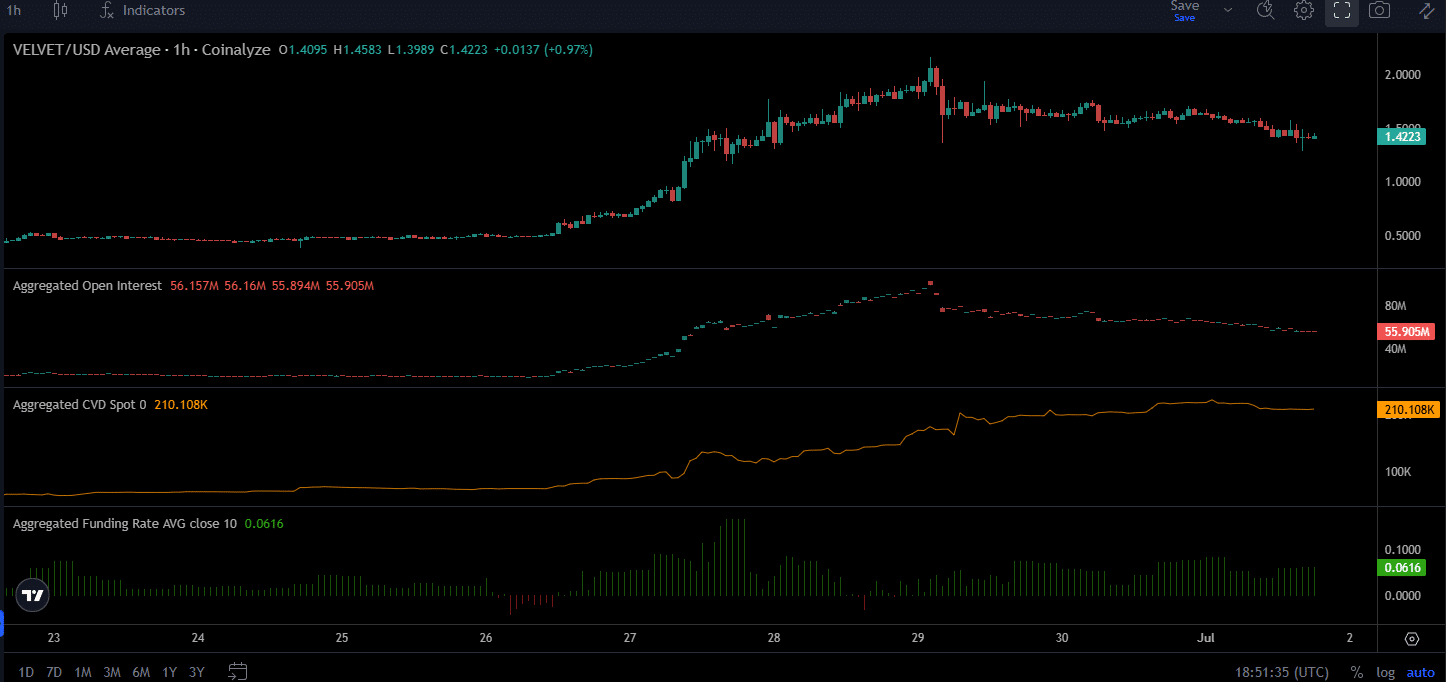
Source: Coinalyze

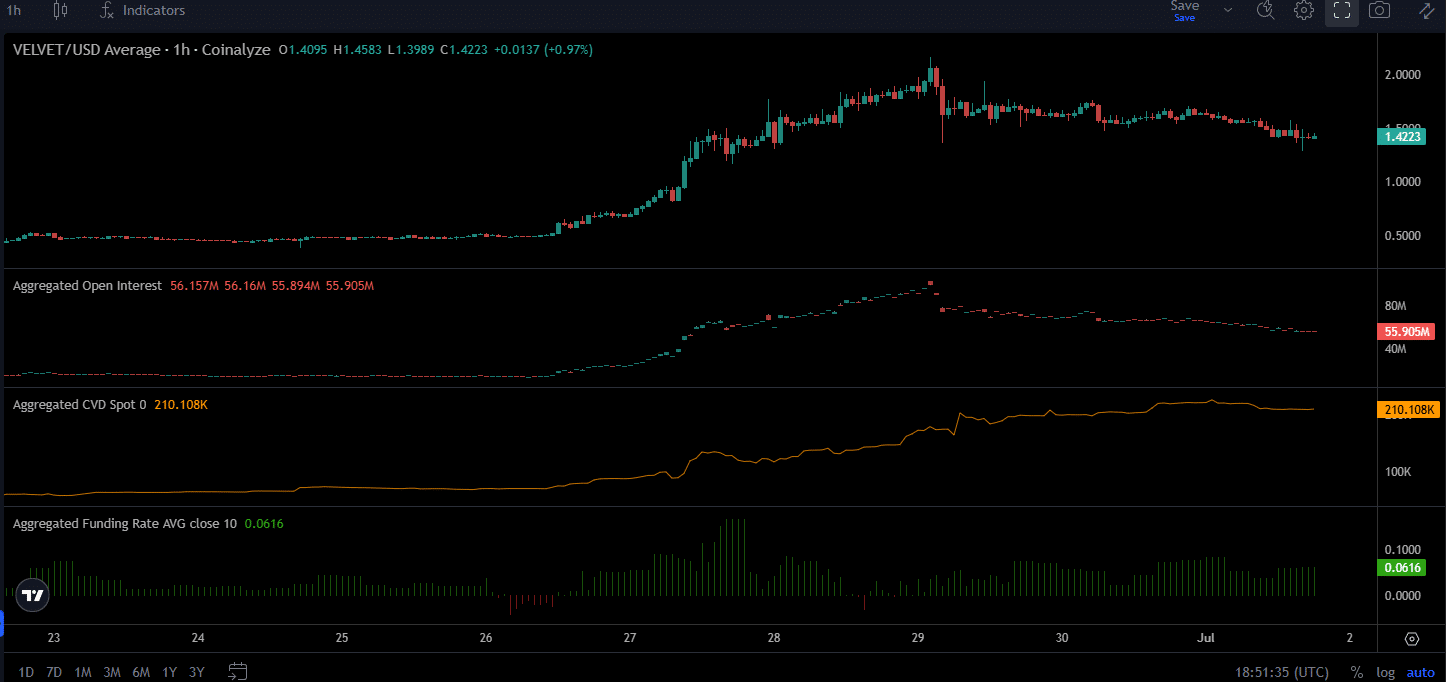
Though the OI was in decline, the spot CVD remained steady, as did the funding rate. This suggested short-term bearish momentum, but there was a good chance VELVET bulls would try to claim the $2 support once more.

The 20-day moving average at $0.75 was an interesting dynamic support to keep an eye on in case of a pullback.


Final Summary

  • Velvet had rallied to a high of $2.17 but was unable to flip the $2 psychological level from resistance to support.
  • It is unclear how deep the current pullback could go, but the evidence pointed toward controlled short-term distributory trends instead of full-blown profit-taking.


Domande pertinenti

QWhat was the key event that helped push Velvet's price briefly above $2.0?

AThe key event was the partnership news with Aerodrome Finance.

QAccording to the article, what are the conflicting signals shown by the volume indicators (OBV and CMF)?

AThe OBV was rising, showing steady buying pressure, while the CMF sank below -0.05, indicating severe capital outflows. This shows short-term distributory pressure despite high overall recent buying volume.

QWhat does the article suggest as a potential dynamic support level in case of a pullback for VELVET?

AThe article suggests the 20-day moving average at $0.75 as an interesting dynamic support level to watch in case of a pullback.

QBased on the data from Coinalyze, what do the steady spot CVD and funding rate suggest despite declining Open Interest?

AThe steady spot CVD and funding rate, despite declining Open Interest, suggest short-term bearish momentum but a good chance that VELVET bulls will try to reclaim the $2 support level again.

QWhat is the article's overall conclusion about the nature of the current pullback for VELVET?

AThe article concludes that while the depth of the pullback is unclear, the evidence points toward controlled short-term distributory trends rather than full-blown profit-taking by investors.

Letture associate

Bitwise CIO: STRC Plunge is a Bottom Signal, Bull Market to Begin in Autumn

Matt Hougan, Chief Investment Officer at Bitwise, explains the recent Bitcoin price drop below $60,000 and its connection to the steep decline in MicroStrategy's STRC (Strategy's Perpetual Preferred Stock). STRC, designed as a high-yield, stable-price instrument, fell from its $100 target to $75 due to market fears over MicroStrategy's ability to sustain its dividend amid Bitcoin's price weakness. Hougan clarifies that while MicroStrategy's overall financial position remains strong, with significant Bitcoin holdings and cash, the core market anxiety centered on the optional nature of the dividend payments. In response, MicroStrategy announced a new operational framework: it will sell some Bitcoin as needed to fund dividends, will no longer actively defend the $100 share price through dividend hikes, and may repurchase STRC on the open market. This shift marks a change in MicroStrategy's role from a consistent, one-way buyer of Bitcoin to a more dynamic participant that may both buy and sell. According to Hougan, the STRC volatility is a classic late-cycle event, signaling the painful but necessary process of flushing out excessive leverage from the market. He draws parallels to the unwinding of the GBTC premium in the previous cycle. He identifies key potential bottoming signals: MSTR trading at a discount to its net asset value (NAV), extreme readings on the Crypto Fear & Greed Index, and persistently negative Bitcoin funding rates. Hougan concludes that while the exact timing of the market bottom is unpredictable, the current deleveraging phase suggests it is near. He expresses confidence that a new bull market will begin in the fall of this year, with the next major wave of buying expected to come from institutional investors like banks, asset managers, and pension funds.

Foresight NewsAdesso

Bitwise CIO: STRC Plunge is a Bottom Signal, Bull Market to Begin in Autumn

Foresight NewsAdesso

ENS Founder Seeks to 'Seize Power' from DAO

On June 29th, the ENS community entered the on-chain voting phase for a proposal to renew the ENS DAO Security Council's veto power for two more years. Shortly after voting began, ENS founder Nick Johnson used his substantial ENS holdings to cast over 3.55 million votes against the proposal, swinging the outcome despite initial strong support. The Security Council was established in July 2024 with a 4/8 multisig veto power to protect the DAO's treasury (valued over $350 million) from malicious proposals during a period of low voter participation. Its powers were limited to vetoing only harmful proposals, not normal ones. Nick Johnson's opposition stems from broader concerns about ENS DAO's governance. In late 2025, he and others expressed frustration that the DAO had become mired in political gamesmanship, with capable contributors leaving and leadership falling to less experienced or misaligned parties. This context set the stage for a major restructuring proposal by ENS COO Katherine Wu on June 19th, titled "Next Era of ENS DAO: Empowering the ENS Foundation." The controversial proposal aims to transfer daily operations, treasury management, and long-term strategy to a restructured ENS Foundation with a professional board, while the DAO would retain core protocol governance powers. Critics, including original ENS constitution author Brantly Millegan, argue this effectively transfers treasury control from token holders to ENS Labs (the core development team), undermining the DAO's original decentralized design. Nick's massive "no" vote on the Security Council renewal is seen as the first move in this power struggle. He explained his vote was due to concerns about insufficient checks on the Council's power and the potential for its veto to be used politically. In response, Katherine Wu submitted a revised proposal with higher execution thresholds (5/8 instead of 4/8) and stricter limits. The push for change comes as ENS's annual revenue has declined significantly, from over $10 million in 2023 to under $2 million in 2025, increasing pressure to manage the treasury more effectively. Nick Johnson now faces the challenge of proving that a more structured foundation can steer ENS better than the current DAO model.

Foresight News30 min fa

ENS Founder Seeks to 'Seize Power' from DAO

Foresight News30 min fa

Predicting World Cup Knockout Matches: Why Are Different AI Models So Far Apart?

AI performance in predicting the 2026 FIFA World Cup knockout matches varied significantly, according to an analysis of models including ChatGPT, Grok, DeepSeek, Gemini, and Claude. The standout predictions came from DeepSeek and Gemini for the Netherlands vs. Morocco match. Gemini precisely forecasted a 1-1 draw and a penalty shootout win for Morocco, while DeepSeek correctly identified the high probability of a draw and Morocco's potential to advance via a defensive and counter-attacking strategy. Grok and Tongyi Qianwen (千问) demonstrated strength in predicting accurate scores for matches with clearer favorites. They correctly called the narrow 1-0 win for Canada over South Africa and Brazil's 2-1 victory over Japan, as well as Norway's 2-1 win over Ivory Coast. ChatGPT and Claude excelled more in match process analysis than in predicting exact scores or upsets. They frequently identified potential challenges for favorites, such as Japan's pressing against Brazil or DR Congo's defensive tactics against England, even when predicting the favorite's ultimate victory. A notable failure was the unanimous misjudgment of Germany vs. Paraguay. All models incorrectly favored Germany, underestimating Paraguay's ability to force a penalty shootout and cause an upset. In summary, Gemini and DeepSeek showed the most insight for high-stakes, unpredictable matches. Grok and Qianwen were reliable "score predictors" for less volatile games. ChatGPT and Claude were strong "analytical models," adept at outlining match dynamics but often hesitant to predict upsets.

Odaily星球日报1 h fa

Predicting World Cup Knockout Matches: Why Are Different AI Models So Far Apart?

Odaily星球日报1 h fa

Will There Be a Next Wave of Web3 Games? Veteran Player's Review: At the Peak of Hype, You Should at Least Sell Half

**Title: Is There Another Wave for Web3 Gaming? A Veteran Player's Review: When Hype Peaks, You Must Exit at Least Half** **Summary:** In an interview, veteran player "Earn Money Chicken" shares his journey and reflections on Web3 gaming. He transitioned from being a traditional in-game trader to a Web3 gamer, having profited from games like Mobox, StepN, and Seraph, but also experiencing significant losses. He defines himself primarily as a player, not an investor, attracted to Web3 games for the blend of earning potential, engaging gameplay, and the satisfaction of researching game mechanics. While he enjoys strategic "gambling" within games, he emphasizes it's not about zero-sum competition with other players. The interview explores the complex, often adversarial relationship between players, projects, and major investors (whales). The player's experience as a traditional game merchant helped develop his analytical mindset for spotting opportunities, but wasn't directly transferable. He identifies the core sources of profit in early Web3 gaming as **"era红利" (era-specific红利)** and strategic foresight, not just simple calculations. He warns that the biggest mistake ordinary players make is calculating their return-on-investment (ROI) period at peak hype, as asset and yield depreciation can trap them. Reflecting on his wins and losses, he now advocates for managing expectations. His most successful exit was from Seraph, where he sold at a relatively good time. The key problem with current Web3 games, he argues, is that most are not mature games first. A successful Web3 game must primarily be a **good, fun game** with a genuine player base willing to spend money for enjoyment, not just participants seeking profit. The blockchain element should solve problems within that context, not be the primary driver. While he believes the sector might see another speculative boom (possibly another strong "Ponzi" model attracting hype), a truly mature and sustainable Web3 game likely needs to come from a traditional major game studio. It would leverage a proven IP, mature content, a functional NFT trading system, and attract both traditional and crypto-native players, offering more normalized returns rather than extreme暴利. His final advice: Newcomers without prior experience should avoid the space now, as it's like searching for a diamond in the rough. For those remaining, the rule is: be brave when assets are low and overlooked, but **when everyone is talking about it (at peak hype), you must sell at least half your holdings.**

marsbit1 h fa

Will There Be a Next Wave of Web3 Games? Veteran Player's Review: At the Peak of Hype, You Should at Least Sell Half

marsbit1 h fa

Trading

Spot
活动图片