Valuation $1 Billion, Nvidia Doubles Down! Is Prime Intellect Washing Off Its Web3 Label?

Foresight NewsPubblicato 2026-07-13Pubblicato ultima volta 2026-07-13

Introduzione

Prime Intellect, a decentralized AI infrastructure company founded in 2024, recently announced a $130 million Series A funding round at a $1 billion valuation, with investments from NVIDIA, Intel, and Dell's venture arms. The company claims its annualized recurring revenue (ARR) has exceeded $100 million within a year, serving over 6,000 enterprise clients. Initially rooted in Web3 and decentralized science (DeSci), Prime Intellect has evolved into a full-stack AI training and deployment platform. Its core technology enables distributed training of large language models across globally dispersed, heterogeneous GPU clusters. Key milestones include releasing open-source models like INTELLECT-1 and INTELLECT-3, and launching Prime Intellect Lab, a platform allowing users to train and optimize agentic models without managing their own GPU infrastructure. The company's deep collaboration with hardware giants, particularly NVIDIA, extends beyond investment to joint optimization of software (e.g., integrating NVIDIA Dynamo) and hardware systems. A notable commercial case involves fintech company Ramp using Prime Lab to train a specialized agent, demonstrating the platform's applied value. While achieving rapid commercial growth, Prime Intellect has systematically downplayed its earlier Web3 and token-based incentives from its official documentation, repositioning itself as a mainstream AI infrastructure provider focused on enterprise adoption and potential IPO.


Written by: KarenZ, Foresight News


An AI infrastructure company founded just over two years ago, on one hand announces support from investment arms of Nvidia, Intel, and Dell, and on the other claims its annualized revenue has already exceeded $100 million—these two figures combined are enough to make Prime Intellect one of the most noteworthy AI projects to re-examine recently.


July 8, 2026, the decentralized AI infrastructure network Prime Intellect announced the completion of a $130 million Series A funding round at a $1 billion valuation, led by AI-focused venture capital firm Radical Ventures, with rare joint participation from investment arms of Nvidia, Intel, and Dell, bringing its total funding raised to over $150 million.


While disclosing the massive funding, Prime Intellect officially announced that in less than a year, its annualized revenue (ARR) has rapidly jumped to over $100 million, and the platform serves more than 6,000 enterprise and startup clients.


What's the Background?


As mentioned in "OpenAI Founding Member Steps In! Quick Read on Decentralized AI Dark Horse Project Prime Intellect" in March 2025, Prime Intellect was founded in January 2024 by co-founders Vincent Weisser and Johannes Hagemann.


  • CEO Vincent Weisser was previously long involved in the intersection of decentralized science (DeSci) and AI, having co-initiated projects like Bio Protocol, VitaDAO, and CryoDAO, and served as the Ecosystem and AI Lead at the DeSci platform Molecule.
  • CTO Johannes Hagemann focused on distributed AI and semi-automated engineering, brain-computer interfaces, and previously worked as an AI Research Engineer at the German AI company Aleph Alpha.


Additionally, in October 2025, venture capitalist Ash Arora joined Prime Intellect as Head of Applied Go-to-Market (Applied GTM), responsible for product strategy, commercialization, revenue, and applied AI products in post-training processing and reinforcement learning. Ash Arora recently pointed out that Prime Intellect's full-time team size has now reached 40 people.


In terms of funding, Prime Intellect has raised over $150 million cumulatively. A $5.5 million seed round in April 2024 was co-led by Distributed Global and CoinFund, with angel investors including Hugging Face CEO Clem Delangue.


Less than a year later, in March 2025, Prime Intellect completed another $15 million funding round led by Peter Thiel's Founders Fund, with investors including OpenAI founding member and former Tesla AI Director Andrej Karpathy, Together.AI Chief Scientist Tri Dao, Stability AI co-founder Emad Mostaque, and other heavyweight figures in the AI field.


The latest round is different in nature. In the $130 million Series A round, NVIDIA Ventures, Intel Capital, and Dell Technologies Capital are not just financial investors; their parent companies hold key positions in GPU, CPU, server, and data center infrastructure respectively.
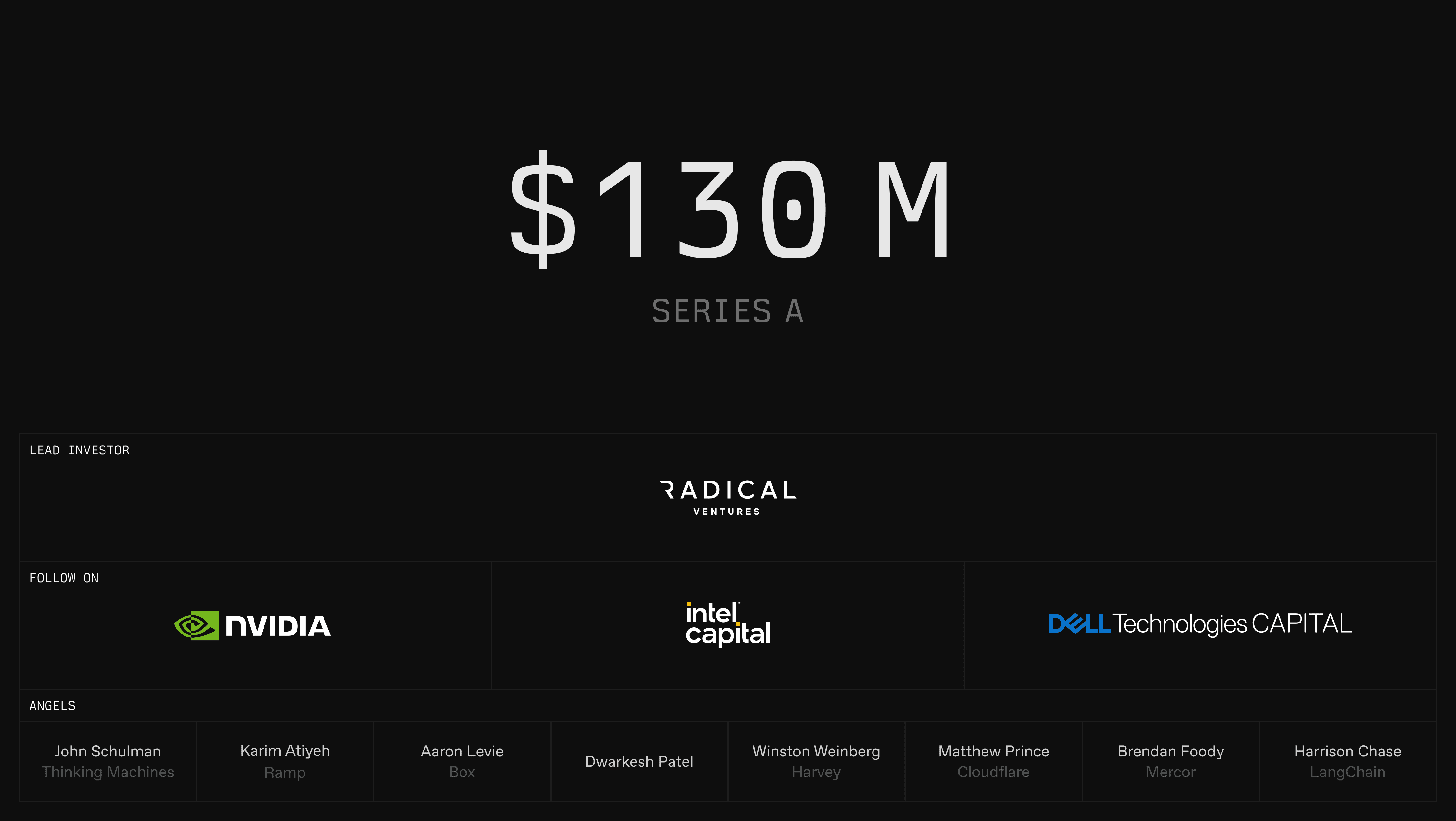


Intel Capital's explanation of this investment also indicates: The reason hardware giants are buying in is that Prime Intellect is attempting to bring underlying computation, training environments, evaluation, reinforcement learning post-training, and upstream inference together on a unified control plane.


What Are the Substantive Developments?


An early notable achievement of Prime Intellect was proving that long-distance, heterogeneous GPUs could also collaborate on training. Following its technical iterations over the past two years, one can see how the platform gradually transformed research experiments into commercial product lines.


In late November 2024, Prime Intellect released the 10-billion parameter model INTELLECT-1, with training nodes spanning five countries and three continents. The company claimed it achieved an overall compute utilization of 83% across continents at that time, and when training using only nodes distributed across the United States, compute utilization reached 96%.


Less than half a year later, Prime Intellect released INTELLECT-2, advancing the goal to globally distributed reinforcement learning with 32 billion parameters. To achieve this, the team developed the asynchronous reinforcement learning framework PRIME-RL, SHARDCAST for propagating model weights, and TOPLOC to verify if inference nodes are "working honestly."


A more critical change occurred with INTELLECT-3. In November 2025, Prime Intellect released a 106-billion parameter MoE model based on Zhipu GLM-4.5-Air, fine-tuned with supervision and reinforcement learning. The model was trained for about two months on 64 nodes with 512 NVIDIA H200 GPUs; model weights, training framework, data, RL environments, and evaluation methods were all open-sourced. The significance here is not just releasing another model, but the company validated an entire production system with its own research project: PRIME-RL handles asynchronous training, Verifiers and Environments Hub provide unified tools and a community ecosystem to build and host RL environments and evaluations, Prime Sandboxes isolate execution of agent-generated code, and the compute orchestration layer manages clusters, storage, and monitoring.


In February of this year, Prime Intellect launched a full-stack AI training platform called Prime Intellect Lab, specifically designed to help individuals, engineers, and AI companies train and optimize their own models (especially agentic models) without needing to build expensive GPU clusters themselves. On May 7th, Lab ended its beta and officially opened fully.


In June, Prime Intellect released prime-rl version 0.6.0, claiming to push the engineering limit to trillion-parameter scale MoE (Mixture of Experts) models. Prime Intellect disclosed that on GLM-5 series software engineering tasks, it could process sequences up to 131,000 tokens using 28 H200 nodes, with single-step training time under 5 minutes.


The key behind this is not a single algorithm, but the joint optimization of training and inference systems: the inference side uses FP8 low-precision computation and components like DeepEP and DeepGEMM to increase throughput; pre-filling and decoding are separated to avoid long tool outputs slowing down generation; KV Cache hierarchical offloading improves concurrency. The training side also adopts block-scaled FP8 and reduces routing discrepancies between MoE model training and inference via Router Replay, combined with FSDP, expert parallelism, and context parallelism. These optimizations ultimately impact GPU utilization, training time, and customer costs.


In July this year, prime-rl added a unified algorithm layer, built-in with six types of training methods: GRPO, MaxRL, On-Policy Distillation, self-distillation, SFT Distillation, and ECHO, and allows selecting different algorithms for different environments within the same training run. Simply put, the same agent can use one learning method for math tasks and another for terminal operation tasks without rewriting the underlying trainer. This moves Prime Intellect from "running training for clients" closer to a scalable RL operating system.


Hardware-Software Synergy: Nvidia is More Than Just an Investor


Looking at the Series A investor lineup, the binding between hardware giants and Prime Intellect goes beyond capital, extending deep into hardware-software architecture co-construction.


The collaboration between Prime Intellect and Nvidia spans both hardware and software layers. On the hardware side, its training and serving workloads already use NVIDIA Blackwell, Blackwell Ultra, and NVL72 rack-scale systems, which the company claims are more efficient than previous Hopper clusters.


On the software side, NVIDIA Dynamo is used for global inference orchestration, auto-scaling, request routing, and KV Cache offloading, and is integrated with Prime Intellect's large-scale LoRA (Low-Rank Adaptation, a fine-tuning technique for large language models) deployments.


Nvidia's own technical blog also confirms that Prime Intellect has deployed the NVIDIA Dynamo inference framework in its production workflows and participated in co-designing and integrating LoRA Adapter support.


Prime Intellect stated in March this year that it would test RL sandbox workloads around the NVIDIA Vera CPU and plans to migrate some sandboxes and provide GPU sandboxes on Vera Rubin systems once Vera is publicly available. The company's self-tests claim each Vera CPU socket can stably run 176 VMs in parallel; in its defined RL sandbox workloads, with multi-threading enabled, throughput is on average about 30% higher than the baseline of AMD Zen 5 with only physical cores enabled on AWS.


These numbers show potential cost advantages, but they currently come from collaborative testing between the parties, and the comparison environments are not identical, so they cannot be taken as independent general performance conclusions. References to Vera Rubin and GPU sandboxes should be stated as "planned adoption," not already large-scale commercial deployment.


Along with product maturity, real commercial monetization is occurring. According to Prime Intellect's disclosure, fintech company Ramp uses Prime Intellect Lab to train the retrieval sub-agent FastAsk for Ramp Labs: Ramp turned its AI spreadsheet editor Ramp Sheets into a trainable RL environment, then performed reinforcement learning training based on the Qwen3.5-35B-A3B foundational model.


Results published by Prime Intellect show FastAsk's accuracy at 66.25%, higher than Claude Opus 4.6's 61.88%, with average response time about 27% lower.


Since the test set and evaluation were defined by the collaborating parties, this does not mean this 35B model outperforms Opus in general capabilities, but it proves a narrower yet more commercially valuable proposition: enterprises can train smaller models to become experts in specific workflows.


Is the $100 Million 'ARR' Real?


It must be clarified that Prime Intellect's official statement uses the phrase "over $100 million in annualized revenue," not "has earned $100 million in revenue in the past year."


Annualized revenue is typically extrapolated from recent monthly or quarterly revenue speed to a full year; if the business is growing rapidly, it may be significantly higher than the actual revenue over the past twelve months. For GPU, training, and inference businesses charging based on usage, this metric also does not represent clients signing automatically renewable annual contracts of equivalent value.


From Prime Intellect's announcements and launched paid products, the company's commercialization mainly covers four categories: first, the compute marketplace, including GPU instances billed per usage hour, multi-node clusters, and reserved clusters; second, Lab hosted training, charging based on model input, output, and training tokens; third, inference and hosted evaluation, also related to model call volume; fourth, Sandboxes, charging based on CPU, memory, disk, and runtime.


The growth drivers of this revenue structure are not hard to understand. First, GPU clusters themselves are high-price-per-client, continuously consumed resources billed hourly, allowing revenue scale to climb faster than pure software subscriptions. Second, Prime Intellect is extending the customer consumption path from "renting GPUs" to "building environments—running inference—conducting evaluations—reinforcement learning training—deployment," allowing the same client to generate usage across multiple stages. Third, agent reinforcement learning inherently requires extensive parallel rollouts, long-context inference, and isolated sandboxes, naturally consuming more compute power than ordinary API Q&A.


Prime Intellect's disclosed over 6,000 clients and the Ramp case at least indicate the platform is no longer just a research demo. However, when scrutinizing the $100 million figure, several boundaries remain. Prime Intellect is a private company; currently, there are no publicly audited financial reports, the monthly or quarterly revenue basis for calculating annualized revenue, customer payment rates, revenue breakdown, or customer concentration. Whether compute marketplace revenue is recognized based on total client expenditure or platform net revenue has also not been clarified by the company.


Furthermore, Prime Intellect's compute marketplace currently does not offer formal Service Level Agreements (SLAs), with the company stating the reason is the underlying infrastructure comes from multiple suppliers. The official suggestion is for users with higher stability requirements to choose Secure Cloud; if supplier-side failures occur, refunds or platform credits may be provided.


Compared to a single financial number, more easily verifiable progress is that Prime Intellect has turned originally scattered distributed collaborative training into a true full-stack infrastructure "with proprietary models, an open-source ecosystem, backing from hardware giants, and actual enterprise billing for implementation."


Token Cues Erased from Documentation


One detail that cannot be ignored is that as Prime Intellect now steps into the $1 billion valuation club and loudly announces $100 million ARR, the author discovered: The once highly Web3-colored statements in the official documentation—"contracts deployed on Base Sepolia testnet," "future migration to a proprietary chain," and "distributing token rewards to compute pools based on active time via the RewardsDistributor contract"—have been completely erased.


This deletion at the documentation level was foreshadowed as early as March 2025 in that initial official tweet.


At that time, Prime Intellect announced the completion of a $15 million funding round led by Silicon Valley powerhouse Founders Fund, with a core investor roster even featuring top figures like Andrej Karpathy (OpenAI co-founder), Clem Delangue (Hugging Face CEO), and Balaji Srinivasan. It was from this moment that the project's underlying logic was deconstructed.


The previously grassroots-flavored narrative of "issuing tokens, pooling retail computing power, airdrop incentives" immediately became a red-line compliance risk zone for traditional venture capital. To receive ammunition from mainstream capital markets, Prime Intellect had to superficially complete a thorough cleansing from "Crypto-first" to "AI-first."


However, its distributed model training still retains the P2P network topology kernel, but decentralization is no longer a token narrative aimed at retail speculation; instead, it has become an invisible pipeline for B2B enterprises to "schedule idle global compute at low cost."


Now, Prime Intellect more closely resembles a pure AI SaaS company, with its endgame likely being an IPO or a high-premium acquisition by traditional hardware giants.

Crypto di tendenza

Domande pertinenti

QWhat significant achievements and milestones has Prime Intellect announced regarding its growth and partnerships?

APrime Intellect announced a $1.3 billion Series A funding round at a $10 billion valuation, co-led by NVIDIA Ventures, Intel Capital, and Dell Technologies Capital. It also reported achieving over $100 million in annualized recurring revenue (ARR) and serving more than 6,000 enterprise clients within a year.

QHow has Prime Intellect evolved its technological offerings from its early stages to its current commercial platform?

APrime Intellect evolved from demonstrating cross-continent, heterogeneous GPU training with models like INTELLECT-1 and INTELLECT-2, to launching Prime Intellect Lab—a full-stack AI training platform. It now provides a unified control plane for compute, training, evaluation, reinforcement learning post-training, and inference, with optimizations like FP8 precision and integrated algorithms in prime-rl.

QWhat is the nature and significance of the partnerships between Prime Intellect and hardware giants like NVIDIA and Intel?

AThe partnerships with NVIDIA and Intel are strategic and extend beyond financial investment. They involve deep hardware and software integration. For example, Prime Intellect uses NVIDIA Blackwell systems and Dynamo inference framework, and collaborates on LoRA adapter support. It also tests RL workloads on Intel's Vera CPU, aiming for cost-efficient performance scaling.

QWhat are the main components of Prime Intellect's business model and revenue streams?

APrime Intellect's commercial model includes four main product lines: 1) A compute marketplace with GPU instances and clusters, 2) The Lab platform for managed training (charged per token), 3) Inference and hosted evaluation services, and 4) Sandboxes billed for CPU, memory, disk, and runtime usage. Revenue is driven by high-value GPU consumption and extending customer usage across the AI development lifecycle.

QHow has Prime Intellect's public narrative and documentation changed regarding its Web3 and token-related origins?

APrime Intellect has systematically removed all Web3 and crypto-native language from its official documentation. References to 'contracts deployed on Base Sepolia testnet,' 'future migration to a proprietary chain,' and 'token rewards via RewardsDistributor' have been erased. This shift aligns with its transition to an 'AI-first' narrative to attract traditional venture capital and enterprise clients, moving away from a 'Crypto-first' and retail-focused token model.

Letture associate

After 13% Daily Distribution, Why Did SATA Still Fall?

Strive Asset Management's BTC-linked preferred stock SATA transitioned from monthly to daily dividend distributions on June 16, with a current annualized yield of 13%. Despite this change, SATA's price fell approximately 9.9% from June 22 to June 26. The analysis highlights that this decline reflects fundamental credit and structural risks, not simply dividend frequency. SATA represents a perpetual, cumulative preferred equity interest in Strive, not a direct Bitcoin-backed bond. Its dividends depend on Strive's corporate credit and access to capital markets. While Strive's Bitcoin holdings grew from 15,009 to 19,864 BTC between May 12 and June 18, SATA's outstanding shares grew faster (from ~4.96 million to ~7.83 million). Coupled with a drop in BTC price, the pure Bitcoin coverage ratio for SATA's stated amount fell from ~2.44x to ~1.52x. A further ~34.3% decline in BTC to ~$39,416 would bring this coverage to 1.0x. Daily dividends smooth cash flow for investors and reduce dividend-capture trading, but do not eliminate price volatility or credit risk. SATA now trades at a ~12.25% discount to its $100 stated amount, implying a market yield of ~14.81% and a credit spread of ~1,117 bps over SOFR. Key risks include a negative feedback loop if SATA trades below par, making new issuance dilutive; reliance on capital markets for dividend funding despite a ~17-month cash buffer; and the perpetual nature of the security, where dividends can be deferred. In summary, SATA innovates by providing daily income from a Bitcoin-focused corporate balance sheet, but its recent price action underscores its exposure to Bitcoin valuation, company-specific financing risks, and perpetual duration. The market is repricing it from a near-par yield product to a deeply discounted high-risk credit instrument.

marsbit1 h fa

After 13% Daily Distribution, Why Did SATA Still Fall?

marsbit1 h fa

Unlocking 20%, $125 Million in Pressure, Can PUMP Hold Up?

"Pump.fun Faces Crucial Test with $125M Token Unlock Despite a cooldown in the meme coin market, Pump.fun remains one of Web3's top revenue-generating protocols, earning $28.4 million in the past 30 days. The platform has accumulated approximately $1.05 billion in total revenue from over 12 million tokens created. The protocol now faces its biggest challenge: the first unlock of team and investor tokens. A total of 82.5 billion PUMP tokens (8.25% of total supply, 20.23% of previous circulating supply), valued at around $125 million, have been unlocked. This potential selling pressure is significant compared to the token's 24-hour trading volume of only $28 million. While Pump.fun uses a portion of its revenue to buy back and burn PUMP tokens, creating buy-side pressure, this support has weakened. The buyback rate was reduced from 100% to 50% of net fees in April 2024. In June 2024, monthly buybacks totaled just $9.2 million, an over 80% drop from its peak. At this rate, selling just 7% of the newly unlocked tokens would offset a full month of buybacks. Furthermore, this unlock is only the first batch; team and investors still hold another 247.5 billion locked PUMP tokens, with 240 billion community tokens awaiting a release schedule. Despite these headwinds, PUMP is argued to be a relatively scarce asset in the current market. With a $610 million market cap against $28.4 million in monthly revenue, its valuation is lower than competitors like Hyperliquid. The investment thesis for PUMP is not betting on a single meme coin but on the persistent activity of the meme market and Pump.fun's ability to maintain its position as a key platform. The conclusion suggests that while the unlock tests short-term price resilience, the protocol's underlying revenue strength will determine PUMP's long-term trajectory, potentially making the current dip a viable entry point for long-term accumulation."

Odaily星球日报1 h fa

Unlocking 20%, $125 Million in Pressure, Can PUMP Hold Up?

Odaily星球日报1 h fa

Trading

Spot

Articoli Popolari

Cosa è GROK AI

Grok AI: Rivoluzionare la Tecnologia Conversazionale nell'Era Web3 Introduzione Nel panorama in rapida evoluzione dell'intelligenza artificiale, Grok AI si distingue come un progetto notevole che collega i domini della tecnologia avanzata e dell'interazione con l'utente. Sviluppato da xAI, un'azienda guidata dal rinomato imprenditore Elon Musk, Grok AI cerca di ridefinire il modo in cui interagiamo con l'intelligenza artificiale. Mentre il movimento Web3 continua a prosperare, Grok AI mira a sfruttare il potere dell'IA conversazionale per rispondere a query complesse, offrendo agli utenti un'esperienza che è non solo informativa ma anche divertente. Cos'è Grok AI? Grok AI è un sofisticato chatbot di intelligenza artificiale conversazionale progettato per interagire dinamicamente con gli utenti. A differenza di molti sistemi di intelligenza artificiale tradizionali, Grok AI abbraccia un'ampia gamma di domande, comprese quelle tipicamente considerate inappropriate o al di fuori delle risposte standard. Gli obiettivi principali del progetto includono: Ragionamento Affidabile: Grok AI enfatizza il ragionamento di buon senso per fornire risposte logiche basate sulla comprensione contestuale. Supervisione Scalabile: L'integrazione dell'assistenza degli strumenti garantisce che le interazioni degli utenti siano sia monitorate che ottimizzate per la qualità. Verifica Formale: La sicurezza è fondamentale; Grok AI incorpora metodi di verifica formale per migliorare l'affidabilità delle sue uscite. Comprensione del Lungo Contesto: Il modello di IA eccelle nel trattenere e richiamare una vasta storia di conversazione, facilitando discussioni significative e consapevoli del contesto. Robustezza Adversariale: Concentrandosi sul miglioramento delle sue difese contro input manipolati o malevoli, Grok AI mira a mantenere l'integrità delle interazioni degli utenti. In sostanza, Grok AI non è solo un dispositivo di recupero informazioni; è un partner conversazionale immersivo che incoraggia un dialogo dinamico. Creatore di Grok AI Il cervello dietro Grok AI non è altri che Elon Musk, un individuo sinonimo di innovazione in vari campi, tra cui automotive, viaggi spaziali e tecnologia. Sotto l'egida di xAI, un'azienda focalizzata sull'avanzamento della tecnologia AI in modi benefici, la visione di Musk mira a rimodellare la comprensione delle interazioni con l'IA. La leadership e l'etica fondamentale sono profondamente influenzate dall'impegno di Musk nel superare i confini tecnologici. Investitori di Grok AI Sebbene i dettagli specifici riguardanti gli investitori che sostengono Grok AI rimangano limitati, è pubblicamente riconosciuto che xAI, l'incubatore del progetto, è fondato e supportato principalmente dallo stesso Elon Musk. Le precedenti imprese e partecipazioni di Musk forniscono un robusto sostegno, rafforzando ulteriormente la credibilità e il potenziale di crescita di Grok AI. Tuttavia, al momento, le informazioni riguardanti ulteriori fondazioni di investimento o organizzazioni che supportano Grok AI non sono facilmente accessibili, segnando un'area per potenziali esplorazioni future. Come Funziona Grok AI? Le meccaniche operative di Grok AI sono innovative quanto il suo framework concettuale. Il progetto integra diverse tecnologie all'avanguardia che facilitano le sue funzionalità uniche: Infrastruttura Robusta: Grok AI è costruito utilizzando Kubernetes per l'orchestrazione dei container, Rust per prestazioni e sicurezza, e JAX per il calcolo numerico ad alte prestazioni. Questo trio garantisce che il chatbot operi in modo efficiente, si scaldi efficacemente e serva gli utenti prontamente. Accesso alla Conoscenza in Tempo Reale: Una delle caratteristiche distintive di Grok AI è la sua capacità di attingere a dati in tempo reale attraverso la piattaforma X—precedentemente nota come Twitter. Questa capacità consente all'IA di accedere alle informazioni più recenti, permettendole di fornire risposte e raccomandazioni tempestive che altri modelli di IA potrebbero perdere. Due Modalità di Interazione: Grok AI offre agli utenti la scelta tra “Modalità Divertente” e “Modalità Normale”. La Modalità Divertente consente uno stile di interazione più giocoso e umoristico, mentre la Modalità Normale si concentra sulla fornitura di risposte precise e accurate. Questa versatilità garantisce un'esperienza su misura che soddisfa varie preferenze degli utenti. In sostanza, Grok AI sposa prestazioni con coinvolgimento, creando un'esperienza che è sia arricchente che divertente. Cronologia di Grok AI Il viaggio di Grok AI è segnato da traguardi fondamentali che riflettono le sue fasi di sviluppo e distribuzione: Sviluppo Iniziale: La fase fondamentale di Grok AI si è svolta in circa due mesi, durante i quali sono stati condotti l'addestramento iniziale e il perfezionamento del modello. Rilascio Beta di Grok-2: In un significativo avanzamento, è stata annunciata la beta di Grok-2. Questo rilascio ha introdotto due versioni del chatbot—Grok-2 e Grok-2 mini—ognuna dotata delle capacità per chattare, programmare e ragionare. Accesso Pubblico: Dopo lo sviluppo beta, Grok AI è diventato disponibile per gli utenti della piattaforma X. Coloro che hanno account verificati tramite un numero di telefono e attivi per almeno sette giorni possono accedere a una versione limitata, rendendo la tecnologia disponibile a un pubblico più ampio. Questa cronologia racchiude la crescita sistematica di Grok AI dall'inizio all'impegno pubblico, enfatizzando il suo impegno per il miglioramento continuo e l'interazione con gli utenti. Caratteristiche Chiave di Grok AI Grok AI comprende diverse caratteristiche chiave che contribuiscono alla sua identità innovativa: Integrazione della Conoscenza in Tempo Reale: L'accesso a informazioni attuali e rilevanti differenzia Grok AI da molti modelli statici, consentendo un'esperienza utente coinvolgente e accurata. Stili di Interazione Versatili: Offrendo modalità di interazione distinte, Grok AI soddisfa varie preferenze degli utenti, invitando alla creatività e alla personalizzazione nella conversazione con l'IA. Avanzata Struttura Tecnologica: L'utilizzo di Kubernetes, Rust e JAX fornisce al progetto un solido framework per garantire affidabilità e prestazioni ottimali. Considerazione del Discorso Etico: L'inclusione di una funzione di generazione di immagini mette in mostra lo spirito innovativo del progetto. Tuttavia, solleva anche considerazioni etiche riguardanti il copyright e la rappresentazione rispettosa di figure riconoscibili—una discussione in corso all'interno della comunità AI. Conclusione Come entità pionieristica nel campo dell'IA conversazionale, Grok AI incarna il potenziale per esperienze utente trasformative nell'era digitale. Sviluppato da xAI e guidato dall'approccio visionario di Elon Musk, Grok AI integra conoscenze in tempo reale con capacità di interazione avanzate. Si sforza di spingere i confini di ciò che l'intelligenza artificiale può realizzare, mantenendo un focus su considerazioni etiche e sicurezza degli utenti. Grok AI non solo incarna il progresso tecnologico, ma rappresenta anche un nuovo paradigma conversazionale nel panorama Web3, promettendo di coinvolgere gli utenti con sia conoscenze esperte che interazioni giocose. Man mano che il progetto continua a evolversi, si erge come testimonianza di ciò che l'incrocio tra tecnologia, creatività e interazione simile a quella umana può realizzare.

518 Totale visualizzazioniPubblicato il 2024.12.26Aggiornato il 2024.12.26

Cosa è GROK AI

Cosa è ERC AI

Euruka Tech: Una Panoramica di $erc ai e delle sue Ambizioni in Web3 Introduzione Nel panorama in rapida evoluzione della tecnologia blockchain e delle applicazioni decentralizzate, nuovi progetti emergono frequentemente, ciascuno con obiettivi e metodologie uniche. Uno di questi progetti è Euruka Tech, che opera nel vasto dominio delle criptovalute e del Web3. L'obiettivo principale di Euruka Tech, in particolare del suo token $erc ai, è presentare soluzioni innovative progettate per sfruttare le crescenti capacità della tecnologia decentralizzata. Questo articolo si propone di fornire una panoramica completa di Euruka Tech, un'esplorazione dei suoi obiettivi, della funzionalità, dell'identità del suo creatore, dei potenziali investitori e della sua importanza nel contesto più ampio del Web3. Cos'è Euruka Tech, $erc ai? Euruka Tech è caratterizzato come un progetto che sfrutta gli strumenti e le funzionalità offerte dall'ambiente Web3, concentrandosi sull'integrazione dell'intelligenza artificiale nelle sue operazioni. Sebbene i dettagli specifici sul framework del progetto siano piuttosto sfuggenti, è progettato per migliorare l'engagement degli utenti e automatizzare i processi nello spazio crypto. Il progetto mira a creare un ecosistema decentralizzato che non solo faciliti le transazioni, ma incorpori anche funzionalità predittive attraverso l'intelligenza artificiale, da cui il nome del suo token, $erc ai. L'obiettivo è fornire una piattaforma intuitiva che faciliti interazioni più intelligenti e un'elaborazione delle transazioni più efficiente all'interno della crescente sfera del Web3. Chi è il Creatore di Euruka Tech, $erc ai? Attualmente, le informazioni riguardanti il creatore o il team fondatore di Euruka Tech rimangono non specificate e piuttosto opache. Questa assenza di dati solleva preoccupazioni, poiché la conoscenza del background del team è spesso essenziale per stabilire credibilità nel settore blockchain. Pertanto, abbiamo classificato queste informazioni come sconosciute fino a quando dettagli concreti non saranno resi disponibili nel dominio pubblico. Chi sono gli Investitori di Euruka Tech, $erc ai? Allo stesso modo, l'identificazione degli investitori o delle organizzazioni di supporto per il progetto Euruka Tech non è prontamente fornita attraverso la ricerca disponibile. Un aspetto cruciale per i potenziali stakeholder o utenti che considerano di impegnarsi con Euruka Tech è la garanzia che deriva da partnership finanziarie consolidate o dal supporto di società di investimento rispettabili. Senza divulgazioni sulle affiliazioni di investimento, è difficile trarre conclusioni complete sulla sicurezza finanziaria o sulla longevità del progetto. In linea con le informazioni trovate, anche questa sezione rimane allo stato di sconosciuto. Come funziona Euruka Tech, $erc ai? Nonostante la mancanza di specifiche tecniche dettagliate per Euruka Tech, è essenziale considerare le sue ambizioni innovative. Il progetto cerca di sfruttare la potenza computazionale dell'intelligenza artificiale per automatizzare e migliorare l'esperienza dell'utente all'interno dell'ambiente delle criptovalute. Integrando l'IA con la tecnologia blockchain, Euruka Tech mira a fornire funzionalità come operazioni automatizzate, valutazioni del rischio e interfacce utente personalizzate. L'essenza innovativa di Euruka Tech risiede nel suo obiettivo di creare una connessione fluida tra gli utenti e le vaste possibilità presentate dalle reti decentralizzate. Attraverso l'utilizzo di algoritmi di apprendimento automatico e IA, mira a ridurre le sfide degli utenti alle prime armi e semplificare le esperienze transazionali all'interno del framework Web3. Questa simbiosi tra IA e blockchain sottolinea l'importanza del token $erc ai, fungendo da ponte tra le interfacce utente tradizionali e le avanzate capacità delle tecnologie decentralizzate. Cronologia di Euruka Tech, $erc ai Sfortunatamente, a causa delle limitate informazioni disponibili riguardo a Euruka Tech, non siamo in grado di presentare una cronologia dettagliata dei principali sviluppi o traguardi nel percorso del progetto. Questa cronologia, tipicamente preziosa per tracciare l'evoluzione di un progetto e comprendere la sua traiettoria di crescita, non è attualmente disponibile. Man mano che le informazioni su eventi notevoli, partnership o aggiunte funzionali diventano evidenti, gli aggiornamenti miglioreranno sicuramente la visibilità di Euruka Tech nella sfera crypto. Chiarimento su Altri Progetti “Eureka” È importante sottolineare che più progetti e aziende condividono una nomenclatura simile con “Eureka.” La ricerca ha identificato iniziative come un agente IA della NVIDIA Research, che si concentra sull'insegnamento ai robot di compiti complessi utilizzando metodi generativi, così come Eureka Labs ed Eureka AI, che migliorano l'esperienza utente nell'istruzione e nell'analisi del servizio clienti, rispettivamente. Tuttavia, questi progetti sono distinti da Euruka Tech e non dovrebbero essere confusi con i suoi obiettivi o funzionalità. Conclusione Euruka Tech, insieme al suo token $erc ai, rappresenta un attore promettente ma attualmente oscuro nel panorama del Web3. Sebbene i dettagli sul suo creatore e sugli investitori rimangano non divulgati, l'ambizione centrale di combinare intelligenza artificiale e tecnologia blockchain si erge come un punto focale di interesse. Gli approcci unici del progetto nel promuovere l'engagement degli utenti attraverso l'automazione avanzata potrebbero distinguerlo mentre l'ecosistema Web3 progredisce. Con l'evoluzione continua del mercato crypto, gli stakeholder dovrebbero tenere d'occhio gli sviluppi riguardanti Euruka Tech, poiché lo sviluppo di innovazioni documentate, partnership o una roadmap definita potrebbe presentare opportunità significative nel prossimo futuro. Così com'è, attendiamo ulteriori approfondimenti sostanziali che potrebbero svelare il potenziale di Euruka Tech e la sua posizione nel competitivo panorama crypto.

541 Totale visualizzazioniPubblicato il 2025.01.02Aggiornato il 2025.01.02

Cosa è ERC AI

Cosa è DUOLINGO AI

DUOLINGO AI: Integrare l'apprendimento delle lingue con Web3 e innovazione AI In un'era in cui la tecnologia rimodella l'istruzione, l'integrazione dell'intelligenza artificiale (AI) e delle reti blockchain annuncia una nuova frontiera per l'apprendimento delle lingue. Entra in scena DUOLINGO AI e la sua criptovaluta associata, $DUOLINGO AI. Questo progetto aspira a fondere la potenza educativa delle principali piattaforme di apprendimento delle lingue con i benefici della tecnologia decentralizzata Web3. Questo articolo esplora gli aspetti chiave di DUOLINGO AI, esaminando i suoi obiettivi, il framework tecnologico, lo sviluppo storico e il potenziale futuro, mantenendo chiarezza tra la risorsa educativa originale e questa iniziativa indipendente di criptovaluta. Panoramica di DUOLINGO AI Alla sua base, DUOLINGO AI cerca di stabilire un ambiente decentralizzato in cui gli studenti possono guadagnare ricompense crittografiche per il raggiungimento di traguardi educativi nella competenza linguistica. Applicando smart contracts, il progetto mira ad automatizzare i processi di verifica delle competenze e le allocazioni di token, aderendo ai principi di Web3 che enfatizzano la trasparenza e la proprietà da parte degli utenti. Il modello si discosta dagli approcci tradizionali all'acquisizione linguistica, facendo forte affidamento su una struttura di governance guidata dalla comunità, che consente ai detentori di token di suggerire miglioramenti ai contenuti dei corsi e alle distribuzioni delle ricompense. Alcuni degli obiettivi notevoli di DUOLINGO AI includono: Apprendimento Gamificato: Il progetto integra traguardi blockchain e token non fungibili (NFT) per rappresentare i livelli di competenza linguistica, promuovendo la motivazione attraverso ricompense digitali coinvolgenti. Creazione di Contenuti Decentralizzati: Apre opportunità per educatori e appassionati di lingue di contribuire con i propri corsi, facilitando un modello di condivisione dei ricavi che beneficia tutti i collaboratori. Personalizzazione Guidata dall'AI: Utilizzando modelli avanzati di machine learning, DUOLINGO AI personalizza le lezioni per adattarsi ai progressi individuali, simile alle funzionalità adattive presenti nelle piattaforme consolidate. Creatori del Progetto e Governance A partire da aprile 2025, il team dietro $DUOLINGO AI rimane pseudonimo, una pratica comune nel panorama decentralizzato delle criptovalute. Questa anonimato è inteso a promuovere la crescita collettiva e il coinvolgimento degli stakeholder piuttosto che concentrarsi su sviluppatori individuali. Lo smart contract distribuito sulla blockchain di Solana annota l'indirizzo del wallet dello sviluppatore, che segna l'impegno verso la trasparenza riguardo alle transazioni, nonostante l'identità dei creatori sia sconosciuta. Secondo la sua roadmap, DUOLINGO AI mira a evolversi in un'Organizzazione Autonoma Decentralizzata (DAO). Questa struttura di governance consente ai detentori di token di votare su questioni critiche come l'implementazione di funzionalità e le allocazioni del tesoro. Questo modello si allinea con l'etica dell'empowerment della comunità presente in varie applicazioni decentralizzate, enfatizzando l'importanza del processo decisionale collettivo. Investitori e Partnership Strategiche Attualmente, non ci sono investitori istituzionali o capitalisti di rischio identificabili pubblicamente legati a $DUOLINGO AI. Invece, la liquidità del progetto proviene principalmente da scambi decentralizzati (DEX), segnando un netto contrasto con le strategie di finanziamento delle aziende tradizionali di tecnologia educativa. Questo modello di base indica un approccio guidato dalla comunità, riflettendo l'impegno del progetto verso la decentralizzazione. Nel suo whitepaper, DUOLINGO AI menziona la formazione di collaborazioni con “piattaforme educative blockchain” non specificate, mirate ad arricchire la sua offerta di corsi. Sebbene partnership specifiche non siano ancora state divulgate, questi sforzi collaborativi suggeriscono una strategia per mescolare innovazione blockchain con iniziative educative, ampliando l'accesso e il coinvolgimento degli utenti attraverso diverse vie di apprendimento. Architettura Tecnologica Integrazione AI DUOLINGO AI incorpora due componenti principali guidate dall'AI per migliorare la sua offerta educativa: Motore di Apprendimento Adattivo: Questo sofisticato motore apprende dalle interazioni degli utenti, simile ai modelli proprietari delle principali piattaforme educative. Regola dinamicamente la difficoltà delle lezioni per affrontare le sfide specifiche degli studenti, rinforzando le aree deboli attraverso esercizi mirati. Agenti Conversazionali: Utilizzando chatbot alimentati da GPT-4, DUOLINGO AI offre una piattaforma per gli utenti per impegnarsi in conversazioni simulate, promuovendo un'esperienza di apprendimento linguistico più interattiva e pratica. Infrastruttura Blockchain Costruito sulla blockchain di Solana, $DUOLINGO AI utilizza un framework tecnologico completo che include: Smart Contracts per la Verifica delle Competenze: Questa funzionalità assegna automaticamente token agli utenti che superano con successo i test di competenza, rinforzando la struttura di incentivi per risultati di apprendimento genuini. Badge NFT: Questi token digitali significano vari traguardi che gli studenti raggiungono, come completare una sezione del loro corso o padroneggiare competenze specifiche, consentendo loro di scambiare o mostrare digitalmente i loro successi. Governance DAO: I membri della comunità dotati di token possono partecipare alla governance votando su proposte chiave, facilitando una cultura partecipativa che incoraggia l'innovazione nell'offerta di corsi e nelle funzionalità della piattaforma. Cronologia Storica 2022–2023: Concettualizzazione I lavori per DUOLINGO AI iniziano con la creazione di un whitepaper, evidenziando la sinergia tra i progressi dell'AI nell'apprendimento delle lingue e il potenziale decentralizzato della tecnologia blockchain. 2024: Lancio Beta Un lancio beta limitato introduce offerte in lingue popolari, premiando i primi utenti con incentivi in token come parte della strategia di coinvolgimento della comunità del progetto. 2025: Transizione DAO Ad aprile, avviene un lancio completo della mainnet con la circolazione di token, stimolando discussioni nella comunità riguardo a possibili espansioni nelle lingue asiatiche e ad altri sviluppi dei corsi. Sfide e Direzioni Future Ostacoli Tecnici Nonostante i suoi obiettivi ambiziosi, DUOLINGO AI affronta sfide significative. La scalabilità rimane una preoccupazione costante, in particolare nel bilanciare i costi associati all'elaborazione dell'AI e nel mantenere una rete decentralizzata reattiva. Inoltre, garantire la creazione e la moderazione di contenuti di qualità in un'offerta decentralizzata presenta complessità nel mantenere standard educativi. Opportunità Strategiche Guardando al futuro, DUOLINGO AI ha il potenziale per sfruttare partnership di micro-credentialing con istituzioni accademiche, fornendo validazioni verificate dalla blockchain delle competenze linguistiche. Inoltre, l'espansione cross-chain potrebbe consentire al progetto di attingere a basi utenti più ampie e a ulteriori ecosistemi blockchain, migliorando la sua interoperabilità e portata. Conclusione DUOLINGO AI rappresenta una fusione innovativa di intelligenza artificiale e tecnologia blockchain, presentando un'alternativa focalizzata sulla comunità ai sistemi tradizionali di apprendimento delle lingue. Sebbene il suo sviluppo pseudonimo e il modello economico emergente comportino alcuni rischi, l'impegno del progetto verso l'apprendimento gamificato, l'istruzione personalizzata e la governance decentralizzata illumina un percorso per la tecnologia educativa nel regno di Web3. Man mano che l'AI continua a progredire e l'ecosistema blockchain evolve, iniziative come DUOLINGO AI potrebbero ridefinire il modo in cui gli utenti interagiscono con l'istruzione linguistica, potenziando le comunità e premiando il coinvolgimento attraverso meccanismi di apprendimento innovativi.

498 Totale visualizzazioniPubblicato il 2025.04.11Aggiornato il 2025.04.11

Cosa è DUOLINGO AI

Discussioni

Benvenuto nella Community HTX. Qui puoi rimanere informato sugli ultimi sviluppi della piattaforma e accedere ad approfondimenti esperti sul mercato. Le opinioni degli utenti sul prezzo di AI AI sono presentate come di seguito.

活动图片