US Stock Storage Fever Spreads to Crypto for the Third Time, VVV Leads 'AI Data Infrastructure' Sector Gains

marsbitPubblicato 2026-05-11Pubblicato ultima volta 2026-05-11

Introduzione

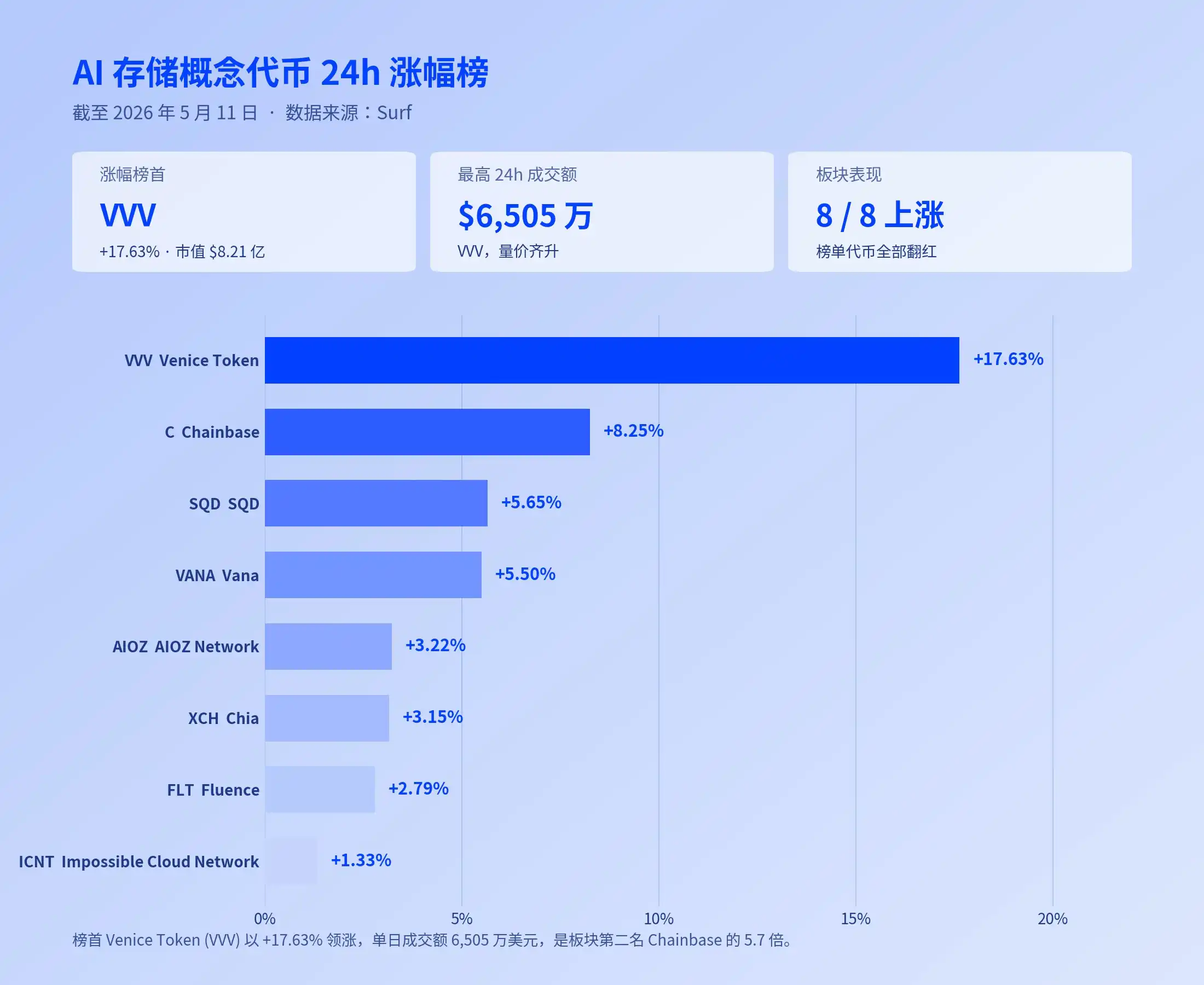
U.S. stock storage rally spreads to crypto for the third time, with VVV leading the 'AI data infrastructure' sector. On May 11, Venice Token (VVV) surged 17.63% with $65.05M volume, followed by Chainbase, SQD, and Vana, rising 5-8%. This mirrors gains in U.S. storage stocks like SanDisk and Micron. The crypto AI narrative is shifting. The initial wave (May 6-7) saw pure storage tokens like FIL, AR, and STORJ rise, driven by spillover from the U.S. storage chip boom. The second wave saw broader DePIN sector gains. The current third wave has moved beyond pure storage to broader "AI infrastructure." VVV, a decentralized AI inference platform, leads due to its own catalysts like a token burn mechanism and partnership news, alongside the broader market trend. Notably, traditional storage tokens showed minimal gains (<4%) on May 11, indicating the rally is becoming more selective, focusing on projects with specific narratives like AI data or compute. The pattern suggests the sector rally may be in a later stage, with sustainability depending on whether the U.S. storage chip boom continues.

Author: Claude, Shenchao TechFlow

Shenchao Insight: The capital spillover effect of the US stock market's storage chip "super cycle" is recurring in the crypto market with a frequency of three times a week. On May 11, the 'AI Data Infrastructure' sector token Venice Token (VVV) surged 17.63% in a single day, leading the gains with a trading volume of $65.05 million; Chainbase, SQD, and Vana followed with gains between 5% and 8%. Meanwhile, the fuel hasn't died down on the US stock end. On May 8, SanDisk skyrocketed 16.60%, Micron Technology rose 15.49%, pushing its market cap past $842.2 billion, and accumulated a nearly 38% gain for the week. From FIL breaking out of its range on May 6, to IO soaring 69% in a single day on May 7, and VVV taking the baton this Monday, the market trend has extended from single storage leaders to the entire "AI Data + Inference Compute" infrastructure sector.

The crypto AI sector is up again today, but the narrative is quietly shifting.

If the story a week ago was "the three major storage leaders FIL, AR, and STORJ rising in tandem with US stocks SanDisk and Micron," then entering this week, the main market trend has spread from pure storage to a broader "AI infrastructure": AI inference compute (VVV), on-chain data networks (Chainbase), data indexing (SQD), user data DAOs (Vana) are taking turns leading the charge. However, the driving source behind all this remains unchanged: the still-burning storage chip frenzy in US stocks.

First Wave of Transmission: May 6, FIL/AR/STORJ Triple Rise

The first instance of follow-on gains in the crypto market occurred on May 6.

According to a BanklessTimes report on May 6, Filecoin (FIL) opened at $0.975 that day, reaching an intraday high of $1.161 and closing at $1.122, marking a single-day gain of 15.08%, breaking out of a sideways consolidation range that had lasted over three months since early February. FIL's spot trading volume for the day reached $372 million, a sharp 260.22% increase from the previous day; futures trading volume hit $816 million, up 213.63% sequentially. In the same sector, Storj gained 40% and Arweave rose 20% for the day.

Chinese crypto information channel Followin that day forwarded analyst Ao Ying's viewpoint, directly attributing this round of gains to capital spillover from US stock storage trading, stating "funds from equity market storage trading are repricing FIL." The logic chain is that AI infrastructure's consumption of storage capacity has already booked capacity through 2026; this supply-demand logic first gets priced in the US stock market, then transmits to crypto tokens pegged as "on-chain storage."

Second Wave Continuation: May 7, IO Soars 69% in a Day, DePIN Sector Follows Suit and Spreads

The market movement didn't stop after a single day. According to TradingView data cited by CoinMarketCap CMC AI, FIL rose another 15.5% on May 7, breaking through the key resistance level of $1.08 that it had failed to breach since February.

The sector's diffusion was even more dramatic, with IO surging 69% and STORJ rising another 30% on the same day. The second wave of gains indicates this is no longer a localized rally of "leaders rising alone while the long tail remains calm," but rather the DePIN (Decentralized Physical Infrastructure Networks) sector being systematically repriced by the market.

However, CoinMarketCap CMC AI also cited a bearish analysis on the same day, labeling FIL a "dead asset," citing the token's cumulative decline of 99% from its all-time high. This contradiction precisely reflects the current rift in the crypto storage sector: short-term beta-driven gains from capital spillover coexist with medium-to-long-term skepticism about business models.

Third Wave Diffusion: May 11, VVV Leads 'AI Data + Inference Compute' Gains

This Monday's rally saw the main theme shift from "pure storage" to broader "AI infrastructure."

Data shows VVV's current price is $17.83, with a market cap of $821 million and a single-day trading volume of $65.05 million, 5.7 times that of the second-ranked project in the sector, Chainbase. Ranks two through four in the sector were Chainbase (C, +8.25%), SQD (+5.65%), and Vana (VANA, +5.50%), with market caps ranging between $14 million and $54 million.
However, VVV is not strictly a storage token. According to a January 2025 report by The Block and Venice's official documentation, VVV is the native token of Venice, a decentralized AI inference platform founded by Erik Voorhees, positioned to "provide private, uncensorable inference services for AI Agents." Staking VVV allows users to proportionally share in the compute power revenue from the Venice API, without needing to pay per request.

VVV's leading gains have their own fundamental catalysts. According to a Phemex analysis on April 7, Venice permanently reduced its annual token inflation by 25% on February 10, 2026 (from 80 million to 60 million). On March 2, it surged 20% in a single day after OpenClaw announced selecting Venice as its primary inference model supplier. According to Messari data, Venice officially launched a "programmatic VVV buyback and burn" mechanism on April 15, where every Venice Pro subscription triggers a $1 on-chain token buyback and burn. CMC AI data shows that as of March, approximately 33 million VVV (42% of the initial supply) had been burned.

At this point, the crypto AI sector's story can be broken into two layers: the external factor is the spillover from the US stock storage frenzy, while the internal factor is that tokens like VVV, which have real deflation mechanisms and concrete partnership developments, are catalyzing themselves. The tokens that have delivered outsized gains in this rally almost all possess both layers of logic.

Four Genuine Storage Tokens Gained Less Than 4% Today

It's worth noting that the genuine storage projects are not among the top gainers on today's Surf list. Four traditional decentralized storage projects—AIOZ Network (+3.22%), Chia (+3.15%), Fluence (+2.79%), and Impossible Cloud Network (+1.33%)—all gained less than 4%. Last week's leaders, FIL, AR, and STORJ, don't even appear on this list.

This structural difference signals that the pure "storage beta transmission" rally might have entered its second stage. The first stage (May 6-7) was the catch-up rally of storage leaders. The second stage (this week) sees tokens with their own narrative catalysts taking the baton: VVV has its buy-and-burn mechanism, Chainbase carries the "AI data" label, while SQD and Vana belong to the "data network" concept. Capital is picking "tokens with a story" within the sector, rather than indiscriminately deploying funds.

Historically, this three-phase pattern of "leader catch-up → concept diffusion → capital cherry-picking" often signifies that a sector rally has entered its latter half. Future sustainability will depend on whether the US stock storage chip frenzy can maintain momentum. Based on the current supply-demand landscape of DRAM contract prices rising 58% to 63% and HBM capacity sold out through 2026, the story, at least from a fundamental perspective, is not over yet.


Domande pertinenti

QWhat are the three major phases of the 'storage hype' spillover from the U.S. stock market into the crypto market as described in the article?

AThe three phases are: 1) Initial spillover on May 6th with leading storage tokens like FIL, AR, and STORJ rising. 2) Continuation and diffusion on May 7th, extending to the broader DePIN/AI infrastructure sector, highlighted by IO's surge. 3) Further diffusion on May 11th, where the rally spread from pure storage to 'AI data + inference compute' infrastructure, led by VVV and followed by projects like Chainbase, SQD, and Vana.

QWhy did VVV (Venice Token) experience a significant price increase on May 11th, according to the article?

AVVV's surge was driven by a combination of external and internal factors. Externally, it benefited from the ongoing spillover effect from the U.S. stock market's storage chip rally. Internally, it had specific fundamental catalysts: a permanent 25% reduction in annual token inflation in February 2026, a partnership announcement with OpenClaw in March that boosted its price, and the launch of a 'programmatic VVV buyback and burn' mechanism on April 15th, where every Venice Pro subscription triggers a $1 token buyback and burn.

QWhat key difference does the article highlight between the market performance on May 11th and the initial rallies on May 6th-7th?

AOn May 11th, the rally shifted from purely 'storage' tokens (like FIL, AR, STORJ) to a broader 'AI infrastructure' theme, including AI inference compute (VVV), on-chain data networks (Chainbase), data indexing (SQD), and user data DAOs (Vana). In contrast, the initial rallies on May 6th-7th were more focused on traditional decentralized storage龙头 tokens. Furthermore, on May 11th, actual storage projects like AIOZ Network and Chia saw minimal gains (<4%), indicating资金 was becoming more selective, focusing on projects with stronger narratives beyond just the storage beta.

QWhat is the primary external driver identified for the rallies in the crypto AI/data infrastructure sector throughout the discussed period?

AThe primary external driver is the capital spillover from the 'super cycle' boom in U.S. stock market storage chip companies, specifically the massive gains seen in stocks like美光科技 (Micron) and闪迪 (SanDisk). The article states that the logic is that AI infrastructure's huge demand for storage capacity, which has already driven up prices and valuations in traditional markets, is now being repriced into crypto tokens that represent 'on-chain storage' and related AI data infrastructure.

QAccording to the article, what does the current market structure (with selective gains in narrative-driven tokens) suggest about the stage of the sector's rally?

AThe article suggests that the market structure, moving from 'leader catch-up' to 'concept diffusion' and then to 'capital picking specific stories,' typically indicates the sector rally is entering its later stages. The sustainability from this point forward will depend more on whether the U.S. stock market storage hype continues and on the individual fundamentals of the crypto projects, rather than on broad, indiscriminate buying across the entire sector.

Letture associate

SpaceX's Trillion-Dollar Valuation Base: Who's Sharing in Musk's Annual Tens of Billions in Capital Expenditure?

**Title: The Foundation of SpaceX's Trillion-Dollar Valuation: Who Benefits from Musk's Annual $100 Billion Capital Expenditure?** This article argues that investors seeking to benefit from SpaceX's growth might find greater opportunities in its supply chain rather than directly investing in the company itself, drawing parallels to historical successes with Apple, Tesla, and NVIDIA suppliers. **SpaceX's Business Model & Cash Flow:** SpaceX generates revenue from three main areas: 1. **Starlink:** Its profitable core, earning $11.3B in 2023 (60% of revenue), funding other ventures. 2. **Rockets (Falcon/Starship):** Requires $3B+ in annual R&D but achieves the world's lowest launch costs. 3. **AI:** Currently unprofitable (-$6B+ in 2023), investing heavily in ground-based supercomputers (220,000 GPUs) and future orbital data centers. The cycle is: Starlink profits → fund cheaper rockets → low-cost launches deploy AI hardware → AI compute rentals generate future revenue. This cycle drives annual procurement spending of tens of billions of dollars. **The Supply Chain Beneficiaries:** Suppliers are categorized by their replaceability: **1. Nearly Irreplaceable (High Barriers to Entry):** * **NVIDIA:** Powers the Colossus supercomputer; its CUDA ecosystem creates immense switching costs. * **Eutelsat (SATS):** Controls critical radio spectrum for satellite communications; holds a ~3% stake in SpaceX. * **Filtronic (FTC):** Supplies millimeter-wave signal amplifiers for Starlink satellites; SpaceX constitutes 83% of its revenue. * **Materion (MTRN):** Global leader in beryllium production, a strategic material used in Starship structures. * **STMicroelectronics (STM):** Supplies phased-array antenna chips for Starlink satellites. **2. Replaceable, but Switching Cost is Prohibitively High:** * **Honeywell (HON):** Provides flight control and inertial navigation systems with decades of certification. * **Carpenter Technology (CRS):** Manufactures ultra-pure specialty steel alloys for Raptor engines. * **Hexcel (HXL):** Supplies custom carbon fiber composites developed over a decade with SpaceX. * **Broadcom (AVGO):** Manages high-speed data switching. * **Linde Group:** Supplies industrial gases (liquid oxygen/nitrogen) from facilities built near SpaceX launch sites. **3. High-Volume, Cost-Critical Manufacturing:** Focuses on mass-producing components like Starlink user terminals (target: 30 million units). * **Key Players:** Wistron NeWeb (6285, primary terminal manufacturer), several Chinese A-share companies (e.g., Sunway Communication, PAX New Materials, Western Metal Materials, Yingliu Co.), and smaller US firms like Trimble (TRMB, timing systems). **Why Now?** Three factors make the supply chain opportunity timely: 1. **Volume Ramp-Up:** SpaceX plans 100 launches in 2026, aims for 30 million Starlink terminals, and will deploy AI data centers, meaning procurement will accelerate. 2. **Increased Transparency:** The IPO provides public financial data, allowing investors to track supplier order growth. 3. **Historical Precedent:** The current phase is likened to Tesla's early mass-production stage (circa 2018), suggesting a long growth runway for suppliers. **Conclusion:** The article posits that while investing in SpaceX stock is betting on Elon Musk's ambitious vision at a high valuation, investing in its established suppliers is a bet on the tangible, recurring revenue from its massive procurement budget, which is largely decoupled from day-to-day stock price volatility.

链捕手3 min fa

SpaceX's Trillion-Dollar Valuation Base: Who's Sharing in Musk's Annual Tens of Billions in Capital Expenditure?

链捕手3 min fa

The U.S. Government Blocked the Anthropic Model. It Wasn't About 'Jailbreaking' at All.

Last Friday, the U.S. Commerce Department issued an enforcement letter that forced Anthropic to take its two most advanced AI models, Fable 5 and Mythos 5, offline. The stated reason was unspecified national security concerns, initially linked to potential "jailbreaks" of the models' safeguards. However, new details suggest the action stemmed more from a deteriorating relationship between the Trump administration and Anthropic, rather than a genuine technical threat. According to reports, the government cited a little-known export control regulation, compelling Anthropic to block access for all non-U.S. persons, including its own international employees. The company complied, shutting down the models without a court order or specific technical details from the government. Cybersecurity expert Katie Moussouris revealed she was privately shown a research paper detailing a potential safeguard bypass in Fable 5. She argued the described method was minor and did not warrant an export ban, stating that attempts to "fix" it would only weaken the model's defensive capabilities. Moussouris and other experts have since called for the order to be revoked, warning it dangerously removes advanced cybersecurity tools from U.S. defenders. Analysts like Justin Hendrix suggest the move appears retaliatory and sets a dangerous precedent, signaling that the U.S. government can unilaterally shut down a tech company's products. The incident has raised concerns about the reliability of American AI and the potential for political interference in the tech industry, serving as a warning to the broader sector.

marsbit7 min fa

The U.S. Government Blocked the Anthropic Model. It Wasn't About 'Jailbreaking' at All.

marsbit7 min fa

Ray Dalio: AI Bull Market Continues to Soar, Should Investors Go All In or Cash Out and Leave the Field?

In his latest notes, Ray Dalio addresses a critical question for investors amid the AI-driven stock market surge: how should one allocate assets during a transformative technological revolution? Dalio emphasizes that technological advancement does not automatically make related stocks attractive. Historical tech cycles—marked by excitement, crowding, volatility, and eventual shakeouts—show that even long-term winners like Microsoft and Apple experienced severe drawdowns. Today's AI sector faces similar uncertainties: overinvestment, intensifying competition, geopolitical tensions (e.g., Taiwan's chip supply), tax policy shifts, anti-AI sentiment, and potential disruption from future technologies like quantum computing. Dalio's core argument focuses on the highly concentrated market structure, where a few tech giants dominate major indices. He warns investors against unknowingly holding concentrated, correlated exposures. Instead of chasing a handful of AI leaders, he advocates for a robust, diversified portfolio of 15 or more high-quality, uncorrelated investments, risk-balanced to match an investor's volatility tolerance. Mathematically, such diversification significantly improves the risk-return ratio—for example, holding 15 uncorrelated assets can boost the ratio by over four times compared to a single concentrated bet. Dalio cautions that future equity returns appear low, with his bubble indicator suggesting real returns could be negative over the next 5-10 years. He stresses that knowing what you don't know is as important as knowing what you do. In an environment of high uncertainty and concentration, avoiding large, concentrated bets on AI stocks is prudent. The optimal strategy is disciplined diversification—the "holy grail" of investing—to navigate this technologically driven cycle with lower risk and comparable or better returns.

marsbit10 min fa

Ray Dalio: AI Bull Market Continues to Soar, Should Investors Go All In or Cash Out and Leave the Field?

marsbit10 min fa

The World Cup has only been played for a few days, but some AI prediction models have already been crowned as oracles, while others have stumbled badly.

The 2026 FIFA World Cup has sparked significant interest not only on the pitch but also in AI-driven match prediction. Major models like Qwen, Copilot, and ChatGPT are being used to forecast outcomes, scores, upsets, red cards, and key player performances. Qwen gained early attention by accurately predicting Mexico's 2-0 win over South Africa (including a red card risk) and South Korea's 2-1 victory over the Czech Republic in the opening matches. Copilot's pre-tournament predictions had notable successes, such as correctly calling the Mexico 2-0 scoreline, South Korea's 2-1 win, and Brazil's 1-1 draw with Morocco. However, it also had clear misses, failing to predict upsets like Australia's 2-0 win over Turkey or Switzerland's draw with Qatar. ChatGPT provided detailed analytical reasoning, correctly predicting Mexico's 2-0 win, but its full-tournament predictions tended to favor favorites, missing several underdog results and draws. Tests pitting multiple models (ChatGPT, Gemini, Grok, Claude) against the same match, like Mexico vs. South Africa, showed varying predictions, with only some hitting the exact score. In summary, while AI models like Qwen have shown promising early results in specific match details, and others have had isolated successes, they collectively struggle to consistently identify upsets and underdog performances. AI is becoming an additional reference tool for prediction markets but is far from a definitive source.

marsbit11 min fa

The World Cup has only been played for a few days, but some AI prediction models have already been crowned as oracles, while others have stumbled badly.

marsbit11 min fa

Trading

Spot
Futures
活动图片