World Cup Upset! Polymarket User Loses Nearly $1 Million

marsbitPubblicato 2026-06-16Pubblicato ultima volta 2026-06-16

Introduzione

A prediction market trader lost nearly $1 million after underdog Cape Verde held soccer powerhouse Spain to a 0-0 draw in their World Cup group stage match. On Polymarket, a user named "betoor619" had built a roughly $1.1 million position when Spain's implied win probability was around 92%, a low-risk, low-return strategy that backfired spectacularly. The result defied models like Goldman Sachs', which gave Spain a 25% championship probability. Cape Verde's 40-year-old goalkeeper, Vozinha, was the hero with seven key saves. The event highlights the growing scale of crypto-based prediction markets like Polymarket, where total trading volume for this single match reached $64 million.

Author: Bao Yilong,Wallstreetcn

A 0-0 draw between Cape Verde and Spain in the World Cup group stage cost a prediction market trader nearly $1 million in losses.

In the early hours of June 16th Beijing time, during the first round of Group H matches for the 2026 World Cup hosted by the USA, Canada, and Mexico, Cape Verde, making their first-ever World Cup finals appearance with a squad valued under €55 million, held the second-ranked favorites and title contenders Spain, whose squad is valued at a staggering €1.22 billion, to a 0-0 draw.

This result completely upended the odds landscape in prediction markets and inflicted significant losses on several traders who had heavily backed a Spanish victory. Data from Polymarket shows one trader who bet on Spain to win lost close to a million dollars.

Million-Dollar Bet: 'Low-Return for Certainty' Strategy Fails

According to public transaction records on Polymarket, a user named "betoor619" built a large long position of nearly $1.1 million when Spain's win probability was around 92%.
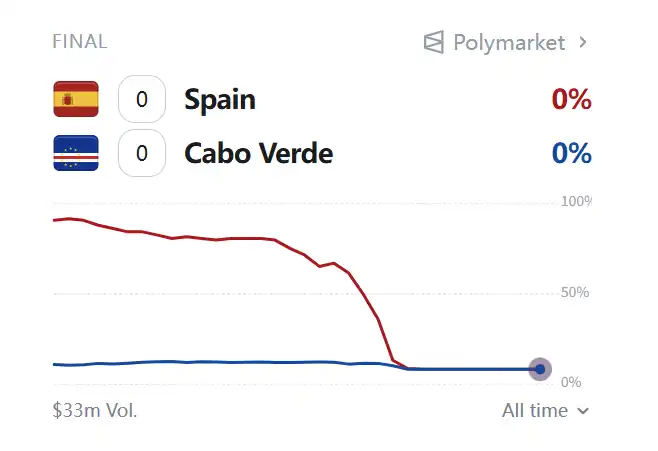
Probability curve for Spain vs. Cape Verde on Polymarket

Had Spain won, this user would have expected a profit of only about $85,000, a typical "low-risk, low-return" strategy: betting on a high-probability event, using a large principal to seek a small, stable return.

However, the user ended up with a loss of nearly $1 million.
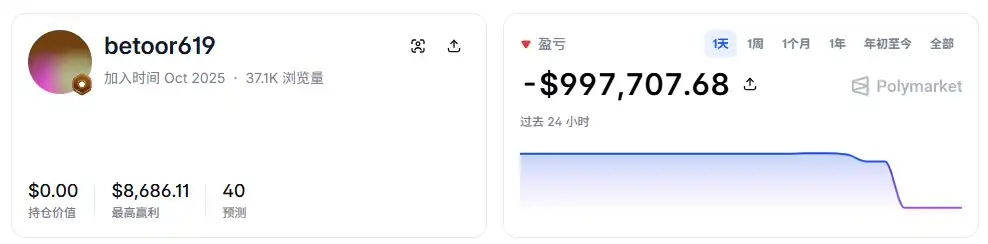
Polymarket user "betoor619" lost $997,000 in the past 24 hours

Records show this account was opened last October, and its previous profit or loss on any single event never exceeded $9,000. The scale of this bet was more than a hundred times its historical record.

Other traders also placed large bets on a Spanish victory, but most executed hedging trades, which partially offset their losses.

Polymarket allows large traders to act as market makers, holding both long and short positions on the same wager, a mechanism similar to how Wall Street institutions profit from spreads by buying and selling the same stock.

Behind the Upset: Cape Verde's 40-Year-Old Goalkeeper Saves the Day

Spain was widely considered the top favorite to win this World Cup.

As Wallstreetcn mentioned, a Goldman Sachs model gave them the highest championship probability at 25% among all participating teams. Cape Verde was not only a World Cup debutant but also had no well-known professional players in its squad.

The pivotal figure who reversed all expectations was goalkeeper Josimar José Évora Dias, nicknamed Vozinha. The 40-year-old veteran made seven crucial saves during the match and walked off the field in tears afterwards, earning the Man of the Match award.

Vozinha stated after the game that visa issues prevented his mother from witnessing this historic moment in person. According to relevant regulations, visitors from certain countries, including Cape Verde, must pay a refundable bond of up to $15,000. He described this match as the goal he had worked towards "his entire career."

This draw was one of several upsets in the opening days of the tournament, following Japan's dramatic comeback to equalize against the Netherlands in stoppage time last Sunday.

Platform Expansion: From Political Betting to Mainstream Sports Wagering

Prediction market platforms like Polymarket have rapidly moved out of niche circles in recent years. Previously known primarily as tools for betting on geopolitical and economic events, they have now become popular platforms for wagering on major global sporting events like the World Cup.

Platform users trade via cryptocurrency wallets, can operate under anonymous accounts, and do not need to disclose their real identity or location. This mechanism has drawn criticism from some lawmakers who argue the platform fails to collect necessary user background information like traditional brokers or betting companies.

Public transaction records also provide an external window into the significant scale and high risks of user bets on events. Just for Monday's match involving Spain, Polymarket users traded a total volume of $64 million.


Domande pertinenti

QWhat was the main financial outcome for a Polymarket user betting on Spain to win against Cape Verde?

AA Polymarket user with the username 'betoor619' suffered a loss of nearly $1 million after Spain unexpectedly drew with Cape Verde in their World Cup group match.

QHow did the odds for a Spanish victory change according to the Polymarket data mentioned?

AThe odds for a Spanish victory were around 92% before the match, representing a high-probability, low-return bet. The draw caused this probability to collapse, leading to significant losses for those who had heavily bet on Spain.

QWho was the key player for Cape Verde in their draw against Spain, and what was notable about him?

AThe key player was the 40-year-old goalkeeper Josimar José Évora Dias, known as Vozinha. He made seven crucial saves, was named Man of the Match, and played a pivotal role in securing the historic draw for Cape Verde.

QWhat is one of the distinctive features of trading on the Polymarket platform mentioned in the article?

AOne distinctive feature is that Polymarket allows users to trade anonymously using cryptocurrency wallets, without needing to disclose their real-world identity or location, which has drawn criticism from some legislators.

QWhat was the total trading volume on Polymarket for the Spain vs. Cape Verde match mentioned in the article?

AThe total trading volume on Polymarket for the Spain vs. Cape Verde match on that Monday was $64 million.

Letture associate

Xpeng and NIO Compete on Computing Power, Li Auto Shifts Architecture

On June 15, 2026, Li Auto unveiled details of its self-developed chip, Mahe M100, for its new L9 Livis model. CTO Xie Yan stated the goal was not just a faster chip, but a fundamentally different one, targeting the chip architecture itself. While competitors like NIO, Xpeng, and Huawei highlight TOPS (computing power) figures for their self-developed chips, Li Auto’s Mahe M100 focuses on redesigning the underlying architecture. It employs a "dynamic data flow architecture" to address memory bandwidth bottlenecks in large model inference, claiming up to 3x the effective computing power of Nvidia's Thor U for its specific workloads and a 40% reduction in latency. The chip's design was peer-reviewed and accepted at ISCA 2026. However, this performance is highly optimized for Li Auto's own VLA2.1 algorithm, meaning it may not generalize as well to other tasks. Li Auto aims to achieve full-stack in-house development with Mahe M100, covering chip, compiler, OS, AI algorithms, and domain controller—a level of vertical integration few competitors match. Beyond the chip, CEO Li Xiang introduced a new strategic narrative: the "embodied intelligent vehicle," defined as an integration of an EV, a professional driver, an AI computer, and a life assistant. This shifts competition from features like large screens to systemic AI capabilities. A key commitment was that Li Auto's Mahe VLA autonomous driving model will match Tesla's FSD V14 by Q4 2026, with specific OTA milestones set for July, September, and December. Financially, Li Auto faces pressure with declining revenue and vehicle gross margins since Q4 2025, while maintaining high R&D investment (approx. ¥12B in 2026, 50% AI-related). Its 2026 sales target is 550,000 vehicles, up from 406,000 in 2025. The new L9 Livis garnered over 10,000 pre-orders in two weeks. The effectiveness of these strategic moves—new products, OTAs, and the novel chip architecture—will begin to show in Q3 2026 financial results, with the year-end FSD V14 benchmark being the ultimate test.

marsbit30 min fa

Xpeng and NIO Compete on Computing Power, Li Auto Shifts Architecture

marsbit30 min fa

The Year of AI Applications: Saying 'Yes' While Ignoring Risks? A Comprehensive Open Source Log of Software Development's Journey

The Year of AI Applications: Blindly Saying "Yes" While Ignoring Risks? A Software Development Log Goes Fully Open Source. AI-generated code harbors risks hidden within seemingly correct programs, potentially leading to data leaks or asset loss. The open-source project "Narwhal AI Code Risks," from Peking University's Narwhal-Lab, compiles real-world cases, early warning signs, and typical risk pathways. Its goal is to help developers identify potential hazards early and avoid repeating past mistakes. In 2026, code is generated faster than ever but deployed with less scrutiny. The danger often lies not in glaring errors, but in code that appears normal—syntactically correct, passing all checks—yet introduces subtle but critical flaws like non-existent dependencies, excessive permissions, or exposed databases. A stark example is the Moonwell cbETH oracle incident. A configuration file error, where a cryptocurrency price was set to ~$1.12 instead of ~$2,200, slipped through 28 checks and a pull request signed by both AI (Claude, Copilot) and human developers. This "semantic deviation" resulted in a loss of $1.78 million. The risk is that AI can produce functionally valid code that is semantically wrong for the business context. As AI moves beyond simple code completion to modifying configurations, installing dependencies, and operating via autonomous agents, it traverses longer, less traceable paths within software engineering, blurring traditional boundaries and oversight points. The Narwhal AI Code Risks project structures information into three layers: `/cases` for documented real-world incidents, `/inferred` for early warning signals, and `/scenarios` for clear, generalized risk patterns not yet tied to specific events. This aims to create a lasting, public record to prevent collective amnesia about past AI-coding pitfalls. Risks are categorized into seven areas: Software Supply Chain (e.g., recommending fake packages), Code-Level Vulnerabilities (e.g., reintroducing path traversal bugs), Cloud & Infrastructure Misconfiguration (e.g., overly permissive settings), Agent Risks (from autonomous tool execution), Vertical Domain Risks (e.g., in finance, healthcare), Intellectual Property & Compliance issues, and Human Factors (like over-reliance on AI output). The project's core value is transforming isolated incidents into reusable knowledge—a foundational resource for developers to spot similar issues, for security researchers to build upon, for toolmakers to create detection rules, and for the community to contribute new findings. As AI integration accelerates, this open-source "logbook" serves as a crucial navigational aid, charting past errors to help future projects steer clear of the same traps.

marsbit30 min fa

The Year of AI Applications: Saying 'Yes' While Ignoring Risks? A Comprehensive Open Source Log of Software Development's Journey

marsbit30 min fa

The Foundation of SpaceX's Trillion-Dollar Valuation: Who is Dividing Up Musk's Annual Tens of Billions in Capital Expenditure?

SpaceX's trillion-dollar valuation is built on its three core businesses: Starlink (profitable, 60% of revenue), rockets (driving down launch costs), and AI (a major investment area). This creates a financial cycle: Starlink funds rocket development, which enables low-cost launches for AI hardware, generating future revenue. This cycle fuels annual capital expenditures of tens of billions, flowing to a vast supply chain. Suppliers are categorized by their replaceability. The first group includes irreplaceable players like NVIDIA (GPU/CUDA ecosystem), Eutelsat (critical radio spectrum), Filtronic (specialized amplifiers), Materion (strategic beryllium), and STMicroelectronics (antenna chips). The second group consists of hard-to-replace suppliers due to high switching costs, such as Honeywell (flight control), Carpenter Technology (specialty alloys), Hexcel (carbon fiber), Broadcom (data exchange), and Linde (industrial gases). The third group comprises high-volume, cost-critical suppliers for mass-produced items like Starlink terminals. Key names include Wistron NeWeb (primary manufacturer) and several A-share companies like Shenzhen Sunway (connectors), Pies New Materials (forgings), Western Superconducting (alloys), and Yingliu (castings). Other niche players include Trimble (timing), Astronics (power distribution), and CTS (thermal management). The article argues that investing in these suppliers, rather than SpaceX stock directly, offers an alternative opportunity. The rationale is threefold: procurement is just beginning to scale, SpaceX's IPO brings new transparency to its supply chain, and the situation mirrors early stages of past "super terminal" ecosystems like Apple or Tesla. While risks exist (commodity cycles, geopolitical factors, technology shifts), the core thesis is that SpaceX's massive, ongoing procurement will translate into reliable revenue for its key suppliers, regardless of its own stock price volatility.

marsbit1 h fa

The Foundation of SpaceX's Trillion-Dollar Valuation: Who is Dividing Up Musk's Annual Tens of Billions in Capital Expenditure?

marsbit1 h fa

SpaceX's Trillion-Dollar Valuation Base: Who's Sharing in Musk's Annual Tens of Billions in Capital Expenditure?

**Title: The Foundation of SpaceX's Trillion-Dollar Valuation: Who Benefits from Musk's Annual $100 Billion Capital Expenditure?** This article argues that investors seeking to benefit from SpaceX's growth might find greater opportunities in its supply chain rather than directly investing in the company itself, drawing parallels to historical successes with Apple, Tesla, and NVIDIA suppliers. **SpaceX's Business Model & Cash Flow:** SpaceX generates revenue from three main areas: 1. **Starlink:** Its profitable core, earning $11.3B in 2023 (60% of revenue), funding other ventures. 2. **Rockets (Falcon/Starship):** Requires $3B+ in annual R&D but achieves the world's lowest launch costs. 3. **AI:** Currently unprofitable (-$6B+ in 2023), investing heavily in ground-based supercomputers (220,000 GPUs) and future orbital data centers. The cycle is: Starlink profits → fund cheaper rockets → low-cost launches deploy AI hardware → AI compute rentals generate future revenue. This cycle drives annual procurement spending of tens of billions of dollars. **The Supply Chain Beneficiaries:** Suppliers are categorized by their replaceability: **1. Nearly Irreplaceable (High Barriers to Entry):** * **NVIDIA:** Powers the Colossus supercomputer; its CUDA ecosystem creates immense switching costs. * **Eutelsat (SATS):** Controls critical radio spectrum for satellite communications; holds a ~3% stake in SpaceX. * **Filtronic (FTC):** Supplies millimeter-wave signal amplifiers for Starlink satellites; SpaceX constitutes 83% of its revenue. * **Materion (MTRN):** Global leader in beryllium production, a strategic material used in Starship structures. * **STMicroelectronics (STM):** Supplies phased-array antenna chips for Starlink satellites. **2. Replaceable, but Switching Cost is Prohibitively High:** * **Honeywell (HON):** Provides flight control and inertial navigation systems with decades of certification. * **Carpenter Technology (CRS):** Manufactures ultra-pure specialty steel alloys for Raptor engines. * **Hexcel (HXL):** Supplies custom carbon fiber composites developed over a decade with SpaceX. * **Broadcom (AVGO):** Manages high-speed data switching. * **Linde Group:** Supplies industrial gases (liquid oxygen/nitrogen) from facilities built near SpaceX launch sites. **3. High-Volume, Cost-Critical Manufacturing:** Focuses on mass-producing components like Starlink user terminals (target: 30 million units). * **Key Players:** Wistron NeWeb (6285, primary terminal manufacturer), several Chinese A-share companies (e.g., Sunway Communication, PAX New Materials, Western Metal Materials, Yingliu Co.), and smaller US firms like Trimble (TRMB, timing systems). **Why Now?** Three factors make the supply chain opportunity timely: 1. **Volume Ramp-Up:** SpaceX plans 100 launches in 2026, aims for 30 million Starlink terminals, and will deploy AI data centers, meaning procurement will accelerate. 2. **Increased Transparency:** The IPO provides public financial data, allowing investors to track supplier order growth. 3. **Historical Precedent:** The current phase is likened to Tesla's early mass-production stage (circa 2018), suggesting a long growth runway for suppliers. **Conclusion:** The article posits that while investing in SpaceX stock is betting on Elon Musk's ambitious vision at a high valuation, investing in its established suppliers is a bet on the tangible, recurring revenue from its massive procurement budget, which is largely decoupled from day-to-day stock price volatility.

链捕手1 h fa

SpaceX's Trillion-Dollar Valuation Base: Who's Sharing in Musk's Annual Tens of Billions in Capital Expenditure?

链捕手1 h fa

The U.S. Government Blocked the Anthropic Model. It Wasn't About 'Jailbreaking' at All.

Last Friday, the U.S. Commerce Department issued an enforcement letter that forced Anthropic to take its two most advanced AI models, Fable 5 and Mythos 5, offline. The stated reason was unspecified national security concerns, initially linked to potential "jailbreaks" of the models' safeguards. However, new details suggest the action stemmed more from a deteriorating relationship between the Trump administration and Anthropic, rather than a genuine technical threat. According to reports, the government cited a little-known export control regulation, compelling Anthropic to block access for all non-U.S. persons, including its own international employees. The company complied, shutting down the models without a court order or specific technical details from the government. Cybersecurity expert Katie Moussouris revealed she was privately shown a research paper detailing a potential safeguard bypass in Fable 5. She argued the described method was minor and did not warrant an export ban, stating that attempts to "fix" it would only weaken the model's defensive capabilities. Moussouris and other experts have since called for the order to be revoked, warning it dangerously removes advanced cybersecurity tools from U.S. defenders. Analysts like Justin Hendrix suggest the move appears retaliatory and sets a dangerous precedent, signaling that the U.S. government can unilaterally shut down a tech company's products. The incident has raised concerns about the reliability of American AI and the potential for political interference in the tech industry, serving as a warning to the broader sector.

marsbit1 h fa

The U.S. Government Blocked the Anthropic Model. It Wasn't About 'Jailbreaking' at All.

marsbit1 h fa

Trading

Spot
Futures

Articoli Popolari

Cosa è USDC(WORMHOLE)

USD Coin (Wormhole): Una panoramica completa Introduzione Nel mondo in rapida evoluzione delle criptovalute, USD Coin (Wormhole), noto come $USDC(Wormhole), si distingue come una soluzione pionieristica all'interno del panorama DeFi (Finanza Decentralizzata). Operando su diverse piattaforme blockchain, tra cui Solana, USD Coin (Wormhole) è più di una semplice rappresentazione digitale del dollaro statunitense. Incarna lo spirito innovativo della finanza moderna, consentendo transazioni senza attriti tra diverse blockchain e migliorando l'interoperabilità tra i vari ecosistemi blockchain attraverso il protocollo avanzato Wormhole. Cos'è USD Coin (Wormhole)? USD Coin (Wormhole) è una versione tokenizzata del dollaro USA progettata per facilitare transazioni senza attriti attraverso diverse reti blockchain. Il suo obiettivo principale è quello di aumentare la liquidità e migliorare la funzionalità dell'ecosistema DeFi. Sfruttando il protocollo Wormhole, che stabilisce una robusta rete di comunicazione cross-chain, gli utenti possono trasferire senza sforzo i token USDC su varie piattaforme. Questa capacità cross-chain segna un avanzamento significativo nell'uso delle criptovalute, promuovendo un ecosistema più interconnesso ed efficiente in cui gli asset possono fluire liberamente tra diverse blockchain. La proposta di valore di USD Coin (Wormhole) risiede non solo nella sua stabilità, essendo ancorata al dollaro USA, ma anche nella sua capacità di colmare le lacune tra ambienti blockchain disparati. Questo approccio innovativo favorisce un maggior livello di partecipazione tra utenti e sviluppatori, aprendo la strada a nuove ed entusiasmanti applicazioni nella finanza decentralizzata. Chi è il creatore di USD Coin (Wormhole)? Le origini di USD Coin (Wormhole) sono intrecciate con la rete Wormhole, sviluppata da Jump Crypto. Sebbene i creatori individuali specifici non siano documentati in modo prominente, Jump Crypto è nota per il suo coinvolgimento nel progresso della tecnologia blockchain e nel supporto delle sue applicazioni in ambito finanziario. Creando la rete Wormhole, Jump Crypto ha svolto un ruolo fondamentale nella promozione dei trasferimenti di asset cross-chain, aumentando l'efficienza e la diversità dell'uso delle criptovalute. Chi sono gli investitori di USD Coin (Wormhole)? Il successo di USD Coin (Wormhole) è sostenuto da investimenti di diversi fondi e organizzazioni note all'interno del settore delle criptovalute. Gli investitori chiave includono: Coinbase Ventures: Un'importante divisione di venture capital sostenuta da uno dei principali scambi di criptovalute del settore, Coinbase Ventures fornisce capitale essenziale e supporto strategico a promettenti progetti blockchain. Arrington XRP Capital: Specializzata in asset digitali, Arrington XRP Capital riconosce il potenziale di progetti innovativi come USD Coin (Wormhole) e ha investito di conseguenza per sostenere il suo sviluppo. Jump Trading: Come organizzazione madre di Jump Crypto, Jump Trading porta non solo investimenti ma anche una ricchezza di esperienza nella tecnologia di trading e nella dinamica di mercato per rafforzare il progetto Wormhole. Come funziona USD Coin (Wormhole)? Il framework operativo di USD Coin (Wormhole) è progettato per facilitare transazioni cross-chain efficaci, massimizzando sicurezza ed efficienza. Ecco una panoramica semplificata di come funziona: Blocco degli asset: Quando un utente desidera trasferire USDC da una blockchain all'altra, prima blocca i propri token sulla blockchain di origine. Questo processo assicura che gli asset siano sicuri e siano pronti per essere bruciati o trasferiti successivamente. Creazione di token: Dopo che i token sono stati bloccati, viene coniato un equivalente di USDC sulla blockchain di destinazione. Ciò fornisce all'utente accesso ai propri fondi su una nuova piattaforma, riflettendo la flessibilità che il protocollo Wormhole consente. Trasferimento cross-chain: Il protocollo Wormhole facilita in modo efficiente l'intero processo di trasferimento. Assicura che una volta che l'USDC è coniato sulla catena di destinazione, i token equivalenti vengano bruciati sulla catena di origine. Il risultato è un trasferimento senza soluzione di continuità di valore tra due ambienti blockchain distinti. Questa metodologia cross-chain assicura che le transazioni rimangano sicure e trasparenti, migliorando significativamente la liquidità all'interno dei diversi ecosistemi DeFi. Cronologia di USD Coin (Wormhole) Comprendere l'evoluzione di USD Coin (Wormhole) fornisce un contesto vitale per la sua importanza nell'arena delle criptovalute. Ecco una cronologia che evidenzia importanti traguardi nella storia del progetto: 2021: Il progetto Wormhole viene lanciato, stabilendo un framework per i trasferimenti di asset cross-chain e preparando il terreno per lo sviluppo di USD Coin (Wormhole). 2022: La rete Wormhole affronta una significativa sfida con una violazione della sicurezza che porta a un furto di 325 milioni di dollari. Tuttavia, l'incidente viene successivamente affrontato e rimborsato da Jump Crypto, dimostrando l'impegno del progetto per la sicurezza e la trasparenza. 2023: USD Coin (Wormhole) si integra con il protocollo di trasferimento cross-chain di Circle (CCTP), migliorando le sue capacità per i trasferimenti cross-chain e consolidando ulteriormente la sua posizione all'interno dell'ecosistema DeFi. 2024: Continuano lo sviluppo e l'espansione della rete Wormhole, mirati ad aumentare l'utilità e la portata di USD Coin (Wormhole) e a migliorare il suo framework operativo. Caratteristiche principali Il successo di USD Coin (Wormhole) può essere attribuito a diverse caratteristiche chiave che lo differenziano da altre offerte di criptovalute: Interoperabilità cross-chain Al centro di USD Coin (Wormhole) c'è la sua capacità di facilitare trasferimenti senza soluzione di continuità attraverso più reti blockchain. Questa interoperabilità funge da pietra miliare per la finanza decentralizzata, consentendo a varie piattaforme di interagire tra loro, accelerando così l'evoluzione dei servizi finanziari. Sicurezza Wormhole impiega una rete Guardian ben progettata composta da validatori di nodi che garantiscono transazioni cross-chain sicure. Questo monitoraggio collettivo riduce al minimo il rischio di frodi e fornisce agli utenti la certezza che i loro asset siano protetti durante i trasferimenti cross-chain. Miglioramento della liquidità Consentendo a USDC di circolare liberamente tra diverse blockchain, USD Coin (Wormhole) aumenta la liquidità nell'ecosistema DeFi. Questa maggiore liquidità può favorire operazioni di trading più efficienti, contribuire a strategie di prezzo migliori e migliorare la dinamica generale del mercato che racchiude vari asset digitali. Conclusione USD Coin (Wormhole) rappresenta un'innovazione fondamentale nello spazio blockchain, rafforzando le capacità della finanza decentralizzata (DeFi) e stabilendo un ecosistema finanziario più connesso. Con il suo robusto framework per le transazioni cross-chain, le caratteristiche di sicurezza e un forte sostegno da parte di investitori di valore, USD Coin (Wormhole) è posizionato per giocare un ruolo chiave nel futuro delle criptovalute. Mentre il panorama della finanza digitale continua ad evolversi, USD Coin (Wormhole) non solo abbraccia il futuro dell'interconnessione tra le reti blockchain, ma riafferma anche il potere della tokenizzazione e della tecnologia blockchain nel trasformare il modo in cui percepiamo e utilizziamo il valore in un mondo digitale. Navigando nelle complessità della funzionalità cross-chain, dimostra un approccio sofisticato per abilitare l'inclusività finanziaria e l'innovazione nel mondo delle criptovalute.

143 Totale visualizzazioniPubblicato il 2024.04.03Aggiornato il 2024.12.03

Cosa è USDC(WORMHOLE)

Cosa è W$C

World$tateCoin ($W$C): Un'Esplorazione Completa del Progetto di Criptovaluta Emergente Introduzione Nel panorama in continua evoluzione delle criptovalute, World$tateCoin ($W$C) è emerso come un progetto che mira a sfruttare il potere delle tecnologie web3 per creare un ecosistema digitale distintivo. Mentre i modelli tradizionali di interazione online subiscono trasformazioni significative, World$tateCoin cerca di affermarsi in questa nascente terza generazione di internet. Questo articolo esaminerà le complessità di World$tateCoin, fornendo una panoramica del progetto, dei suoi obiettivi e del suo potenziale impatto nello spazio web3. Che cos'è World$tateCoin ($W$C)? World$tateCoin ($W$C) è progettato come una criptovaluta che facilita transazioni senza soluzione di continuità all'interno di un ambiente web3. Mirando a creare una piattaforma decentralizzata dove gli utenti possono interagire con varie applicazioni web3, $W$C intende semplificare l'esperienza degli utenti e migliorare l'accessibilità ai servizi digitali. Sebbene il progetto aspiri a diventare una parte integrante del panorama web3, le informazioni dettagliate sui suoi specifici obiettivi e casi d'uso rimangono limitate, sollevando interrogativi riguardo al suo potenziale ruolo e utilità in un contesto digitale in rapida evoluzione. L'essenza di web3 ruota attorno alla decentralizzazione e all'empowerment degli utenti con un maggior controllo sulle loro interazioni online. World$tateCoin intende allinearsi a questi principi, sebbene le applicazioni specifiche e le funzionalità della valuta siano ancora in discussione all'interno della comunità. Chi è il Creatore di World$tateCoin ($W$C)? Esplorando le origini di World$tateCoin, le informazioni riguardanti il suo creatore rimangono elusive. Al momento, non sono disponibili dati pubblici che identificano le persone o le organizzazioni dietro il progetto. Questa oscurità potrebbe gettare un'ombra di incertezza sulla credibilità del progetto, ma l'impegno per l'innovazione all'interno del framework delle criptovalute potrebbe essere una forza trainante per la sua adozione in futuro. La mancanza di una leadership identificabile potrebbe comportare ostacoli relativi alla fiducia e alla trasparenza: elementi cruciali per stabilire una forte comunità nello spazio crypto. Chi sono gli Investitori di World$tateCoin ($W$C)? Le ricerche attuali non rivelano investitori specifici o organizzazioni di supporto coinvolti con World$tateCoin. Non è raro che progetti emergenti di criptovaluta attraggano investimenti riservati o operino in una struttura finanziaria minimalista durante la loro fase iniziale. L'ambiguità che circonda i supporti agli investimenti e le metodologie di finanziamento potrebbe influenzare la sostenibilità e le prospettive di crescita del progetto. Quando si valutano nuovi progetti nel dominio delle criptovalute, gli investitori generalmente cercano trasparenza riguardo al supporto finanziario e al sostegno da entità consolidate. L'assenza di queste informazioni potrebbe richiedere un approccio cauto da parte degli utenti e degli stakeholder potenzialmente interessati al futuro di World$tateCoin. Come Funziona World$tateCoin ($W$C)? Le meccaniche operative di World$tateCoin sono radicate nei principi di decentralizzazione, un marchio distintivo delle tecnologie web3. Facilitando transazioni direttamente tra utenti senza l'intervento di intermediari, $W$C è progettato per migliorare la fiducia e l'efficienza. Tuttavia, la documentazione completa che dettaglia le caratteristiche uniche e il framework operativo che distinguono World$tateCoin da altre criptovalute è notevolmente scarsa. Questa mancanza di informazioni complica la comprensione di come $W$C funzioni all'interno del più ampio ecosistema web3 e quali proposte uniche porti a utenti e sviluppatori. Tuttavia, l'obiettivo fondamentale di consentire transazioni decentralizzate promette un panorama finanziario più liberato, a condizione che il progetto realizzi le sue aspirazioni di implementare meccanismi robusti e interfacce user-friendly. Timeline di World$tateCoin ($W$C) Costruire una timeline che racchiuda la progressione storica di World$tateCoin presenta sfide a causa dell'assenza di documentazione significativa su eventi chiave e traguardi. Tuttavia, una sequenza approssimativa di fasi ipotetiche può essere immaginata, costituendo un percorso futuro per il progetto: Concetto Iniziale (Data Sconosciuta): Concettualizzazione del framework di World$tateCoin nel più ampio contesto delle tecnologie web3. Fase di Sviluppo (Data Sconosciuta): Inizio dello sviluppo tecnico e dei processi di codifica. Coinvolgimento della Comunità (Data Sconosciuta): Contatto con potenziali utenti e stakeholder per promuovere l'interesse della comunità nel progetto. Obiettivo di Lancio (Data Sconosciuta): Annuncio di una data di lancio prevista, in funzione del progresso delle fasi di sviluppo e testing. A causa della mancanza di date e dettagli documentati su queste fasi, gli stakeholder dovranno rimanere vigili e coinvolti con le comunicazioni del progetto per aggiornamenti riguardanti la sua traiettoria. Temi Chiave su World$tateCoin ($W$C) Man mano che il progetto si sviluppa, alcuni argomenti chiave emergono che incarnano il potenziale e le aspirazioni di World$tateCoin: Decentralizzazione: La filosofia centrale che guida il progetto, mirata a promuovere interazioni dirette tra gli utenti. Integrazione Web3: L'obiettivo di rispecchiare i principi web3 e consentire un accesso senza soluzione di continuità a una serie di servizi digitali. Criptovaluta Digitale: Posizionato come una valuta per facilitare transazioni basate su internet, World$tateCoin mira a iniettare ulteriore liquidità nel mercato web3. Problema della Scarsità di Informazioni: L'assenza notevole di informazioni dettagliate riguardo le fondamenta del progetto, i creatori e i metodi operativi, richiedendo maggiore trasparenza da parte degli sviluppatori per costruire fiducia nella comunità. Conclusione World$tateCoin ($W$C) si colloca in un territorio entusiasmante ma incerto di integrazione tra criptovaluta e web3. Mentre mira a coltivare un ambiente decentralizzato, la disponibilità limitata di informazioni riguardo i suoi creatori, investitori e funzionalità specifiche presenta sfide per potenziali stakeholder e utenti. Nel dinamico mondo delle criptovalute, trasparenza, coinvolgimento e comunicazione ben strutturata sono vitali per il successo di progetti come World$tateCoin. Man mano che il panorama continua a evolversi, gli stakeholder saranno ansiosi di vedere come il progetto possa consolidare la sua posizione all'interno della narrativa web3 e contribuire alla trasformazione in corso dell'ecosistema digitale.

90 Totale visualizzazioniPubblicato il 2024.04.05Aggiornato il 2024.12.03

Cosa è W$C

Come comprare W

Benvenuto in HTX.com! Abbiamo reso l'acquisto di Wormhole (W) semplice e conveniente. Segui la nostra guida passo passo per intraprendere il tuo viaggio nel mondo delle criptovalute.Step 1: Crea il tuo Account HTXUsa la tua email o numero di telefono per registrarti il tuo account gratuito su HTX. Vivi un'esperienza facile e sblocca tutte le funzionalità,Crea il mio accountStep 2: Vai in Acquista crypto e seleziona il tuo metodo di pagamentoCarta di credito/debito: utilizza la tua Visa o Mastercard per acquistare immediatamente WormholeW.Bilancio: Usa i fondi dal bilancio del tuo account HTX per fare trading senza problemi.Terze parti: abbiamo aggiunto metodi di pagamento molto utilizzati come Google Pay e Apple Pay per maggiore comodità.P2P: Fai trading direttamente con altri utenti HTX.Over-the-Counter (OTC): Offriamo servizi su misura e tassi di cambio competitivi per i trader.Step 3: Conserva Wormhole (W)Dopo aver acquistato Wormhole (W), conserva nel tuo account HTX. In alternativa, puoi inviare tramite trasferimento blockchain o scambiare per altre criptovalute.Step 4: Scambia Wormhole (W)Scambia facilmente Wormhole (W) nel mercato spot di HTX. Accedi al tuo account, seleziona la tua coppia di trading, esegui le tue operazioni e monitora in tempo reale. Offriamo un'esperienza user-friendly sia per chi ha appena iniziato che per i trader più esperti.

203 Totale visualizzazioniPubblicato il 2024.12.10Aggiornato il 2026.06.02

Come comprare W

Discussioni

Benvenuto nella Community HTX. Qui puoi rimanere informato sugli ultimi sviluppi della piattaforma e accedere ad approfondimenti esperti sul mercato. Le opinioni degli utenti sul prezzo di W W sono presentate come di seguito.

活动图片