US Senators Press Bank Regulators For ‘Fair’ Crypto Capital Rules

bitcoinistPubblicato 2026-06-05Pubblicato ultima volta 2026-06-05

Introduzione

A group of U.S. Senate Republicans, led by Senator Cynthia Lummis, is urging federal bank regulators to establish clear and fair capital rules for banks involved with crypto assets. In a letter to the Federal Reserve, FDIC, and OCC, the lawmakers criticized the international Basel Committee's standards, which impose a punitive 1,250% risk weight on crypto assets, calling it a de facto ban not based on actual risk. They applauded recent interagency guidance that granted tokenized securities the same capital treatment as traditional ones, arguing this risk-based principle should apply consistently to all digital assets. The senators called on the agencies to develop a new capital framework, aligning with recent legislative progress on crypto market structure. Their push coincides with testimonies from top regulators, who emphasized a shift toward more risk-based supervision and responsible innovation, while also addressing stablecoin oversight under new proposals.

A group of Senate Republicans is pressing bank regulators to build on recent regulatory progress by creating a clearer capital framework for crypto activities and asset treatment.

US Senators Call For Clear Crypto Capital Rules

On Thursday, Senate Banking Subcommittee on Digital Assets Chair Cynthia Lummis and Senators Dan Sullivan, Bill Hagerty, Bernie Moreno, Ted Budd, and Jon Husted shared a recent letter urging key financial agencies to move toward “clear and fair” capital rules for banks engaged in crypto asset activities.

The letter, addressed to Federal Reserve Vice Chair for Supervision Miki Bowman, Federal Deposit Insurance Corporation (FDIC) Chairman Travis Hill, and Comptroller of the Currency Jonathan Gould, criticized the international Basel Committee on Bank Supervision’s capital standards, which gave “the most punitive classification in the capital framework” to crypto assets.

Notably, the standard assigned a 1,250% risk weight, used to determine how much a bank must hold against a certain asset, on crypto assets. To the senators, “This classification was not derived from a calibrated assessment of the actual risk profile of digital assets.

Instead, it “appears to be a blanket penalty assigned by asset category as a de facto ban on banks holding this asset class, in direct tension with a technology-neutral approach” that agencies like the Office of the Comptroller of the Currency (OCC) and the FDIC have disclosed over the past year.

The lawmakers applauded the regulatory agencies for their recent interagency guidance on tokenized securities, which clarified the capital treatment of these assets. In March, the FDIC, the OCC, and the Federal Reserve jointly said that tokenized securities should generally receive the same capital treatment as their non-tokenized counterparts, affirming that capital treatment should reflect the risk characteristics of the underlying asset, not the technology used to record ownership.

“That principle should apply consistently—including to other digital assets,” the letter stated. Citing this position and recent progress on the crypto market structure bill, which would expand banks’ ability to engage in balance-sheet crypto asset activities, the senators urged the FDIC, OCC, and Federal Reserve to begin developing a new capital framework for such activities.

Top Regulators Shift To ‘Risk-Based’ Supervision

The senators’ call for new crypto capital rules came as the three regulators testified before the House Financial Services Committee on Thursday morning, updating lawmakers on their broader effort to revisit and ease several bank rules implemented after the 2008 financial crisis.

In prepared remarks, the FDIC chair noted that the agency is implementing several changes to reform its approach to a more “effective and efficient” supervisory framework that continues to support the safety of individual institutions and the broader system.

Hill stated that strong capital standards play a critical role in ensuring a resilient banking system, while driving economic growth and supporting their customers. Regarding crypto assets, he stated that the agency has issued several proposed rules to regulate and oversee subsidiaries of FDIC-supervised Insured depository institutions (IDIs) approved to issue payment stablecoins under the GENIUS Act.

Similarly, the OCC Chief affirmed that it is “returning to risk-based supervision rooted in law and emphasizing examiner judgment, not arbitrary checklists,” and reviewing past supervisory criticisms and enforcement actions.

“Our job is to facilitate, not stymie, responsible innovation,” Gould said, adding that “Our banking system will only remain relevant and trusted if it resists pressures to deny access based on political or religious beliefs or lawful business activity. We have made considerable progress in reviewing the activities of the largest national banks and are investigating complaints of alleged debanking, consistent with the President’s executive order.”
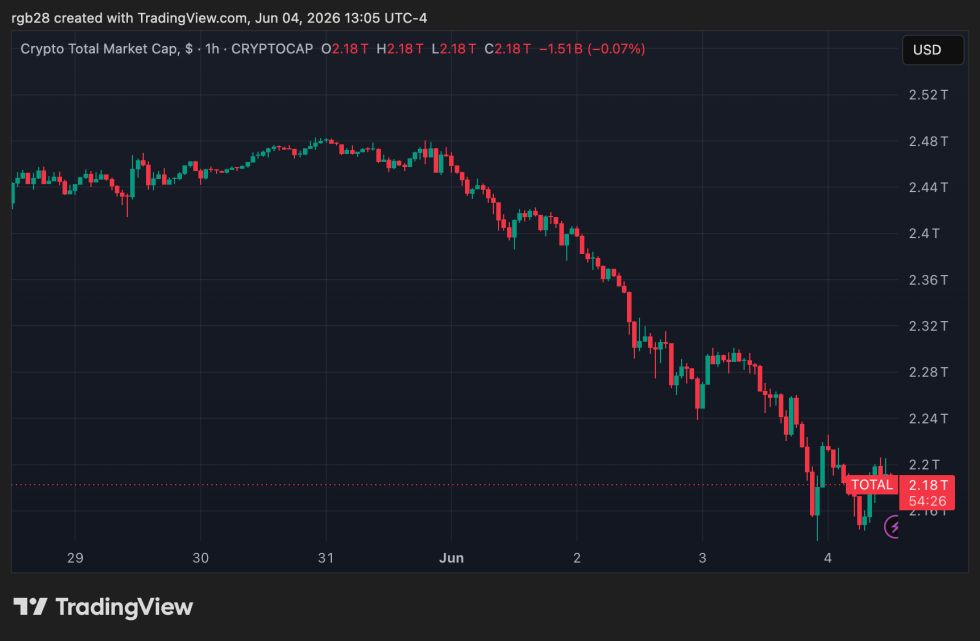
The total crypto market capitalization is at $2.18 trillion in the one-week chart. Source: TOTAL on TradingView


Crypto di tendenza

Domande pertinenti

QWhat are the main concerns of the US Senators regarding the current capital rules for crypto assets?

AThe Senators criticize the Basel Committee's standards for assigning a punitive 1,250% risk weight to crypto assets, arguing it appears to be a blanket penalty and a de facto ban rather than a calibrated assessment of actual risk.

QWhich regulatory agencies did the senators' letter address, and what recent guidance did they praise?

AThe letter was addressed to Federal Reserve Vice Chair Miki Bowman, FDIC Chairman Travis Hill, and Comptroller of the Currency Jonathan Gould. They praised the agencies' recent interagency guidance on tokenized securities, which clarified that tokenized securities should receive the same capital treatment as their non-tokenized counterparts.

QAccording to the letter, what principle should apply to the capital treatment of digital assets?

AThe principle that capital treatment should reflect the risk characteristics of the underlying asset, not the technology used to record ownership, should apply consistently to digital assets.

QWhat broader regulatory shift was mentioned in the testimony of the FDIC and OCC heads?

AThe FDIC and OCC heads indicated a shift towards more 'risk-based' supervision. The FDIC is moving to a more 'effective and efficient' framework, and the OCC is 'returning to risk-based supervision rooted in law and emphasizing examiner judgment, not arbitrary checklists.'

QWhat did OCC Comptroller Jonathan Gould state about the role of regulators regarding innovation and access?

AGould stated that the regulator's job is 'to facilitate, not stymie, responsible innovation,' and that the banking system must resist denying access based on political or religious beliefs or lawful business activity to remain relevant and trusted.

Letture associate

From South Korea to the United States: Blue-Collar Jobs Are Becoming Increasingly Popular, Thanks to AI

AI is reshaping the labor market's value proposition. The traditional four-year college degree is losing its appeal as a guaranteed career path, while skilled blue-collar trades like electricians, welders, and plumbers are experiencing historic demand and wage premiums. This shift is driven by dual pressures: AI's displacement of certain white-collar roles and a booming need for physical infrastructure and data center construction. Data confirms the trend. In the U.S., vocational school revenue surged, and a significant portion of recent layoffs are AI-related. Surveys show a majority of Gen Z adults plan to pursue blue-collar work, citing better job security against AI automation. Vocational education interest has exploded recently. Experts cite a psychological shift as younger generations seek tangible, AI-resistant careers and avoid high student debt. In many cases, salaries for skilled trades now match or exceed those requiring a bachelor's degree. In South Korea, semiconductor vocational high schools boast near-total employment, with graduates securing high-paying roles at companies like Samsung. The shortage is structural, exacerbated by a retiring baby boomer workforce and massive infrastructure projects. Companies like JPMorgan Chase, Meta, and Lowe's are investing heavily in training programs. However, overcoming historical stigma and a "perception gap" around trade careers remains a key challenge to closing the talent gap.

marsbit1 h fa

From South Korea to the United States: Blue-Collar Jobs Are Becoming Increasingly Popular, Thanks to AI

marsbit1 h fa

Qualcomm: AI Hype Subsides, When Will Smartphones Emerge from the Gloom?

Qualcomm reported its Q3 FY2026 results (ending June 2026), with revenue of $9.95B, down 4% YoY but above expectations. Gross margin declined to 53.1%, pressured by rising costs across manufacturing and memory. Key business segments showed mixed performance: Handset revenue fell 19.6% YoY to $5.09B, dragged by an 11% decline in non-Apple Android shipments and weaker high-end mix. Conversely, Automotive revenue surged 61% to $1.59B, and IoT grew 9% to $1.83B. Core operating profit dropped 41% YoY due to margin compression and higher expenses. Management's Q4 FY2026 guidance projects revenue of $9.7B-$10.5B, in line with consensus, but Non-GAAP EPS guidance of $2.05-$2.25 fell short of expectations. Amidst persistent weakness in its core handset market, Qualcomm is pursuing growth in AI, focusing on Edge AI (smartphones, PCs, automotive) and Data Center AI. Its data center strategy includes four pillars: AI accelerators (e.g., AI200), commercial CPUs (Dragonfly C1000), custom silicon, and connectivity solutions. While these initiatives initially boosted its stock, concerns over AI capital expenditure sustainability have since erased those gains. The company targets $5B in data center revenue for FY2027 and $15B for FY2029. The report concludes that with the traditional handset business still under pressure, the data center opportunity is currently viewed as a longer-term option, and a more conservative valuation based on core operations may be warranted until AI contributions materialize.

marsbit1 h fa

Qualcomm: AI Hype Subsides, When Will Smartphones Emerge from the Gloom?

marsbit1 h fa

From TPU to Self-Evolving Agents: How Jeff Dean Predicts the Next Step in AI

At the 2026 YC Startup School, Jeff Dean outlined his vision for AI's next phase, shifting focus from simply scaling models to building intelligent, autonomous systems. He believes AI's progress is no longer just about creating smarter models, but about integrating them into systems capable of long-term, iterative work, automated experimentation, and continuous learning. This evolution moves the competition from "who has the bigger model" to "who can best organize intelligence." Dean suggests AI capabilities are now comparable to a junior engineer, enabling the automation of complex workflows. However, the true challenge and opportunity lie in managing these AI "workers" at scale. He emphasizes the importance of **context engineering**—structuring tools, memory, and feedback loops—over raw model power. For startups, this means building deep expertise in niche domains where general models currently fail (near 0-1% success rates), leveraging proprietary data, specialized tools, and domain-specific evaluators. A recurring theme is re-examining fundamental constraints. Dean's past work, like moving Google's search index to memory or creating the TPU, stemmed from questioning outdated assumptions about hardware and cost. He sees similar inflection points today, particularly in **specialized inference hardware** to drastically reduce latency and energy consumption for real-time Agent operation. Notably, he points out that in modern AI systems, the dominant cost is often not computation but **data movement**. Reliable, long-running Agents require robust system design, borrowing concepts from distributed computing like checkpointing, state management, and parallel exploration to handle failures and maintain progress over days or weeks. As AI automates execution, the scarcest human skills will shift to **defining clear specifications**, **judging what problems are worth solving** (taste), and designing effective feedback loops. Ultimately, Dean's framework prioritizes understanding the problem deeply, identifying the true bottlenecks, and systematically building closed-loop systems where AI can not only perform tasks but also improve AI itself.

marsbit1 h fa

From TPU to Self-Evolving Agents: How Jeff Dean Predicts the Next Step in AI

marsbit1 h fa

Trading

Spot

Articoli Popolari

Cosa è $BANK

Banca AI: Un Passo Rivoluzionario nel Futuro della Banca Introduzione In un'era caratterizzata da rapidi progressi tecnologici, Banca AI si trova all'incrocio tra intelligenza artificiale (AI) e servizi bancari. Questo progetto innovativo mira a ridefinire il panorama finanziario, migliorando l'efficienza operativa, le misure di sicurezza e le esperienze dei clienti attraverso il potere dell'AI. Mentre ci impegniamo in questa esplorazione di Banca AI, esamineremo cosa comporta il progetto, le sue dinamiche operative, il suo contesto storico e i traguardi significativi. Cos'è Banca AI? Alla sua essenza, Banca AI rappresenta un'iniziativa trasformativa volta a integrare l'intelligenza artificiale in varie operazioni bancarie. Questo progetto sfrutta le capacità dell'AI per automatizzare processi, migliorare i protocolli di gestione del rischio e potenziare l'interazione con i clienti attraverso servizi personalizzati. Gli obiettivi principali di Banca AI includono: Automazione delle Funzioni Bancarie: Sfruttando le tecnologie AI, Banca AI mira ad automatizzare compiti di routine, riducendo il carico sulle risorse umane e aumentando l'efficienza. Miglioramento della Gestione del Rischio: Il progetto utilizza algoritmi AI per prevedere e identificare i rischi, rafforzando così le misure di sicurezza contro le frodi e altre minacce. Personalizzazione dei Servizi Bancari: Banca AI si concentra sull'offrire prodotti e servizi finanziari su misura analizzando i dati e i comportamenti dei clienti. Miglioramento dell'Esperienza del Cliente: L'implementazione di soluzioni guidate dall'AI, come chatbot e assistenti virtuali, mira a fornire agli utenti interazioni più umane, rivoluzionando il modo in cui i clienti si relazionano con le banche. Con questi obiettivi, Banca AI si posiziona come un attore cruciale nel rendere la banca più efficiente, sicura e centrata sull'utente. Chi è il Creatore di Banca AI? I dettagli riguardanti il creatore di Banca AI rimangono sconosciuti. Pertanto, non è stata identificata alcuna persona o organizzazione specifica nelle informazioni disponibili. L'anonimato che circonda la nascita del progetto solleva domande, ma non sminuisce la sua ambiziosa visione e obiettivi. Chi sono gli Investitori di Banca AI? Simile al creatore del progetto, informazioni specifiche riguardo gli investitori o le organizzazioni di supporto di Banca AI non sono state divulgate. Senza queste informazioni, è difficile delineare il sostegno finanziario e istituzionale che potrebbe spingere il progetto in avanti. Tuttavia, l'importanza di avere una solida base di investimento è fondamentale per sostenere lo sviluppo in un campo così innovativo. Come Funziona Banca AI? Banca AI opera su più fronti innovativi, concentrandosi su fattori unici che la differenziano dai framework bancari tradizionali. Di seguito sono riportate le caratteristiche operative chiave: Automazione: Applicando algoritmi di machine learning, Banca AI automatizza vari processi manuali all'interno delle banche. Ciò si traduce in una riduzione dei costi operativi e consente ai lavoratori umani di reindirizzare i propri sforzi verso attività più strategiche. Gestione Avanzata del Rischio: L'integrazione dell'AI nelle pratiche di gestione del rischio fornisce alle banche strumenti per prevedere con precisione potenziali minacce come le frodi, garantendo che le informazioni e i beni dei clienti rimangano al sicuro. Raccomandazioni Finanziarie Personalizzate: Attraverso l'apprendimento continuo dalle interazioni con i clienti, i sistemi AI sviluppano una comprensione sfumata delle esigenze degli utenti, consentendo loro di offrire consigli su misura per le decisioni finanziarie. Interazioni Migliorate con i Clienti: Utilizzando chatbot e assistenti virtuali alimentati dall'AI, Banca AI consente un'esperienza cliente più coinvolgente, permettendo agli utenti di risolvere rapidamente le loro richieste, riducendo così i tempi di attesa e migliorando i livelli di soddisfazione. Tutte queste caratteristiche operative posizionano Banca AI come un pioniere nel settore bancario, stabilendo nuovi standard per la fornitura di servizi e l'eccellenza operativa. Timeline di Banca AI Comprendere la traiettoria di Banca AI richiede uno sguardo al suo contesto storico. Di seguito è riportata una timeline che evidenzia traguardi e sviluppi importanti: Inizio 2010: La concettualizzazione dell'integrazione dell'AI nei servizi bancari ha cominciato a guadagnare attenzione mentre le istituzioni bancarie riconoscevano i potenziali benefici. 2018: Si è verificato un aumento significativo nell'implementazione delle tecnologie AI quando le banche hanno iniziato a utilizzare strumenti AI come i chatbot per servizi clienti di base e sistemi di gestione del rischio per migliorare la sicurezza. 2023: La sofisticazione dell'AI ha continuato ad avanzare, con l'introduzione dell'AI generativa per compiti più complessi come l'elaborazione di documenti e l'analisi degli investimenti in tempo reale. Quest'anno ha segnato un significativo salto nelle capacità offerte alle banche dalla tecnologia AI. 2024-Stato Attuale: A partire da quest'anno, Banca AI è su una traiettoria ascendente, con ricerche e sviluppi in corso pronti a migliorare ulteriormente le capacità nelle operazioni bancarie. L'esplorazione continua delle applicazioni AI suggerisce sviluppi entusiasmanti in arrivo. Punti Chiave su Banca AI Integrazione dell'AI nella Banca: Banca AI si concentra sull'adozione dell'intelligenza artificiale per snellire i processi bancari e migliorare le esperienze degli utenti. Focus su Automazione e Gestione del Rischio: Il progetto enfatizza fortemente queste aree, mirando a spostare il carico di compiti di routine mentre migliora le strutture di sicurezza attraverso analisi predittive. Soluzioni Bancarie Personalizzate: Sfruttando i dati dei clienti, Banca AI consente servizi bancari su misura che si adattano alle esigenze individuali degli utenti. Impegno per lo Sviluppo: Banca AI rimane impegnata in sforzi di ricerca e sviluppo continuativi, garantendo la sua adattabilità e rilevanza continua man mano che la tecnologia continua a evolversi. Conclusione In sintesi, Banca AI rappresenta un passo cruciale in avanti nell'industria bancaria, sfruttando l'intelligenza artificiale per rimodellare i paradigmi operativi, migliorare la sicurezza e promuovere la soddisfazione del cliente. Nonostante le lacune nelle informazioni riguardo il creatore e gli investitori, gli obiettivi chiari e i meccanismi funzionali di Banca AI forniscono una solida base per la sua continua evoluzione. Mentre la tecnologia AI continua ad avanzare e fondersi con il settore bancario, Banca AI è ben posizionata per avere un impatto significativo sul futuro dei servizi finanziari, migliorando il modo in cui comprendiamo e interagiamo con la banca.

185 Totale visualizzazioniPubblicato il 2024.04.06Aggiornato il 2024.12.03

Cosa è $BANK

Come comprare BANK

Benvenuto in HTX.com! Abbiamo reso l'acquisto di Lorenzo Protocol (BANK) semplice e conveniente. Segui la nostra guida passo passo per intraprendere il tuo viaggio nel mondo delle criptovalute.Step 1: Crea il tuo Account HTXUsa la tua email o numero di telefono per registrarti il tuo account gratuito su HTX. Vivi un'esperienza facile e sblocca tutte le funzionalità,Crea il mio accountStep 2: Vai in Acquista crypto e seleziona il tuo metodo di pagamentoCarta di credito/debito: utilizza la tua Visa o Mastercard per acquistare immediatamente Lorenzo ProtocolBANK.Bilancio: Usa i fondi dal bilancio del tuo account HTX per fare trading senza problemi.Terze parti: abbiamo aggiunto metodi di pagamento molto utilizzati come Google Pay e Apple Pay per maggiore comodità.P2P: Fai trading direttamente con altri utenti HTX.Over-the-Counter (OTC): Offriamo servizi su misura e tassi di cambio competitivi per i trader.Step 3: Conserva Lorenzo Protocol (BANK)Dopo aver acquistato Lorenzo Protocol (BANK), conserva nel tuo account HTX. In alternativa, puoi inviare tramite trasferimento blockchain o scambiare per altre criptovalute.Step 4: Scambia Lorenzo Protocol (BANK)Scambia facilmente Lorenzo Protocol (BANK) nel mercato spot di HTX. Accedi al tuo account, seleziona la tua coppia di trading, esegui le tue operazioni e monitora in tempo reale. Offriamo un'esperienza user-friendly sia per chi ha appena iniziato che per i trader più esperti.

784 Totale visualizzazioniPubblicato il 2025.05.09Aggiornato il 2026.06.02

Come comprare BANK

Discussioni

Benvenuto nella Community HTX. Qui puoi rimanere informato sugli ultimi sviluppi della piattaforma e accedere ad approfondimenti esperti sul mercato. Le opinioni degli utenti sul prezzo di BANK BANK sono presentate come di seguito.

活动图片













