"Teletubbies" Robot Cleaning Service, $30/Hour, Pure·Manual·Intelligence

marsbitPubblicato 2026-08-03Pubblicato ultima volta 2026-08-03

Introduzione

Anthropomorphic "Teletubby" robot offers cleaning services in San Francisco at $30/hour, but it's entirely remote-controlled. The robot, created by startup Tau Robotics, can perform household tasks like washing hands, mopping floors, and taking out trash. While the initial demo videos appear impressive and are notably shown at normal speed (unlike many sped-up robot demos), the company reveals the actions are performed via human teleoperation, not autonomous AI. Tau Robotics, founded in 2024, argues this "cheat" is a strategic way to bridge the current capability gap, ensure task completion, and collect real-world home data to eventually train autonomous systems. Their service features three robot models: Chelsea for kitchens/bathrooms, Elon for regular tidying with memory, and Tony for deep cleaning. Priced at $30 per hour, it's cheaper than average human cleaners in the US. The article discusses the broader challenge of deploying humanoid robots in homes, comparing Tau's approach to others like China's Ziliang and the US's 1X Neo, which also use teleoperation. A key reason for choosing a humanoid form is to make remote control more intuitive for human operators. The piece also notes the potential "emotional value" of having a humanoid servant. The service is currently invite-only in San Francisco.

San Francisco now has humanoid robots to help with household chores.

Great, another significant step towards entering homes, after all...

This dude can wash his own hands!!!

Amazing, squeezing soap, turning off the faucet... and even knows to wipe his hands with a towel at the end.

It just looks a bit weird, with a Wi-Fi router on its head—like a Teletubby, right?

Doesn't affect its work, though. This mopping demo is quite interesting; while mopping, it sees trash on the floor, bends down to pick it up, turns around, walks a few steps, and throws it into the trash bin.

Could this be what mom calls "having an eye for work"? (just kidding).

But, and I have to say but.

Scrolling to the comments section, I found out that all of the above was remote-controlled. Pure·Manual·Intelligence.

Honestly, when I saw that line, my heart sank halfway...

But thinking about it calmly, there are still things worth praising.

All the videos above are at 1x speed.

You have to know, most home demos of robots on the market start at 2x speed as a baseline, some even crank it up to 4x speed just to look passable.

Maybe at this stage, it's still too difficult for humanoid robots to both work and be aesthetically pleasing. Remote control is a clever workaround, I suppose.

This is the debut of the US robotics company Tau Robotics.

Yes, the τ of Embodied AI (just kidding).

The "Wi-Fi Router" Doing Housework

Tau Robotics is an American robotics startup founded in 2024, headquartered in the San Francisco Bay Area. It's very small, less than 10 people, quite early-stage.
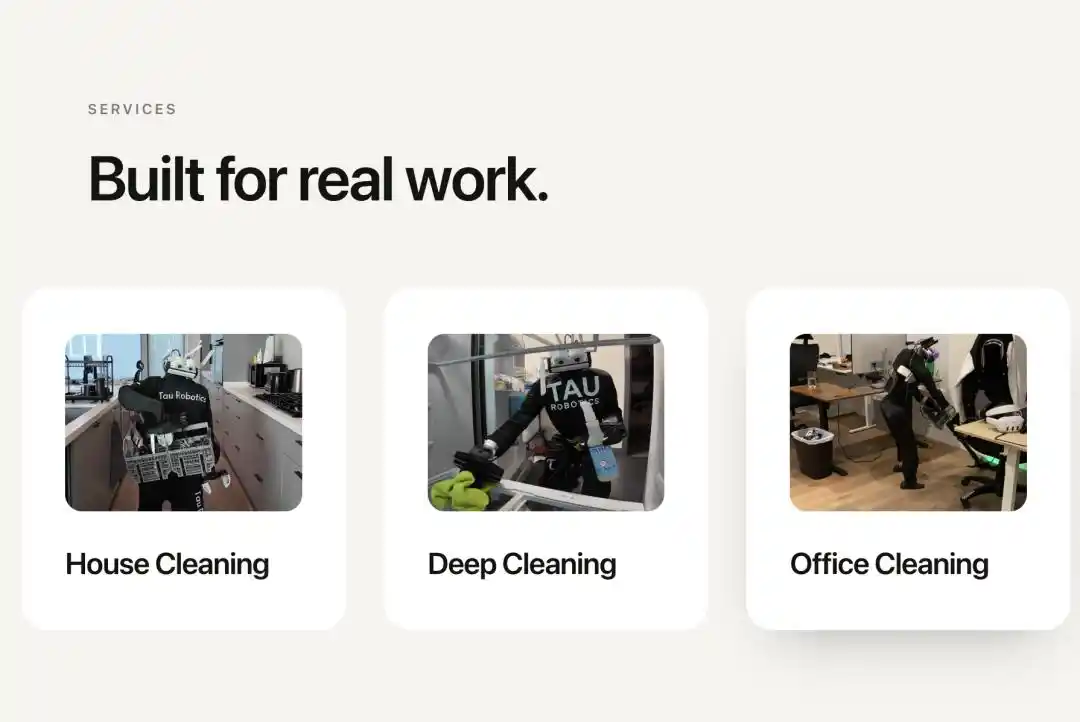
Their approach is quite interesting.

Instead of jumping straight into autonomous AI, they "cheat" via remote control to bridge the gap, aiming to kickstart the data flywheel once real-world home deployment is achieved.

They raised about $3 million in Pre-seed funding in September 2024 and then went quiet. Now they've finally presented their work—

A humanoid robot cleaning service.

Honestly, at first glance, I was wondering where the robot was.

After all, this guy is dressed in dark work clothes, getting out of a van looking quite human-like—

Until I saw that Wi-Fi router on its head...

The founder specifically explained, saying it does look a bit funny, but there's no choice, it's the best spot to place the antenna for the humanoid robot.

Bro, the key is I didn't know it was remote-controlled at first. Seeing that antenna suddenly gave me goosebumps, has Embodied AI already developed to this level??

You can tell the official team is more than a little satisfied with this demo. The website background loops this getting-out-of-the-van video endlessly...
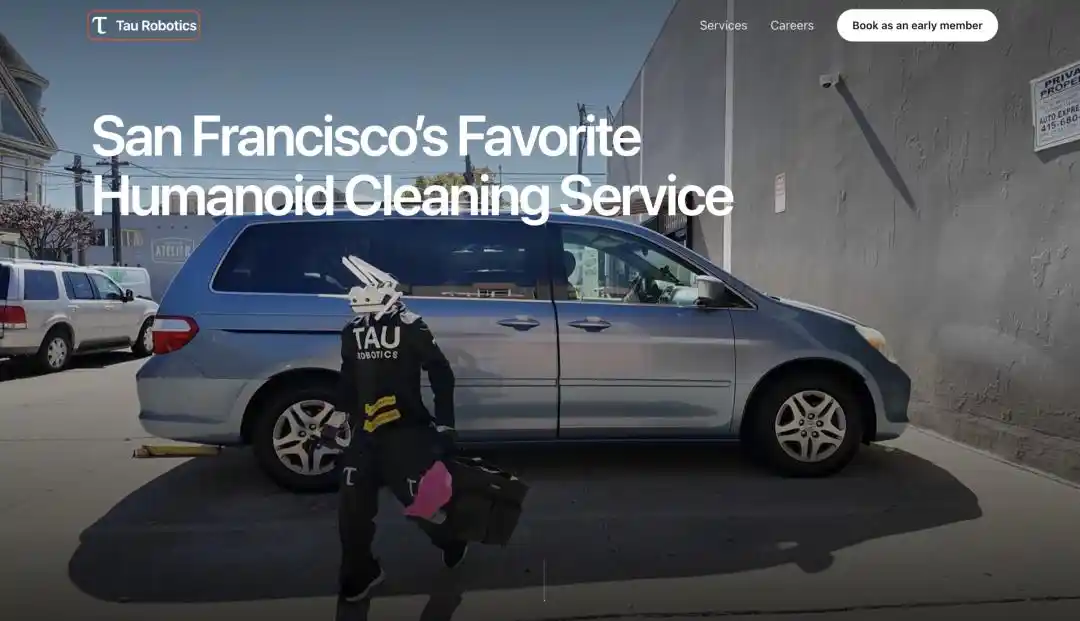
Once inside the home, it starts working officially.

Tau has three "employees".

The first one, Chelsea.
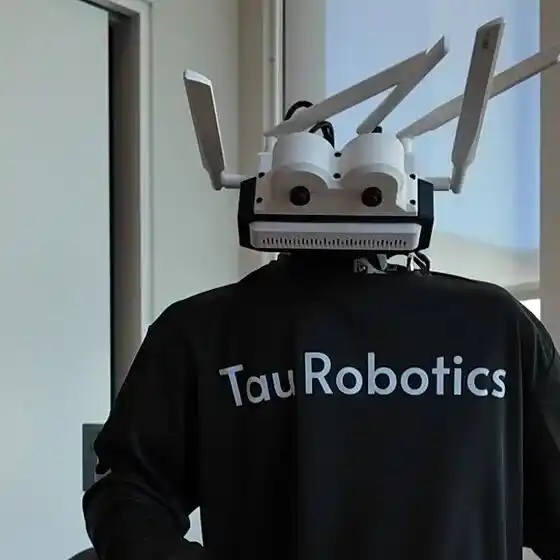
That's the guy who got out of the van. The kitchen and bathroom are its strengths—sink, countertops, mirrors, tiles, floors...

The second one, Elon.

That name, little Musk, huh?

Elon handles regular weekly visits. After a few sessions, it can remember where things are in your home and put everything back in its place after cleaning.

The third one, Tony.
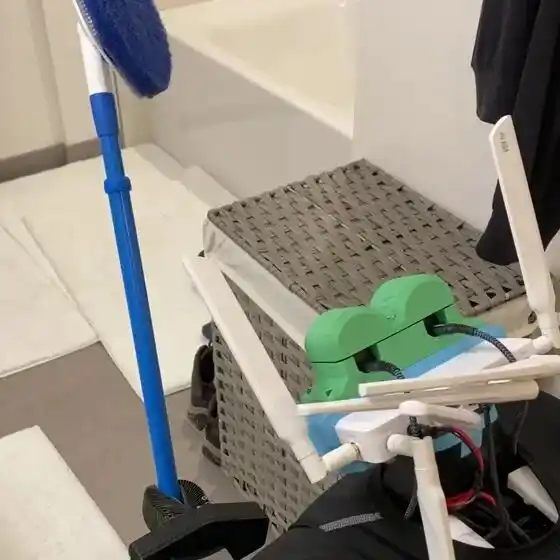
Tony specializes in deep cleaning—baseboards, grout lines, window tracks, under the fridge, behind the washer—targeting years of built-up grime.

But, I really have to complain.

Tau, for your first public debut, couldn't you spend some money to hire a photographer for proper portrait shots??I honestly couldn't find where Tony was in the picture...

No need to go into detail about the demos, as they are remote-controlled and theoretically can do anything a human can.

Wiping tables.

Mopping floors.

Taking out the trash.

Finally, the question everyone cares about most—how much does it cost?

Not bad, $30 per hour (approx. 200 RMB).

Honestly, that's quite affordable in the US. Hiring a real human cleaner can easily cost fifty or sixty dollars per hour.

Humanoid Robots Entering Homes

Last week, I attended WAIC and chatted with several friends working in Embodied AI. A common observation was that getting humanoid robots into homes is indeed extremely, extremely difficult.

It's not like China hasn't made any attempts either, but it's still in the early stages. For example, Ziliang's recent collaboration with 58.com to launch smart cleaning is a good case of entering households.
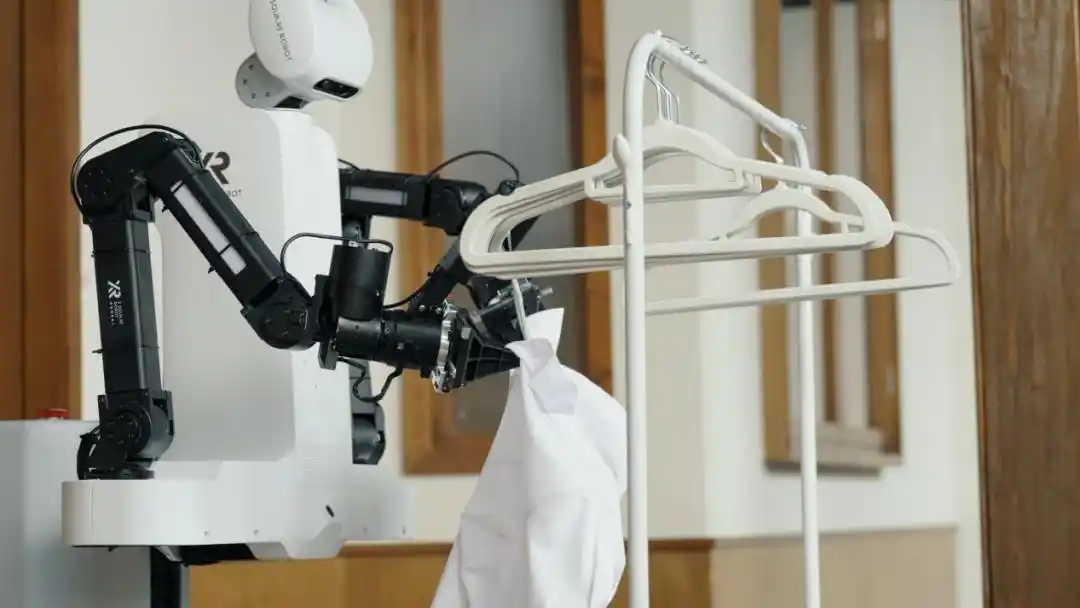
However, many netizens also criticized it, wondering what's the point of having a human cleaner specifically watching over the robot while it works.

Sigh, you can only say there's really no other way. Embodied AI has such a tough starting point; they have to enter the scene first, otherwise they can't collect data at all.

But currently, the main focus domestically is prioritizing industrial applications, where the environment is relatively controllable, and it can provide direction for gradual optimization and enable a closed data loop.

The logic in the US is somewhat different. The demand for manufacturing isn't as strong as in China, which has instead spurred some companies to start from the home scene. For example, 1X Neo, which gained some popularity last year, also promoted the concept of entering homes via teleoperation.

After all, the gap is indeed huge, and remote control is a relatively smart method, somewhat similar to the shadow mode in autonomous driving, ensuring work efficiency while collecting data.

But whether consumers are willing to pay $30 an hour to have a remotely-controlled robot with built-in monitoring working in their homes is another story...

It's been 9 months since the announcement, and 1X Neo still hasn't officially launched on a large scale. It's hard to judge how the market will react.

So let's return to the technology itself.

Some netizens expressed confusion: Why insist on humanoid form for entering homes?
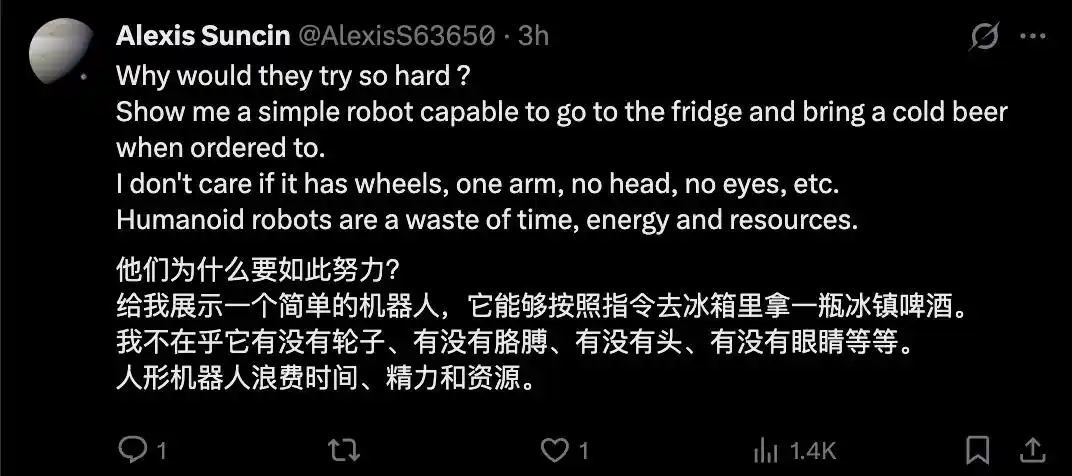
The narrative about bipedal forms being better suited for non-standardized environments has, honestly, been told to death. Robotic vacuum cleaners basically move around homes unimpeded. Aren't wheels great?

I discussed this topic with SuDu half a month ago. Their perspective was that the root cause must be found from the data side

If a person were to remotely operate a wheeled base and perform complex mobile manipulation tasks, the difficulty would be extremely high. For humanoids, operators can map their own body intuition onto the robot, lowering the barrier significantly.

Looking at it this way, Tau and 1X's insistence on humanoid form is likely largely due to considerations for remote control.

It's quite a first-principles choice.

Of course, another point that cannot be ignored.

This humanoid thing, well, it truly is top-tier in providing emotional value.

A human-shaped machine walking around your home, wiping tables, mopping floors, taking out trash, while you sit on the sofa watching... how to put it? Spending $30 to experience life as an Athenian citizen isn't a bad deal either (doge).

Currently, Tau's "Teletubby" is operating on an invitation basis. Friends in San Francisco can go to the official website to sign up for a try (doge).

"Athenian Citizen" Experience Address: https://www.tau-robotics.com/

References:

[1]https://x.com/alexkoch_ai/status/2082135074615763251

This article is from the WeChat public account "QbitAI" (ID: QbitAI), author: Focus on Frontier Technology


Domande pertinenti

QWhat is the main service offered by the robot company Tau Robotics, and how much does it cost per hour?

ATau Robotics offers a humanoid robot house cleaning service. The cost is 30 US dollars per hour (approximately 200 RMB).

QWhat key limitation of the Tau Robotics cleaning robots is revealed in the article?

AThe key limitation is that the robots' impressive actions, such as washing hands and picking up trash, are not autonomous. They are operated via remote control, described as 'pure human intelligence'.

QAccording to the article, what is one advantage of using humanoid robots for remote operation in home settings, as opposed to wheeled robots?

AOne advantage is the lower barrier for human operators. It's easier for an operator to remotely control a humanoid robot because they can intuitively map their own body movements onto the robot. Controlling a wheeled base for complex mobile manipulation tasks would be much more difficult.

QBesides the cleaning function, what additional value might the 'Antenna Baby' robot provide, as suggested in the article?

AThe article suggests that the humanoid robot provides superior emotional value. The sight of a human-shaped machine moving around and doing chores in one's home could offer a unique experience, humorously compared to 'spending 30 dollars to experience the life of an Athenian citizen'.

QWhat is the name of another US-based company mentioned in the article that also uses a teleoperation (remote control) approach for home service robots?

AThe article mentions another US-based company called 1X, specifically its Neo robot, which also uses a teleoperation concept to enter the home service market.

Letture associate

A 'Overlooked' Market Event: Joint US-Japan-South Korea Intervention, Rare US Treasury Involvement, and Bessent's Quiet 'Market Rescue'?

Summary: The United States, Japan, and South Korea executed their largest coordinated foreign exchange intervention in nearly 30 years. The action targeted depreciation pressure on the Japanese yen and South Korean won. This move is seen as a significant effort by the US to stabilize the financial markets of its key allies and prevent the spillover of risks. Key details: * Japan reportedly intervened on July 30 using approximately 8.45 trillion yen (about $52.8 billion). South Korean authorities also intervened that day, selling dollars to support the won. * Notably, the US Treasury Department intervened directly in yen markets for the first time in roughly 30 years. The New York Fed, reportedly acting on behalf of the Treasury, sold euros to buy yen via Goldman Sachs and Morgan Stanley on July 31. Analysts view the use of the euro-yen pair as a way to alleviate yen pressure without adding selling pressure to the US dollar. * Prior to the action, the New York Fed conducted "rate checks" on both USD/JPY and EUR/JPY, a newer signaling tool that falls between verbal and physical intervention. The intervention is interpreted as going beyond traditional currency stabilization. Analysts, such as Michael Hartnett of Bank of America, suggest it resembles a "Price Keeping Operation" for the AI era. The core US objectives are perceived to be: 1. Preventing rapid yen depreciation from triggering a sharp rise in Japanese government bond yields. 2. Containing financial stress from spreading across Asian markets like South Korea and Japan. 3. Reducing the risk of disorderly capital flows impacting the US bond market. This coordinated action underscores the importance of Japan and South Korea as critical partners in the US semiconductor and AI supply chain. Stabilizing their financial markets is seen as vital to mitigating risks to the broader tech industry and the US market itself. The intervention coincides with market pressures, including the KOSDAQ index hitting a low since October 2022. While seen as a move to control volatility, some analysts caution it may not fundamentally reverse existing market trends.

marsbit1 min fa

A 'Overlooked' Market Event: Joint US-Japan-South Korea Intervention, Rare US Treasury Involvement, and Bessent's Quiet 'Market Rescue'?

marsbit1 min fa

Will the Federal Reserve Definitely Raise Interest Rates in September? How Will Cryptocurrencies and US Stocks Bear the Pressure?

In early August 2024, market expectations for a September Federal Reserve rate hike surged dramatically, from below 50% to over 80%, driven by renewed inflation concerns. This shift followed a contentious July FOMC meeting where a 9-3 vote to hold rates revealed a growing hawkish faction advocating for an immediate hike, citing prolonged above-target inflation. The key catalyst is escalating conflict near the Strait of Hormuz, which has pushed oil prices up approximately 20% in July, threatening to reignite inflation. The next critical data point is the July CPI report on August 12th; a hot reading could solidify hike expectations. For crypto assets, particularly Bitcoin, this represents near-term pressure. Bitcoin continues to exhibit high-beta, risk-on characteristics, making it sensitive to tightening liquidity and higher opportunity costs. However, historical precedent suggests that if a hike is perceived as the cycle's end rather than its start, the negative impact may be brief, with markets quickly pivoting to anticipate future rate cuts. U.S. stocks, especially crypto-linked equities like Coinbase and high-valuation tech stocks, face amplified volatility. Higher rates increase discount rates in valuation models, pressuring growth stocks. This coincides with a pivotal tech earnings season where investor focus has shifted from massive AI capital expenditures to demonstrable revenue and cash flow generation. Companies with negative cash flows and weak growth narratives could see severe pressure if a September hike materializes, as financing costs would rise. Key indicators to watch include oil prices, upcoming inflation data, and Fed commentary at events like the Jackson Hole symposium.

Odaily星球日报1 min fa

Will the Federal Reserve Definitely Raise Interest Rates in September? How Will Cryptocurrencies and US Stocks Bear the Pressure?

Odaily星球日报1 min fa

From South Korea to the United States: Blue-Collar Jobs Are Becoming Increasingly Popular, Thanks to AI

AI is reshaping the labor market's value proposition. The traditional four-year college degree is losing its appeal as a guaranteed career path, while skilled blue-collar trades like electricians, welders, and plumbers are experiencing historic demand and wage premiums. This shift is driven by dual pressures: AI's displacement of certain white-collar roles and a booming need for physical infrastructure and data center construction. Data confirms the trend. In the U.S., vocational school revenue surged, and a significant portion of recent layoffs are AI-related. Surveys show a majority of Gen Z adults plan to pursue blue-collar work, citing better job security against AI automation. Vocational education interest has exploded recently. Experts cite a psychological shift as younger generations seek tangible, AI-resistant careers and avoid high student debt. In many cases, salaries for skilled trades now match or exceed those requiring a bachelor's degree. In South Korea, semiconductor vocational high schools boast near-total employment, with graduates securing high-paying roles at companies like Samsung. The shortage is structural, exacerbated by a retiring baby boomer workforce and massive infrastructure projects. Companies like JPMorgan Chase, Meta, and Lowe's are investing heavily in training programs. However, overcoming historical stigma and a "perception gap" around trade careers remains a key challenge to closing the talent gap.

marsbit1 h fa

From South Korea to the United States: Blue-Collar Jobs Are Becoming Increasingly Popular, Thanks to AI

marsbit1 h fa

Qualcomm: AI Hype Subsides, When Will Smartphones Emerge from the Gloom?

Qualcomm reported its Q3 FY2026 results (ending June 2026), with revenue of $9.95B, down 4% YoY but above expectations. Gross margin declined to 53.1%, pressured by rising costs across manufacturing and memory. Key business segments showed mixed performance: Handset revenue fell 19.6% YoY to $5.09B, dragged by an 11% decline in non-Apple Android shipments and weaker high-end mix. Conversely, Automotive revenue surged 61% to $1.59B, and IoT grew 9% to $1.83B. Core operating profit dropped 41% YoY due to margin compression and higher expenses. Management's Q4 FY2026 guidance projects revenue of $9.7B-$10.5B, in line with consensus, but Non-GAAP EPS guidance of $2.05-$2.25 fell short of expectations. Amidst persistent weakness in its core handset market, Qualcomm is pursuing growth in AI, focusing on Edge AI (smartphones, PCs, automotive) and Data Center AI. Its data center strategy includes four pillars: AI accelerators (e.g., AI200), commercial CPUs (Dragonfly C1000), custom silicon, and connectivity solutions. While these initiatives initially boosted its stock, concerns over AI capital expenditure sustainability have since erased those gains. The company targets $5B in data center revenue for FY2027 and $15B for FY2029. The report concludes that with the traditional handset business still under pressure, the data center opportunity is currently viewed as a longer-term option, and a more conservative valuation based on core operations may be warranted until AI contributions materialize.

marsbit1 h fa

Qualcomm: AI Hype Subsides, When Will Smartphones Emerge from the Gloom?

marsbit1 h fa

Trading

Spot
活动图片