U.S. Forces Cross Border to Capture President: Why Did Prediction Market Stage 'Calling a Stag a Horse'?

比推Pubblicato 2026-01-07Pubblicato ultima volta 2026-01-07

Introduzione

U.S. forces conducted a cross-border operation in Venezuela on January 3, capturing President Nicolás Maduro—an act widely considered a military invasion under international law. However, on the prediction market Polymarket, the contract "Will the U.S. invade Venezuela by January 31, 2026?" did not resolve as "Yes" despite the event-driven surge in probability to 80%. Instead, the platform updated its rules post-facto, stating that the operation—including Trump’s remarks about “running Venezuela”—did not meet its specific definition of “invasion.” The probability subsequently dropped to 4%. The article suggests regulatory and insider manipulation: Polymarket, though CFTC-regulated, received investment from Donald Trump Jr. last year. On-chain analysis reveals that a new wallet, funded from an account linked to Trump family associate Steven Witkoff, placed a $30,000 bet on “Maduro leaving office” just hours before the operation, turning it into over $400,000. The piece concludes that Polymarket may be manipulated by political and financial elites using asymmetric information and last-minute rule changes to profit at the expense of ordinary traders.

Author: Liu Kaiwen

Original Title: U.S. Captures Another Country's President, Trump-Linked Platform Says This Doesn't Count as "Invasion"


CARACAS, Venezuela – In the early hours of January 3rd local time, U.S. forces entered Venezuelan territory simultaneously by air and ground, secured several key military facilities, and escorted President Nicolás Maduro to the United States.

Precision airstrikes, armed ground troops taking control, abducting a head of state... According to common definitions under international law, this constitutes a military invasion of a sovereign nation.

Meanwhile, on Polymarket, the world's hottest prediction market, a group of traders had already begun celebrating their own victory triggered by this attack.

They had bet that the U.S. would invade Venezuela before the event, and the smoke and artillery fire reported in the news seemed like an early celebration of their high-odds, massive profits.

At that moment, no one who had placed a bet thought they were already destined to lose the moment they entered the trade.

News Reported Globally Never Happened on Polymarket

The market "Will the U.S. invade Venezuela before January 31, 2026?" had a straightforward definition of invasion before the attack: "a military offensive by U.S. armed forces with the purpose of establishing control."

After the attack, the probability (which translates to odds) in this market surged from 2% to 80%. This probability-as-odds trading model meant traders who bet "Yes" before the attack saw massive floating profits.

Then, just as mainstream media globally were reporting on the "U.S. attack on Venezuela," the market suddenly saw multiple large trades betting "No," asserting that "the U.S. did not invade Venezuela." This caused the probability to drop to a low of 7%.
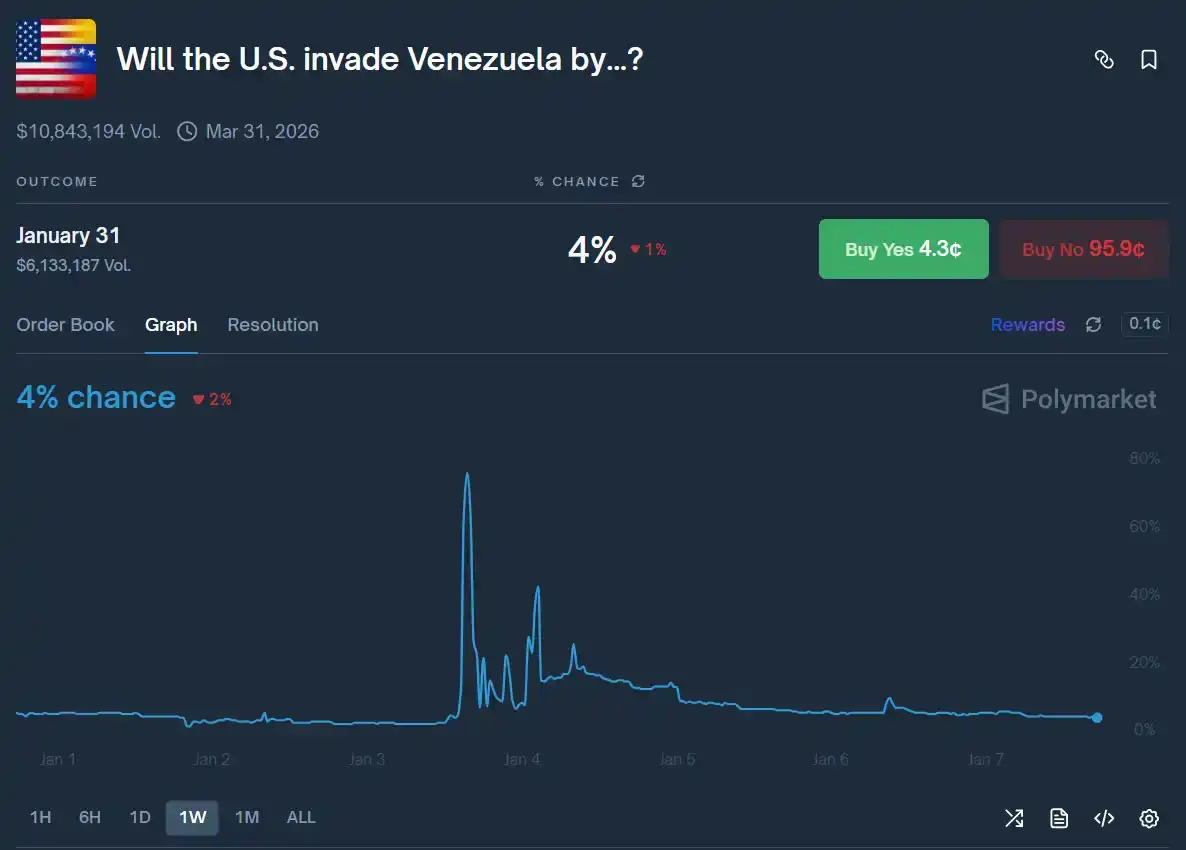
Even after Trump brazenly stated "run Venezuela" following the attack, as of the time of this writing, the market has still not been resolved, and the probability has fallen back to 4%.

This earth-shattering military invasion seems to have never happened on Polymarket.

"Tailor-Made" Rule Updates: Using Wordplay to Deny an Invasion

If you were to look for proof of the invasion happening on Polymarket, it does exist: hours after the attack, the platform officially published a rule supplement:

This market refers to U.S. military operations intended to establish control. President Trump’s statement that they will「run」Venezuela while referencing ongoing talks with the Venezuelan government does not alone qualify the snatch-and-extract mission to capture Maduro as an invasion.

In simple terms: U.S. troops entering the country and bombing don't count as an invasion. Trump talking about invading, occupying, and running the country doesn't count as an invasion. Capturing the president doesn't count as an invasion.

But they stick to their line: "military action with the purpose of establishing control counts as invasion."

Writing job description requirements based on a family register probably wasn't this rigorous. Traders who bet earlier didn't need to consider these hidden clauses, which didn't exist at the time, when analyzing the military situation.

Meanwhile, traders (mostly whales) who bet "No" during the period when its odds surged, relying on these tailor-made rule updates, again achieved substantial profits.

The same script played out in another market: "Will the U.S. and Venezuela engage in military conflict within 2025?" On December 26, 2025, Trump stated publicly in an interview that U.S. forces had destroyed an important facility inside Venezuela.

Multiple mainstream media outlets subsequently reported on the incident, with CNN noting the operation was "planned and executed by the Central Intelligence Agency (CIA)."

Shortly after the event, the platform issued a rule supplement stating that "operations executed by non-military intelligence agencies do not qualify."

As luck would have it, the CIA falls precisely into the category of a non-military intelligence agency.

Without the U.S. government ever formally clarifying which branch was responsible for the action, Polymarket, based on CNN's reporting citing "anonymous sources," precisely excluded a military strike from the settlement criteria.

Why Change the Rules? Digging into the Trump Family's Prediction Market Ties

As losing traders gathered on forums to protest, a more fundamental question emerged: Why would Polymarket risk its reputation being destroyed to modify the rules in plain sight?

Clues point to unusual names at the top of the platform.

Despite its decentralized facade, Polymarket is a实实在在 (shí shí zài zài - real, actual) private company regulated by the U.S. Commodity Futures Trading Commission (CFTC). A pivotal investment that changed its fate occurred last August:

Donald Trump Jr. – the eldest son of the sitting U.S. President – his private investment company formally took a stake in Polymarket, and he himself subsequently joined the company's "Advisory Board."

The timing is intriguing: after Trump Jr.'s investment, Polymarket, which had long operated in a regulatory gray area, quickly obtained an operating license from the CFTC, legalizing its operations in the U.S.

And the CFTC's five highest-ranking commissioners are all appointed directly by the President.

"This is just normal business investment," some commentators tried to downplay the connection. "The Trump administration supports cryptocurrency innovation anyway."

The next step would be to verify whether people close to Trump are using information asymmetry to profit on Polymarket.

From On-Chain Data to White House Inner Circle: When 'Coincidences' Are Too Many to Be Coincidences

Let's turn our attention to three hours before the raid occurred.

In another related market, "Will Maduro leave office before January 31, 2026?", a previously inactive new wallet address suddenly injected $30,000 into the market, all betting "Yes." As Maduro was put on a plane, this $30,000 turned into over $400,000 within hours.

The account's behavior pattern was highly suspicious: newly created, single deposit, betting on only one market within a specific time window, immediate withdrawal after profit. This is the操作 (cāozuò - operation, modus operandi) of treating the prediction market as a private ATM.

Who was this "insider"?

On-chain analysis blogger @Andrey_10gwei found, by comparing deposit/withdrawal amounts on exchanges, that the funds for this insider account could be traced back to an account with the domain "stevencharles.sol".

Steven Charles?

Opening the website for core members of WLFI, orchestrated by Donald Trump Jr., reveals that the second person from the left in the front row is a co-founder of the company, also a New York real estate developer, provided campaign funds to Trump, and the two have a friendship spanning nearly 40 years.
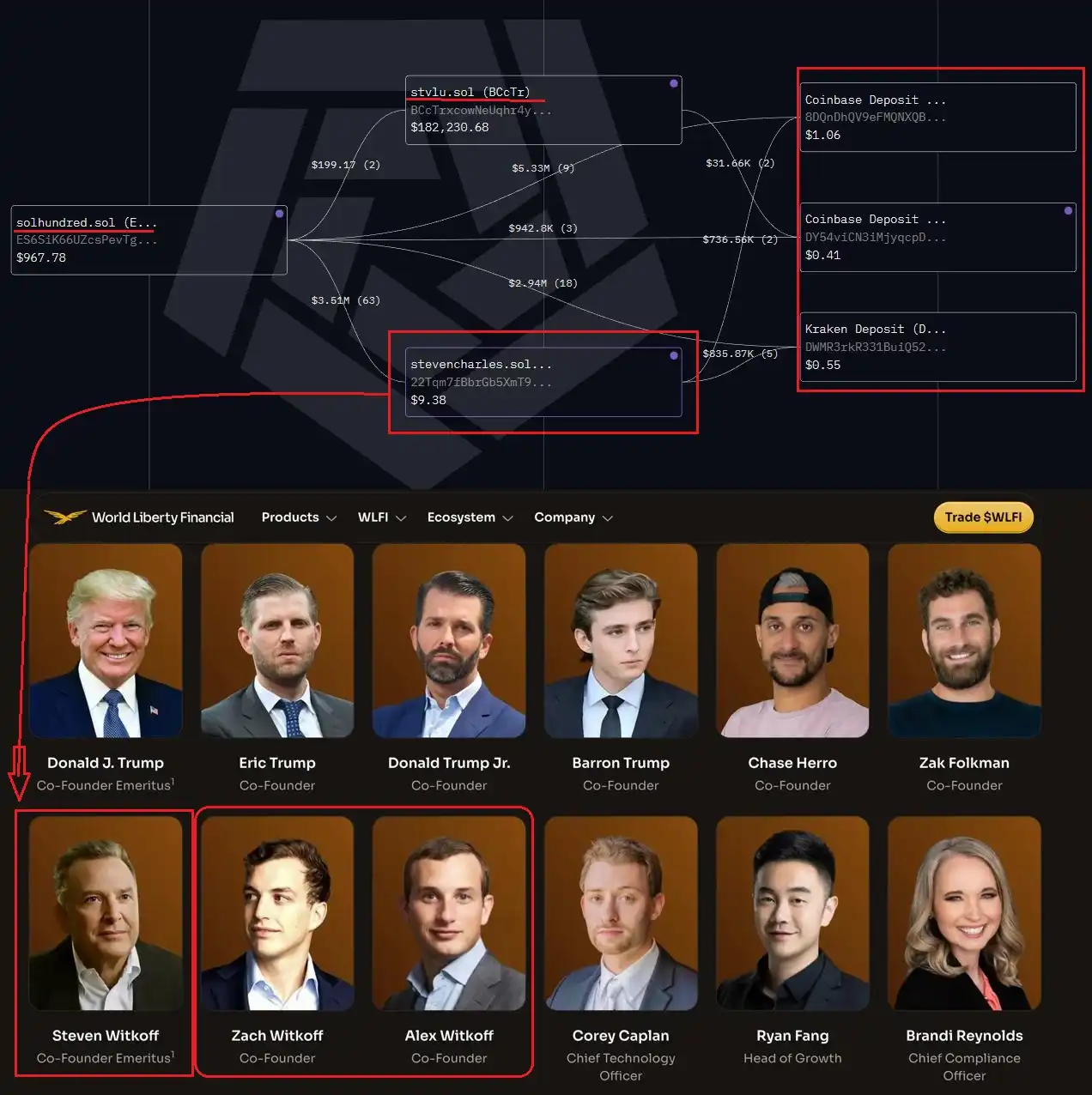
(cr: https://x.com/Andrey_10gwei/status/2007904168791454011?s=20)

His full name? Steven Charles Witkoff. A perfect match for the "stevencharles" on-chain domain.

A mysterious account turning $30k into $400k in 3 hours, an on-chain funding source named "stevencharles", a business magnate inextricably linked to the President's family who can directly influence Polymarket.

Three events with probabilities近乎于零 (jìn hū yú líng - approaching zero)串联在一起 (chuàn lián zài yīqǐ - strung together) can no longer be explained away as coincidence.

Conclusion

Polymarket, touted as a decentralized fair trading platform, might seem to ordinary person as just a financial tool to profit by betting on outcomes.

But perhaps in corners unseen by the common person, it has long become a white glove for those who can arbitrarily修改对错定义本身 (xiūgǎi duì cuò dìngyì běnshēn - modify the very definition of right and wrong), frequently using market-intervening rule updates and asymmetric information差 (chā - gap, asymmetry) to repeatedly empty people's assets.

How long the common person can survive here depends entirely on the desires and moral boundaries of the elite group.


Twitter:https://twitter.com/BitpushNewsCN

Bitpush TG Discussion Group:https://t.me/BitPushCommunity

Bitpush TG Subscription: https://t.me/bitpush

Original link:https://www.bitpush.news/articles/7600740

Domande pertinenti

QWhat was the main event described in the article regarding the US and Venezuela?

AThe article describes a US military operation on January 3rd where American forces entered Venezuela, took control of key military facilities, and captured President Nicolás Maduro, transporting him to the United States.

QHow did the prediction market Polymarket initially react to the news of the military operation, and how did that change?

AInitially, the probability of 'Yes' on the market 'Will the US invade Venezuela before January 31, 2026?' surged from 2% to 80% after the operation. However, the probability later plummeted to as low as 7% and then to 4% after the platform issued a rule update that redefined the event, effectively ruling that the operation did not qualify as an 'invasion'.

QWhat connection does the article suggest exists between Polymarket and the Trump family?

AThe article suggests a significant connection, stating that Donald Trump Jr., the son of the US President, invested in Polymarket through his private investment firm and joined its 'Advisory Board'. This investment coincided with the platform receiving regulatory approval from the CFTC, whose commissioners are appointed by the President.

QWhat evidence does the article present to suggest insider trading on the Polymarket platform?

AThe article presents on-chain data showing that a previously inactive wallet deposited $30,000 into the market 'Will Maduro leave office before January 31, 2026?' just three hours before the operation. This bet, which turned into over $400,000, was traced back to a wallet domain named 'stevencharles.sol', which was linked to Steven Witkoff, a long-time associate of the Trump family and a co-founder of a company run by Donald Trump Jr.

QAccording to the article, how did Polymarket justify not settling the 'invasion' market as 'Yes' after the military operation?

APolymarket issued a rule update stating that the operation to capture Maduro was a 'snatch-and-extract mission' and that President Trump's statement about 'running' Venezuela, in the context of ongoing talks with its government, did not alone qualify the military action as an 'invasion' as defined by their market's rules, which specified 'U.S. military operations intended to establish control'.

Letture associate

E Fund "Quits Drinking"

"Yi Fang Da 'Gives Up Alcohol'" - Summary The article analyzes the recent portfolio adjustments of star fund manager Zhang Kun, focusing on his flagship funds, the Yi Fang Da Blue Chip Select and Yi Fang Da Quality Select. The key trend highlighted is a significant and ongoing reduction in exposure to the consumer sector, particularly liquor (baijiu) stocks like Kweichow Moutai and Wuliangye, which were once core holdings. This shift is driven by several factors: a downturn in the consumer sector's business cycle post-pandemic, with slowing earnings growth for major players; a change in consumer behavior towards value over premium brands; and high channel inventory pressures, especially in the liquor industry. These fundamentals have led to a prolonged phase of valuation contraction for consumer stocks. Concurrently, market capital has rotated aggressively towards the high-growth technology sector, especially AI-related chains, which have dominated fund inflows. This style shift has further diminished the attractiveness of traditional consumer "core assets" for many funds. As a result, Zhang Kun's funds have drastically cut their consumer stock allocations. For example, the Blue Chip Select's baijiu holding proportion has fallen from over 40% to around 20%, and its overall top 10 holdings concentration dropped sharply. This mirrors a broader trend in the active equity fund industry, where allocations to consumer staples have plummeted to multi-year lows while technology holdings have surged. The article concludes that while the consumer sector's valuations are now at historical lows, offering some margin of safety, the fundamental outlook remains challenging due to weak macro consumption recovery and intense internal competition. Therefore, the sector is likely to see only sporadic rebounds rather than a sustained recovery, continuing to weigh on the performance of funds still heavily invested in it. Zhang Kun's timely reduction of Korean semiconductor holdings in his Asia Select fund amid a market crash is also noted as a contrast to his domestic strategy.

marsbit17 min fa

E Fund "Quits Drinking"

marsbit17 min fa

Before the Second Attempt at Hong Kong IPO, Topstar 'Hands Out' 548 Million in Related-Party Orders

Tosda, an industrial robotics firm, is making its second attempt at a Hong Kong listing shortly after its first application lapsed. The company has undergone a significant strategic shift, pivoting away from its lower-margin intelligent energy and environmental management system (IEEMS) business to focus on core robotics and machinery. This "revenue-reduction, profit-growth" strategy saw revenue nearly halve from 2022 to 2025, but resulted in a sharp turnaround to profitability, with a 1147% year-on-year increase in Q1 2026 net profit. This restructuring involved spinning off the IEEMS business, leading to a substantial jump in related-party transactions. Following the departure of a former executive, two newly associated companies are expected to handle up to 548 million RMB worth of IEEMS orders in 2026, with Tosda acting as a platform charging a 3% management fee. While profitability has improved, several financial concerns remain. Accounts receivable collection cycles have lengthened, inventory—particularly for robots—has surged significantly despite falling revenue, and the company faces challenges in overseas market expansion. Notably, overseas business currently has a lower gross margin than domestic operations. The company was also recently reprimanded by regulators for accounting inaccuracies related to revenue recognition and bad debt provisions. The success of its strategic pivot and its second listing attempt will depend on managing these financial risks, the transparency of its new business model, and the long-term performance of its core robotics segment.

marsbit27 min fa

Before the Second Attempt at Hong Kong IPO, Topstar 'Hands Out' 548 Million in Related-Party Orders

marsbit27 min fa

Is the AI Bull Market in Jeopardy? Philadelphia Semiconductor Index Breaks Below Key Support at 11,200 Points

The Philadelphia Semiconductor Index (SOX) faces a critical technical and fundamental test. It recently breached a key short-term support level around 11,200 points—a level that held in mid-July—and closed below it. Technical indicators have deteriorated, with the 21-day moving average crossing below the 50-day, signaling bearish momentum. Should the 11,200 support fail, the next major support is the 200-day moving average. The sell-off, which saw memory chip stocks like Micron and Western Digital plunge over 10%, stems from growing concerns about the cyclicality and quality of AI demand. Market participants question the sustainability of the AI capital expenditure boom, highlighted by divergences between the capital expenditures of mega-cap tech firms and semiconductor index performance. However, some positive structural shifts are emerging. Institutional positioning has normalized, unwinding the previously crowded "long semiconductors, short Mag 7" trade, leaving cleaner positioning. Seasonal tailwinds are also approaching, as the NDX historically performs well after this period, potentially supporting a rebound if retail inflows resume. The core question is whether the SOX can hold the 11,200 support. A failure could trigger further declines toward the 200-day moving average, while a successful defense, combined with lighter positioning and seasonal support, could offer a recovery window for the sector.

marsbit27 min fa

Is the AI Bull Market in Jeopardy? Philadelphia Semiconductor Index Breaks Below Key Support at 11,200 Points

marsbit27 min fa

Trading

Spot
活动图片