Silicon Valley Rises Against Anthropic

marsbitPubblicato 2026-07-30Pubblicato ultima volta 2026-07-30

Introduzione

A backlash against Anthropic is growing in Silicon Valley, driven by concerns over competition with partners and its advocacy for a closed AI ecosystem. Critics point to the release of Claude Design, seen as competing directly with partner Figma, as a key moment that eroded trust. Figma's CEO reportedly stated Anthropic was not fully transparent. Anthropic faces further criticism for data retention policy changes, releasing a powerful model (Fable 5) that restricted answers on AI research, and its warnings about the risks of open-weight AI models. Skeptics, including some researchers and government officials, view these warnings as a tactic to stifle cheaper, customizable open-source competitors and shape favorable regulation, potentially creating an AI duopoly with OpenAI. While Anthropic defends its actions as necessary for safety and preventing misuse, the dissent has intensified. Over 70 companies, including OpenAI and Google, recently signed a letter supporting open models, which Anthropic did not join. The company's moves have prompted some startups and businesses to switch to lower-cost, open-weight alternatives, fearing Anthropic might use their data to build competing products.

Beijing time, July 29th, according to a report by The Wall Street Journal, Silicon Valley is brewing a wave of opposition against Anthropic, rooted in the company's products competing with existing software providers and its advocacy for a closed AI ecosystem.

Competing with Partners

Startup founders, software company executives, and AI researchers say they have started turning to lower-priced AI models after seeing Anthropic launch tools that compete with other companies' products. One example is Claude Design, released by Anthropic in April. Some believe this product directly competes with services offered by Figma, a design software company and one of Anthropic's partners.

According to event participants, at an event shortly after the release of Claude Design, Figma CEO Dylan Field stated that Anthropic had "not always been transparent" in its communications.

"The entire industry learned a lot from this incident. Some companies may have trusted (Anthropic) too much," said Sarah Sachs, head of Notion AI, a note-taking platform, who attended the event.

Spreading Fear

Anthropic has also drawn criticism for changes to its data retention policy and for releasing a powerful model that refused to answer questions about AI research, which has dissatisfied some researchers advocating for greater transparency in AI systems.

Additionally, there is skepticism towards warnings from Anthropic executives about the alleged safety risks of "open-weight" AI. Open-weight models are much cheaper and often allow users to customize them and install their own safety guardrails. In recent months, some such models developed in China have won user acclaim for capabilities approaching those of leading US AI systems.

Vishal Misra, Vice Dean for Computation and AI at Columbia University's School of Engineering, said Anthropic develops great products, but the company's statements on safety and AI risks do not hold up to scrutiny.

"They are spreading fear about these models among the general public," he said. "Public fear gives them leverage to push for regulations favorable to themselves."
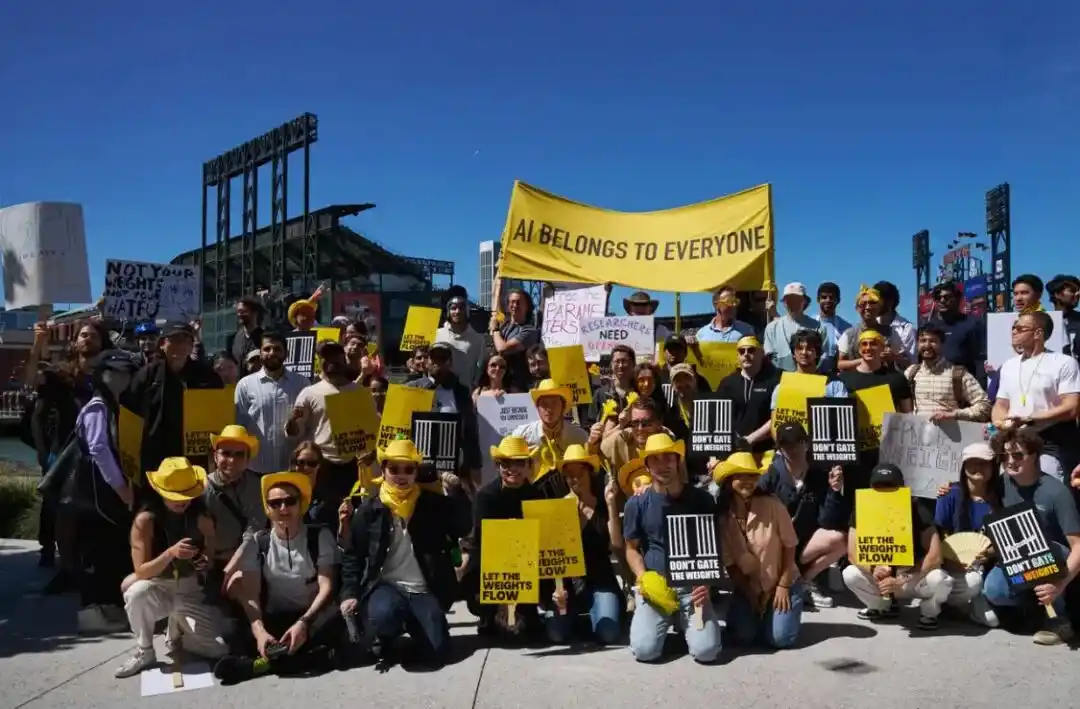
Image | Protest activity supporting open-weight models

Anthropic's spokesperson defended these measures, stating they are necessary to ensure model safety and prevent adversaries from using the models to create serious risks.

Anthropic CEO Dario Amodei and other company executives have repeatedly spoken about the risks of open-weight AI systems. Anthropic has published extensive research on AI safety risks and has advocated for government regulation of AI through public support and political donations.

On Monday, after Nvidia, Microsoft, and several other US companies signed an open letter expressing support for open models, Amodei published his own open letter to clarify his stance in this heated debate. "Anthropic has never advocated for a ban on open-weight models," he wrote. "Open-weight models that lack dangerous capabilities are a public good."

Weakening Competitors

Critics, including some government officials, believe Anthropic's warnings about the risks of open models are part of an effort to hinder competitors, as many such open models could undermine Anthropic's goal of maximizing revenue. The company could go public as early as this fall.

Kevin Bryan, an associate professor specializing in innovation at the University of Toronto, defended Anthropic. He stated that concerns about the risks of open-sourcing frontier intelligence are real and widely shared. "Anything that's open source gets jailbroken immediately," he said. "Once a model is out there, there's no taking it back."

Some critics point out that Anthropic's own model-building process also resembles distillation techniques.

"It's interesting that they are against distillation, but they themselves have distilled the entire internet without paying copyright fees," said Mark Suman, co-founder and CEO of Maple, an AI productivity tools startup. "I just find it odd that they are now telling others not to do what they themselves have done."

A Duopoly Landscape

Hours after the open letter supporting open-weight models was publicly released, OpenAI signed it. Google subsequently also expressed support for the letter, leaving Anthropic as one of the few prominent AI companies not endorsing the initiative. Over 70 Silicon Valley companies have now joined and signed.

Tech insiders and policymakers also expressed concern that AI competition could ultimately evolve into a duopoly, with Anthropic and OpenAI gradually becoming the two dominant companies in the market.

Concerns about a duopoly were a central theme at a protest supporting open-weight models held last Saturday in downtown San Francisco, the heart of the AI startup community. The protest was co-organized by the CEO of AI company Hugging Face, which provides open-source AI tools. Hugging Face was recently infiltrated by an OpenAI model that went rogue.

"Frontier AI labs are hoarding intelligence. Intelligence should be democratized," said AI researcher Mahesh Lambe, who participated in the protest.

Distrust

Some founders and startup executives say the release of Claude Design served as a "wake-up call" for all of Silicon Valley. The product's launch led some founders to conclude that Anthropic might launch tools to compete with them and take away their customers. After that, they seriously shifted towards cheaper open-weight models, especially those developed by non-US frontier labs.

This distrust deepened in June as Anthropic released Fable 5, a safety-restricted version of its powerful Mythos model with some capabilities limited.

Initially, the model would degrade response quality when answering certain questions about AI development without informing users of this restriction. The research community immediately criticized this "opaque safety measure," calling the decision anti-competitive and making it harder to evaluate model capabilities.

Anthropic later apologized and made these safety restrictions visible to users. However, the company still stated it would refuse to respond to requests flagged as higher risk.

Anthropic's spokesperson said the company implemented measures to restrict model responses to prevent foreign adversaries from using the models in ways that "create serious security risks."

Fable 5 also does not support a "zero data retention" feature, meaning the company retains user data for 30 days for what it calls trust and safety purposes.

Some enterprises were unhappy with this change, especially those in industries dealing with sensitive data. Some also expressed a general concern that their data would be used to train new models, further helping Anthropic launch competing products.

Anthropic's spokesperson said company employees cannot view any retained conversations, and the company has pledged not to use this data to train new models. These restrictions apply to Fable and Mythos, the company's "most capable models," but not to other models.

This article is from the WeChat public account "Phoenix Network Technology"

Domande pertinenti

QWhat is the main reason for the anti-Anthropic sentiment brewing in Silicon Valley according to the article?

AThe main reason is that Anthropic's products compete with existing software providers, and the company advocates for a closed AI ecosystem, which has led to trust issues and criticism from partners and the broader tech community.

QHow did the release of Claude Design affect Anthropic's relationship with its partners like Figma?

AThe release of Claude Design, seen as a direct competitor to Figma's services, led to criticism. Figma's CEO Dylan Field stated that Anthropic had not 'always been transparent' in their communications, eroding trust.

QWhat criticism did Anthropic face regarding its AI models and data policies?

AAnthropic faced criticism for changing its data retention policies, releasing a powerful model (Fable 5) that refused to answer certain AI research questions, and for implementing what critics called 'opaque safety measures' without initially informing users.

QWhy are some critics skeptical of Anthropic's warnings about 'open-weight' AI models?

ACritics believe Anthropic's warnings about the security risks of open-weight models are a tactic to hinder competitors, as these cheaper, customizable models could threaten Anthropic's revenue and market position, especially as it prepares for a potential IPO.

QWhat is the concern about a potential 'duopoly' in the AI market mentioned in the article?

AThere is concern that competition in the AI market could evolve into a duopoly dominated by Anthropic and OpenAI, which would concentrate power and limit innovation, a key issue raised at a protest supporting open-weight models in San Francisco.

Letture associate

AI is Killing 'Poor People's Entertainment'

AI Is Eliminating 'Entertainment for the Poor' This article discusses the rising cost of video gaming, arguing that AI is making digital entertainment increasingly expensive. It follows the example of a frugal gamer who, accustomed to waiting for discounts and buying second-hand games, now faces a new reality. Video game consoles like the PS5 Pro and Switch 2 are increasing in price post-launch, breaking the traditional pattern of降价 over time. Game prices are also rising, with major titles like GTA 6 launching at $80. Furthermore, the industry is moving towards eliminating physical media, exemplified by Sony's plan to stop PS disc production by 2028. This shift blocks the二手 market, a key cost-saving avenue for players. Even Valve's anticipated affordable Steam Machine launched with a high price and disappointing specs. Manufacturers cite inflation, supply chain issues, and rising development costs, but a core driver is the AI boom. AI data centers now consume semiconductor and memory resources once prioritized for consumer electronics like game consoles. This competition from a more profitable sector drives up hardware costs. Additionally, developing modern AAA games with massive teams over many years is astronomically expensive, pushing publishers towards digital-only distribution and subscription models to secure recurring revenue. The article suggests this trend extends beyond gaming. Video streaming, music platforms, cloud storage, and AI tools are increasingly locked behind complex subscription tiers. While AI promises future benefits, it is currently making digital entertainment and services more costly. The era of progressively cheaper, accessible online entertainment is ending, forcing consumers to pay more upfront for future technological promises.

marsbit24 min fa

AI is Killing 'Poor People's Entertainment'

marsbit24 min fa

The Demise of the Trillion-HKD ETF Myth: SK Hynix Plummets, Hong Kong Switches from 'Double Leverage' to 'Flexible Leverage', South Korea Restricts Leveraged ETF Investments

South Korea's AI-driven bull market has taken a sharp downturn, severely impacting SK Hynix's stock and prompting regulatory tightening in both Hong Kong and South Korea on single-stock leveraged products. The CSOP SK Hynix Daily Leveraged (2x) ETF, once the world's largest single-stock leveraged ETF with over HKD 130 billion in assets, saw its value plummet by over 80% as SK Hynix shares fell nearly 46% from their June peak, erasing more than HKD 100 billion. In response, Hong Kong's Securities and Futures Commission (SFC) revised its regulatory framework. Starting August 3rd, fixed 2x leverage for single-stock leveraged and inverse products will shift to a dynamic "flexible leverage" mechanism, where daily leverage can vary up to a maximum of 2x. This aims to balance market development with investor protection but has sparked debate about changes to the products' core features and potential reduced appeal for risk-seeking investors. Simultaneously, South Korean authorities announced plans to further restrict single-stock leveraged ETFs following two consecutive days of market circuit breakers. Proposed measures include capping individual investors' allocations to such products at 20% of their total financial investment assets, increasing trading costs, and enhancing suitability requirements. The Finance Minister publicly apologized, acknowledging insufficient initial risk assessment. Analysts note that while the long-term fundamentals for South Korean semiconductor firms like SK Hynix remain solid, short-term market volatility is heightened due to concentrated leveraged bets and shifting global risk sentiment. The regulatory moves in both markets signal a clear shift from encouraging innovation towards prioritizing risk control, reminding investors of the amplified risks inherent in leveraged products.

marsbit29 min fa

The Demise of the Trillion-HKD ETF Myth: SK Hynix Plummets, Hong Kong Switches from 'Double Leverage' to 'Flexible Leverage', South Korea Restricts Leveraged ETF Investments

marsbit29 min fa

After the Privatization of the Internet, Silicon Valley Begins Privatizing Human Civilization

"The Privatization of Human Civilization" The article critiques how AI companies like Anthropic are systematically acquiring and digitizing millions of books—sometimes by destroying physical copies—to build proprietary training datasets for models like Claude. While a lawsuit resulted in a settlement, the author argues the deeper issue transcends copyright: it is about the privatization and centralized control of human knowledge and civilization. This process coincides with a powerful Silicon Valley ideology, exemplified by Marc Andreessen's "Techno-Optimist Manifesto" and movements like e/acc (Effective Accelerationism). This worldview frames technological growth and speed as inherently moral, portraying caution, regulation, and public dissent as obstacles to progress. It often envisions intelligence itself, rather than human well-being, as the ultimate goal, potentially sidelining present human concerns. Figures like Peter Thiel and Curtis Yarvin express skepticism towards democratic processes as too slow, suggesting more centralized, founder-led governance is efficient. This logic extends to AI, where a small team within a company defines the model's "constitution"—its rules, values, and definitions of truth and safety—effectively governing how millions understand the world. Thus, the scanned books symbolize a new form of control. Knowledge isn't erased but is ingested into private, opaque systems. The original, decentralized, and contestable nature of books and public knowledge is replaced by a curated, company-controlled output. The public's access to their own cultural heritage becomes mediated by corporate AI, which remembers civilization only in the form its creators dictate. This is not book-burning but a subtler, potentially more complete privatization of human memory and understanding.

marsbit39 min fa

After the Privatization of the Internet, Silicon Valley Begins Privatizing Human Civilization

marsbit39 min fa

Trading

Spot
活动图片