Understanding Premium Rate: Stay 24 Hours Ahead of ETF Data

marsbitPubblicato 2026-01-30Pubblicato ultima volta 2026-01-30

Introduzione

Understanding ETF Premium Rates: A 24-Hour Advantage in Crypto Trading With the approval of BTC and ETH spot ETFs, daily fund flows have become a critical indicator for traders. However, this data is delayed by one day, often causing market prices to reflect the information before it is officially published. A key real-time indicator to anticipate ETF net inflows or outflows is the **ETF premium rate**. The premium rate reflects the difference between an ETF's market price and its net asset value (NAV). A positive premium suggests bullish sentiment and potential inflows, while a negative premium indicates bearish sentiment and likely outflows. Data from January 2026 showed that negative premium rates occurred on 16 out of 18 trading days, with 11 of those days resulting in net outflows. A longer-term analysis (July 2025 to January 2026) revealed an **81% accuracy rate** for negative premiums predicting outflows and **84%** for positive premiums predicting inflows. The mechanism behind this involves Authorized Participants (APs) who perform arbitrage: - A positive premium prompts APs to create ETF shares (buying underlying assets → net inflow). - A negative premium leads to share redemption (selling assets → net outflow). To use premium rates effectively: 1. Focus on **sustained trends** rather than one-day values. 2. Watch for **extreme values** (e.g., beyond ±1%), indicating strong sentiment shifts. 3. Consider **price context**—high prices with n...

Author: San, Deep Tide TechFlow

Since the approval of spot ETFs for BTC and ETH, daily ETF fund inflows and outflows have become a core indicator for many traders to gauge the market.

The logic is simple: net inflows indicate institutional buying and bullish sentiment; net outflows indicate institutional selling and bearish sentiment.

But the problem is, the ETF data we see every day is from the previous day.

By the time the data is released, the price has often already reflected it.

So, is there any way to predict whether today's ETF will have net inflows or outflows in advance?

Yes, the answer is the ETF premium rate.

It's not hard to verify this pattern; looking back at the recently concluded January 2026 is the best sample.

As of January 28, there were 18 trading days in the U.S. stock market.

Statistics show that the premium index on Coinbase remained in positive territory for two days, while the other 16 days were all in negative premium territory.

Corresponding ETF fund flows show that 11 of these 16 days ultimately recorded net outflows.

Especially from January 16 to 23, the negative premium rate continuously fell below -0.15%, corresponding to a weekly net outflow of over $1.3 billion from the ETF market, with BTC's price dropping from a high of $97,000 to around $88,000.
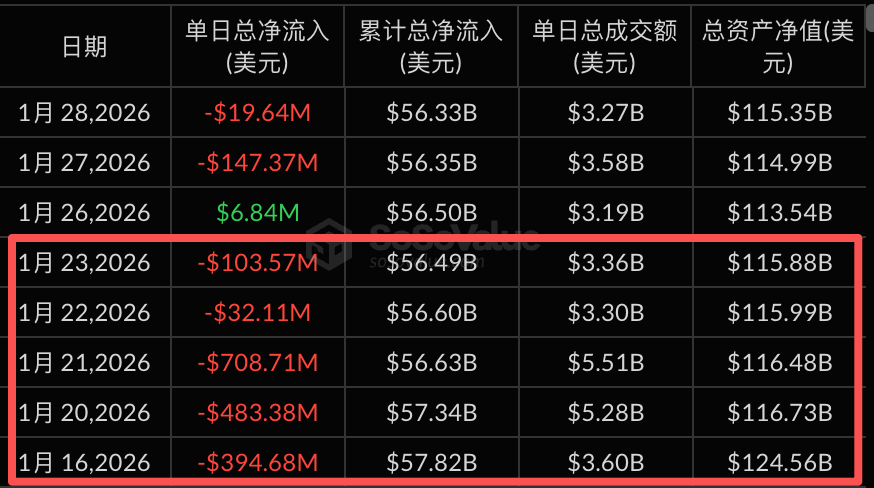
Data source: sosovalue

Let's take a broader view.

From July 1, 2025, to January 28, 2026, there were a total of 146 trading days.

· Negative premium rate occurred for 48 days, corresponding to net outflows for 39 days, with an accuracy rate of 81%.

· Positive premium rate occurred for 98 days, corresponding to net inflows for 82 days, with an accuracy rate of 84%.

This is the value of the premium rate: it allows you to see where the money is flowing earlier than most.

What Is the Premium Rate?

We've been talking about the premium rate, but what exactly is it?

Here's an analogy.

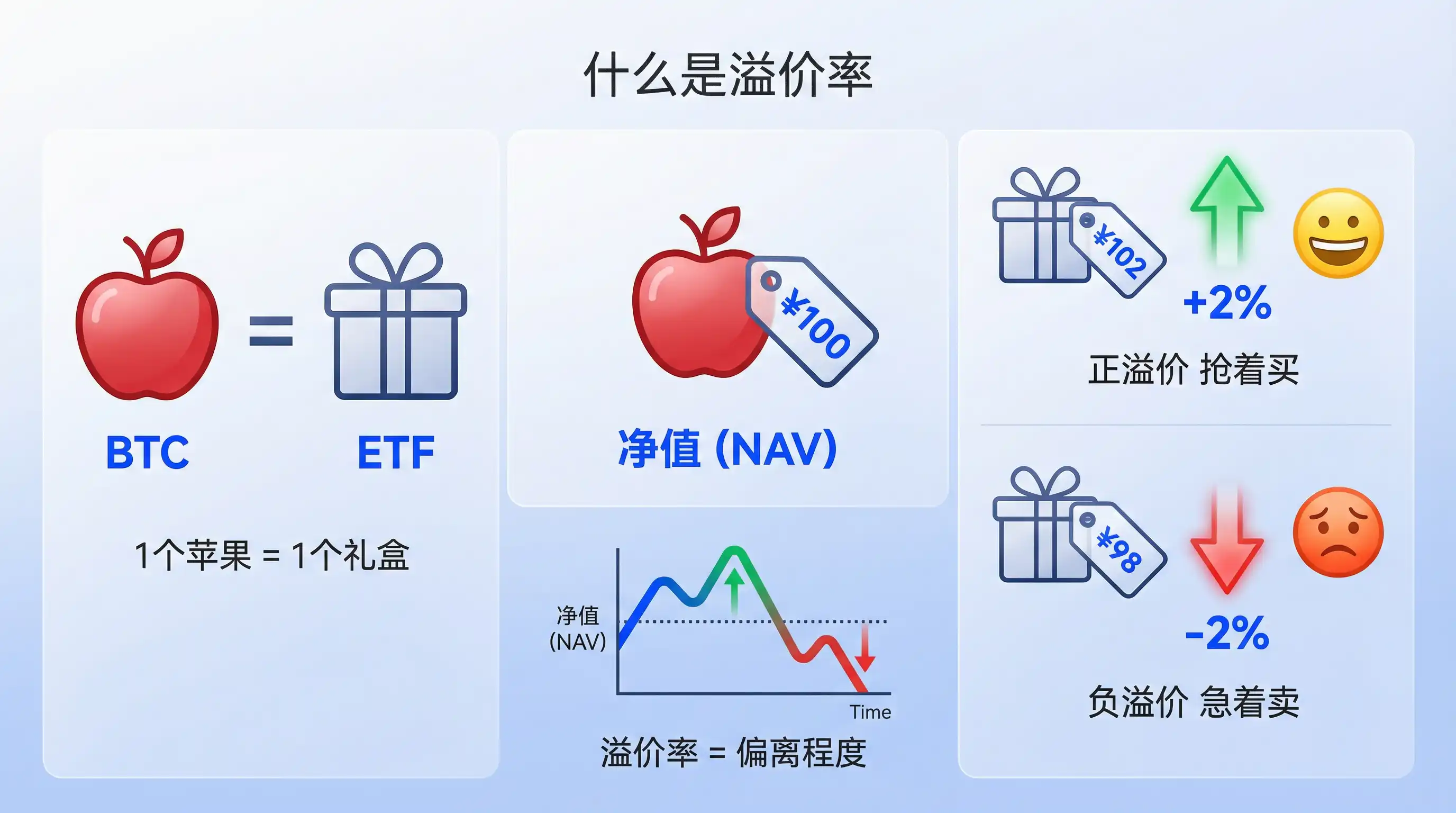
BTC is like loose apples in a grocery market, while BTC spot ETFs are like packaged apple gift boxes in a supermarket, each containing one apple.

An apple sells for $100 in the grocery market—this is the net asset value (NAV).

How much the apple gift box sells for in the supermarket depends on supply and demand.

If many people buy it, the box is driven up to $102—this is a positive premium rate, with a premium of +2%.

If many people sell it, the box drops to $98—this is a negative premium rate, with a premium of -2%.

The premium rate reflects the degree to which the ETF market price deviates from the real price of BTC.

A positive premium indicates optimistic market sentiment, with people rushing to buy.

A negative premium indicates pessimistic market sentiment, with people rushing to sell.
The Relationship Between Premium Rate and ETF Inflows/Outflows

The premium rate is not just a market sentiment indicator; it also becomes a key driver of fund flows.

The key players here are APs, or Authorized Participants, whom you can think of as privileged intermediaries.

The core logic for APs is risk-free arbitrage: they can subscribe to and redeem ETF shares in the primary market, and they can also buy and sell in the secondary market.

As long as there is a price difference, they will engage in arbitrage.

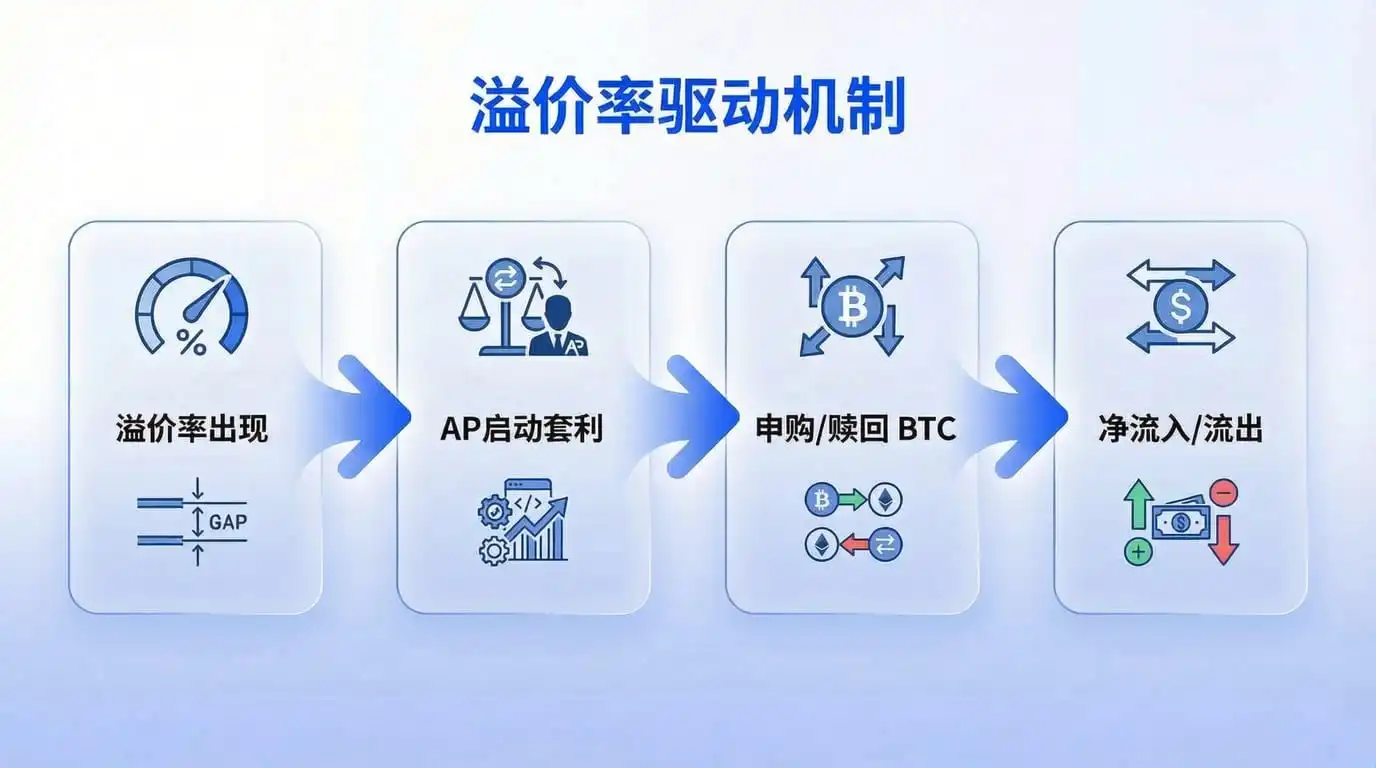
When a positive premium rate appears, the gift box is more expensive than the apple. APs will go to the primary market to buy BTC, package it into ETF shares, and then sell it in the secondary market to profit from the difference. In this process, BTC is bought, resulting in net inflows.

Conversely, when a negative premium rate appears, the gift box is cheaper than the apple. APs will buy ETFs in the secondary market, unpack them to redeem BTC, and then sell the BTC to profit from the difference. In this process, BTC is sold, resulting in net outflows.

So the logical chain is as follows:

Premium rate appears → APs initiate arbitrage → Subscription or redemption occurs → Net inflows or outflows are formed.
And the ETF fund data we see every day is published the next day after settlement.

The premium rate is real-time; the fund data is lagging.

This is why the premium rate can give you an edge over the market.

How to Apply the Premium Rate

Now that we understand the principle of the premium rate and its relationship with ETF net inflows and outflows, how can we apply it to our individual trading plans?

First, the premium rate is not an indicator to be used alone.

It can tell us the direction of funds but not the magnitude or sustainability.

Here, I suggest combining it with the following dimensions.

1. The Sustainability of the Premium Rate Is More Important Than a Single-Day Value

A single day of negative premium rate may just be short-term volatility.

But if the negative premium rate persists for multiple days, it is likely to correspond to continuous net outflows, which is worth noting.

Looking back at the five consecutive trading days of negative premium rate from January 16 to 23 this year, it corresponded to five days of net outflows, with BTC falling nearly 10%.

2. Pay Attention to Extreme Values of the Premium Rate

Generally, a premium rate fluctuating within ±0.5% is normal.

Once it breaks through ±1%, it indicates a significant deviation in market sentiment, and AP arbitrage activity intensifies, accelerating fund flows.

3. Combine with Price Levels for Judgment

A sustained negative premium rate at high levels may be an early signal of capital flight.

A sustained positive premium rate at low levels may indicate bottom-fishing capital entering the market.

The premium rate itself does not constitute a basis for buying or selling, but it can help you verify the current trend or detect turning points in advance.

Final Thoughts

Finally, there are a few points to note.

No indicator is a holy grail; the effectiveness of the premium rate is based on the normal operation of the AP arbitrage mechanism.

In extreme market conditions, such as the 10.11 crash, where market liquidity dries up, the arbitrage mechanism may fail, and the correlation between the premium rate and fund flows may decrease.

Additionally, the premium rate is just one window into ETF fund movements.

For mature investors, the premium rate is just one piece of the puzzle.

It is recommended to combine it with the following indicators for multi-dimensional cross-verification:

  1. ETF Holdings Changes: An increase in holdings indicates institutions are accumulating; a decrease indicates they are reducing positions. More direct than the premium rate, but data updates are delayed.
  2. Futures Basis and Funding Rate: A positive basis and continuously rising funding rate indicate overheated bullish sentiment, suggesting the market may be overly optimistic. The opposite indicates bearish dominance.
  3. Put/Call Ratio in the Options Market: Puts are put options; calls are call options. A rising ratio indicates increased market避险 sentiment; a falling ratio indicates dominant optimism.
  4. On-Chain Large Transfers and Exchange Net Inflows: Large BTC transfers into exchanges often signal impending selling pressure. Large transfers out of exchanges indicate accumulation.

For example.

When you observe: a continuous negative premium rate, a decrease in ETF holdings, and an increase in exchange net inflows.

Three signals point in the same direction: funds are withdrawing, and selling pressure is accumulating.

At this point, you should at least be alert and control your position, rather than buying the dip.

A single indicator cannot reveal the full picture; multi-dimensional cross-verification is needed to improve the accuracy of judgment.

In this market, the more dimensions you observe, the smaller the information gap, but the time gap will always exist.

Those who see the direction of funds first gain an extra edge.

Crypto di tendenza

Domande pertinenti

QWhat is the ETF premium rate and how does it help predict fund flows?

AThe ETF premium rate is the percentage difference between the ETF's market price and its net asset value (NAV). A positive premium rate indicates market optimism and potential net inflows, while a negative rate suggests pessimism and potential net outflows. It serves as a real-time indicator that can predict the next day's official ETF flow data, giving traders a 24-hour advantage.

QHow accurate is the premium rate in predicting ETF net inflows and outflows based on the data from July 2025 to January 2026?

AFrom July 1, 2025, to January 28, 2026, covering 146 trading days, the premium rate had an 81% accuracy in predicting net outflows when negative (48 days, 39 net outflows) and an 84% accuracy in predicting net inflows when positive (98 days, 82 net inflows).

QWhat role do Authorized Participants (APs) play in the relationship between premium rate and ETF flows?

AAuthorized Participants (APs) are key players who perform risk-free arbitrage. When there's a positive premium, APs buy BTC, create ETF shares, and sell them on the secondary market for a profit, leading to net inflows. During negative premiums, APs buy ETF shares, redeem them for BTC, and sell the BTC, resulting in net outflows.

QWhat factors should be considered alongside the premium rate for better investment decisions?

AThe premium rate should be used alongside other indicators: 1) Persistence of the premium rate (sustained trends matter more than single-day values), 2) Extreme values (beyond ±0.5% signal stronger movements), 3) Price level (high prices with negative premiums may indicate early sell-offs, low prices with positive premiums may suggest accumulation), and cross-verification with ETF holdings, futures basis, funding rates, options Put/Call ratios, and on-chain large transfers.

QWhy might the premium rate's effectiveness decrease in extreme market conditions?

AIn extreme market conditions, such as severe crashes or liquidity crises (e.g., the 10.11 crash), the arbitrage mechanism may break down. APs might be unable to execute trades efficiently due to market illiquidity, reducing the correlation between the premium rate and actual ETF fund flows.

Letture associate

Only 153 Venture Capital Firms Invested in July: Is the Crypto VC Industry Experiencing a 'Mass Extinction'?

In July 2026, only 153 unique venture capital firms participated in disclosed crypto funding rounds, marking the lowest monthly count since November 2020. This figure represents an 87% decline from the peak of 1,177 firms in 2022. Overall, the first seven months of 2026 saw crypto projects raise approximately $11.78 billion across 481 rounds. This crypto VC contraction contrasts sharply with the broader venture capital landscape, where global VC investment reached a record $560.4 billion in H1 2026, heavily fueled by major AI company financings. This shift in capital allocation has drawn funds away from the crypto sector. Within crypto, funding is highly concentrated. Trading platforms, prediction markets, and payment sectors absorbed 53% of the total capital. While early-stage deals remain frequent, the largest sums flow to a few late-stage rounds and mergers & acquisitions, which surged to $7.23 billion in Q2 2026. The market is consolidating around top funds like a16z crypto and Dragonfly, which successfully raised new multi-billion dollar funds, while many smaller firms have retreated. Analysts describe this as a "great extinction" for crypto VCs, where capital is becoming more selective, favoring proven business models and assets over early-stage speculation. This raises the bar for project quality, funding efficiency, and viable exit paths.

marsbit17 min fa

Only 153 Venture Capital Firms Invested in July: Is the Crypto VC Industry Experiencing a 'Mass Extinction'?

marsbit17 min fa

Strategy's Loss in the Second Quarter Reaches $8.22 Billion Amid Bitcoin Decline

Strategy, the largest corporate holder of Bitcoin, reported a net loss of $8.22 billion for the second quarter. This loss was primarily driven by an $8.32 billion unrealized loss on its Bitcoin holdings due to a decline in the asset's price during the period. Despite these paper losses, the company increased its Bitcoin holdings to 843,775 BTC, a 25% growth since the start of the year. As part of a new monetization strategy, Strategy sold approximately $218.4 million worth of Bitcoin, mainly to fund dividends for preferred shareholders, with $216 million of that sold after Q2 ended. The company also built a $3.75 billion cash reserve, which it claims is sufficient to cover over two years of dividend and interest payments, aiming to insulate itself from Bitcoin's volatility while meeting obligations. Following the earnings release, Strategy's stock (MSTR) rose 4.7% in regular trading but corrected slightly after-hours. This pattern reflects how the company's accounting results are heavily tied to Bitcoin's price swings, even as its long-term strategy remains unchanged. The report indicates that Strategy is maintaining its core strategy of accumulating Bitcoin while building a financial buffer. This quarterly loss follows a recognizable pattern, with the company posting significant unrealized losses in previous quarters (e.g., $12.4 billion in Q4 2025 and ~$12.5 billion in Q1 2026) due to fair-value accounting. A key technical shift is its new monetization program, which introduces periodic selling pressure on the market, transitioning Strategy from a pure accumulator to a participant that occasionally adds supply. A critical question remains: how long can the cash reserve cover dividend obligations if a Bitcoin price downturn persists beyond two years?

cryptonews.ru36 min fa

Strategy's Loss in the Second Quarter Reaches $8.22 Billion Amid Bitcoin Decline

cryptonews.ru36 min fa

Will Terrorist Durov Ban Russian Officials?

Telegram founder Pavel Durov publicly reacted to being labeled a "terrorist" by Russian authorities, stating the designation came after he refused demands for mass surveillance and censorship on the platform. In a Telegram post, he highlighted that this status formally bans him from "publishing information online." Durov concluded with a statement widely circulated: Russian officials "clearly don't understand who can ban whom on the internet." This remark suggests Durov could potentially restrict official Russian government and officials' channels on Telegram, which continue to operate on the platform despite its formal blocking in Russia. The situation parallels previous, slow-moving state directives, like switching officials to domestic cars, contrasted with the current push to migrate all government communication to the Russian-made messenger MAX by 2030. However, reports indicate many officials still use Telegram via workarounds, fearing surveillance on MAX, while alternatives like BiP and KakaoTalk recently became inaccessible in Russia without a VPN. Durov has not specified any immediate actions against state channels. His statement is an initial response, with further developments depending on the authorities' reaction. The dynamic differs from 2020 when Russian regulators lifted a block on Telegram; now, Durov implies control from within the platform itself over the official accounts that persisted through that earlier blockade.

cryptonews.ru36 min fa

Will Terrorist Durov Ban Russian Officials?

cryptonews.ru36 min fa

DeepSeek V4 Official Version Arrives, New Capabilities Emerge, Value-for-Money King Enters the Fray

On July 31st, DeepSeek officially launched the public API beta for its DeepSeek-V4-Flash model. A key highlight is its performance on multiple Agent benchmark tests, reportedly nearing or even surpassing the level of the V4-Pro preview version from three months ago. Notably, the Flash model achieves this with significantly smaller scale (130B active parameters vs. Pro's 490B), suggesting that post-training optimization and data quality may be as crucial as raw model size. DeepSeek emphasized that the V4-Flash-0731 uses the same model architecture and size as its preview version, with improvements attributed solely to "re-trained post-training." The update also marks the official debut of DeepSeek's self-developed Agent framework, "Harness." The move signals DeepSeek's strategic push to position its cost-effective Flash model as a competitive base for Agent applications—scenarios requiring autonomous planning, tool usage, and complex task execution—where inference speed and cost are critical. By natively supporting OpenAI's Responses API format and adapting for code-generation scenarios, DeepSeek aims not just to be a cheaper alternative but to establish its own ecosystem in the Agent era. This release follows DeepSeek's record-breaking ~$50 billion fundraising round roughly two months prior, underscoring market confidence in its technology and commercialization prospects. The company is reportedly preparing for another funding round at a valuation of approximately $71 billion. The Flash model's advancement represents a step in fulfilling the high expectations that come with this valuation, setting the stage for the impending release of the V4-Pro official version and intensifying competition in the global Agent landscape.

marsbit41 min fa

DeepSeek V4 Official Version Arrives, New Capabilities Emerge, Value-for-Money King Enters the Fray

marsbit41 min fa

Trading

Spot

Articoli Popolari

Cosa è BITCOIN

Comprendere HarryPotterObamaSonic10Inu (ERC-20) e la sua posizione nel mondo delle criptovalute Negli ultimi anni, il mercato delle criptovalute ha assistito a un aumento della popolarità delle meme coin, catturando l'interesse non solo dei trader, ma anche di coloro che cercano coinvolgimento comunitario e valore di intrattenimento. Tra questi token unici c'è HarryPotterObamaSonic10Inu (ERC-20), un progetto intrigante che mescola riferimenti culturali nel tessuto delle criptovalute. Questo articolo esplora gli aspetti chiave di HarryPotterObamaSonic10Inu, analizzando i suoi meccanismi, l'etica guidata dalla comunità e il suo coinvolgimento con il panorama crittografico più ampio. Che cos'è HarryPotterObamaSonic10Inu (ERC-20)? Come suggerisce il suo nome, HarryPotterObamaSonic10Inu è una meme coin costruita sulla blockchain di Ethereum, classificata secondo lo standard ERC-20. A differenza delle criptovalute tradizionali che possono enfatizzare l'utilità pratica o il potenziale investimento, questo token prospera grazie al valore di intrattenimento e alla forza della sua comunità. Il progetto mira a creare un ambiente in cui gli utenti coinvolti possono riunirsi, condividere idee e partecipare ad attività ispirate a diversi fenomeni culturali. Una caratteristica notevole di HarryPotterObamaSonic10Inu è la zero tassa sulle transazioni. Questo elemento allettante tende a incoraggiare il trading e il coinvolgimento della comunità, privo di costi aggiuntivi che possono scoraggiare i trader di piccole dimensioni. L'offerta totale della moneta è fissata a un miliardo di token, un numero che segna la sua intenzione di mantenere una circolazione sostanziale all'interno della comunità. Creatore di HarryPotterObamaSonic10Inu (ERC-20) Le origini di HarryPotterObamaSonic10Inu sono avvolte in un certo mistero; i dettagli sul creatore rimangono sconosciuti. Lo sviluppo di questo token non presenta un team identificabile o un piano esplicito, cosa non rara nel settore delle meme coin. Invece, il progetto è emerso organicamente, con il suo progresso fortemente dipendente dall'entusiasmo e dalla partecipazione della sua comunità. Investitori di HarryPotterObamaSonic10Inu (ERC-20) Per quanto riguarda investimenti esterni e finanziamenti, HarryPotterObamaSonic10Inu rimane ambiguo. Il token non elenca alcuna fondazione di investimento conosciuta o un sostegno organizzativo significativo. Invece, la linfa vitale del progetto è la sua comunità di base, che informa la sua crescita e sostenibilità attraverso azioni collettive e coinvolgimento nello spazio crittografico. Come funziona HarryPotterObamaSonic10Inu (ERC-20)? In quanto meme coin, HarryPotterObamaSonic10Inu opera principalmente al di fuori delle strutture tradizionali che governano spesso il valore degli asset. Ci sono diversi aspetti distintivi che definiscono il funzionamento del progetto: Transazioni senza tasse: Senza costi fiscali sulle transazioni, gli utenti possono comprare e vendere liberamente il token senza preoccuparsi di costi nascosti. Coinvolgimento della comunità: Il progetto prospera sull'interazione della comunità, sfruttando le piattaforme social per creare entusiasmo e facilitare il coinvolgimento. Discussioni, condivisione di contenuti e coinvolgimento sono elementi cruciali che aiutano ad espandere la sua portata e a favorire la lealtà tra i sostenitori. Nessuna utilità pratica: Va notato che HarryPotterObamaSonic10Inu non offre un'utilità concreta all'interno dell'ecosistema finanziario. Piuttosto, è classificato come un token principalmente per attività di intrattenimento e comunitarie. Riferimento culturale: Il token incorpora astutamente elementi della cultura pop per attirare interesse, collegandosi a appassionati di meme e seguaci delle criptovalute. HarryPotterObamaSonic10Inu esemplifica come le meme coin operino in modo diverso rispetto ai progetti di criptovalute più tradizionali, entrando nel mercato come costrutti sociali innovativi piuttosto che come asset utilitari. Cronologia di HarryPotterObamaSonic10Inu (ERC-20) La storia di HarryPotterObamaSonic10Inu è segnata da diversi traguardi notevoli: Creazione: Il token è emerso da un meme virale, catturando l'immaginazione di molti appassionati di criptovalute. Le date di creazione specifiche non sono disponibili, sottolineando la sua crescita organica. Inserimento negli scambi: HarryPotterObamaSonic10Inu ha fatto il suo ingresso in vari scambi, consentendo un accesso e un trading più facili da parte della comunità. Iniziative di coinvolgimento della comunità: Attività in corso volte a migliorare l'interazione della comunità, comprese gare, campagne sui social media e generazione di contenuti da parte di fan e sostenitori. Piani di espansione futura: La tabella di marcia del progetto include il lancio di una collezione NFT, merchandising e un sito di eCommerce relativo ai suoi temi culturali, coinvolgendo ulteriormente la comunità e cercando di aggiungere più dimensioni al suo ecosistema. Punti chiave su HarryPotterObamaSonic10Inu (ERC-20) Natura guidata dalla comunità: Il progetto dà priorità al contributo collettivo e alla creatività, garantendo che il coinvolgimento degli utenti sia al centro del suo sviluppo. Classificazione come meme coin: Rappresenta l'epitome delle criptovalute basate sull'intrattenimento, distinguendosi dai veicoli d'investimento tradizionali. Nessuna affiliazione diretta con Bitcoin: Nonostante la somiglianza nel nome del ticker, HarryPotterObamaSonic10Inu è distintivo e non ha alcuna relazione con Bitcoin o altre criptovalute consolidate. Focus sulla collaborazione: HarryPotterObamaSonic10Inu è progettato per creare uno spazio per la collaborazione e la condivisione di storie tra i suoi detentori, fornendo un canale per la creatività e il legame comunitario. Prospettive future: L'ambizione di espandersi oltre il suo presupposto iniziale verso NFT e merchandising delinea un percorso per il progetto per potenzialmente entrare in strade più mainstream all'interno della cultura digitale. Poiché le meme coin continuano a catturare l'immaginazione della comunità crittografica, HarryPotterObamaSonic10Inu (ERC-20) si distingue per i suoi legami culturali e il suo approccio centrato sulla comunità. Anche se potrebbe non adattarsi al modello tipico di un token orientato all'utilità, la sua essenza risiede nella gioia e nella camaraderia coltivate tra i suoi sostenitori, evidenziando la natura in evoluzione delle criptovalute in un'epoca sempre più digitale. Con la continuazione dello sviluppo del progetto, sarà importante osservare come le dinamiche della comunità influenzano la sua traiettoria nel panorama in continuo cambiamento della tecnologia blockchain.

1.9k Totale visualizzazioniPubblicato il 2024.04.01Aggiornato il 2024.12.03

Cosa è BITCOIN

Come comprare BTC

Benvenuto in HTX.com! Abbiamo reso l'acquisto di Bitcoin (BTC) semplice e conveniente. Segui la nostra guida passo passo per intraprendere il tuo viaggio nel mondo delle criptovalute.Step 1: Crea il tuo Account HTXUsa la tua email o numero di telefono per registrarti il tuo account gratuito su HTX. Vivi un'esperienza facile e sblocca tutte le funzionalità,Crea il mio accountStep 2: Vai in Acquista crypto e seleziona il tuo metodo di pagamentoCarta di credito/debito: utilizza la tua Visa o Mastercard per acquistare immediatamente BitcoinBTC.Bilancio: Usa i fondi dal bilancio del tuo account HTX per fare trading senza problemi.Terze parti: abbiamo aggiunto metodi di pagamento molto utilizzati come Google Pay e Apple Pay per maggiore comodità.P2P: Fai trading direttamente con altri utenti HTX.Over-the-Counter (OTC): Offriamo servizi su misura e tassi di cambio competitivi per i trader.Step 3: Conserva Bitcoin (BTC)Dopo aver acquistato Bitcoin (BTC), conserva nel tuo account HTX. In alternativa, puoi inviare tramite trasferimento blockchain o scambiare per altre criptovalute.Step 4: Scambia Bitcoin (BTC)Scambia facilmente Bitcoin (BTC) nel mercato spot di HTX. Accedi al tuo account, seleziona la tua coppia di trading, esegui le tue operazioni e monitora in tempo reale. Offriamo un'esperienza user-friendly sia per chi ha appena iniziato che per i trader più esperti.

4.3k Totale visualizzazioniPubblicato il 2024.12.12Aggiornato il 2026.06.02

Come comprare BTC

Cosa è $BITCOIN

ORO DIGITALE ($BITCOIN): Un'Analisi Completa Introduzione all'ORO DIGITALE ($BITCOIN) L'ORO DIGITALE ($BITCOIN) è un progetto basato su blockchain che opera sulla rete Solana, con l'obiettivo di combinare le caratteristiche dei metalli preziosi tradizionali con l'innovazione delle tecnologie decentralizzate. Sebbene condivida un nome con Bitcoin, spesso definito “oro digitale” a causa della sua percezione come riserva di valore, l'ORO DIGITALE è un token separato progettato per creare un ecosistema unico all'interno del panorama Web3. Il suo obiettivo è posizionarsi come un asset digitale alternativo valido, anche se i dettagli riguardanti le sue applicazioni e funzionalità sono ancora in fase di sviluppo. Cos'è l'ORO DIGITALE ($BITCOIN)? L'ORO DIGITALE ($BITCOIN) è un token di criptovaluta esplicitamente progettato per l'uso sulla blockchain di Solana. A differenza di Bitcoin, che fornisce un ruolo di stoccaggio di valore ampiamente riconosciuto, questo token sembra concentrarsi su applicazioni e caratteristiche più ampie. Aspetti notevoli includono: Infrastruttura Blockchain: Il token è costruito sulla blockchain di Solana, nota per la sua capacità di gestire transazioni ad alta velocità e a basso costo. Dinamiche di Offerta: L'ORO DIGITALE ha un'offerta massima fissata a 100 quadrilioni di token (100P $BITCOIN), sebbene i dettagli riguardanti la sua offerta circolante siano attualmente non divulgati. Utilità: Sebbene le funzionalità precise non siano esplicitamente delineate, ci sono indicazioni che il token potrebbe essere utilizzato per varie applicazioni, potenzialmente coinvolgendo applicazioni decentralizzate (dApp) o strategie di tokenizzazione degli asset. Chi è il Creatore dell'ORO DIGITALE ($BITCOIN)? Attualmente, l'identità dei creatori e del team di sviluppo dietro l'ORO DIGITALE ($BITCOIN) rimane sconosciuta. Questa situazione è tipica tra molti progetti innovativi nel settore blockchain, in particolare quelli allineati con la finanza decentralizzata e i fenomeni delle meme coin. Sebbene tale anonimato possa favorire una cultura guidata dalla comunità, intensifica le preoccupazioni riguardo alla governance e alla responsabilità. Chi sono gli Investitori dell'ORO DIGITALE ($BITCOIN)? Le informazioni disponibili indicano che l'ORO DIGITALE ($BITCOIN) non ha alcun sostenitore istituzionale noto o investimenti di venture capital prominenti. Il progetto sembra operare su un modello peer-to-peer incentrato sul supporto e sull'adozione della comunità piuttosto che su percorsi di finanziamento tradizionali. La sua attività e liquidità si trovano principalmente su exchange decentralizzati (DEX), come PumpSwap, piuttosto che su piattaforme di trading centralizzate consolidate, evidenziando ulteriormente il suo approccio di base. Come Funziona l'ORO DIGITALE ($BITCOIN) Le meccaniche operative dell'ORO DIGITALE ($BITCOIN) possono essere elaborate in base al suo design blockchain e alle caratteristiche della rete: Meccanismo di Consenso: Sfruttando il proof-of-history (PoH) unico di Solana combinato con un modello di proof-of-stake (PoS), il progetto garantisce una validazione efficiente delle transazioni contribuendo all'alta performance della rete. Tokenomics: Sebbene meccanismi deflazionistici specifici non siano stati dettagliati ampiamente, l'ampia offerta massima di token implica che potrebbe soddisfare microtransazioni o casi d'uso di nicchia che devono ancora essere definiti. Interoperabilità: Esiste il potenziale per l'integrazione con l'ecosistema più ampio di Solana, inclusi vari piattaforme di finanza decentralizzata (DeFi). Tuttavia, i dettagli riguardanti integrazioni specifiche rimangono non specificati. Cronologia degli Eventi Chiave Ecco una cronologia che evidenzia traguardi significativi riguardanti l'ORO DIGITALE ($BITCOIN): 2023: Il dispiegamento iniziale del token avviene sulla blockchain di Solana, contrassegnato dal suo indirizzo di contratto. 2024: L'ORO DIGITALE guadagna visibilità poiché diventa disponibile per il trading su exchange decentralizzati come PumpSwap, consentendo agli utenti di scambiarlo contro SOL. 2025: Il progetto assiste a un'attività di trading sporadica e a un potenziale interesse per impegni guidati dalla comunità, sebbene non siano state documentate partnership significative o avanzamenti tecnici fino ad ora. Analisi Critica Punti di Forza Scalabilità: L'infrastruttura sottostante di Solana supporta alti volumi di transazioni, il che potrebbe migliorare l'utilità di $BITCOIN in vari scenari di transazione. Accessibilità: Il potenziale basso prezzo di trading per token potrebbe attrarre investitori al dettaglio, facilitando una partecipazione più ampia grazie a opportunità di proprietà frazionata. Rischi Mancanza di Trasparenza: L'assenza di sostenitori, sviluppatori o di un processo di audit pubblicamente noti potrebbe generare scetticismo riguardo alla sostenibilità e all'affidabilità del progetto. Volatilità del Mercato: L'attività di trading è fortemente dipendente dal comportamento speculativo, il che può comportare una significativa volatilità dei prezzi e incertezze per gli investitori. Conclusione L'ORO DIGITALE ($BITCOIN) emerge come un progetto intrigante ma ambiguo all'interno dell'evolvente ecosistema di Solana. Sebbene tenti di sfruttare la narrativa dell'“oro digitale”, la sua partenza dal ruolo consolidato di Bitcoin come riserva di valore sottolinea la necessità di una chiara differenziazione della sua utilità e struttura di governance. L'accettazione e l'adozione future dipenderanno probabilmente dall'affrontare l'attuale opacità e dalla definizione più esplicita delle sue strategie operative ed economiche. Nota: Questo rapporto comprende informazioni sintetizzate disponibili a ottobre 2023, e potrebbero essersi verificati sviluppi oltre il periodo di ricerca.

200 Totale visualizzazioniPubblicato il 2025.05.13Aggiornato il 2025.05.13

Cosa è $BITCOIN

Discussioni

Benvenuto nella Community HTX. Qui puoi rimanere informato sugli ultimi sviluppi della piattaforma e accedere ad approfondimenti esperti sul mercato. Le opinioni degli utenti sul prezzo di BTC BTC sono presentate come di seguito.

活动图片