Two Acquisitions in One Day: OpenAI Buys 'Narrative', Anthropic Buys 'Barriers'

marsbitPubblicato 2026-04-03Pubblicato ultima volta 2026-04-03

Introduzione

On April 2, OpenAI and Anthropic each announced an acquisition, reflecting their divergent strategies as both target an IPO by late 2026. OpenAI acquired tech talk show TBPN to shape public AI discourse and support its revenue base, which is 60% consumer-driven from ChatGPT subscriptions. In contrast, Anthropic purchased AI biotech startup Coefficient Bio for approximately $400 million in stock, continuing its focused strategy of deepening enterprise capabilities, particularly in high-switching-cost sectors like life sciences. Over the past three years, OpenAI completed 15 acquisitions across diverse fields including hardware, media, and healthcare, spending over $7.7 billion on disclosed deals, such as the $6.5 billion purchase of Jony Ive’s AI hardware firm. Anthropic made only three acquisitions, each precisely strengthening its product stack: Bun for coding infrastructure, Vercept for autonomous agents, and now Coefficient Bio for biotech R&D pipelines. Anthropic’s enterprise-focused revenue (80% of total) drives its strategy to lock in clients with vertical integration, as seen in its sequenced moves into life sciences and healthcare. Meanwhile, with a higher reliance on consumer subscriptions, OpenAI is investing in narrative influence—TBPN aims to boost ad revenue and steer public AI conversation. Both companies are on accelerated IPO paths: Anthropic eyeing a $60+ billion offering led by Goldman Sachs and JPMorgan, and OpenAI targeting a ~$1 trillion valuation. The...

On April 2, OpenAI and Anthropic each announced an acquisition. OpenAI acquired the tech live show TBPN, while Anthropic spent approximately $400 million in stock to acquire AI biotech startup Coefficient Bio. Both companies are sprinting toward an IPO by the end of 2026, but their shopping lists point to entirely different anxieties.

15 vs. 3. This is the number of acquisitions completed by OpenAI and Anthropic, respectively, over the past three years.
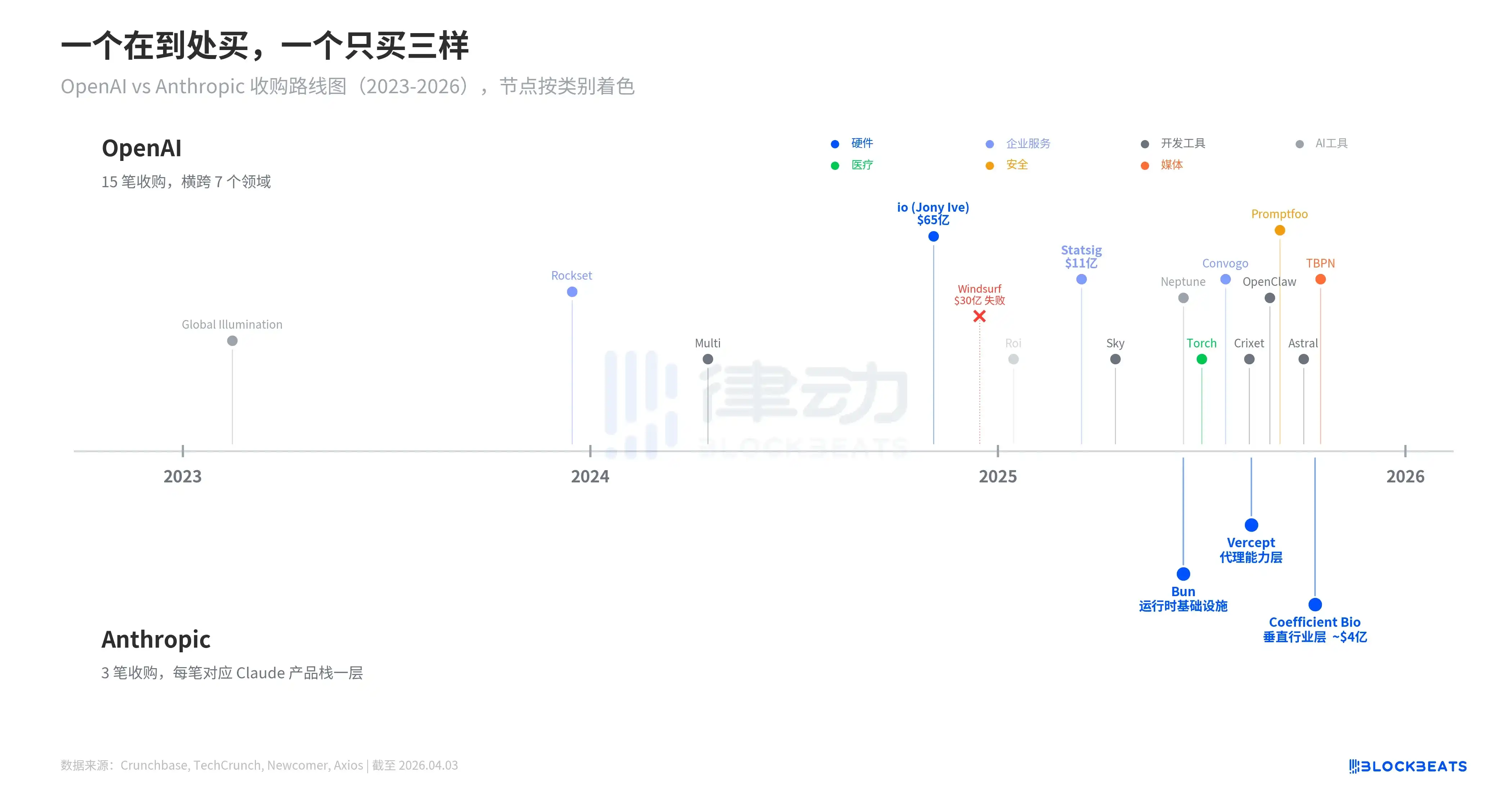
According to Crunchbase statistics, OpenAI has completed 15 acquisitions since 2023, spanning seven areas: hardware, enterprise services, developer tools, healthcare, security, media, and consumer. Six were completed in the first three months of 2026 alone. The total disclosed value of these transactions exceeds $7.7 billion, with the largest being the $6.5 billion acquisition of io, an AI hardware company founded by former Apple designer Jony Ive, in May 2025.

Anthropic has only made 3. In December 2025, it acquired the JavaScript runtime Bun to complete the underlying infrastructure for Claude Code. According to an official Anthropic announcement, the acquisition of Bun coincided with the disclosure that Claude Code had reached $1 billion in annualized revenue. In February 2026, it acquired the computer use agent startup Vercept to strengthen Claude's autonomous operation capabilities. On April 2, it acquired Coefficient Bio to enter the life sciences R&D pipeline. Each acquisition precisely corresponds to a technical layer in the Claude product stack.

It is worth noting that OpenAI also had one failed transaction. In May 2025, OpenAI reached a $3 billion acquisition intent with the code editor Windsurf (formerly Codeium). However, according to IT Pro, due to IP clauses in the Microsoft contract, OpenAI could not protect Windsurf's technology from being accessed by Microsoft, and the deal fell through in July. This failure also reflects a structural constraint of OpenAI's "broad procurement" model.

This difference in density is not accidental. It reflects the two companies' vastly different revenue structures and the resulting different anxieties.

Revenue Structure Determines Acquisition Direction

According to Sacra estimates, OpenAI's annualized revenue as of February 2026 was approximately $25 billion, with about 60% coming from the consumer end (ChatGPT subscriptions) and 40% from the enterprise end. 15.5 million paying users are the foundation of OpenAI's income. For a company about to IPO, a high proportion of consumer revenue means public sentiment directly impacts the valuation narrative.

This explains why OpenAI bought TBPN. According to Axios, TBPN is a daily live tech talk show with $5 million in advertising revenue in 2025 and a target of over $30 million for 2026. Post-acquisition, OpenAI will maintain its editorial independence while hiring former Postmates executive Dylan Abruscato to handle advertising monetization. The logic behind buying a tech podcast lies not in its revenue, but in its ability to continuously influence the public discussion framework around AI topics.
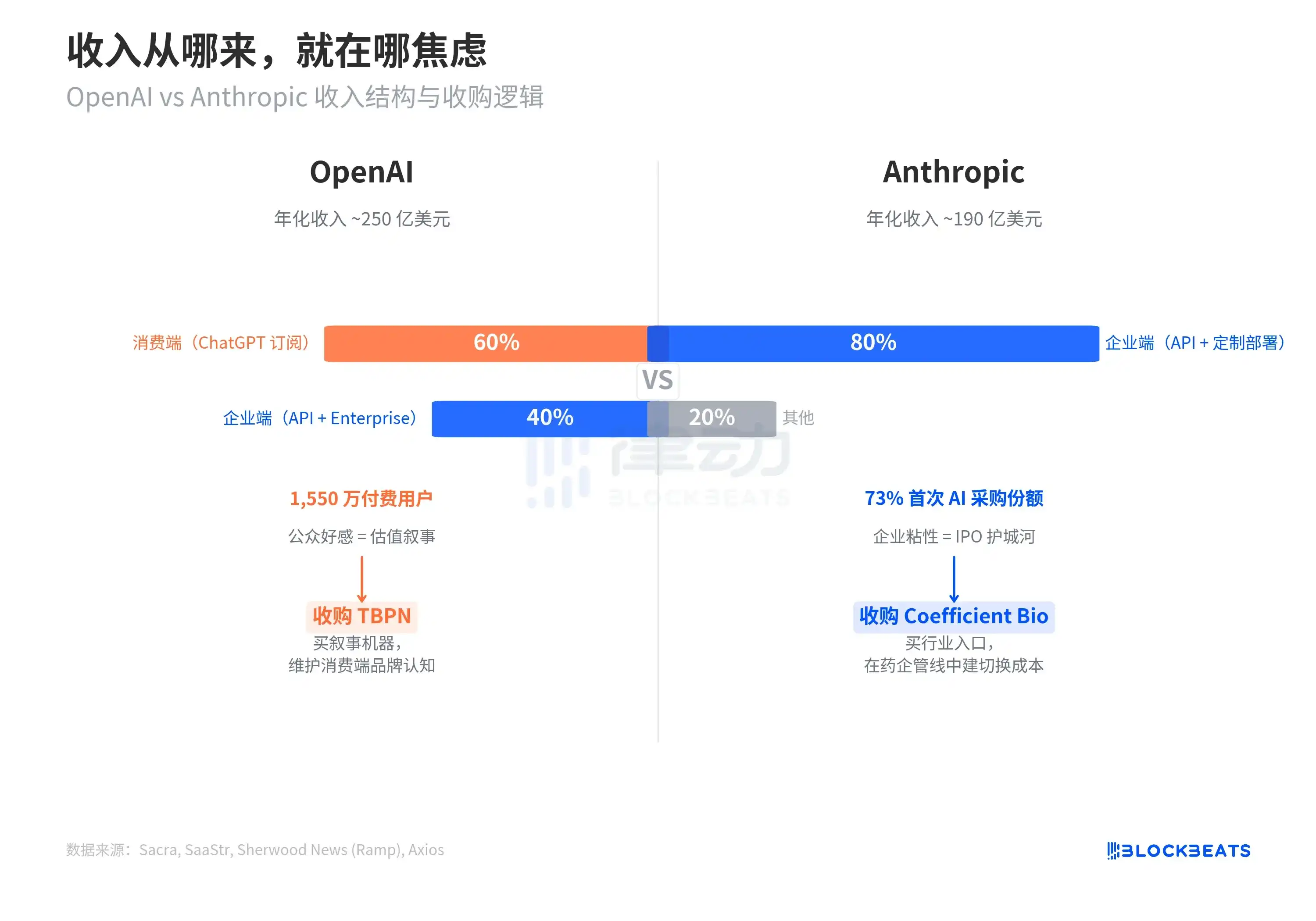
Anthropic's anxiety is entirely different. According to Ramp data cited by Sherwood News, Anthropic currently captures 73% of the market share for first-time AI procurement enterprise clients; ten weeks ago, this number was 50%. According to SaaStr, about 80% of Anthropic's revenue comes from the enterprise end. For enterprise customers, choosing an AI supplier is a decision with high switching costs. Anthropic's IPO narrative needs to prove that these enterprise customers will not leave.

Three Moves in Six Months

Coefficient Bio is not an impulsive acquisition. Viewed within the sequence of Anthropic's actions over the past six months, the logic is clear.

In October 2025, Anthropic launched Claude for Life Sciences, integrating with research databases like PubMed and UniProt, enabling Claude to assist with literature reviews and experimental design. In January 2026, at the JPM26 conference, it launched Claude for Healthcare, obtained HIPAA compliance certification, and formally entered the healthcare system. On April 2, it acquired Coefficient Bio, gaining full-cycle AI capabilities for drug R&D.
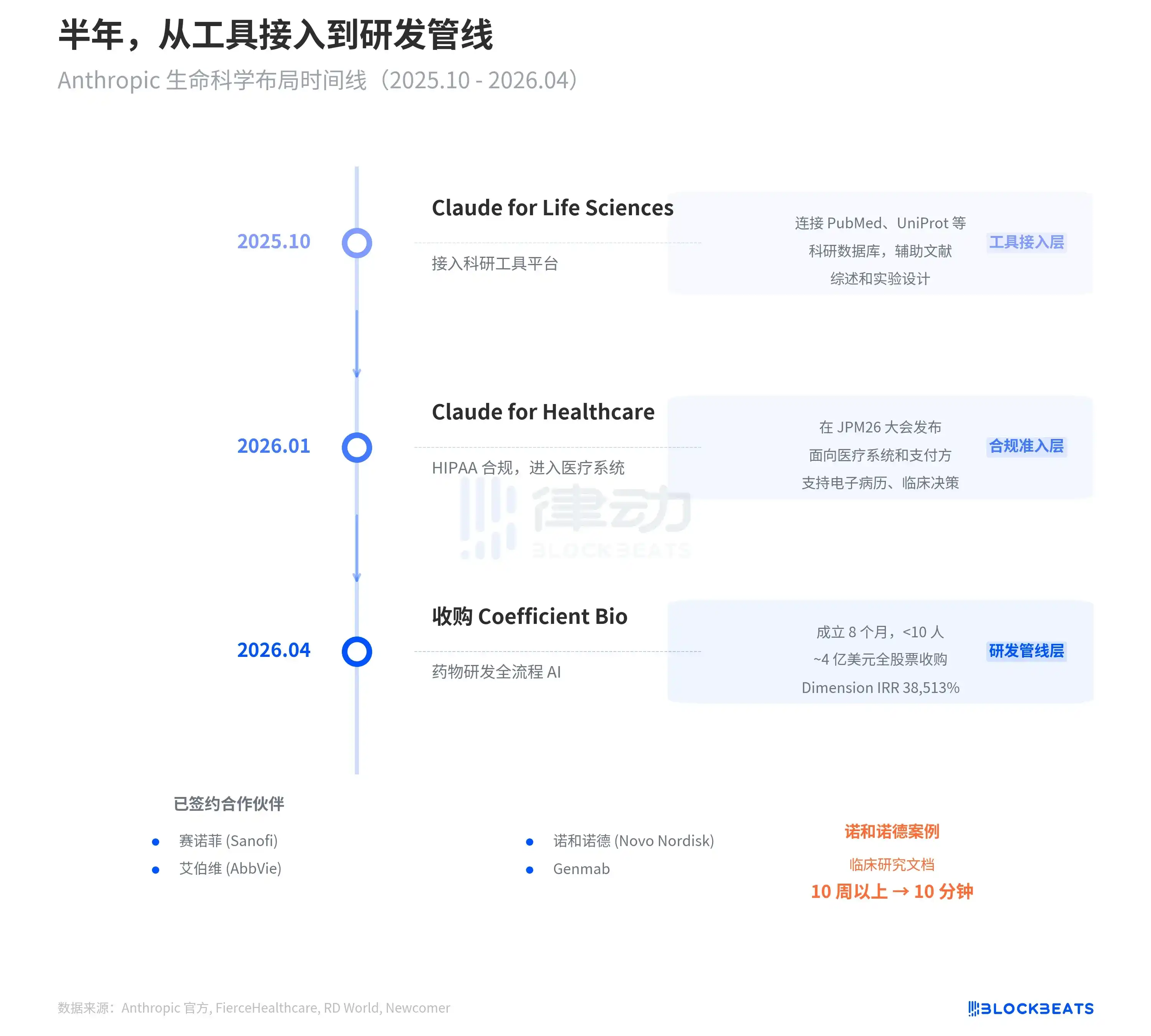
In six months, it progressed from the tool integration layer to the compliance access layer, and then to the R&D pipeline layer. According to Newcomer, Coefficient Bio was founded just 8 months ago, has fewer than 10 employees, and is about 50% owned by venture capital firm Dimension. Anthropic completed the acquisition for approximately $400 million in stock. Dimension stated in a letter to LPs that the IRR on this investment reached 38,513%.

This number itself shows that Anthropic is not buying a company's revenue or product, but rather a team plus an industry entry point. According to reports from Anthropic and RD World, pharmaceutical companies like Sanofi, Novo Nordisk, AbbVie, and Genmab are already using Claude's life science tools. The Novo Nordisk case is particularly typical, reducing clinical study document processing time from over 10 weeks to 10 minutes.

Two Balance Sheets, One Countdown

According to WinBuzzer and The Tech Portal, Anthropic has hired Goldman Sachs and J.P. Morgan to lead underwriting, targeting an IPO as early as October 2026 with a financing scale exceeding $60 billion. OpenAI is targeting Q4 2026 or Q1 2027 with a valuation nearing $1 trillion. According to Tom Tunguz's analysis, if OpenAI, Anthropic, and SpaceX all IPO in the same year, these three alone could absorb over $3 trillion in market liquidity.

Both are making final strategic adjustments before their IPOs. According to CNBC, OpenAI CEO Fidji Simo internally announced the cancellation of Sora, the Atlas browser, hardware projects, and instant checkout features, stating the company is "like entering a red alert" and needs to focus on enterprise and agent products. Anthropic's path is to continue deepening into vertical industries like life sciences, using industry switching costs to lock in enterprise customers.
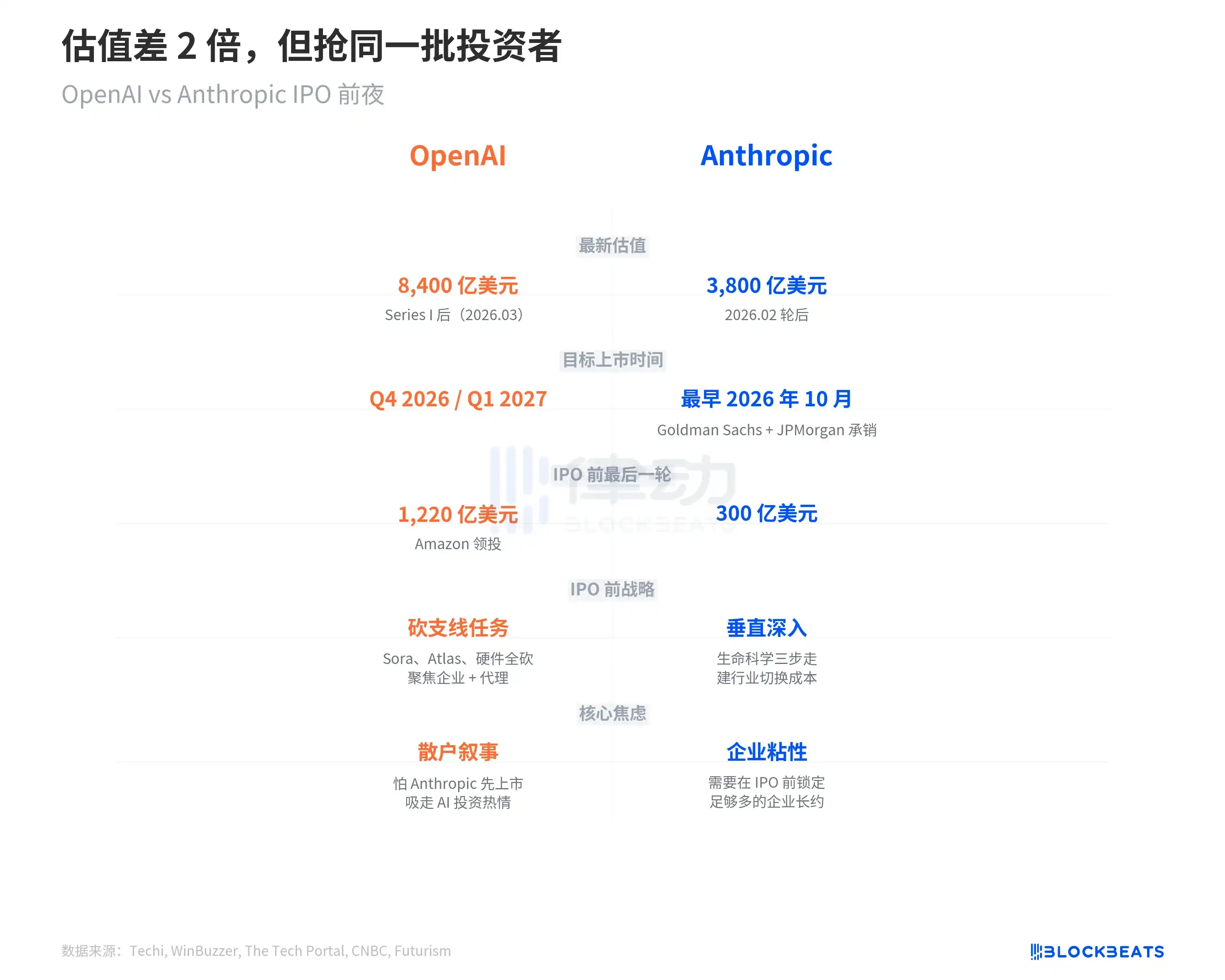
According to FinancialContent, the OpenAI board is concerned that if Anthropic goes public first, it will siphon off the retail investment enthusiasm that has been building up for AI. The valuations of the two companies differ by more than 2 times, but they are competing for the same pool of investors' money. Two acquisitions on the same day: one buying a narrative machine, the other buying an industry entry point.

Crypto di tendenza

Domande pertinenti

QWhat are the key differences in acquisition strategies between OpenAI and Anthropic as described in the article?

AOpenAI has pursued a broad acquisition strategy, completing 15 acquisitions across seven fields including hardware, media, and consumer services, focusing on influencing public narrative and consumer markets. Anthropic has made only 3 highly targeted acquisitions, each precisely strengthening a specific technical layer of its Claude product stack, such as infrastructure, autonomous operation, and industry-specific capabilities like biotech R&D.

QWhy did OpenAI acquire the tech broadcast network TBPN according to the article?

AOpenAI acquired TBPN, a daily tech talk show, not for its revenue but for its ability to continuously influence the public discussion framework around AI topics. This aligns with OpenAI's high reliance on consumer subscriptions and its need to manage public sentiment, which directly impacts its IPO valuation narrative.

QWhat was the strategic rationale behind Anthropic's acquisition of Coefficient Bio?

AAnthropic acquired Coefficient Bio, an AI biotech startup, to gain full-process AI capabilities for drug R&D. This was the final step in a clear six-month strategic sequence to deeply penetrate the life sciences vertical, following the release of specialized tools and achieving healthcare compliance, aiming to lock in enterprise clients with high switching costs.

QHow do the revenue structures of OpenAI and Anthropic influence their respective acquisition anxieties?

AOpenAI's revenue is ~60% consumer-based (ChatGPT subscriptions), making it anxious about public narrative affecting its IPO valuation, hence its 'narrative' acquisitions. Anthropic's revenue is ~80% from enterprise clients, making it anxious about proving client retention, hence its acquisitions focus on building technical 'moats' and deep vertical integration to increase switching costs.

QWhat are the reported IPO timelines and valuation targets for OpenAI and Anthropic?

AAnthropic aims for an IPO as early as October 2026, targeting a fundraising scale of over $60 billion. OpenAI is targeting an IPO in Q4 2026 or Q1 2027, with a valuation nearing $1 trillion. The article notes a concern that if both IPO around the same time as SpaceX, they could collectively absorb over $3 trillion in market liquidity.

Letture associate

After Three Consecutive Quarters of Decline, Can the Crypto Market Find a Window for Stabilization in Q3?

The cryptocurrency market has just concluded its worst-performing quarter since 2022, with total capitalization dropping 12.6% to $2.1 trillion. All core metrics indicate capital is leaving the sector, not just rotating within it. Bitcoin fell 14.2% and Ethereum dropped 25.4% in Q2, breaking their previous correlation with US tech stocks. A key driver is the reversal in US spot Bitcoin ETF flows, which saw a net outflow of approximately $4.67 billion in Q2, including a record monthly outflow near $4.5 billion in June. While recent data suggests long-term holders are accumulating again, sustained ETF outflows mean continued selling pressure. Market focus is now singularly on the Federal Reserve. The upcoming July FOMC meeting is seen as the most critical event for Q3. A dovish signal could support Bitcoin reclaiming a $68,000-$84,000 range, while a hawkish stance might establish a new trading band around $50,000-$56,000. Additionally, regulatory uncertainty persists, with the progress of the crucial *CLARITY Act* stalling in the Senate, reducing its perceived 2026 passage probability to 40-45%. Despite the broad downturn, a few sectors showed growth. Prediction markets saw nominal volume surge 48.7% year-over-year to $113.8 billion, and tokenized collectibles transaction volume rose 143% quarterly to $1.4 billion. The Real-World Asset (RWA) tokenization sector also continued steady growth, now representing ~$28.1 billion in on-chain value. The market's foundation for an extreme crash appears limited, with Bitcoin price hovering near its 200-week moving average. However, the trading paradigm has shifted from narrative-driven speculation to decisions based on price action, policy developments, and interest rate expectations, making a broad sentiment-driven rally unlikely in the near term.

marsbit18 h fa

After Three Consecutive Quarters of Decline, Can the Crypto Market Find a Window for Stabilization in Q3?

marsbit18 h fa

BIT Trading Moment: BTC Still Suppressed by Weekly 200 EMA, Rejection May Restart Decline; Storage and Semiconductors that Surged Last Night Begin Falling in Evening Trading

**Crypto & Stock Market Wrap: Bitcoin Tests Resistance, Stocks Retreat After AI Surge** Bitcoin consolidates around $66,000, facing key resistance near $68,000—an area seen as a major psychological and technical hurdle where previous rallies have failed. Analysts note the cryptocurrency is caught between its 200-week moving average (~$63,333) and 200-week EMA (~$68,328). A clear break above $68k is needed to signal a stronger bullish trend, while a rejection could lead to a retest of $63k support. Market sentiment remains cautious, with low futures open interest pointing to a low-liquidity rebound rather than a full bull market. Bitcoin spot ETFs saw another $203 million inflow. US stock futures pointed lower after a strong Tuesday session led by a massive rebound in semiconductors and memory stocks. The rally was fueled by renewed optimism about AI-driven hardware demand, with Micron, SanDisk, and SK Hynix surging. However, those gains reversed in pre-market trading. Super Micro Computer (SMCI) soared over 20% after hours on strong guidance and a record backlog. Other standouts included Rocket Lab and nuclear energy plays Oklo and X-Energy. Rising oil prices (Brent above $91) and climbing Treasury yields (10-year near 4.64%), however, are reigniting inflation concerns and acting as a headwind for equities. In Asia, markets were mixed. South Korea's KOSPI pared early gains to close slightly higher as semiconductor stocks like SK Hynix gave back initial surges. Japan's Nikkei edged lower as the yen hit a fresh 38-year low against the dollar, raising fears of potential market intervention. Key events to watch include the Samsung Galaxy launch, AMD's AI event, and a slew of major tech earnings from Alphabet, Tesla, and IBM after the close on Wednesday, followed by the ECB meeting and Intel's earnings on Thursday.

marsbit18 h fa

BIT Trading Moment: BTC Still Suppressed by Weekly 200 EMA, Rejection May Restart Decline; Storage and Semiconductors that Surged Last Night Begin Falling in Evening Trading

marsbit18 h fa

Former CFTC Chairman, Circle President Tarbert: Preaching Long-Termism While Cashing Out $30 Million Himself

Former CFTC Chairman and Circle President Heath Tarbert has consistently advocated for a long-term vision in public, urging patience from investors as Circle’s stock price has fallen significantly from its peak. However, it has been revealed that since Circle’s IPO, Tarbert has continuously sold his CRCL shares through pre-arranged trading plans, cashing out approximately $30 million, without making any public market purchases. This contrast between his public messaging and personal actions has drawn criticism. Tarbert joined Circle in July 2023 as Chief Legal Officer, leveraging his regulatory experience to help guide the company through its IPO and expansion. Despite promoting stablecoins as long-term infrastructure, he established a 10b5-1 trading plan just before Circle went public, leading to substantial stock sales over the following year. In March 2026, he initiated another plan to sell more shares. His career trajectory highlights a pattern of moving between high-level regulatory roles and influential positions in the financial sector. After resigning as CFTC Chairman in early 2021, he joined Citadel Securities as Chief Legal Officer just 27 days later, during a period of intense regulatory scrutiny for the firm. He later joined Circle, aiding its efforts to navigate regulatory challenges for its public listing. While Tarbert's expertise in policy and compliance is valuable to companies like Circle, his actions—advocating long-term confidence while personally divesting—raise questions about the alignment between his public statements and his private financial decisions, leaving investors who followed his advice to bear the market risks.

marsbit19 h fa

Former CFTC Chairman, Circle President Tarbert: Preaching Long-Termism While Cashing Out $30 Million Himself

marsbit19 h fa

Gate Research Institute: The 'Wall Street-ization' Wave of Crypto Financial Products – Competition or Integration?

The article titled "Gate Research Institute: Are Crypto Financial Products Sparking a 'Wall Street' Wave—Competition or Convergence?" explores the evolving relationship between the crypto ecosystem and traditional finance (TradFi). The piece begins by reflecting on Bitcoin's original 2009 vision of decentralization, disintermediation, and moving away from banks. It then contrasts this with the 2024 landscape, where key crypto assets like Bitcoin are increasingly held through Wall Street products like ETFs issued by giants like BlackRock. The article questions whether this signifies that TradFi is systematically taking over the rights to issue, price, custody, and distribute crypto financial assets. The core argument is that this is not a zero-sum takeover but rather a bidirectional convergence where each side addresses the other's weaknesses. Crypto offers 24/7 global markets, programmable settlement, and open access but lacks compliant channels, institutional-grade custody, deep fiat liquidity, and mainstream distribution. TradFi possesses these but is constrained by legacy systems, limited operating hours, and slow settlement. Two primary convergence paths are highlighted: * **Path A (CEX to TradFi):** Exemplified by Gate, which has progressed from offering tokenized stocks and CFDs to providing direct, real stock trading (US, Hong Kong, South Korea) within its platform, using USDT. * **Path B (TradFi to Crypto):** Exemplified by Robinhood, which has integrated crypto trading, acquired exchanges like Bitstamp, and is moving traditional assets like stocks onto the blockchain via tokenization and its own Layer 2. Both paths are ultimately competing to become the next-generation, unified financial account—a "super account" where users can seamlessly trade cryptocurrencies, stocks, ETFs, RWA (Real World Assets), and tokenized treasury products in one interface. The growth of RWA and tokenized treasuries (e.g., BlackRock's BUIDL) is presented as the asset-layer fusion, providing stable, yield-bearing assets on-chain and acting as a bridge between the two worlds. In conclusion, the "Wall Street-ization" of crypto is framed as a mutual transformation. Decentralized ideals persist in the protocol layer, while at the application layer, a more efficient, global, and accessible unified capital market is emerging from this convergence. The future competition lies not between crypto exchanges and stockbrokers, but between platforms vying to offer the most comprehensive asset coverage, liquidity, and user experience within a single account.

marsbit19 h fa

Gate Research Institute: The 'Wall Street-ization' Wave of Crypto Financial Products – Competition or Integration?

marsbit19 h fa

Trading

Spot

Articoli Popolari

Come comprare ONE

Benvenuto in HTX.com! Abbiamo reso l'acquisto di Harmony (ONE) semplice e conveniente. Segui la nostra guida passo passo per intraprendere il tuo viaggio nel mondo delle criptovalute.Step 1: Crea il tuo Account HTXUsa la tua email o numero di telefono per registrarti il tuo account gratuito su HTX. Vivi un'esperienza facile e sblocca tutte le funzionalità,Crea il mio accountStep 2: Vai in Acquista crypto e seleziona il tuo metodo di pagamentoCarta di credito/debito: utilizza la tua Visa o Mastercard per acquistare immediatamente HarmonyONE.Bilancio: Usa i fondi dal bilancio del tuo account HTX per fare trading senza problemi.Terze parti: abbiamo aggiunto metodi di pagamento molto utilizzati come Google Pay e Apple Pay per maggiore comodità.P2P: Fai trading direttamente con altri utenti HTX.Over-the-Counter (OTC): Offriamo servizi su misura e tassi di cambio competitivi per i trader.Step 3: Conserva Harmony (ONE)Dopo aver acquistato Harmony (ONE), conserva nel tuo account HTX. In alternativa, puoi inviare tramite trasferimento blockchain o scambiare per altre criptovalute.Step 4: Scambia Harmony (ONE)Scambia facilmente Harmony (ONE) nel mercato spot di HTX. Accedi al tuo account, seleziona la tua coppia di trading, esegui le tue operazioni e monitora in tempo reale. Offriamo un'esperienza user-friendly sia per chi ha appena iniziato che per i trader più esperti.

354 Totale visualizzazioniPubblicato il 2024.12.12Aggiornato il 2026.06.02

Come comprare ONE

Discussioni

Benvenuto nella Community HTX. Qui puoi rimanere informato sugli ultimi sviluppi della piattaforma e accedere ad approfondimenti esperti sul mercato. Le opinioni degli utenti sul prezzo di ONE ONE sono presentate come di seguito.

活动图片