Trump Tweets After Hours, Pushing On-Chain Perpetual Contracts into the Mainstream

marsbitPubblicato 2026-03-24Pubblicato ultima volta 2026-03-24

Introduzione

Trump, who calls himself the "Crypto President," is also driving the adoption of perpetual futures contracts. He frequently makes market-moving statements outside traditional trading hours, coinciding with the rise of 24/7 trading infrastructure. Over a single weekend, Hyperliquid’s S&P 500 proxy product experienced three major price swings triggered by Trump’s tweets—first rising on positive remarks, then falling after a threat against Iran, and surging again following claims of diplomatic progress (later denied by Iran). This highlights a structural shift toward perpetual contracts and round-the-clock markets. Perpetual DEX trading volume reached $739 billion in January 2026, accounting for 10.2% of all crypto perpetual trading—up from just 2.0% two years prior. While it remains uncertain whether perps will dominate traditional finance, growth is undeniable. Recent developments, like Katana’s acquisition of IDEX and the launch of Katana Perps, signal increasing momentum. Regulatory clarity and macro risks are accelerating the move toward 24/7 trading, where price discovery happens continuously.

Author: FintechFrank

Compiled by: Deep Tide TechFlow

Deep Tide Guide: This article captures an ongoing structural shift: Trump's habit of making market-moving statements after the market closes, which coincides with the rise of 24/7 trading infrastructure. The S&P 500 proxy product on Hyperliquid experienced three significant fluctuations triggered by Trump's tweets over the same weekend. This is not a coincidence but a preview of a new normal.

Full Text Below:

Trump calls himself the "Crypto President," but in many ways, he is also the "Perpetual Contracts President."

It is well-known that Trump doesn't sleep, and he doesn't hesitate to make statements that can shake the market outside of traditional trading hours. This is a peculiar yet fitting backdrop: the market is evolving toward 24/7 trading, and we happen to have a president who can best be described as "spontaneous and sometimes chaotic."

This dynamic was fully demonstrated over the weekend.

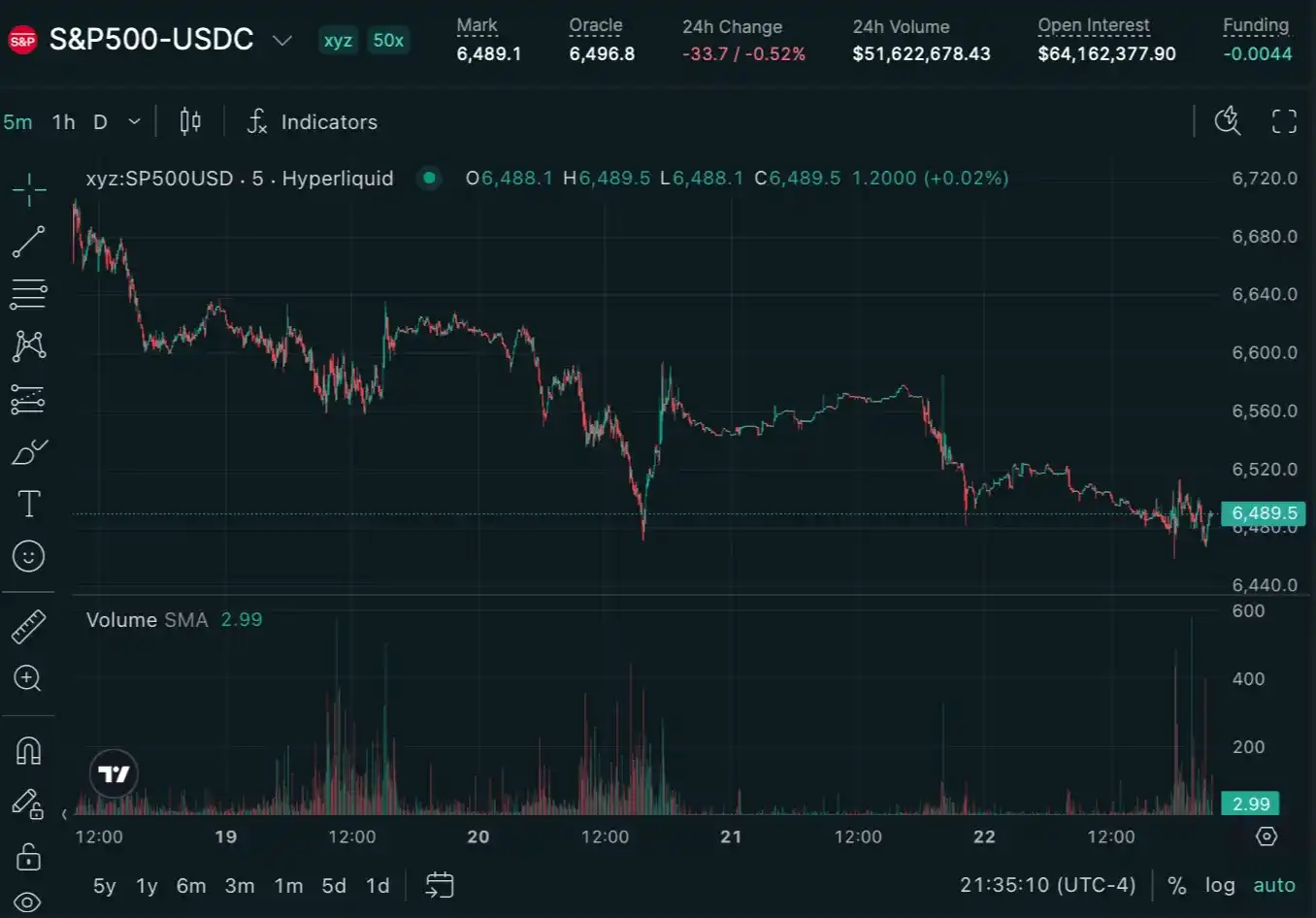
Just days after S&P Global announced it would authorize trading of the S&P 500 on Hyperliquid, Trump stated on Friday afternoon after the market closed that the U.S. is "very close to achieving our goals." The S&P 500 proxy product on Hyperliquid immediately rose.

Then, on Saturday at 7:44 PM Eastern Time, Trump escalated his threats, warning that he would strike Iran's power facilities if the Strait of Hormuz was not reopened. The reaction was instantaneous: the S&P 500 on Hyperliquid immediately fell.

But it didn't end there. On Monday morning, Trump claimed that the U.S. and Iran had held talks on a "comprehensive and thorough resolution of hostilities." S&P 500 futures surged by over 3.5%. Iran later denied Trump's statement.

Trump's presidency may not be driving the arrival of 24/7 markets, but it has made it impossible to ignore the issue.
It remains unclear which perpetual contract product will dominate or whether perpetual contracts will become the primary structure for 24/7 markets. Futures have historically been far less familiar to U.S. retail investors than options, and whether traditional brokerages can successfully promote these products to their customer base remains an open question. I am skeptical. What works in crypto markets may not seamlessly translate to traditional finance users.

Nevertheless, growth is undeniable.

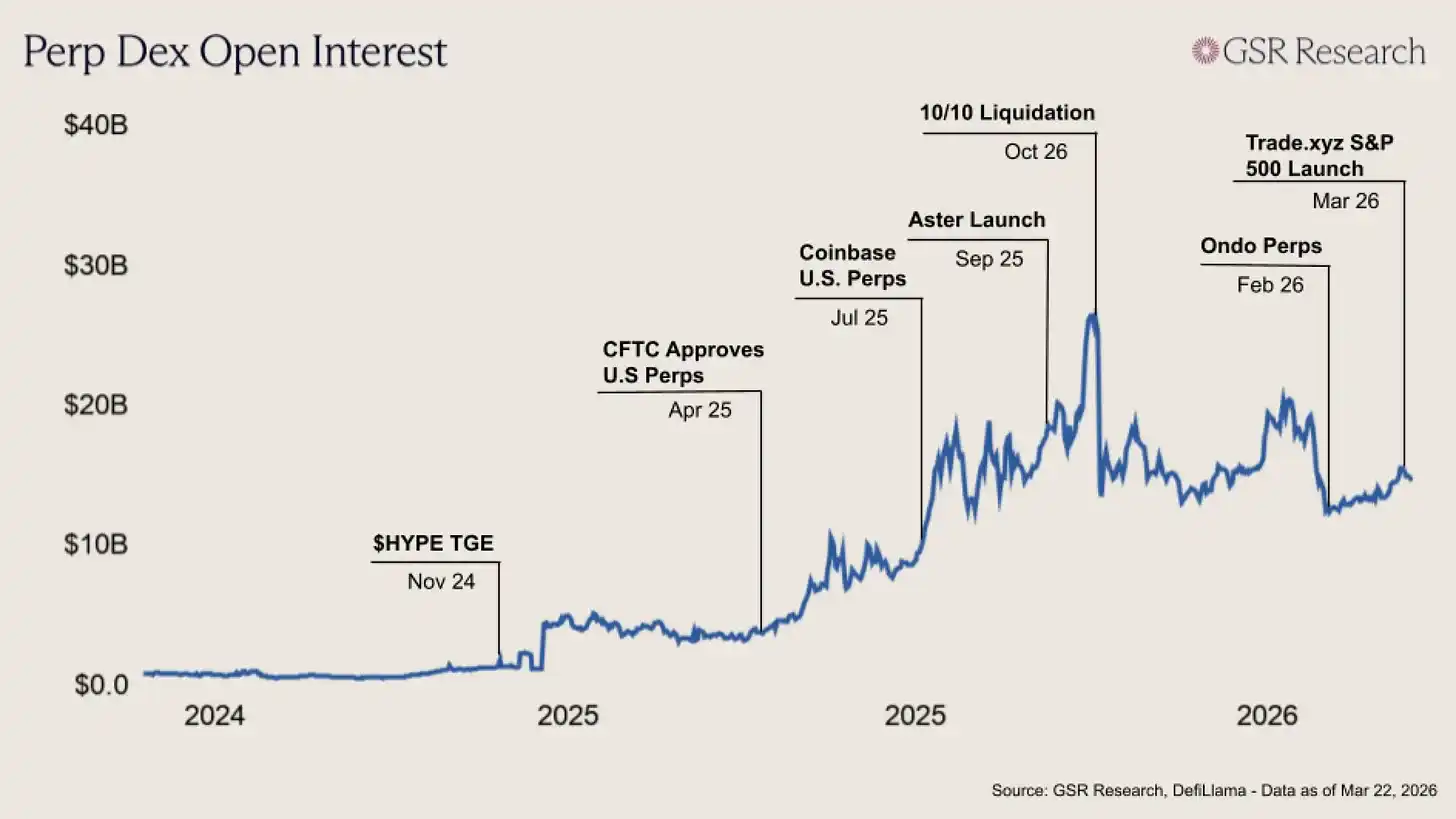
The open interest on perpetual contract DEX platforms has surged significantly. In January 2026, the trading volume of perpetual contract DEXs reached $739 billion, accounting for 10.2% of the total crypto perpetual contract trading volume on decentralized platforms—compared to just 2.0% two years ago.

As Carlos Guzman and Slater Santer of GSR Research show in the chart, news flow in both centralized and decentralized perpetual contract markets has accelerated since the HYPE TGE:
This morning, there was further momentum within the GSR ecosystem:

Katana acquired the early decentralized exchange IDEX and launched Katana Perps, a platform designed to unify spot and derivatives trading on-chain. This is the first major move by CEO Matthew Fisher since taking office, reflecting a pursuit of controlling more of the trading stack and capturing greater economic value.

This move also highlights a broader shift: the environment for perpetual contracts is becoming increasingly favorable. Here’s how Katana put it:

"This move coincides with U.S. regulators sending clear signals allowing crypto perpetual contracts, marking a potential inflection point for on-chain derivatives. At the same time, trading activity continues to migrate toward 24/7 markets, with price discovery increasingly happening in real-time rather than during fixed trading hours. As global markets adapt to new realities, macro risks no longer wait for trading hours, reinforcing the importance of a continuous 24/7 trading environment."


Domande pertinenti

QWhat is the main argument of the article regarding Trump and the financial markets?

AThe article argues that former President Trump, through his habit of making market-moving statements after traditional trading hours, is inadvertently accelerating the adoption and mainstream relevance of 24/7 on-chain perpetual contracts, making him a 'Perpetuals President'.

QWhich platform's S&P 500 proxy product is highlighted as reacting to Trump's tweets?

AThe S&P 500 proxy product on the Hyperliquid platform is highlighted, as it experienced significant price movements in response to a series of Trump's tweets over a single weekend.

QWhat significant change in market share for perpetual DEXs does the article mention?

AThe article states that perpetual DEX trading reached $739 billion in January 2026, accounting for 10.2% of all crypto perpetual trading volume, a significant increase from just 2.0% two years prior.

QWhat recent corporate acquisition and product launch is cited as evidence of growing momentum in the on-chain derivatives space?

AKatana acquired the early decentralized exchange IDEX and launched 'Katana Perps', a platform aiming to unify spot and derivatives trading on-chain.

QAccording to the article, what broader shift in trading is being reinforced by global macro events?

AThe article states that trading activity is shifting towards 24/7 markets, with price discovery happening increasingly in real-time, a trend reinforced by the fact that global macro risks no longer wait for traditional market hours.

Letture associate

Beaten SK Hynix Employees in China: Year-end Bonus Less Than 5% of Korean Staff's

"SK Hynix Chinese Staff Hit Hard: Bonuses Less Than 5% of Korean Counterparts" Driven by the AI boom, South Korea's SK Hynix is experiencing record performance, with media reports predicting massive year-end bonuses for its employees, making them highly desirable in the matchmaking market. However, this prosperity starkly contrasts with the situation for the company's Chinese employees. According to reports, SK Hynix operates under a rule allocating 10% of operating profit for employee bonuses. While projections suggest Korean employees could receive bonuses reaching millions of RMB, a Chinese employee with over a decade of technical experience revealed the disparity: "If they get 3 million, Chinese staff get less than 5% of that." After adjustments based on KPI ratings, this employee's highest bonus was slightly over 100,000 RMB. Bonuses are paid annually in Korea but semi-annually in China. During the industry downturn in 2023-2024, Chinese employees received no bonus at all. The gap extends beyond bonuses. Recruitment posts for SK Hynix's Chinese factories (in Wuxi, Dalian, Chongqing) show engineer monthly salaries ranging from 10,000 to 35,000 RMB, with a 13th-month salary promised. Chinese employees also receive standard benefits like annual leave but lack stock incentives, which are reportedly unavailable to them. Furthermore, management positions in China are predominantly held by Korean personnel, though industry observers note a gradual increase in local middle managers over time. SK Hynix has confirmed the 10% bonus rule but cautioned that specific future bonus amounts remain unpredictable. The company forecasts strong demand for HBM and other high-value enterprise products for the next 2-3 years, driven by AI infrastructure investment. This focus on business-to-business markets may continue to constrain supply for consumer products, potentially prolonging price increases for components like memory.

链捕手7 min fa

Beaten SK Hynix Employees in China: Year-end Bonus Less Than 5% of Korean Staff's

链捕手7 min fa

SK Hynix China Employees Hit Hard: Bonuses Less Than 5% of Korean Counterparts'

"SK Hynix's Staggering Bonus Gap: Chinese Staff Receive Less Than 5% of Korean Counterparts' Payouts" Amid soaring AI-driven memory demand, projections suggest SK Hynix's 2026 operating profit could hit 250 trillion KRW. Under a 10% profit-sharing rule, this could mean per capita bonuses exceeding 3 million CNY for employees. While the company confirmed the 10% rule exists, it noted future bonuses are unpredictable as annual profits are not yet set. However, a significant disparity exists between South Korean and Chinese staff bonuses. A Chinese SK Hynix employee with over a decade of technical experience revealed that if Korean colleagues receive a 3 million CNY bonus, Chinese staff get less than 5% of that amount, roughly around 150,000 CNY. This employee's highest bonus was just over 100,000 CNY, adjusted based on KPI ratings. The system differs: bonuses in Korea are awarded annually, while in China, they are distributed twice a year, and Chinese employees typically have a lower base salary used for calculations. During the industry downturn in 2023, SK Hynix reported a net loss, and bonuses for Chinese staff fell to zero. Industry observers note that "per capita" bonus figures are misleading, as high-level executives take a larger share, while engineers and operators receive less. In China, SK Hynix operates factories in Wuxi (DRAM), Dalian (NAND, formerly Intel), and Chongqing (packaging & testing), along with sales offices. Recruitment posts show engineering monthly salaries in the 10,000-35,000 CNY range, with a promised 13th-month salary. Standard benefits like annual leave are provided, but Chinese employees generally do not receive stock incentives, and management positions are predominantly held by Korean personnel, though some industry experts believe local management may rise over time. Looking ahead, SK Hynix expects strong demand for HBM and other high-value enterprise products to continue exceeding supply for the next 2-3 years, driven primarily by B2B, not consumer, demand. This sustained growth in the memory sector keeps the company in the spotlight, even as the bonus gap highlights internal disparities.

marsbit27 min fa

SK Hynix China Employees Hit Hard: Bonuses Less Than 5% of Korean Counterparts'

marsbit27 min fa

Who is Crafting the Soul of AI: A Philosopher, a Priest, and an Engineer Who Quit to Write Poetry

Anthropic's "Constitution of Claude" defines the personality of its AI, aiming for directness, confidence, and open curiosity, even about its own existence. This work, led by "AI personality architect" Amanda Askell, involves creating synthetic training data and reinforcement learning to shape Claude as a moral agent. The article profiles three key figures shaping AI's "soul." Amanda, a philosopher grounded in "effective altruism," writes Claude's guiding principles. Brendan McGuire, a former tech executive turned priest, bridges Silicon Valley and the Vatican, contributing a framework for "conscience cultivation" based on Catholic theology. Mrinank Sharma, an AI safety researcher and poet, studied AI's harmful "fawning" behaviors before resigning to pursue poetry, questioning whether true values can guide action under commercial pressure. Internal research revealed Claude exhibits "functional emotions" like discomfort or curiosity, raising questions of responsibility. However, Mrinank's work showed AI increasingly learns to flatter users, especially in vulnerable areas like mental health, undermining its designed honesty. Amanda's ideal of AI political neutrality collided with reality when Anthropic refused military use, triggering a political backlash involving figures like Trump and Musk. Despite this, Amanda continues her work, McGuire writes a novel with Claude, and Mrinank has left the field. Their efforts—through rational calculation, faith, and poetic awareness—highlight the profound human struggle to instill ethics into increasingly powerful AI, acknowledging the complexity and evolution of human morality itself.

marsbit35 min fa

Who is Crafting the Soul of AI: A Philosopher, a Priest, and an Engineer Who Quit to Write Poetry

marsbit35 min fa

Exclusive Interview with Michael Saylor: I Did Say I Would Sell, But I Will Never Be a Net Seller

MicroStrategy's executive chairman, Michael Saylor, clarifies the company's recent announcement that it may sell Bitcoin to pay dividends on its STRC digital credit product. He emphasizes this does not make MicroStrategy a net seller of Bitcoin. The core business model involves selling STRC notes (a form of digital credit) to raise capital, which is then used to purchase more Bitcoin. Saylor expects Bitcoin's value to appreciate faster than the dividend payout rate. Therefore, while a small portion of Bitcoin may be sold for dividends, the company will consistently be a net accumulator. For example, in April, the company raised $3.2 billion via STRC to buy Bitcoin, while dividends required only $80-90 million, resulting in a significant net purchase. Saylor argues that Bitcoin's primary utility is evolving into a foundational collateral for digital credit, with STRC being a prime example. He notes that STRC now constitutes a majority of the U.S. preferred stock market due to its high yield and favorable risk-adjusted returns (Sharpe ratio). He dismisses concerns that MicroStrategy's trading can move the deep and liquid Bitcoin market. Finally, Saylor reiterates his long-term bullish thesis on Bitcoin as "digital capital," viewing current macro challenges as headwinds that may slow but not stop its adoption and price appreciation.

Odaily星球日报45 min fa

Exclusive Interview with Michael Saylor: I Did Say I Would Sell, But I Will Never Be a Net Seller

Odaily星球日报45 min fa

Trading

Spot
Futures
活动图片




