Treasuries and yield funds – Is this the next phase of tokenization?

ambcryptoPubblicato 2026-04-10Pubblicato ultima volta 2026-04-10

Introduzione

Tokenized finance is experiencing significant growth, with BNB Chain's tokenized asset market cap reaching a record $16.6 billion, more than doubling year-over-year. The broader tokenized funds market has expanded to $31.9 billion, driven primarily by yield-bearing products rather than simple stablecoins. While Tether and USDC remain the largest issuers, faster growth is occurring among smaller players like Ondo Finance, Maple Finance, and Centrifuge. The trend highlights a shift beyond cash proxies toward income-generating on-chain assets, signaling a new phase in asset tokenization.

Tokenized finance is one of crypto’s most serious growth stories today. However, is this just another trend or the foundation of something new?

AMBCrypto previously reported that S&P Dow Jones Indices moved its iBoxx U.S. Treasuries Index on-chain via the Canton [CC] Network, one of the clearest steps forward. The move came as tokenized U.S Treasuries crossed $12.6 billion.

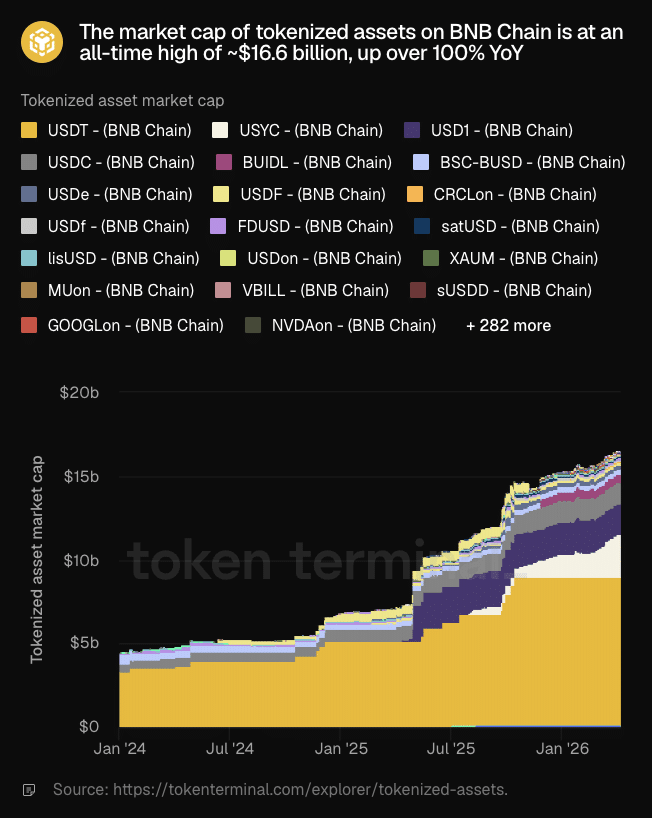
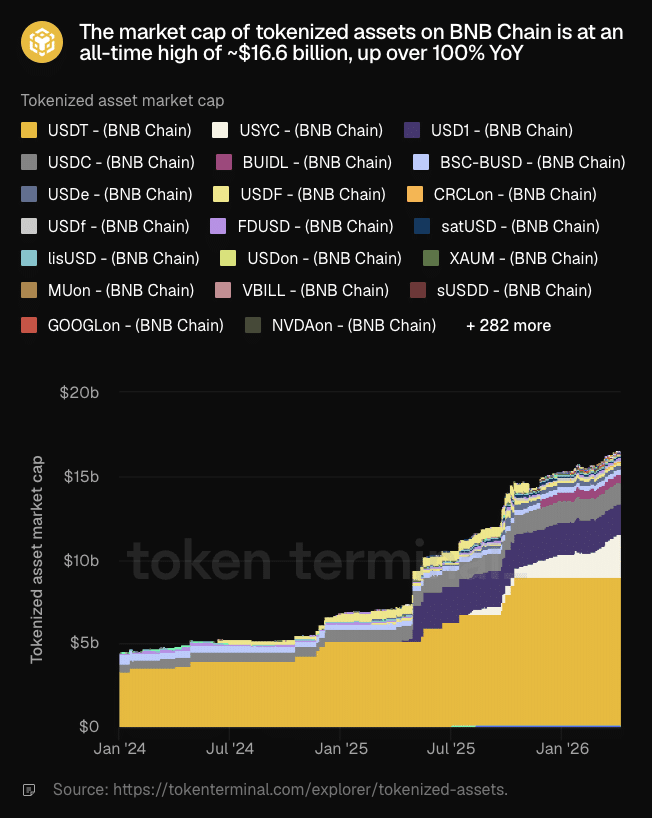
BNB Chain’s tokenized asset market cap at a record $16.6B

BNB Chain’s tokenized asset market has expanded over the past year, reaching an all-time high of about $16.6 billion! According to Token Terminal, that is more than 2x higher YoY, up from roughly $4 billion to $5 billion in early 2024.
Source: Token Terminal

Growth sped through 2025, with the market cap first pushing past $10 billion and then moving above $15 billion. Tether [USDT] still makes up the largest share of the stack, but a broader base is forming across names like USD Coin [USDC] and WLFi’s USD1.

Growth is spread beyond the top 2

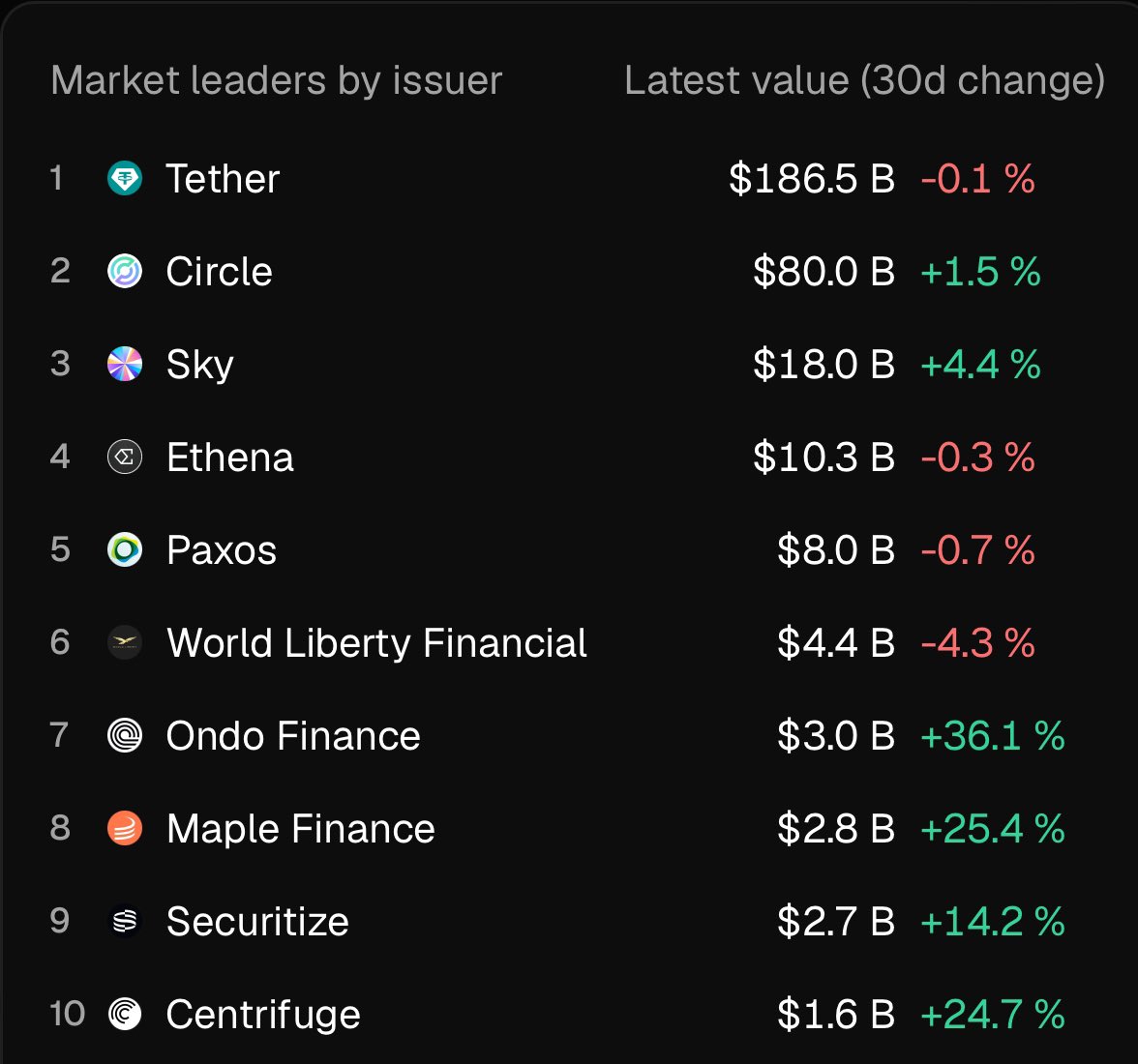
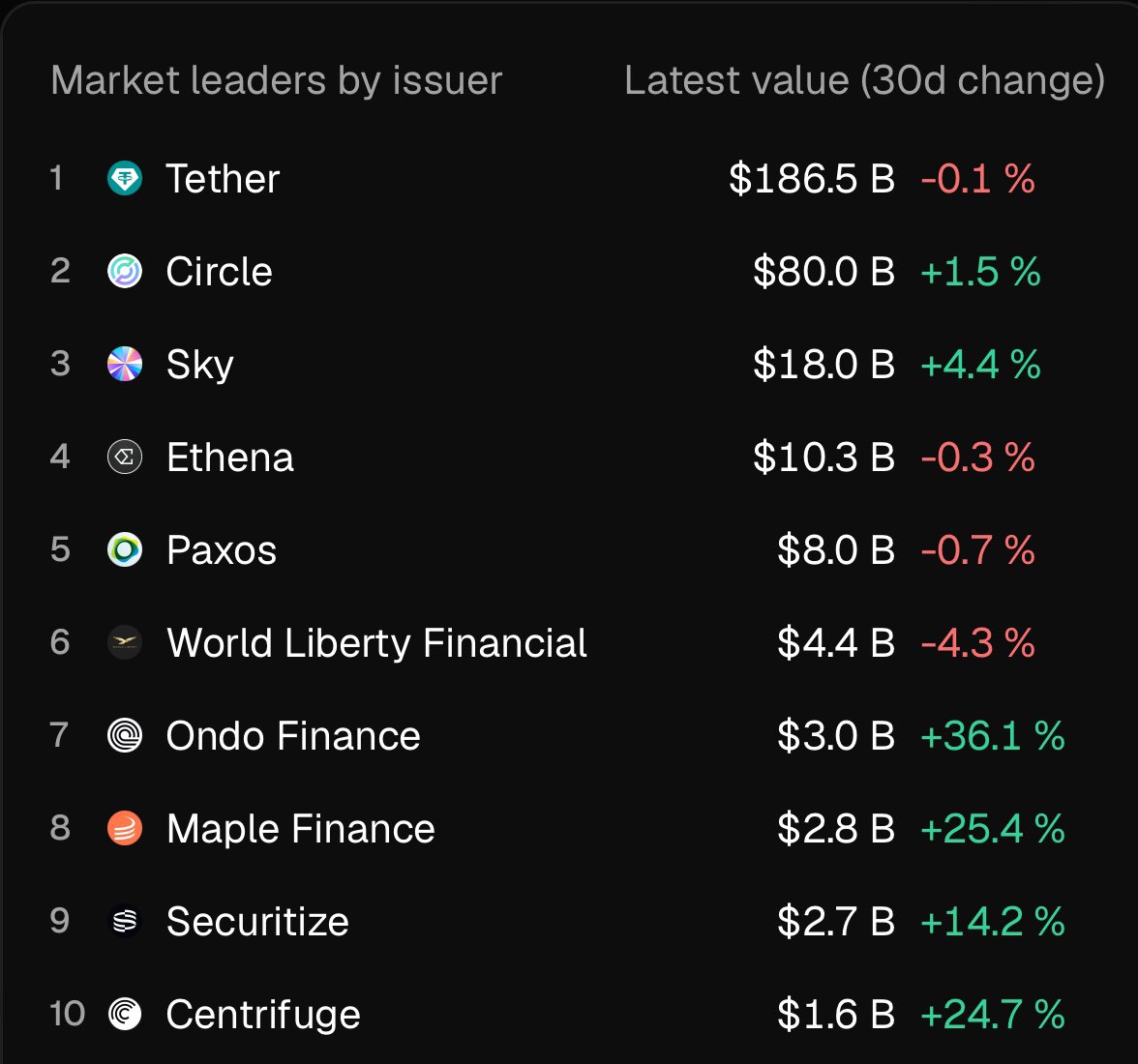
At press time, Tether still led issuance by a wide margin at $186.5 billion, while Circle followed at $80.0 billion. However, the faster growth is happening lower down the table.
Source: X

Over the last 30 days, Ondo Finance has expanded by 36.1% to $3 billion. Similarly, Maple Finance climbed by 25.4% to $2.8 billion and Centrifuge added 24.7% to reach $1.6 billion. Securitize also grew 14.2% to $2.7 billion.

On the contrary, Tether’s growth was nearly flat at -0.1%.

Tokenized funds reach $31.9B as yield products take the lead

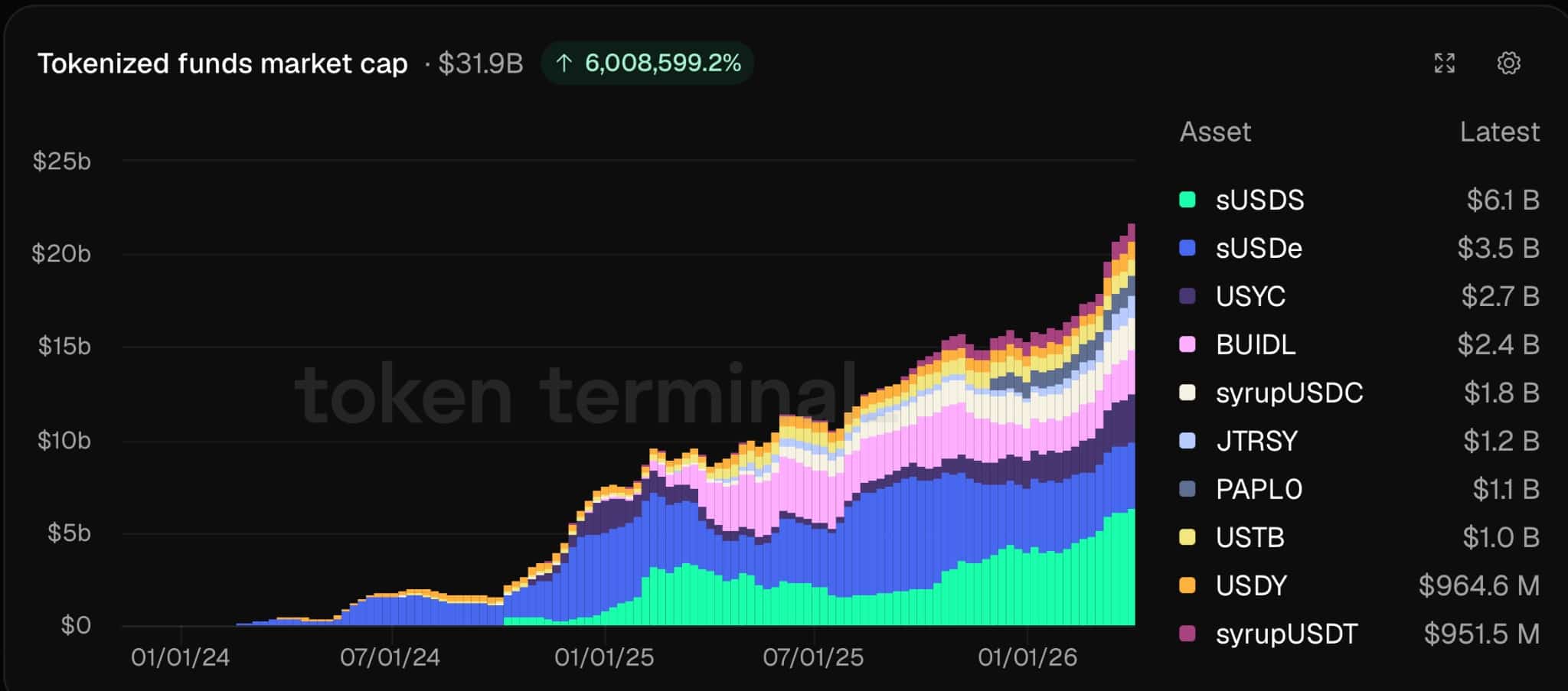
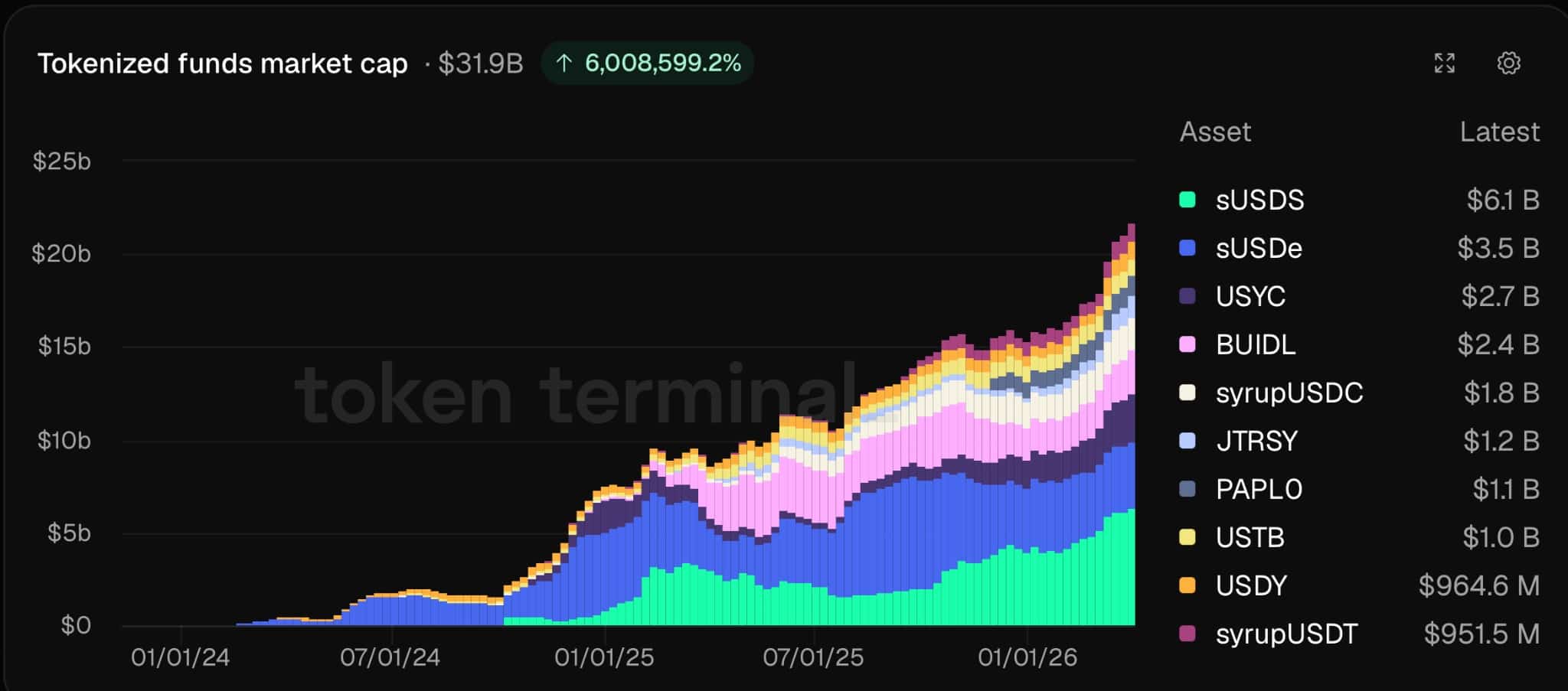
The tokenized funds market was at $31.9 billion at press time. Growth has been led by yield-oriented products, rather than plain cash proxies alone.
Source: Token Terminal

sUSDS was the largest fund at $6.1 billion, followed by sUSDe at $3.5 billion, USYC at $2.7 billion, and BUIDL at $2.4 billion. The next layer also appeared to be meaningful – syrupUSDC is at $1.8 billion, JTRSY at $1.2 billion, and PAPLO at $1.1 billion.

It’s not just stablecoins anymore. Income-bearing on-chain products are scaling fast!


Final Summary

  • BNB Chain’s tokenized asset market cap has reached a record $16.6 billion – 2x YoY!
  • Tokenized funds climbed to $31.9 billion, with yield-bearing on-chain products in the lead.

Domande pertinenti

QWhat is the current market cap of BNB Chain's tokenized assets and how does it represent growth year-over-year?

ABNB Chain's tokenized asset market cap has reached a record $16.6 billion, which is more than 2x higher year-over-year (YoY).

QWhich two stablecoins are the largest by issuance in the tokenized asset market, and what are their respective market caps?

ATether [USDT] leads with an issuance of $186.5 billion, followed by USD Coin [USDC] at $80.0 billion.

QWhich tokenized funds have shown the most significant growth in the last 30 days, and what were their growth rates?

AOndo Finance grew by 36.1% to $3 billion, Maple Finance climbed 25.4% to $2.8 billion, and Centrifuge added 24.7% to reach $1.6 billion.

QWhat is the total value of the tokenized funds market, and what type of products are leading this growth?

AThe tokenized funds market was valued at $31.9 billion, with growth being led by yield-oriented, income-bearing on-chain products rather than plain cash proxies.

QWhat was the significance of S&P Dow Jones Indices moving its iBoxx U.S. Treasuries Index on-chain?

AIt was one of the clearest steps forward for tokenized finance, occurring as the same time that tokenized U.S. Treasuries crossed $12.6 billion in value.

Letture associate

Is AI Creating a New Class of 'Information Poor'?

AI is generating a new kind of "information poverty." The core issue isn't that AI denies answers to the poor; it's that it provides abundant, cheap, and plausible-sounding answers to everyone. This availability shifts the true scarcity from obtaining answers to possessing the **judgment to evaluate them** and the access to turn them into real-world opportunities. New information poverty thus describes those who have AI tools and outputs, but lack the complementary skills, authorization, and contextual experience to critically assess and act on them. Research reveals a multi-layered divide: access to AI is stratified by income and platform design (e.g., premium vs. free, embedded tools). In workplaces, usage heavily favors higher-paid, more experienced, or formally trained employees, with AI often automating entry-level tasks that were traditional stepping stones. Crucially, the heaviest users are often mid-career professionals whose existing expertise allows them to effectively judge and leverage AI outputs, while novices risk over-relying on them without building judgment. While controlled experiments show AI can significantly boost low-skilled workers' performance, real-world adoption and benefit are constrained by unequal social and organizational structures. Historically, general-purpose technologies first reward those with existing complementary capital. AI, by affecting judgment-based work, may accelerate and deepen this initial inequality gap, even if it narrows over decades. The danger lies in the illusion of competence it creates, potentially stunting the very critical thinking needed in an era where judgment is paramount.

marsbit21 min fa

Is AI Creating a New Class of 'Information Poor'?

marsbit21 min fa

Jensen Huang 'Saves' South Korean Stock Market: Locks In SK Hynix Memory, Chip Shortage to Continue

On June 5th, South Korea's stock market experienced a sharp decline, with major chipmakers like Samsung and SK Hynix dropping nearly 10%. Amidst the turmoil, NVIDIA CEO Jensen Huang's visit to Seoul played a dramatic role in boosting market sentiment. Following a dinner meeting with SK Group Chairman Chey Tae-won and SK Hynix CEO Kwak Noh-Jung, Huang confirmed that NVIDIA's new Vera CPU will utilize SK Hynix DRAM. The companies announced a multi-year technical partnership to co-develop next-generation memory for NVIDIA's AI infrastructure, covering products from data centers to personal AI and robotics. This collaboration extends beyond memory supply. SK Hynix is integrating NVIDIA's AI and Omniverse platform into its own semiconductor design and manufacturing processes, including computational lithography and creating digital twins of its fabrication plants for autonomous operation. While strengthening ties with SK Hynix, NVIDIA is diversifying its supply chain for the upcoming HBM4 memory, with Samsung, SK Hynix, and Micron all certified as suppliers for its Vera Rubin platform. Despite this, Huang warned that the global chip shortage, driven by relentless demand from AI factory construction, is expected to persist for several years across the entire supply chain. His visit underscores NVIDIA's systematic effort to deepen integration with South Korea's broader tech industry.

marsbit1 h fa

Jensen Huang 'Saves' South Korean Stock Market: Locks In SK Hynix Memory, Chip Shortage to Continue

marsbit1 h fa

Nasdaq Plunges 4.2% in a Single Day: Does "Black Friday" Burst the U.S. Stock Market Bubble?

The Nasdaq plunged 4.18% on June 5, 2026, its worst single-day drop in over a year, as a much stronger-than-expected US jobs report triggered fears of economic overheating and delayed Federal Reserve interest rate cuts. The selloff, centered on high-valuation tech and AI stocks like Nvidia and Broadcom, spread across major indices. The article examines whether this signals a market top. The strong May non-farm payrolls data, nearly double expectations, pushed bond yields higher, directly hurting rate-sensitive tech stocks. This exposed vulnerabilities in the crowded AI trade, where valuations had soared on narratives of infinite growth, despite emerging signs of slowing order momentum and corporate AI monetization challenges. Prior to the drop, market indicators flashed warning signs: historically high valuations (e.g., Shiller CAPE ratio near 39.5), extreme bullish sentiment, and high levels of leverage. Technical charts showed key support levels being breached. Wall Street is divided on the outlook. Bears, citing risks of "stagflation" and AI bubble comparisons to the dot-com era, warn of a potential significant correction. Bulls view the drop as a healthy correction within a bull market, underpinned by a strong economy and expected corporate earnings growth of around 7% in 2026. The immediate future hinges on upcoming key events: the May CPI inflation data and the mid-June FOMC meeting. Their outcomes will critically shape market expectations for the Fed's rate path. The article concludes that conditions for a major market top are aligning, marking a fragile transition from narrative-driven gains to a phase demanding validation from macroeconomic data and corporate fundamentals. Caution is advised.

marsbit1 h fa

Nasdaq Plunges 4.2% in a Single Day: Does "Black Friday" Burst the U.S. Stock Market Bubble?

marsbit1 h fa

Nasdaq Plunges 4.2% in a Single Day, Did 'Black Friday' Pop the U.S. Stock Bubble?

The Nasdaq Composite plummeted 4.18% on June 5, its biggest single-day drop since April 2025, triggering widespread debate over whether the U.S. stock market has peaked. The sell-off was sparked by a stronger-than-expected U.S. non-farm payrolls report, which fueled fears of economic overheating and pushed back market expectations for Federal Reserve rate cuts, leading to a sharp rise in Treasury yields. The AI sector, the primary driver of the recent bull market, suffered severe losses, with the Philadelphia Semiconductor Index crashing over 10%. Stocks like Nvidia, Broadcom, and Micron led the decline. Concerns are mounting about the sustainability of AI capital expenditures and high valuations, with signs of order cuts for next-generation chips emerging. Analyses point to several warning signs: historically high market valuations (e.g., elevated Shiller CAPE ratio, Buffett Indicator), extreme bullish sentiment indicators, and significant insider selling. The sell-off also caused a key technical breakdown, with the S&P 500 breaking below its short-term moving average and testing its 200-day moving average. Wall Street is divided on the outlook. Bears warn this could be the start of a bubble deflation or a "stagflation" scenario, while bulls view it as a healthy, overdue correction within a bull market driven by solid corporate earnings growth. A more moderate view suggests the easy liquidity-driven rally is over, and markets are entering a phase of fundamental stock-picking with potential for consolidation. The immediate future hinges on key upcoming events: the May CPI report and the mid-June FOMC meeting. Their outcomes will be critical in determining whether this is a temporary pullback or the beginning of a more significant trend reversal. The consensus is that the era of one-directional market gains may be ending, requiring increased investor caution.

Odaily星球日报1 h fa

Nasdaq Plunges 4.2% in a Single Day, Did 'Black Friday' Pop the U.S. Stock Bubble?

Odaily星球日报1 h fa

The First Case on AI Agents: What Was Adjudicated?

"The First 'Agent' Ruling: What Was Decided?" On April 30, the Guangzhou Internet Court issued a ruling—China's first behavior preservation order in the intelligent agent (AI agent) field. The defendant, an open-source AI agent software, was ordered to stop downloads, cease actions that bypassed a platform's technical protection measures, and delete related tutorials and data. The core issue: the software used the operating system's "accessibility service" permissions to automate user interactions within other apps without those platforms' authorization. This mirrors a recent US case where Amazon sued Perplexity for similar reasons—bypassing Amazon's API to directly scrape and interact with its pages—and won a preliminary injunction. Both rulings establish a crucial legal boundary for the AI agent era: agents cannot operate unchecked. The article argues the fundamental legal principle emerging is one of **dual authorization**. An AI agent requires both **user consent** AND **platform consent** to operate legitimately within that platform's ecosystem. Bypassing platform rules through system-level permissions, even with user permission, undermines platform responsibilities for content moderation, data security, and user privacy, creating liability issues. The piece uses the evolution of "Doubao Phone" (an AI-integrated smartphone) as a case study. Its initial, aggressive version that bypassed platform controls faced roadblocks. Its upcoming 2.0 version is reportedly pivoting to negotiate API access and authorization deals with major platforms (like Alibaba's ecosystem), seen as a strategic adaptation to the new regulatory reality. A global trend is identified: the era of unregulated, "wild west" growth for AI agents is ending, replaced by a **compliance race**. This raises barriers to entry, as securing platform authorizations becomes a new cost. Open-source status is also not a legal shield if the code facilitates bypassing technical protections. In conclusion, these first rulings target not the largest, but the most **aggressive and representative** cases. By setting precedent with them, regulators are efficiently steering the entire industry towards a new, more regulated operating paradigm defined by dual authorization and platform cooperation.

marsbit1 h fa

The First Case on AI Agents: What Was Adjudicated?

marsbit1 h fa

Trading

Spot
Futures

Articoli Popolari

Come comprare ONE

Benvenuto in HTX.com! Abbiamo reso l'acquisto di Harmony (ONE) semplice e conveniente. Segui la nostra guida passo passo per intraprendere il tuo viaggio nel mondo delle criptovalute.Step 1: Crea il tuo Account HTXUsa la tua email o numero di telefono per registrarti il tuo account gratuito su HTX. Vivi un'esperienza facile e sblocca tutte le funzionalità,Crea il mio accountStep 2: Vai in Acquista crypto e seleziona il tuo metodo di pagamentoCarta di credito/debito: utilizza la tua Visa o Mastercard per acquistare immediatamente HarmonyONE.Bilancio: Usa i fondi dal bilancio del tuo account HTX per fare trading senza problemi.Terze parti: abbiamo aggiunto metodi di pagamento molto utilizzati come Google Pay e Apple Pay per maggiore comodità.P2P: Fai trading direttamente con altri utenti HTX.Over-the-Counter (OTC): Offriamo servizi su misura e tassi di cambio competitivi per i trader.Step 3: Conserva Harmony (ONE)Dopo aver acquistato Harmony (ONE), conserva nel tuo account HTX. In alternativa, puoi inviare tramite trasferimento blockchain o scambiare per altre criptovalute.Step 4: Scambia Harmony (ONE)Scambia facilmente Harmony (ONE) nel mercato spot di HTX. Accedi al tuo account, seleziona la tua coppia di trading, esegui le tue operazioni e monitora in tempo reale. Offriamo un'esperienza user-friendly sia per chi ha appena iniziato che per i trader più esperti.

320 Totale visualizzazioniPubblicato il 2024.12.12Aggiornato il 2026.06.02

Come comprare ONE

Discussioni

Benvenuto nella Community HTX. Qui puoi rimanere informato sugli ultimi sviluppi della piattaforma e accedere ad approfondimenti esperti sul mercato. Le opinioni degli utenti sul prezzo di ONE ONE sono presentate come di seguito.

活动图片













