Written by: Hongyu
Preface
I have been following Nikita Bier since I started my social product entrepreneurship in 2023, up until he joined X as the product lead last year. I have always wanted to write about him.
His three products—Politify, TBH, and GAS—have all achieved significant success. His company had only a dozen people. These three products may not have reached an unshakable scale, as that requires the right timing, location, and people. But he is one of the most insightful social product managers in my mind; many in the English-speaking community call him the king of viral growth.
Nikita Bier's entrepreneurial journey is like a precise experiment targeting human weaknesses: from a policy simulation tool at Berkeley to two viral apps that addicted teenagers, and now leading product iterations at X (formerly Twitter). He always finds leverage in the subtle psychological gaps of "why users click and why they stay" to drive large-scale behavioral change. At 31, he has already turned small team ideas into high-value exits twice. Now, he brings this approach to Musk's platform, attempting to reshape the future of a social media giant. But behind the glamorous success are countless failed experiments and a direct gaze at "shameful truths."
Politify: Zero-Cost User Acquisition for a College Startup Project
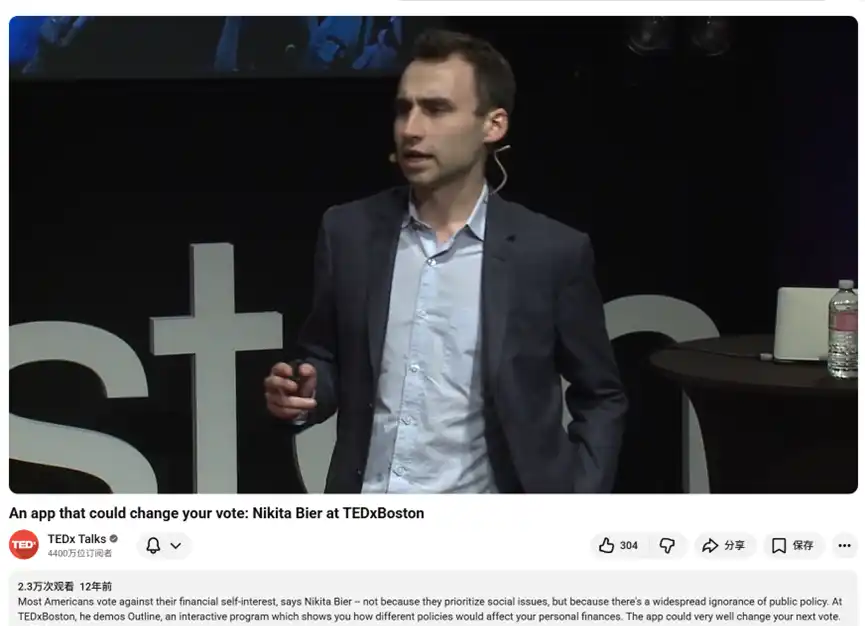
(Nikita talking at TED about why he founded Politifi, link:https://www.youtube.com/watch?v=k9QTVII_lkg)
Nikita's starting point was not Silicon Valley but his early tinkering with websites. From the age of 12, he started building web pages for consumer apps, like a full e-commerce site. Back then, he pondered why users would click and why they would stay—perhaps out of curiosity, a sense of urgency, or emotional触动. This early practice cultivated his sensitivity to user behavior.
This sensitivity became evident during his time at Berkeley.
His first product, Politify,表面上 looked like a tax calculator but went further than similar tools at the time. Around the 2012 election, many competitors were simple tax calculators based on rough rate estimates; Politify required details like family status to simulate the comprehensive impact of different presidential candidates' policies (e.g., Obama's or Romney's tax reforms, welfare adjustments) on personal, community, and even national finances, including income changes, expenditure effects, and government service usage.
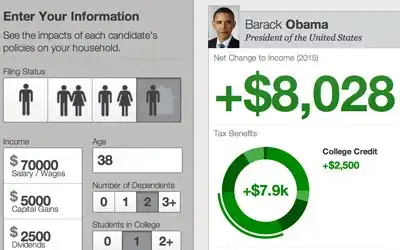
This design stemmed from Bier's observation: most Americans vote ignoring their own economic interests, leading to "self-harming behavior." Politify used data algorithms and visual charts to directly target this blind spot. Users seeing results like "supporting this candidate will cost you a net $2000 per year" would naturally stay, share, and even reconsider their voting choices.
This logic was not function-driven nor a simple copycat; it naturally extended from user pain points. This is also the biggest difference between a product and a tool. I see many so-called Vibe coding works on Twitter (including my own) that are actually tools, not products. A product is an extension and reshaping of emotions; a tool solves a specific problem for you. I won't elaborate further here.
Politify's influence extended far beyond campus. During the 2012 election, it attracted 4 million users with zero marketing budget, topped download charts, and won multiple awards. The Knight Foundation supported its expansion into Outline.com, collaborating with governments like Massachusetts to promote "digital democracy" discussions. Bier直言 in his TED talk: "Information asymmetry in voter decision-making is the root of social problems." Although there is no substantial data proving the product achieved significant returns, it demonstrated Bier's viral talent:targeting human weaknesses through policy.
Later, he reflected on similar logic on X:"Consumers don't adopt products because of feature gaps, but because of the feeling they provide." This insight became the underlying theme of all his products—from Politify's "self-interest simulation" to the dopamine loops of subsequent apps.
TBH: Viral Explosion Among Student Groups
What truly brought Nikita Bier into the spotlight was TBH (To Be Honest) in 2017. An anonymous mutual praise app for high school students, allowing only positive feedback to avoid toxic social interactions. In detail, it started from a high school in Georgia, relying on natural裂变 within the student群体, reaching 5 million total users and 2.5 million daily active users in just two months. All this was achieved by just four people—Nikita Bier and three co-founders (Erik Hazzard, Kyle Zaragoza, Nicolas Ducdodon).
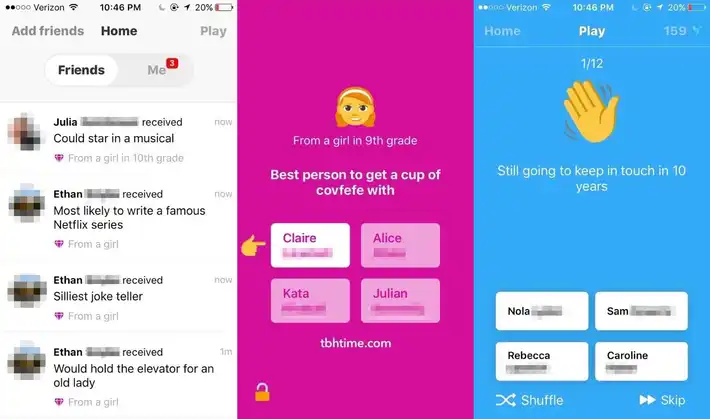
tbh product schematic
Analyzing the reasons for the product's爆款 success, it was likely because it tapped into teenagers' primal craving for "social validation": mainly the excitement young people felt upon seeing anonymous compliments, forming a dopamine loop (Who has a crush on me? Who actually likes me? Should I pursue something with them?).
Bier revealed in a podcast that they failed with 14 apps before hitting this point; the team initially tried a more negative anonymous rating system but didn't receive much positive feedback, as it was just a productization of traditional cyberbullying. So they switched to anonymous positive feedback.
After launch, TBH was quickly noticed by an anxious Facebook. From Instagram to Mnus, you know Facebook often tries to solve problems with acquisitions, and this time was no exception.
At that time, Snapchat was capturing the youth market, and Facebook faced an "aging" crisis, with its content ecosystem full of negativity.
TBH's positive interaction model aligned with Zuckerberg's shift towards "healthy communities"; more importantly, its viral mechanism proved the potential to leverage young users with zero budget. After the acquisition, TBH operated independently but closed in 2018 due to declining usage. Bier joined Meta as a product manager until 2021.
In hindsight, this deal was a multi-win situation. Facebook successfully executed an anti-competition strategy (like the early acquisition of Instagram), Bier gained money and big company experience, and it was probably during this time that he learned to maintain iteration speed at scale.
Gas: Basically Hooked on Teenagers, Finally Profitable
Gas app
In 2022, Bier made a comeback with Gas—you could see it as an upgraded version of TBH, with added features like voting, gamification, and paid features to reveal who praised you. It reached 10 million users in three months, generating $11 million in revenue, and一度 ranked above TikTok and Meta on the App Store, becoming the most popular app in the US.
In detail, it leveraged users' curiosity to pay and see who complimented them, forming a closed-loop monetization. The product was acquired by Discord for $50 million in January 2023, as they were interested in Gas's understanding of the teen community and his growth hacking skills, which had proven capable of turning短暂 viral explosions into sustainably profitable networks.
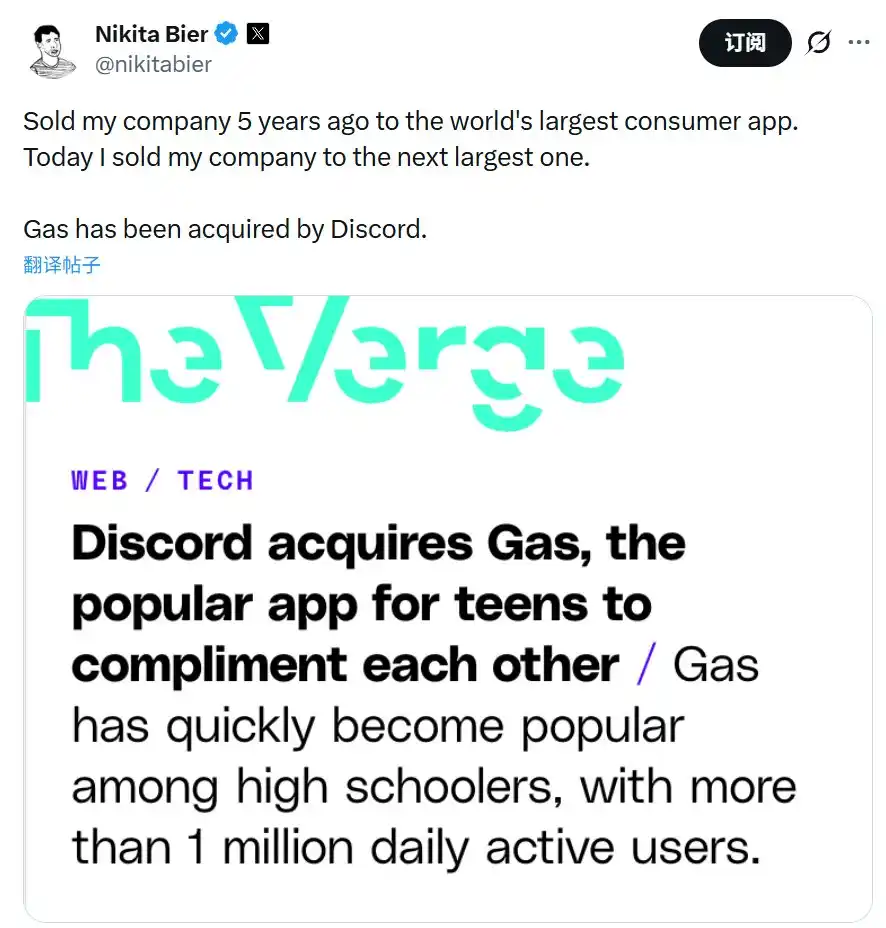
"Five years later, sold to the next big player."
Summarizing his two创业 models: both relied on small teams, no funding, and rapid iteration. Although the failure rate was high, once they hit, they exploded virally.
Product Methodology: Emotional Leverage and "Madman" Mindset
Bier's product methodology is actually simple, yet残酷.
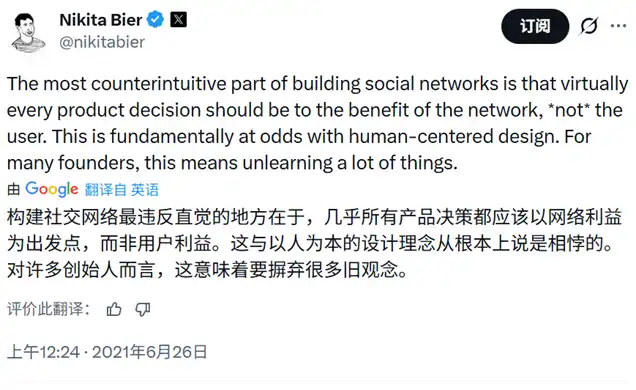
Serving network interests rather than single pain points
He repeatedly emphasizes: good consumer apps don't solve a single user's pain point; they serve the entire network. They don't fix competitors' bugs; they reshape the growth flywheel.
"Don't optimize 10% of messages or photos; that's already done well enough by WeChat and Instagram. New players must rely on viral creativity, on dopamine loops, to leverage from zero.
" His favorite concept is "life turning points"—vulnerable moments like starting school, transactions, or new jobs, where users most crave connection. Products that卡准 these moments can explode.
Bier is also直言不讳: one must acknowledge the "shameful truths" in human nature, like the primal craving for praise, status, and social validation. Only by amplifying these emotions can you create addictive things. He views consumers as having a "lizard brain": politics or decentralization don't drive adoption; only本能 needs like making money or dating do. Building products requires a "madman" mindset: 99% of decisions are life-or-death, the failure rate is extremely high, but iteration is king. On X, he abstracts this as "academic honesty": quickly admitting mistakes, embracing feedback, avoiding big company phantom chases.
Crypto Interlude: From Advisor to Mobile Ecosystem Driver for Solana
After two exits, Bier didn't rest; he turned his attention to crypto/Web3—but his involvement was as pragmatic as ever: not speculating or building chains, but using his growth experience to help top公链 like Solana build consumer mobile ecosystems. In September 2024, he joined Lightspeed Venture Capital as a Product Growth Partner. Lightspeed is an old player in crypto, having invested in Solana early on. Nikita focused here on helping portfolio companies optimize viral growth, network effects, and distribution strategies. This role gave him exposure to more Web3 projects at the VC level without being tied to a single chain.
On March 25, 2025, Bier officially joined Solana Labs as an advisor. He publicly stated that his views on crypto in recent years were full of controversy, but recent regulatory loosening, App Store becoming more crypto-friendly, and the memecoin craze普及 Phantom wallet to millions of phones—these changes made Solana an ideal platform for consumer apps. His specific work at Solana involves helping with the growth of Solana's mobile ecosystem and related projects.
But he still maintains some distance from crypto. Although he became an advisor for Pump.fun through Solana connections and publicly praised founder Alon, he also emphasized that he does not have pump.fun equity.
He occasionally comments on memecoins on X, like讽刺 "dropping a meme coin is a liquidation of your brand equity" or吐槽 "every single meme coin launched in the last year has gone to zero." But these are more like调侃 or statements of moral底线, never真正 promoting specific token launch products.
This crypto interlude is highly consistent with his一贯 style:
- Seizing the "inflection point" (here, regulation + mobile inflection point)
- Amplifying network effects, not chasing short-term fluctuations
After joining X, he was occasionally调侃 by the crypto community as a Solana maxi, especially when recent algorithm adjustments affected crypto-related content. But the above also set the stage for X's financial positioning.
Joining X: Timeline from Self-Recommendation to Product Leadership
In late June 2025, Bier officially joined X as Product Lead.
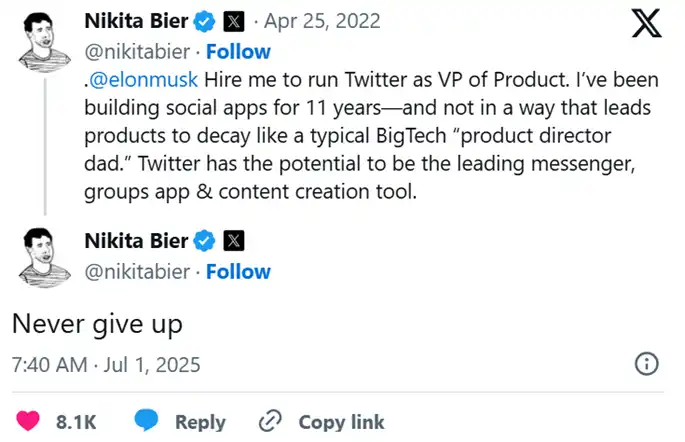
In 2022, Nikita Bier publicly recommended himself to Musk on X to become Twitter's product VP
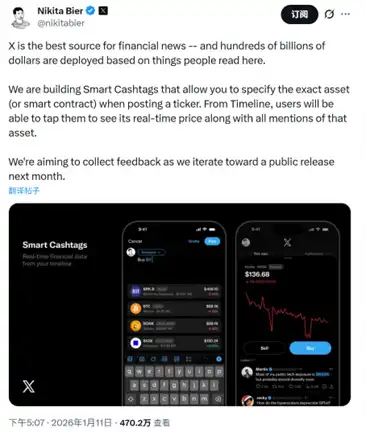
After taking office, he started卷 again, rolling out a bunch of features. Here's a quick list: optimized core feed flow in early July, previewed Community features in October. January 2026 was the climax—collaborating with the algorithm team to adjust the recommendation page, increasing the proportion of content from friends, mutuals, and followers.同期 launched Smart Cashtags (real-time stock prices + discussion), synced drafts (app to web端), cracked down on AI spam, etc.
Why do this? It's also his logic:
- The recommendation page targets "network density," letting users see acquaintances to enhance habits (like TBH's praise loop).
- Smart Cashtags strengthen X's unique positioning (financial news), utilizing "turning points" (trading decisions).
- Feedback response speed is extremely fast because he believes every user is leverage—ignoring them means network effects fail.
These measures all serve a closed loop: first improve retention, then capture monetization potential, aligning with his growth-oriented approach. The effect was a 60% increase in X app downloads, 20-43% growth in user time, and subscriptions surpassing 1 billion.
From Politify's virality to Gas's revenue to X's new subscription highs, he consistently proves: product is "emotional leverage", leveraging human nature.
Banning Infofi: This Might Be What You Clicked to See
On January 16th, Nikita dropped a bombshell, announcing that X revised its Developer API policy, no longer allowing "infofi"类 apps (mechanisms that reward users for posting), and directly revoked API access for these apps.

Infofi was originally a hot term in the crypto community, referring to models that incentivize users to produce content on X through points or tokens, like projects such as Kaito and Cookie. These apps were once all the rage, with users earning rewards by "yapping" (chatty posting), but they also generated massive amounts of AI-generated "slop" (low-quality content) and reply spam, polluting the timeline. If you've read the above, you should think Nikita's ban on Infofi is natural. Mass generation of low-quality content not only pollutes the timeline but could also cause significant user流失 for Twitter.
Nikita一贯 emphasizes "serving the network, not the individual." Infofi content damaged the quality of Twitter's network content,违背了他的 growth philosophy.
Digging deeper, this might also conflict with X's strategic layout in the crypto field.
X is pushing financial features, like Smart Cashtags' real-time asset price display (including crypto), with preview versions already supporting smart contracts and asset mentions, aiming to make X a reliable hub for financial news and trading discussions.
In Musk's vision, X should integrate payments, DeFi, and even memecoin ecosystems, but前提 is high-quality content主导. If infofi continues to泛滥, the platform would be淹没 in low-quality yap, scaring away serious investors and builders. The大量垃圾内容 already has this trend.
Banning infofi is equivalent to Bier clearing the path for X's crypto ambitions:淘汰 scams, turning towards sustainable network effects. This move might bring X some minor growing pains, but in the long run, it could make X stand out as the "emotional infrastructure" for the crypto era.
In today's increasingly difficult consumer social landscape, Bier's approach seems both ancient and avant-garde. We've seen too many apps that skyrocket overnight and then fall. Now, he holds the larger实验场 of X: if successful, he might reshape the rules of social platforms; if he fails, it will be another footnote of experimentation. The outcome remains to be seen.






