Top House Democrat Questions Kansas City Fed’s Approval Of Kraken Master Account

bitcoinistPubblicato 2026-03-28Pubblicato ultima volta 2026-03-28

Introduzione

Representative Maxine Waters, the top Democrat on the House Financial Services Committee, has questioned the Federal Reserve Bank of Kansas City's approval of a "limited purpose account" for crypto exchange Kraken. This approval grants Kraken's banking arm direct access to the Fed's payment system, a first for a cryptocurrency firm. Waters expressed concerns about the lack of transparency, potential risks to financial stability, and the adequacy of consumer protections, especially as this access was granted while Congress is still debating the terms for such expansions. She has requested detailed information on the services accessible to Kraken, the conditions applied, and the risk assessments conducted. The move has also drawn opposition from traditional banking groups, who warn it could threaten the U.S. payment system.

House of Representatives Ranking Member Maxine Waters has pressed the Federal Reserve Bank of Kansas City over its approval of a “limited purpose account” for Kraken, expressing concerns about the implications of granting a crypto firm access to the Federal Reserve’s (Fed) payment system.

Rep. Waters Seeks Clarity On Kraken’s Master Account Approval

On Thursday, Representative Maxine Waters, the top Democrat on the House Financial Services Committee, sent a letter to Jeff Schmid, President and CEO of the Federal Reserve Bank of Kansas City, questioning the Kansas City Fed’s recent decision to approve a “limited purpose account” to the US’s second-largest crypto exchange, Kraken.

In the letter, Waters seeks clarification from the Kansas City Fed regarding the practical implications of this approval “at a time when Congress has debated whether or not to expand access to the Fed’s payment rails and on what terms.”
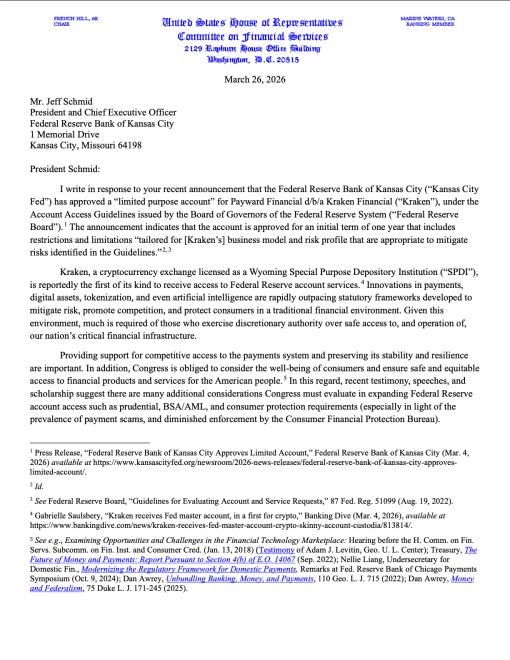
Rep. Waters' letter to Kansas City Fed's President Jeff Schmid. Source: House Financial Services Committee

Notably, Kraken Financial, Kraken’s banking arm, made history as the first crypto company to gain direct access to the Federal Reserve’s core payment system. This achievement was accomplished after Kraken secured approval from the Kansas City Fed for a Fed master account earlier this month.

As reported by Bitcoinist, the master account’s approval will enable Kraken Financial to expedite and streamline transactions for its large clients and professional traders. Additionally, it will grant Kraken’s banking unit direct access to Fedwire, a prominent interbank payment system that processes over $4 trillion in transfers daily.

The milestone represents a significant triumph for the crypto industry, which had been repeatedly denied access to the Federal Reserve system for years. Previously, the company had relied on intermediary banks to facilitate transfers to other firms.

The lawmaker highlighted that granting a cryptocurrency firm access to the Federal Reserve’s payment system for the first time raises policy, regulatory, and consumer protection concerns, arguing that it is particularly concerning given the rapid pace at which financial innovation is outpacing the rules and safeguards designed to ensure the safety of the financial system.

The Kansas City Fed’s announcement does not disclose specific information about Kraken’s access to the range of Federal Reserve financial services “due to the confidentiality of business information provided by applicants.” However, the announcement raises questions about the approval because neither statute nor the Federal Reserve Board’s Account Access Guidelines refer to a ‘limited purpose account’ type.

Crypto Access To Fed’s Payment Rails Faces Opposition

Representative Waters emphasized that access to the nation’s core payments infrastructure carries significant public responsibility and should not be extended without full transparency, clear legal grounding, and confidence that risks will be properly managed.

Therefore, she requested information no later than April 10, 2026, on the Federal Reserve services that Kraken can now access, the conditions or restrictions that apply, and the prudential, anti-money laundering (AML), and consumer protection considerations that were weighed before proceeding with the approval.

The lawmaker’s letter arrives as banking groups express significant concerns about granting crypto and fintech companies direct access to the Federal Reserve’s payment systems. Traditional banks have cautioned that even limited access could pose a substantial threat to the US payment system and overall financial stability.

For context, Kraken’s limited access to the master account is similar to the “skinny” master account concept initially proposed by the Federal Reserve Board of Governors in October 2025.

This type of restricted account would enable payment fintechs and crypto companies to access the Federal Reserve’s payment systems. However, it would exclude other advantages more closely associated with banks, such as the discount window lending facility.

In addition, the Office of the Comptroller of the Currency (OCC) approved conditional bank charters for Ripple, Circle, BitGo, Paxos, and Fidelity in December, raising concerns that it could blur the lines between banking activities and lead to regulatory arbitrage.

Last month, the American Bankers Association (ABA) urged the main banking regulator to postpone its approval of applications for crypto bank charters, suggesting that the agency should wait until the regulatory uncertainties are resolved.
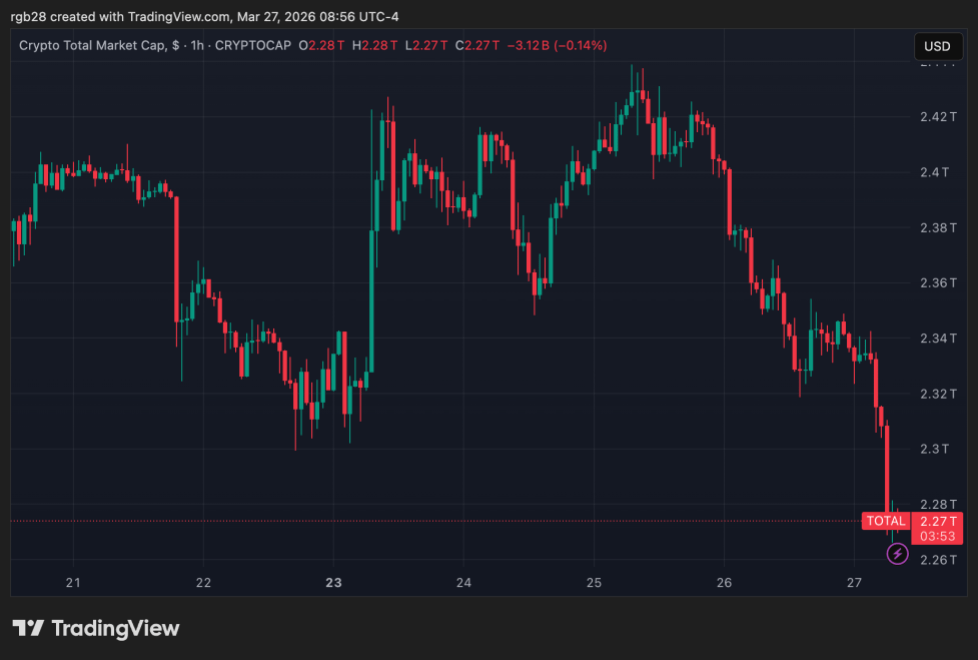
Total crypto market capitalization is at $2.27 trillion in the one-week chart. Source: TOTAL on TradingView


Crypto di tendenza

Domande pertinenti

QWhat is the main concern raised by Representative Maxine Waters regarding the Kansas City Fed's approval of a master account for Kraken?

ARepresentative Maxine Waters expressed concerns about the policy, regulatory, and consumer protection implications of granting a cryptocurrency firm direct access to the Federal Reserve's payment system for the first time, arguing that financial innovation is outpacing existing rules.

QWhat specific type of account did the Federal Reserve Bank of Kansas City approve for Kraken, and why is it notable?

AThe Kansas City Fed approved a 'limited purpose account' for Kraken. It is notable because it marks the first time a crypto company has gained direct access to the Federal Reserve's core payment system, a significant milestone for the industry.

QWhat practical benefits does the master account provide to Kraken Financial?

AThe master account enables Kraken Financial to expedite and streamline transactions for its large clients and professional traders and grants it direct access to Fedwire, a major interbank payment system that processes over $4 trillion daily.

QWhat information did Representative Waters request from the Kansas City Fed, and by when?

ARepresentative Waters requested information on the Federal Reserve services Kraken can access, the conditions or restrictions that apply, and the prudential, AML, and consumer protection considerations weighed before approval. This information was requested by April 10, 2026.

QWhy are traditional banking groups opposed to granting crypto companies access to the Fed's payment systems?

ATraditional banking groups, like the American Bankers Association, are concerned that even limited access for crypto and fintech companies could pose a substantial threat to the U.S. payment system and overall financial stability, potentially leading to regulatory arbitrage.

Letture associate

How Does Codex Use a Computer? Three Entry Points and Permission Boundaries

This article explains the three primary methods for Codex to interact with a computer, each with distinct use cases, permission boundaries, and trust levels. **1. Computer Use:** This offers the broadest access, allowing Codex to visually control and interact with the graphical user interface of authorized macOS/Windows apps, system settings, and even iOS simulators. It's ideal for tasks lacking APIs or structured tools, such as operating legacy software or multi-app workflows. However, it's the slowest method and has the widest permission scope, requiring careful supervision for sensitive actions. **2. Chrome Extension:** This grants Codex access to the user's logged-in Chrome browser state, including cookies, profiles, and open tabs. It's best for tasks requiring user identity across websites like Gmail, LinkedIn, Salesforce, or internal dashboards. Its key advantage is multi-tab control for complex workflows. While more powerful for browser-based tasks than Computer Use, it carries higher sensitivity as actions are performed under the user's identity. **3. In-App Browser:** This is a browser isolated within the Codex thread, separate from the user's personal browsing data. It excels in web development and debugging scenarios—previewing local servers, testing responsive layouts, or annotating designs directly on the page. Its isolation is a strength for development but a limitation for tasks requiring login sessions. The core principle is to choose the narrowest, safest, and most structured interface for the task. Use plugins or MCPs first, resort to visual control (Computer Use) only for GUI-dependent tasks, employ the Chrome extension for identity-reliant browser work, and prefer the In-App Browser for isolated development. **Appshots** are clarified as a fourth, complementary tool for *inputting* context—capturing a screenshot of a window to point Codex to something—rather than a method for Codex to *act*. Together, this layered approach highlights a key to AI agent productization: not granting unlimited permissions, but constraining them within clear boundaries for specific tasks while preserving user oversight.

marsbit38 min fa

How Does Codex Use a Computer? Three Entry Points and Permission Boundaries

marsbit38 min fa

The "Iron Rule" of Chip Equipment Is Being Broken

For years, the semiconductor equipment industry followed an unwritten "iron rule": suppliers offered steep discounts for new tool introductions (Design-in) and faced consistent price pressure during repeat orders, especially during market downturns. This long-standing buyer's market dynamic is now being upended. Recently, SK Hynix's primary equipment suppliers have reportedly requested a 3-4% price *increase*, a nearly unprecedented move. This shift is driven by a severe supply-demand imbalance fueled by the AI compute boom. Securing equipment has become an urgent arms race as chipmakers' expansion speed dictates their ability to fulfill massive AI chip orders. Key areas feeling the strain include: **TCB (Thermal Compression Bonding) Equipment:** Demand is exploding, driven by the simultaneous needs of HBM4 memory stacking, AI chip Chip-on-Substrate (C2S), and logic Chiplet Chip-on-Wafer (C2W) packaging. Players like Hanmi Semiconductor, Hanwha Semitech, and ASMPT are receiving major orders. While hybrid bonding is seen as the future, TCB remains the pragmatic choice for HBM4 mass production, with its lifecycle extended by relaxed specifications and ongoing technological upgrades. **Test Equipment Bottlenecks:** Ironically, AI-driven shortages are now crippling test equipment manufacturing. Critical components like FPGAs, Driver ICs, and CPUs face severe shortages and extended lead times (up to 52 weeks for FPGAs), as AI data center and server vendors prioritize supply. This creates a paradoxical cycle: AI chip shortages drive fab expansion, which requires more test equipment, whose production is delayed because its key parts are diverted to make AI chips. The industry is entering a broad, AI-powered upcycle. SEMI forecasts global semiconductor equipment sales to hit a record $156 billion by 2027, fueled by investment in advanced logic/foundry, HBM-driven DRAM, and advanced packaging (like CoWoS). Major players like TSMC, SK Hynix, and Micron are aggressively ramping capital expenditure. In conclusion, leading equipment vendors are no longer just selling tools; they are selling the critical capability to deliver AI-era capacity. Pricing power is shifting decisively to those with indispensable technology in key process nodes like advanced logic, HBM, and advanced packaging, rewriting the industry's traditional power structure.

marsbit51 min fa

The "Iron Rule" of Chip Equipment Is Being Broken

marsbit51 min fa

Trading

Spot
Futures

Articoli Popolari

Come comprare HOUSE

Benvenuto in HTX.com! Abbiamo reso l'acquisto di Housecoin (HOUSE) semplice e conveniente. Segui la nostra guida passo passo per intraprendere il tuo viaggio nel mondo delle criptovalute.Step 1: Crea il tuo Account HTXUsa la tua email o numero di telefono per registrarti il tuo account gratuito su HTX. Vivi un'esperienza facile e sblocca tutte le funzionalità,Crea il mio accountStep 2: Vai in Acquista crypto e seleziona il tuo metodo di pagamentoCarta di credito/debito: utilizza la tua Visa o Mastercard per acquistare immediatamente HousecoinHOUSE.Bilancio: Usa i fondi dal bilancio del tuo account HTX per fare trading senza problemi.Terze parti: abbiamo aggiunto metodi di pagamento molto utilizzati come Google Pay e Apple Pay per maggiore comodità.P2P: Fai trading direttamente con altri utenti HTX.Over-the-Counter (OTC): Offriamo servizi su misura e tassi di cambio competitivi per i trader.Step 3: Conserva Housecoin (HOUSE)Dopo aver acquistato Housecoin (HOUSE), conserva nel tuo account HTX. In alternativa, puoi inviare tramite trasferimento blockchain o scambiare per altre criptovalute.Step 4: Scambia Housecoin (HOUSE)Scambia facilmente Housecoin (HOUSE) nel mercato spot di HTX. Accedi al tuo account, seleziona la tua coppia di trading, esegui le tue operazioni e monitora in tempo reale. Offriamo un'esperienza user-friendly sia per chi ha appena iniziato che per i trader più esperti.

287 Totale visualizzazioniPubblicato il 2025.04.27Aggiornato il 2026.06.02

Come comprare HOUSE

Discussioni

Benvenuto nella Community HTX. Qui puoi rimanere informato sugli ultimi sviluppi della piattaforma e accedere ad approfondimenti esperti sul mercato. Le opinioni degli utenti sul prezzo di HOUSE HOUSE sono presentate come di seguito.

活动图片