Three Scenarios for BTC's Future Direction and a Duel Between Two Strong Forces | Special Invited Analysis

Odaily星球日报Pubblicato 2026-05-12Pubblicato ultima volta 2026-05-12

Introduzione

**Title: Three Scenarios for BTC's Future Trajectory and a Key Duel | Invited Analysis** The market remains at a critical juncture. Over the past week, Bitcoin (BTC) consolidated broadly between $79,500 and $80,600, validating previous technical analysis. The current focus is on whether this marks the start of a new uptrend or a pause within a larger correction. **BTC Multi-Cycle Analysis & Three Possible Scenarios** BTC's daily chart structure, following its peak at $126,200 in October 2025, presents three primary technical scenarios based on Elliott Wave theory: 1. **Bullish Scenario (End of Correction):** The corrective A-B-C wave from $126,200 ended at the $60,000 low in February 2026. The current price action is the start of a major Wave I uptrend. A subsequent Wave II pullback would not break below $60,000. 2. **Bearish Scenario 1 (Complex Correction):** The correction is unfolding as an A-B-C-D-E pattern. The current move from $60,000 is a D-wave rally. After its completion, a final E-wave decline could potentially breach the $60,000 level. 3. **Bearish Scenario 2 (Larger Correction):** The entire move down from $126,200 to $60,000 was a large A-wave. The current rally is a B-wave correction within a larger A-B-C structure, to be followed by a C-wave decline below $60,000. *Analysis suggests Scenario 2 is less probable due to time disproportions between waves. The battle is effectively between the Bullish Scenario (1) and Bearish Scenario (3).* **Key BTC Levels &...

The market never lies; it simply remains silent.

When prices linger in critical zones, both bulls and bears are waiting for an answer.

Over the past week, Bitcoin completed the wide-range oscillation we previously predicted within the core zone of $79,500 to $80,600. The market's price action has validated the effectiveness of our technical logic. However, validation is merely the starting point; the real game begins this week.

BTC's daily chart correction structure stands at a crossroads with three diverging paths: Is it the starting point of a new rising wave, or a midpoint in a larger-scale correction? Wave analysis can provide a framework, but the market ultimately votes with its price. Regarding HYPE, its seven-wave structure is clearly discernible. Whether it can break through the key level around $45.76 will become the variable most worth watching closely this week.

In this week's article, we will continue to approach from a multi-timeframe perspective, analyzing the structure, judging the direction, and formulating plans. Strategy is ready; discipline is self-held.

Summary of Core Trading Views for This Week:

• Analysis of BTC's Multi-Timeframe Price Structure (Detailed in Part One)
• BTC Market Forecast and Mid-/Short-Term Trading Strategies for This Week. (Detailed in Part Two)
• Analysis of HYPE's Daily Chart Price Structure. (Detailed in Part Three)
• HYPE Market Forecast and Short-Term Trading Strategies for This Week. (Detailed in Part Four)

Market Validation of Last Week's Trading Strategy and Core Views:

• Validation of BTC Market Forecast: In last week's article, we pointed out that we should focus on observing the battle between bulls and bears over the core zone of $79,500 to $80,600 and judged that the market was likely to experience wide-range oscillation there. Current market movements have largely validated our previous view.

One: Analysis of Bitcoin's Multi-Timeframe Price Structure

1. Analysis of BTC's Daily Chart Price Structure: (Three Scenarios for BTC's Subsequent Wave Structure)

Bitcoin _ Daily Candlestick Chart:
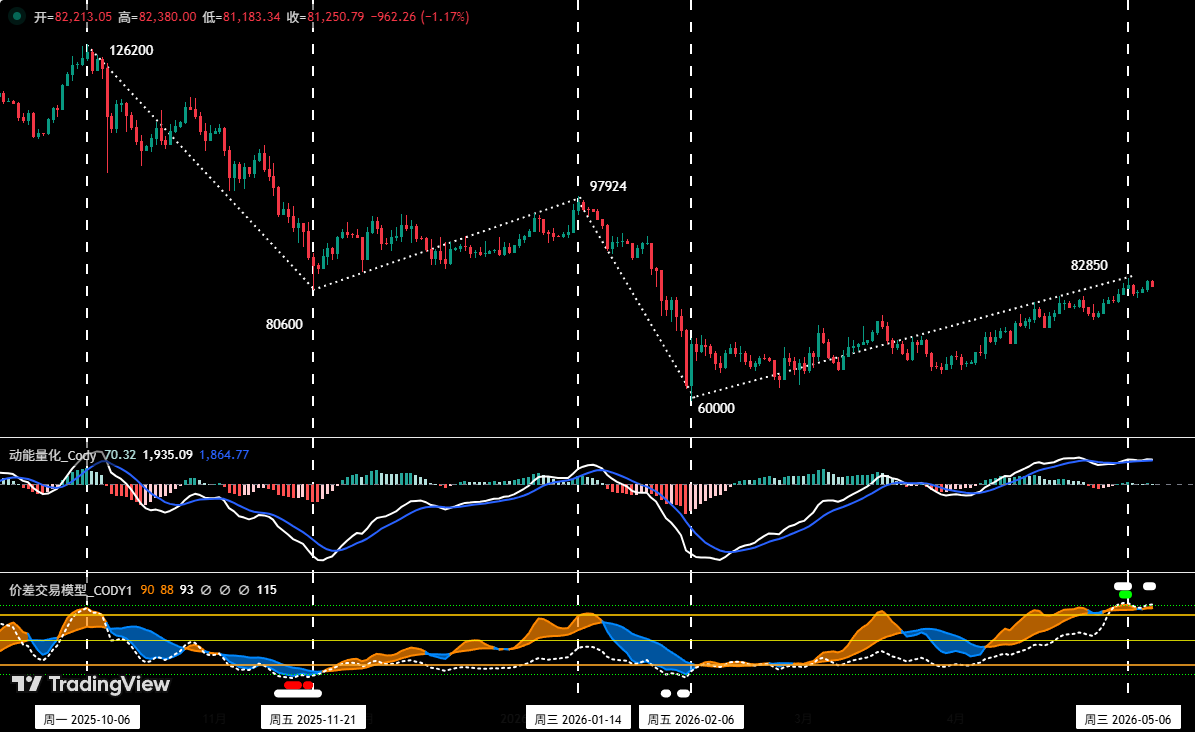
Chart One

As shown in (Chart One), since reaching the high of $126,200 in October 2025, Bitcoin has entered an adjustment cycle lasting about 7 months (216 days). There is significant divergence in the market regarding the subsequent direction. The bearish view argues that the downtrend is not over yet; after the recent rebound concludes, the price will still correct and break below the $60,000 low. The bullish view believes that the adjustment starting from $126,200 ended at $60,000, marking a reversal of the correction trend. The rebound since February is the start of a new upward trend. Next, we will analyze this daily chart correction structure based on Elliott Wave Theory rules and propose three technical scenarios for the subsequent movement for your reference.

1. Scenario One: Adjustment Concluded, New Rising Wave Initiated (Bullish View)

This view holds: The daily-level adjustment starting from the previous high of $126,200 is an A-B-C three-wave structure, with Wave C ending at $60,000. Currently, Major Wave I (the initial rising wave) is underway.

Wave A (Decline): $126,200 (2025-10-06) to $80,600 (2025-11-21), lasting 46 days, maximum decline ~36%.
Wave B (Rebound): $80,600 (2025-11-21) to $97,924 (2026-01-14), lasting 54 days, maximum increase ~21.5%.
Wave C (Decline): $97,924 (2026-01-14) to $60,000 (2026-02-06), lasting 23 days, maximum decline ~38.7%.
• Major Wave I (Initial Rising Wave): $60,000 (2026-02-06) to present, has run for 94 days, maximum increase ~38.1% so far, still ongoing.
• Potential Major Wave II (Correction Wave): The adjustment wave to run after Major Wave I ends. Its low point will not break below $60,000.

2. Scenario Two: Complex Five-Wave Adjustment Structure, Currently in Wave D Rebound (Bearish View One)

This view holds: The daily-level adjustment starting from the previous high of $126,200 may complete as an A-B-C-D-E five-wave structure. Currently, Wave D rebound is underway.

Wave A (Decline): $126,200 (2025-10-06) to $80,600 (2025-11-21), lasting 46 days, maximum decline ~36%.
Wave B (Rebound): $80,600 (2025-11-21) to $97,924 (2026-01-14), lasting 54 days, maximum increase ~21.5%.
Wave C (Decline): $97,924 (2026-01-14) to $60,000 (2026-02-06), lasting 23 days, maximum decline ~38.7%.
• Wave D (Rebound Wave): $60,000 (2026-02-06) to present, has run for 94 days, maximum increase ~38.1% so far, still ongoing.
• Potential Wave E (Decline Wave): The correction wave to run after Wave D rebound ends. Its low point may break below $60,000.

3. Scenario Three: Larger-Level Adjustment Structure (e.g., Weekly), Currently in Wave B Rebound (Bearish View Two)

This view holds: The daily-level adjustment starting from the previous high of $126,200 may be part of a larger-level A-B-C three-wave adjustment structure. Currently, Wave B rebound is underway.

Wave A (Decline): $126,200 (2025-10-06) to $60,000 (2026-02-06), lasting 112 days, maximum decline ~52.5%.
• Wave B (Rebound Wave): $60,000 (2026-02-06) to present, lasting 94 days, maximum increase ~38.1% so far, still ongoing.
• Potential Wave C (Decline Wave): The correction wave to run after Wave B rebound ends. Its low point may break below $60,000.

4. Summary:

• From the perspective of Elliott Wave time rules and pattern harmony, in Scenario Two, Waves B and D are rebound waves of the same degree. However, the current Wave D rebound cycle (94 days) has significantly exceeded the Wave B rebound cycle (54 days). Therefore, due to the excessive extension of Wave D in the time dimension, it disrupts the balance of the wave structure, thereby significantly reducing the probability of this scenario occurring.
• Based on the above analysis, if Scenario Two is excluded, the probability of the market choosing Scenario One (bullish) and Scenario Three (bearish) increases accordingly. As for which of the two has a higher probability, it involves a comprehensive judgment of multiple dimensions, which we will delve into in the next weekly review.

2. In-depth Analysis of BTC's Hourly Chart Structure: (Using the 4-hour chart as the analysis timeframe)

Bitcoin _ 4-hour Candlestick Chart
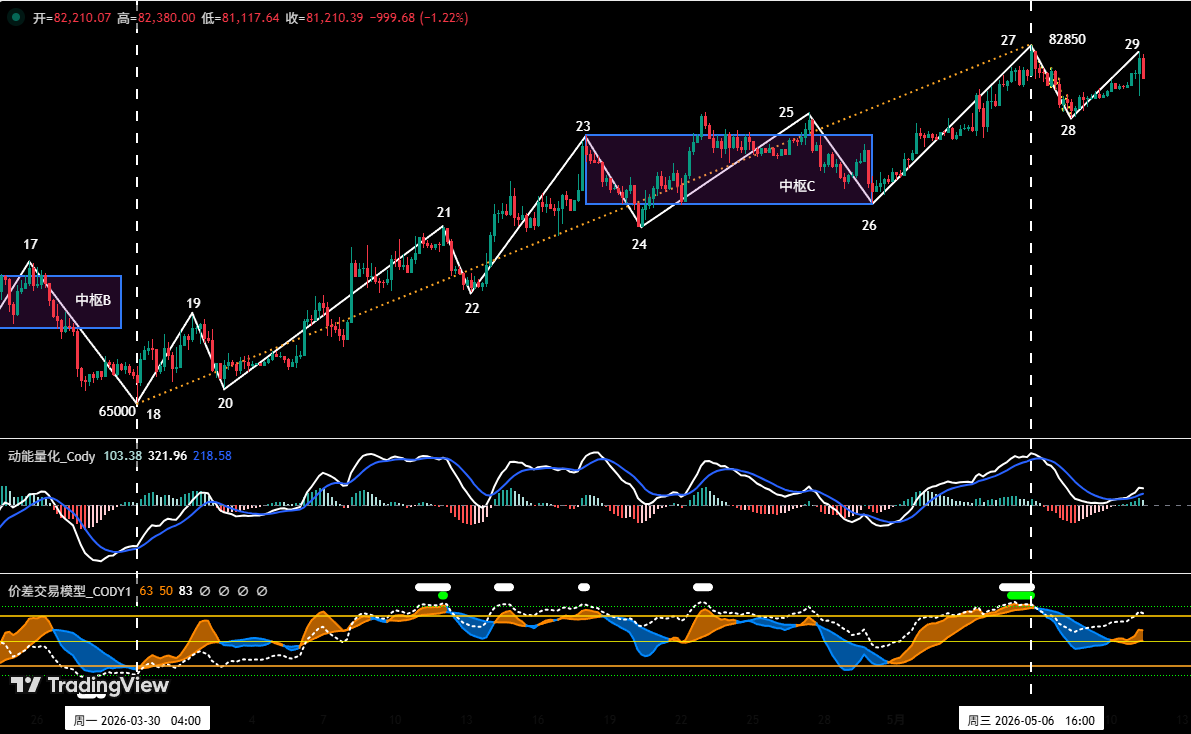
Chart Two

As shown in (Chart Two), the price is currently above central pivot C and is developing segment 28-29.

• If the price effectively holds support above the upper boundary of central pivot C (around $78,500), the high-range wide oscillation pattern will be maintained.
• If the price effectively breaks below the lower boundary of central pivot C (around $75,000), a daily-level correction may initiate.

Two: Bitcoin's Market Forecast and Trading Strategies for This Week

1. BTC Market Forecast for This Week:

Core view this week: The key to this week's movement lies in observing the battle between bulls and bears over the upper and lower boundaries of central pivot C. The gain or loss of this area can serve as an important basis for judging whether the price can continue its rebound or turn downward for adjustment.

2. Core Resistance Levels:

• First Resistance Zone: $83,500~$84,500 region (previous area of concentrated bulls/bears transactions)
• Second Resistance Zone: $89,000~$90,500 region (previous consolidation platform)

3. Core Support Levels:

• First Support Level: $78,500~$79,500 region (near the upper boundary of the central pivot)
• Second Support Level: $73,500~$75,000 region (previous important support level)
• Third Support Level: $69,500~$70,500 region (previous important support level)

4. Trading Strategies for This Week (Excluding Impact of Sudden News)

1. Mid-term Strategy:

Bitcoin _ Daily Candlestick Chart: (Position Monitoring Model)
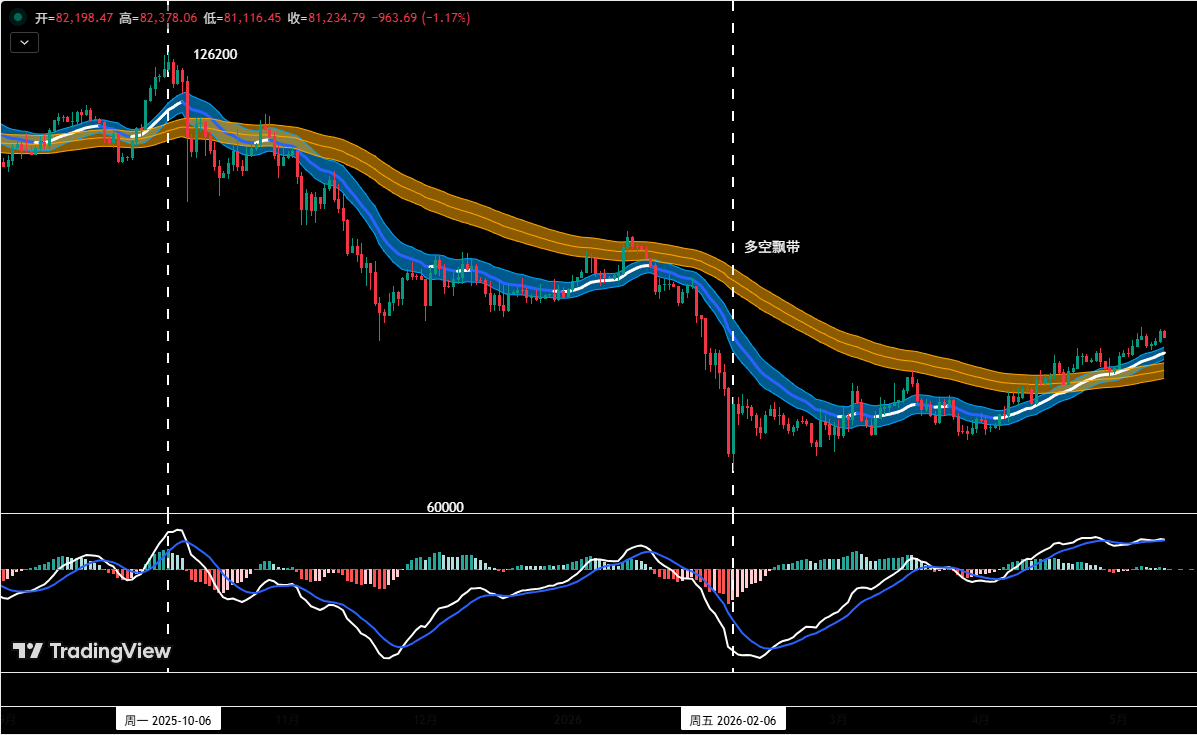
Chart Three

Position Monitoring Model: As shown in (Chart Three), based on trading rules, the market's mid-term direction is not yet clear. This week, the mid-term strategy is to maintain a cash position and wait patiently, avoiding chasing rallies or selling off in panic, until the direction becomes clear before entering positions.

2. Short-term Strategy: Use 30% of capital, set stop-loss points, and look for "price difference" opportunities based on support and resistance levels. (Use 30-minute/60-minute charts as the operation timeframe).

3. In short-term operations, to dynamically respond to the market's complex evolution, we have prepared two specific operation plans in advance, A/B.

Plan A: Effective Holding Above, Go Long on Dips.

• Entry: When the price effectively holds above the $78,500~$79,500 region and combines with bottom signals from the quantitative model, a long position below 20% can be established.
• Risk Control: Initial stop-loss set below $78,500.
• Exit: When rebounding near important resistance levels and combined with model signals, gradually close positions to take profits.

Plan B: Effective Break Below Support, Go Short on Rallies.

• Entry: When the price effectively breaks below the $73,500~$75,000 support region and combines with top signals from the model, a short position below 30% can be established.
• Risk Control: Initial stop-loss set above $76,500.
• Exit: When declining to important support levels and combined with model signals, gradually close positions to take profits.

Three: Analysis of HYPE's Daily Chart Price Structure:

HYPE_ Daily Candlestick Chart
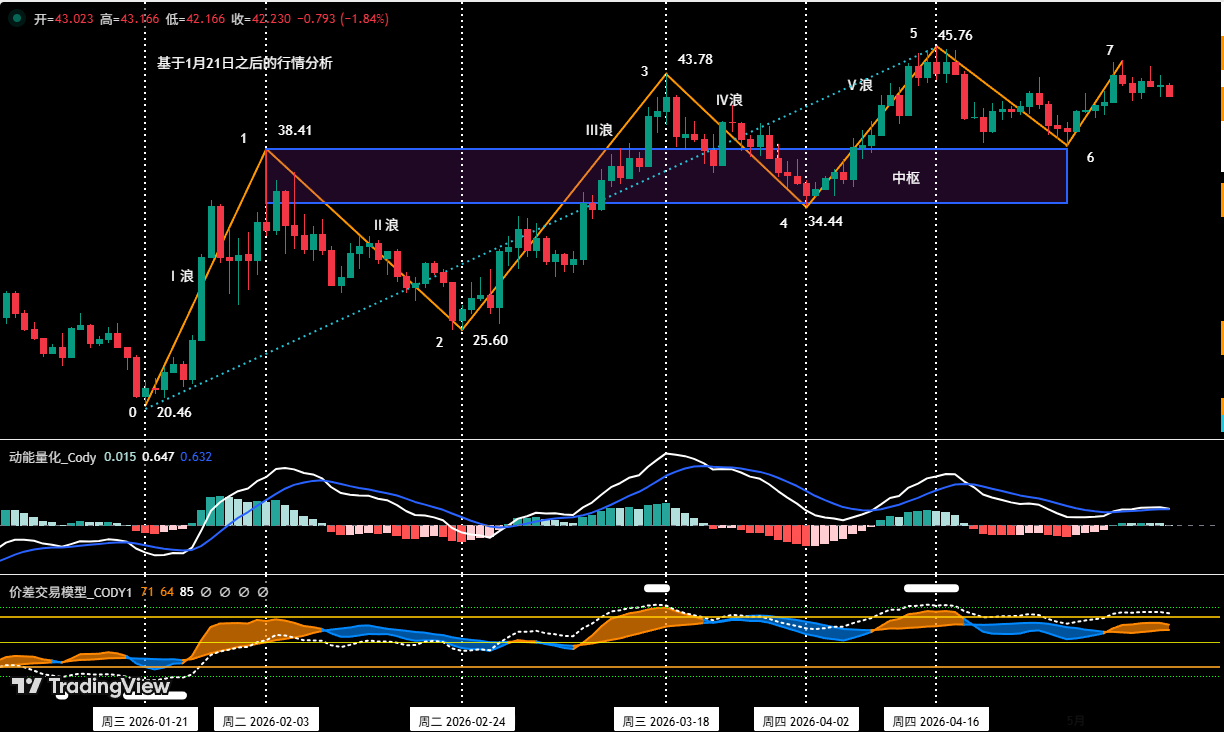
Chart Four

1. As shown in (Chart Four), the uptrend of HYPE starting from the low of $20.46 on January 21 can be divided into a seven-segment structure in the daily chart: 0-1, 1-2, 2-3, 3-4, 4-5, 5-6, 6-7. In the first five segments, prices continuously made new highs, forming a volatile rising structure. In the last two segments, because endpoint 7 ($44.79) is lower than endpoint 5 ($45.76), it is currently viewed as a correction structure.

2. (Chart Four) shows that because the price movements of segments 1-2, 2-3, and 3-4 overlap with each other, they together form an "uptrend central pivot."

Four: HYPE's Market Forecast and Short-Term Trading Strategies for This Week

1. HYPE Market Forecast for This Week:

Core view on HYPE this week:

• Focus on observing whether the price can break through the previous high of $45.76 in subsequent movements. A breakout would indicate the current movement is still within the daily-level uptrend structure.
• Pay attention to the battle between bulls and bears near the upper and lower boundaries of the central pivot.

2. HYPE Short-Term Trading Strategies for This Week:

• This week's short-term operations will be formulated based on the gain or loss of the two key price levels: the upper boundary of the central pivot ($38.41) and the lower boundary of the central pivot ($34.44).
• Long Strategy: If the price retraces to near $38.41, finds support, shows signs of stabilization, and combines with bottom signals triggered by the two major models, consider a light long position. Position size must be controlled below 30%, and stop-loss discipline must be strictly observed.
• Short Strategy: If the price effectively breaks below the support near $34.44 and combines with top signals triggered by the two major models, consider a light short position. Position size must be controlled below 30%, and stop-loss discipline must be strictly observed.

Five: Special Reminders:

1. When opening a position: Immediately set the initial stop-loss level.
2. When profit reaches 1%: Move the stop-loss to the entry cost price (breakeven point) to ensure capital safety.
3. When profit reaches 2%: Move the stop-loss to the level representing a 1% profit.
4. Continuous tracking: Thereafter, for every additional 1% profit in price, move the stop-loss up 1% accordingly, dynamically protecting and locking in profits.

Financial markets change rapidly. All market analysis and trading strategies require dynamic adjustment. All views, analysis models, and operation strategies mentioned in this article originate from personal technical analysis and are solely for personal trading log purposes. They do not constitute any investment advice or basis for operation. Markets involve risks; investing requires caution. Please do not make decisions based solely on this content.


Domande pertinenti

QAccording to the article, what are the three technical wave-based scenarios for BTC's future trend after its correction cycle?

AThe three wave-based scenarios for BTC's future trend are: 1) Adjustment complete, new uptrend initiated (Bullish view - A-B-C correction finished, now in major Wave I up). 2) Complex five-wave correction structure, currently in Wave D rebound (Bearish view one - A-B-C-D-E structure, in Wave D). 3) Larger-degree (e.g., weekly) correction structure, currently in Wave B rebound (Bearish view two - larger A-B-C structure, in Wave B).

QWhy does the article consider the probability of the second scenario (five-wave correction) to be low?

AThe probability of the second scenario (five-wave correction) is considered low because in this scenario, Wave B and Wave D are supposed to be corrective waves of the same degree. However, the current Wave D rebound has lasted 94 days, which significantly exceeds the 54-day duration of the prior Wave B rebound. This excessive extension in the time dimension disrupts the equilibrium of the wave structure, thus greatly reducing its likelihood.

QWhat is the key price zone for judging whether BTC can continue its rebound or start a downward adjustment this week?

AThe key price zone for judging BTC's direction this week is the area defined by the upper and lower rails of 'Central C' on the 4-hour chart. Specifically, observing whether the price effectively holds above the upper rail (around $78,500-$79,500) or breaks below the lower rail (around $75,000) is crucial. Holding above suggests maintaining a wide-range oscillation, while breaking below may initiate a daily-level adjustment.

QWhat is the critical price level for HYPE this week, and what does its breakthrough signify?

AThe critical price level for HYPE this week is the previous high of $45.76. The article states that whether the price can break through this level in subsequent movements is a key focus. A successful breakthrough would indicate that the current price action is still within the daily-level upward structure.

QWhat are the two specific short-term operation plans (A and B) provided for BTC, and what are their respective triggers?

AThe two short-term operation plans for BTC are: Plan A (Effective Holding, Go Long on Dips): Triggered when the price effectively holds above the $78,500-$79,500 area, combined with a bottom signal from the quantitative model. A long position of less than 20% can be established. Plan B (Effective Break of Support, Go Short on Rebound): Triggered when the price effectively breaks below the $73,500-$75,000 support area, combined with a top signal from the model. A short position of less than 30% can be established.

Letture associate

Breaking: OpenAI Undergoes Major Reorganization, President Brockman Assumes Command

OpenAI has announced a major internal reorganization just months before its anticipated IPO. The company is merging its three flagship product lines—ChatGPT, Codex, and the API platform—into a single, unified product organization. The most significant leadership change involves co-founder and President Greg Brockman moving from a background technical role to take full, permanent control over all product strategy. This follows the indefinite medical leave of AGI Deployment CEO Fidji Simo. Additionally, ChatGPT's longtime lead, Nick Turley, has been reassigned to enterprise products, with former Instagram executive Ashley Alexander taking over consumer offerings. The consolidation, internally framed as a strategic move towards an "Agentic Future," aims to break down internal silos and create a cohesive "Super App." This planned desktop application would integrate ChatGPT's conversational abilities, Codex's coding power, and a rumored internal web browser named "Atlas" to autonomously perform complex user tasks. The reorganization occurs amid significant internal and external pressures. OpenAI has recently seen a wave of high-profile departures, including Sora co-lead Bill Peebles and other senior technical leaders, leading to concerns about a thinning executive bench. Externally, rival Anthropic recently secured funding at a staggering $900 billion valuation, surpassing OpenAI's own. Google's upcoming I/O developer conference also poses a competitive threat. Analysts suggest the dramatic restructure is a pre-IPO move to present a clearer, more focused narrative to Wall Street—streamlining operations and demonstrating decisive leadership under Brockman to counter internal turbulence and intense market competition.

marsbit1 h fa

Breaking: OpenAI Undergoes Major Reorganization, President Brockman Assumes Command

marsbit1 h fa

Two Survival Structures of Market Makers and Arbitrageurs

Market makers and arbitrageurs represent two distinct survival structures in high-frequency trading. Market makers primarily use limit orders (makers) to profit from the bid-ask spread, enjoying high capital efficiency (nominally 100%) but bearing inventory risk. This "inventory risk" arises from passive, fragmented, and discontinuous order fills in the limit order book (LOB). This risk, while a potential cost, can also contribute to excess profit if managed within control boundaries, allowing for mean reversion. Market makers essentially sell "time" (uncertainty over execution timing) to the market for price control and low fees. In contrast, cross-exchange arbitrageurs typically use market orders (takers) to exploit price differences or funding rates, resulting in lower nominal capital efficiency (requiring capital on both exchanges) and higher transaction costs. Their risk exposure stems from asymmetries in exchange rules (e.g., minimum order sizes), execution latency, and infrastructure risks (e.g., ADL, oracle drift). These exposures are active, exogenous gaps that primarily erode profits rather than contribute to them. Arbitrageurs essentially sell "space" (capital sunk across venues) for localized, immediate certainty. Both strategies engage in a trade-off between execution friction and residual risk. Optimal systems allow for temporary, controlled risk exposure rather than enforcing zero exposure at all costs. Their evolution converges towards hybrid models: arbitrageurs may use maker orders to reduce costs, while market makers may use taker orders or hedges for risk management. Ultimately, both use different forms of risk exposure—market makers exposing inventory, arbitrageurs immobilizing capital—to extract marginal, hard-won certainty from the market.

链捕手1 h fa

Two Survival Structures of Market Makers and Arbitrageurs

链捕手1 h fa

Who Will Define the Rules of the AI Era? Anthropic Discusses the 2028 US-China AI Landscape

This article, based on Anthropic's analysis, outlines the intensifying systemic competition between the U.S./allies and China for AI leadership by 2028. It argues that access to advanced computing power ("compute") is the critical bottleneck, where the U.S. currently holds a significant advantage through chip export controls and allied innovation. However, China's AI labs remain competitive by exploiting policy loopholes—via chip smuggling, overseas data center access, and "model distillation" attacks to copy U.S. model capabilities—keeping them close to the frontier. The piece presents two contrasting scenarios for 2028. In the first, decisive U.S. action to tighten compute controls and curb distillation locks in a 12-24 month AI capability lead, cementing democratic influence over global AI norms, security, and economic infrastructure. In the second, policy inaction allows China to achieve near-parity through continued access to U.S. technology, enabling Beijing to promote its AI stack globally and integrate advanced AI into its military and governance systems, altering the strategic balance. Anthropic contends that maintaining a decisive U.S. lead is essential for shaping safe AI development and governance. The core recommendation is for U.S. policymakers to urgently close compute and model access loopholes while promoting global adoption of the U.S. AI technology stack to secure a lasting strategic advantage.

marsbit3 h fa

Who Will Define the Rules of the AI Era? Anthropic Discusses the 2028 US-China AI Landscape

marsbit3 h fa

Trading

Spot
Futures

Articoli Popolari

Cosa è BITCOIN

Comprendere HarryPotterObamaSonic10Inu (ERC-20) e la sua posizione nel mondo delle criptovalute Negli ultimi anni, il mercato delle criptovalute ha assistito a un aumento della popolarità delle meme coin, catturando l'interesse non solo dei trader, ma anche di coloro che cercano coinvolgimento comunitario e valore di intrattenimento. Tra questi token unici c'è HarryPotterObamaSonic10Inu (ERC-20), un progetto intrigante che mescola riferimenti culturali nel tessuto delle criptovalute. Questo articolo esplora gli aspetti chiave di HarryPotterObamaSonic10Inu, analizzando i suoi meccanismi, l'etica guidata dalla comunità e il suo coinvolgimento con il panorama crittografico più ampio. Che cos'è HarryPotterObamaSonic10Inu (ERC-20)? Come suggerisce il suo nome, HarryPotterObamaSonic10Inu è una meme coin costruita sulla blockchain di Ethereum, classificata secondo lo standard ERC-20. A differenza delle criptovalute tradizionali che possono enfatizzare l'utilità pratica o il potenziale investimento, questo token prospera grazie al valore di intrattenimento e alla forza della sua comunità. Il progetto mira a creare un ambiente in cui gli utenti coinvolti possono riunirsi, condividere idee e partecipare ad attività ispirate a diversi fenomeni culturali. Una caratteristica notevole di HarryPotterObamaSonic10Inu è la zero tassa sulle transazioni. Questo elemento allettante tende a incoraggiare il trading e il coinvolgimento della comunità, privo di costi aggiuntivi che possono scoraggiare i trader di piccole dimensioni. L'offerta totale della moneta è fissata a un miliardo di token, un numero che segna la sua intenzione di mantenere una circolazione sostanziale all'interno della comunità. Creatore di HarryPotterObamaSonic10Inu (ERC-20) Le origini di HarryPotterObamaSonic10Inu sono avvolte in un certo mistero; i dettagli sul creatore rimangono sconosciuti. Lo sviluppo di questo token non presenta un team identificabile o un piano esplicito, cosa non rara nel settore delle meme coin. Invece, il progetto è emerso organicamente, con il suo progresso fortemente dipendente dall'entusiasmo e dalla partecipazione della sua comunità. Investitori di HarryPotterObamaSonic10Inu (ERC-20) Per quanto riguarda investimenti esterni e finanziamenti, HarryPotterObamaSonic10Inu rimane ambiguo. Il token non elenca alcuna fondazione di investimento conosciuta o un sostegno organizzativo significativo. Invece, la linfa vitale del progetto è la sua comunità di base, che informa la sua crescita e sostenibilità attraverso azioni collettive e coinvolgimento nello spazio crittografico. Come funziona HarryPotterObamaSonic10Inu (ERC-20)? In quanto meme coin, HarryPotterObamaSonic10Inu opera principalmente al di fuori delle strutture tradizionali che governano spesso il valore degli asset. Ci sono diversi aspetti distintivi che definiscono il funzionamento del progetto: Transazioni senza tasse: Senza costi fiscali sulle transazioni, gli utenti possono comprare e vendere liberamente il token senza preoccuparsi di costi nascosti. Coinvolgimento della comunità: Il progetto prospera sull'interazione della comunità, sfruttando le piattaforme social per creare entusiasmo e facilitare il coinvolgimento. Discussioni, condivisione di contenuti e coinvolgimento sono elementi cruciali che aiutano ad espandere la sua portata e a favorire la lealtà tra i sostenitori. Nessuna utilità pratica: Va notato che HarryPotterObamaSonic10Inu non offre un'utilità concreta all'interno dell'ecosistema finanziario. Piuttosto, è classificato come un token principalmente per attività di intrattenimento e comunitarie. Riferimento culturale: Il token incorpora astutamente elementi della cultura pop per attirare interesse, collegandosi a appassionati di meme e seguaci delle criptovalute. HarryPotterObamaSonic10Inu esemplifica come le meme coin operino in modo diverso rispetto ai progetti di criptovalute più tradizionali, entrando nel mercato come costrutti sociali innovativi piuttosto che come asset utilitari. Cronologia di HarryPotterObamaSonic10Inu (ERC-20) La storia di HarryPotterObamaSonic10Inu è segnata da diversi traguardi notevoli: Creazione: Il token è emerso da un meme virale, catturando l'immaginazione di molti appassionati di criptovalute. Le date di creazione specifiche non sono disponibili, sottolineando la sua crescita organica. Inserimento negli scambi: HarryPotterObamaSonic10Inu ha fatto il suo ingresso in vari scambi, consentendo un accesso e un trading più facili da parte della comunità. Iniziative di coinvolgimento della comunità: Attività in corso volte a migliorare l'interazione della comunità, comprese gare, campagne sui social media e generazione di contenuti da parte di fan e sostenitori. Piani di espansione futura: La tabella di marcia del progetto include il lancio di una collezione NFT, merchandising e un sito di eCommerce relativo ai suoi temi culturali, coinvolgendo ulteriormente la comunità e cercando di aggiungere più dimensioni al suo ecosistema. Punti chiave su HarryPotterObamaSonic10Inu (ERC-20) Natura guidata dalla comunità: Il progetto dà priorità al contributo collettivo e alla creatività, garantendo che il coinvolgimento degli utenti sia al centro del suo sviluppo. Classificazione come meme coin: Rappresenta l'epitome delle criptovalute basate sull'intrattenimento, distinguendosi dai veicoli d'investimento tradizionali. Nessuna affiliazione diretta con Bitcoin: Nonostante la somiglianza nel nome del ticker, HarryPotterObamaSonic10Inu è distintivo e non ha alcuna relazione con Bitcoin o altre criptovalute consolidate. Focus sulla collaborazione: HarryPotterObamaSonic10Inu è progettato per creare uno spazio per la collaborazione e la condivisione di storie tra i suoi detentori, fornendo un canale per la creatività e il legame comunitario. Prospettive future: L'ambizione di espandersi oltre il suo presupposto iniziale verso NFT e merchandising delinea un percorso per il progetto per potenzialmente entrare in strade più mainstream all'interno della cultura digitale. Poiché le meme coin continuano a catturare l'immaginazione della comunità crittografica, HarryPotterObamaSonic10Inu (ERC-20) si distingue per i suoi legami culturali e il suo approccio centrato sulla comunità. Anche se potrebbe non adattarsi al modello tipico di un token orientato all'utilità, la sua essenza risiede nella gioia e nella camaraderia coltivate tra i suoi sostenitori, evidenziando la natura in evoluzione delle criptovalute in un'epoca sempre più digitale. Con la continuazione dello sviluppo del progetto, sarà importante osservare come le dinamiche della comunità influenzano la sua traiettoria nel panorama in continuo cambiamento della tecnologia blockchain.

1.5k Totale visualizzazioniPubblicato il 2024.04.01Aggiornato il 2024.12.03

Cosa è BITCOIN

Come comprare BTC

Benvenuto in HTX.com! Abbiamo reso l'acquisto di Bitcoin (BTC) semplice e conveniente. Segui la nostra guida passo passo per intraprendere il tuo viaggio nel mondo delle criptovalute.Step 1: Crea il tuo Account HTXUsa la tua email o numero di telefono per registrarti il tuo account gratuito su HTX. Vivi un'esperienza facile e sblocca tutte le funzionalità,Crea il mio accountStep 2: Vai in Acquista crypto e seleziona il tuo metodo di pagamentoCarta di credito/debito: utilizza la tua Visa o Mastercard per acquistare immediatamente BitcoinBTC.Bilancio: Usa i fondi dal bilancio del tuo account HTX per fare trading senza problemi.Terze parti: abbiamo aggiunto metodi di pagamento molto utilizzati come Google Pay e Apple Pay per maggiore comodità.P2P: Fai trading direttamente con altri utenti HTX.Over-the-Counter (OTC): Offriamo servizi su misura e tassi di cambio competitivi per i trader.Step 3: Conserva Bitcoin (BTC)Dopo aver acquistato Bitcoin (BTC), conserva nel tuo account HTX. In alternativa, puoi inviare tramite trasferimento blockchain o scambiare per altre criptovalute.Step 4: Scambia Bitcoin (BTC)Scambia facilmente Bitcoin (BTC) nel mercato spot di HTX. Accedi al tuo account, seleziona la tua coppia di trading, esegui le tue operazioni e monitora in tempo reale. Offriamo un'esperienza user-friendly sia per chi ha appena iniziato che per i trader più esperti.

3.8k Totale visualizzazioniPubblicato il 2024.12.12Aggiornato il 2025.03.21

Come comprare BTC

Cosa è $BITCOIN

ORO DIGITALE ($BITCOIN): Un'Analisi Completa Introduzione all'ORO DIGITALE ($BITCOIN) L'ORO DIGITALE ($BITCOIN) è un progetto basato su blockchain che opera sulla rete Solana, con l'obiettivo di combinare le caratteristiche dei metalli preziosi tradizionali con l'innovazione delle tecnologie decentralizzate. Sebbene condivida un nome con Bitcoin, spesso definito “oro digitale” a causa della sua percezione come riserva di valore, l'ORO DIGITALE è un token separato progettato per creare un ecosistema unico all'interno del panorama Web3. Il suo obiettivo è posizionarsi come un asset digitale alternativo valido, anche se i dettagli riguardanti le sue applicazioni e funzionalità sono ancora in fase di sviluppo. Cos'è l'ORO DIGITALE ($BITCOIN)? L'ORO DIGITALE ($BITCOIN) è un token di criptovaluta esplicitamente progettato per l'uso sulla blockchain di Solana. A differenza di Bitcoin, che fornisce un ruolo di stoccaggio di valore ampiamente riconosciuto, questo token sembra concentrarsi su applicazioni e caratteristiche più ampie. Aspetti notevoli includono: Infrastruttura Blockchain: Il token è costruito sulla blockchain di Solana, nota per la sua capacità di gestire transazioni ad alta velocità e a basso costo. Dinamiche di Offerta: L'ORO DIGITALE ha un'offerta massima fissata a 100 quadrilioni di token (100P $BITCOIN), sebbene i dettagli riguardanti la sua offerta circolante siano attualmente non divulgati. Utilità: Sebbene le funzionalità precise non siano esplicitamente delineate, ci sono indicazioni che il token potrebbe essere utilizzato per varie applicazioni, potenzialmente coinvolgendo applicazioni decentralizzate (dApp) o strategie di tokenizzazione degli asset. Chi è il Creatore dell'ORO DIGITALE ($BITCOIN)? Attualmente, l'identità dei creatori e del team di sviluppo dietro l'ORO DIGITALE ($BITCOIN) rimane sconosciuta. Questa situazione è tipica tra molti progetti innovativi nel settore blockchain, in particolare quelli allineati con la finanza decentralizzata e i fenomeni delle meme coin. Sebbene tale anonimato possa favorire una cultura guidata dalla comunità, intensifica le preoccupazioni riguardo alla governance e alla responsabilità. Chi sono gli Investitori dell'ORO DIGITALE ($BITCOIN)? Le informazioni disponibili indicano che l'ORO DIGITALE ($BITCOIN) non ha alcun sostenitore istituzionale noto o investimenti di venture capital prominenti. Il progetto sembra operare su un modello peer-to-peer incentrato sul supporto e sull'adozione della comunità piuttosto che su percorsi di finanziamento tradizionali. La sua attività e liquidità si trovano principalmente su exchange decentralizzati (DEX), come PumpSwap, piuttosto che su piattaforme di trading centralizzate consolidate, evidenziando ulteriormente il suo approccio di base. Come Funziona l'ORO DIGITALE ($BITCOIN) Le meccaniche operative dell'ORO DIGITALE ($BITCOIN) possono essere elaborate in base al suo design blockchain e alle caratteristiche della rete: Meccanismo di Consenso: Sfruttando il proof-of-history (PoH) unico di Solana combinato con un modello di proof-of-stake (PoS), il progetto garantisce una validazione efficiente delle transazioni contribuendo all'alta performance della rete. Tokenomics: Sebbene meccanismi deflazionistici specifici non siano stati dettagliati ampiamente, l'ampia offerta massima di token implica che potrebbe soddisfare microtransazioni o casi d'uso di nicchia che devono ancora essere definiti. Interoperabilità: Esiste il potenziale per l'integrazione con l'ecosistema più ampio di Solana, inclusi vari piattaforme di finanza decentralizzata (DeFi). Tuttavia, i dettagli riguardanti integrazioni specifiche rimangono non specificati. Cronologia degli Eventi Chiave Ecco una cronologia che evidenzia traguardi significativi riguardanti l'ORO DIGITALE ($BITCOIN): 2023: Il dispiegamento iniziale del token avviene sulla blockchain di Solana, contrassegnato dal suo indirizzo di contratto. 2024: L'ORO DIGITALE guadagna visibilità poiché diventa disponibile per il trading su exchange decentralizzati come PumpSwap, consentendo agli utenti di scambiarlo contro SOL. 2025: Il progetto assiste a un'attività di trading sporadica e a un potenziale interesse per impegni guidati dalla comunità, sebbene non siano state documentate partnership significative o avanzamenti tecnici fino ad ora. Analisi Critica Punti di Forza Scalabilità: L'infrastruttura sottostante di Solana supporta alti volumi di transazioni, il che potrebbe migliorare l'utilità di $BITCOIN in vari scenari di transazione. Accessibilità: Il potenziale basso prezzo di trading per token potrebbe attrarre investitori al dettaglio, facilitando una partecipazione più ampia grazie a opportunità di proprietà frazionata. Rischi Mancanza di Trasparenza: L'assenza di sostenitori, sviluppatori o di un processo di audit pubblicamente noti potrebbe generare scetticismo riguardo alla sostenibilità e all'affidabilità del progetto. Volatilità del Mercato: L'attività di trading è fortemente dipendente dal comportamento speculativo, il che può comportare una significativa volatilità dei prezzi e incertezze per gli investitori. Conclusione L'ORO DIGITALE ($BITCOIN) emerge come un progetto intrigante ma ambiguo all'interno dell'evolvente ecosistema di Solana. Sebbene tenti di sfruttare la narrativa dell'“oro digitale”, la sua partenza dal ruolo consolidato di Bitcoin come riserva di valore sottolinea la necessità di una chiara differenziazione della sua utilità e struttura di governance. L'accettazione e l'adozione future dipenderanno probabilmente dall'affrontare l'attuale opacità e dalla definizione più esplicita delle sue strategie operative ed economiche. Nota: Questo rapporto comprende informazioni sintetizzate disponibili a ottobre 2023, e potrebbero essersi verificati sviluppi oltre il periodo di ricerca.

99 Totale visualizzazioniPubblicato il 2025.05.13Aggiornato il 2025.05.13

Cosa è $BITCOIN

Discussioni

Benvenuto nella Community HTX. Qui puoi rimanere informato sugli ultimi sviluppi della piattaforma e accedere ad approfondimenti esperti sul mercato. Le opinioni degli utenti sul prezzo di BTC BTC sono presentate come di seguito.

活动图片













