A familiar scene is playing out once more.
Investment community learned that Jijia Shijie (Excellent Vision) announced the completion of another 10 billion yuan Series B2 financing round. The round was jointly invested by global top-tier national fund-of-funds, industrial capital, financial institutions, and state-owned platforms, including Singapore's top cross-border investment institution Lion City Capital (multiple rounds of continuous follow-on investments), China-Belgium Fund (CBF), JIC Investment, Wanxiang Qianchao, Fosun Rui Zheng, Huagai Chuangying, Jinchuangtou, Deyi Capital, Huacang Capital, Yuanshi Fund, among others. Existing shareholders including Guozhong Capital, Fortune Capital, Turing Asset Management, and others continued to invest with significant additional funds.
According to informed sources, market investment interest in this round far exceeded the original financing target. It is worth mentioning that this is already the third financing round for Jijia Shijie within three months, with the cumulative amount reaching a staggering 35 billion yuan.
Thus, Jijia Shijie and its helmsman, the 90s-born PhD Huang Guan, have created one of the hottest spectacles in this year's venture capital circle. Behind the collective bets from investors lies the anticipation that the "GPT-3 moment" for Physical AGI might be imminent.
Investors Queue Up, 35 Billion Yuan Raised in Three Months
As you can see, nearly all types of leading investment institutions in the market have appeared behind Jijia Shijie.
Early in its inception, Jijia Shijie secured tens of millions of yuan in seed funding from Chentao Capital. Subsequently, investors began queuing up. In September 2024, it completed two consecutive angel and angel+ rounds totaling nearly 50 million yuan, invested by BAIC Capital, MiraclePlus (formerly ZhenFund MiraclePlus), Huamin Capital, Longding Investment, Qingzhi Capital, PKSHA Algorithm Fund, and other institutions.
After a year, in August 2025, Jijia Shijie raised hundreds of millions of yuan in two consecutive Pre-A & Pre-A+ rounds. The Pre-A round was led by Guozhong Capital, with Zifeng Capital and existing shareholder PKSHA Algorithm Fund participating. The Pre-A+ round was invested by China International Capital Corporation (CICC) Capital, Guangzhou Industrial Investment, Yicun Songling, and Huaqiang Capital.
Later, Jijia Shijie's financing pace intensified. In November of the same year, the company completed a new 100-million-yuan-level Series A1 financing round, jointly invested by Huawei Hubble and Huakong Fund. One month later, it completed a 200-million-yuan Series A2 financing round led by Fortune Capital, with existing shareholder Huakong Fund co-leading. Other renowned institutions participating included Capital Development & Investment Group (Shoufazhan Chuangtou), Puyao Xinye, Caixin Capital, Huajin Capital, Zhangke Yaokun, Fuzhuo Chuangtou, among others. Existing shareholder Hedding Gong Capital also made an additional significant investment.
Entering 2026, Jijia Shijie's financing pace left a deep impression on the venture capital circle.
First, in early March this year, it completed a nearly 10-billion-yuan Pre-B round. Investors included top-tier chip and automotive industrial capital such as China Fortune-tech Capital, Shanghai Semiconductor Industry Investment Fund, Linxin Capital, Xingyuan Capital, Wanlin International, as well as heavyweight state-owned platforms and well-known financial institutions like CICC Capital, Suzhou Venture Capital Group (Suzhou Chuangtou), Huaqiang Capital, Changjiang Capital, Optics Valley Industrial Investment, Xishan Guotou, Jinyumaowu, NewD Capital, Lingyang Investment, Caixin Capital, Zhangke Yaokun, Chengzhu Investment. Among them, CICC Capital, Huaqiang Capital, Caixin Capital, Zhangke Yaokun, etc., as existing shareholders, continued their significant heavy-weight support.
Following closely in April, Jijia Shijie's Series B1 financing emerged—invested by a renowned technology giant, several top-tier national fund-of-funds, the CVC (Corporate Venture Capital) arm of Yili Group (Jianling Capital), Pu Hua Capital, Huafu Investment, Yi Da Capital, New Industrialization Fund, Shengjing Jiacheng, Turing Asset Management, Kaiyang Capital, Wuhan High-tech, Guiyang Jintou, Shandong Industrial Investment, and other top state-owned platforms, industrial capital, and dual-currency financial institutions. Existing shareholders including Huakong Fund, Huamin Capital, Yicun Capital, Lingyang Investment, among others, continued to make substantial additional investments.
By this point, Jijia Shijie's valuation had surpassed 100 billion yuan, making it China's first World Model centibillion-yuan unicorn.
Until now, with this official unveiling of the B2 round, it means that within a short three months, Jijia Shijie has cumulatively raised 35 billion yuan. Investors have cast their votes with real money.
Analyzing the journey, Jijia Shijie's financing history since its establishment is precisely a microcosm of the primary market's continuously warming confidence in the Physical AGI track. Moreover, it reflects investors' firm optimism towards Jijia Shijie's "world-model-driven Physical AGI technology path + productivity-level implementation capabilities."
The signals revealed are also profound. Further viewed, this is not only a testament to Jijia Shijie's past technological accumulation but also the most valuable endorsement for its leadership in the Physical AGI track and its pioneering of a new industrial landscape. It is foreseeable that more investors will gather behind Jijia Shijie in the future.
The "Dual Pyramid" System: The Confidence to Move Towards Physical AGI
As outsiders wonder, why is it Jijia Shijie?
Investment is about betting on people. The helmsman behind Jijia Shijie is a 90s-born Tsinghua PhD—Huang Guan. He earned his bachelor's degree from Huazhong University of Science and Technology, then pursued a master's degree at the Institute of Automation, Chinese Academy of Sciences, and later became a PhD at the Department of Automation, Tsinghua University. Furthermore, he previously worked at Horizon Robotics and Jianzhi Robotics, and has work experience at institutions like Microsoft Research Asia and Samsung China Research Institute.

More remarkably, throughout his career, Huang Guan has led or participated in financing exceeding 20 billion yuan. Thus, Huang Guan is a rare compound-type leader in the industry, possessing top-notch research experience in Physical AI direction, mass production engineering experience, commercial implementation experience, and continuous entrepreneurial experience.
The core team led by Huang Guan has similarly experienced the full development journey of Physical AI over the past decade, continuously delivering outstanding achievements in technological innovation and industrial implementation at each stage, including CV, autonomous driving, embodied intelligence, and world models. This is a rare team in the industry with top-tier experience and capabilities across six dimensions of Physical AGI: algorithms, data, embodiment, mass production, commerce, and organization—truly a "dream team" for Physical AGI.
If talent is the booster for Jijia Shijie's rise, then technological innovation is the core foundation for its foothold in the global Physical AGI track.
As is well known, Physical AGI R&D faces two core bottlenecks: first, data fragmentation, lacking high-quality, multi-dimensional data suitable for physical interaction scenarios; second, language-dominated foundational models are not architectures that effectively encode 3D information, physical causality, and actions, making it difficult for models to understand complex physical laws.
How to solve these two problems? Jijia Shijie's answer is centering on the world model while constructing a "dual pyramid" system encompassing algorithms and data.
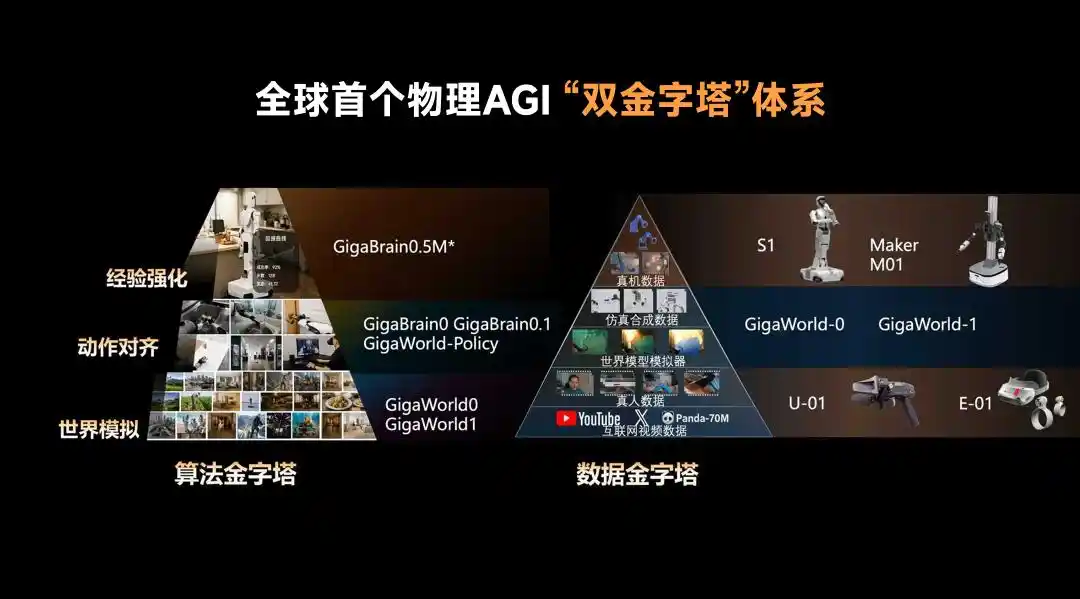
Among them, the Data Pyramid consists of five layers, from bottom to top: Internet video data, real human data, world model simulator, simulation synthetic data, and real robot data. This five-layer data architecture addresses the pain points in Physical AGI R&D of insufficient data, low quality, and singular scenarios, providing ample and high-quality "fuel" for algorithm model training.
The Algorithm Pyramid is divided into three layers, mainly focusing on three core capabilities: world simulation, action alignment, and experience reinforcement. This enables the leap from physical cognition to entity execution, and from passive execution to active evolution, endowing Physical AGI with learning and adaptation capabilities similar to humans.
The core value of the "Dual Pyramid" system lies in constructing a closed-loop evolution mechanism where data drives algorithms, and algorithms feed back into data. The Data Pyramid provides massive, high-quality physical interaction data for the Algorithm Pyramid, supporting the training and optimization of algorithm models. The iterative upgrades of the Algorithm Pyramid can, in turn, improve the accuracy of data collection and the authenticity of simulated data, thereby enriching the content of the Data Pyramid.
More importantly, after three years of accumulation, Jijia Shijie has built a "World Generation - Action" dual-model system. Within this, the World Action Model transforms the world model's understanding and predictions into action policies for robots—GigaBrain-0: a self-developed world-model-driven embodied VLA large model, which won the global championship with a 51.67% task success rate in the world's largest real-robot evaluation benchmark RoboChallenge;
GigaBrain-0.5M*: the world's first physical intelligent agent native paradigm centered on "world-model-led experience learning," achieving self-evolution through "world model + reinforcement learning," with task success rates approaching 100% for high-difficulty, long-horizon tasks;
GigaWorld-Policy: a world action model breaking the "speed-performance-efficiency" impossible triangle, achieving 10x inference speed, 10x training efficiency improvement, and task success rate improvement of approximately 30 percentage points. It defeated Nvidia GR00T N1.5, PI0.5, etc., on the globally authoritative household mobile manipulation task evaluation platform RoboCasa365, securing the global top spot, and becoming the first world action model to top the list.
The World Generation Model understands, simulates, and generates the physical world, providing data, a simulation base, and pre-trained parameters for the action model—GigaWorld-0: the world's first milestone work validating that "world-model-generated data can effectively improve real robot performance," released and open-sourced in December 2025, its GitHub open-source code garnered 1.5k+ Stars;
GigaWorld-1: an action-conditioned world model (AC-WM), which defeated models from international top-tier institutions like Google, NVIDIA, and Alibaba on the authoritative benchmark WorldArena with a comprehensive score of 62.34, winning the global championship and being the first model on the list to break the 60-point mark;
DriveDreamer: the world's first autonomous driving world model for the real physical world, invited for NVIDIA Oral Presentation, one of the most influential papers at ECCV 2024, and the first to achieve large-scale industrial implementation of world models.
Undoubtedly, the World Action Model and the World Generation Model are indispensable, existing in a complementary, spiraling upward relationship, jointly constituting the foundational model for Physical AGI, thereby accelerating its march towards the "GPT-3 moment." To some extent, Jijia Shijie has carved out a new path that is gradually being validated.
The Physical World: The Next Stop for AGI
A new watershed moment for the AI era has arrived.
In recent years, Digital AGI has focused on information processing and virtual interaction, relying on large language models and multimodal generative models to achieve functions like text creation, image design, and code writing, essentially optimizing and enhancing "information productivity."
Its limitations are also evident. Although Digital AGI has greatly improved the efficiency of information dissemination, content creation, and data processing, it has yet to break through the boundary between the virtual and the real. As "AI godmother" Fei-Fei Li stated, large language models are still "wordsmiths in the dark," eloquent but lacking experience, knowledgeable but not grounded.
Therefore, in the view of Jijia Shijie's team, AGI should not remain confined to screens. The core value of Physical AGI lies in entity execution and physical transformation—understanding physical laws through world models, perceiving the physical environment through multimodal senses, and executing physical actions through mechanical bodies.
Undoubtedly, GPT-3 is widely recognized as the critical node in the Digital AGI journey where Scaling Law first manifested emergence abilities. Today, after three years of continuous breakthroughs in its algorithm and data systems, Jijia Shijie has observed a convergence trend in the Physical AGI path, implying that the "GPT-3 moment" for Physical AGI may arrive soon.
It is reported that Jijia Shijie's GigaBrain-1 will be released in the third quarter of this year. As the world's first Physical AGI foundational model built upon the "Dual Pyramid" system, GigaBrain-1 will bring three key breakthroughs: visual-native understanding (using vision as the primary channel for state understanding), language-high-level planning (language responsible for high-level task decomposition), and physical law alignment (systematically expanding full-type, large-scale training data).
Following this, GigaBrain-2 and GigaBrain-3 will be successively launched. Among them, GigaBrain-3 will be trained on 10 million hours of video data + 1 million hours of world-action data, aiming directly at Physical AGI's "GPT-3 moment."
Of course, technology must ultimately deliver industrial value.
Jijia Shijie has uniquely charted its course: entering households via the C-end and entering factories via the B-end, running both lines simultaneously. Looking across the industry, currently, only a handful of embodied intelligence companies can secure household orders. The reason lies in the more complex and diverse demands of real household scenarios, far less standardized than industrial settings.
Nevertheless, Jijia Shijie has risen to the challenge. Not long ago, it launched its household scene sub-brand "Shiguang SeeLight" and introduced its first general-purpose humanoid robot for real households, "Shiguang S1." It has already received orders for hundreds of units for real household scenarios and will be first deployed in the Wuhan Optics Valley Zhiyu community, commencing scaled operations from the third quarter. The next-generation household general-purpose robot "Shiguang S2" will also be released in the third quarter.
Thus, Jijia Shijie has achieved a breakthrough in the industry's most scarce resource: real household robot data. Aligning with the product roadmap of Shiguang S2/S3 corresponds precisely to the ChatGPT moment for Physical AGI—making common skills widely applicable in real household scenarios.
On the B-end, on one hand, facing industrial manufacturing scenarios, Jijia Shijie is transitioning from point verification to scaled mass production. In April this year, Jijia Shijie launched its fully self-developed native Physical AGI general-purpose robot Maker H01. Collaborating with FAW Mould and Die and Alibaba Cloud, it completed the implementation of a full-process solution for embodied intelligent robots in real industrial manufacturing scenarios, compressing the scene adaptation cycle of traditional automation solutions from months to weeks.
Simultaneously, Jijia Shijie announced this month a plan to jointly deploy 1,000 general-purpose robots equipped with Jijia Shijie's world-model embodied brain and the Maker series with Longsheng Technology in Wuxi within three years. This marks the world's first thousand-unit-level scaled deployment of general-purpose robots driven by a physical intelligence foundational model in industrial scenarios. It signifies that China's embodied intelligence has completely moved beyond small-scale pilots and fully entered the scaled mass production cycle for industrial scenarios.
On the other hand, Jijia Shijie has long established its autonomous driving world model DriveDreamer series as an industry masterpiece. The new-generation driving simulator, centered on the world model, has already secured signed contracts and mass production cooperation with multiple domestic leading OEMs, overseas and joint-venture OEMs, as well as AI chip and Tier 1 giants, serving over 30 leading domestic and international OEMs and autonomous driving companies.
In summary, the B-end layout, represented by the industrial series products, corresponds to the Claude Code moment for Physical AGI—the breakthrough of advanced skills in productivity scenarios.
More importantly, Jijia Shijie's dual-line implementation of landing scenarios enables the continuous accumulation of real data and cash flow to further feed back into the Data Pyramid's data foundation, driving the "scenario—data—model—product—ecosystem" flywheel.
In Huang Guan's view, the GPT-3 moment achieved the emergent intelligence of model capabilities; the ChatGPT moment brought productivity benefits to every ordinary person; the Claude Code moment meant digital intelligence model capabilities reached expert levels in professional domains.
"As one of the earliest companies in China to focus on world models and a leader in Physical AGI, Jijia Shijie believes that Physical AGI will also undergo similar stages in the future. The difference lies in—Physical AGI will act directly upon the real physical world. Its impact will not only be an enhancement in information efficiency but also a reshaping of production and lifestyles. Therefore, its influence on the economy and society will be even more profound."
Throughout the history of human civilization, every major leap in productivity has been inseparable from disruptive breakthroughs in core technologies. Therefore, when AI truly breaks through the limitations of digital boundaries and enters the vast expanse of the physical world, it is bound to trigger a new round of productivity revolution, unleashing unlimited physical productivity.
This is precisely the ultimate vision Jijia Shijie paints—the era where Physical AGI serves every individual will gradually unfold, one real household at a time.
Perhaps, that moment is coming soon.
This article is from the WeChat public account "Investment Community" (ID: pedaily2012), author: Liu Bo






