Author: Claude, Deep Chao TechFlow
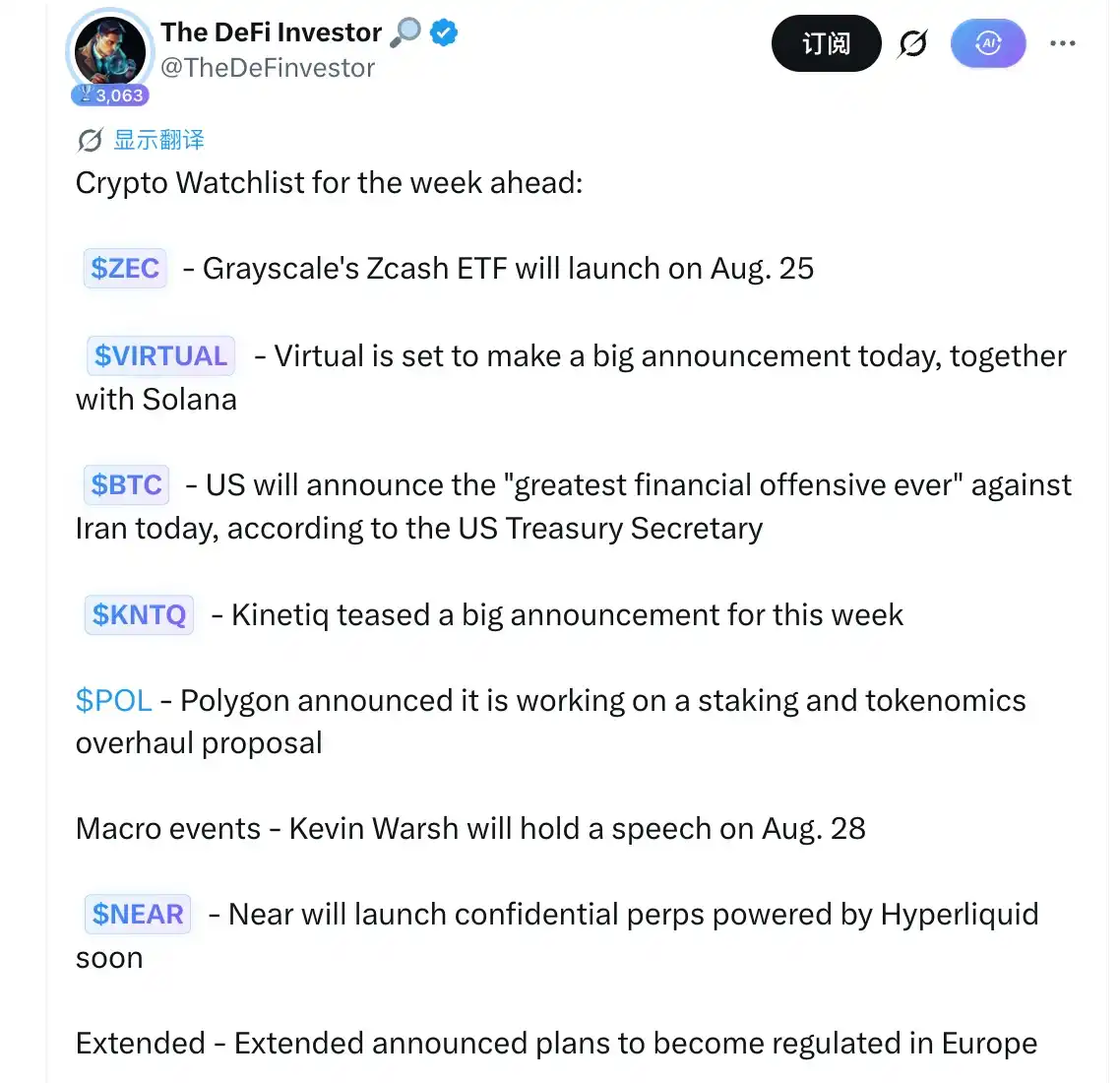
Deep Chao Guide: Crypto KOL @TheDeFinvestor lists this week's catalyst watchlist.
The biggest news is the Grayscale Zcash Trust is expected to list on NYSE Arca on August 25 under the ticker ZCSH, becoming the first US spot ETF to directly hold a privacy coin. ZEC has risen over 70% in the past week, hitting an 8-year high.
Meanwhile, the Virtuals Protocol officially opened AI Agent ownership and tokenization to Solana users on August 24. The ACF mechanism has cumulatively raised over $6.8 million for Agents. US Treasury Secretary Scott Bessent also announced the launch of "Operation Economic Outcast" on the same day, calling it the "largest financial offensive ever" against Iran, with digital assets listed as one of the key target areas. Kinetiq announced Elysium, an L2 network for Hyperliquid, with 50% of sequencer fees to be used for KNTQ buyback and burn. Polygon co-founder Sandeep Nailwal is advancing proposals for staking and tokenomics reform, with POL staking yields potentially nearly doubling.
ZEC: Grayscale Zcash ETF Expected to List on August 25, First US Privacy Coin Spot Product
This is the most certain event of the week.
According to a Form 8-K filed by Grayscale with the SEC on August 21, shares of the Grayscale Zcash Trust (ZEC) are expected to begin trading on NYSE Arca around August 25 under the ticker ZCSH. The trust will be renamed The Zcash ETF concurrently. Listing is still subject to obtaining relevant regulatory approvals, and the filing explicitly states "no assurance can be given that the Shares will commence trading as expected."
The amended S-3 filing sets the sponsor fee at an annual rate of 2.5% (calculated based on NAV, accrued daily), which is the trust's only general recurring expense. The trust currently holds approximately 391k to 393k ZEC, with assets under management totaling about $263.5 million as of August 21. Coinbase Custody serves as the custodian, and Jane Street Capital and Virtu Americas act as authorized participants.
DCG International Investment Company is still in discussions to contribute about 200k ZEC to the trust in exchange for shares, but this transaction has not been finalized. The market has reacted strongly: ZEC has risen over 70% in the past week, once touching an 8-year high of around $885 before falling back to around $820. Futures open interest has also surpassed that of DOGE and BNB.
If successfully listed, this will be the first spot ETF in the US market to directly track a privacy coin. The privacy features themselves still face regulatory and exchange access risks, but opening an institutional channel changes accessibility.
VIRTUAL: Virtuals Officially Opens AI Agent Ownership to Solana Users
On August 24, the Virtuals Protocol and Solana jointly announced: millions of users can now directly own working AI Agents on Solana.
According to official and Solana-related reports, Virtuals has extended its tokenized AI Agent system to Solana. Users can create tokens tied to AI Agents and connect the Agents to wallets and on-chain services. Agents can autonomously raise capital, set taxes, fund their own intelligence, and trade with their own wallets, with profits shared by the owners.
The core mechanism, Automated Capital Formation (ACF), has cumulatively raised over $6.8 million for Agents on the platform as of August 24. Tokens are traded via Meteora DBC pools with a 1% fee, of which 70% goes to the creator and 30% to the Virtuals treasury. Upon cumulatively reaching 42k VIRTUAL tokens, a token automatically "graduates," with liquidity migrating to a public Meteora pool and LP tokens locked for 10 years.
VIRTUAL tokens had previously been bridged to Solana via LayerZero, with foundations laid in early 2025 and further developments in June with the launch of the Agent creation launchpad and cross-chain asset bridge. As of August 23, there were approximately 28.2k VIRTUAL holders on Solana. This move shifts the focus from "creation" to "ownership" for a broader Solana user base.
Macro: US Launches "Largest Financial Offensive Ever" Against Iran
US Treasury Secretary Scott Bessent announced the launch of Operation Economic Outcast on August 24.
Bessent used the same phrase repeatedly in statements and media appearances: "the single greatest financial offensive ever marshaled against an adversary," calling it an "economic D-Day." The operation's goal is to sever every economic lifeline for Iran and its supporters, with a focus on five key areas: digital assets, technology, gold, aviation, and shipping.
The Treasury has imposed sanctions on over 60 entities, individuals, and vessels worldwide and expanded the scope of secondary sanctions. Any entity assisting Iran in money laundering will be cut off from the dollar system. "The clock has already started ticking," Bessent said, adding that Iran now has only two paths: complete global isolation or a return to a normal economy.
The potential impact on the crypto market stems mainly from digital assets being explicitly listed as a target, alongside broader risk-off sentiment and changes in dollar liquidity. As a macro asset, BTC could see short-term sentiment-driven volatility.
KNTQ: Kinetiq Launches Hyperliquid L2 Elysium, 50% Fees for Buyback & Burn
Kinetiq (the largest liquid staking protocol on Hyperliquid) officially announced Elysium on August 24.
Elysium is a high-performance EVM L2 specifically built for the Hyperliquid ecosystem, using HYPE as its gas token and deeply integrated with HyperCore. Its goals are to address HyperEVM throughput and peak fee issues while significantly improving spot trading experience, PropAMM deployment, and the token lifecycle (from long-tail AMM launch → deep liquidity → HyperCore spot order book → HIP-3 perps).
Sequencer fee allocation is clear: 25% to developers, 25% to the Kinetiq treasury, and 50% for open market KNTQ buybacks, all of which will be burned (via the Hyperliquid Assistance Fund). Kinetiq stated that Elysium is launching soon, with technical specifications and core partner information to follow.
KNTQ rose over 30% briefly after the announcement before paring some gains.
POL: Polygon Advances Staking and Tokenomics Reform, Staking Yields Could Double
Polygon co-founder Sandeep Nailwal stated on August 23-24 that, in response to strong community demand, the team is advancing proposals for staking and tokenomics reform.
Key elements include: introducing native staking mechanisms on Polygon PoS similar to L1s (which can run parallel to Ethereum staking); priority fees from each transaction will be distributed to POL stakers (PIP-85 has been approved, native staking can simplify implementation); staking yields are expected to nearly double, with the increase mainly coming from real network fees rather than inflation; staking POL may receive additional incentives like gas discounts; and sPOL remains liquid and usable in DeFi.
Nailwal also revealed that Polygon's revenue has grown 10x this year, currently reaching 5000 TPS, with block time already reduced by 25%, and efforts are underway to push block time below 1 second. Polygon Labs will be responsible for code development and submitting it to the community forum for approval.
Other Catalyst Overview
NEAR: Confidential perps powered by Hyperliquid are coming soon.
NEAR had previously launched Hyperliquid perps on near.com, allowing users to deposit assets directly from 35+ chains to trade 50+ markets. The official team previously explicitly stated that "the next step is confidential perps." Combined with NEAR's already-launched Confidential Intents (private shard execution to avoid MEV and strategy exposure), a confidential version of perpetuals is seen as a natural extension.
Extended: Announces European compliance pathway.
Extended plans to establish a dedicated regulatory framework in Europe to gain direct access to EU retail users, as well as B2B distribution via brokers, fintechs, and consumer platforms. The project emphasizes this is a major expansion of its existing business, which will also affect the preparation for TGE (including compliance work for the token and corporate structure).
Macro Event: Kevin Warsh's Jackson Hole Speech on August 28.
Fed Chair Kevin Warsh will deliver his first major public speech since taking office at the Jackson Hole Economic Symposium. The market is focused on his communication style, inflation path, and interest rate framework, especially against the backdrop of record US Treasury yields and public debt.