THIS is the stablecoin power angle that nobody is talking about

ambcryptoPubblicato 2026-02-02Pubblicato ultima volta 2026-02-02

Introduzione

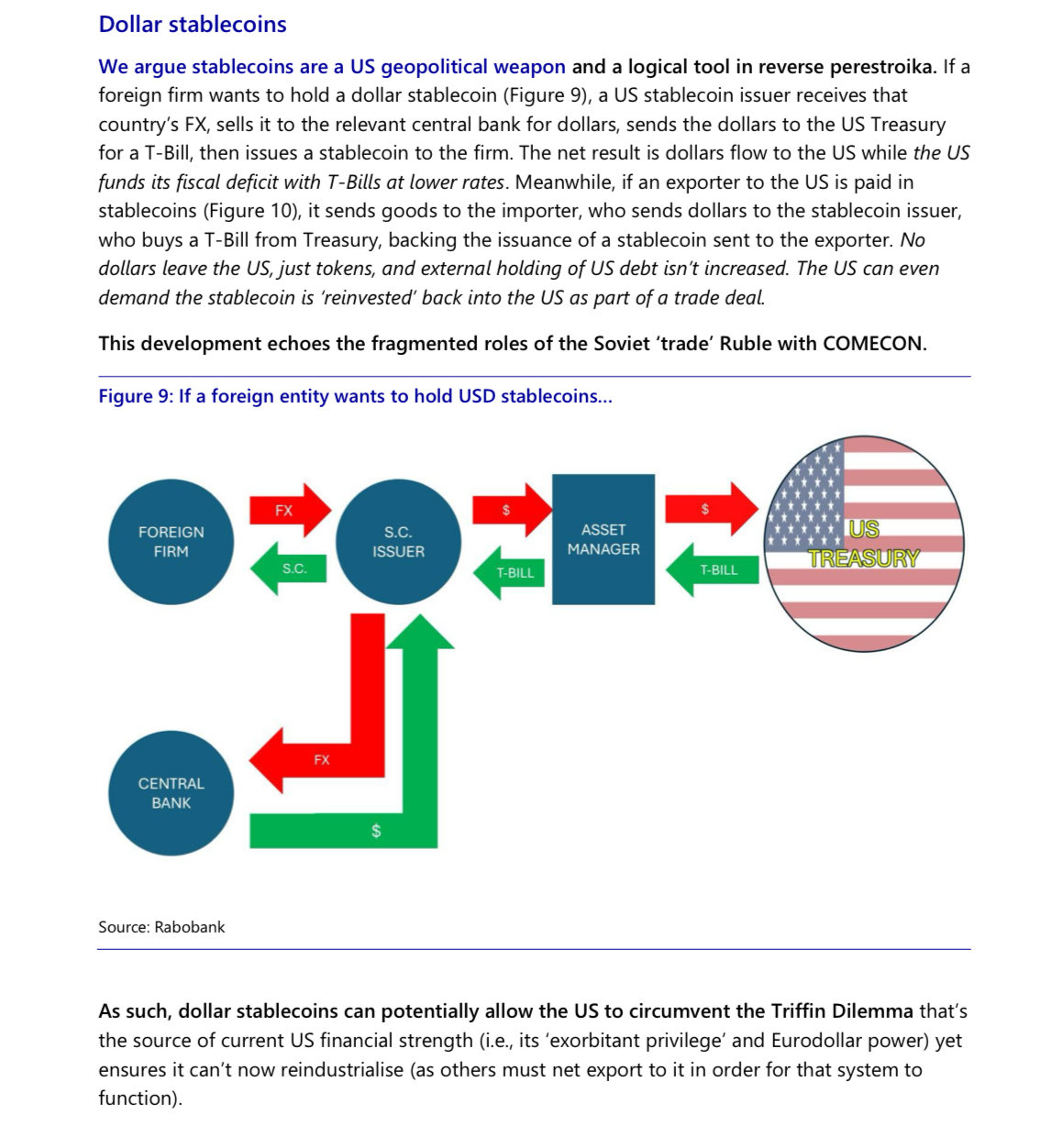
Dollar-backed stablecoins are increasingly serving as a tool for the U.S. to extend its monetary influence abroad without physically moving dollars overseas, according to a Rabobank report. When foreign entities demand dollar stablecoins, U.S. issuers convert this demand into Treasury bill purchases, helping fund U.S. deficits at lower rates while digital tokens circulate internationally. This mechanism allows dollars to remain within the U.S. financial system while still facilitating global trade. Non-USD stablecoins are also gaining traction, with their supply surging 260% over the past year to a combined market cap of $1.55 billion, though they remain small compared to dollar-pegged alternatives. A key application driving adoption is crypto-backed payment cards, which have grown into an $18 billion market. Monthly transaction volumes have increased from $100 million in early 2023 to over $1.5 billion, growing at an annual rate exceeding 100%. These cards operate on top of traditional networks like Visa and Mastercard, using stablecoins to settle transactions in the background while maintaining a familiar user experience. In summary, dollar-backed stablecoins are expanding U.S. monetary power digitally without exporting physical dollars, while crypto payment infrastructure accelerates their real-world use.

Dollar-backed stablecoins are now more than just a crypto payment tool. Recent reports say that they may also be helping the U.S. extend dollar influence abroad, in a way that keeps real capital at home.

Here’s what you need to know.

Stablecoins – A secret weapon?

A report by Rabobank has stated that dollar-backed stablecoins are spreading dollar influence, without letting real dollars leave the country.

Source: X

The idea is that when a foreign firm wants a dollar stablecoin, a U.S. issuer converts that demand into Treasury bill purchases. Dollars flow back to the U.S. government, helping fund deficits at lower rates, while the firm gets digital dollars instead of cash.

In trade, it goes a step further. U.S. importers can pay exporters in stablecoins, while the underlying dollars stay parked in Treasuries. Only tokens move across borders.

With comparisons to the Soviet-era trade ruble, dollars are exported digitally… all while keeping the power at home.

Non-dollar stablecoins step up

That growing influence hasn’t gone unnoticed, with non-USD-pegged alternatives gaining ground.

For long, more than 99% of stablecoins were pegged to the U.S. dollar. That number is now decreasing at the margins.

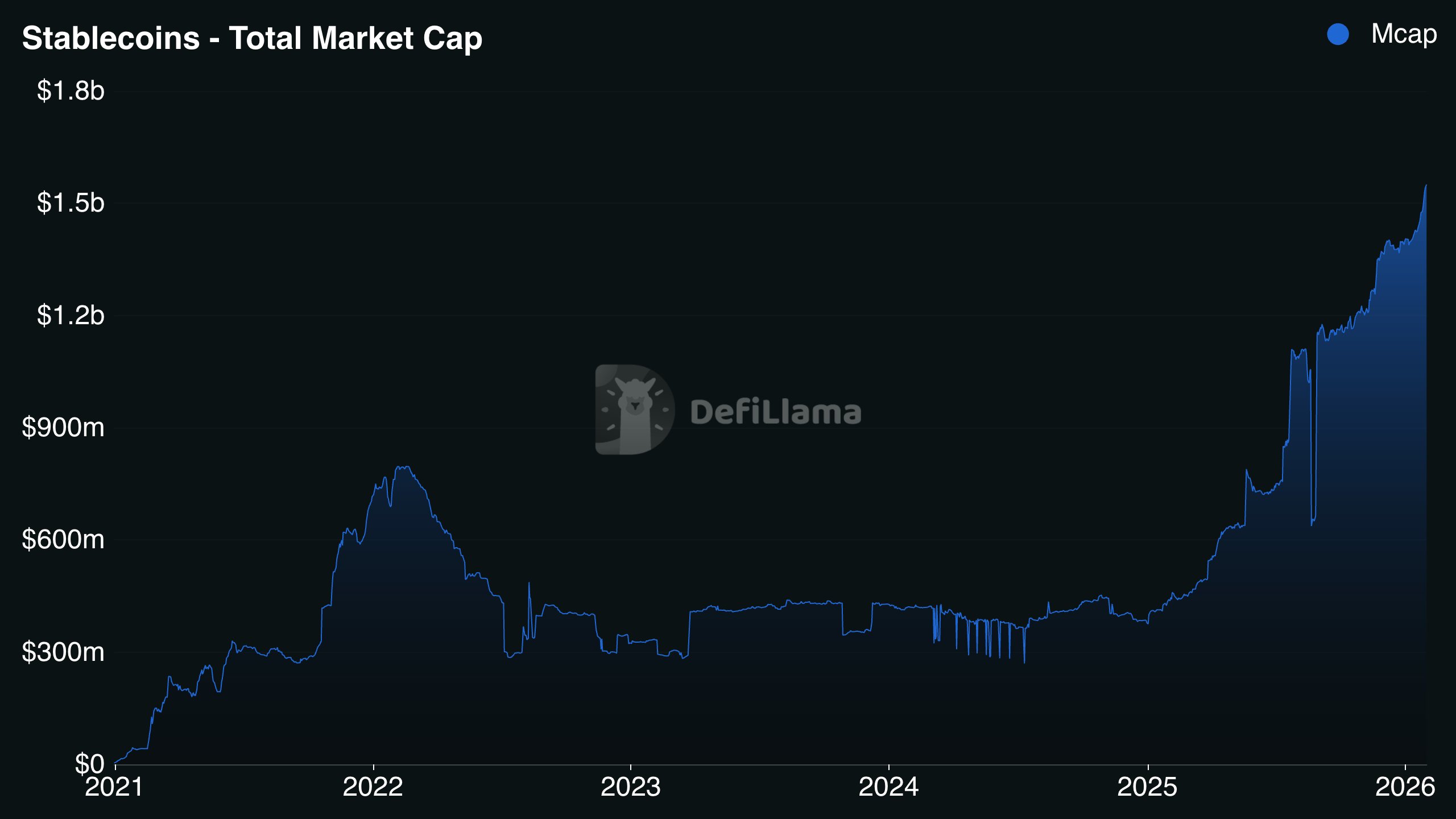
Over the past year, non-USD stablecoins have surged 260% in supply, pushing their combined market cap to about $1.55 billion.

Source: X

It’s still small next to dollar-backed giants, but it certainly matters.

All of this theory matters because…

…it’s already showing up in day-to-day payments. One of the fastest-growing payment modes for stablecoins right now is crypto cards.

Source: X

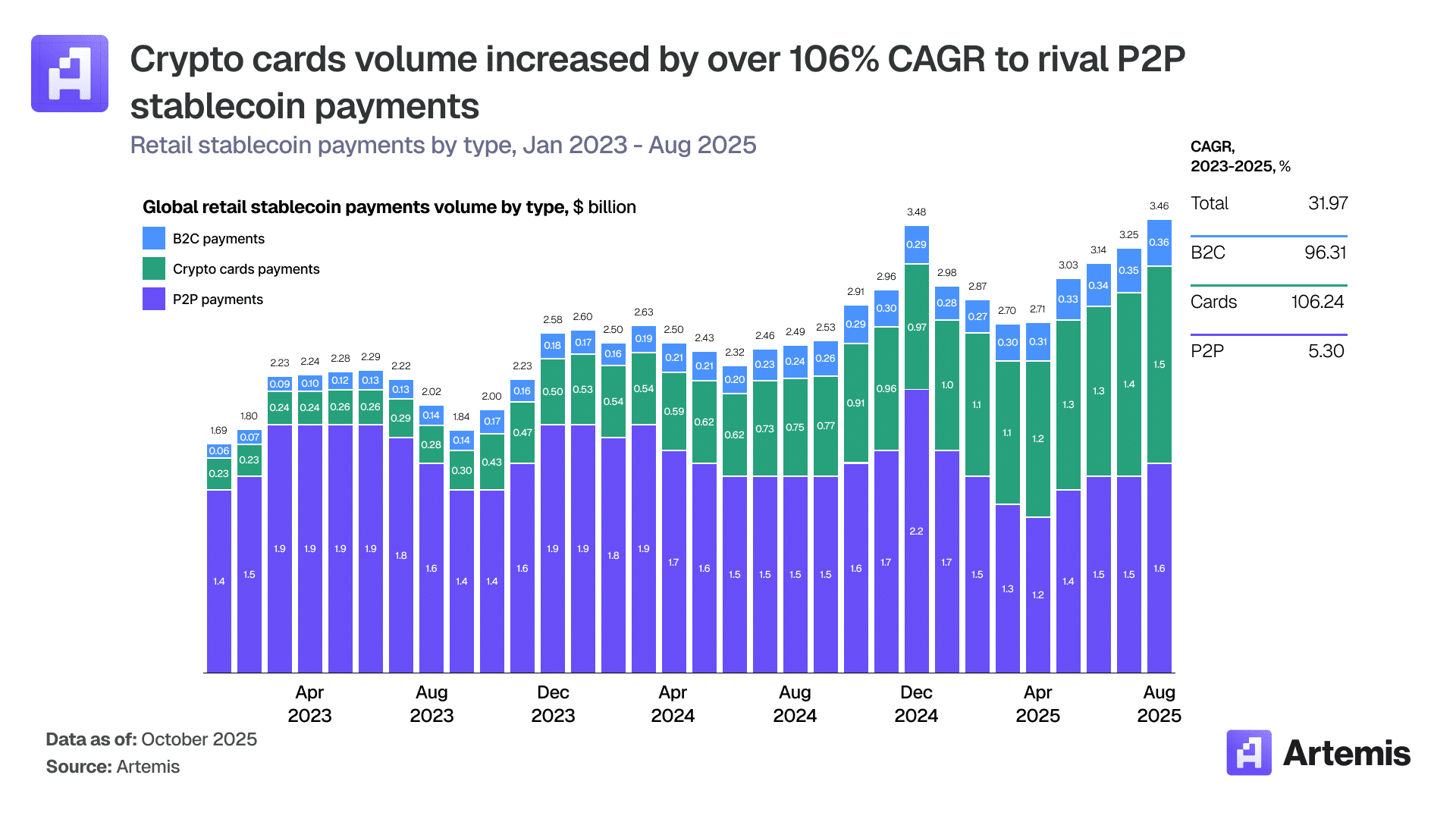
Once a niche product, crypto cards are now an $18 billion market.

Monthly volumes went from about $100 million in early 2023 to over $1.5 billion today, growing at a 100%+ annual rate.

Source: X

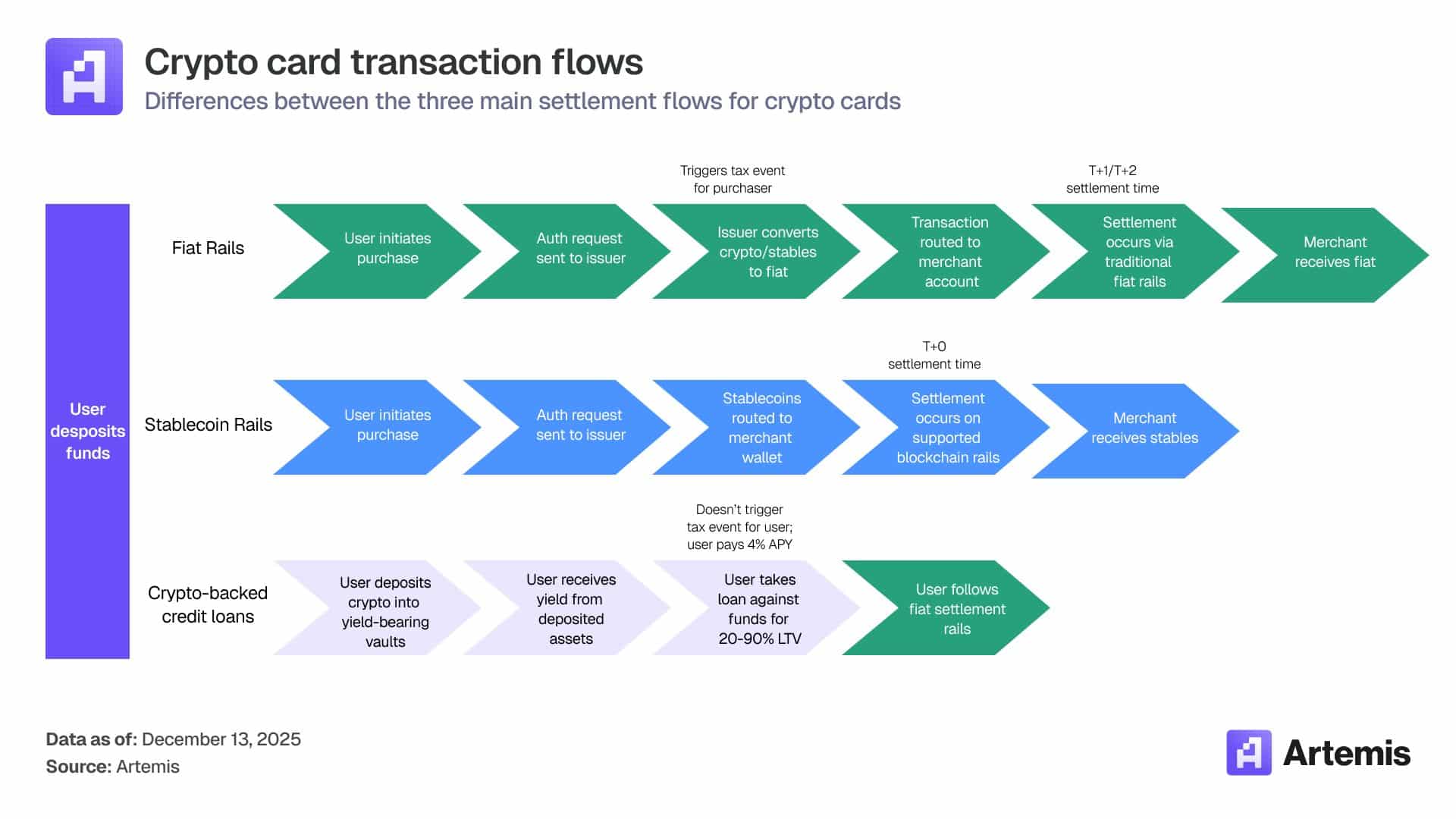
Importantly, these cards don’t replace Visa or Mastercard.

Rather, they sit on top of them. Stablecoins fund the transaction in the background, while card networks handle acceptance. For users and merchants, what looks like normal payments are actually digital dollars doing the work.


Final Thoughts

  • Dollar-backed stablecoins are exporting U.S. monetary power, without exporting actual dollars.
  • As crypto cards grow, digital dollars are moving fast.
Next: BONK drops 18% as memecoins slide – Is another leg down coming?
Share
  • Share
  • Tweet

Domande pertinenti

QHow are dollar-backed stablecoins helping the U.S. extend dollar influence abroad without exporting real dollars?

ADollar-backed stablecoins allow foreign firms to obtain digital dollars while U.S. issuers convert that demand into Treasury bill purchases. This keeps actual dollars within the U.S., helping fund deficits at lower rates, while only tokens move across borders.

QWhat is the current market trend for non-USD-pegged stablecoins?

ANon-USD stablecoins have surged 260% in supply over the past year, reaching a combined market cap of approximately $1.55 billion, though they remain small compared to dollar-backed stablecoins.

QHow are crypto cards contributing to the growth of stablecoin payments?

ACrypto cards, now an $18 billion market, use stablecoins to fund transactions in the background while leveraging traditional card networks like Visa or Mastercard for acceptance. Monthly volumes grew from $100 million in early 2023 to over $1.5 billion, with a 100%+ annual growth rate.

QWhat role do U.S. Treasury bills play in the stablecoin ecosystem?

AWhen foreign demand for dollar stablecoins arises, U.S. issuers purchase Treasury bills with the incoming dollars, effectively recycling foreign demand into U.S. government debt and keeping capital domestically parked.

QWhy are non-USD stablecoins gaining traction despite the dominance of dollar-backed options?

ANon-USD stablecoins are growing as alternatives to reduce reliance on U.S. dollar influence, with a 260% supply increase reflecting heightened interest in diversified digital currency pegs.

Letture associate

In-depth: The Foreign Guest Genspark

The article "The Foreign Guest: Genspark" investigates the identity and business practices of AI startup Genspark, which presents itself as a Palo Alto-based "AI Costco" offering a subscription bundle of over 70 models and numerous AI agent tools. Despite its official Silicon Valley narrative, Genspark's founding team has deep roots in Chinese tech giant Baidu, a history systematically downplayed in its branding. The company actively cultivates an image as an elite US firm, heavily publicizing partnerships and endorsements from OpenAI, Anthropic, and Microsoft, while distancing itself from the Chinese AI community and obscuring its connections to Chinese investors and open-weight models (like those from DeepSeek, Moonshot AI, and MiniMax) that power its services. Genspark's core strategy involves rapidly cloning and integrating successful AI product concepts (e.g., from Perplexity, Manus, Plaud) into its unified platform, supported by aggressive marketing, including Super Bowl ads and paid native content in publications like The Wall Street Journal. Critically, the article suggests a significant portion of its engineering and product development is conducted by a team in Beijing, operating outside its official US corporate structure. This duality allows Genspark to leverage Chinese talent and models for efficiency and cost reduction while constructing a public facade as a purely American success story. The piece concludes that Genspark's most effective agent is its own corporate identity, meticulously engineered to obscure its Chinese underpinnings and be perceived solely as a Silicon Valley company.

marsbit40 min fa

In-depth: The Foreign Guest Genspark

marsbit40 min fa

Debate: Korean Workers Fear Unemployment, While Musk Envisions a Society 'Without Work'?

While South Korean auto workers fear job losses from robotics, Elon Musk envisions a future where AI and robots render most work optional. This article explores the growing tension between immediate anxieties over automation and long-term visions of a post-work society. The piece begins with recent strikes at Hyundai's Korean plants, where unions, amid standard wage negotiations, also sought job guarantees against advancing robotics—specifically mentioning Boston Dynamics' Atlas. This reflects how anxiety about technological displacement is emerging even before robots are fully capable of replacing skilled labor on assembly lines. The author argues that while current robotics still struggle with the nuanced, experiential knowledge of veteran workers, the *perception* of imminent replacement is fueling social conflict prematurely. This modern "Luddite" sentiment is compared to the 19th-century English textile workers who smashed machines. Historically, Luddites weren't simply anti-technology; they were protesting the rapid devaluation of their skills and the unequal distribution of productivity gains. Similarly, today's workers ask who will bear the cost of transition and share in the new wealth created by machines. In contrast, figures like Elon Musk propose an optimistic endpoint: with AI and robotics driving extreme abundance, the link between work and survival could break. He suggests concepts like "Universal High Income" could allow society to share the technological bounty, transforming work from a necessity into a choice. The core challenge, however, lies in the transition. The author notes that technology's benefits diffuse slowly, while its disruptive costs—job losses, skill obsolescence—can be concentrated and immediate. The risk is a painful interim period where productivity gains are captured by a few before new social contracts, safety nets, and retraining systems are established. The conclusion calls for proactive governance. Just as past industrial revolutions gave rise to labor standards and social safety nets, the robotics era needs its own frameworks. These should address job transition support, distribution of productivity gains, safety liability, and ethical deployment. Embracing such "constraints" is not opposition to progress but a necessary step to ensure technology benefits society broadly. The discussion sparked by Hyundai's workers, therefore, is not premature but essential.

marsbit53 min fa
Debate: Korean Workers Fear Unemployment, While Musk Envisions a Society 'Without Work'?

marsbit53 min fa

Trading

Spot
活动图片